Filipino language is going global
Hawaii-based poet and teacher Ruth Mabanglo has made it her mission to
promote the Filipino language and culture worldwide
By
Anna
Leah Sarabia
Philippine Daily Inquirer
Sunday, December 16th,
2012

RUTH Elynia Mabanglo of the University of Hawaii
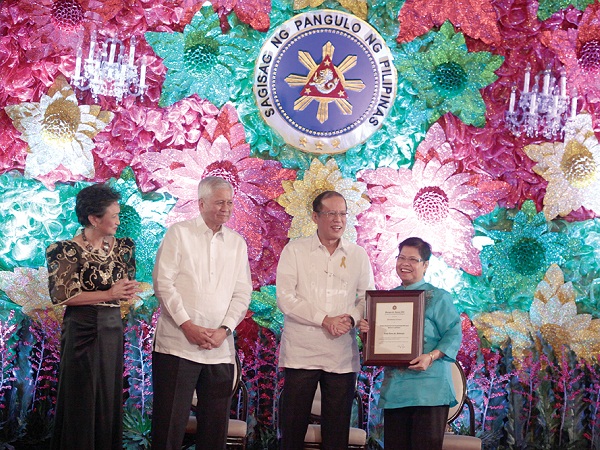
(right) received a plaque of recognition from President Aquino, with Foreign
Secretary Albert del Rosario and CFO chair Imelda Nicolas looking on. MALACAÑANG
PHOTO
In this age of globalization, nothing could be more difficult for a Filipino
living abroad than to work for the preservation of one’s own language and
culture. But Dr. Ruth Elynia S. Mabanglo is not so easily discouraged.
As a multiawarded poet and playwright, her love for the Filipino language has
found meaning and it remains a calling. The first woman to join the Hall of
Fame of the Don Carlos Palanca Awards for Literature, Ruth has made it her
mission to promote Filipino worldwide.
Ruth was in Manila recently to pick up a plaque from President Aquino as a
2012 Presidential Awardee for Filipino Individuals and Organizations Overseas,
in the “Pamana ng Pilipino” category. It is conferred on Filipinos overseas who
have brought the country honor and recognition through excellence and
distinction in the pursuit of their work or profession.
She has published six books of poetry and several scholarly works included in
anthologies and often cited in scholarly journals. In 2008, the De La Salle
University Filipino Department convened critics and scholars for a monthly forum
on her works, the “Ruth Elynia Mabanglo Lecture Series.” Her poems were among
those highlighted in the 2012 Aliw award-winning film by Alvin Yapan, “Ang Sayaw
ng Dalawang Kaliwang Paa.”
Ruth’s latest crusade is to nurture Filipino as a global language. Several
years ago, when then President Gloria Arroyo pushed for Spanish to be taught in
high schools and for prioritizing English so Filipinos could better serve global
business, Ruth mobilized a protest petition.
“I encouraged my students all over the United States to sign a petition to
fight the killing of Filipino in high school and college, which was part of the
Gullas Bill that Arroyo favored. Later on, I organized the ‘Filipino as a Global
Language’ conference as a professor of Filipino language and Philippine
literature at the University of Hawaii,” she said.
Courses around the world
Through the conference, Ruth began to identify all the Filipino language
programs in the world.
“I was able to identify, for instance, that in Sorbonne University in France,
there is a Filipino named Marina Pattiere who is teaching Filipino. I found out
that in the University of London, there is a Philippine Studies course and
students there are asked to go to learn the Filipino language in the Philippine
Embassy. I was looking for courses, programs and people teaching Filipino. I
am in correspondence with some high school teachers in Melbourne, Australia who
are teaching Filipino there.
“I also found out that there are Filipinos teaching Filipino in Malaysia,
Brunei and Beijing. In Beijing, there is a masters’ degree program in Filipino.
In Gaida University in Osaka, Japan, there is a Philippine Studies program,
major in Filipino, and it sends students to take higher level courses in
Filipino to the University of the Philippines.
“In the University of Hawaii, I have a government-funded Fulbright program
that sends Fil-Am students to study advanced-level Filipino in Manila for 10
weeks.”
Teaching materials
Apart from identifying these programs and creating a global network of
specialists in Filipino, Ruth and her conference colleagues agreed to help each
other with materials for teaching courses on Filipino.
Right now, she said, there is a Consortium for the Advancement of Filipino
started by Dr. Teresita Ramos; there is a newsletter that informs and updates
members about developments and conferences.
“In my case, I started an
organization called the Global Consortium for the Advancement of Filipino
Language and Culture, which is another network.
People want to study the Filipino language for different reasons. “In Germany
and France, the interest would be mainly for the children of women who married
Germans or French. I met some of them in 1997. There are volunteers who were
teaching Filipino as a church-based activity. The idea was to connect the
children to the culture of their mothers, as sometimes the mothers can’t speak
German so well and the children need to have conversations with their mothers.”
In Osaka, the interest in Filipino could be related to being able to use it
in business and work places where there are Filipinos. Maybe some Japanese
students also take up Philippine Studies in connection with their history. “We
are part of the World War II story of Japan, so they opt to learn Filipino,
too,” she added.
2nd generation Filipinos
In Hawaii, Filipino is taught mainly for two reasons. One is for the younger
ones to learn the language of their fathers or grandfathers. “Before, children
of immigrants were not allowed to speak (any other language besides English) so
they want to correct this. The third-generation Filipinos want to learn to speak
with their lolas and lolos.”
The other reason has to do with the history of immigrants in Hawaii. “The
American sugar barons who brought in Filipinos workers to the sugar plantations
1906 were required to hire only those who could not read or write. This was to
prevent the workers from applying for jobs with other companies, since the
working conditions in the plantations were very oppressive. They were treated
almost like slaves,” she said.
“There are a few Filipinos in Hawaii who are saying that Tagalog is
marginalizing the other languages in the Philippines. Which is
untrue—historically or anthropologically,” she argued.
“In the past, others claimed that there were more Cebuano or Ilocano
speakers. But today, Filipino is really the dominant language. My job is to
find out how globalized Filipino is at the secondary and tertiary levels.”
Language and culture
At the basic level, overseas Filipinos have found the means to teach Filipino
language and culture. In Boston, for instance, the doctors and nurses have
established church-based programs including a children’s rondalla that has
released a DVD. But all the teachers are volunteers, and there are no learning
levels.
“However, in San Diego, California, would you believe there are 70 high
schools that teach Filipino as a ‘world language’? California even has an
accreditation system for those who would like to teach Filipino in high
schools. I would like to bring that system to Hawaii so that Filipino majors
can earn credits to teach in high schools. I am working on that now. I am also
trying to standardize the curriculum so that high school students can have at
least basic knowledge of Philippine culture, and a basic literacy of Philippine
literature in Filipino. For instance, one basic canon of Philippine Literature
is Florante at Laura by Balagtas. Students must be able to pass basic exams on
this Tagalog work.
“You cannot learn a language without understanding its culture so I have
developed many courses. I have a course on Philippine films… on Filipino food,
music and rituals. Language and culture: they are like twins.”