Thursday, February 14, 2013

...the NEDA perspective

Better economy this year — Balisacan


February 13, 2013

 
The Philippines will likely post better gross domestic product (GDP) growth this quarter as the economy becomes more investment-driven, the country's top economist said Wednesday.

"We expect a faster pace this year and that the economy will become more investment-driven," Socioeconomic Planning Secretary Arsenio Balisacan told reporters in an ambush interview at the sidelines of the Philippine Economic Briefing.


Balisacan, who is also National Economic and Development Authority (NEDA) Director General, noted that the key drivers of the economy will remain private and public spending as well as the services sector on the back of a robust tourism and business process outsourcing sector.

"Consumption to continue fueling the expansion of the economy. We expect government spending, particularly infrastructure, as well as private investment will expand," he said.

"Services will also fuel the economy and tourism and BPO to further strengthen," the chief economist noted.

He, likewise, said "manufacturing pace will continue to gain momentum, coming from a good performance since the third quarter."

With a more robust manufacturing sector, Balisacan forecast that first quarter GDP growth will be faster than the 7.1 percent and 6.8 percent expansion posted in the third and fourth quarters respectively.

The inter-agency, policy-setting Development Budget Coordination Committee (DBCC) has targeted GDP growth at 6 to 7 percent in 2013.

Last year, the Philippine economy grew 6.6 percent, the fastest in Southeast Asia. — BM, GMA News

...the PH Math Olympiad medal harvests

PHL bags record 308 medals in intl science, math tilts


GMA News
February 13, 2013
 

Filma Brawner feted the students with the Youth Excellence in Science (YES) Award, for exemplary achievement in the fields of science and mathematics.


“(It is) never easy to compete with the best of other nations ... Let us prove to the world that we are achievers beyond competitions. You can do this by starting a pathway towards greatness in whatever science and technology field you may choose. Being YES Awardees mean that you are more than capable to do that and I really hope to see you make names for yourselves in the sciences,” said Brawner.
 
She also urged the awardees to maintain their thirst for excellence and said the DOST-SEI shall help them reach their potential.
 
 
The DOST noted this was the first time that the number of YES Awardees reached over 300. The previous high was 297 in 2009.
 
DOST Secretary Mario Montejo lauded the students for their feat - including 171 medalists from Metro Manila alone.
 
 
Fourteen students from Saint Jude Catholic School won 22 medals, while 14 students from Grace Christian College won 21 medals.
 
The students competed in contests in different countries such as Singapore, India, Romania, Malaysia, Argentina, Taiwan and China.
 
In his message, DOST Secretary Mario Montejo congratulated the awardees and expressed optimism in the students’ capability to contribute soon in the science community.
 
“I believe that our talent is far more sufficient to answer the needs of our people, be it of this generation or beyond,” said Montejo.
 
Meanwhile, undersecretary for science and technology services Fortunato dela Peña encouraged the students to help in boosting the country’s drive for more innovations.
 
 
“We believe that Filipinos can make good use of available knowledge, processes, and technologies into creating local innovations that will improve productivity of small and medium based industries, and resiliency of the general population against natural occurrences,” he said.
 
He cited the need for an elite group of scientists, engineers, robotics experts, mathematicians, physicists, and others "who could make science work for the benefit of the 100 million Filipinos.”
 
“That elite group needs you. And you belong in that class,” he said. — TJD, GMA News


...the Vesoul filmfest awardee

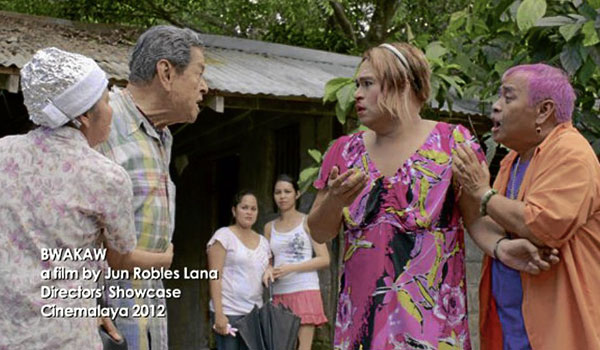
Bwakaw’ wins three awards in Vesoul int’l filmfest

By Bayani San Diego
Philippine Daily Inquirer


MANILA, Philippines—Jun Robles Lana’s “Bwakaw” won three awards at the 19th Vesoul International Film Festival of Asian Cinema held in France.

The film bagged the Emile Guimet award given by the Friends of the National Museum of Asian Arts of Paris.

“Bwakaw” also won the Grand Prix de Jury International and the High School Award, which is voted by students.

Written and directed by the much-awarded playwright-screenwriter Lana, “Bwakaw” tackles the story of a gay old man who lives alone with his pet dog.

Described a comedy-drama, it won the best actor award for veteran actor Eddie Garcia, audience choice and Netpac awards during last year’s Cinemalaya Independent Film Festival.

“Bwakaw” is topbilled by Garcia.


...the Filipina nurse in State of the Union address

Obama praises Filipina nurse in State of the Union address


First lady Michelle Obama is applauded by Menchu Sanchez (second from right) along with Dr. Jill Biden prior to U.S. President Barack Obama's State of the Union Speech on Capitol Hill in Washington, February 12, 2013. Photo by Jonathan Ernst, Reuters

MANILA, Philippines - US President Barack Obama praised a Filipina nurse, who is considered one of the heroes of the Hurricane Sandy disaster, in his State of the Union address before the joint session of Congress in Washington D.C., Tuesday evening (Wednesday morning, Manila time).

In his speech, Obama mentioned Menchu Sanchez, a nurse at New York University’s Langone Medical Center, as an example to all Americans.


"We were sent here to look out for our fellow Americans in the same way they look out for one another every single day, usually without fanfare all across the country. We should follow their example," he said.

"We should follow the example of a New York City nurse named Menchu Sanchez. When Hurricane Sandy plunged her hospital into darkness, she wasn't thinking about how her own home was faring.

Her mind was on the 20 precious newborns in her care and the rescue plan she devised that kept them all safe," the US president said.

Sanchez was seated between First Lady Michelle Obama and Jill Biden, wife of Vice President Joe Biden, during the State of the Union address.

When President Obama mentioned Sanchez, the First Lady was seen nudging Sanchez and smiling at her.

Sanchez was invited by Obama for her role in saving 20 at-risk infants during the Hurricane Sandy disaster that devastated large parts of New York and New Jersey last year.

She devised a plan to transport 20 at-risk infants at the Langone Medical Center to intensive care units around the city. She organized the nurses and doctors to carefully carry the babies down eight flights of stairs with only cell phones to light the way.

Even as her own home was flooding, Sanchez thought only of protecting the babies in her care, the White House said.

Sanchez was born, raised, and educated in the Philippines and she immigrated to the United States in the 1980s.
 
She has worked as a nurse in New York for more than 25 years, and has been at NYU since 2010.

Sanchez currently lives in New Jersey with her husband and two children, both of whom are in college. - With report from Rodney Jaleco, ABS-CBN News


...the lovers' paradise

Pinoys top global 'love ranking' - report


02/14/2013 
 
 
 MANILA, Philippines - Pinoys have been identified as the most emotional in the world, and now another survey said they are the ones who get the most love.
 
In keeping up with Valentine's Day, Bloomberg.com said the Philippines topped a Gallup survey of 136 countries which asked: "Did you experience love for a lot of the day yesterday?"

The following are where most of the respondents felt most loved:

1. Philippines - 93%
2. Rwanda - 92%
3. Puerto Rico - 90%
4. Hungary - 89%
5. Cyprus - 88%
6. Trinidad and Tobago - 88%
7. Paraguay - 87%
8. Lebanon - 86%
9. Costa Rica - 85%
10. Cambodia - 85%

Meanwhile, these are the countries that occupied the bottom of the list:

136. Armenia - 29%
135. Uzbekistan - 32%
134. Mongolia - 32%
133. Kyrgyzstan - 34%
132. Georgia - 43%
131. Belarus - 43%
130. Morocco - 43%
129. Kazakhstan - 45%
128. Moldova - 46%
127. Tajikistan - 47%

The Gallup survey was conducted in 2006 and 2007.

Tuesday, February 12, 2013

...the Korean apple of the eye

Philippines catches eye of S. Korea investors


Philippine Daily Inquirer
 
 
More South Korean investors are expected to invest in the Philippines after a credit-rating firm based in Seoul upgraded its outlook on the country from “stable” to “positive.”

A positive outlook suggests a probability that the Philippines’ present credit rating of BB+, which is a notch just below investment grade, may be upgraded within the short term.

NICE Investors Service Co. Ltd. said that when it made the decision to revise its outlook on the Philippines, it took into account the government’s improving fiscal situation, the country’s rising reserves of foreign exchange, and strength of its economy.

The factors indicate that the Philippines has an improved capacity to settle its debts to foreign creditors, NICE said.

On the fiscal front, the recent implementation of the new Sin Tax law, which raised taxes on cigarettes and alcohol, reflected the Aquino administration’s commitment to shoring up revenue collection.

NICE likewise cited the strength of domestic demand in the Philippines that allows it to weather the problems of an ailing the global economy.

Domestic demand is being fueled partly by remittances from overseas Filipino workers and investments in the business process outsourcing (BPO) sector.

“Solid private consumption and BPO industry expansion have led service business-centered economic growth. Consumption based on remittances is robust enough to absorb external shocks to some extent,” NICE said in its report.

“Solid private consumption and BPO industry expansion have led service business-centered economic growth. Consumption based on remittances is robust enough to absorb external shocks to some extent,” NICE said in its report. Michelle V. Remo

...the next potential popes

Cardinal Tagle in Reuters list of potential popes


02/11/2013  


PARIS - With Pope Benedict's stunning announcement that he will resign later this month, the time may be coming for the Roman Catholic Church to elect its first non-European leader and it could be a Latin American.

The region already represents 42 percent of the world's 1.2 billion-strong Catholic population, the largest single block in the Church, compared to 25 percent in its European heartland.

After the Pole John Paul and German-born Benedict, the post once reserved for Italians is now open to all. Who gets the nod depends on the profile of the new pope that the cardinals who elect him at the next conclave think will guide the Church best.

Two senior Vatican officials recently dropped surprisingly clear hints about possible successors. The upshot of their remarks is that the next pope could well be from Latin America.

"I know a lot of bishops and cardinals from Latin America who could take responsibility for the universal Church," said Archbishop Gerhard Mueller, who now holds the pope's old post as head of the Congregation for the Doctrine of the Faith.

"The universal Church teaches that Christianity isn't centred on Europe," the German-born archbishop told Duesseldorf's Rheinische Post newspaper just before Christmas.

Swiss Cardinal Kurt Koch, head of the Vatican department for Christian unity, told the Tagesanzeiger daily in Zurich at the same time that the Church's future was not in Europe.

"It would be good if there were candidates from Africa or South America at the next conclave," he said, referring to the closed-door election in the Vatican's Sistine Chapel.

Asked if he would vote for a non-European over a European candidate if they were equally qualified, he responded: "Yes."

If the next conclave really is Latin America's turn, the leading candidates there seem to be Odilo Scherer, archbishop of the huge diocese of Sao Paolo, or the Italian-Argentine Leonardo Sandri, now heading the Vatican department for Eastern Churches.

Peter Turkson from Ghana, now head of the Vatican's justice and peace department, is often tipped as Africa's frontrunner.

About half the cardinals who can vote are from Europe, even though only a quarter of the world's Catholics live there. If the conclave tilts to the Old Continent, Vatican watchers say Angelo Scola of Milan is in pole position.

Vienna Cardinal Christoph Schoenborn, a former student and close ally of Benedict, is also considered a strong candidate.

FRONTRUNNERS FOR NOW

While there are no official candidates, here are "papabili" (potential popes) the most frequently mentioned recently. The list is in alphabetical, not in order of their chances, and will probably change between now and when the conclave is held, most likely in March.


- Joao Braz de Aviz (Brazil, 65) brought fresh air to the Vatican department for religious congregations when he took over in 2011. He supports the preference for the poor in Latin America's liberation theology, but not the excesses of its advocates. Possible drawbacks include his low profile.


- Timothy Dolan, (USA, 62) became the voice of U.S. Catholicism after being named archbishop of New York in 2009. His humour and dynamism have impressed the Vatican, where both are often missing. But cardinals are wary of a "superpower pope" and his back-slapping style may be too American for some.


- Marc Ouellet (Canada, 68) is effectively the Vatican's top staff director as head of the Congregation for Bishops. He once said becoming pope "would be a nightmare." Though well connected within the Curia, the widespread secularism of his native Quebec could work against him.


- Gianfranco Ravasi (Italy, 70) has been Vatican culture minister since 2007 and represents the Church to the worlds of art, science, culture and even to atheists. This profile could hurt him if cardinals decide they need an experienced pastor rather than another professor as pope.


- Leonardo Sandri (Argentina, 69) is a "transatlantic" figure born in Buenos Aires to Italian parents. He held the third-highest Vatican post as its chief of staff in 2000-2007. But he has no pastoral experience and his job overseeing eastern churches is not a power position in Rome.


- Odilo Pedro Scherer (Brazilia, 63) ranks as Latin America's strongest candidate. Archbishop of Sao Paolo, largest diocese in the largest Catholic country, he is conservative in his country but would rank as a moderate elsewhere. The rapid growth of Protestant churches in Brazil could count against him.


- Christoph Schoenborn (Austria, 67) is a former student of Pope Benedict with a pastoral touch the pontiff lacks. The Vienna archbishop has ranked as papal material since editing the Church catechism in the 1990s. But some cautious reform stands and strong dissent by some Austrian priests could hurt him.


- Angelo Scola (Italy, 71) is archbishop of Milan, a springboard to the papacy, and is many Italians' bet to win. An expert on bioethics, he also knows Islam as head of a foundation to promote Muslim-Christian understanding. His dense oratory could put off cardinals seeking a charismatic communicator.


- Luis Tagle (Philippines, 55) has a charisma often compared to that of the late Pope John Paul. He is also close to Pope Benedict after working with him at the International Theological Commission. While he has many fans, he only became a cardinal in 2012 and conclaves are wary of young candidates.


- Peter Turkson (Ghana, 64) is the top African candidate. Head of the Vatican justice and peace bureau, he is spokesman for the Church's social conscience and backs world financial reform. He showed a video criticising Muslims at a recent Vatican synod, raising doubts about how he sees Islam. (Additional reporting by Philip Pullella; Editing by Giles Elgood)