Friday, February 22, 2013

...the PH growth forecast 2013 (HSBC)

HSBC on PH: 5.9% growth, investment grade in 2013


Rappler.com
02/22/2013
 

Manila, Philippines- Global giant Hong Kong and Shanghai Banking Corp (HSBC) upgraded its growth outlook for the Philippines to 5.9% from 4.9%, and joined the chorus of expectations that an investment grade rating for the country is likely coming in the second quarter.

In a research note on Friday, February 22, HSBC cited "improved external outlook, supportive monetary policy, and increased fiscal spending" as reasons for its gross domestic product growth outlook.

It called the Philippines "one of the greatest comeback stories in the past year" for transforming from being "the 'sick man of Asia' to a symbol of what gradual and steady reform can achieve."

This GDP forecast is lower than the 6% to 7% official target of the government for 2013. The Philippines grew 6.6% in 2012 from 3.9% the previous year.

HSBC, however, noted that international credit rating agencies will soon include the Philippines among A-lister companies with an investment grade. The country is now one notch below it.

"The sovereign will likely be rewarded with an investment grade in the second half for its prudent management of the economy," it said.

It noted that the the resulting "cheaper and more stable sources of funding for the government" will be crucial since "a lot of work is still required."

While "remittances shielded the Philippines from sluggish external demand" and that "timely fiscal and monetary policy bolstered government and private consumption," challenges still remain, including "weak infrastructure."

"Lacklustre infrastructure and business environment hinder investment and productivity. Stagnant FDI (foreign direct investment) inflows reflect challenges such as high costs of electricity, poor infrastructure, and restrictive ownership laws," it said.

"We remain watchful of further reforms to transform the economy," it added. - Rappler.com


...the US largest SE Asia's food market

PH is largest market for US food, beverage - report

Rene Pastor
02/22/2013
 
 
“The Philippines remains the largest U.S. food and beverage market in Southeast Asia, and one of the fastest growing in the world.” - US Agriculture
 
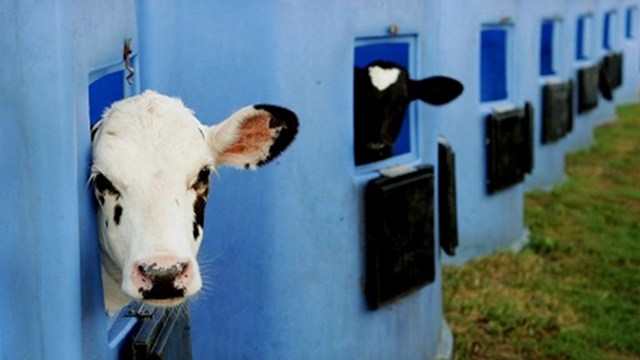
BOUND FOR PHILIPPINES. Calves peer out windows of their hutches on a dairy farm. Beef is one of the agriculture products US exports to Asia. Photo by AFPBOUND FOR PHILIPPINES. Calves peer out windows of their hutches on a dairy farm. Beef is one of the agriculture products US exports to Asia. Photo by AFP
The Philippines has become the largest market for U.S. food and beverage products in Southeast Asia as a surging economy and rising tourism are seen stoking demand for American goods in 2013, a report by the U.S. agriculture attaché said.

“U.S. consumer oriented food and beverage exports to the Philippines have increased an estimated 12% in 2012 to a record $850 million and have doubled since 2009,” the report said.

The report by the attaché is compiled by U.S. agriculture experts and is not official data from the U.S. Agriculture Department. But they are considered as authoritative and influential in the commodity trading community.

“The Philippines remains the largest U.S. food and beverage market in Southeast Asia, and one of the fastest growing in the world,” the report said.

The latest U.S. Customs data through November showed that at least 10 of the 16 food and beverage categories will hit record sales in 2012. The list of U.S. food and beverage exports to the Philippines includes dairy products, red meats, poultry meat, snack foods, processed fruits and vegetables, and fresh fruits.

The U.S. attaché urged American exporters to take part in trade shows so they can meet potential importers of their products. U.S. exporters should partner with Philippine importers, with some setting up buying offices in the U.S. to consolidate their shipments on the U.S. West Coast.

“U.S. exporters are encouraged to maintain close contact with their Philippine importers and support efforts to introducing the products to foodservice customers by participating in technical seminars, product demonstrations, and local trade shows. Regular market visits are also highly valued by Philippine importers and regarded as a show of support,” the attaché said. - Rappler.com


...the PH hot air ballon fest

Hot air balloon fest puts PH on aerial tourism map


Katherine Visconti
Rappler.com
02/21/2013


BIGGEST FIESTA SO FAR. This year's Philippine Hot Air Balloon Fiesta brings together 32 balloons from 15 countries. Photo by Katherine ViscontiBIGGEST FIESTA SO FAR. This year's Philippine Hot Air Balloon Fiesta brings together 32 balloons from 15 countries. Photo by Katherine Visconti
ANGELES CITY, Philippines - A floating bus, men dangling from parachutes, and military training jets dot the sky.
 
The view sounds fantastical and it is.
 
From February 21 to 24, paragliders, skydivers, helicopters, kites, jets, and hot air balloons take to the sky for the 18th Philippine International Hot Air Balloon Fiesta. Not surprisingly, the annual event is also known as "the weekend of everything that flies."
 
"A record number of 32 balloons represented by some 15 countries will participate in this year's 18th Philippine International Hot Air Balloon Fiesta, the biggest participation in the history of the Philippine Hot Air Balloon Fiesta to date," said Arnel Paciano D. Casanova, president and CEO of the Bases Conversion and Development Authority, in a statement.
 
AERIAL TOURISM. The Philippines is determined to take the lead. Photo by Katherine ViscontiAERIAL TOURISM. The Philippines is determined to take the lead. Photo by Katherine Visconti
Visitors have come from as far as Belgium, England, Poland, the United States, and the Netherlands to chart hot air balloons in the yearly aviation event.
 
Aimed at putting the Philippines on the map for aerial tourism, the event is supported by the Department of Tourism, the Clark Development Corporation, the Clark International Airport Corporation, and the Bases Conversion Development Authority.
 
An orchestra in the air
 
NEED FOR SPEED. The sexy jets of the Breitling Jet Team gleaming and ready to fly. Photo by Katherine ViscontiNEED FOR SPEED. The sexy jets of the Breitling Jet Team gleaming and ready to fly. Photo by Katherine Visconti
A special sight this 2013 is the acrobatic performance of the world-renowned Breitling Jet Team, which considers itself "the world's largest professional civilian flight team." The team was brought to Manila by jewelry and timepiece brand Lucerne.
 
Composed largely of former fighter pilots from France, the skilled crews steered 7 L-39 C Albatros aircrafts — Czech-made twin-seater military training jets — through a daunting series of tricks.
 
They looped through the air, barrel-rolled, and dove straight down together, splitting apart at exactly the same moment.
 
Watch a video on the team's stunts here:

Actor Dingdong Dantes was a passenger in one of the Breitling flights. He described the experience as "exciting and nerve wracking." He added that his dad used to fly planes and that he always dreamed of being a pilot since he was a child.
 
Dantes was in professional hands but there are always risks at every corner, explained Breitling pilot Patrick Marchand. Breitling said in a press statement that pilots flying upside down may be subjected to 9 times the amount of pressure on a typical human body, causing "immense strain on the muscles to keep blood flowing evenly throughout the body."
 
DREAM COME TRUE. Actor Dingdong Dantes's father was a pilot. Photo courtesy of GMA7DREAM COME TRUE. Actor Dingdong Dantes's father was a pilot. Photo courtesy of GMA7
The pilots' lives depend on working together as a team. Marchand said they are all extremely close and he intuitively recognizes his teammates' voices over the radio.
 
He called their team "a symphony in the sky" for whom precision is of utmost importance.
 
Captain Jacques Bothelin agreed. "I'm the conductor," he laughed. When he dives, his wingmen follow no matter what, he explained to Rappler.
 
Like musicians, they all have to be in perfect sync for the performance to come off without a hitch, added Marchand.
 
Here are photos from the Breitling Jet Team's shows on February 21 at 8:30am and 10:30am:
Photo by Angie de SilvaPhoto by Angie de Silva
ONE DOWN, 3 TO GO. The 18th Philippine International Hot Air Balloon Fiesta runs until February 24 at the Clark Freeport Zone in Angeles City, Pampanga. Photo by Angie de SilvaONE DOWN, 3 TO GO. The 18th Philippine International Hot Air Balloon Fiesta runs until February 24 at the Clark Freeport Zone in Angeles City, Pampanga. Photo by Angie de Silva

Thursday, February 21, 2013

...the best microfinance environments

Editorial

Philippines Among Best Microfinance Environments


Manila Bulletin
February 20, 2013
 
The Philippines is a global leader in microfinance, having one of the best business environments for microenterprises. It ranked 4th out of 55 countries in the annual global survey “Global Microscope on the Microfinance Business Environment 2012,” released in 2012 by the London-based think-tank Economist Intelligence Unit (EIU). The Philippines posted a two-notch improvement from its 6th ranking in 2011. The report highlighted the country’s stable market and reforms initiated by public and private institutions to develop an enabling microfinance environment.

The EIU said the rankings recognized key efforts of the Bangko Sentral ng Pilipinas (BSP) such as raising the ceiling for “microfinance plus” that microenterprises and small businesses can avail of to fund their operations. Microfinance originally financed microenterprises or small livelihood activities but BSP expanded loan products to include microfinance housing, micro-agri loans, micro-insurance, and micro-deposits. There are 202 microfinance institutions operating in the Philippines.

In the 2nd quarter of 2012, the BSP, in Circular No. 748, eased its guidelines on microfinance lending to allow banks to disburse more funds in the countryside for agriculture and agrarian reform sectors.

The BSP, in Circular No. 782 on January 21, 2013, raised the threshold of microfinance clients to allow low-income clients access to credit such as housing microfinance. Low-income are those with income below P17,000 a month or P206,000 per year.

Microfinance is a way of providing financial services to entrepreneurs and small businesses lacking access to conventional banking. In the Republic of the Philippines, microfinancing is an activity dominated by rural banks, non-government and people organizations, with support from international donors. Rural and cooperative banks provide financial services to over 85 percent of cities and towns, under the Micro-enterprise Access to Banking Services of the Rural Bankers Association of the Philippines, supported by the United States Agency for International Development.

We congratulate the Bangko Sentral ng Pilipinas, headed by Governor Amando M. Tetangco Jr., in its efforts to promote microfinance as one of the powerful programs of the Philippine economy. CONGRATULATIONS AND MABUHAY!


Wednesday, February 20, 2013

...the stock market bull run

No stopping bull run in Philippines
 
Philippine Stock Exchange Index now Asia's most expensive in what is seen as an Aquino-led rally


BT 20130220 EMPHIL 413142
Chasing away the bears: Dragon dancers at the Philippine Stock Exchange help usher in the year of the snake. Global players are upbeat about the nation's prospects citing a clean, honest government, pro-business climate and impressive stock valuations. - PHOTO: AFP
 
 
THE world's biggest equity bull market is propelling Philippine valuations to all-time highs as international investors pile into the country's stocks in an endorsement of President Benigno Aquino's economic policies.

The Philippine Stock Exchange Index climbed 13 per cent this year till yesterday, bringing gains since October 2008 to 285 per cent, at least 124 percentage points more than every other bull market in emerging and developed nations, according to data compiled by Bloomberg. The index turned into Asia's most expensive from the second-cheapest four years ago as rallies in Ayala Land Inc and Bank of the Philippine Islands lifted the gauge to 19 times estimated profits.

Aquino's efforts to boost spending on government projects and tackle corruption are convincing foreign investors to look past the nation's speculative-grade credit rating and focus on the third-fastest growth in Asia after China and Thailand. While Invesco Ltd says shares are too expensive, Samsung Asset Management and Religare Capital Markets see further gains of at least 20 per cent and an investment-grade ranking this year.

"Funds will remain net buyers," Alan Richardson, who helps oversee about US$110 billion as a money manager at Samsung Asset in Singapore, said in a Feb 6 email. "The focus is on opportunity and growth rather than contraction caused by deleveraging, bank recapitalisation, fiscal austerity and increased regulatory oversight in many of the developed economies."

The benchmark gauge for the nation's US$236 billion equity market rose 0.9 per cent, the biggest gain in Asia today, to a record 6,620.72. The bull market, defined as an advance of at least 20 per cent from the most recent low without a drop of the same magnitude on a closing basis, is the biggest since Bloomberg began compiling Philippine index data in 1987.

Mexico's IPC Index has climbed about 161 per cent since March 2009, making it the second-biggest bull market among 45 emerging and advanced countries, while the Standard & Poor's 500 Index is up 125 per cent from a low in the same month. In China, the biggest emerging market, the Shanghai Composite Index has increased 24 per cent from its Dec 3 low.

Philippine shares will probably return about 38 per cent by the end of 2014, according to Samsung's Mr Richardson. The benchmark index may rally 20 to 30 per cent this year, said John Sturmey, head of equity capital markets at Religare Capital Markets, a unit of New Delhi-based Religare Enterprises Ltd.

"We are very bullish on the Philippines for this year and the following years," Mr Sturmey said in a Feb 5 interview in Manila.

Foreign investors purchased a net US$819 million worth of shares in Asia's 12th-biggest stock market this year, 120 per cent more than during the same period a year ago, according to Philippine Stock Exchange data compiled by Bloomberg. The nation of about 100 million people recorded US$2.5 billion of inflows last year, the most since Bloomberg began tracking the data in 2000.

Stronger peso

Growing confidence in the economy is also boosting the nation's currency and debt. The peso has appreciated 5 per cent against the dollar during the past 12 months, the most in emerging markets
and reached the strongest level since 2008 last month at 40.55 to the dollar.

Yields on local-currency debt, rated BB+ by Standard & Poor's, fell to a record 3.76 per cent on Jan 28, according to the JPMorgan GBI-EM Philippines Index. The cost to insure government bonds, rated one level below investment grade, against non-payment for five years using credit-default swaps was 103 basis points yesterday, data compiled by Bloomberg show. That compares with 121 for Brazil, whose foreign-currency debt is rated two levels above the Philippines.

Philippine gross domestic product increased 6.8 per cent from a year earlier in the fourth quarter, compared with 7.9 per cent in China. The euro region contracted during the period, while the US expanded 1.5 per cent.

Mr Aquino plans to boost spending to a record and seek more than US$17 billion of infrastructure investments to spur growth of at least 6 per cent this year. Projects to build a toll-road south of Manila and more than 9,300 classrooms have already been announced since he took office in June 2010.

The 53-year-old president has narrowed the budget deficit by cracking down on tax evasion and raising taxes on liquor and tobacco. The gap was probably 2.3 per cent of GDP in 2012, Budget Secretary Butch Abad said in a Feb 14 interview in Manila. That's down from 3.5 per cent in 2010, according to Philippine Department of Finance data.

Mr Aquino, who had a 66 per cent approval rating in a January survey conducted by Pulse Asia, has also focused on reducing corruption. Renato Corona, the country's top judge, was ousted in May for illegally concealing his wealth.

The Philippines was ranked 105 on Transparency International's 2012 Corruption Perceptions Index, an improvement from 134 in 2010. (A lower ranking signals less corruption.)

"The macro environment looks very positive and the Philippines probably has the cleanest government in its history," Alistair Thompson, deputy head of Asia Pacific ex- Japan equities at First State Investments in Singapore, said in a Jan 16 phone interview. "Companies are very optimistic." His firm oversees about US$147 billion.

Philippine stock valuations already reflect the good news, according to Paul Chan, the Hong Kong-based chief investment officer for Asia ex-Japan at Invesco, which oversees about US$713 billion.
The benchmark index's valuation of 19 times projected 12-month earnings is the highest since Bloomberg began compiling the data in January 2006 and 46 per cent more expensive than the MSCI All-Country World Index. The Philippine gauge has the world's second-highest multiple after Greece's ASE Index, which trades at 22 times estimated profits, the data show.

Ayala Land, a Manila-based developer, is valued at 39 times 2013 profit forecasts, more than twice the median multiple for global peers, according to the average of 14 projections compiled by Bloomberg.

Bank of the Philippine Islands, the country's biggest lender by market capitalisation, trades for four times net assets, versus the 1.6 industry average.

Earnings outlook

Earnings-per-share in the Philippine index will probably increase 14 per cent in the next 12 months, versus 25 per cent for the MSCI All-Country gauge, according to analyst estimates compiled by Bloomberg.

"The Philippines is a very crowded market," Invesco's Mr Chan said in a Feb 7 phone interview. He cut Philippine positions to less than 1 per cent of total holdings from "much higher" levels last year and prefers shares in China and South Korea, where price-earnings ratios are about half the level of the South-east Asian nation's.

There is "probably room" for Philippine stock valuations to climb as long as growth in earnings and the economy can be sustained, Hans Sicat, president of the country's bourse, said in a Feb 15 interview in Tokyo.

First State's Mr Thompson said he purchased shares of Manila-based BDO Unibank Inc after visiting the country in November. The nation's second-biggest bank by market value trades for 2.2 times net assets, about half the multiple of Bank of the Philippine Islands.

"We remain positive," Douglas Cairns, an investment specialist for Asia and emerging-market equities at Threadneedle Investments in London, which oversees about US$122 billion, said in an email on Feb 7. Mr Cairns said the firm has overweight holdings in Philippine shares, meaning positions exceed the country's representation in benchmark indexes.

An investment-grade credit rating may open Philippine capital markets to pension funds and endowments that have avoided the country, according to Samsung Asset's Mr Richardson.

The rating will probably be upgraded in the first half, central bank Governor Amando Tetangco said in a Bloomberg Television interview on Jan 25. S&P raised its outlook to positive from stable on Dec 20, citing the stability of Mr Aquino's administration and economic growth. GDP will probably increase 6 to 7 per cent this year and accelerate in 2014, Economic Planning Secretary Arsenio Balisacan said at a forum in Manila on Feb 13.

Investors should add to their stock holdings on any declines, Christopher Wood, a Hong Kong-based strategist at CLSA Asia-Pacific Markets who recommends a bigger overweight position in the Philippines than any other equity market in Asia excluding Japan, said in a Feb. 7 report. "In such a structural bull market, those investors who focus too much on valuations sell way too early." - Bloomberg

...the Investment "Sweet Spot"

Editorial

Philippines 'Sweet Spot' for Investment


Manila Bulletin
February 18, 2013
 
 
The Philippines edged its Asian neighbors in providing an environment that attracts big foreign companies. Besides traditional investment sources such as United States of America, Japan, South Korea, and Taiwan, potential investors from Europe, the Middle East, and Africa now look at the country as investment site.

The Board of Investments (BOI) reported that R75 billion worth of investments poured in the first month of 2013 the biggest of which was the R40-billion Subic power project. BOI-registered investments come with tax holiday packages and incentives to attract more big companies. The growing investor confidence is fueled by the robust 6.6% growth in the economy in 2012, a competitive labor force, and a stable government.

The International Finance Corp. (IFC), the private sector financing arm of the World Bank, plans to invest up to $400 million in the Philippines in 2013 in Public-Private Partnership (PPP) projects, transport, tollroads, water, and power, particularly renewable.

The United Kingdom (UK) has increased trade and investment in the Philippines, particularly in information and communications technology, PPP, retail, education, energy, and health care.

Investments from Taiwan rose over 30 percent to $400 million in 2012 from $300 million in 2011, according to the Taipei-based Manila Economic and Cultural Office. Some $400 million in investments were infused by 16 companies in various Philippine industries, of which about $100 million went to Clark and the rest to economic zones in Batangas, Laguna, and Cavite. Some 800,000 Filipinos are employed today by foreign investors in 275 special economic zones nationwide.

We congratulate the Department of Trade and Industry, headed by Secretary Gregory L. Domingo, and other Officers, in their collective efforts to push for long-term and sustainable investments to ensure a strong economy in the Republic of the Philippines. CONGRATULATIONS AND MABUHAY!

Tuesday, February 19, 2013

...the Pinay in The Bachelor

Pinay among top three vying for Bachelor’s heart


Joseph Pimentel | AJPress
Catherine Ligaya Mejia Giudici
A half-Filipina is in the running to be the Bachelor’s next sweetheart.

Catherine Ligaya Mejia Giudici is a 26-year-old graphic designer and blogger from Washington who has survived eight episodes.

So far, she has bested 23 other female contestants to make it in the top three for Sean Lowe’s affection in ABC’s reality series, The Bachelor.

Catherine is the daughter of Cynthia Mejia-Giudici, a trustee for the Filipino-American National Historical Society in Seattle.


Her father, Carey “Trip” Guidici, is of Scottish and Swiss-Italian descent, and a renowned journalist and former editor-in-chief of Northwest Asia Weekly.

The Bachelor is a popular reality television dating game show where women compete for the affection of a “Bachelor.”

This season (its 17th) features 28-year-old Sean Lowe, an insurance agent from Texas, as the Bachelor.

On Monday’s episode, Catherine introduced Lowe to her family in Seattle. There, the couple ate lumpia and Catherine shared how to show proper respect to her Lola (grandma) in traditional Filipino culture by placing her hand on his forehead (doing the “mano po”).

Catherine is a graduate of Washington State University and is a “self-proclaimed ‘opportunistic vegan.’”

According to her bio, she currently works at Amazon and blogs for Seattleite, a lifestyle website.

(www.asianjournal.com)
(LA Midweek February 20, 2013 MDWK pg.2)