Showing posts with label ASEAN. Show all posts

Monday, February 10, 2020

...the 2nd ASEAN's fastest growing market for motor vehicle

Philippines 2nd fastest-growing market for motor vehicles in South East Asia


Louella Desiderio
Philippine Star
10 February 2020
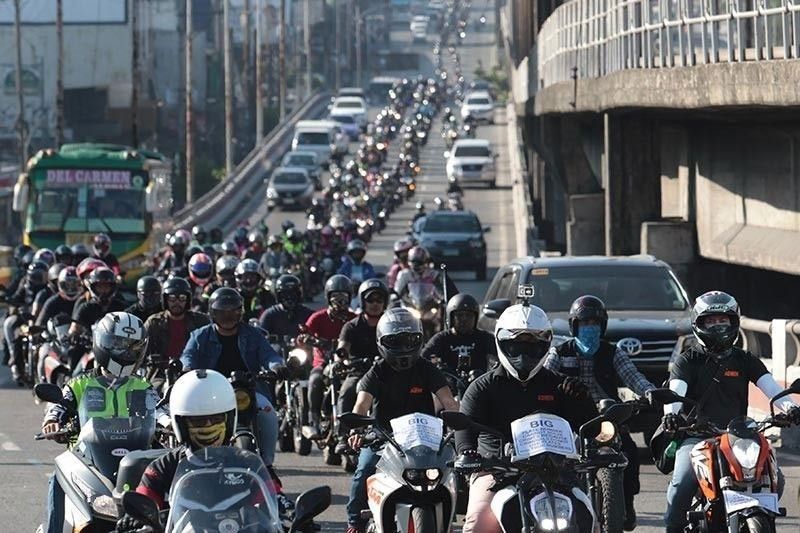

MANILA, Philippines — The Philippines was the second fastest-growing motor vehicle assembler in Southeast Asia last year, registering a 19 percent growth in output, according to the Association of Southeast Asian Nations Automotive Federation (AAF).
Data from AAF showed the Philippines assembled 95,094 motor vehicles last year, up from just 79,763 units in 2018.

Posting the fastest growth in motor vehicle output last year was Myanmar, which assembled 15,496 units, 26 percent higher than the 12,292 units in 2018.

Apart from Myanmar and the Philippines, the only country in the region with a higher motor vehicle output was Malaysia which produced 571,632 units last year, up 1.2 percent from the 564,971 units in 2018.

All other countries with motor vehicle assembly operations in the region registered declines.
Thailand, which serves as the region’s automotive hub, assembled 2.01 million units last year, seven percent lower than the 2.17 million units in 2018.

Indonesia’s motor vehicle output decreased by 4.2 percent to 1.29 million units last year from 1.34 million units in 2018, while Vietnam’s output went down by 12 percent to 176,203 units last year from 200,436 units in 2018.

Total motor vehicle output in Southeast Asia decreased by 4.8 percent to 4.16 million units last year from 4.37 million units in 2018.

In terms of motor vehicle sales, the Philippines was among those with higher sales last year.

AAF data showed the Philippines sold 369,941 units last year, 3.5 percent higher than the 357,410 units in 2018.

Other countries in the region with higher sales last year are Myanmar with a 25 percent growth in sales to 21,916 units, Vietnam with an 11.7 percent increase to 322,322 units, Brunei with a six percent uptick to 11,909 units, and Malaysia with one percent growth to 604,287 units.

Posting lower sales last year, meanwhile, are Indonesia with a 10.5 percent drop to 1.03 million units, Singapore with a five percent decrease to 90,429 units, and Thailand down 3.3 percent to 1.01 million units.

Total motor vehicle sales in the region reached 3.46 million units last year, 2.9 percent lower than the 3.56 million units sold in 2018.

Recently, the Department of Trade and Industry (DTI) launched a preliminary probe on a petition filed by workers group Philippine Metalworkers’ Alliance (PMA) to impose safeguard measure or duty on vehicles, a development which may affect both the production and sales performance of automotive firms in the country.

PMA filed the petition as increased vehicle imports are seen to pose threat to local car assembly, auto parts manufacturers, as well as employment in the sector.

A safeguard duty may be imposed by the government when a surge in imports of a certain product causes injury to local players.


Saturday, November 30, 2019

...The Southeast Asian Game host (opening)

Philippines showcases cultural heritage to kick off 30th Sea Games

New Straits Times
30 November 2019


MANILA: The Philippines staged a spectacular opening ceremony for the 30th SEA Games at the world’s biggest indoor arena, the Philippine Arena, in Bulacan, near here, tonight.


In a departure from tradition, the opening ceremony was held in an indoor arena rather than a stadium.


Also, for the first time in the biennial Games’ 60-year history, the games cauldron was placed at a different location, at the New Clark City Athletics Stadium, some 90km from Bulacan, and the lighting of the cauldron was shown on screen at the 55,000 capacity arena.

The extravaganza started after Filipino singer Lani Misalucha sang the republic’s national anthem, which was followed by an extraordinary performance themed “The Roots of our Strength”, showcasing the culture and heritage of the nation.
The spectators were treated to a series of warrior dances from the Bagobo, the Kalinga, the Maguindanao, Islamic and the pre-Hispanic Visayans.

The later part of the ceremony was powered by modern and hip-hop performances led by local artistes Inigo Pascual, Robert Sena, Apl.de.Ap and KZ Tandingan, among others.
The contingents received loud cheers from the audience as they paraded into the arena in alphabetical order, starting with Brunei, Cambodia, Indonesia, Laos, Malaysia, Myanmar, Singapore, Thailand, Timor Leste and Vietnam, before host nation the Philippines ended the march.

Led by flag-bearer and 2018 bowling world champion Rafiq Ismail, the Malaysian contingent were represented by a delegation of about 100, including chef de mission Datuk Megat Zulkarnain Omardin and his two deputies, Nurul Huda Abdullah and Ahmad Faedzal Md Ramli.


With the men dressed in white baju melayu and red samping with tengkolok, and the women in white baju kurung and selendang with Jalur Gemilang motif, and black shoes, the multi-racial Malaysian contingent, the hosts of the previous games, walked past the crowd proudly, symbolising the multiculturalism of the country.

World renowned Filipino boxers Manny Pacquiao and Nesthy Petecio were given the honour as the torchbearers before they jointly lit the cauldron to officially mark the beginning of the 30th SEA Games, after Philippine President Rodrigo Duterte had declared open the Games.

Themed ‘We Win As One’, the Games will run for 12 days until the closing ceremony at the New Clark City Athletics Stadium on Dec 11.
More than 8,000 athletes from the 10 ASEAN countries and Timor Leste will compete in 530 events in 56 sports at the three main clusters, namely Manila, Clark and Subic.


The Philippines have hosted the SEA Games three times before – in 1981, 1991 and 2005.
This year’s Games see the introduction of a few new sports such as arnis, jujitsu, kickboxing, underwater hockey and esports.

Defending champions Malaysia have sent a strong contingent of 773 athletes and 339 officials to participate in 52 sports, targeting 70 gold, 51 silver and 105 bronze medals, which is expected to place them fourth overall.– BERNAMA

Monday, November 25, 2019

...the future of ASEAN

South Korea's Moon says the Philippines is 'future of Asean'


Pathricia Ann Roxas
Inquirer.net
25 November 2019

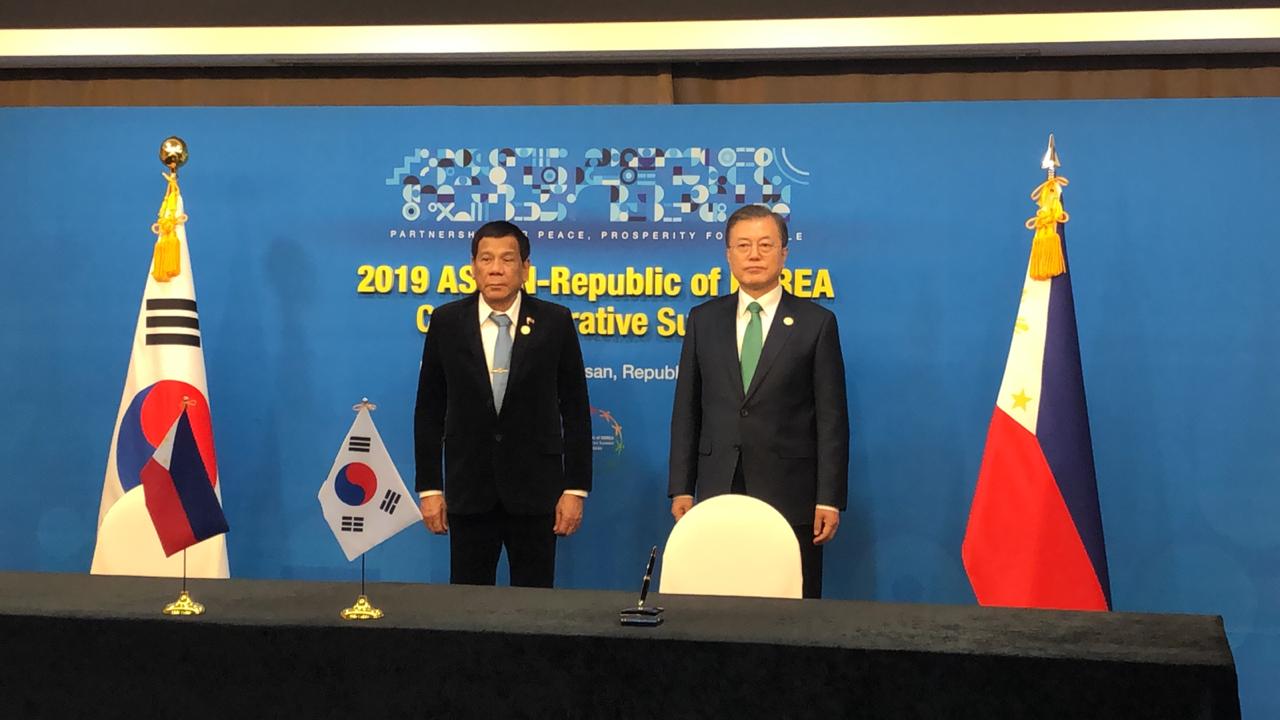
BUSAN, South Korea — South Korean President Moon Jae-in has described the Philippines as “the future of Asean” as President Rodrigo Duterte met him in a bilateral meeting here Monday.


South Korea's Moon says Philippines is ‘future of Asean’

“The Philippines is the future of Asean as it continues to achieve an impressive growth rate of 6 percent each year thanks to your outstanding leadership,” Moon said in his opening speech.

“Through our meeting today I hope to strengthen my friendship with you and extend our bilateral cooperation to contribute further to the development of Asean,” he added.


For his part, Duterte expressed gratitude to the Korean government for their 70 years of cooperation in various areas like trade, industry, agriculture, infrastructure, and technology.


Duterte said the two nations “took diverging paths and fortunes,” with South Korea rising “as one of Asia’s economic and technological powerhouse.”


“Ours faltered, but with perseverance, the Philippines has since recovered and is now an emerging economy,” Duterte said.


He further noted that South Korea was the Philippines’ 4th largest trading partner in 2018 as well as a major source of foreign and direct investments.


“I assure you that the Philippines will find common cause and purpose with the Republic of Korea towards enhancing our bilateral engagement and promoting peace and stability in your region,” Duterte promised.


This bilateral meeting is anticipated to result in the two leaders’ signing of agreements on education, tourism, social security, and fisheries.

Edited by KGA

Thursday, October 24, 2019

...the PH economic optimism

Optimism amid dark global economic clouds highest in PH, says think tank


Daxim L. Lucas
INQUIRER.NET
24 October 2019


Global uncertainty may be on the rise but Philippine companies have kept an optimistic outlook on the domestic economy, according to a recent business survey by accounting and consulting firm Grant Thornton International.


In the Asia-Pacific region, emerging markets including the Philippines are holding up well, Grant Thornton’s International Business Report said.

Related image


The report was based on a quarterly global survey of nearly 5,000 mid-market companies in over 30 countries interviewed in May and June this year.


Data on the first half of 2019 showed that optimism, revenue expectations, and profitability forecasts were down in economies around the globe compared with second-half 2018 data, “with most of the main measures of growth at levels not seen since 2016,” the report said.

Yet pockets of resilience were seen across mid-sized companies, such as in export expectations, which are expected to fare well globally amid the threat of a US-China trade war.

The outlook continued to vary between emerging and developed economies in the Asia-Pacific, reflecting varying levels of exposure to the trade war. Optimism was generally down in the region, falling 8 percentage points since the second half of 2019 and more than 50 percent lower than the first half of 2018.

Less developed economies like the Philippines, however, had rosier prospects. Philippine businesses were more upbeat than anywhere else in the region, with 84 percent of those polled being optimistic about the domestic economy.

Expectations for revenue and profit growth in the ASEAN mid-market, too, rose and were now among the highest globally.

“It’s important to heed the signs of volatility and uncertainty in global financial markets, but it’s also worth highlighting that local business leaders choose not to be paralyzed or get sidetracked by the grim possibilities,” P&A Grant Thornton chair and CEO Maria Victoria Espano said.

She also cited bigger capital spending, especially by the government, and the steady flow of remittances from overseas Filipino workers that continued to boost overall economic growth and optimism.

In September, a slowdown in the global economy and domestic investment prompted the Asian Development Bank to offer a slightly lower economic growth forecast for the Philippines.

In an update of its flagship annual economic publication, the ADB changed its forecast for the country’s gross domestic product growth to 6 percent in 2019 and 6.2 percent in 2020, against earlier forecast of 6.4 percent for both years. The International Monetary Fund has a slightly lower projection of 5.7 percent GDP in 2019, 6.2 percent in 2020, and 6.5 percent by 2024. The World Bank’s updated projection for 2019 is at 5.8 percent GDP growth.

Investor sentiment in the country was generally positive paired with a pickup in business confidence, as reflected in the Bangko Sentral ng Pilipinas’ third-quarter consumer expectations survey./TSB


Wednesday, October 23, 2019

...the Philippines in Asian Century


The opportunity for the Philippines in the Asian century 

The Corner Oracle
Andrew J. Marasigan
Philippine Star 
23 October 2019


The 300-year reign of the west as the world’s economic epicenter is coming to a close.

By next year, the collective size of all Asian economies will eclipse that of the rest of the world combined. Thus, the year 2020 marks the official beginning of the Asian Century, declared the United Nations Conference for Trade and Development (UNCTAD).

Asia is now the new center of the world as it is home to more than half of the world’s population and half of the world’s middle class consumers. It is also where 21 out of the world’s 30 largest global cities are located. Experts agree that the average growth rate of Asian economies will be more than double that of the rest of the world in the next 20 years.

Driving Asia is the phenomenal rise of China, India and ASEAN as economic powerhouses. To provide perspective on the phenomenal rise of the continent, Asia accounted for only one-third of global output in the year 2000. It now comprises 50 percent of the planet’s gross domestic product.

On a purchasing power parity (PPP) perspective, China’s economy is now bigger than that of the United States. India has overtaken Japan to become the 3rd largest economy. Within ASEAN, Indonesia is well on its way to becoming the 7th largest economy while Vietnam has overtaken 17 countries to take 32nd position. The Philippines, despite challenges in its manufacturing sector, has overtaken seven countries and it now has 26th largest economy. If the Philippines plays its cards right, it can be the 16th largest economy by the year 2050.

Prospects are promising for ASEAN. With China and India slowing down due to the trade war, ASEAN is in the position to take center stage as the world’s engine of growth. ASEAN’s economy is now bigger than that of Great Britain.

ASEAN’s development came in waves with Singapore and Brunei being the first to achieve high income status. Thailand and Malaysia achieved rapid growth in the 90’s and are now counted among upper middle income economies. In the last ten years, however, Indonesia, Vietnam and the Philippines have lead the way in as far as economic development is concerned. The three nations have clocked-in an average annual growth rate of between five and six percent since 2010. The Philippines is seen to graduate to upper-middle income status next year.

As I mentioned, China and India’s slowdown have made Indonesia, Vietnam and the Philippines the most dynamic global economies today. All three are in stiff competition to attract foreign investments. But to compete on an equal footing, the Philippines must resolve several structural weaknesses.

The gaping hole in the Philippines’ growth story is its manufacturing sector. It is weak, to say the least. For context, our merchandise exports revenues of $67 billion is less than a fourth of Vietnam’s $297 billion. We have become a nation dependent on imports – from simple ball pens to heavy equipment. This is why our budget deficit (and current account deficit) is growing at an alarming rate every year.

Deficits are covered by debt so it goes without saying that the country’s debt load is growing at an alarming rate too. Sure, it is still manageable today, but if government fails to balance the national budget soon, we could face a serious debt crisis.

To put it simply, we need to export more to pay for the debts government is amassing for its infrastructure program and for its massive importations of consumer goods.

The crux of our woes is our inability to attract foreign investments. Again, for context, the Philippines attracted $9.8 billion worth of investment last year while Vietnam attract $35.5 billion. Foreign investments are the silver bullet to our problems since they bring both capital and technologies needed to build factories. These factories export goods and provide the local market with what it needs, thus, making the country less import-dependent.

The structural weaknesses I referred to earlier are those that contribute in making the Philippines unattractive to foreign investors. They include the constitutional provisions that restrict foreign investments in certain industries, expensive power cost, insufficient infrastructure and difficulty to do business (due to bureaucratic red tape). Exacerbating matters is that corporate income tax in the Philippines is 30 percent, compared to only 20 percent in Vietnam and 25 percent in Indonesia.

The Philippines must address these structural weaknesses if it is to compete. Our economic managers have numerous reforms waiting to be approved by Congress.Whether our legislators have the political will to enact these reforms without watering them down is another story.

On corporate income tax, the CITIRA Law proposes to gradually reduce corporate income tax from 30 percent to 20 percent over a ten-year period. I reckon, however, that 10 years is too long. If we are to be a real contender, this should be accelerated to just three years. Indonesia just passed a law to reduce its rate to 20 percent next year. The CITIRA Law is now pending in the Senate.

As far as infrastructure is concerned, while construction of several roads, rails and ports are ongoing, it is still grossly insufficient. Only 9 out of the 75 projects in Build Build Build are under construction today. Government must work faster and with more urgency lest it fail to deliver its promise of a “golden age of infrastructure”.

Another reform we must undertake is to open up more industries in which foreigners can participate as a majority stakeholder. Unfortunately, the 1987 Constitution was written with a protectionist intent and it has been a great impediment to attracting investors. That said, only an amendment of the Constitution can fix this. Even if politically contentious, we must confront this issue eventually.

The transport and telecommunications backbone of the country needs to be strengthened if we are to be truly competitive, especially in the information and communication technology space. The Open Access in Data Transmission Act and the amendment to the Public Services Act will address this. Both bills are pending in Congress.

As for bureaucratic red tape goes, the Ease of Doing Business and Efficient Government Service Delivery Act has already been passed into law and is now awaiting implementation. When completely rolled out, it is envisioned that all front-line government services will be fully automated, making it easier to conduct business. Again, the devil is in the execution.

Apart from this, Congress must revisit the EPIRA Law which has proved ineffective to bring down power cost.

Conditions are right for the Philippines to break away economically. However, we must first get our house in order before investors come. It would be a shame if the Asian century happens and we are left behind.

Thursday, October 10, 2019

...the fast growing gig economy

Philippines’ fast-growing gig economy