Showing posts with label Philippines. Show all posts

Saturday, November 30, 2019

...The Southeast Asian Game host (opening)

Philippines showcases cultural heritage to kick off 30th Sea Games

New Straits Times
30 November 2019


MANILA: The Philippines staged a spectacular opening ceremony for the 30th SEA Games at the world’s biggest indoor arena, the Philippine Arena, in Bulacan, near here, tonight.


In a departure from tradition, the opening ceremony was held in an indoor arena rather than a stadium.


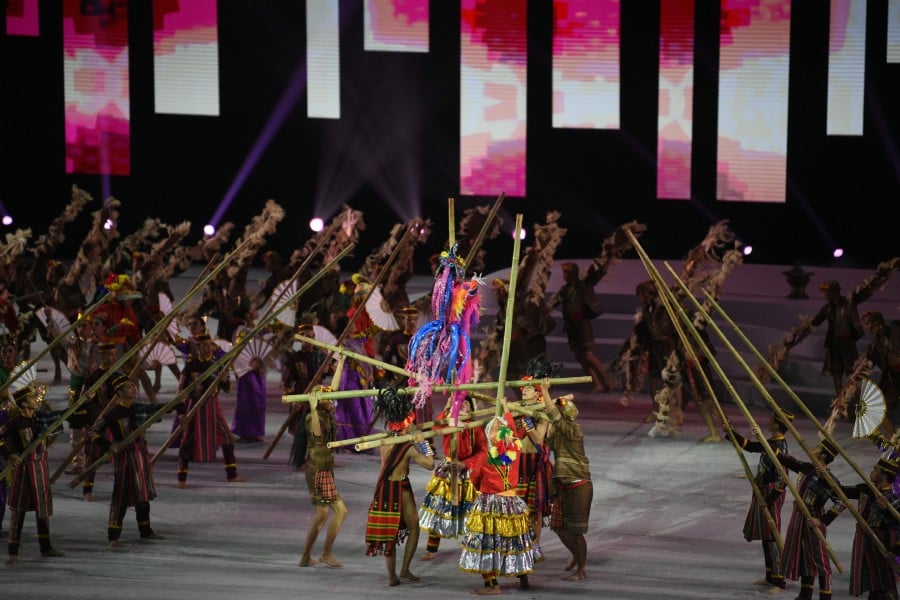

Also, for the first time in the biennial Games’ 60-year history, the games cauldron was placed at a different location, at the New Clark City Athletics Stadium, some 90km from Bulacan, and the lighting of the cauldron was shown on screen at the 55,000 capacity arena.

The extravaganza started after Filipino singer Lani Misalucha sang the republic’s national anthem, which was followed by an extraordinary performance themed “The Roots of our Strength”, showcasing the culture and heritage of the nation.
The spectators were treated to a series of warrior dances from the Bagobo, the Kalinga, the Maguindanao, Islamic and the pre-Hispanic Visayans.

The later part of the ceremony was powered by modern and hip-hop performances led by local artistes Inigo Pascual, Robert Sena, Apl.de.Ap and KZ Tandingan, among others.
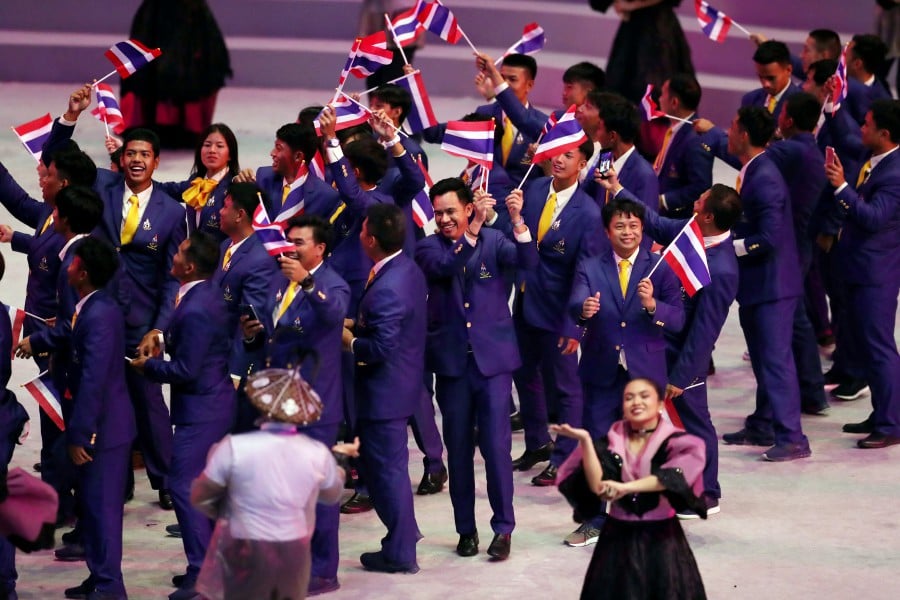
The contingents received loud cheers from the audience as they paraded into the arena in alphabetical order, starting with Brunei, Cambodia, Indonesia, Laos, Malaysia, Myanmar, Singapore, Thailand, Timor Leste and Vietnam, before host nation the Philippines ended the march.

Led by flag-bearer and 2018 bowling world champion Rafiq Ismail, the Malaysian contingent were represented by a delegation of about 100, including chef de mission Datuk Megat Zulkarnain Omardin and his two deputies, Nurul Huda Abdullah and Ahmad Faedzal Md Ramli.
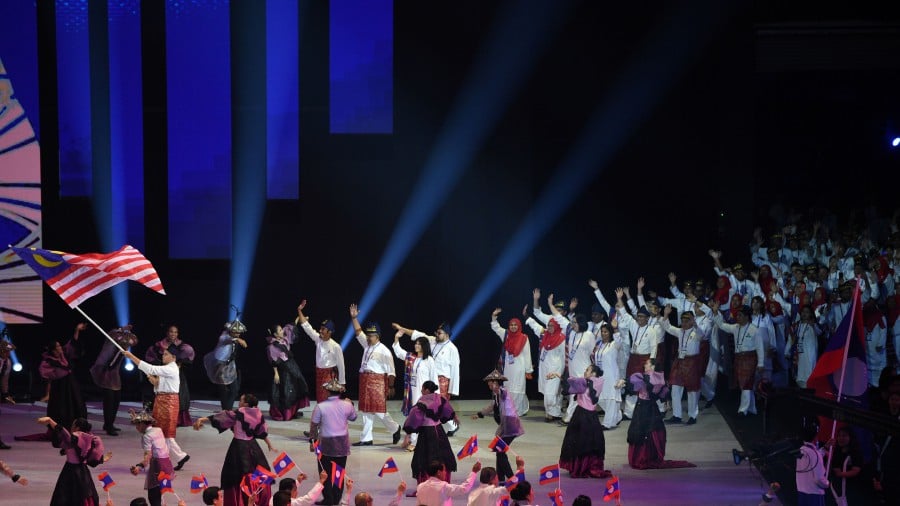

With the men dressed in white baju melayu and red samping with tengkolok, and the women in white baju kurung and selendang with Jalur Gemilang motif, and black shoes, the multi-racial Malaysian contingent, the hosts of the previous games, walked past the crowd proudly, symbolising the multiculturalism of the country.

World renowned Filipino boxers Manny Pacquiao and Nesthy Petecio were given the honour as the torchbearers before they jointly lit the cauldron to officially mark the beginning of the 30th SEA Games, after Philippine President Rodrigo Duterte had declared open the Games.

Themed ‘We Win As One’, the Games will run for 12 days until the closing ceremony at the New Clark City Athletics Stadium on Dec 11.
More than 8,000 athletes from the 10 ASEAN countries and Timor Leste will compete in 530 events in 56 sports at the three main clusters, namely Manila, Clark and Subic.


The Philippines have hosted the SEA Games three times before – in 1981, 1991 and 2005.
This year’s Games see the introduction of a few new sports such as arnis, jujitsu, kickboxing, underwater hockey and esports.

Defending champions Malaysia have sent a strong contingent of 773 athletes and 339 officials to participate in 52 sports, targeting 70 gold, 51 silver and 105 bronze medals, which is expected to place them fourth overall.– BERNAMA

Sunday, November 3, 2019

...the 2019 WAGC World Finalist

Philippines finishes second overall in 2019 WAGC World Finals

Jean Russel V. David
Manila Times
03 November 2019


The Philippine team finished second overall in the recently concluded 2019 World Amateur Golfers Championship (WAGC) World Finals on October 19 to 26 in Sabah, Malaysia.
Team captain Joseph Uy together with WAGC team members Edsel Opulencia, Chucky Reyes, Fernando Reyes, and Rutsy Ramirez played hot on the last day, shocking heavy favorites that include New Zealand, Japan and Sweden to finish second.
The Philippines carded a total of 1,178 aggregate points banking on rounds of 300, 294, 289, and 295.
Malaysia notched 1,115 (284, 283, 289, 299) to bag the overall title while New Zealand came in at third with 1,182 (298, 294, 300, 290).
In the individual race, Uy of Forest Hills and Chucky of Valley Golf claimed the top honors in Division 2 and 3, respectively.
Skipper Uy scored 290 to beat Henry Gao of New Zealand and Mika Laaksonen of Finland, who had identical 294s.
Chucky, meanwhile, shot a 291 to win by two strokes against Kazuhito Miyawaki of Japan and Alexander Carlsson of Sweden, who had identical 293s.
Opulencia landed fifth with a 303 in Division 1 while Fernando Reyes had a 315 while Rutsy Ramirez scored 306 to settle at the 12th and seventh places in Divisions 4 and 5, respectively.
In the World Amateur Golfers Invitational finals, Division 3’s Ernest Platon and Division 5’s Vicky Herrera both emerged first placers.
Platon dominated his division with a 291 while Herrera outclassed her rivals with a strong 294.
Blake Go of Cebu City finished eighth with a 309 in Division 2.
The tandem of Go and Platon, on the other hand, finished fifth overall out of 75 teams in the 2-man play.


Friday, November 1, 2019

...the FIBA 3x3 Olympic Qualifyer

Philippines earns ticket to FIBA 3x3 Olympic Qualifying Tournament in India


Philip Matel
ESPN
01 November 2019


The Philippines booked a ticket in the FIBA 3x3 Olympic Qualifying Tournament in India from March 18-22 next year.

FIBA made the announcement in a gala in Utsunomiya, Japan on Friday, the site of the 2019 World Tour Final. Tokyo will play host to the Summer Games next August for the first time since 1964.
The Philippines is in Group Pool C, along with Slovenia, France, Qatar, and the Dominican Republic.


A total of 20 countries will be vying for three slots for Tokyo. An additional spot will be allotted to the winner of the Universality-driven Olympic Qualifying Tournament, to be held in Hungary in April.
Host Japan and top three countries Serbia, China, and Russia were given direct qualification to the inaugural tournament in the men's division. In the women's category, Russia, China, Mongolia, and Romania directly qualified.
Other countries that have qualified include India, the United States, Latvia, Poland, Mongolia, Netherlands, Lithuania, Brazil, Belarus, Canada, Croatia,South Korea, Turkey, Spain, and New Zealand in the men's division.
Meanwhile, for the distaff division, India, Hungary, France, Iran, Netherlands, Italy, Chinese Taipei, Estonia, United States, Germany, Ukraine, Belarus, Czech Republic, Switzerland, Uruguay, Turkmenistan, Indonesia, Australia, and Sri Lanka also advanced to the tournament.
"We're very happy that the Philippines will be competing in the upcoming Olympic Qualifying Tournament for a shot at making it to the 2020 Tokyo Olympics," said Samahang Basketbol ng Pilipinas (SBP) president Al Panlilio.
"3x3 is an area where Filipino basketball players can really excel and we're delighted that a Filipino basketball team will get to test their skills against the world's best."
The Philippines, which started 61st in the World Rankings at the start of 2019, leapt over 40 spots and went as high as 20 -- primarily due to a collective effort on numerous fronts.
Major players include the Chooks-to-Go Pilipinas 3x3 tournaments, which featured four conferences, and the Samahang Basketbol ng Pilipinas' Pambansang Tatluhan.
Also a contributor was the country's international involvement in this emerging variety, with several clubs like Pasig, Balanga, and Basilan participating in several high-level 3x3 competitions over the past nine months. Manila also played host to some high-profile 3x3 contests, including the first-ever Challenger tournament last September.
The pool for the 3x3 squads will be determined at a later date. However, FIBA rules stipulate that at least two of the four must be part of a country's Top 10 3x3 rankings.
To serve as tuneup for the OQT, Chooks-to-Go Pilipinas 3x3 will open its 2020 season in January.
"We would like to thank the [SBP], headed by chairman emeritus Manny V. Pangilinan and president Al Panlilio, the numerous private promoters, all the players from Chooks-to-Go Pilipinas 3x3, and of course, the Filipino people who supported us for the last nine months," bared CTG Pilipinas 3x3 league owner Ronald Mascariñas.
"The journey is far from over as the goal is to not just make it to the OQT. The endgame is to make it to Tokyo. We are all going all out to prepare our national team for this and we hope that everyone joins us in this journey."

Saturday, October 26, 2019

...the Banana Ketchup Inventor

She Invented Banana Ketchup & Saved Thousands of Lives. Why Have we Never heard of Her?

Amelia Rampe
Food52
26 October 2019

I’ve seen the look on my friends’ faces when the words banana ketchup are uttered. Confusion, maybe even disgust. How can two things with such different flavor profiles exist in one product? Despite its seeming incongruity, banana ketchup is a pantry staple that rings nostalgic to many Filipinos all over the world.
a vintage photo of a person wearing a costume
Magdalo V. Francisco, Sr. is credited with mass-producing banana ketchup in 1942, thus making it a fixture in the Filipino household. To this day it’s used as a condiment that accompanies many popular dishes such as tortang talong (an eggplant omelet), fried chicken, Filipino spaghetti (pasta with banana ketchup and sliced hot dogs), as well as a sauce for hamburgers.
You can even find some refined versions of banana ketchup in modern Filipino cuisine. At Toyo Eatery in Manila, Jordy Navarra makes a “Banana Catsup” using fermented bananas, banana peel vinegar, banana blossom, tomatoes, and spices. True to tradition, he also serves his alongside tortang talong.
But to truly understand the roots of banana ketchup, it’s important to understand the person behind the innovation, as well as the environment in which it was produced.
Her name? Maria Orosa.
a close up of a white background
As Chef Navarra says, “Growing up in Manila, we always knew the name of Maria Orosa as a pretty famous and busy street. After getting into food and learning about the history of banana catsup, we stumbled upon her story.”
A food chemist and innovator, Maria saw that the Philippines was heavily reliant on imports like tomatoes. At the same time, she understood and envisioned the vast potential of a great many products endemic to the island nation that, when used properly, could make the country more self-sufficient. She was passionate about a self-sustaining Philippines and made it her life’s work to study native food, and the use of fermentation and various preserving techniques to educate and uplift people in need. She would eventually become a war heroine through her food innovations. Most notably: banana ketchup.
One day, she created a banana sauce with mashed bananas, vinegars, and spices. The brownish-yellow color was not very appetizing, so a little red dye was added, turning it to what is today known as banana ketchup.
But her story is far vaster than her most popular invention.
Maria moved to the United States at the age of 23 (some accounts say she was a stowaway). She was a government-sponsored scholar at the University of Washington in Seattle. There, she earned a bachelors and a masters degree in pharmaceutical chemistry, as well as one in food chemistry. During her education, Maria would spend her summer breaks working in the Alaskan canneries.
In the end, she earned a position as an assistant chemist for the state of Washington, but instead chose to return to the Philippines in 1922. Upon her return, she taught home economics at Centro Escolar University and would later transfer to the Bureau of Science organizing the food preservation division.
A humanitarian at heart, Orosa had a vision of empowering the Filipino family. She launched Health, Heart, Head and Hand (4-H) Clubs. This organization brought herself and other educators into rural areas and barrios to teach women how to raise poultry and preserve food, as well as how to prepare and plan meals. By 1924, the organization had over 22,000 members. Part of her initiative was to introduce one of her inventions, the palayok oven—a clay oven intended for people who did not have access to electrical appliances.
She used her background in food chemistry to run experiments in fermenting, dehydrating, and preserving native plants and animals. The innovations that emerged are said to still be used in laboratories today. The ultimate goal? Make the Philippines more self-sufficient and sustaining.
Local fruits like tamarind, santol, and calamansi provided her with foundations to make wine, jams, and jellies. Cassava and green banana flour would replace the need for wheat. Coconuts would yield vinegars; she was the first to preserve macapuno, a jelly-like product of coconut that is used in Southeast Asia to this day. She was also the first to freeze mangos, enabling distributors to send the famous Filipino fruit throughout the world.
The Bureau of Science recognized her efforts and promoted Maria to head of the Home Economics Division and the Division of Food Preservation. Her work with the bureau would send her all over the world to research canning and preserving technologies.
She was passionate about a self-sustaining Philippines and made it her life’s work to study native food, and the use of fermentation and various preserving techniques to educate and uplift people in need.
Some of Maria’s most known contributions to the food world came during World War II. She was beloved within Filipino households for her banana ketchup, but she would become a war hero for her food inventions: Soyalac and Darak. Soyalac is a protein-rich, highly nutritious powdered soybean product. Darak is a rice by-product that is high in B vitamins, thiamine, and vitamins A, D, and E (intended to fight the vitamin B deficiency disease, beriberi).
During World War II, Orosa was a captain in Marking’s Guerrillas, a group of Filipinx soldiers who would fight alongside the United States against the Japanese during the war. Legend says that she devised a system for smuggling Soyalac and Darak in bamboo into Japanese-run concentration camps. These internment camps, which housed mostly Guerrillero and American prisoners of war, were known for poor sanitation and lack of food. Many would perish as a result of malnutrition. Freedom fighters disguised as carpenters would deliver Maria’s “magic food,” saving countless POWs and civilians.
Despite pleas from her family and colleagues to leave Manila during the war, she stayed until she was killed by shrapnel from fratricide in 1945.
Maria Orosa was a scientist, an activist, a humanitarian, and a war hero who loved her country and dedicated her life to uplifting the Philippines through food innovation. Many of her recipes and experiments were compiled by her niece, Helen Orosa del Rosario, in a posthumous book called Maria Orosa: Her life and Work. The book contains over 700 recipes, some of them unedited since Maria wrote them.
Banana ketchup, while probably the most beloved of Maria’s creations, is just a small part of her great and many contributions to food history. Her creations were intended to bring forth self-sufficiency and empowerment for her nation—and yet, in this day and age, it’s hard not to see that Maria symbolizes so much more.
As Chef Navarra says, “It’s amazing that she basically is the Filipina food hero. Ingenuity in a time of need which I think captures the Filipino spirit.”

Thursday, October 24, 2019

...the PH ranking in Ease of Doing Business

Philippines climbs to 95th spot in World Bank’s ‘Doing Business’ rankings

Ian Nicolas Cigaral
Philippine Star
24 October 2019

MANILA, Philippines — Ease of doing business in the Philippines improved over the past year, with the Southeast Asian country climbing 29 notches in World Bank’s “Doing Business 2020” report released Thursday.
Philippine economy
Out of 190 economies, the Philippines advanced to the 95th spot from 124th place in 2019. The country’s score improved to 62.8 from 60.9 previously.

Compared to its peers in the East Asia Pacific, the Philippines ranked below Singapore (2nd), Hong Kong (3rd), Malaysia (12th), Taiwan (15th), Thailand (21st), China (31st), Brunei (66th), Vietnam (70th), Indonesia (73rd) and Mongolia (81st).

The Washington-based multilateral lender’s annual report looks into the regulations that enhance business activity and those that constrain it.

Quezon City was used as a benchmark for the Philippines.
According to World Bank, starting a business in the Philippines became easier following the abolition of the minimum capital requirement for domestic companies.

The country also made dealing with construction permits easier by improving coordination and streamlining the process for obtaining an occupancy certificate.

“The Philippines strengthened minority investor protections by requiring greater disclosure of transactions with interested parties and enhancing director liability for transactions with interested parties,” World Bank added.

Worldwide, 115 economies made it easier to do business, World Bank said, with New Zealand remaining the most business-friendly country in the world.

Somalia was the worst with a score of 20.

Meanwhile, the economies with the most notable improvement in Doing Business 2020 are Saudi Arabia, Jordan, Togo, Bahrain, Tajikistan, Pakistan, Kuwait, China, India and Nigeria.

“The Doing Business 2020 study shows that developing economies are catching up with developed economies in ease of doing business,” World Bank President David Malpass said.

“Still, the gap remains wide,” he added.

Wednesday, October 23, 2019

...the Philippines in Asian Century


The opportunity for the Philippines in the Asian century 

The Corner Oracle
Andrew J. Marasigan
Philippine Star 
23 October 2019


The 300-year reign of the west as the world’s economic epicenter is coming to a close.

By next year, the collective size of all Asian economies will eclipse that of the rest of the world combined. Thus, the year 2020 marks the official beginning of the Asian Century, declared the United Nations Conference for Trade and Development (UNCTAD).

Asia is now the new center of the world as it is home to more than half of the world’s population and half of the world’s middle class consumers. It is also where 21 out of the world’s 30 largest global cities are located. Experts agree that the average growth rate of Asian economies will be more than double that of the rest of the world in the next 20 years.

Driving Asia is the phenomenal rise of China, India and ASEAN as economic powerhouses. To provide perspective on the phenomenal rise of the continent, Asia accounted for only one-third of global output in the year 2000. It now comprises 50 percent of the planet’s gross domestic product.

On a purchasing power parity (PPP) perspective, China’s economy is now bigger than that of the United States. India has overtaken Japan to become the 3rd largest economy. Within ASEAN, Indonesia is well on its way to becoming the 7th largest economy while Vietnam has overtaken 17 countries to take 32nd position. The Philippines, despite challenges in its manufacturing sector, has overtaken seven countries and it now has 26th largest economy. If the Philippines plays its cards right, it can be the 16th largest economy by the year 2050.

Prospects are promising for ASEAN. With China and India slowing down due to the trade war, ASEAN is in the position to take center stage as the world’s engine of growth. ASEAN’s economy is now bigger than that of Great Britain.

ASEAN’s development came in waves with Singapore and Brunei being the first to achieve high income status. Thailand and Malaysia achieved rapid growth in the 90’s and are now counted among upper middle income economies. In the last ten years, however, Indonesia, Vietnam and the Philippines have lead the way in as far as economic development is concerned. The three nations have clocked-in an average annual growth rate of between five and six percent since 2010. The Philippines is seen to graduate to upper-middle income status next year.

As I mentioned, China and India’s slowdown have made Indonesia, Vietnam and the Philippines the most dynamic global economies today. All three are in stiff competition to attract foreign investments. But to compete on an equal footing, the Philippines must resolve several structural weaknesses.

The gaping hole in the Philippines’ growth story is its manufacturing sector. It is weak, to say the least. For context, our merchandise exports revenues of $67 billion is less than a fourth of Vietnam’s $297 billion. We have become a nation dependent on imports – from simple ball pens to heavy equipment. This is why our budget deficit (and current account deficit) is growing at an alarming rate every year.

Deficits are covered by debt so it goes without saying that the country’s debt load is growing at an alarming rate too. Sure, it is still manageable today, but if government fails to balance the national budget soon, we could face a serious debt crisis.

To put it simply, we need to export more to pay for the debts government is amassing for its infrastructure program and for its massive importations of consumer goods.

The crux of our woes is our inability to attract foreign investments. Again, for context, the Philippines attracted $9.8 billion worth of investment last year while Vietnam attract $35.5 billion. Foreign investments are the silver bullet to our problems since they bring both capital and technologies needed to build factories. These factories export goods and provide the local market with what it needs, thus, making the country less import-dependent.

The structural weaknesses I referred to earlier are those that contribute in making the Philippines unattractive to foreign investors. They include the constitutional provisions that restrict foreign investments in certain industries, expensive power cost, insufficient infrastructure and difficulty to do business (due to bureaucratic red tape). Exacerbating matters is that corporate income tax in the Philippines is 30 percent, compared to only 20 percent in Vietnam and 25 percent in Indonesia.

The Philippines must address these structural weaknesses if it is to compete. Our economic managers have numerous reforms waiting to be approved by Congress.Whether our legislators have the political will to enact these reforms without watering them down is another story.

On corporate income tax, the CITIRA Law proposes to gradually reduce corporate income tax from 30 percent to 20 percent over a ten-year period. I reckon, however, that 10 years is too long. If we are to be a real contender, this should be accelerated to just three years. Indonesia just passed a law to reduce its rate to 20 percent next year. The CITIRA Law is now pending in the Senate.

As far as infrastructure is concerned, while construction of several roads, rails and ports are ongoing, it is still grossly insufficient. Only 9 out of the 75 projects in Build Build Build are under construction today. Government must work faster and with more urgency lest it fail to deliver its promise of a “golden age of infrastructure”.

Another reform we must undertake is to open up more industries in which foreigners can participate as a majority stakeholder. Unfortunately, the 1987 Constitution was written with a protectionist intent and it has been a great impediment to attracting investors. That said, only an amendment of the Constitution can fix this. Even if politically contentious, we must confront this issue eventually.

The transport and telecommunications backbone of the country needs to be strengthened if we are to be truly competitive, especially in the information and communication technology space. The Open Access in Data Transmission Act and the amendment to the Public Services Act will address this. Both bills are pending in Congress.

As for bureaucratic red tape goes, the Ease of Doing Business and Efficient Government Service Delivery Act has already been passed into law and is now awaiting implementation. When completely rolled out, it is envisioned that all front-line government services will be fully automated, making it easier to conduct business. Again, the devil is in the execution.

Apart from this, Congress must revisit the EPIRA Law which has proved ineffective to bring down power cost.

Conditions are right for the Philippines to break away economically. However, we must first get our house in order before investors come. It would be a shame if the Asian century happens and we are left behind.

Monday, October 21, 2019

...the world's largest caldera

Pinay scientist discovers 'largest caldera' Apolaki in Benham Rise


Ma. Angelica Garcia
GMA News
21 October 2019


A Filipina marine geophysicist has discovered the existence of what could be the world's largest caldera within Benham Rise.

New Zealand-based scientist Jenny Anne Barretto, an alumnus of the University of the Philippines, recently published a research paper titled "Benham Rise unveiled: Morphology and structure of an Eocene large igneous province in the West Philippine Basin," detailing the morphology and formation of the underwater feature.
a close up of a map: apolaki caldera
Benham Rise is described in the paper as "a large igneous province located in the West Philippine Basin." A caldera is a large volcanic crater created by a major eruption.
Named the Apolaki Caldera, Barretto's discovery has a diameter of about 150 kilometers, about 90 kilometers larger than Yellowstone, one of the earth's largest calderas.
The size is comparable to shield calderas such as Olympus Mons on Mars (80 km x 65 km) and Sacajawea on Venus (150 km x 105 km).
The name Apolaki, meaning "giant lord," comes from the Filipino mythical god of the sun and war.
"Features like a breached rim, intra-caldera benches, and a resurgent dome indicate a multi-phase volcanic history consisting of both quiet and explosive eruptions," the paper's abstract read.
The research paper became available online on Sunday as part of  "Marine Geology," an international journal of Marine Geology, Geochemistry and Geophysics.