Showing posts with label exports. Show all posts

Thursday, September 26, 2019

...the emerging trade war winners

Asia's emerging economies are winning US-China trade war

Robin Harding
Financial Times
25 September 2019


Asia’s emerging economies have been the big winners from the US-China trade war and they will gain even more if it escalates, according to the latest outlook from the Manila-based Asian Development Bank.
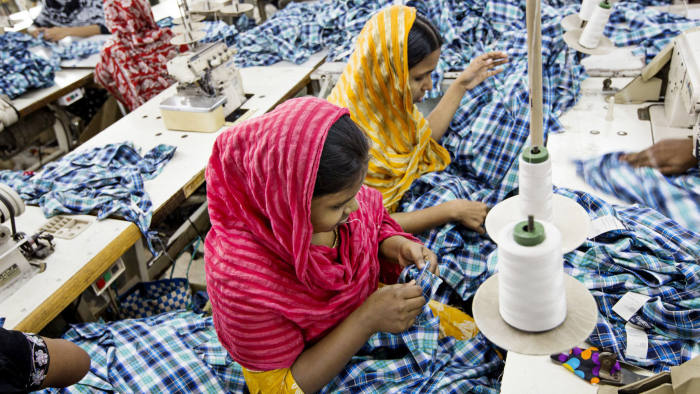

Workers sew plaid shirts on the production line of the Fashion Enterprise garment factory in Dhaka, Bangladesh, on Tuesday, April 30, 2013. Bangladesh authorities said they were accelerating rescue efforts at the factory complex that collapsed last week as hopes fade for more survivors after the nation’s biggest industrial disaster. Bangladesh’s labor law requires safety measures such as fire extinguishers and easily accessible exits at factories. Jeff Holt/Bloomberg
Bangladesh has seized market share in textiles © Bloomberg

Exports from developing Asian countries to the US rose by 10 per cent over the previous year in the first half of 2019, even as exports from China fell by 12 per cent. Exports from Vietnam to the US jumped by 33 per cent and from Bangladesh by 13 per cent.

The report shows how the huge trade diversion effects caused by the US-China tariff war are creating winners and losers as they reshape global supply chains, with Bangladesh seizing market share in textiles and Vietnam in electronics.

“Chinese products are encountering tariff measures so exports and production are slowing down.

Naturally, suppliers connected to these Chinese exports are also slowing down,” said Yasuyuki Sawada, chief economist at the ADB, which lends to developing countries in the region.“But at the same time we see this rather positive channel through trade redirection,” he said, at the launch of an update to the bank’s flagship Asian Development Outlook.The more serious trade tensions get, the bigger the trade redirection effect will become.

In a worst-case scenario, with 30 per cent tariffs on all US-China trade plus an extension of the trade war to automobiles, the ADB expects a drag on overall growth in developing Asia of 0.7 per cent over the next few years. Within that, however, Vietnam’s economy would grow by an additional 2.3 per cent, with Malaysia, Thailand, Bangladesh and the Philippines all coming out as winners too.

 The analysis does not include the impact of uncertainty over trade hurting investment, which could lead to a worse outcome in reality, Mr Sawada noted.For the region as a whole, the ADB trimmed its growth outlook for 2019 from 5.7 per cent to 5.4 per cent, reflecting the global slowdown, trade tensions and a “sharp contraction” in the global electronics cycle — especially for semiconductors.


The ADB cut its growth forecast for Hong Kong from 2.5 per cent to 0.3 per cent, reflecting the slowdown in global trade as well as political turmoil, and lowered its growth forecast for semiconductor-dependent South Korea from 2.5 per cent to 2.1 per cent.

On the other hand, it raised its growth forecast for Bangladesh from 8 per cent to 8.1 per cent, predicting it will be the fastest-growing economy in the region this year and next.

Mr Sawada said that risks to the region included the US-China trade conflict, the deepening growth malaise in advanced economies as well as a build-up of private debt in some emerging Asian economies. “The corporate sector in China and the household sector in Korea, Thailand and Malaysia have had a rising debt-GDP ratio. I think this is another risk,” he said.

Monday, April 14, 2014

...the best manufacturing relocation site

Foreign firms seen relocating to Phl


MANILA, Philippines - Several foreign manufacturing companies operating in China and in Southeast Asian countries are eyeing to relocate to the Philippines citing the available high-quality labor here, the Foreign Buyers Association of the Philippines (FOBAP) said.

In a statement from the Philippine Exporters Confederation Inc., FOBAP president Robert Young said two French investors are coming to Manila by the end of the month, while a number of Canadian, Chinese and American companies are visiting the country in mid-May to scout for investment opportunities.

Young said these are mid-sized manufacturers of garments, apparel, shoes, toys and housewares looking to invest around $500 million and employ 1,000 to 3,000 workers.

“These people are financially capable, they are ready, they mean business, they are serious... We are lucky if we get at least 10 initially from all parts of China and other ASEAN (Association of Southeast Asian Nations) countries,” he said.

Companies are moving out of China amid increasing labor unrest resulting in reduced labor pool, as well as higher capital costs.

The group is looking forward to the country becoming a beneficiary of the European Union’s Generalized Scheme of Preferences Plus (EU GSP+) citing that such will make the country an attractive and cheaper source of goods.

The Department of Trade and Industry submitted the Philippines’ application to the EU GSP+, a scheme which will allow more goods to enter the bloc at zero duty, in December.

The EU GSP+ covers 6,274 products which can enter the EU at zero duty.

At present, the Philippines is a beneficiary of the regular GSP, which covers 6,209 products, with 2,442 products subject to zero duty and the rest slapped with lower tariffs.

“Philippine goods will be duty free entry to EU. Also, (with) the forthcoming incentivized/subsidized labor, this makes investments in the Philippines attractive,” Young said.

By having new investments here, Young said FOBAP members which source products for foreign buyers, will have more factories and suppliers to choose from.

“Right now, we are running out of suppliers because in the past five years, they closed shops one by one. If they will come back, our own business will also flourish together with the Philippine economy,” he added.
 

Tuesday, October 1, 2013

...the PH Q3 growth

Q3 GDP growth seen at over 7%

By Michelle V. Remo
Philippine Daily Inquirer
 
 
The Philippines, which together with China registered the fastest growth in Asia in the first semester, is likely to have posted a growth rate of beyond 7 percent in the third quarter.

This was according to Arsenio Balisacan, director general of the National Economic and Development Authority, who said the combination of rising investments and strong household consumption helped maintain robust economic growth.

Balisacan said weaker-than-expected export revenues would drag growth, but the impact was likely outweighed by local investment and consumption spending.

The clash between government forces and members of the Moro National Liberation Front (MNLF) in Zamboanga City also had an adverse economic effect, but Balisacan said the impact on growth would be minimal.

The Philippines last year became one of the fastest growing economies in Asia when its economy expanded by 6.8 percent year on year.

It then became the fastest growing economy in Asia, together with China, when it grew by 7.7 percent and 7.5 percent in the first and second quarters of this year, respectively.

The Philippine government’s official growth target for this year was set at a range of 6 to 7 percent.
With the domestic economy’s performance in the first half, economic officials said there was a good chance the target would be surpassed.

The government, however, acknowledged that the fast growth was yet to be felt by the majority of Filipinos.

Poverty incidence in the country, at 27.9 percent as of the first semester of 2012, was one of the highest in Asia and not a significant improvement from 28.6 percent in 2009.


Monday, August 26, 2013

...the PH brands go global

Filipino pride: Local franchises go global


Philippine Daily Inquirer
 
 
Filipino brands continue to create waves in the international franchise arena, proving that the local franchise industry is fast becoming one of the country’s biggest dollar earners.

“With at least $11 billion in earnings, Philippine franchising is no less a major export player. Some of our members have successfully established their brands overseas, paving the way for more players to try and conquer new markets,” says Armando Bartolome, president of the Association of Filipino Franchisers Inc. (AFFI).

Throughout the years AFFI, the country’s leading franchise group, has helped franchise brands expand to Asia, the United States, as well as in less familiar territories overseas.

AFFI is showcasing these local franchise brands that have gone global in a three-day event dubbed “Galing ng Pinoy, the 12th Filipino Franchise Show” slated on Oct. 4-6 at the World Trade Center, Pasay City.

Going global

With at least 25 outlets scattered around America, 28 in Jakarta, Indonesia, and one in Panama, Potato Corner is certainly one of the most inspiring franchise success stories. Operating for 20 years now, the company through its CEO Jose Magsaysay Jr., recently announced that they are considering listing at the Philippine Stock Exchange (PSE).

Crystal Clear Water dubbed “the business that never runs dry” has invaded Indonesia, Malaysia and South Africa. Locally, the company has at least 500 branches nationwide.

Fiorgelato, a famous ice cream franchise, is now in Japan and the US, while Sweet Corner’s (corn) cart business now operates in Australia and is soon to open in the Middle East.

Food franchisors are not the only success stories abroad. Lay Bare Waxing has three branches in the US; Eat Bulaga, the country’s most popular afternoon program has been franchised in Indonesia.

“Operating a franchise overseas comes with a unique set of challenges. These include not only different laws, languages, and cultural differences in how business is conducted but also finding a franchisee to partner with,” says Bartolome.

The franchisor’s local partner should help translate the concept and the brand into a commodity that is both acceptable and profitable thus one has to make adjustments, he adds.

Despite risks, however, the venture is definitely most rewarding. “With an international franchise, you are bringing a Pinoy brand into the international spotlight. You become a source of pride for the country. What can be more inspiring?” the AFFI chief says.


Saturday, June 8, 2013

...the resilient countries

Indonesia, Philippines, Malaysia showing resilient growth – SCB


Manila Bulletin
Published: June 8, 2013


ASEAN countries – particularly Indonesia, the Philippines and Malaysia – have continued to grow close to or above trend growth in recent years, despite poor external conditions, a new research conducted by Standard Chartered Bank disclosed. “The growing affluence of the domestic population, relatively healthy fiscal positions, a largely stable political environment and strong liquidity inflows are lending resilience to economic activity, even as external demand falters, “ the British bank with extensive network in the region stressed.

Examining sources of growth over the past decade, we find that the contribution of household consumption increased for Malaysia, Thailand and Vietnam in the 2008-12 period relative to the 2003-07 period.

For Indonesia and the Philippines, the contribution of household consumption was relatively stable; this is not surprising given their relatively closed economies. For Singapore, household consumption remains a small contributor to growth. In fact, Singapore’s economy has become even more open, supporting the case for the continued use of FX as the main monetary policy tool, the SCB paper noted..

“Investment has discernibly increased its contribution to growth in Malaysia and the Philippines. This reflects government efforts to upgrade their economies and positive domestic investor sentiment. With the exception of Singapore, domestic sources have been the key drivers of growth in the region.”

Since 2000, the ASEAN region has been outgrowing the world, the bank said.

“Admittedly, the region has plenty of catching up to do, as it is still relatively undeveloped. With the exceptions of Malaysia, Brunei and Singapore, ASEAN’s per-capita GDP based on purchasing power parity (PPP) is well below that of the world. The region is catching up – ASEAN per-capita GDP has grown faster than global GDP since 2000.”

“This growing affluence is a source of resilience for the region. Intra-regional trade has benefited externally oriented industries, even amid weaker demand from traditional markets such as Europe and China.”

In 2012, ASEAN exports grew just 1.7% amid a weak global trade environment. Exports to countries within ASEAN contributed around 70% of that growth. Had ASEAN been in a weaker position, externally oriented industries would have been hit even harder.

The import profile of ASEAN countries by end-use classification provides some interesting insights (the bank examined the Philippines, Indonesia, Thailand and Malaysia). Comparing the amount of consumer-goods imports with total imports (the sum of consumer goods, intermediate goods and capital goods), we find that the Philippines has the highest proportion of consumer-goods imports. It is followed by Indonesia, Malaysia and Thailand. This is in line with the fact that Indonesia and the Philippines are more closed economies than Thailand and Malaysia. Because domestic consumption contributes a larger share of growth, consumer goods make up a larger share of import content. This is particularly the case for the Philippines.

Thailand and Malaysia are more export-oriented economies. As a result, intermediate goods (inputs for final goods) account for a larger share of their total imports. Meanwhile, imports of capital goods (such as machinery for production) have been increasing for Malaysia and Thailand in the past 1.5 years. We believe this was driven by flood reconstruction efforts in Thailand, and by the ongoing Economic Transformation Program in Malaysia.


Friday, April 5, 2013

...the creditworthy country

The Philippines

In ratings heaven

The archipelago has never been more creditworthy

The Economist
 

MANY emerging economies rely on foreign creditors to bridge the gap between their exports and imports. The Philippines is a bit different. It relies on overseas employers. Over 10m Filipinos, equivalent to about a quarter of the country’s labour force, live or work abroad, permanently or temporarily, legally or illegally, in over 200 countries. Their remittances are equivalent to 8.5% of GDP, helping the country to plug its trade deficit and amass over $80 billion of currency reserves. As a result, the Philippines has become a net creditor to the rest of the world (see chart), not just a net supplier of labour.

These impregnable external finances are one reason why Fitch, a ratings agency, awarded the Philippines its first ever investment-grade credit rating on March 28th. The upgrade was long awaited and warmly greeted. The governor of the central bank was at first quoted as saying that it represented “the seal of God”, which might be the nicest thing anyone has ever said about a ratings agency. His actual words were more mundane: he said it was “the seal of good…good housekeeping”.
Both this government and its predecessor have worked hard to put the country’s fiscal house in order, reducing its debt from 68% of GDP in 2003 to 41% last year, while refinancing it more cheaply, lengthening its maturity (to over ten years on average) and increasing the proportion denominated in pesos, for which the world shows strong appetite.

Now the government is going beyond housekeeping to much needed repairs. The public finances rest on narrow foundations: the government collected less than 13% of GDP in taxes last year, a paltry ratio that helps explain why public investment amounted to less than 3% of the economy. To raise revenues, it last year passed a “sin tax” on tobacco and alcohol, which survived the Senate by a single vote and came into effect on January 1st. In a country with powerful brewers and tobacco farmers, the tax took “political courage”, says Andrew Colquhoun of Fitch.

 Compare world debt levels over time with our updated interactive debt guide

In principle, the upgrade should widen the pool of investors willing to buy the government’s debt and lower its cost of borrowing. Graduation to investment grade reduces the “spread” between a country’s borrowing costs and American Treasury yields by over a third, according to Laura Jaramillo and Catalina Michelle Tejada of the IMF.

But the Philippines does not suffer from a lack of foreign-investor interest. Indeed the central bank has been fretting about excessive capital inflows, which might push up the peso or lead to inflation or asset bubbles. Perhaps the upgrade, and the progress it reflects, will persuade some overseas workers to return to the Philippines. That would be the most convincing seal of approval for the economy.


Thursday, February 14, 2013

...the PH export growth 2012

Phl export growth in 2012 highest among East, SE Asian countries


By Jenny Red
Philippine Information Agency
Thursday 14th of February 2013


QUEZON CITY, Feb 14 (PIA) -- Filipinos have a lot to be proud of, one of which is that the country is out of the economic mire.

According to the National Economic and Development Authority (NEDA), the posted annual growth in merchandise exports of the Philippines in December 2012 was the highest among its trade-oriented neighbors in East and Southeast Asia.

“The country’s export performance in December 2012 reflects the generally improved prospects in the global economy on the back of policy support implemented by major economies, most notably of the Euro area, the United States, and Japan,” said Socioeconomic Planning Secretary Arsenio M. Balisacan as merchandise exports jumped by 16.5 percent in the said month.

Other Asian economies that recorded positive export growth in December 2012 include Hong Kong (14.8 percent), the People’s Republic of China (14.1 percent), Viet Nam (14.1 percent), Thailand (13.5 percent), and Taiwan (9.0 percent).

Export earnings, meanwhile, grew by 7.6 percent to $52 billion in 2012 as compared to $48.3 billion in 2011. Balisacan said, however, that this is below the Development Budget Coordination Committee-approved export growth assumption of 10.0 percent for the year.

The country’s total export earnings reached $4 billion in December 2012 from $3.4 billion in the same period in 2011 as outward shipments of manufactured goods (17.8 percent), total agro-based products (19.1 percent), petroleum (137.0 percent) and forest products (29.9 percent) posted annual gains.

The strong performance of manufactured exports was attributed to higher receipts from machinery and transport equipment (138.8 percent), electronic equipment and parts (52.4 percent), wood manufactures (51.3 percent), processed food and beverages (40.4 percent), chemicals (15.1 percent), travel goods and handbags (453.7 percent), miscellaneous manufactures (25.1 percent), baby carriage and toys (48.4 percent), furniture and fixtures (17.6 percent), basket work, wicker work and other articles of plaiting materials (56.1 percent), footwear (96.8 percent), and iron and steel (4.3 percent).

Meanwhile, total agro-based exports amounted to $379.8 million in December 2012, up by 19.1 percent from $318.8 million in December 2011. Similarly, petroleum exports grew by 137.0 percent in December 2012 to $95.1 million from $40.1 million in the same period in 2011.

Accounting for 18.0 percent of total export receipts is Japan which was the top destination of Philippine exports in December 2012. The US came in second with a 12.7 percent-share followed by the Republic of China (10.5 percent), Hong Kong SAR (9.6 percent), and Singapore (8.6 percent). (NEDA/RJB/JGR-PIA NCR)

Wednesday, February 6, 2013

...the water that changes life

The Celebrity Obsession With Coconut Water Is Changing Life In The Philippines


vitacoco coconut water rihanna ad
Rihanna for VitaCoco
 
 
Philippine farmer Liezl Balmaceda has never heard of Madonna, but the US pop star's endorsement of coconut water may help change her impoverished life for the better.

After centuries of replenishing Filipinos, the mineral-rich liquid has become a must-have health drink thanks to aggressive marketing by a beverage industry looking to offset soda sales that have lost their fizz.
 
Balmaceda, 33, and her husband process truckloads of coconuts at their backyard each week to get the meat that is turned into vegetable oil. The arduous labour earns the family of five about $9 a day, barely enough to get by.
 
"We just throw the water away when we extract the copra (coconut meat). But if you tell me people actually pay money to drink it, we could use the extra cash," she told AFP in rural Mulanay town, four hours' drive south of Manila.
 
In his most recent state of the nation address, President Benigno Aquino hailed coconut water as one of the country's most promising new export opportunities.
 
He cited industry figures showing exports jumping more than nine-fold to 16.76 million litres (4.4 million gallons) in 2011.
 
Manila-based Fruits of Life is one local business to have started profiting from the growing appreciation in the West for coconut water as an alternative to sugar-laden carbonated drinks.
 
"People have become more health-conscious in general," said Phoebe de la Cruz, sales manager for Fruits of Life.
 
"Athletic types have taken to coco water for its natural electrolytes."
 
Fruits of Life, which began exporting its own branded product in 2006, now exports about 240 tonnes in cans and tetra packs a year directly to supermarket chains in the United States and Canada.
 
The biggest players in the global beverage industry, including Coca-Cola and Pepsi, have also jumped into the coconut water health drink craze in recent years.
 
ZICO, a US coco water brand majority owned by Coca-Cola, has supermodel Gisele Bundchen and basketball star Kevin Garnett as its endorsers.
 
Meanwhile, pop stars such as Madonna and Rihanna, as well as baseball player Alex Rodriguez, are among celebrity shareholders in Vita Coco, one of the other major brands.
 
Its 0.33-litre (11-ounce), $3 drink is touted as a healthier alternative to energy drinks for athletes and the company boasts an office in New York's Flatiron District.
 
The Philippines is already the world's biggest exporter of coconut products.
 
Big Philippine mills have for years processed desiccated coconut meat and turned it into powder for baking biscuits, snack bars, cakes and pastries.
 
Coconut flesh is also turned into vegetable oil used for cooking and in a range of common household products, including bath soap.
 
Supply is not a problem in the Philippines with 350 million coconut trees growing from the beaches up to its hills and yielding 15 billion fruits a year, according to industry regulator the Philippine Coconut Authority.
 
In the Philippines, coconut water remains a popular, cheap drink, with stalls selling it straight from the fruit—a common site throughout the big cities as well as the countryside.
 
However, because of a lack of demand as well as the costs required to process and preserve it, the water had never been profitable enough to sell overseas, Philippine Coconut Authority chief Euclides Forbes told AFP.
 
"From mere waste it's being turned into gold," Forbes said.
 
Nevertheless, Agriculture Secretary Proceso Alcala said that while coconut water holds the potential of improving the lot of impoverished Filipino coconut farmers, logistical issues held the industry back.
 
"The demand is huge. The only problem is how to bring the liquid to the processing centres before it spoils, since most coconut farms are in hilly areas without good roads," Alcala said.
 
Meanwhile, some farmers remain sceptical that they will cash in on the Western craze, citing the fact they have remained poor for decades while big business has profited from other coconut exports.
Among them is Rodolfo Aquino, 68, who is paid by traders to haul coconuts by ox-drawn cart about two hours' drive from Manila.
 
"Whether they want the meat and water or just the meat, we get paid the same," Aquino told AFP.


Wednesday, January 30, 2013

...the Philippines rebranded

“Philippines is worth the price of admission”

President Benigno Aquino III has pitched to the international investor community the Philippine story of transformation from being a “sick man of Asia” into one dynamic country bucking a global economic downturn.
 
“What we offer you today is a Philippines where change has set in. That, perhaps, is the single most compelling reason to come in and invest in our country,” Aquino said in a roundtable meeting with global business executives at the World Economic Forum recently..
 
The President invited investors to participate in three rapidly growing sectors in the country-agriculture, tourism and infrastructure.
 
“Those who have already bet on the Philippines have not been disappointed; they have seen the sincerity of our commitment to restoring integrity and leveling the playing field.
 
“This is a commitment we intend to keep with all who want to conduct honest, fair business in the Philippines,” he said in the business forum organised by Credit Suisse.
 
Aquino told prospective investors he couldn’t promise a completely risk-free environment, noting that any worthwhile endeavour was not without its risks.
 
Nevertheless, he said the “sick man of Asia is now revitalized, more dynamic than it ever was in its history, marching toward equitable progress.”
 
Contrasting his administration from that of his predecessor’s, when he said decisions were based on political factors-mainly, on the desire to stay in power-he said the government was now earnestly refocusing efforts toward leveling the playing field, minimizing regulatory risks and investing in people.
 
He said the government was empowering the Filipino through health, education and conditional cash transfer programs that would aid their transition from being below subsistence living toward gainful employment.
 
“We already know that, given the right environment, the Filipino is able to thrive; how many of you have ridden cruise ships or stayed in hotels manned by Filipinos? How many have been awed by the creativity, loyalty and professionalism of our workers in the business process outsourcing industry?”
“In a world increasingly dominated by uncertainty and pessimism, is it not refreshing to witness a country full of optimism, experiencing positive, meaningful change and inviting everyone in to ride its momentum?”
 
The President again referred to his administration’s thrust of eliminating corruption as a means to drastically reduce poverty and open opportunities for both the Filipino people and business, thereby allowing the Philippines to achieve inclusive growth.
 
On efforts to level the playing field, the President said that when contracts are no longer awarded arbitrarily, and when the rule of law applies to all, a sense of justice and fairness naturally takes over.
“Among investors, in particular, this instills confidence: That the Philippines is worth the price of admission,” he said.
 
In the first three quarters of 2012, the domestic economy has grown by an average of 6.5 per cent, much faster than the 4.9-per cent trend growth during the nine-year Macapagal-Arroyo administration. The stock market has trebled in the last four years to record highs.
 
“These are truly exciting times for our country. We are realizing the long-untapped potential of our country and we are here to invite you to join us,” he said.
 
On the priority areas for investment, Aquino said tourism and agriculture were crucial because they play into the key strengths of our country-an abundance of natural resources-and because they tend to spur growth all over the archipelago, not merely in urbanized areas.
 
Since he came into office, he said the government had been working towards rice self-sufficiency by going back to the basics and helping our farmers through improved irrigation systems and a genuine certified seeds programme.
 
“As we focus on the basic needs of our farmers, we have not lost sight of the value of innovation, and of moving up the value chain,” Aquino said.
 
“For example, coco coir and coco water used to be considered as waste. Today, they are the reasons behind the revitalization of our coconut industry,” he said.
 
In 2009, Aquino said the Philippines exported a total of 483,862 liters of cocowater.
 
By 2011, this has increased exponentially to more than 16.7 million liters of cocowater.
 
“Coco coir fiber, transformed into geotextile materials, has among others, been found effective in erosion control,” he said.
 
The Department of Publics Works and Highways (DPWH) is already using this technology in their projects, and investments into the coco coir industry reached P293.75 million pesos(C$8.85 million) in 2012.
 
On tourism, the President mentioned the Department of Tourism’s “It’s More Fun in the Philippines” campaign and noted favourable tourism reviews from publications like Conde Nast Traveller, the New York Times, and Travel + Leisure Magazine.
 
In 2012, he said there were 4.3 million tourists that visited the country, a little short of the 4.6 million target which he said was a consequence of some political tension in the region, referring to the territorial dispute between the Philippines and China.
 
“In spite of this, though, China’s Oriental Morning Post named my country the ‘Best Tourist Destination’ in its annual World Travel - Special Trips awards, and the Shanghai Morning Post identified the Philippines as the “Most Romantic Destination” in the world-an award surely inspired by the magnificent sunsets over our numerous white sand beaches, or the pristine, secluded coves dotting our many islands,” he said.
 
The hotels that have been sprouting up around the Philippines in the past two years are proof positive of the tourism boom, Aquino said, noting that an additional 1,599 rooms have been built in Boracay. “So, whether you want to come to the Philippines for business or for leisure, we will gladly accommodate you,” he said.
 
Infrastructure is also seen as a prority in attracting investments. The President acknowledged that this was the key to further growth and development in tourism and agriculture, among other sectors.
“For example, a lack of paved roads or even adequate transportation hubs redounds to longer traveling time: imagine how much the quality of produce will suffer in two to three days of road travel, or even the difficulty that tourists will have in reaching the more far-flung parts of my country,” he said.
 
Aquino cited the World Economic Forum’s Global Competitiveness Report which showed that the Philippines was lagging behind Southeast Asian neighbours in terms of quality infrastructure, including the quality of roads. “This presents an opportunity, because we are committed to closing this gap and increasing our competitiveness,” he said.
 
Last year, Aquino said disbursements for infrastructure reached US$4.9 billion and another US$5.7 billion is allotted for this in 2013.
 
“Part of this allotment will go to the complete paving of our national road network by 2016. Since 2010, our DPWH has already completed 28 per cent, or 2,006 kilometers, of the 7,256 kilometers of national arterial and secondary roads that needed paving,” he said.
 
The President added that the country was seeking to boost connectivity all around our country through the following: train systems in Metro Manila; expressways that cut across the National Capital Region and reduce travel time drastically; the construction improvement of both domestic and international airports, as well as the exploration of a new nautical highway that could cut travel time between Luzon to Mindanao, from three days to 15 hours.
 
“We are exploring opportunities for the private sector to join us in these endeavours, and we hope that you will consider partnering with us in the future, towards our mutual benefit,” Aquino said.

Thursday, January 24, 2013

...the PH Market in Focus

Top Ranked Philippines ETF in Focus: EPHE - ETF News And Commentary


By Zacks.com
NASDAQ
January 23, 2013


The Philippines is one nation which has been able to outperform other emerging markets in the recent past. This strength has been attributed to a solid consumer market and booming exports thanks to a weak currency.
 
This combination comes at a great time, as most of the developed economies are in the doldrums, leaving many emerging markets to fend for themselves ( Buy These Emerging Asia ETFs to Beat China, India ).
 
This has been no problem for the Philippines as the country has shown incredible resilience to the global turmoil, posting a solid GDP growth rate. In the third quarter, the region delivered a robust growth rate of 7.1%. This is much better than the GDP growth of 6% posted in the second quarter.
 
Meanwhile, in an effort to cut interest expenses and shore up its financial position, the Philippines government recently announced the repurchase of $1.46 billion in dollar and euro denominated bonds.
 
The initiative by the government can be viewed as an effort to improve the investment grade credit rating and further show that the country is an economic power in the region ( Philippines ETF: A Rising Star in Emerging Market Investing ).
 
Rating agencies have taken note as well, as in early 2012 S&P bumped the country's long-term foreign currency-denominated debt to BB+ from BB, the highest rating since 2003. This does not end here with Moody's lifting its outlook on the economy to positive.
 
Clearly, the trends are continuing to be positive for the country, suggesting that some might want to consider the area for investment. One way to do this in basket form is via the MSCI Philippines Investable Market Index Fund (EPHE) which currently has a Zacks ETF Rank of 1 or 'Strong Buy'.
 
We expect it to outperform its peers over the next year and continue to be a solid pick for emerging market ETF investors. Given this, the product could be worth a closer look by investors seeking exposure to this economy.
 
About the Zacks ETF Rank
 
The Zacks ETF Rank provides a recommendation for the ETF in the context of our outlook for the underlying industry, sector, style box, or asset class. Our proprietary methodology also takes into account the risk preferences of investors. ETFs are ranked on a scale of 1 (Strong Buy) to 5 (Strong Sell) while they also receive one of three risk ratings, namely Low, Medium, or High.
 
The aim of our models is to select the best ETFs within each risk category. We assign each ETF one of five ranks within each risk bucket. Thus, the Zacks Rank reflects the expected return of an ETF relative to other products with a similar level of risk.
 
For investors seeking to apply this methodology to their portfolio in the Philippines market, we have taken a closer look at the top ranked EPHE below:
 
MSCI Philippines Investable Market Index Fund ( EPHE )
 
The fund tracks the MSCI Philippines Investable Market Index, which looks to offer investors a broad exposure to equities listed in the Philippines ( Do Corrupt Countries Make for Great ETFs? ). The fund trades with an asset base of $221.4 million and volume of more than 0.4 million shares a day.
 
The performance of the ETF has been quite remarkable. This ETF has added about 30.8% so far and it has gained roughly 39% over the last 52 weeks. Meanwhile, the yield of the fund stands at 0.96% while costs come in at 59 basis points a year ( Emerging Markets Dividend ETFs for Income, Growth & Diversification ).
 
Currently, the product has just over 42 securities in its basket. Maximum sector exposure is to Financials (41.6%), Industrials (25.0%), and Utilities (10.3%).
 
investors should note that the fund is concentrated in the top 10 holdings with more than 55% of investment. Among individual holdings, SM Investments Corp, Ayala Land and SM Prime Holdings take the top three positions with 10.4%, 8% and 6.3%, respectively, of EPHE's assets.
 
Clearly, despite the heavy financial exposure, the product has not been hampered by the European crisis, suggesting it could be an interesting choice for those looking for an ETF that is not heavily correlated to the euro zone, which still has the chance to be a strong performer.

Friday, January 11, 2013

...the best export performer in Asia

Neda: PH export performance best in Asia


But rebound in shipments said to be uncertain

By Riza T. Olchondra
Philippine Daily Inquirer


Shipping containers of Philippine products for export sit stacked along the docks of the international container port in Manila on Sept. 11, 2012. Philippine merchandise exports topped those of other Asian countries in the first 11 months of 2012, the National Economic and Development Authority said Thursday, Jan. 10, 2013. AFP PHOTO/JAY DIRECTO


Philippine merchandise exports topped those of other Asian countries in the first 11 months of 2012, the National Economic and Development Authority (Neda) said Thursday.

But private economists believe a strong rebound in outbound shipments may still be a long way off.

Merchandise exports earnings in November grew 5.5 percent to $3.551 billion, from the $3.366 billion seen the previous year. This brought year-to-date exports to $48.026 billion—7 percent up from the $44.898 billion recorded in the same period of 2011, the National Statistics Office said.

The growth was due to higher value in shipments of such commodities as metal components, woodcraft and furniture, electronic products, cathodes, refined copper and ignition wiring sets, and other parts used in manufacturing vehicles, aircraft and ships.

On a monthly basis, exports contracted by 19.4 percent from the $4.408 billion posted in October 2012.

“I expect similar (growth) trends in December, but I think a complete rebound isn’t forthcoming because the [economies of] US and Europe have not recovered,” Cid L. Terosa of the University of Asia and the Pacific said via text message.

For Benjamin E. Diokno of the UP School of Economics, the growth in November exports was “lackluster.”

Diokno said the outlook for Philippine exports continues to be “gloomy” due to three factors: a world economy that remains weak, an appreciating peso, and heavy reliance on electronic products.

“Exports of electronic products contracted by 5.19 year-to-date. This problem could be both transitory and structural. A strong recovery in December is unlikely,” Diokno said via e-mail.

Electronics accounted for 48.8 percent of total exports revenue last November, earning $1.734 billion—13.3 percent up from the $1.523 billion reported a year ago. Semiconductors was the top earner in the electronics sector with $1.402 billion in receipts—a 15.5-percent growth from the $1.213 billion seen in November 2011. But on a monthly basis, electronic products, as well as semiconductors, dropped 8.8 percent and 10.4 percent, respectively.

The next-best performers were woodcraft and furniture ($271.32 million, 56 percent up from $173.9 million), apparel and clothing accessories ($113.7 million, 13.1 percent down from $130.76 million), and electrical wiring harness for motor vehicles ($109.7 million, 6.2 percent up from $103.31 million).

Metal components excluding brakes grew the fastest among the country’s top exports with shipments worth $129.05 million—163.5 percent up from $48.97 million.

Receipts from the top 10 exports reached $2.557 billion, accounting for 72 percent of the total.

Japan was the top destination of Philippine exports accounting for 20.8-percent share of the total with receipts worth $740.21 million.

The United States followed with $458.37 million in receipts, while Hong Kong received shipments worth $373.81 million.

Tuesday, January 8, 2013

...the PH 2012 forex reserve

Forex reserves end 2012 at all-time high of $84.25B


By Michelle V. Remo
Philippine Daily Inquirer
 

The country’s foreign exchange reserves hit an all-time high of $84.25 billion at the close of 2012, buoyed by the central bank’s dollar purchases that were meant to temper what could have been a sharp appreciation of the peso. MARK WILSON/GETTY IMAGES/AFP


The country’s foreign exchange reserves hit an all-time high of $84.25 billion at the close of 2012, buoyed by the central bank’s dollar purchases that were meant to temper what could have been a sharp appreciation of the peso.

The yearend gross international reserves (GIR) were enough to cover a year of the country’s import requirements and were nearly six times the combined foreign currency-denominated debts of the government and private entities maturing within a year.

The latest amount of GIR was up by about 12 percent from $75.30 billion the previous year.

The BSP admitted that it had been buying dollars from the market to prevent a steep rise in the value of the peso against the greenback.

Officials said that under its policy, the BSP allowed the exchange rate to be generally determined by the market, but intervened through currency trading in cases of significant volatility pressures. They said the sharp and sudden rise or fall of the peso was disruptive to businesses and to the economy.

The peso closed at 41.05 against the dollar at the last trading day of 2012, gaining nearly 7 percent since the start of the year. The peso was the second-fastest appreciating Asian currency against the dollar last year after the Korean won, which rose 7.17 percent.

Exporters said the rise of the peso has made Philippine-made goods more expensive in dollar terms and less competitive. The appreciation of the local currency has also reduced the peso value of the dollar remittances sent by overseas Filipinos.

The BSP has sufficient dollars to buy from the market given the robust inflow of remittances, foreign investments in the local business process outsourcing (BPO) sector and external portfolio investments.

Officials said foreign portfolio investments were substantial in 2012 because the favorable performance of the Philippine economy fueled the appetite for peso-denominated securities.

The heavy dollar purchases by the BSP pushed its expenditures and led to a net loss of about P68 billion in the first three quarters of 2012, its latest income statement showed.

Nonetheless, the BSP said it would not hesitate to continue buying dollars if appreciation pressures on the peso remained significant this year.

The BSP said the accumulation of dollars has its benefits to the economy. The increase in the GIR reflected the improving capacity of the Philippines to pay its dollar-denominated debts. This, in turn, has led to improved credit ratings for the country.

Tuesday, November 13, 2012

...the East Asia's top exporter

NEDA: PH exporters top regional performers


Outbound shipments up 22.8% in September

By Riza T. Olchondra
Philippine Daily Inquirer


Philippine exports grew by 22.8 percent year-on year-in September to nearly $4.8 billion, the National Statistics Office Tuesday reported.

On a monthly basis, exports expanded by about 26 percent from the estimated $3.8 billion posted last August.

The National Economic and Development Authority (Neda) and the Department of Trade and Industry (DTI) both noted how, amid the sluggishness of the global economy, Philippine exporters emerged as the strongest performers during the period among those in Southeast Asia.

The Philippines emerged on top of countries in the region that posted positive exports growth in September. These include Hong Kong, with exports up 15.8 percent; Vietnam with 15.6 percent; Taiwan with 10.4 percent; China with 9.9 percent; and Thailand with 0.2 percent.

On the other, Japan’s exports went down by 11.8 percent; Indonesia by 9.4 percent; Singapore by 4.8 percent; and South Korea by 2 percent.

“The strong export performance mainly reflected the moderate improvement in global economic activity as industrial production and business confidence indicators showed signs of recovery,” said Neda deputy director-general for planning and policy Emmanuel F. Esguerra.

The Philippines is only one of four East Asian economies that posted positive growth in the first nine months of 2012. The others were Vietnam, China and Hong Kong.

The total volume of outbound shipments in September increased by 47.3 percent year-on-year. It was also up by 152.6 percent from that of the previous month.

Likewise, cumulative merchandise exports in the first nine months of 2012 grew by 7.2 percent to $40.067 billion, from the $37.376 billion posted in the same period last year.

The increase in the value of shipments of commodities —such as tuna, metal components, fresh bananas, woodcrafts and furniture, ignition wiring set and other wiring sets used in vehicles, aircrafts and ships, petroleum products, coconut oil and electronic products—largely accounted for the growth, according to government data.

But electronic exports grew by only 1.1 percent in September, after experiencing five consecutive months of contractions.

Japan was again the top destination of exports from Manila, accounting for 30.8 percent of total export receipts. The United States followed, with a share of 12.6 percent; China, with 11.1 percent; Hong Kong SAR, with 7.5 percent; and Singapore with 7.1 percent.

“Improved overall demand for the country’s manufactured exports was mainly due to the generally favorable developments in global industrial production, with new orders further showing signs of expansion following persistent declines,” Esguerra said.

He explained that the nearly flat performance of electronics shipments was brought about by weak sales of processing units due to consumers’ growing preference for lower-end desktop PCs and notebooks over higher performance models due to the state of the global economy.

Still, Senen M. Perlada of DTI’s Bureau of Export Trade Promotion expressed optimism that Filipino exporters would attain their targets “to double total exports to $100 billion by 2016.”

Wednesday, October 24, 2012

...the potential aerospace hub

PHL a potential aerospace manufacturing hub — AIAP


GMA News
October 24, 2012
 
 
The Philippines has the potential to be a center for manufacturing for the trillion-dollar global aerospace and aviation industry, an official of the Aerospace Industries Association of the Philippines said Wednesday.

According to AIAP board of trustees member John Lee, the next two decades could see the country becoming a manufacturing hub of aerospace and aviation parts and components in the ASEAN region, generating jobs and providing "meaningful career developments" in the country.

"The nature of manufacturing involved in aerospace products will entail highly skilled manpower that surely will facelift the capabilities of local labor to advanced stages of competence in varying degrees," he said.

Lee said the local aerospace industry is “a net export industry," with 99 percent of industrial output manufactured for export.

"[Aerospace] is a global extensive industry entailing over [$1 trillion in] business that will transform [into] highly beneficial gains for the country," he said.

Lee said that the manufacturing industry for aerospace is fast gaining momentum, bringing with it related industries in the supply chain as well as other backward and forward linkages of industries.

The aerospace industry projects a double-phased growth over the next five years, especially with the recent formation of the AIAP.

The association will focus on the build-up of the aerospace supply chain; the promotion of productive partnerships between buyers and suppliers; the enhancement of the business environment through the government’s policy reforms and the formulation of strong government support structures; and the improvement of the technical base capability through manpower education and training, and technology systems upgrading. — BM, GMA News

Wednesday, September 26, 2012

...the growth projection 2012 (S&P)

S&P raises growth forecast for Philippines

Projections for China, Japan, other countries slashed


By Michelle V. Remo
Philippine Daily Inquirer


An overview of cranes loading ships with containers at the Manila South Harbor port taken in 2009. Standard & Poor’s raised its growth forecast for the Philippines for 2012, as it said the growth performance of the country was less affected by unfavorable global developments than those of other emerging Asia-Pacific economies partly because it relied less on exports to fuel economic growth. AFP PHOTO/TED ALJIBE


International credit watcher Standard & Poor’s raised its growth forecast for the Philippines for 2012, even as it downgraded its outlook for other economies in Asia and the Pacific, saying the country has the capability to withstand unfavorable developments in the global economy.

In its latest report titled “Asia Pacific Feels the Pressure of Ongoing Global Economic Uncertainty,” S&P said it now expected the Philippine economy to expand by 4.9 percent, instead of the earlier projection of 4.3 percent, this year.

On the contrary, the credit-rating firm lowered its growth projections for several economies and kept its previous forecasts for a few others in the region to take into account the impact of the prolonged debt crisis in the eurozone, the still lackluster growth of the United States and the slowdown of China and India.

S&P said the unfavorable developments in the world’s biggest economies were expected to dampen growth of many Asia-Pacific countries, except for the Philippines.

The growth forecasts have been reduced by one percentage point for Hong Kong and India, which S&P now sees growing by just 1.8 percent and 5.5 percent, respectively.

The projections have been cut by about half a percentage point for China to 7.5 percent; Japan, 2 percent; South Korea, 2.5 percent; Singapore, 2.1 percent; and Taiwan, 1.9 percent. For Australia, the growth forecast was cut to 3 percent from 3.2 percent.

“The forecasts for other Asian economies remain unchanged except for the Philippines, which went to 4.9 percent from 4.3 percent, reflecting the ongoing strength of that domestic economy,” S&P said in the report.

The outlook of S&P for the Philippines, however, was still below the government’s official target of between 5 and 6 percent.

The government’s economic officials believed that the official target would be achieved, citing the above-target growth in the first semester of 6.1 percent. This was one of the fastest growth rates in the region.

The growth performance of the country was less affected by unfavorable global developments than those of other emerging Asia-Pacific economies partly because it relied less on exports to fuel economic growth. Export earnings account for about 30 percent of the Philippines’ gross domestic product. In some neighboring countries, exports account for more than half of GDP.

The weakness of the economies of the United States and Europe and the slowdown of China and India are weighing down on the growth prospects of many emerging markets because these big economies are major export markets.

Meantime, Philippine government officials credited the boost in public spending, strong household consumption (supported by remittances) and a highly liquid banking sector for the domestic economy’s growth performance.

“S&P’s upward revision of the GDP growth forecast for the Philippines validates our view that home-grown sources of resilience can buffer the economy from the external headwind,” Governor Amando Tetangco Jr. of the Bangko Sentral ng Pilipinas told reporters.

Thursday, September 20, 2012

...the sweet spot to export

PHL in 'sweet spot' to expand exports into EU — DFA Usec


September 20, 2012
GMA News
 
 
The country's improvement in the 2012 global competitiveness ranking could facilitate the expansion of exports to the European markets, a Department of Trade and Industry official said.

"Looking at our macro-economic fundamentals and increased ranking in international competitiveness surveys, we can say that we are in a sweet spot to grow and expand [in] markets like the EU," Undersecretary Adrian Cristobal said during the Philippines–EU Trade Policy Consultations on Thursday.

The recent global competitiveness survey showed the Philippines jumped 10 notches higher from 75 last year to 65 this year.

Cristobal also said there is a need to diversify the country's exports and not rely solely on electronics.

"Electronics, our key export product to the EU, is mostly FDI [foreign direct investment]-driven. While we see growth of non-electronics exports to the EU [4 percent] and agriculture products [20 percent], we also recognize the need to diversify our exports and product offerings while attracting more investments," Cristobal said.

He said the DTI is also working on the formulation of sound industry development policies to increase the competitiveness of Philippine industries in FTA markets.

Currently, the Philippines has free trade agreements with the ASEAN, Japan, China, Korea, Australia and New Zealand.

Cristobal said the analysis and recommendations on a potential Philippine-EU FTA are vital inputs to crafting trade policies, negotiating positions and industry development.

In 2010, Philippine exports to the EU registered its highest growth at 34 percent. Among ASEAN countries, the Philippines was the sixth top exporter to the EU.

The DTI had been actively doing "Doing Business in Free Trade Areas" seminars nationwide to inform businessmen, particularly local exporters, on the benefits of the FTAs the country has entered into.

Among the issues usually tackled in the previous consultations were tariff rate quotas, need for technical assistance to enter a particular market, foregone revenues in FTAs, impact of trade agreements in employment, issues on the movement of natural persons, and the need for better information dissemination about FTAs.

"Since last year, we have held stakeholder consultations on the Japan-Philippines Economic Agreement [JPEPA] and Philippine-EU FTA in key cities and provinces nationwide," Cristobal said.

Among these cities were Cebu, Davao, Manila, General Santos, and Southern Luzon (Tagaytay).

The consultations brought together stakeholders from government, civil society groups, academe, and the private sector. — BM, GMA News

Friday, February 24, 2012

...the business outlook

Philippine firms optimistic on 1st-quarter performance


By: Michelle V. Remo
Philippine Daily Inquirer
 
 
Businesses in the Philippines were optimistic about the economy and their ability to generate profits in the first quarter, citing expectations that overall demand for their goods would increase as export markets improve and as domestic demand remained strong.
 
This was according to the Bangko Sentral ng Pilipinas, which released Thursday results of the Business Expectation Survey for the first quarter showing that the business confidence index stood at +40.5 percent.

A positive index means that the percentage of respondents who said they were optimistic exceeded the percentage of those who said they were pessimistic.

“On the basis of the results of this survey, we may expect economic growth for the first quarter of this year to be higher than those in previous quarters,” BSP Deputy Governor Diwa Guinigundo said Thursday in a briefing.

He said past data showed that there was a close correlation between business sentiment, which influenced actual investments, and economic growth.

The latest index was higher than the +38.7 percent registered for the fourth quarter of 2011, but lower than the +47.5 percent for the first quarter of last year.

Rosabel Guerrero of the BSP’s economic statistics department said in the same briefing that businesses were upbeat in the first quarter due to various favorable factors such as rising orders from foreign buyers, favorable economic fundamentals, prospects of improved credit ratings for the Philippines and commitment of the government to increase public spending, among others.

Expectations that demand for Philippine exports would improve this year were anchored partly on projections that the US economy, which is recovering very modestly from its recession since 2009, was improving as shown by rising employment and home sales.

Guinigundo also said projections that inflation would remain benign this year would help support consumer spending, which could be favorable to businesses.

The government expects the economy to grow 5 to 6 percent this year, faster than last year’s 3.7 percent

Thursday, November 24, 2011

...the social media in business

Philippine firms beat global peers in social media usage


By: Michelle V. Remo
Philippine Daily Inquirer


The Philippines, earlier cited as one of the most tech-savvy countries in Asia, has beaten the global average in terms of the proportion of businesses that use social media as a means to market their products and boost revenues.

This is according to the results of the latest survey by Grant Thornton showing that 44 percent of enterprises in the country use social media—one of which is the social networking site Facebook—to improve profitability.

This figure is slightly higher than the global average of 43 percent, although slightly lower than the average of 45 percent for the Asean region.

Punongbayan & Araullo, a member of the Grant Thornton group, said that the proportion of Philippine businesses that use social media is expected to grow over the short term given the popularity of social media sites among Filipinos.

P&A said this popularity is aided by the significant number of Filipinos working offshore and who use social media to communicate with their families in the Philippines.

“Filipino businesses in particular have more of an incentive to use social media because of the large number of overseas Filipino workers that are all over the globe.

These online tools are probably the most efficient way to cover such a diffused market— they’re borderless and a business can get a campaign going at zero to minimum cost,” Marivic Españo, P&A managing partner and chief executive officer, said in a report on the survey released yesterday.

The Philippines is the fourth-biggest exporter of labor in the world, next to China, India and Mexico. There are about 10 million Filipinos working abroad.

Businesses in the Philippines that use social media use it mainly for advertising and for communicating with their customers. Other uses are for communicating with suppliers, communication with staff and recruitment.

Wednesday, November 23, 2011

...the potential investment location

Investors now eyeing Philippines

China wage inflation drives business to Manila


By: Abigail L. Ho
Philippine Daily Inquirer

The Philippines is benefiting more and more from China’s increasing wage inflation as companies in the region turn to other countries with their investments.

According to Trade Secretary Gregory Domingo, even native Chinese companies are keen on locating in the Philippines.

“There have been movements from China to the Philippines. We have gotten increased queries from Chinese, Japanese and Korean firms,” he told reporters in a recent interview.

Domingo declined to give specific names, saying only that these potential investors were a mix of medium and large companies, some of them multinationals.

A survey conducted by Chinese media group Caixin a few months ago showed that labor costs in China continued to increase due to higher demand for labor and rising salaries.

Labor-intensive companies, such as those in the garments and textile sectors, are now feeling the pinch from this accelerated wage inflation, the Caixin survey found.

Some garments factories in China have already transferred their operations to the Philippines due to increasing labor costs in the mainland, Domingo said.

Meanwhile, the Philippine Economic Zone Authority (PEZA) is expecting to increase its investment haul for the year, and looks forward to another good year in 2012.

According to PEZA director general Lilia de Lima, the PEZA board has further increased its investment growth target for the year to more than 11 percent.

Initially set at 10 percent, PEZA has revised the target to 11 percent, due to the expected increase in investments, exports, and employment for the year, she said.

And given the success of recent investment missions, de Lima said PEZA’s investment pledges for the year could grow by more than 11 percent.

PEZA last year registered a little over P201 billion in investments, $40.47 billion in exports, and 735,672 in employment.

Sunday, November 20, 2011

...the aggie exports

PHL eyes increased exports to European agriculture center

Philippine officials in Europe are considering tapping the European Center for Fruits and Vegetables in Brussels, Belgium as an outlet for the increased export of Philippine agricultural products to the region.

Ambassador-designate to Belgium and Luxembourg Victoria Bataclan, who heads the Philippine Mission to the European Union, visited the center, one of its kind in Europe, last Oct. 13.

"In the meeting (with Center director Thierry Nuttin), she shared with Director Nuttin her vision of tapping all possible avenues to increase the trade of Philippine goods in Europe," the Department of Foreign Affairs said.

Bataclan also relayed her interest to increase Philippine exports of agricultural products as she noted the inroads made by the Philippines in technology, innovation and research.

With her in the visit to the center were Agricultural Attaché Jose Laquian and Celso Enriquez, Team Leader for the fruits and vegetable sector of the United States Agency for International Development (USAID) Growth with Equity in Mindanao (USAID-GEM) Program.

The USAID-GEM program aims to accelerate economic growth in Mindanao and to assure that as many people as possible can equally benefit from this growth.

It had sent its own representatives from the Philippines to visit the center and explore market opportunities for Philippine exotic and tropical fruits and other produce.

Established in 1981, the European Center for Fruits and Vegetables is a 13-hectare world-class integrated supply chain facility where first-grade quality fruits and vegetables from around the world are stored, showcased and traded.

It has 28 importers and exporters, and boasts of an annual sales turnover of €500 million and 950,000 metric tons. — LBG, GMA News