Showing posts with label Brunei. Show all posts

Saturday, November 30, 2019

...The Southeast Asian Game host (opening)

Philippines showcases cultural heritage to kick off 30th Sea Games

New Straits Times
30 November 2019


MANILA: The Philippines staged a spectacular opening ceremony for the 30th SEA Games at the world’s biggest indoor arena, the Philippine Arena, in Bulacan, near here, tonight.


In a departure from tradition, the opening ceremony was held in an indoor arena rather than a stadium.

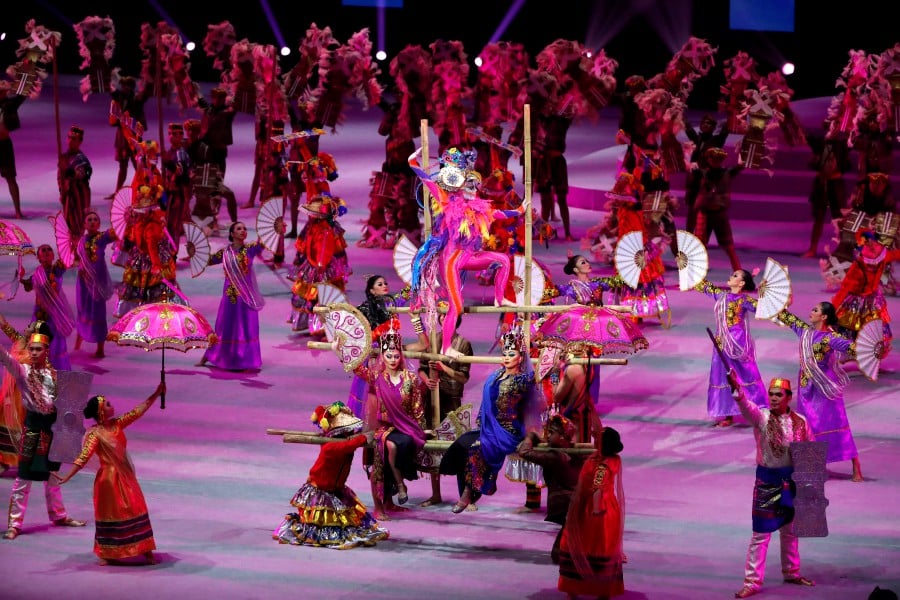
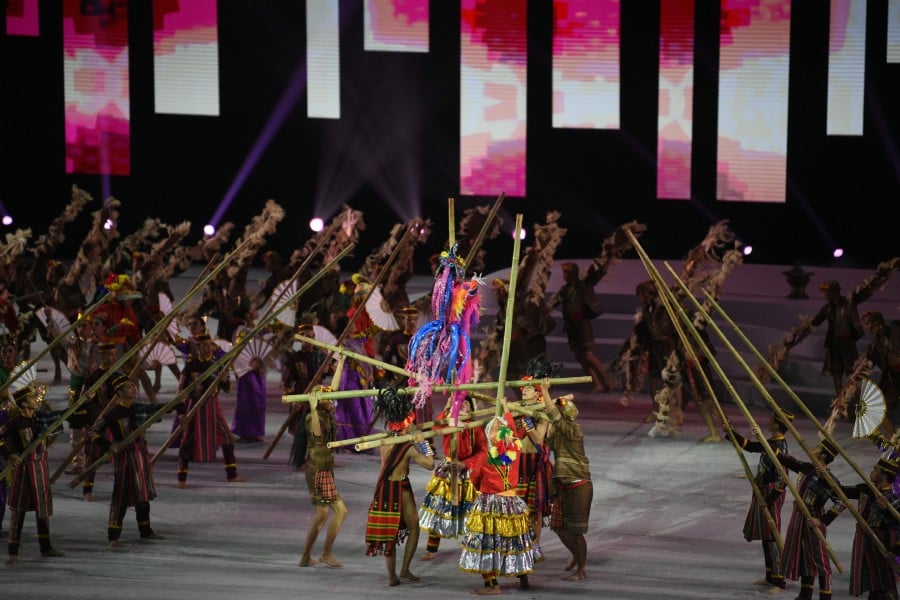
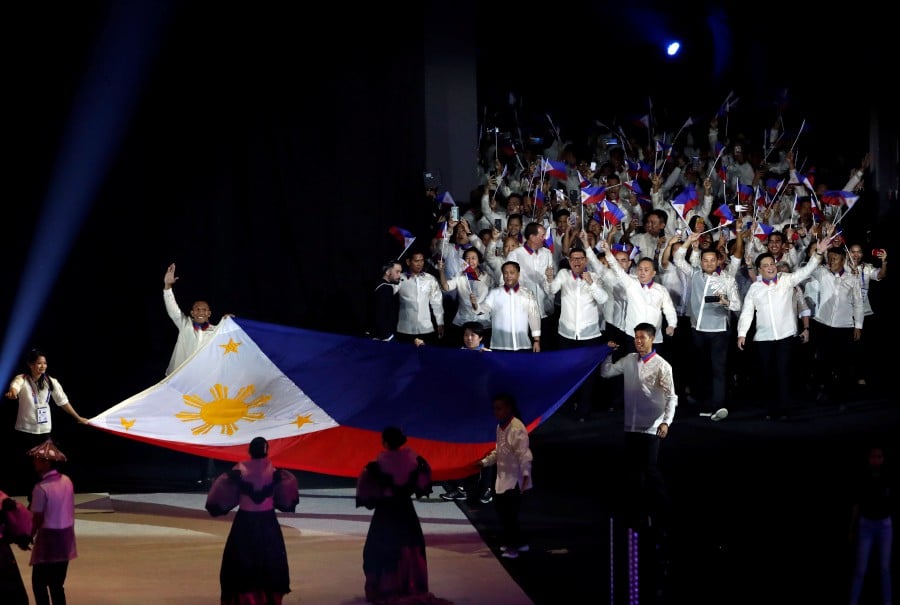
Also, for the first time in the biennial Games’ 60-year history, the games cauldron was placed at a different location, at the New Clark City Athletics Stadium, some 90km from Bulacan, and the lighting of the cauldron was shown on screen at the 55,000 capacity arena.

The extravaganza started after Filipino singer Lani Misalucha sang the republic’s national anthem, which was followed by an extraordinary performance themed “The Roots of our Strength”, showcasing the culture and heritage of the nation.
The spectators were treated to a series of warrior dances from the Bagobo, the Kalinga, the Maguindanao, Islamic and the pre-Hispanic Visayans.

The later part of the ceremony was powered by modern and hip-hop performances led by local artistes Inigo Pascual, Robert Sena, Apl.de.Ap and KZ Tandingan, among others.
The contingents received loud cheers from the audience as they paraded into the arena in alphabetical order, starting with Brunei, Cambodia, Indonesia, Laos, Malaysia, Myanmar, Singapore, Thailand, Timor Leste and Vietnam, before host nation the Philippines ended the march.

Led by flag-bearer and 2018 bowling world champion Rafiq Ismail, the Malaysian contingent were represented by a delegation of about 100, including chef de mission Datuk Megat Zulkarnain Omardin and his two deputies, Nurul Huda Abdullah and Ahmad Faedzal Md Ramli.
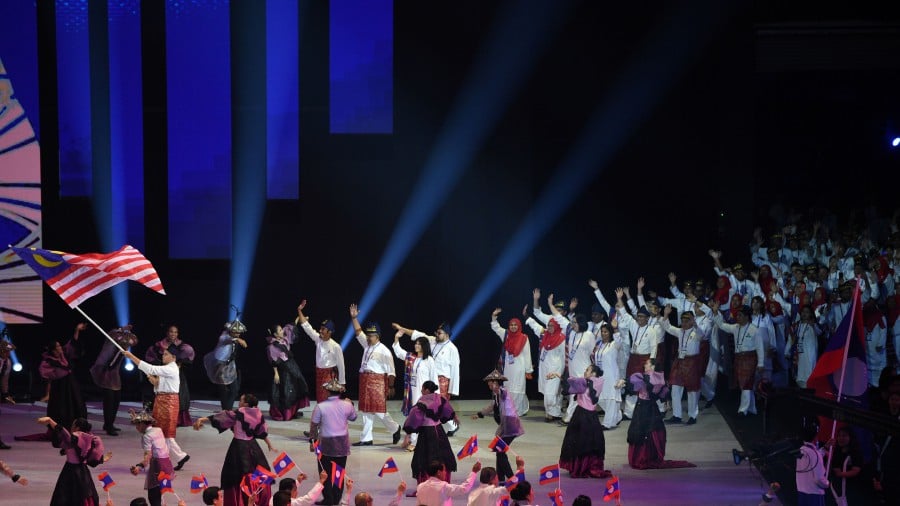

With the men dressed in white baju melayu and red samping with tengkolok, and the women in white baju kurung and selendang with Jalur Gemilang motif, and black shoes, the multi-racial Malaysian contingent, the hosts of the previous games, walked past the crowd proudly, symbolising the multiculturalism of the country.
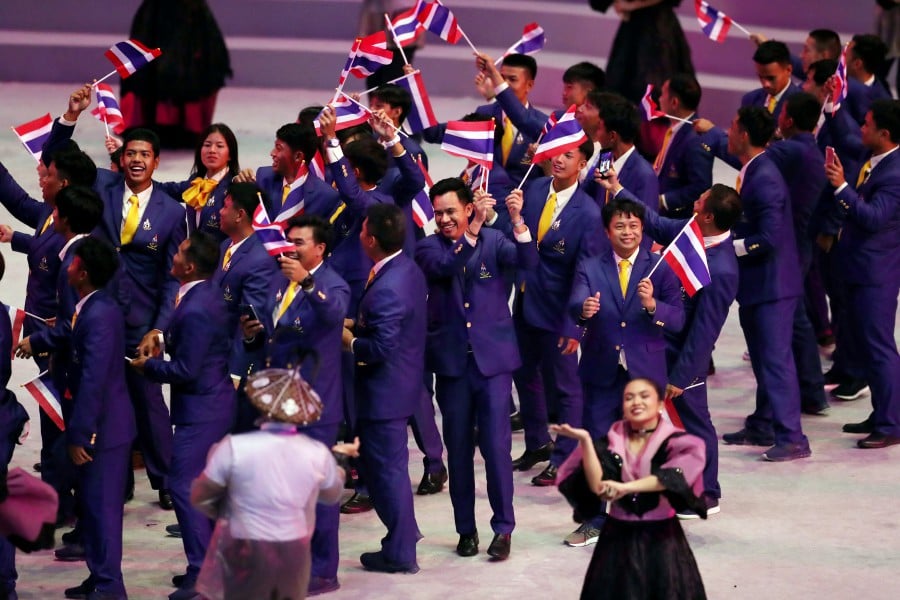
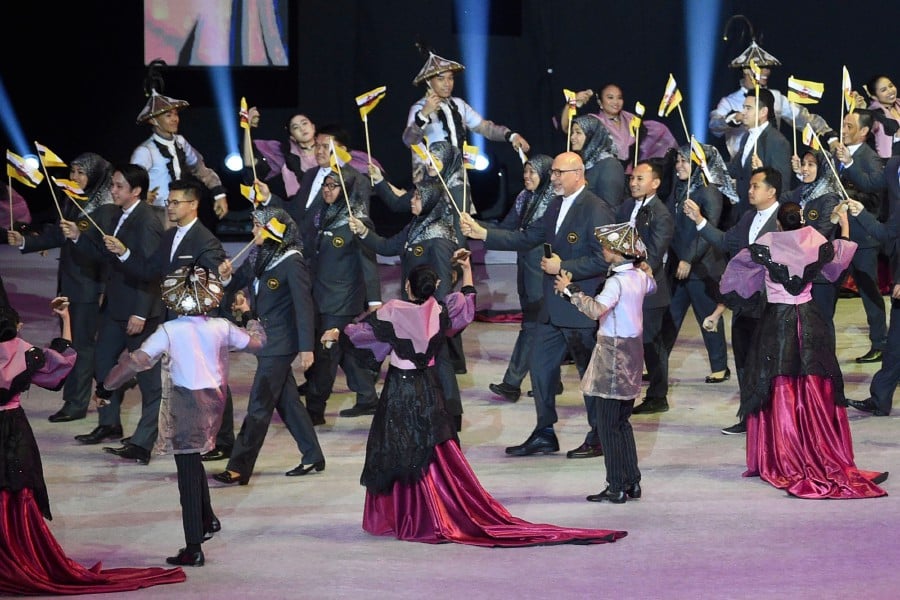
World renowned Filipino boxers Manny Pacquiao and Nesthy Petecio were given the honour as the torchbearers before they jointly lit the cauldron to officially mark the beginning of the 30th SEA Games, after Philippine President Rodrigo Duterte had declared open the Games.

Themed ‘We Win As One’, the Games will run for 12 days until the closing ceremony at the New Clark City Athletics Stadium on Dec 11.
More than 8,000 athletes from the 10 ASEAN countries and Timor Leste will compete in 530 events in 56 sports at the three main clusters, namely Manila, Clark and Subic.


The Philippines have hosted the SEA Games three times before – in 1981, 1991 and 2005.
This year’s Games see the introduction of a few new sports such as arnis, jujitsu, kickboxing, underwater hockey and esports.

Defending champions Malaysia have sent a strong contingent of 773 athletes and 339 officials to participate in 52 sports, targeting 70 gold, 51 silver and 105 bronze medals, which is expected to place them fourth overall.– BERNAMA

Thursday, October 24, 2019

...the PH ranking in Ease of Doing Business

Philippines climbs to 95th spot in World Bank’s ‘Doing Business’ rankings

Ian Nicolas Cigaral
Philippine Star
24 October 2019

MANILA, Philippines — Ease of doing business in the Philippines improved over the past year, with the Southeast Asian country climbing 29 notches in World Bank’s “Doing Business 2020” report released Thursday.
Philippine economy
Out of 190 economies, the Philippines advanced to the 95th spot from 124th place in 2019. The country’s score improved to 62.8 from 60.9 previously.

Compared to its peers in the East Asia Pacific, the Philippines ranked below Singapore (2nd), Hong Kong (3rd), Malaysia (12th), Taiwan (15th), Thailand (21st), China (31st), Brunei (66th), Vietnam (70th), Indonesia (73rd) and Mongolia (81st).

The Washington-based multilateral lender’s annual report looks into the regulations that enhance business activity and those that constrain it.

Quezon City was used as a benchmark for the Philippines.
According to World Bank, starting a business in the Philippines became easier following the abolition of the minimum capital requirement for domestic companies.

The country also made dealing with construction permits easier by improving coordination and streamlining the process for obtaining an occupancy certificate.

“The Philippines strengthened minority investor protections by requiring greater disclosure of transactions with interested parties and enhancing director liability for transactions with interested parties,” World Bank added.

Worldwide, 115 economies made it easier to do business, World Bank said, with New Zealand remaining the most business-friendly country in the world.

Somalia was the worst with a score of 20.

Meanwhile, the economies with the most notable improvement in Doing Business 2020 are Saudi Arabia, Jordan, Togo, Bahrain, Tajikistan, Pakistan, Kuwait, China, India and Nigeria.

“The Doing Business 2020 study shows that developing economies are catching up with developed economies in ease of doing business,” World Bank President David Malpass said.

“Still, the gap remains wide,” he added.

Tuesday, September 24, 2019

...the PH ranking in global trade facilitation

Philippines boosts global ranking in trade facilitation


Louella Desiderio
Philippine Star
24 September 2019


MANILA, Philippines — The Philippines saw its trade facilitation score go up in this year’s United Nations (UN) Global Survey on Digital and Sustainable Trade Facilitation amid improvements in four out of five categories tracked by the report.

This year’s report showed the Philippines got a trade facilitation score of 80.65 percent, up from 69.89 percent in 2017.

Covering 128 economies, the UN report looks at trade facilitation measures being implemented in relation to the World Trade Organization Trade Facilitation Agreement, digital trade, small and medium enterprises, agriculture and women, and trade finance.

The measures are grouped into five categories which are cross-border paperless trade, paperless trade, institutional arrangement and cooperation, formalities, and transparency.

In Southeast Asia, the Philippines had a better trade facilitation score than neighbors Indonesia (80 percent), Brunei Darussalam (77 percent), Cambodia (71 percent), Vietnam (61 percent), Myanmar (60 percent) and Lao People’s Democratic Republic (59 percent).

The Philippines, however, was behind Malaysia and Thailand which both got 83 percent, and Singapore which had a score of 94 percent.

Results of the survey showed the Philippines had higher scores in all the categories except in institutional arrangement and cooperation, where its rating was unchanged at 55.56 percent.

In the cross-border paperless trade category, the Philippines got a score of 55.56 percent this year from just 33.33 percent in 2017.

The Philippines’ score also rose to 77.78 percent this year from 70.37 percent in 2017 in the paperless trade category.

In terms of the formalities category, the Philippines had a rating of 100 percent this year from 87.50 percent last year.

The Philippines also had a 100 percent score in the transparency category this year, up from 93.33 percent in 2017.

In conducting the survey, the UN aims to help countries benchmark and reduce the time and cost of trading across borders.

It likewise seeks to provide information for policy makers to take advantage of trade in the implementation of the 2030 Agenda for Sustainable Development which aims to put an end to poverty.

Tuesday, September 10, 2019

...the Asean leader in gender-equality

PHL cited as gender-equality leader in government hiring - ADB, OECD


Business World | September 10, 2019

THE Philippines is a regional leader in terms of gender equality in job hiring, specifically in the public sector, the Asian Development Bank (ADB) and the Organization for Economic Co-operation and Development (OECD).
Asian Development Bank (ADB)
Speaking to reporters at the launch of the Government at a Glance Southeast Asia 2019 report issued by the ADB and OECD, Chiara Bronchi, an ADB Chief Thematic Officer from the bank’s Thematic Advisory Service Cluster, said the study found that 53.7% of public sector jobs in the Philippines were occupied by women in 2016, up from 50.7% in 2009.
The Philippines outperformed the the Southeast Asian average of 47% in 2016, while also employing larger proportions of women than Japan or South Korea, where less than 50% of public sector employees were women,
“That makes actually Philippines a leader… in terms of hiring [with] a gender balance if you are in the public sector,” Ms. Bronchi said.
Edwin Lau, Head of the Reform of the Public Sector division at the OECD’s, Public Governance Directorate, said the findings reflect “meritocratic” hiring in government service.
“You also see that the types of recruitment systems that are used are very meritocratic, so they’re really built to ensure top-quality people are rising in the public service,” Mr. Lau said.
He said the Philippines is “far above” the Southeast Asian average in terms of performance management systems.
“It’s [Philippines] even using more performance management systems than OECD countries… (In) public employment… the systems are fairly well developed,” he added.
The study also found that women are underrepresented in parliamentary bodies, with only 20% of these seats across the region held by women in 2018, just 1.7 percentage point higher from a decade earlier.
The report is the first of its kind that looked into the latest available data on public administration in Brunei, Cambodia, Indonesia, Laos, Malaysia, Myanmar, the Philippines, Singapore and Vietnam. — Luz Wendy T. Noble

Thursday, April 24, 2014

...the PH Infotech uptrend

PH jumps 8 spots in global ICT rankings


04/24/2014
 
 
MANILA, Philippines - The Philippines jumped eight notches to 78th spot in the Networked Readiness Index 2014 of the World Economic Forum.

The Philippines had previously ranked 86th on the index for the past three years. The index, which covers 148 countries, assesses an economy's capacity to fully leverage information and communications technology (ICT) for growth and well-being.

The WEF Global Information Technology Report 2014 noted the significant improvement of the Philippines' ranking in the overall index, as well as among ASEAN countries.

"With a significant improvement in its overall score, the country continues its positive trend. The scores of all the 10 networked readiness pillars register an increase. A significant improvement in the perceived efficiency in the country’s legal system and property rights protection drive the political and regulatory environment up to 87th place," the report noted.

Another area where the Philippines showed significant improvement is ICT readiness, with "more affordable (75th) access to ICT infrastructure and better skills (69th), despite the need for higher quality in the educational system."

"Business usage is, as in many other Asian economies, at a more advanced stage (43rd) than individual usage (91st). Progress made in terms of economic impacts registered last year continues this year, moving up eight positions and reaching 48th place. The role of ICTs in fostering innovation by creating new products and services (42nd) and organizational models (28th) is confirmed and contributes to this promising result," the report noted.

However, the Philippines still lagged behind other ASEAN neighbors, such as Singapore (2nd), Malaysia (30th), Brunei Darussalam (45th), Indonesia (64th), and Thailand (67th), in the index.

The Philippines ranked ahead of Vietnam (84th), Cambodia (108th), Lao PDR (109th), and Myanmar (146th) in the index.

Makati Business Club executive director Peter Perfecto said the Philippines has competitive advantages in 11 out of the 54 indicators under the networked readiness index.

These 11 indicators are: availability of latest technologies, venture capital availability, quality of management schools, internet and telephony competition, quality of educational system, use of virtual social networks, firm-level technology absorption, capacity for innovation, extent of staff training, impact of ICTs on new services and products, and impact of ICTs on new organizational models.

Digital divide remains

The Global Information Technology Report 2014 noted that there is little progress in bridging the digital divide between tech-savvy countries and others.

Overall, Finland ranked 1st in the Networked Readiness Index, followed by Singapore (2nd), Sweden (3rd), Netherlands (4th), Norway (5th), Switzerland (6th), United States (7th), Hong Kong (8th), United Kingdom (9th) and South Korea (10th).

On the other hand, emerging economies such China (62nd), Brazil (69th), Mexico (79th) and India (83rd) registered a drop in the rankings, as they struggle to realize their full digital potential.

A key finding of the WEF report is that countries cannot rely only on ICT infrastructure development to become competitive. It noted that the benefits of ICT can be fully realized when a country "implements a holistic strategy aimed at creating conditions for skills, innovation and entrepreneurship to flourish alongside modern infrastructure."

"In addition to the persistent digital divide across countries, governments should also be wary of understanding, identifying and addressing potential internal digital divides so that new opportunities can be created for all and support enhanced social inclusion,” said Beñat Bilbao-Osorio, senior economist at the WEF's Global Competitiveness and Benchmarking Network and co-editor of the report.

Thursday, November 28, 2013

...the Math wizzards in Taguig


Philippines bags 62 medals in 10th IMSO


Filipino elementary students took home 62 medals including three gold in the 10th International Mathematics and Science Olympiad (IMSO) for Primary School Students held in the country from Nov. 25 to 29.

Math, Science, Philippine studients, Manila Bulletin
Gold medalists (front row from left) Sanprem Taechawichian of Thailand, Stefan Marcus Ong and Steven Reyes of the Philippines, Stanve Avrilium Widjaja of Indonesia and Yu Chia Zhang of Singapore show their medals awarded by officials led by Mayor Lani Cayetano of Taguig (back row fourth from left). (Photo by Jonathan Hicap)


The IMSO drew contestants from South Africa, Thailand, Taiwan, Indonesia, China, India, Nigeria, Singapore, Sri Lanka, Nepal, Kazakhstan, Brunei, Malaysia, and host Philippines.

The country won three gold, 18 silver and 41 bronze medals in the competition organized by Mathematics Trainers Guild-Philippines (MTG) under Dr. Simon Chua and the City of Taguig under Mayor Lani Cayetano in cooperation with the Department of Education (DepEd) and the Science Education Institute of the Department of Science and Technology (DOST-SEI).

The mayor and her husband Senator Alan Peter Cayetano, and DOST-SEI Officer-in-Charge Elizabeth Fontanilla led the awarding ceremony held on Nov. 28 at the Samsung Hall of SM Aura Premier at Bonifacio Global City in Taguig.

In Math, winners of gold medals for the Philippines are Stefan Marcus Ong and Steven Reyes of St. Jude Catholic School and John Henry Marquez of UP Integrated School.

Winner of silver medals in math are Wiliam Joshua King, Matthew Eric Tan, Audrey Sy, Marksen Viktor Lizarondo, Marjana Ysabelle Montanez, Eion Nikolai Chua, Fedrick Lance Lim, Maxinne Louise Dominique Co, Vanessa Ryanne Julio and Patrick Nino Policarpio.

Bronze medalists are Ken Rassel Isidro, Al Patrick Castro, Bryce Ainsley Sanchez, Kylee Wiona Sy, Ryan Jericho Sy, Genrish Wendell Ng, Vincent Paul Fadri, Hanna Jo, Hiraya Marcos, Naomi Anne King, Ma. Erin Daphne Raton, Albriz Moore Bagsic, Robert Gerard Uy, Elean Almazan, Vien Vicente Jio Viloria, Lance Andrei Esteban, Ellan Puerto, Allyana Coleen Reyes, Christopher Neil Defensor and Kristin Angela Narag.

In Science, the Filipino silver medalists are Hugh Angelo Sonon, Jernnex Mullaneda, Neil Joshua Patiag, Dion Stephan Ong, Katrina Laura Colasito, Joseph Ryan Ong, Lyra Winette Tamayo and Neil Martin Cantillana.

Science bronze medalists are Gabrial Joseph Pua, Laila Denise Dy, Sophia Marion Medina, Lance Kendrick Sebastian, John Ian Lenix Hingan, Justin Miguel Quismundo, Sean Marcus So, Jerome Pasia, Kathleen Ann Sison, Martie Angelica Bueno, Aleck Josef Aquino, Ma. Leibniz Charisse Parra, Ayeasha Alea Irabagon, Raymund Carlo Masbano, Joshua Alvarez, Sherwin Adrien Tiu, Monica Panti, Ashley Maive Butcon, Ryan Christopher Deodores, Marc Danielle Bas and Immanuel Josiah Balete.

In Math, Chen Xinyl of Singapore emerged as the overall top scorer while Master Papon Lapate of Thailand was best in exploration and Yu Chi Zhang of Singapore took home the best in theory award.

In Science, Kar Weng Sean Leong of Singapore won as the overall winner and Bowen Jiang of Singapore was best in experiment. Disanayaka Mudiyanselage Sumanasekara of Sri Lanka was best in theory.

Dr. Chua thanked Mayor Cayetano and city government of Taguig, Senator Cayetano and companies for their valuable support to the contest. The 10th International Mathematics and Science Olympiad (IMSO) was sponsored by PhilFlex Electrical Wires and Cables, Phoenix Publishing House, Petron, SM Supermalls, Federation of Filipino Chinese Chamber of Commerce and Industry Inc. (FFCCCII), San Miguel Corporation, Collins International Trading Corp., City of Taguig with the support from Senator Antonio Trillanes IV and the municipality of Alfonso, Cavite.


Saturday, June 8, 2013

...the resilient countries

Indonesia, Philippines, Malaysia showing resilient growth – SCB


Manila Bulletin
Published: June 8, 2013


ASEAN countries – particularly Indonesia, the Philippines and Malaysia – have continued to grow close to or above trend growth in recent years, despite poor external conditions, a new research conducted by Standard Chartered Bank disclosed. “The growing affluence of the domestic population, relatively healthy fiscal positions, a largely stable political environment and strong liquidity inflows are lending resilience to economic activity, even as external demand falters, “ the British bank with extensive network in the region stressed.

Examining sources of growth over the past decade, we find that the contribution of household consumption increased for Malaysia, Thailand and Vietnam in the 2008-12 period relative to the 2003-07 period.

For Indonesia and the Philippines, the contribution of household consumption was relatively stable; this is not surprising given their relatively closed economies. For Singapore, household consumption remains a small contributor to growth. In fact, Singapore’s economy has become even more open, supporting the case for the continued use of FX as the main monetary policy tool, the SCB paper noted..

“Investment has discernibly increased its contribution to growth in Malaysia and the Philippines. This reflects government efforts to upgrade their economies and positive domestic investor sentiment. With the exception of Singapore, domestic sources have been the key drivers of growth in the region.”

Since 2000, the ASEAN region has been outgrowing the world, the bank said.

“Admittedly, the region has plenty of catching up to do, as it is still relatively undeveloped. With the exceptions of Malaysia, Brunei and Singapore, ASEAN’s per-capita GDP based on purchasing power parity (PPP) is well below that of the world. The region is catching up – ASEAN per-capita GDP has grown faster than global GDP since 2000.”

“This growing affluence is a source of resilience for the region. Intra-regional trade has benefited externally oriented industries, even amid weaker demand from traditional markets such as Europe and China.”

In 2012, ASEAN exports grew just 1.7% amid a weak global trade environment. Exports to countries within ASEAN contributed around 70% of that growth. Had ASEAN been in a weaker position, externally oriented industries would have been hit even harder.

The import profile of ASEAN countries by end-use classification provides some interesting insights (the bank examined the Philippines, Indonesia, Thailand and Malaysia). Comparing the amount of consumer-goods imports with total imports (the sum of consumer goods, intermediate goods and capital goods), we find that the Philippines has the highest proportion of consumer-goods imports. It is followed by Indonesia, Malaysia and Thailand. This is in line with the fact that Indonesia and the Philippines are more closed economies than Thailand and Malaysia. Because domestic consumption contributes a larger share of growth, consumer goods make up a larger share of import content. This is particularly the case for the Philippines.

Thailand and Malaysia are more export-oriented economies. As a result, intermediate goods (inputs for final goods) account for a larger share of their total imports. Meanwhile, imports of capital goods (such as machinery for production) have been increasing for Malaysia and Thailand in the past 1.5 years. We believe this was driven by flood reconstruction efforts in Thailand, and by the ongoing Economic Transformation Program in Malaysia.


Tuesday, April 2, 2013

...the Filipinos in ASEAN Film fest

Filipino talents shine in ASEAN Film Festival


Philippine Information Agency
April 2, 2012


MANILA, April 2 -- Filipino film talents proved once again that they are world-class in their chosen field as they reaped honors during the first ASEAN International Film Festival and Awards (AIFFA 2013) in Kuching, Sarawak from March 28 to 30.

Best Picture - Sta. Niña

During the awards night held on March 30 at the Borneo Convention Center and attended by prominent ASEAN film personalities, Filipino actors Alessandra de Rossi, Anita Linda and Bugoy Carino took home the Best Actress, Best Supporting Actress and Best Supporting Actor awards, respectively. The movie Sta. Niña garnered the Best Picture-Drama honors.


Best Actress Alessandra de Rossi - Sta. Niña
 
Best Supporting Actress Anita Linda - Sta. Niña

Best Supporting Actor Bugoy Cariño - Alagwa


De Rossi and Linda were honored for their performance in Emmanuel Quindo Palo’s Sta. Niña, while Mr. Carino took home the prize for the Ian Dean Loreños’-directed Alagwa.


The Philippines tied with Malaysia for the number of awards at four, Indonesia bagged three awards, while Singapore garnered one award. Brunei Darussalam, Laos, Myanmar and Hong Kong also participated in the AIFFA 2013, a statement from the Department of Foreign Affairs said.

Malaysian director U-wei Haji Saari was given a Special Honour award, while Malaysian-born Hollywood actress Michelle Yeoh was bestowed the AIFFA Lifetime Achievement Award.

“Once again, Filipino artistry in film shone brightly in this festival. With these honors, we have uplifted the profile of the Filipino community here in Malaysia and in the entire ASEAN. I extend to them my warmest congratulations,” Philippine Ambassador to Malaysia J. Eduardo Malaya said.

“Here in Malaysia, the Philippines and Filipino actors are well-admired because of their talent and charisma. Malaysian channels have bought rights to and screen Filipino soap operas here, which are actively watched and enjoyed by audiences here. In fact, some Filipino actors enjoy a huge following in this country,” the Ambassador added.

Eleven Filipino feature films joined over 100 films made by ASEAN artists in the the maiden edition of the film festival, including Tyrone Acierto’s The Grave Bandits, Whammy Alcazaren’s Colossal, Lawrence Fajardo’s Posas, Marie Jamora’s Ang Nawawala, Gutierrez Mangansakan II’s Qiyamah, Vincent Sandoval’s Aparisyon, Richard Somes’ Supremo and Paul Sta. Ana’s Oros.

A student’s short film, Juan Paulo Reyes’ “Ode to Home,” was also screened.

A 25-member Philippine delegation was present during the film festival, led by cinematographer Rain Yamson II. Other notable Filipino personalities who attended were popular Filipino actors Ricky Davao, who was member of the five-man jury, and Jericho Rosales, who was also nominated for Best Actor honors for his role in Alagwa.

Filipinos also played vital roles during the awards ceremonies, with actors Alfred Vargas and Dominic Roco presenting the awards and Miss Saigon star Ima Castro performing in one of the intermission numbers.

Embassy Cultural Attaché Helen Grace Cuisia and Filipino community leaders Justin Yntig Bersales Jr. and Audry Wan Ullok-Bersales were present during the awards ceremonies.

The AIFFA 2013 aims to draw attention to and raise the profile of ASEAN films. The festival hopes to contribute towards the development of films within ASEAN, providing an avenue for its filmmakers to showcase their work to a global audience and most importantly, have these films recognised on an international scale.

It was endorsed by the Sarawak Tourism Ministry and fully supported by the Malaysian Ministry of Information, Communications and Culture, the Malaysian Foreign Ministry’s ASEAN-Malaysia National Secretariat and the National Film Development Corporation Malaysia. (DFA/ASEAN)

Thursday, March 28, 2013

...the international dance fest host

Puerto Princesa hosts int’l dance fest


The Halili-Cruz School of Ballet is one of the dance companies featured in Dance Xchange on April 11 to 14 in Puerto Princesa, Palawan
 
 
MANILA, Philippines - Puerto Princesa City, led by Mayor Edward Hagedorn, will host a grand gathering of world-class performers billed as Dance Xchange: The Philippine International Dance Workshop and Festival on April 11 to 14.
Artistic director Shirley Halili-Cruz
The National Committee on Culture and the Arts (NCCA) National Committee on Dance, under the leadership of Shirley Halili-Cruz, established the annual big event five years ago.

Its 2013 edition will feature leading dance companies and experts from Japan, Hong Kong, South Africa, South Korea, Spain, England, Singapore, Malaysia, Indonesia, Brunei Darussalam and Taiwan. Also participating are 22 Filipino dance companies.

One of the said groups, the Halili-Cruz School of Ballet, will represent the country at the Dance Excellence USA in Los Angeles, California, from March 30 to April 7, before joining the Dance Xchange at Puerto Princesa. With its artistic director Shirley Halili-Cruz, the company won the coveted grand prize Dance Excellence trophy in the international contest participated by 50 American states, 30 countries and more than 10,000 dancers. A potential National Artist for Dance awardee, Shirley’s company has brought home top honors in several dance competitions, all over the world, in the last four years.

Meanwhile, on the welcome dinner alone of Dance Xchange, hosted by Mayor Hagedorn, more than 1,200 delegates are expected to attend.

With dance being the new and creative form of connecting people, culture and nations, Dance Xchange, one of the biggest events of the art, has proven very effective.

Only a leading tourism attraction, Puerto Princesa’s hosting the Dance Xchange will further attract more visitors to Palawan from all over the globe.
 
One of the highlights of the dance festivals is a tour of one of the new Seven Wonders of the World, Puerto Princesa’s underground river.


Wednesday, March 27, 2013

...the Azkals goes to AFC Challenge Cup

AFC Challenge Cup Qualifiers: Philippines top Group E as rivalry with Turkmenistan grows


March 27, 2013


On to Maldives - the Philippines topped Group E to advance to the next phase of the 2014 AFC Challenge Cup. Roehl Niño Bautista, GMA News Online

With a 3-0 default win from Brunei, an 8-0 thrashing of Cambodia, and 1-0 victory over Turkmenistan, the Philippines won nine points with the highest goal difference of the competition to top their group and the qualification period as a whole. Defeating Turkmenistan for the very first time, the Philippines is now the team to beat come 2014 on the main stage of the Challenge Cup in the Maldive Islands.

With these performances, the Philippines is set to jump to their highest FIFA Ranking ever, possibly within the 130s, when they are released next time. So with a growing rivalry with Turkmenistan, Phil Younghusband back to his scoring ways, seven clean sheets in nine games, but more controversy off the pitch, we dissect the Philippines’ route to the 2014 Challenge Cup main stage.

‘Like a Final’

In the post-match press conference, the Turkmenistan coach, Hojageldiyev Yazguly, said, “It was a very interesting game…I think this match was like a final.” Similar sentiments followed from Coach Weiss who added, “For me, Turkmenistan will be the team to beat again and on neutral soil it will be different.”

Ladies and gentlemen, what we have is a rivalry.

There wasn’t much in this game, and the Turkmenistan coach pointed out, “The last two games against the Philippines, the luck was on our side but this time the luck was with [the Philippines].”

However, this is the advancement the Philippines has made. Turkmenistan was rated 121st in the world in the previous FIFA Rankings, dropping 19 places that month due to a lack of games and the natural cycle, rather than any statement of their quality. Turkmenistan was considered by many to be the best team in the Challenge Cup Qualifiers, as runners-up to North Korea in the previous two editions, and the Philippines went and beat them.

Whatever you think of the style of play, who should or shouldn’t start, how Neil Etheridge wasn’t even among the subs, or the lack of substitutions from those who were on the bench, valid concerns, there is no doubting the progress of this team. Turkmenistan has now been defeated in a continually growing list of countries the Philippines have beaten for the very first time under manager Dan Palami and coach Michael Weiss.

This list includes India, Bangladesh, Nepal, Mongolia, Tajikistan, Myanmar, Palestine, Singapore, and a couple more if you don’t include the Olympic Games forty years ago as full international matches. That list, that progress, and this line-up, is the best the Philippines has ever had. The biggest challenge now is keeping them together.

Phil rediscovers where he put his Golden Boot

Phil Younghusband finished as the leading scorer of the 2012 Challenge Cup, with two more than anyone else, totaling six in that competition. Here, the top scorer of the Philippines scored five goals, again two ahead of everyone else, to take his tally to 33 for his country. It seems he really enjoys playing in the Challenge Cup, and for the rest of the teams left in the competition, their challenge will be to keep him quiet.

In the Suzuki Cup, he hit a dry spell as teams had scouted the Philippines, identified him as the major threat, and bullied him out of the game. It was effective and his only goal came against Myanmar at the start of the second half, in a tournament where he was pushed and elbowed into anonymity.

While this tactic may prove effective again for the other teams in the Challenge Cup, it will be too much of a price for other teams to pay now. Committing two defenders to bully Younghusband would leave space for Javier Patiño, who has proven himself worthy of a place in the starting line-up with a brace in his debut and an enterprising performance against Turkmenistan. That means the Philippines are top dog and can go out playing to win every single game come March 2014.

The only caveat for Younghusband is he got sent off versus Turkmenistan. A yellow card in the first half for deliberately handling the ball was followed by a second for holding onto his man and dragging him back in the 85th minute. He will therefore be unavailable for the first group game in the 2014 Challenge Cup.

Stalwart defense and team spirit

The unsung heroes of the Azkals was their defense. If the defense goes unnoticed, they’ve done their job well and Rob Gier in particularly never put a foot wrong. After the game the veteran Azkal said, “I think today the game was all about the defenders… I think we’ve proved we have all the right ingredients to show we can be a very good team”.

Of the squad as a whole, he said, “When people keep asking about what’s special about the team I keep coming back to it; it’s the team spirit.” And with Rob Gier and Juani Guirado solid in defense, the Philippines have kept seven clean sheets in their last nine games (not including the default win against Brunei).

This has been part of an overall defensive unit where Dennis Cagara and Carli De Murga have thwarted the wing play, offering offensive options too, and seen fourteen clean sheets in the twenty games since the last Challenge Cup. During the Suzuki Cup, the defensive strength came at the expense of the attack, but now the Philippines look much more balanced with, as Weiss said, “the best still yet to come.”

Stadium half-full or half-empty?

On the pitch, the Philippines was superb and has been constantly improving. But off the pitch there is so much more that needs to be done – and a lot of it is just common sense.

The most prestigious tournament in South East Asia, the Suzuki Cup, sold their most expensive tickets for the Final at around P700. Yet somehow the organizers of these qualifiers thought that charging almost four times that amount for some seats was appropriate.

Group D hosts Nepal had an average of 16,000 for their group matches, more than twice the Philippine attendance. The Philippines has the potential to average similar figures quite easily and this would build a sustainable financial picture for Philippine football, something essential for the continued growth of the sport. But if ever decisions like ticket prices here are repeated, it will not only choke the National team, but the UFL and grassroots football too.

Who makes it to the Maldives?

As Group E winners, the Philippines will join the other four group winners for the final stage of the Challenge Cup, namely Myanmar, Kyrgyzstan, Afghanistan, and Palestine.

Turkmenistan made it as the best runners-up while Bangladesh are the second best runners-up and these seven nations will join host country Maldives in March 2014, for the group stage.

Of interest in the qualification stage, 2006 winners Tajikistan and 2008 winners India, who the Philippines beat in the group stage last year to qualify for the semifinals, will not be in the final stage for the first time since the competition began as both finished as runners-up in their groups. With weaker goal differences than Turkmenistan and Bangladesh, it was simply the luck of the draw as those who qualified could rack up the goal difference against Cambodia and the Northern Mariana Islands, respectively.

The Challenge Cup has certainly had its share of challenges so far, and we can probably expect a new and hopefully fairer system of qualification next time around. But for 2014, the Philippines have just put themselves in top contention to win their first ever internationally sanctioned trophy. Come March, 2014, everyone will be looking out for the Philippines. - AMD, GMA News