Showing posts with label Visayas. Show all posts

Wednesday, October 9, 2019

...the Ju Jitsu next big hub

The Philippines could be the next big hub for Jiu-Jitsu superstars


With height and physical strength not much of a factor, and our longstanding heritage in combat sports, the grappling martial art can be the next big thing for Pinoy athletes. And, with its debut in the Southeast Asian Games next month, our fighters can showcase what they've got to the rest of the world.


Nissi Icasiano
ABS-CBN Sports
09 October 2019


Grappling is one of the oldest forms of combat in the world. Cave drawings in France from over 15,000 years ago appear to depict people engaged in acts of grappling. Babylonian and Egyptian artifacts show people employing most of the maneuvers known today. In Greece, wrestling served as the main attraction in the ancient Olympic Games. 


Various grappling disciplines evolved across the globe, including Sumo in Japan, Turkish oil wrestling, and Uzbekistan’s Kurash among others. In the Philippines, traditional indigenous martial arts are practiced in different regions like Bultong in the Cordilleras, Dumog in Western Visayas, and Layug in Central Visayas and Mindanao.

Due to American colonization, modern-style wrestling made its way into the country and has remained up to the present time. Many Filipinos have etched marks in this field, notably in the 1954 Asian Games, where Nicolas Arcales and Mansueto Napilay brought home silver medals, and Basilio Fabila captured bronze. It was the only year in Asian Games history that the Philippines claimed medals in wrestling. Filipino wrestlers were privileged to compete at the Summer Olympics from 1936 to 1988. Since the implementation of continental qualifiers the year after, not a single grappler has had the opportunity to set foot on an Olympic mat.

Next big thing

Through lifelong Filipino martial artist Alvin Aguilar in the mid-90s, Brazilian Jiu-Jitsu was formally introduced in the Philippines. The grappling art was formed from the Kodokan Judo fundamentals that were taught by a number of individuals, including pioneers Takeo Yano, Mitsuyo Maeda, Soshihiro Satake, and Isao Okano.

Brazilian Jiu-Jitsu eventually came to be its own discipline through the experiments, practices, and adaptation of Judo through Carlos and Helio Gracie in the 1900s. Though our nation is heavily engrossed with basketball, boxing, billiards, and currently volleyball, one Filipino practitioner believes that Brazilian Jiu-Jitsu could find a foothold in the Parthenon of Philippine sports.

Franco Rulloda, who earned his black belt in Brazilian Jiu-Jitsu under the tutelage of Aguilar last May, sees a bright future for Filipinos in the sport because, unlike basketball, it does not require height. It is built on the concept that a smaller person can successfully defend against a bigger and heavier assailant. This you can do by using proper technique, leverage, and taking the fight to the ground before applying joint-locks and chokeholds to subdue the opponent.

“The fighting spirit and passion for combat sports makes Brazilian Jiu-jitsu perfect for Filipinos,” Rulloda explains. “It is honing one’s physical attributes and using acquired knowledge to his or her advantage. It does not require too much strength, height, and athleticism.”

Rulloda points out that a lot of our prominent and successful athletes come from combat sports.

 “Manny Pacquiao, Nonito Donaire, Eduard Folayang, and the list goes on. Fighting has been ingrained in every Pinoy’s DNA,” he says. “Martial arts have deep roots in Filipino culture. History has proven that Filipinos have that warrior spirit.”

There are already a handful of Filipino competitors who have made a name for themselves internationally, including Meggie Ochoa and May Masuda. Ochoa captured three-straight gold medals from 2014 to 2016 at the World Jiu-Jitsu Championship or the Mundials. On the other hand, Masuda became the first Filipina to snare a gold medal at the Mundials in 2009.

Eros Baluyot, meanwhile, had his career-defining moment in 2010 by bagging a gold medal at the age of 17. Joey Lepiten, Gian Dee, Kaila Napolis, Annie Ramirez, Kim Custodio, Vince Ortiz, and Marc Lim have likewise made it to the podium in different overseas tourneys.

“Filipinos learn fast. We somehow have this gene attributed to absorbing techniques quickly and applying them right away. We are dedicated athletes. We put our heart and soul into whatever it is we are doing. We invest so much in our endeavors, and we are passionate about what we believe in,” Rulloda says.

Making a mark

The Philippines now houses the most number of Brazilian Jiu-Jitsu black belts in Southeast Asia: Aguilar, Rulloda, Masuda, John Baylon, Fritz Rodriguez, Pichon Garcia, Allan Co, Toffy Ilagan, Froilan Sarenas, among others.

Currently, there are 10 clubs in the country that have been recognized by the International Brazilian Jiu-Jitsu Federation including DEFTAC-Ribeiro, Atos Philippines, KMA-Fabricio, John Baylon BJJ, and Cobrinha BJJ Manila.

Aguilar, who holds the distinction as the first homegrown black belt here, says the sport has come a long way since he first piloted a small class in his garage. “Back then, Jiu-Jitsu was only comprised of four or five people. Right now, we have at least more than a thousand competitors,” he shares. “I am very happy with the level and the standard that we’ve already established here in the Philippines because we’ve produced a lot of champions.”

The pioneering fighter says that we are definitely number one in Southeast Asia, and top three in Asia. “These are the things we should take advantage of. We have so many good grapplers. Everybody here is so good, not just from my team,” he adds. “You put them in any gym around the world, and they will always be able to produce.”

Brazilian Jiu-Jitsu in the Philippines made significant strides last year when both Philippine Olympic Committee and Philippine Sports Commission declared the Jiu-Jitsu Federation of the Philippines as the sport's national governing body. The sport will also make its much-awaited debut at the Southeast Asian Games, which our country will host from November 30 to December 11.

Ochoa is more than excited to participate in the regional biennial meet, as she doesn’t get a lot of opportunities to compete in her country. “It is a big deal because we’re the host, and I’m definitely going to prepare for that,” she says, “Not just me but every Filipino athlete is going to prepare for that. We want to show what we are really capable of.”

 Spreading the gospel

Despite the success of a few homegrown talents in Brazilian Jiu-Jitsu, Rulloda admitted that it still has a lot of work to do to adapt to Filipino taste. “The growth has been steady through the years. However, the biggest hindrance to the growth of the art is the lack of awareness of what really happens in an actual self-defense situation and how Jiu-Jitsu can be an effective tool for it,” he stresses. “The sporting aspect has a slow progress because the low awareness level leads to low exposure and that results in difficulty of getting sponsorships for deserving athletes.”

To help in this cause, Rulloda stages a yearly tournament called Arte Suave Manila. It started in 2015, and aims to excite at a grassroots level. “Whatever noise this event will create is going to help the future of these athletes. I want them to get exposed, I want them to be discovered, and I want them to get sponsors,” he reveals.

The two-day competition originally focused on white and blue belters, but it opened its doors to purple belts in 2016. One of its main attractions is the submission-only super-fights, where combatants will contend in a ten-minute match. If there is no submission by the end of the given time, a draw will be declared.

Arte Suave Manila is set to hold its fifth annual event from October 19 to 20 at the Commercenter Alabang in Muntinlupa, and Rulloda is expecting a promising turnout. “It is a league by fighters, for fighters. The sport is growing in the country, and so we’re expecting to see high-level Jiu-Jitsu displayed on the mats again this year,” he promises.

Rulloda reiterates that Filipinos have the potential to do great things in the sport. “We can take Jiu-Jitsu to the next level, not only here in our country, but to the Asian level, and even worldwide,” he declares.

Tuesday, March 5, 2013

...the upbeat Filipinos

SWS: More Filipinos upbeat in 2013


Philippine Daily Inquirer


Almost two of every five adult Filipinos are optimistic about their quality of life, while one in three are optimistic about the Philippine economy this year, a recent Social Weather Stations (SWS) survey showed.

The survey, conducted from Dec. 8 to 11 and first reported in BusinessWorld, found that 37 percent of Filipinos were optimistic that their quality of life would improve in the next 12 months, as against 8 percent who said it would get worse, for a “high” net optimism score (optimists minus pessimists) of plus 29.

The SWS asked respondents: “In your opinion, what will be the quality of your life in the coming 12 months?” and were told to choose from two answers: “Will be better” (optimists) or “Will be worse” (pessimists).

Better economy

The same survey found that 33 percent were optimistic the Philippine economy would be better this year while 14 percent were pessimistic, for a “very high” net optimism score of plus 19.

But the survey also found a bigger proportion (32 percent) saying their life had worsened compared to a year ago (losers) while 25 percent said their life had improved over the same period (gainers), for a “fair” net score of minus 8.

Across classes, net optimism about their own quality of life ranged from a “high” plus 24 among class E to a “very high” plus 40 among classes ABC. It was at plus 30 (“very high”) among class D.

Very high in Metro

Across areas, it ranged from a “fair” plus 19 in Mindanao to a “very high” plus 35 in Metro Manila and the Balance of Luzon. It was at plus 23 (“high”) in the Visayas.

Net optimism on the economy across classes, on the other hand, ranged from a “very high” plus 16 among class E to a “very high” plus 28 among classes ABC. It was at plus 19 (“very high”) among class D.

Net economic optimism across areas ranged from a “high” plus 9 in Mindanao to a “very high” plus 26 in Balance Luzon. It was at plus 11 in the Visayas and at plus 21 in Metro Manila (both “very high” scores).

Meanwhile, the net percentage of gainers over losers across classes was a “very high” plus 29 among classes ABC, a “fair” minus 7 among class D and a “mediocre” minus 17 among class E.

Across areas, the net percentage score of gainers over losers was a “fair” minus 7 in Metro Manila, zero in Luzon outside Metro Manila (“fair”), minus 13 in the Visayas (“mediocre”), and minus 18 in Mindanao (“mediocre”).

For net personal optimism, SWS considers scores of plus 30 and above as “very high”; scores from plus 20 to plus 29, “high”; plus 10 to plus 19, “fair”; plus 1 to plus 9, “mediocre”; zero to minus 9, “low”; and minus 10 and below, “very low.”

Face-to-face interviews

For net economic optimism and net gainers, SWS classifies scores from plus 10 and above “very high”; plus 1 to plus 9, “high”; minus 9 to zero, “fair”; minus 10 to minus 19, “mediocre”; minus 20 to minus 29, “low”; minus 30 and below, “very low”

The survey used face-to-face interviews with 1,200 respondents and had a margin of error of plus or minus 3 percentage points.—Inquirer Research


Thursday, July 12, 2012

...the marine conservation model

Tubbataha Reef hailed by experts as marine conservation model


July 12, 2012


CAIRNS, Australia – In what is regarded as the center of coral diversity in the world, the Tubbataha Reef in the Philippines is emerging as a model for conservation in the face of grave threats to the region’s coral reefs.


The Philippines is one of the six countries in a region dubbed the Coral Triangle, which contains nearly 30 percent of the world’s coral reefs and more than 3,000 species of fish — twice the number found anywhere else in the world.


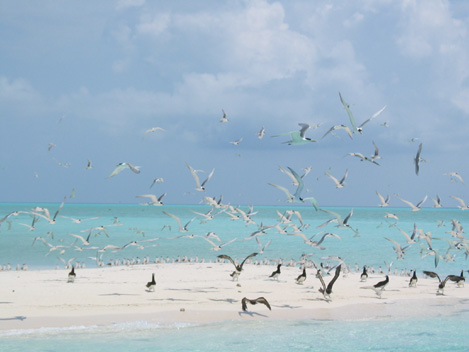
Seabirds on the north islet of Tubbataha. Photo: Michael D. Marasigan


A new report from the World Resources Institute released at a weeklong symposium here said more than 85 percent of reefs in the Coral Triangle —the global average is 60 percent— are directly threatened by human activities such as overfishing, pollution from watersheds, and coastal development.

“Across the Coral Triangle region, coastal communities depend on coral reefs for food, livelihoods, and protection from waves during storms, but the threats to reefs in this region are incredibly high,” said Lauretta Burke, senior associate at WRI and a lead author of the report.

More than 130 million people living in Indonesia, Malaysia, Papua New Guinea, the Philippines, Solomon Islands, and Timor-Leste depend on coral reefs for food, employment, and tourism revenues, the report said.


“Much of the threat is anthropogenic, which is something we have control of,” observed Alan White, senior scientist of The Nature Conservancy and one of the report’s contributing authors.

Protection measures are lacking, however, with only three per cent of coral reefs in the Philippines designated as no-take zones inside marine protected areas (MPA), he said. In comparison, 29 per cent of reefs in Indonesia and 11 per cent in Malaysia are inside MPAs.

Amid the gloomy statistics, the Tubbataha Reef is one of the “excellent sites” among the measly one per cent of MPAs in the Coral Triangle that are considered to be effectively managed, White said. The Solomon Islands also has some good sites, he added.

“The Tubbataha is really a success story,” said White, who has done long-term monitoring of the reef’s resources for two decades.

Shift in marine diversity

Located within the municipality of Cagayancillo in Palawan, the Tubbataha Reef was declared the Philippines’ first national marine park in 1988 by then-President Corazon Aquino and subsequently proclaimed a World Heritage Site five years later.

Since the mid-1990s, when then-President Fidel Ramos stationed Philippine Navy and Coast Guard in the uninhabited coral atolls, Tubbataha has benefited from continuous protection against poachers that brave the difficult crossing in the Sulu Sea to reach the reefs.

A park manager and civilian staff have augmented the armed personnel while a multi-sectoral board sets management policies in the park, which has been voted as one of the world’s ten best dive sites.

Theresa Mundita Lim, director of the Protected Areas and Wildlife Bureau (PAWB), said a study conducted in 2010 showed that the center of marine diversity in the Philippines had shifted to Tubbataha Reef instead of the central Philippine Sea, as an earlier study had indicated.

Fishing pressure in the Visayas due to increasing population and disturbance from tourism could be some of the possible reasons for the trend, she said.

Moreover, “we protected Tubbataha,” Lim told reporters on the sidelines of the symposium, which is held every four years to share new research results.

Secretary Ramon Paje of the Department of Environment and Natural Resources, which administers PAWB, has given instructions to her agency to come up with guidelines for scuba divers so that the country’s coral reefs can be protected from further degradation, Lim said.

Two-thirds of PHL reefs highly threatened

Overfishing and destructive practices such as blast or poison fishing are the greatest threats to the country’s reefs, affecting 98 percent or nearly the entire reef area, according to the WRI report.

The only exceptions are reefs in well-managed MPAs, the report added. These include the Tubbataha Reefs, along with Apo Island in the Visayas, and 23 smaller MPAs managed by local government and community organizations.

Two-thirds of the reefs are rated in the high or very high threat categories, going up to nearly 80 per cent when global warming and coral bleaching are included in the analysis.

Infrastructure development and crowding of coastlines, along with pollution mainly from farms and erosion of deforested mountains, threaten nearly 60 percent of reefs, the report said. — TJD/VS/HS, GMA News

Saturday, November 5, 2011

...the young and the restless

10 youth groups receive awards

 
By SARAH HILOMEN-VELASCO
November 5, 2011
Manila Bulletin
 
 
MANILA, Philippines — At least 10 youth organizations in the country received awards for exceptional achievements in their communities during the 9th Search for Ten Accomplished Youth Organizations (TAYO).

Two of the organizations came from the National Capital Region (NCR) – the Linangan sa Imahen, Retorika at Anyo (LIRA) and Indak Kabataan Youth Organization. Two are from Luzon – the University of the Cordilleras - HapiyohMi Cultural Group and AUL-STAGE (Sama-samang Tinig ng mga Aktor na Gumagalaw sa Entablado).

Receiving appreciation were the Industrial Engineering Council of Cebu Institute of Technology University, Alyansang mga Kristyanong Mag-aaral – Responsible nga Balikatanhan mga Kabataan (AKMA-RESBAK), and Aklan Catholic College Junior Philippine Institute of Accountants from the Visayas, and Youth Solidarity for Peace-Peace Advocates Zamboanga, Association of Locally -Empowered Youth in Northern Mindanao, and Young Mindanawans Peace Builders from Mindanao.

The organizations received their awards from President Benigno S. Aquino III at the Heroes Hall in Malacañang.

Also at the awarding ceremony were Senator Francis “Kiko” Pangilinan; Paolo Benigno Aquino “Bam” Aquino of the TAYO Awards Foundation; Leon Flores III, chairman and CEO of the National Youth Commission; Guillermo Aponte, president and general manager of the Coca-Cola Export Corporation; Koh Kong Meng, general manager and executive director of Lenovo ASEAN; and Hermino “Sonny” Coloma, secretary of the Presidential Communications Operations Office.

Co-presented by Coca-Cola Foundation Philippines, the 9th TAYO Awards showcases organizations that have a deep commitment in addressing social concerns such as alleviating the need for community healthcare by using herbal medicines, teaching accounting to marginalized cooperatives, promoting and preserving cultural heritage and the arts, and environmental conservation.

Each organization received a TAYO trophy sculpted by artist Toym de Leon Imao, and a P50,000 cash grant from Coca-Cola Foundation Philippines.

Special recognitions given were the Coke Barkada Award from Coca-Cola Foundation, and the Lenovo Young Do-ers IT Award from Lenovo Philippines.

The organizers said the winners were chosen based on the impact of their projects to the community, the capability to bind the spirit of volunteerism and citizenship, creativity and innovation, and the sustainability of the project and their effective use of resources.