Showing posts with label Thailand. Show all posts

Saturday, December 19, 2020

The PH world rank in financial promo

Philippines ranks 2nd in Asia, 8th worldwide for financial inclusion promotion

By TED CORDERO
GMA News
December 18, 2020

The Philippines remains among the top leaders in financial inclusion, according to the 2020 Global Microscope on Financial Inclusion of the Economist Intelligence Unit (EIU), the research arm of The Economist Group.

The country ranks second in Asia, next to India; and eight worldwide, tied with Brazil, in the EIU study, which assessed the financial inclusion environment in 55 countries.

The EIU study rated countries across five dimensions, namely Government and Policy; Stability and Integrity; Products and Outlets; Consumer Protection; and Infrastructure.

Together with Thailand and Russia, the Philippines posted the highest improvement in Asia and Eastern Europe, in view of the government’s push to promote digital channels as part of its responses to the COVID-19 pandemic, according to the study.

The Philippines got a perfect score of 100 points in Products and Outlets dimension, which covers Bangko Sentral ng Pilipinas (BSP) regulations on e-money, simplified accounts like the Basic Deposit Account (BDA), and financial outlets such as cash agents.

Focusing on the role of financial inclusion in the COVID-19 response, the EIU study recognized the initiatives of the Philippines to mitigate the adverse economic impact of the pandemic.

The report cited the regulatory relief measures of the BSP to ease liquidity constraints in the financial system, restore business confidence, and sustain the flow of credit amid the unprecedented health crisis.

These include the temporary relaxation of compliance to reporting requirements, easier access to rediscounting facility, and waiver of licensing fees and charges for financial institutions setting up their electronic payment and financial services.

It also cited the initiative of financial service providers to suspend fees for electronic fund transfers during the community quarantine period.

In addition, the EIU report highlighted measures to promote MSME financing such as allowing banks to include loans granted to MSMEs as alternative compliance with reserve requirements, reducing the credit risk weight of MSME loans that are current in status to 50% from 75%, and reducing the minimum liquidity ratio (MLR) for stand-alone thrift banks, rural banks and cooperative banks to 16% from 20% until end-December 2020.

While the Philippines scored lowest in the Infrastructure dimension with 69 points, there is noted improvement from last year’s level owing to ongoing initiatives on digital connectivity, digital identification, and digital payments infrastructure.

The report emphasized the importance of digital infrastructure that includes access to identification, mobile phones, and financial accounts to facilitate efficient delivery of cash assistance to vulnerable segments.

It also noted that better data integration is needed for proper targeting of cash aid program beneficiaries.

The Global Microscope is an annual cross-country assessment of the enabling environment for financial inclusion. Since 2009, the Philippines consistently belongs to the top-ranked countries in terms of having a supportive framework for inclusive finance.

Latin American countries namely Colombia, Peru, Uruguay, Argentina, and Mexico dominated the top five spots of 2020 Global Microscope. —KBK, GMA News


Monday, February 10, 2020

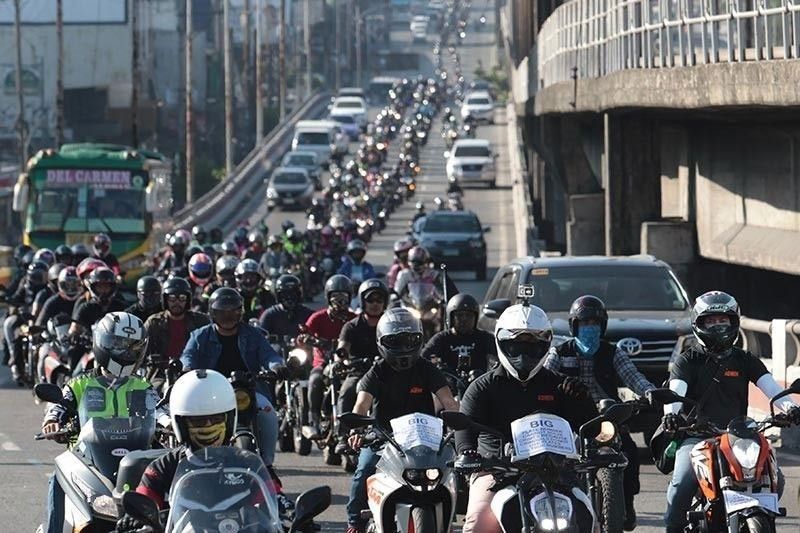
...the 2nd ASEAN's fastest growing market for motor vehicle

Philippines 2nd fastest-growing market for motor vehicles in South East Asia


Louella Desiderio
Philippine Star
10 February 2020


MANILA, Philippines — The Philippines was the second fastest-growing motor vehicle assembler in Southeast Asia last year, registering a 19 percent growth in output, according to the Association of Southeast Asian Nations Automotive Federation (AAF).
Data from AAF showed the Philippines assembled 95,094 motor vehicles last year, up from just 79,763 units in 2018.

Posting the fastest growth in motor vehicle output last year was Myanmar, which assembled 15,496 units, 26 percent higher than the 12,292 units in 2018.

Apart from Myanmar and the Philippines, the only country in the region with a higher motor vehicle output was Malaysia which produced 571,632 units last year, up 1.2 percent from the 564,971 units in 2018.

All other countries with motor vehicle assembly operations in the region registered declines.
Thailand, which serves as the region’s automotive hub, assembled 2.01 million units last year, seven percent lower than the 2.17 million units in 2018.

Indonesia’s motor vehicle output decreased by 4.2 percent to 1.29 million units last year from 1.34 million units in 2018, while Vietnam’s output went down by 12 percent to 176,203 units last year from 200,436 units in 2018.

Total motor vehicle output in Southeast Asia decreased by 4.8 percent to 4.16 million units last year from 4.37 million units in 2018.

In terms of motor vehicle sales, the Philippines was among those with higher sales last year.

AAF data showed the Philippines sold 369,941 units last year, 3.5 percent higher than the 357,410 units in 2018.

Other countries in the region with higher sales last year are Myanmar with a 25 percent growth in sales to 21,916 units, Vietnam with an 11.7 percent increase to 322,322 units, Brunei with a six percent uptick to 11,909 units, and Malaysia with one percent growth to 604,287 units.

Posting lower sales last year, meanwhile, are Indonesia with a 10.5 percent drop to 1.03 million units, Singapore with a five percent decrease to 90,429 units, and Thailand down 3.3 percent to 1.01 million units.

Total motor vehicle sales in the region reached 3.46 million units last year, 2.9 percent lower than the 3.56 million units sold in 2018.

Recently, the Department of Trade and Industry (DTI) launched a preliminary probe on a petition filed by workers group Philippine Metalworkers’ Alliance (PMA) to impose safeguard measure or duty on vehicles, a development which may affect both the production and sales performance of automotive firms in the country.

PMA filed the petition as increased vehicle imports are seen to pose threat to local car assembly, auto parts manufacturers, as well as employment in the sector.

A safeguard duty may be imposed by the government when a surge in imports of a certain product causes injury to local players.

Saturday, November 30, 2019

...The Southeast Asian Game host (opening)

Philippines showcases cultural heritage to kick off 30th Sea Games

New Straits Times
30 November 2019


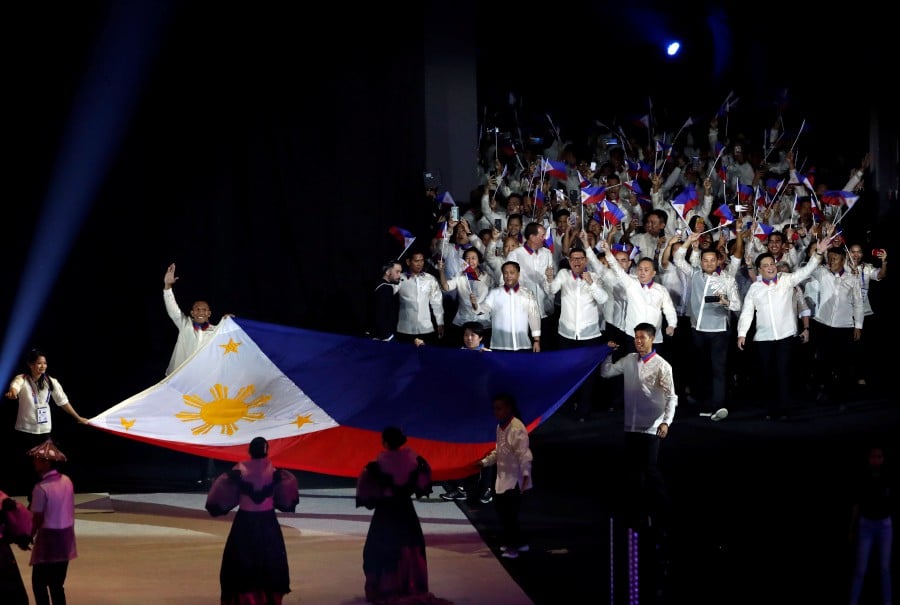
MANILA: The Philippines staged a spectacular opening ceremony for the 30th SEA Games at the world’s biggest indoor arena, the Philippine Arena, in Bulacan, near here, tonight.


In a departure from tradition, the opening ceremony was held in an indoor arena rather than a stadium.


Also, for the first time in the biennial Games’ 60-year history, the games cauldron was placed at a different location, at the New Clark City Athletics Stadium, some 90km from Bulacan, and the lighting of the cauldron was shown on screen at the 55,000 capacity arena.

The extravaganza started after Filipino singer Lani Misalucha sang the republic’s national anthem, which was followed by an extraordinary performance themed “The Roots of our Strength”, showcasing the culture and heritage of the nation.
The spectators were treated to a series of warrior dances from the Bagobo, the Kalinga, the Maguindanao, Islamic and the pre-Hispanic Visayans.

The later part of the ceremony was powered by modern and hip-hop performances led by local artistes Inigo Pascual, Robert Sena, Apl.de.Ap and KZ Tandingan, among others.
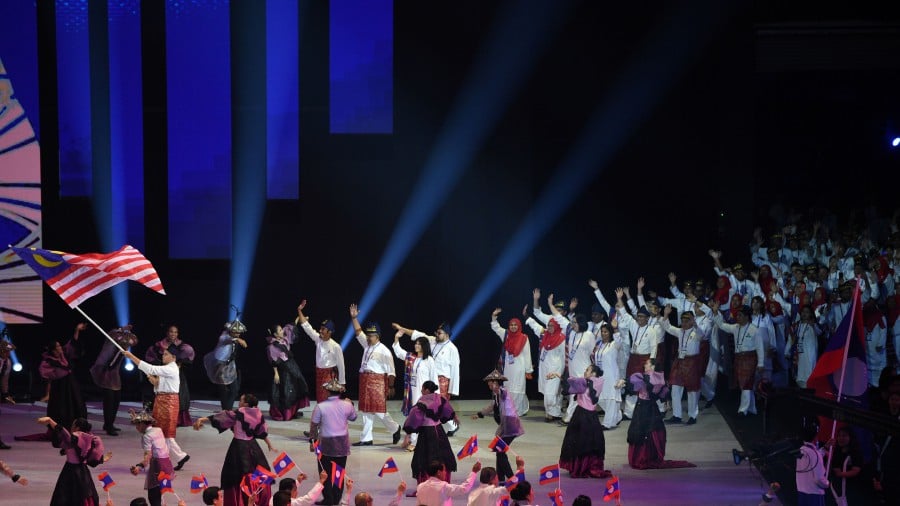
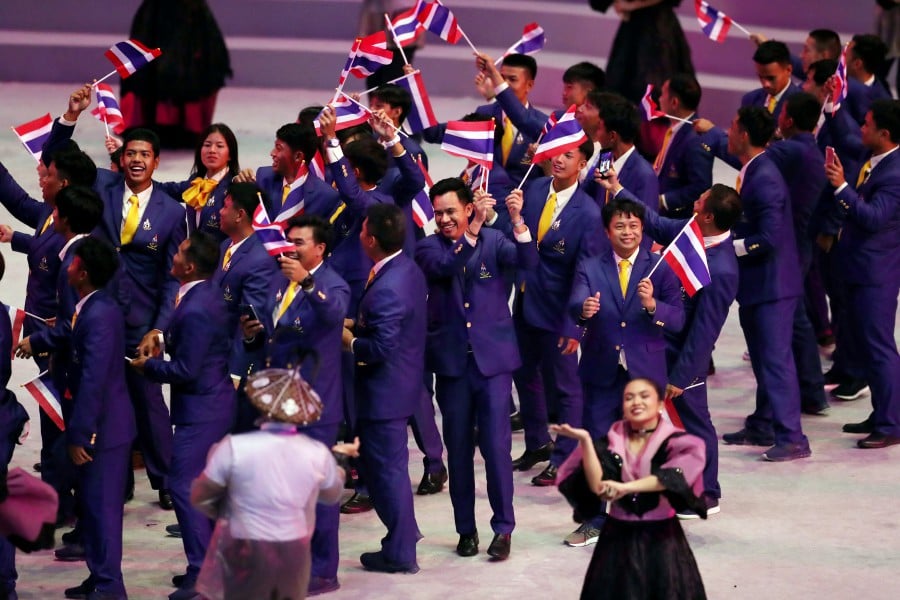
The contingents received loud cheers from the audience as they paraded into the arena in alphabetical order, starting with Brunei, Cambodia, Indonesia, Laos, Malaysia, Myanmar, Singapore, Thailand, Timor Leste and Vietnam, before host nation the Philippines ended the march.

Led by flag-bearer and 2018 bowling world champion Rafiq Ismail, the Malaysian contingent were represented by a delegation of about 100, including chef de mission Datuk Megat Zulkarnain Omardin and his two deputies, Nurul Huda Abdullah and Ahmad Faedzal Md Ramli.


With the men dressed in white baju melayu and red samping with tengkolok, and the women in white baju kurung and selendang with Jalur Gemilang motif, and black shoes, the multi-racial Malaysian contingent, the hosts of the previous games, walked past the crowd proudly, symbolising the multiculturalism of the country.

World renowned Filipino boxers Manny Pacquiao and Nesthy Petecio were given the honour as the torchbearers before they jointly lit the cauldron to officially mark the beginning of the 30th SEA Games, after Philippine President Rodrigo Duterte had declared open the Games.

Themed ‘We Win As One’, the Games will run for 12 days until the closing ceremony at the New Clark City Athletics Stadium on Dec 11.
More than 8,000 athletes from the 10 ASEAN countries and Timor Leste will compete in 530 events in 56 sports at the three main clusters, namely Manila, Clark and Subic.


The Philippines have hosted the SEA Games three times before – in 1981, 1991 and 2005.
This year’s Games see the introduction of a few new sports such as arnis, jujitsu, kickboxing, underwater hockey and esports.

Defending champions Malaysia have sent a strong contingent of 773 athletes and 339 officials to participate in 52 sports, targeting 70 gold, 51 silver and 105 bronze medals, which is expected to place them fourth overall.– BERNAMA

Tuesday, November 19, 2019

...the PH improved world talent ranking

Philippines up 6 notches in world talent ranking


Louella Desiderio
Philippine Star 
19 November 2019


MANILA, Philippines — The Philippines was among 63 countries that posted the biggest climb in the latest World Talent Ranking (WTR) report of the International Institute for Management Development (IMD), as it rose six places to 49th place from 51st last year.


The country remained the laggard however, among Southeast countries.

Released in partnership with the Asian Institute of Management Rizalino S. Navarro Policy Center for Competitiveness in the Philippines, the WTR looks at countries’ ability to attract, develop and retain an employable talent pool.

The other countries which posted the biggest improvements are Taiwan, which went up seven places to 20th; Lithuania, which rose eight notches to 28th; and Colombia which advanced six places to 54th.

While the Philippines’ ranking improved in this year’s report, it was still behind its peers in the region.
All other Southeast Asian countries included in the report had better rankings than the Philippines such as Singapore (10th), Malaysia (22nd), Indonesia (41st), and Thailand (43rd).

In ranking countries, the WTR looked at three factors such as investment and development, appeal and readiness, and took into account responses to IMD’s executive opinion survey.

In the investment and development factor which measures funds poured in, as well as development of domestic human resources, the Philippines ranked 61st, up from the 62nd spot last year.

“This represents a one-place improvement from 2018, but this factor has consistently ranked in the 60s. Its low rank was mostly driven by pupil-teacher ratio in primary and secondary education and public expenditure on education per student,” IMD said.

As for the appeal factor, which looks at the ability to attract and retain high-quality talent from abroad, the Philippines rose to 31st place from 38th a year ago.

IMD said the highest ranked indicators for the Philippines under the appeal factor were cost of living and effective personal income tax rate, while the lower ranked ones were quality of life, justice, and brain drain.

When it comes to the readiness factor which assessed the quality and growth of the existing talent pool, the country placed 26th, 11 places higher than the previous year’s 37th.

“The relatively higher rank of the readiness factor was mostly driven by indicators on skilled labor, language skills, and share of science graduates among college degree holders,” IMD said.

Switzerland continued to top the WTR, strengthening its position as a global talent hub.

This was followed by Denmark in second place, and Sweden on the third spot. Mongolia, on the other hand, was at the bottom of the list or 63rd place.

Tuesday, November 5, 2019

...the World E-Sports Games SEA champion

PH still overall World Electronic Sports Games SEA champion


Gabriel Pe
Spin.ph
05 November 2019


THE PHILIPPINES  was names overall champion in the World Electronic Sports Games (WESG) Southeast Asia for the second year in a row, after getting three podium finishes out of four events.


TNC Predator repeated as regional champ for DOTA 2 after beating Vietnamese team 496 Gaming in a thrilling three-game title series,

The predominantly Filipino squad looked out of form in the opening match, losing key team fights in the late game and ultimately crumbling against their SEA rivals. Backs against the wall, TNC bounced back with a quick sub-30-minute Game 2 to set up a rubber match.
The winner-take-all appeared to be going in 496's favor, as the Viets picked off heroes in the early and mid-game. However, Kim "Gabbi" Villafuerte's Naga Siren was left unchecked and the reigning champions were able to turn the game around with crucial team fights.

TNC, which swept the group stage (4-0), pocketed 7,500 USD — about P379,000 — for coming out on top of the regionals and now have the chance to defend their title in the WESG Global Finals, which will happen March next year.
It was a different story for the country's StarCraft II representative in the upcoming SEA Games, though, as Caviar "EnDerr" Acampado failed to secure back-to-back WESG regional championships and fell to last year's runner-up, Tran "MeomaikA" Hong Phuc from Vietnam. Both players qualified for the global finals.

EnDerr, who netted $2,000 or about P100,000, managed to take the opener, but MeomaikA maintained composure to go all the way in the Zerg versus Zerg matchup.
Meanwhile, female CS:GO Team Amplify took home bronze and the same prize money as EnDerr.

The group of Kyung In "Tr1cks" Lee, Tiara "Alluka" Pleno, Pat "c0ffee" Lagua, Aya "Kuchii" Kashikawa, and Daisy "Dzai" Madulin lost to Indonesian squad Celeste in the semifinals, then beat Thailand's Mystery to finish third.

Saturday, October 26, 2019

...the favorite countries among travelers

Philippines 8th favorite country among travelers

Christina Mendez/Catherine Talavera
Philippine Star
26 October 2019


MANILA, Philippines — Foreign visitors’ interest in the Philippines remains strong after the country was voted by readers of travel magazine Conde Nast Traveler as one of the favorite destinations in the world to visit.


Based on results of Conde Nast Traveler’s Top 20 Countries in the World: Readers Choice Awards 2019, the Philippines ranked eighth with a score of 90.63.

The magazine cited island hopping, surfing and shopping as some of the activities tourists can do in the country.

It also cited Palawan, particularly Coron, El Nido and Linapacan, as among the top destinations.

The Philippines joined the other favorite countries to visit that included Indonesia, Thailand, Portugal and Sri Lanka.

“Gaining yet another prestigious recognition as the 8th Favorite Country in the World speaks well of the concerted effort of the Philippine tourism industry stakeholders in nurturing the many natural wonders the country is blessed with,” Tourism Secretary Bernadette Romulo-Puyat said.

Department of Tourism New York attaché Francisco Lardizabal received the award in behalf of the Philippines during ceremonies at the One World Trade Center in New York.

“All these accolades that the country and our other island destinations continue to receive bode well for the country’s sustainable tourism development program as continuity is the very essence of sustainability,” Puyat said.

Malacañang lauded yesterday the DOT for efforts to promote the Philippines after the country placed 8th in the Readers’ Choice Awards 2019 of Conde Nast Traveler.

“The world has spoken: it is truly more fun in the Philippines,” presidential spokesman Salvador Panelo said.

The Palace official is grateful to the readers of Conde Nast Traveler for making the Philippines eighth in their list of favorite countries in the world.

“We commend the Department of Tourism, their industry partners and other stakeholders for their splendid job. In its most recent report, the DOT counted a total of 5,554,950 visitors between January and August 2019,” Panelo said.

On top of this, Panelo noted that the Philippines registered a 14.08 percent year-on-year increase in the country’s international inbound traffic.

The recognition comes on the heels of two major awards the Philippines won at the recent 2019 World Travel Awards held at Phu Quoc island in Vietnam.

Readers of Conde Nast Traveler also voted three Philippine islands as the best islands in Asia, with Boracay grabbing the number one spot, despite the six-month closure of the island last year due to clean up and rehabilitation efforts.

“This itty-bitty island (just under four square miles) in the Western Philippines is as close to a tropical idyll as you’ll find in Southeast Asia, with gentle coastlines and made-for-Instagram sunsets,” according to Conde Nast Traveler.

“Fold in a thriving nightlife scene, and you have one of the top tourist spots in the region,” it added.
The magazine acknowledged the island’s closure and ongoing rehabilitation, noting that it has “become too touristed” in the past.

At present, the Philippine government is implementing a carrying capacity for Boracay, with only 19,215 tourists allowed to be on the island at any one time, and 6,405 tourists allowed to enter the island per day.

“The aptly named White Beach is Boracay’s main draw, with powdery white sand and shallow azure water ideal for swimming and snorkeling,” Conde Nast said.

Following Boracay is Cebu and the Visayas islands landing in second spot.

“Located in the center of the Philippines, Cebu draws nearly two million travelers annually for its pristine beaches and diving off the island’s northern coast. Spanish and Roman Catholic influences permeate Cebu City; Basilica Minore del Santo Niño houses a small statue of Christ that was presented by Ferdinand Magellan,” Conde Naste said.

The magazine highlighted Cebu’s Kawasan Falls near Cebu’s southwest coast, noting its popularity among locals and tourists.

Thursday, October 24, 2019

...the PH ranking in Ease of Doing Business

Philippines climbs to 95th spot in World Bank’s ‘Doing Business’ rankings

Ian Nicolas Cigaral
Philippine Star
24 October 2019

MANILA, Philippines — Ease of doing business in the Philippines improved over the past year, with the Southeast Asian country climbing 29 notches in World Bank’s “Doing Business 2020” report released Thursday.
Philippine economy
Out of 190 economies, the Philippines advanced to the 95th spot from 124th place in 2019. The country’s score improved to 62.8 from 60.9 previously.

Compared to its peers in the East Asia Pacific, the Philippines ranked below Singapore (2nd), Hong Kong (3rd), Malaysia (12th), Taiwan (15th), Thailand (21st), China (31st), Brunei (66th), Vietnam (70th), Indonesia (73rd) and Mongolia (81st).

The Washington-based multilateral lender’s annual report looks into the regulations that enhance business activity and those that constrain it.

Quezon City was used as a benchmark for the Philippines.
According to World Bank, starting a business in the Philippines became easier following the abolition of the minimum capital requirement for domestic companies.

The country also made dealing with construction permits easier by improving coordination and streamlining the process for obtaining an occupancy certificate.

“The Philippines strengthened minority investor protections by requiring greater disclosure of transactions with interested parties and enhancing director liability for transactions with interested parties,” World Bank added.

Worldwide, 115 economies made it easier to do business, World Bank said, with New Zealand remaining the most business-friendly country in the world.

Somalia was the worst with a score of 20.

Meanwhile, the economies with the most notable improvement in Doing Business 2020 are Saudi Arabia, Jordan, Togo, Bahrain, Tajikistan, Pakistan, Kuwait, China, India and Nigeria.

“The Doing Business 2020 study shows that developing economies are catching up with developed economies in ease of doing business,” World Bank President David Malpass said.

“Still, the gap remains wide,” he added.

Wednesday, October 16, 2019

...the improved PH FIFA Ranking

FIFA Rankings 2019: Thailand, Philippines set for rise, Indonesia to fall after poor display


Fox Sports Asia
16 October 2019


Thailand and Philippines are set to rise up the FIFA Rankings table after their latest exploits in the 2022 FIFA World Cup Qualifiers while Indonesia, Cambodia and Singapore are set to fall down.

Thailand registered a massive 2-1 win over the United Arab Emirates while Philippines produced a fine defensive display to hold the mighty Chinese side for a goalless draw. Indonesia, on the other hand, lost 3-1 to Vietnam, Cambodia suffered a 4-0 defeat to Iraq and Singapore went down 3-1 against Uzbekistan.


With their win over UAE, Thailand are expected to move up six spots to 109, while Philippines will gain one spot and will move up to 126. Indonesia will lose one spot and go down to 171 while Singapore will lose two spots and will go down to 159. Cambodia, who were hammered 14-0 by Iran last week, will go down to the 172nd spot after the loss against Iraq.

Sunday, October 13, 2019

...the state of Philippine economy

The PHL economy is better than you think


Business Mirror Editorial 
13 October 2019

"Don’t believe all the negatives about the Philippines. Much needs to be done to make our economy better, but we are still on the right path." - Capital Economics


A nation’s economy is highly complex and even complicated. Understanding the data requires putting it all in context and analyzing the implications. As they say, the devil is in the details.


Unfortunately, many of the self-proclaimed “thought leaders” are either ignorant, or intellectually dishonest in order to, perhaps, serve a political agenda.

We are often compared to our regional neighbors that are allegedly doing a much better economic job and we should follow their example.

The Philippine current account—the net difference between outflow and inflow—is talked about frequently. While the Philippines recorded a current-account surplus of $566 million in June 2019, this is only the second surplus in the past 12 months. On the other hand, one of our neighbors recorded a surplus of $4 billion in August, and has run a surplus  in 11 months of the past year.

And, this is not the only area of lesser numbers from the Philippines. The best we could do was show the Philippines’s trade deficit narrowed to $2.41 billion in August 2019, while still showing 12 months of consecutive deficits. Our neighbor shows a trade balance of $2.05 billion surplus in August.

The neighbor’s annual inflation rate fell to 0.32 percent in September 2019 from 0.52 percent in August. Ours fell to 0.9 percent in September 2019 from 1.7 percent in the previous month. Our base interest rate is 4 percent. Our neighbor’s is 1.5 percent.

The Philippine peso has appreciated against the US dollar by 1.4 percent in 2019. Our rival’s currency is up by 5.9 percent. The Philippine stock market index is basically flat for the year as against a 4-percent increase for our neighbor’s stock market.

Maybe the critics are correct that we are doing it all wrong in the Philippines. Our money flow is worse. Our interest rates are high. Our trade balance is in a deficit. Our currency is not appreciating like the others.

Except for one factor that tells an entirely different story and paints a completely different picture that some choose to ignore.

Thailand’s economy expanded 0.6 percent quarter-on-quarter in the three months to June 2019. The Philippines gross domestic product advanced 1.4 percent quarter-on-quarter in the three months to June of 2019. Thailand’s GDP grew by 2.3 percent year-on-year in the second quarter of 2019. The Philippine economy expanded 5.5 percent year-on-year for the same period.

London-based economic research consultancy firm Capital Economics explains what the thought leaders are missing about the strength of the Thai baht and the country’s Current Account surplus, and why the Thai economy is not growing. “The continued strength of the Thai baht is mainly the result of the country’s huge current account surplus, which, in turn, reflects a very weak domestic economy that has been operating at below potential for a number of years.”

The situation is so critical that Capital says that “policy-makers may also soon start to consider the introduction of capital controls.” Don’t believe all the negatives about the Philippines. Much needs to be done to make our economy better, but we are still on the right path.