Showing posts with label law. Show all posts

Tuesday, August 27, 2019

...the UC professor

UC professor is first Asian, Filipino to helm

environmental law academy


Cris Evert Lato-Ruffalo
Cebu Daily News
23 August 2019


CEBU CITY, Philippines–Lawyer Rose Liza Eisma-Osorio of the University of Cebu is the newly-elected chairperson of the International Union for Conservation of Nature (IUCN) Academy of Environmental Law (IUCNAEL).


Eisma-Osorio teaches environmental law public and private international law, legal research and writing, and human rights law at the UC College of Law.


Osorio is also the Faculty Adviser and Editor-in-Chief of the Journal of Research in Law and Policy.


According to the news announcement published in the IUCNAEL website, Eisma-Osorio is also one of the faculty members who acts as official representative to the IUCNAEL.


One of the founders and managing trustee of the Philippine Earth Justice Center (PEJC), Eisma Osorio received the prestigious Tatak UP awards in 2018.UCNAEL noted that PEJC filed several environmental cases in the Philippines.


One of the cases is the  landmark decision of the Supreme Court in Resident Marine Mammals and Dolphins vs. Reyes where she (Eisma-Osorio was one of the “two lawyers who were recognized as the stewards of the dolphins and whales of TaƱon Strait Protected Seascape in Central Philippines against illegal oil exploration in a protected seascape.”


Fellow environmental lawyer Gloria Estenzo-Ramos congratulated Eisma-Osorio’s feat and described her as the first Filipino chairperson of the IUCNAEL.


The University of Cebu also congratulated Eisma-Osorio in a Facebook post saying that the UC Law senior professor was recently elected as chairman of the governing board of the IUCNAEL.

She is also reportedly the first person from Asia to hold the post.


The IUCNAEL is an international network of approximately 200 environmental law faculties and research centres from 60 countries.


Its academy secretariat is currently located at the University of Maryland, USA.


According to the IUCNAEL website, the Academy is “uniquely positioned in building environmental law education capacity and promoting the conceptual development of environmental law.”


“It recognizes that environmental legal education is a vital contributor to the rule of law and to robust environmental governance essential for sustainable development,” the statement reads. / celr

Saturday, January 11, 2014

...the Utah Attorney General

Lawyer with Filipino roots is Utah attorney general

By Nimfa U. Rueda
Philippine Daily Inquirer


REYES

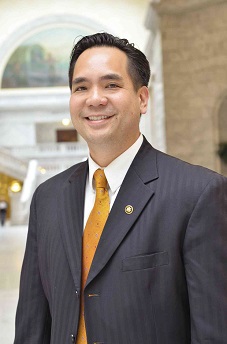
LOS ANGELES—Utah’s new attorney general, the first member of an ethnic minority to hold a state position, is of Filipino heritage.

Sean Reyes, a 42-year-old topnotch lawyer, is the son of immigrants with Filipino and Spanish roots, according to the National Federation of Filipino American Associations (Naffaa).

“As Filipino-Americans, we are elated that one of our own has gained the distinction and honor of serving as Utah’s top law enforcement officer,” said Naffaa, in a statement congratulating Reyes.

However, the United States Hispanic Chamber of Commerce (USHCC) described Reyes as Hispanic. The influential organization, in a statement applauding Reyes’ appointment, described him as “one of the first Hispanic lawyers to become a partner at a major Utah firm.”

The new attorney general played a crucial role in reestablishing the Utah Hispanic Chamber of Commerce and cofounded its education-targeted foundation, the USHCC said.

Reyes was also involved in a national commission established by former President George W. Bush to advise him on Hispanic American issues.


Reyes’ official biography said he “was born to immigrant parents of Spanish, Hawaiian and Asian heritage” while some newspaper articles mentioned his Filipino roots.

“I am humbled by the responsibility and the weight of the Attorney General’s office,” Reyes said in a statement posted on his office’s web site. “I respect what it stands for and I’m deeply appreciative of the trust Governor (Gary R.) Herbert has shown in me.”

Before his appointment, Reyes served for more than a decade as a small claims judge and two years on the governing body of the Utah State Bar.

As president of the Utah Minority Bar, Reyes received numerous state and national awards.

He got his bachelor’s degree from Brigham Young University, graduating summa cum laude, and earned a law degree with honors from University of California, Berkeley.

A Republican, Reyes will soon lead the fight to defend the voter-approved ban on same-sex marriage.
The 10th US Circuit Court of Appeals in Denver, Colorado has denied Utah’s motion for a stay on federal Judge Robert Shelby’s ruling that struck down a constitutional amendment banning same-sex marriage.

On Monday, the US Supreme Court granted the state’s request for a temporary halt on same-sex marriage while it appeals Shelby’s ruling that legalized such unions.

Reyes vowed to restore public confidence in the attorney general’s office previously headed by John Swallow, who resigned amid allegations of bribery and influence peddling.

Reyes, who ran for attorney general in 2012 but lost, would serve out the remaining two years of Swallow’s term.


Thursday, June 6, 2013

...the PH hot properties

Foreigners flock to PHL for property investments — consultancy firm


June 6, 2013


Foreigners are flocking to the Philippines for luxury residential investments amid tightening realty laws in other Asian countries, property consultancy firm CBRE Philippines said Wednesday.

Overseas Filipinos and the rising middle-class, on the other hand, continue to fuel demand for housing in the fringe areas of Metro Manila.

“The luxury residential sector will continue to pick up,” said Rick Santos, chairman at CBRE Philippines. “Foreigners are now moving from renters to buyers.”

“New restrictive property tax laws in Hong Kong and Singapore will drive more Asian residential investors to the Philippines,” he added.

While the Philippine Constitution prohibits foreign ownership of land, there is no restriction for foreigners to buy condominium units. Thus, foreign fund managers and retail investors buy luxury units by top developers here for investment purposes.

"Foreigners have opted to invest in branded condominium projects," said Santos. "And so far, they're very happy."

Early this year, Hong Kong and Singapore raised taxes for luxury homeowners and investment properties as part of their campaign against bubble risks stemming from speculative investments in the realty sector.

Investor-friendly tax laws

With tightening restrictions there, foreigners are turning to the Philippines – where tax laws are more investor-friendly and financing is relatively cheap – for secondary properties.

“Number one, it's much cheaper here from a tax perspective and cost. From a financing point of view, it's much more expensive to get financing there,” Santos said.

He noted that the Philippines' real-estate developers continue to benefit from foreign interest in branded developments.

Santos, however, was quick to add that he still doesn't see a bubble arising from such investment flows. “This isn't a bubble. This is sustainable,” he said.

“It is exciting. You will see a lot more money from mainland China, Russia, Europe, Korea and US flowing here,” Santos said.

OFWs and housing backlog

Overseas Filipino workers (OFWs) and middle-income earners support demand for residential products, particularly single-detached homes, in the fringe areas of Metro Manila

“OFWs and middle-income earners to sustain the demand for horizontal residential projects,” said Jan Custodio, CBRE Philippines' senior director for global research and consultancy.

“Economic housing will continue to observe strong take-up with its affordable prices and ample supply in the fringes of the country’s major cities,” he added.

Total housing needs for 2013 can reach 646,128 units, of which 57 percent will come from new households who can afford to own or rent, CBRE data showed. — KBK, GMA News


Friday, December 14, 2012

...the new US Federal Judge

US Senate confirms first Fil-Am federal judge


By Nimfa U. Rueda
LA Correspondent


Lorna Schofield


LOS ANGELES—The Filipino-American community is celebrating another milestone: The United States Senate confirmation of the first Fil-Am to serve as Article III federal judge.

By a 91-0 vote Thursday (Friday in Manila), the United States Senate confirmed trial lawyer Lorna Schofield, who was nominated by US President Barack Obama and Sen. Chuck Schumer of New York in April, as a federal district court judge for the Southern District of New York.

Article III judges are nominated by the President, confirmed by the Senate and appointed to lifetime tenure.

Schofield, 56, is the daughter of a Filipino woman who immigrated to the United States during the post-World War II reconstruction of the Philippines.

She grew up in a blue-collar community in the US Midwest, where she earned a full scholarship for her undergraduate education at Indiana University. She double-majored in German and English, graduating magna cum laude in 1977.

Schofield went to New York University (NYU) Law School, where she was a Pomeroy scholar and became editor of the NYU Law Review.

She worked at Debevoise & Plimpton LLP as a litigation partner for nearly 20 years. In 1991, she became the firm’s first minority partner.

Schofield shares a place in history with Judge Alfred Laureta, a Filipino-American who served as judge for the District of the Northern Mariana Islands from 1978 to 1988.

Although technically federal judges, those appointed to the District of Northern Mariana Islands are not lifetime tenure Article III judges but 10-year-term judges under Article I of the US Constitution, according to the Congressional Asian Pacific American Caucus (Capac).

Capac joined various Fil-Am groups in lauding the confirmation of Schofield.

“Ms. Schofield’s confirmation by the Senate is a historic moment not only for our community but [also] for the entire nation,” National Federation of Filipino American Associations (NaFFAA) national chair Ed Navarra said in a statement.

“Given that Asian Americans are significantly underrepresented in the federal judiciary, Ms. Schofield’s addition [to the bench] will greatly enhance the judiciary’s diversity,” he said.

“We need more role models like Judge Schofield to inspire our young people to aspire for public service,” said Gloria T. Caoile, a former White House commissioner.

“[The United States Senate’s] laudable action is a demonstration of their continued commitment to nominate well-qualified and diverse candidates to the federal bench,” said Rozita Lee, former NaFFAA national vice chair and a member of the White House Commission on Asian Pacific American Islanders.

“We are elated with her confirmation and our community is very proud to see a Filipino-American achieve this honor and distinction,” Lee said.

KAYA national cochair Jason T. Lagria said Schofield’s confirmation was “an inspirational story that shows there is no limit to what our community can achieve through perseverance and hard work.”

Lagria said the New York metropolitan area had the fourth largest Filipino-American population in the United States, “so it is encouraging to see our judiciary reflect the population it serves.”

“This is definitely a reflection of continued commitment from our country’s leadership,” said Ray Buenaventura, mayor of Daly City and honorary KAYA board adviser.

“[Schofield] will be an inspiration for the legal profession, especially those from minority groups,” said lawyer and community leader Arnedo Valera, executive director of the Washington-based Migrant Heritage Commission.

“Our judiciary and the legal system as a whole is best served when the judges belonging to different ethnicities are recognized and appointed to the bench,” Valera said.

Schofield also served as an assistant US attorney in the criminal division of the Southern District of New York. She became the first Asian-American Pacific Islander (AAPI) to chair the Litigation Section of the American Bar Association. The National Law Journal named her one of the nation’s 50 most influential minority lawyers.

Schofield and Judge Kiyo Matsumoto of the Eastern District of New York are the only judges of Asian descent to serve on the federal district courts of New York.

“It heartens me to know that the judiciary, the branch of government dedicated to the interpretation of our most important cornerstone–the Constitution–is becoming more reflective of the dynamism and diversity of our nation,” said Congresswoman Judy Chu, Capac chair.

Congressman Mike Honda, Capac chair emeritus, said Schofield’s confirmation is not only a victory for the people of New York and the nation as a whole but also a “giant step toward a more equitable representation of Asian-Americans and Pacific Islanders on the federal bench.”

“Ms. Schofield has broken many barriers throughout her career, and today’s confirmation symbolizes a judiciary that better mirrors the nation it serves,” Honda said.

Thursday, December 13, 2012

...the US best lawyers


Pinoy named one of best US lawyers under 40


GMA News
December 13, 2012


Rio M. Guerrero, Esq. was a 2012 recipient of the Best Lawyers Under 40 Award presented by the National Asian Pacific American Bar Association (NAPABA) to “talented and accomplished” lawyers.


Rio received his award at NAPABA’s 24th Anniversary Gala Banquet in Washington D.C. on November 17, an event attended by leading Asian American lawyers, judges, business leaders, and politicians, such as Supreme Court Justice Sonia Sotomayor, and Second Circuit Court of Appeals Judge Denny Chin. He accepted his award in the presence of his wife Joan and his mother Dr. Rosario Guerrero.

“I am deeply honored and humbled to receive this distinguished national award,” said Rio, who has been practicing immigration law for 15 years. His law firm Guerrero Yee LLP has an office in Manhattan. “It is an overwhelming feeling to be included among the most accomplished attorneys and judges in this country.”

NAPABA President Wendy Shiba congratulated Rio on his award. She said, “You truly deserve it. You are a champion of the (Asian Pacific American) community.”

Rio’s law firm has represented companies, organizations and individuals with U.S. visa, work permit, green card and other immigration-related matters, proud that he and his law partners are “descendants of immigrants.”

In 2012, the Filipino-American National Historical Society (FANHS) honored him with the Contributions to Excellence Award, recognizing his success as an attorney and his pro bono service to the Filipino American community.

Rio is also a member of the American Immigration Lawyers Association New York Chapter. He founded and co-chairs the Asian American Bar Association of New York (AABANY) Immigration and Nationality Law Committee.

Since 2007, he has taught as an Adjunct Professor of Immigration Law at the City University of New York School of Professional Studies. An Edward V. Sparer Fellow at the Brooklyn Law School, Rio holds a baccalaureate degree in Economics and a second one in International Studies as a Dean’s Scholar of The American University of Washington D.C.

AABANY President Jean Lee said she was “thrilled to see talented and deserving AABANY members being recognized by NAPABA.” Executive Director Yang Chen echoed Lee, saying, “We have always been fortunate to count some highly accomplished and distinguished attorneys and individuals among AABANY’s membership.” - The FilAm

Tuesday, October 9, 2012

...the Bangsamoro

UN Chief Hails Aquino Over ‘Bangsamoro’ Deal


Manila Bulletin
October 9, 2012
 
 
UNITED NATIONS (AFP) — UN Secretary General Ban Ki-moon Monday Ban commended President Benigno S. Aquino III for his vision and courage, as well as the commitment of the Moro Islamic Liberation Front (MILF) leadership in reaching a framework peace accord ending a decades-long Muslim separatist insurgency that killed 150,000 people.

This developed as MalacaƱang said nobody, not even the Moro National Liberation Front (MNLF), will be left out in the government’s consultations on the proposed creation of the new autonomous Bangsamoro region.

The agreement would see the establishment of a new semi-autonomous Muslim area in the resource-rich Mindanao, which the 12,000-strong MILF regards as its ancestral homeland.

Ban expressed “his heartfelt wishes for peace and prosperity to the government and the people of the Philippines,” and in particular the people in the new semi-autonomous region, called Bangsamoro.

Mindanao served as a base for the MILF, the biggest and most important remaining rebel group, after the Moro National Liberation Front signed a peace pact with the government in 1996.

It is one of the most fertile and resource-rich parts in the archipelago -- but decades of violence and unrest have left it into one of the poorest regions of the Philippines.

The rebellion, which began in 1978, has left 150,000 people dead and displaced hundreds of thousands more.

Senate President Juan Ponce Enrile said the framework agreement is doable without a constitutional amendment. This agreement must be “given a chance to work” and must be studied “carefully before shooting it down,” he stressed.

In a brief talk with Senate reporters, Enrile said the creation of Bangsamoro, a political entity that will replace the current Autonomous Region in Muslim Mindanao (ARMM), does not require amendments to the 1987 Constitution.

Chief Philippine negotiator Marvic Leonen, in an interview with Manila Bulletin, allayed fears about the framework peace deal, clarifying fears that the Moro National Liberation Front (MNLF) will be disregarded in the crafting of the peace agreement.

Leonen is certain that all Bangsamoro organizations such as the MNLF will play a crucial role in the crafting of the peace agreement.

He noted that the government peace panel (GPH) is certain to provide a seat for the MNLF in the creation of a Transition Commission that will work in the drafting of a Bangsamoro Basic Law to jumpstart the agreement. “We are definite that the MNLF will have a seat in the GPH,” Leonen said, citing that Cotabato City Vice Mayor Muslimin Sema, one of the founding members of the MNLF, has expressed his support to the framework agreement. Leonen also maintained that the agreement will push through this time following the stalling of a previous agreement five years ago on the memorandum of agreement on ancestral domain.

Leonen expressed confidence that there will no longer be any more delays in the creation of a Bangsamoro government. “How can you be wrong in this kind of approach? Look at the big picture.

The big picture is independence. They turned down to Cha-cha. They did not ask for an Islamic state.

We have been fair with respect to their territory, which is smaller than the MOA-AD, and culture such as applying the Shar’iah Court to the Muslims,” he said.

Deputy presidential spokeswoman Abigail Valte said the government has already posted the preliminary peace agreement with the MILF on its official website precisely to encourage public discourse prior to its formal signing next week.

Valte made the remarks after the MNLF reportedly expressed concern over the framework deal that seeks to create a new autonomous political entity by 2016.

Even former MNLF chief Nur Misuari has questioned the draft GRP-MILF peace agreement, insisting the government has not yet fully complied with the pact signed with the MNLF in 1996.

“The draft framework agreement was precisely announced even before the signing because we want to engage the public. We want to have discussions and consultations with the stakeholders,” Valte said in a Palace press briefing.

Meanwhile, various nations throughout the world has congratulated the Philippines and the MILF on the successful conclusion of the negotiations on the framework deal.

According to Catherine Ashton, the High Representative of European Union for Foreign Affairs and Security Policy and Vice-President of the Commission, "the early signature of this truly historical document is a major step towards a long-lasting peace in Mindanao, which will lead the island to stability and prosperity."

Ashton added that the EU recognizes the contribution of the Malaysian facilitator of the peace talks, Tengku Dato' Ab Ghafar Tengku Mohamed as well as the members of the International Contact Group, to the successful conclusion of the peace negotiations.

Earlier, United States Ambassador to Manila Harry K. Thomas, Jr. welcomed the announcement by the Philippines and the MILF that the two sides finalized a framework peace agreement.

UK Foreign Secretary William Hague said the UK believes the framework agreementhas the potential to bring peace, stability, and development for Muslims in Mindanao.

British Ambassador to Manila Stephen Lillie said the peace process between the GPH and the MILF has taken a huge step forward with this framework agreement. —wth reports from Sarah H. Velasco, Genalyn D. Kabiling, Mario B. Casayuran, and Roy C. Mabasa

Wednesday, September 26, 2012

...the internet's 6th most free country

Internet use in PH among world's most free


Internet use in the Philippines is among the most free in the world, a report said Wednesday, amid Pinoys' worry over of a newly approved law that critics say threaten online rights.

"People in the Philippines enjoy nearly unrestricted access to the Internet and other ICTs," independent watchdog Freedom House said in a report dubbed "Freedom on the Net 2012."

The Philippines was rated "free," scoring 23 points in the report where a score of zero means "most free" and 100 "least free".

This placed the country 6th out of 47 in the list, a spot it shared with Australia.

Performing better were Estonia, with a score of 10 points; U.S., 12 points; Germany, 15 points; Australia, 18 points; Hungary, 19 points; and Italy.

In Asia, the Philippines is the only country deemed "free."

South Korea was a far second with a score of 34 points. It was followed by India, 39 points; Indonesia, 42 points; and Malaysia, 43 points.

"To date, the [Philippine] government has steered clear of blocking access to any type of online content," said the report, which covered the January 2011-May 2012 period.

During the survey period, however, the report noted eight proposed measures on the "regulation of online content."

Such proposals have raised concerns the government is seeking to institute a "filtering infrastructure" which "could be potentially used for political and social censorship," Freedom House said.

Cry vs. cybercrime

"The law can be invoked to restrict access to and use of the Internet," Kabataan (youth) party-list Rep. Mong Palatino said in a phone interview.

Although the intention of the measure is to "protect rights," it may be misconstrued to support censorship, he added.

"The law will also definitely have a 'chilling effect' on press and Internet freedom," Palatino told Yahoo! Southeast Asia.

Although written before the enactment of the anti-cybercrime law, the report seems to echo Palatino's fear, as it cited the tendency of self-censorship in the Philippines.

"[G]iven that many news websites are online versions of traditional media—-many of whom self-censor due to the high levels of violence against journalists in the country—-it is fair to surmise that self-censorship is reflected in the content of online outlets as well," the report said.

This, even as it noted that "the Filipino blogosphere is rich and thriving."

"In 2010, the Philippines together with Indonesia led blog growth in Southeast Asia with an 18 percent increase from
the previous year," Freedom House said.

"Both state and non-state actors actively use the internet as a platform to discuss politics, especially during elections," it added.

Palatino, for his part, urged Filipinos to further heighten online engagement on policy issues, particularly the Cybercrime Prevention Law.

"If netizens will oppose the absolute implementation of the law, then the measure may actually serve its intention," Palatino said.

Palatino added that instead of moving to regulate the Internet in the Philippines, the government should strive for a policy environment that will spur its growth, he added.

"One possible step is the implementation of an Internet Bill of Rights," Palatino said.

Stifling Internet growth in the Philippines are "mergers and acquisitions amid the country's market liberalization initiatives during the 1980s and the absence of anti-trust laws," Freedom House said.

It particularly cited the Philippine Long Distance Telephone Co. (PLDT) whose recent acquisition of Sun Cellular operator Digital Telecommunications Philippines, Inc. gave it 70 percent of the country's telco market.

"The slow growth of the broadband industry is mainly due to the dominance of the privately-owned PLDT that has maintained a stronghold since the late 1920s," the report said.

Tuesday, September 18, 2012

...the case of speaking Filipino

Filipinos win settlement in English-only case


Associated Press


DELANO, California — Dozens of Filipino hospital workers in California will share a nearly $1 million settlement in a lawsuit claiming they were targeted by a rule requiring English only at work, federal officials said Monday.

The settlement involves nearly 70 nurses and medical staff members who accused Delano Regional Medical Center in California’s Kern County of banning them from speaking Tagalog and other Filipino languages while letting other workers speak in their native languages, including Spanish, the US Equal Opportunity Employment Commission announced.

The lawsuit, filed jointly by the commission and the Asian Pacific American Legal Center in 2010, accused the hospital of creating a hostile working environment for Filipinos by singling them out for reprimands and by encouraging other staff to report them.

The medical center defended its English-only policy as essential to patient care. In a written statement, officials said the hospital did nothing wrong.

Under California law, employers can require workers to speak English if there is a business necessity.

For decades, thousands of nurses from the Philippines have migrated to the United States to alleviate the nursing shortage. More than half of American nurses trained abroad are from the Philippines.

Filipino nurses in Delano said they were called to a special meeting with hospital managers in 2006, warned not to speak Tagalog, and told surveillance cameras would be installed, if necessary, to monitor them. No other language groups were included in the meeting, the lawsuit states.

Since then, workers said, they were told on a daily basis by fellow staffers to speak only English, even on breaks. The workers allege they were targets of undue scrutiny, discipline, harassment and threats over the issue.

The hospital’s policy, which requires the use of either English or the patient’s preferred language while care is provides, remains in effect, the hospital’s statement said, though it has been updated.

As part of the settlement, the hospital also agreed to develop strong protocols for handling complaints of harassment and discrimination; adopt a language policy that complies with the Civil Rights Act; and conduct anti-harassment and anti-discrimination training for all staff with additional training for supervisors.

Delano Regional Medical Center is a 156-bed hospital located about 30 miles (48 kilometers) north of Bakersfield.


Sunday, August 26, 2012

..the new Chief Justice

PH gets first ever lady Chief Justice in Lourdes Sereno


The Philippines has a new Chief Justice.

Supreme Court Associate Justice Maria Lourdes Sereno makes history as the first woman to be appointed head of the judiciary.


President Benigno "Noynoy" Aquino III on Friday named Sereno as the 24th Chief Justice of the Supreme Court, months after ex-Chief Justice Renato Corona was removed from his post by an impeachment court.

“In the midst of this period of deep mourning for the loss of Interior and Local Government Secretary Jesse Robredo, the President is cognizant of his constitutional duty to appoint the next Chief Justice of the Philippines. He has therefore decided to appoint Associate Justice Maria Lourdes Punzalan Aranal-Sereno as the 24th Chief Justice of the Supreme Court,” Presidential spokesperson Edwin Lacierda said in a statement Friday.

Sereno bested other five Supreme Court "insiders" who were on the JBC shortlist submitted to Aquino such as acting Chief Justice Antonio Carpio (7 votes) as well as Associate Justices Roberto Abad (6 votes), Arturo Brion (6 votes), and Teresita Leonardo-De Castro (5 votes).

Sereno, 52, is the second youngest to be appointed as Chief Justice and will have 18 years before reaching the mandatory retirement age. This means she will potentially have the longest term in recent Supreme Court history. She will also be serving alongside four Presidents: Aquino and the winners of the 2016, 2022, and 2028 national elections.

“The President is confident that Chief Justice Sereno will lead the judiciary in undertaking much-needed reforms. We believe the Judicial Branch of government has a historic opportunity to restore our people’s confidence in the judicial system,” Lacierda added.

Sereno was among the witnesses that the House prosecution panel wanted to testify at the impeachment trial of ex-chief justice Renato Corona.


Bayan Muna Rep. Neri Colmenares, a member of the prosecution panel, had invited Sereno to testify but prosecutors ended their presentation of evidence before she could respond. Sereno said this superseded prosecution's invitation.

Justice Secretary Leila De Lima, who did testify, quoted from Sereno's dissenting opinion on a decision to allow Pampanga Rep. Gloria Macapagal-Arroyo to leave the country.

According to Sereno's dissenting opinion, "Corona sent in his own handwritten corrections on the typewritten draft Resolution from Justice (Prebitero, Jr.) Velasco with the instruction that the Chief Justice’s version is to be immediately promulgated."

Prosecutors said this showed irregularities in how the temporary restraining order on a government barring foreign travel for Arroyo was issued.

Senate President Juan Ponce Enrile ruled that De Lima was not present during SC deliberations on the TRO, so her testimony on that was hearsay.

In April, Sereno was among the justices who voted against having the Department of Agrarian Reform pay for Cojuangco-owned Hacienda Luisita based on 1989 rates. The Cojuangcos had been asking for compensation based on the current land value, around P1 million per hectare, or around P5 billion, from the government.

Sereno was co-counsel with Justice Florentino Feliciano on the Fraport case before the International Centre for the Settlement of Investment Disputes and in the Philippine Air Terminals Company, Inc. (PIATCO) before the International Chamber of Commerce-International Court of Arbitration in Singapore. The Republic of the Philippines won both cases.

Sereno has a Master of Laws degree from the University of Michigan Law School, a Bachelor of Laws class degree from the University of the Philippines College of Law, where she was class valedictorian, and an Economics degree from Ateneo de Manila University.

Monday, June 11, 2012

...the PH law students in ILO

Pinoy law students win top prize in ILO video contest

 06/11/2012
 
 
MANILA, Philippines - Three Filipino law students took home the top prize in a worldwide video contest organized by the International Labor Organisation (ILO).
The entry submitted by Alfonso Orioste, Jr., Janeca Naboya and Gian Carlo Miranda beat out hundreds of entries from around the world. The contest, which was open to individuals or groups ages 18-29, was aimed to show how the global economic crisis affected the lives of the youth.

Based on a statement issued by the Department of Foreign Affairs, the team's winning video entry "Listen to my Story" is about Janet, a Filipina teacher who is forced by circumstance to seek employment as a domestic worker in the Middle East. 

The team received the prize during ILO's Youth Employment Forum held in Geneva, Switzerland from May 23 to 25. 

Orioste, Naboya and Miranda are currently students of the law schools of San Beda College, Lyceum of the Philippines and Ateneo de Manila University, respectively.

Saturday, May 5, 2012

...the World's best climate change law

UN lauds Philippines' climate change laws 'world's best'


Manila (Philippine Daily Inquirer/ANN) - The Philippines' laws on climate change adaptation (CCA) and disaster risk reduction (DRR) are the "best in the world," UN special envoy Margareta Wahlstrom said Thursday.

Wahlstrm, special DRR representative of UN Secretary General Ban Ki-moon, praised the Philippines for taking the lead in the global campaign to mitigate disaster risks brought about by global warming.

She commended Senator Loren Legarda, the UN Champion for DRR and CCA for Asia and the Pacific, for ensuring the passage of climate-responsive laws and for mainstreaming the CCA and DRR mechanisms into the national political agenda.

"You do have now an excellent legal framework for disaster risk reduction and an excellent legal framework for climate adaptation. The basis [of the laws] is really for empowering local governments," Wahlstr?m said in a press conference.

Legarda thanked Wahlstr?m for the compliment, but told the media that the "challenge is to translate them into local community action to save lives, and reduce disaster risks and economic losses."

An environmental crusader for two decades now, Legarda authored the Climate Change Act of 2009 (Republic Act No. 9729), which created the Climate Change Commission and cosponsored the Philippine Disaster Risk Reduction and Management Act of 2010 (RA 10121).

Wahlstrom stressed that both laws highlighted the policy shift from a reactionary to a proactive stance in addressing disasters.

"We have in the Philippines the best two laws-not only in Asia-Pacific, but in Margareta's words-in the world," said Legarda.

Since her arrival on Tuesday, Wahlstr?m has met with government officials, businessmen and donors. She will be here until May 5 to engage both the government and private sector in strengthening the country's disaster resiliency initiatives.

She will go to Albay province, where she will have a discussion with 31 mayors in a two-day seminar sponsored by Governor Joey Salceda.

"We are here to really sustain engagement in the Philippines, and support the realization of the legal basis of the action plan that already exists in the country," Wahlstrom said.

Wahlstr?m talked about the international strategy on disaster risk reduction, or UNISDR, that called for "safe schools, safe hospitals and safe cities" through programs such as the retrofitting of buildings, the relocation of communities and government public infrastructure from hazard-prone areas, and capacity-building such as disaster-preparedness training.

Other environment laws

Legarda also authored other environmental laws such as the Renewable Energy Act, Solid Waste Management Act and the Environmental Awareness Education Act.

She pointed out that "the challenge is to translate national policies, plans and programs into local action with measurable gains."

She said that with the policy framework already in place, what was needed was to make the laws work at the grassroots' level.

Sunday, October 9, 2011

...the Maid in Hong Kong

Filipino maid in Hong Kong can’t believe she made history

By Yolanda Sotelo
Inquirer Northern Luzon


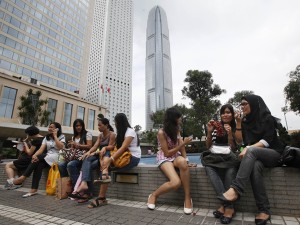
POLARIZED HONG KONG. Foreign maids gather in Central, business district in Hong Kong. A Filipino maid in Hong Kong won the opening legal battle in her fight for permanent residency after a court ruled that an immigration provision excluding the city's hundreds of thousands of foreign maids was unconstitutional. The decision has polarized opinions in Hong Kong and has also prompted different reactions among maids themselves. AP photo/Kin Cheung


URDANETA CITY, Pangasinan—Evangeline Vallejos is happily incredulous that she won her case for permanent residency in Hong Kong, for which she had been fighting for three years.

“Unbelievable,” she said on Saturday when reached by the Inquirer in China where she was vacationing with her employers. “But I am very happy I won. Ang tagal kong hinintay ito (I have long waited for this).”

Vallejos, 59, has been employed as a maid in Hong Kong since 1986. She said that while she was not sure she would win the case, she trusted the law granting permanent residency to foreigners who had lived in the Chinese territory for seven years.

She said many Filipino workers in Hong Kong were happy about the court decision handed down on Sept. 30 because it paved the way for thousands of others to seek permanent residency.

But in Barangay Paurido where Vallejos’ family lives, there was hardly a stir when news broke of her legal victory.

Family members took pride in her achievement. But while a door has been opened for them to live in Hong Kong, Vallejos’ husband, Zacarias Oria, said they were not planning to do so.

And Vallejos—who is using her maiden name as it appears in her passport—has not discussed with the family the possibility of settling there, Oria told the Inquirer in an interview recently.

In reports, Justice Johnson Lam was quoted as saying in his decision that the immigration provision denying foreign maids the right to gain permanent residency after seven years, which is granted to other foreigners, was inconsistent with Hong Kong’s Constitution.

But the Hong Kong government will appeal Lam’s ruling, the reports said.

Fighter

Oria, 60, said he received a call from his wife shortly after the decision was issued.

“It was a very brief call. She just said, ‘Nanalo ang kaso (The case won),’ then the phone went dead. Then I saw the news on TV the next day,” he said.

Oria, a tricycle driver, has visited his wife in Hong Kong only twice. “Life is difficult there, and there are no available jobs for men. Most jobs there are for women,” he said.

Vallejos’ legal fight and her eventual victory did not come as a surprise for Oria and their five adult children.
Oria described his wife as “a fighter who will not stop fighting for what she thinks is right.”

“Matapang siya, palaban (She’s brave, aggressive),” he added. “That’s why I was not afraid when she decided to pursue the case for her permanent residency.”

The children, all now employed and raising their own families, said they were proud of their mother.
“Imagine, she is only a maid and a high school graduate but she managed to fight for her permanent residency in Hong Kong,” said her third child, Ryan.

Vallejos managed to send the children to college with her earnings as a maid.

Reggie, 36, has a degree in electronics and communication engineering; Renante, 34, in architecture; Ryan, 32, in accountancy; Gilbert, 29, in nursing; and Jaime, 27, in business management.

Helping hand

According to Ryan’s wife, Shiery, Vallejos is helping other maids in Hong Kong who are grappling with various problems, including abuse by their employers, early termination of work contracts, and illness.

“Siya ang sumbungan (They take their problems to her). She never lets them down. She goes with them to the labor department to seek settlement of the cases. Most of the time, she is able to get help and benefits for distressed OFWs (overseas Filipino workers),” Shiery said.

It helps that Vallejos’ employers, whom she has been serving for 25 years, are kind and supportive of her advocacy. It was they who encouraged her to pursue the permanent residency case, Shiery said.

She said the house of Vallejos’ employers was always open to her fellow Filipinos as well as her guests from the Philippines.

Vallejos has apparently become so close to her employers that one of them flew to the Philippines in July to stand as sponsor at the wedding of her youngest son.

Shiery and another daughter-in-law, Erna (Renante’s wife), also worked in Hong Kong as maids on Vallejos’ prodding.

“She wanted us to experience her life as a domestic helper,” said Shiery, a management graduate. “We stayed there for two years. It’s a difficult job.”


Happy family

Before she went to work as a maid in Hong Kong, Vallejos was a washerwoman in Urdaneta City.
Oria said he and his wife had agreed that she would work overseas and he would stay to tend to their children.

“Ang hirap kasi ng buhay namin noon. Inaapi kami dahil wala kaming pera (Our life was so hard then. We experienced being oppressed because we had no money),” Oria said.

It was inevitable that the children, some of whom were mere toddlers when their mother left, grew closer to their father.

Recalled Ryan: “Sometimes she would be jealous because of our close relationship with our father. She would say, ‘I know I did not raise you.’ But ours is a happy family. We would make her laugh and everything would be all right again. She would laugh again.”

The children also said their mother tried to make up for her absence by constantly phoning and talking to them.

They said she always reminded them not to fight and to always stand by one another.

Friday, September 30, 2011

...the Hong Kong landmark case

Filipina wins landmark Hong Kong residency case


Agence France-Presse, Associated Press


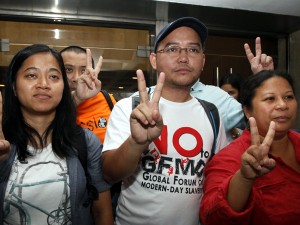
Eman C. Villanueva, second right, secretary general of the United Filipinos in Hong Kong, and other supporters of the Filipino migrants organizations flash victory signs outside High Court in Hong Kong Friday. AP


HONG KONG—A Filipino maid in Hong Kong won the opening legal battle Friday in her fight for permanent residency after a court ruled an immigration provision excluding the city’s hundreds of thousands of foreign maids was unconstitutional.

The legal action, brought by Evangeline Banao Vallejos, who has lived in Hong Kong since 1986, has cast a spotlight on the financial hub’s treatment of its army of 292,000 maids, most of whom are from the Philippines or Indonesia.

The High Court ruled that the immigration provision denying the maids the right to gain permanent residency after seven years — as other foreign residents can — was inconsistent with the Basic Law, Hong Kong’s mini-constitution.

“My conclusion is that on the common law interpretation approach the impugned provision is inconsistent with (Hong Kong’s Basic Law),” Judge Johnson Lam wrote in a ruling issued Friday.

Lam rejected arguments by Hong Kong government lawyers that the maids did not have the same residency status as other foreign residents.

“The mere maintenance of (a) link with her country of origin does not mean that (a maid) is not ordinarily resident in Hong Kong.”

The government is likely to appeal Friday’s ruling.

The case was launched by Vallejos, a longtime foreign domestic helper, who sought a judicial review after her bid for permanent residency was rejected.

Vallejos’s lawyer Mark Daly hailed the decision as “a good win for the rule of law.”

“To be clear, Ms Vallejos won on the unconstitutionality of the provisions,” said Daly, one of the lawyers handling her case.

“We spoke to Vallejos—she said she thanks God and all the people who have helped her, including her employer and her lawyers,” he said. “She is busy working so she has no time to be here today.”

The case has divided opinion in Hong Kong, with some arguing that immigration provisions barring maids from applying amounts to ethnic discrimination.

Activists said the legal challenge would entrench domestic workers’ right to equality, but opponents fear it will open the floodgates to new immigrants, which would put a strain on the city’s resources.

A pro-government political party has warned there would be an influx of as many as 500,000 people — including children and spouses of foreign maids — that would cost HK$25 billion ($3.2 billion) in social welfare spending.

The Democratic Alliance for the Betterment and Progress of Hong Kong forecast unemployment could jump from the current 3.5 percent to 10 percent.

The government has declined to say how many maids would currently be eligible to apply for permanent residency.

Under Hong Kong law, foreigners can apply to settle in the city after seven years of uninterrupted residency, but maids were specifically excluded.

Vallejos challenged the restriction, saying it was unconstitutional and discriminatory, but the government argued in court it was “appropriate” and that it is empowered to define who is eligible for residency.

Another court hearing will be held on October 26 on whether Vallejos can now be declared a permanent resident, but government lawyers have already said they would appeal any ruling in favor of the maids.

The case could also have implications beyond Hong Kong for other Asian economies that rely on cheap imported labor for cooking, cleaning and care of the young and elderly.

Foreign maids in Hong Kong are entitled to better working conditions than in other parts of Asia — they are guaranteed one day off a week, paid sick leave, and a minimum wage of HK3,740 ($480) a month.

But rights groups say they still face general discrimination and a lack of legal protection. A maid’s visa is tied to a specific employer, leaving her vulnerable to domestic abuse, the activists say.

Without the right to permanent residency, if dismissed by her employer she must find another job in domestic service or leave Hong Kong within two weeks.

Daly said he expected the government to appeal within the 28-day deadline.

About 290,000 of Hong Kong’s 7.1 million people are foreign maids.

Thursday, March 24, 2011

...the Federal judge

Fil-Am in Federal Court proud of her roots

03/24/2011


WASHINGTON DC – Three months into her new job as an Associate Justice of the Washington DC Superior Court, Judge Maribeth Raffinan is the highest ranking Filipino-American in a federally-administered court.


The daughter of doctors Jun and Maria Raffinan of Cebu, she reached out to fellow Filipinos during an event of the Philippine American Chamber of Commerce and the Philippine American Bar Association of Metro DC.

“We started in a small town of Hillsboro where the population of that town was about 6,000 people but there was about 5 Filipino families there and I can tell you this, we dominated that town!”, she told them in jest.

From that small town in Ohio, the Raffinans moved to Tampa, Florida where her parents had a successful medical practice. Now a parent herself, Judge Raffinan has found her biggest fans in her husband, their 4-year-old daughter and 19-month-old Jonah.

“When the kids get to see their mom as a judge, the kids are really proud of their mom. It’s a great accomplishment and we’re very proud of her”, her husband, Efrem Levy, said.

Rafinan spent 11 years with the Public Defenders Office before President Barrack Obama named her to the post last October.

Fil-Am lawyers helped push her appointment in the White House.

She was confirmed by the US Senate in December and has a fixed term of 15 years.

“It’s important for the judiciary to have a lot of diversity on the bench because it brings a lot of different values and perspectives to the bench and it’s important to think about where you came from and as a Filipino-American i think that’s what’s important to me”, Rafinan said.

At age 40, Justice Raffinan’s road in the judiciary is long and full of promise, but for now, she says she’s just focused at being a good and fair judge.