Showing posts with label schools. Show all posts

Thursday, February 21, 2019

...the Asia-Pacific top univeristies

UP, DLSU among top universities in Asia Pacific 


CNN Philippines| 21February 2019

Metro Manila —  Two Philippine universities were included among the top educational institutions in the Asia-Pacific region, according to London-based data provider Times Higher Education (THE).
Results published on Wednesday showed that the University of the Philippines (UP) and the De La Salle University (DLSU) were in the top 300 schools of the region.
UP was at 101st-110th bracket, an improvement from its 2018 ranking of 151-160.
DLSU joined the list at the 201st-250th bracket. The Taft-based institution was unranked last year.
China's Tsinghua University rose to the top spot from its second place in 2018. It displaced the National University of Singapore which dropped to No. 2.
The University of Melbourne came in third.
The Hong Kong University of Science and Technology and the University of Hong Kong were in fourth and fifth spots.
Japan listed the most number of schools in the rankings, with 103 of its universities featured.
The Asia-Pacific University Rankings analyzed universities across East Asia, Southeast Asia, and Oceania. The featured schools represented 13 countries.
UP and DLSU were also the only Philippine universities in the Emerging Economies for 2019 of the same data provider.

Wednesday, May 14, 2014

...the Asia's best schools

5 Phl universities make Asia’s best list

MANILA, Philippines - Five universities in the Philippines made it to the Top 300 Asian universities list of the London-based education and career network Quacquarelli Symonds (QS).

The state-run University of the Philippines-Diliman remains the country’s top school after it was ranked 63rd in the 2014 QS University Rankings in Asia.

UP’s latest ranking was higher than last year’s 67th spot. Its best performance was in 2011 when it was ranked 62nd among Asian universities.

It was followed by Ateneo de Manila University at 115th place from last year’s 109th and the University of Santo Tomas, which ranked 141st from last year’s 148th.

De La Salle University remains in the 151-160 grouping. Ateneo de Davao University was included in the 251-300 bracket for the first time.

The University of Southern Philippines, which was included in the 251-300 bracket last year, did not make it to the 2014 list.

“This is a much more encouraging set of results for Filipino institutions, following on from two years in which many of them have seen their ranking drop,” QS head of research Ben Sowter said in a statement.
 
“The proposed ASEAN Economic Community may help more Philippine institutions gain greater recognition in the coming years through greater inter-regional collaboration and exchange programs,” he said.

Sowter noted the Philippine universities scored relatively weak on the internationalization indicators, which measure the proportion of international students and staff, and participation in exchange programs.

Despite making the top 50 for both academic and employer reputation, UP failed to make it to the top 200 in all four internationalization indicators, Sowter said.

The National University of Singapore topped the ranking for the first time.

In second place is the Korea Advanced Institute of Science and Technology, followed by the University of Hong Kong, Seoul National University and the Hong Kong University of Science and Technology.

The Chinese University of Hong Kong landed in sixth place, followed by Singapore’s Nanyang Technological University, China’s Peking University, South Korea’s Pohang University of Science and Technology and the University of Tokyo.

UP has overtaken University of Indonesia (71) in the ranking. Also in the list are Malaysia’s Universiti Malaya (32), Thailand’s Mahindol University (40), Chulalongkorn University of (48), Universiti Kebangsaan Malaysia (56), and Universiti Sains Malaysia (57).

The Top 300 universities were ranked by QS based on academic and employer reputation, faculty and student population and international students and faculty, among others.
Calendar shift
 
UP, Ateneo, De La Salle and UST have shifted their academic calendar to synchronize it with other universities in Southeast Asia.

University officials said changing the school calendar will help facilitate the enrollment abroad of Filipino students and faculty members while attracting foreign students.

At present, the Philippines is the only member of the ASEAN that follows the June-to-March academic calendar. Cambodia, Laos, Indonesia, Singapore, Malaysia, Vietnam, and Thailand are all following a September-to-May school calendar.

Philippine universities are expected to perform better in global rankings with the decision to shift the academic calendar.

“We expect to go higher as soon as student mobility will increase,” UP vice president for public affairs Prospero de Vera told The STAR yesterday. “We’re getting closer to them. Although many ASEAN schools are aggressively improving on internationalization.”

For his part, UP president Alfredo Pascual said the improvement in the ranking can be attributed to the university’s efforts to increase funds and incentives for research, upgrading of facilities and improving support for PhD and master’s scholarships.

“We need to build facilities for foreign students such as dormitories, well equipped laboratories, IT-enabled classrooms, sports facilities and improve the quality of education through curriculum reform and competent faculty,” he said.

De Vera noted that the QS rankings did not include “public service” as an indicator, saying UP will rank higher as it is one of the thrusts of the university.

“One third of the budget of UP goes to PGH (Philippine General Hospital),” he said. “Its impact is not counted.”– Janvic Mateo


Wednesday, January 15, 2014

...the Asia's Next Top Model Season 2 hopefuls

Two Filipinas represent Philippines in ‘Asia’s Next Top Model’ season 2


Who between Jodilly Pendra (left) and Katarina Rodriguez (right) will come out on top as “Asia’s Next Top Model”?-PR Photo
 
 
MANILA, Philippines- Two Filipinas are representing the Philippines in the second season of “Asia’s Next Top Model.”

Jodilly Pendra and Katarina Rodriguez are the two Pinays who were lucky to be included among the show's 16 contestants.

In a presscon held Tuesday afternoon, January 14, the entertainment press got to know them better.

Jodilly, 20 years old, took up and finished an Information System course at the University of Santo Tomas. Still, she says, she is not a "computer nerd", but someone who "sometimes loves to program.”

Prior to joining the modeling contest, Jodilly or Jody to those close to her, has been in the modeling industry for four years already and has helped her pay for school.

She was given a partial scholarship at the UST, but she says that her family could not afford to pay the rest of her tuition.

“I was forced to model, to go into the modeling industry because I needed to pursue my studies,” she relates. “I really, really wanted to finish my studies because my father died before I graduated from college.”

With her perseverance and dedication, Jody was able to finish her studies and now finally decided to pursue her dream of joining “Asia’s Next Top Model.”

“Gusto ko talaga sumali ng Asia’s Next Top Model pero ayaw ko na habang nag-aaral ako kasi mapipilitan ako mag-stop. So nang nakita ko ulit ‘yon, nag-audition ako.”

Meanwhile, the other Filipina who made it to the competition is the 21-year-old Katarina or Kat as she’s fondly called.
 
 
Unlike Jody, Kat didn’t have any experience in modeling, since she’s very focused with her studies as she’s currently taking a double major in philosophy and business management at the De La Salle University, and also a member of the university's track and field varsity team.

“I joined the show because I always wanted to try and go for it,” she said. And thanks to her friends who encouraged her, she finally had the guts to give modeling a shot.

“My barkada really believed in me, they pushed me to at least audition,” she recalled, which she said happened during her 21st birthday. “They were saying, ‘you’re 21, you’re getting old.’ So I auditioned and actually got in.”

But then, her grandfather whom she describes as “conservative” at first didn’t approve of her plans.
So with the help of her relatives, “he allowed it and I think he saw that I had my time of my life there.”

Representing Philippines

The two Filipinas are “excited” and “proud” to represent the Philippines in the competition.

“The pressure is on!” Kat says with a laugh. “My mentality during the show, I’m not only representing the Philippines, but I’m also representing all the younger girls.”

While on the other hand, Jody says, “Sobra lakas ng fighting spirit ko. Kaya sabi ko sa sarili ko, I won’t be pressured pag ando’n na ko sa model house.

“I’m here, I will focus, I’m here to win and I’m here to give pride to Filipinos. So more on excitement ang naramdaman ko kaysa pressure kasi I really enjoyed being there.”

The two are not yet allowed to reveal who won the competition, though they’re already done taping the whole second season.

Yet they admit that the experience in joining “Asia’s Next Top Model” has changed their lives a lot.

“It is a process,” Kat replies. “It is a big change especially I’m balancing school, and track [and field] and this. And I want to promote myself and this show as much as I can. So you know it’s really time management, so I’m really busier than I was before.”

For Jody, who says joining the competition is a dream come true, relates that “I learned how to present myself. I learned how to manage my emotions when you’re with other types of people. You know, when you’re with the other girls [and] they have different culture, so it’s really hard for me.”

Will one of Jody and Kat take home the title this season? Catch the season 2 of “Asia’s Next Top Model” on TV5 starting Thursday, January 16, after “For Love or Money.”


Friday, November 29, 2013

...the PH cheerleader

Philippines places 3rd in cheerleading world championships
 
 
Sun Star
Friday, November 29, 2013


THE Philippines provided another milestone by taking two bronzes in the recently concluded 7th Cheerleading World Championships at the Impact Arena in Nonthaburi, Bangkok, Thailand.

Bannered by the 3rd PSC-Philippine National Games champions -- the University of the Philippines pep squad, along with teams coming from 3rd PNG co-champions from Centro Escolar University, St. Pedro Poveda College and the Zamboanga City Red Barons -- the nationals duplicated their bronze medal finish in 2011 with an aggregate score of 408.5 points in the Team Cheer event, behind repeat World Champions Japan with 517 points and hosts, Thailand, who also repeated their silver medal placing with a score of 496 points.

Philippines places 3rd in cheerleading world championships
Contributed photo

The first surprise bronze medal was captured by Philippines Team B, which was anchored by UP Pep squad members Audrey Munoz, Donina Ramirez and members Aaron Casurao, Leandro De Chavez, Nil Costales and Kim Parra. They surprised the highly favored teams from Russia, Slovenia and former world champions Chinese Taipeh with a score of 223 points.

Russia took home the gold in the mixed group stunts event, while Thailand Team A took the silver with 229.5 points.

The Philippine All Female teams who were in contention for a bronze medal before the start of the finals failed to gain momentum by and landed sixth (All female team, 268.5 points) and fourth place (All female group stunts, 124.5 points). Japan dominated both events followed by Germany and Russia.

The Cheerdance team was 7 points adrift of bronze behind Poland and Japan on the first day but couldn’t gain ground as they finished fifth with a total score of 343 points. Russia again flexed its muscle in this event followed by Germany and Poland.

In all, it was the best showing by the Philippines by far in the any international cheerleading competition since competing in the international stage in 2007. It augers well for programs of the Gymnastics Association of the Philippines, which is celebrating its 50th anniversary and the Philippine Sports Commission, which is embarking on mass-based program through the Batang Pinoy Games.

The team arrives in Manila today and will start in helping in the relief and rehabilitation efforts of the Typhoon Yolanda victims in the Visayas region. (PR)


Thursday, November 28, 2013

...the Math wizzards in Taguig


Philippines bags 62 medals in 10th IMSO


Filipino elementary students took home 62 medals including three gold in the 10th International Mathematics and Science Olympiad (IMSO) for Primary School Students held in the country from Nov. 25 to 29.

Math, Science, Philippine studients, Manila Bulletin
Gold medalists (front row from left) Sanprem Taechawichian of Thailand, Stefan Marcus Ong and Steven Reyes of the Philippines, Stanve Avrilium Widjaja of Indonesia and Yu Chia Zhang of Singapore show their medals awarded by officials led by Mayor Lani Cayetano of Taguig (back row fourth from left). (Photo by Jonathan Hicap)


The IMSO drew contestants from South Africa, Thailand, Taiwan, Indonesia, China, India, Nigeria, Singapore, Sri Lanka, Nepal, Kazakhstan, Brunei, Malaysia, and host Philippines.

The country won three gold, 18 silver and 41 bronze medals in the competition organized by Mathematics Trainers Guild-Philippines (MTG) under Dr. Simon Chua and the City of Taguig under Mayor Lani Cayetano in cooperation with the Department of Education (DepEd) and the Science Education Institute of the Department of Science and Technology (DOST-SEI).

The mayor and her husband Senator Alan Peter Cayetano, and DOST-SEI Officer-in-Charge Elizabeth Fontanilla led the awarding ceremony held on Nov. 28 at the Samsung Hall of SM Aura Premier at Bonifacio Global City in Taguig.

In Math, winners of gold medals for the Philippines are Stefan Marcus Ong and Steven Reyes of St. Jude Catholic School and John Henry Marquez of UP Integrated School.

Winner of silver medals in math are Wiliam Joshua King, Matthew Eric Tan, Audrey Sy, Marksen Viktor Lizarondo, Marjana Ysabelle Montanez, Eion Nikolai Chua, Fedrick Lance Lim, Maxinne Louise Dominique Co, Vanessa Ryanne Julio and Patrick Nino Policarpio.

Bronze medalists are Ken Rassel Isidro, Al Patrick Castro, Bryce Ainsley Sanchez, Kylee Wiona Sy, Ryan Jericho Sy, Genrish Wendell Ng, Vincent Paul Fadri, Hanna Jo, Hiraya Marcos, Naomi Anne King, Ma. Erin Daphne Raton, Albriz Moore Bagsic, Robert Gerard Uy, Elean Almazan, Vien Vicente Jio Viloria, Lance Andrei Esteban, Ellan Puerto, Allyana Coleen Reyes, Christopher Neil Defensor and Kristin Angela Narag.

In Science, the Filipino silver medalists are Hugh Angelo Sonon, Jernnex Mullaneda, Neil Joshua Patiag, Dion Stephan Ong, Katrina Laura Colasito, Joseph Ryan Ong, Lyra Winette Tamayo and Neil Martin Cantillana.

Science bronze medalists are Gabrial Joseph Pua, Laila Denise Dy, Sophia Marion Medina, Lance Kendrick Sebastian, John Ian Lenix Hingan, Justin Miguel Quismundo, Sean Marcus So, Jerome Pasia, Kathleen Ann Sison, Martie Angelica Bueno, Aleck Josef Aquino, Ma. Leibniz Charisse Parra, Ayeasha Alea Irabagon, Raymund Carlo Masbano, Joshua Alvarez, Sherwin Adrien Tiu, Monica Panti, Ashley Maive Butcon, Ryan Christopher Deodores, Marc Danielle Bas and Immanuel Josiah Balete.

In Math, Chen Xinyl of Singapore emerged as the overall top scorer while Master Papon Lapate of Thailand was best in exploration and Yu Chi Zhang of Singapore took home the best in theory award.

In Science, Kar Weng Sean Leong of Singapore won as the overall winner and Bowen Jiang of Singapore was best in experiment. Disanayaka Mudiyanselage Sumanasekara of Sri Lanka was best in theory.

Dr. Chua thanked Mayor Cayetano and city government of Taguig, Senator Cayetano and companies for their valuable support to the contest. The 10th International Mathematics and Science Olympiad (IMSO) was sponsored by PhilFlex Electrical Wires and Cables, Phoenix Publishing House, Petron, SM Supermalls, Federation of Filipino Chinese Chamber of Commerce and Industry Inc. (FFCCCII), San Miguel Corporation, Collins International Trading Corp., City of Taguig with the support from Senator Antonio Trillanes IV and the municipality of Alfonso, Cavite.


Sunday, July 7, 2013

...the PH Math Wizzards in Bulgaria

PH elementary schools win 16 medals in Bulgaria math fest

By Jerry E. Esplanada
Philippine Daily Inquirer
 
 
MANILA, Philippines — With a 16-medal haul, the Philippine elementary mathematics team topped the primary division in the just-ended 2013 Bulgaria International Math Competition (BIMC), held June 30 to July 4 in the Black Sea city of Burgas.

The good news was relayed to the Philippine Daily Inquirer on Sunday by Dr. Simon Chua, president of the non-government Mathematics Trainers’ Guild of the Philippines (MTG) and head of the Philippine delegation to the 29-country contest.

The young Filipino math wizards, mostly students from Metro Manila private schools, bagged three gold, four silver, four bronze and five merit medals in the annual competition. The teams from Vietnam and Thailand placed second and third overall.

In an e-mail, Chua also said that the Philippine high school team bagged a total of 14 medals, but failed to land in the Top 3, where the teams from Japan, Hong Kong and China emerged as champions.

The Filipino medalists in the elementary level were: (Gold) Jinger Chong from St. Jude Catholic School; Shaquille Wyan Que from Grace Christian College; and Vicente Raphael Chan from Zamboanga Chong Hua High School. (Silver) Stefan Marcus Ang from St. Jude Catholic School, Steven John Wang from UNO High School, Jose Ignacio Locsin from St. John Institute in Bacolod City, and Tiffany Mae Ong from Immaculate Conception Academy; (Bronze) Luke Matthew Bernardo from Philadelphia High School, Adam Christopher Chan from Grace Christian College, Ryan Mark Shao from Xavier School, and Eason Wong from Philippine Cultural College.

The merit medal winners were William Joshua King from Bethany Christian School in Cebu City, Anna Nicola Baizas from Philippine Science High School, Jaymi Mae Ching from Jubilee Christian Academy, Alyana Zoie Chua from MGC New Life Christian Academy, and Christopher Jose Carlos from Ateneo de Manila University.

In the high school division, the country’s medals came courtesy of the following: (Gold) Clyde Wesley Ang from Chiang Kai Shek College and Farrell Eldrian Wu from MGC New Life Christian Academy; (Silver) John Thomas Chutak from St. Stephen’s High School, Shawn Gabriel Cabanes from Zamboanga Chong Hua High School and Sedrick Scott Keh from Xavier School; (Bronze) Kelsey Lim and Kaye Janelle Yao, both from Grace Christian College; Andrew Lawrence Sy from Xavier School, Andrea Jessica Jaba from St. Jude Catholic School; Nathanael Joshua Balete from St. Stephen’s High School, and John Aries Hingan from San Beda College-Alabang.

The merit medalists were Genmark Tanno from Southville International School, Joseph Raymond Fadri from Makati Science High School and Andrew Brandon Ong from Chaing Kai Shek College.
The following countries also took part in this year’s BIMC: US, Russia, India, Bangladesh, Nepal, Indonesia, Iran, South Korea, Kazakhstan, Malaysia, Mexico, Nigeria, Romania, Taiwan, South Africa, and the Netherlands, among others.

The other members of the Philippine delegation were Director Lolita Andrada of the Department of Education; Director Filma Brawner of the Science Education Institute of the Department of Science and Technology; and Rechilda Villame, Dr. Eduardo dela Cruz, Arvie Ubarro, Isidro Aguilar, Joseph Wee, and Robert Degolacion, all team coaches and MTG officials.

After a six-hour bus trip from Burgas to Istanbul on Friday, the group took a connecting flight to Dubai before returning to Manila the following day.


Wednesday, June 26, 2013

...the New York's best teachers

Pinay among best teachers in New York

              
Geraldino


MANILA, Philippines - A Filipina has been named one of New York City’s best teachers.

Marietta Geraldino, geometry teacher in 10th and 11th grades at the Fredrick Douglas Academy II in Manhattan, was one of the 11 teachers who received the “Big Apple Award” last June 12.

On its website, the NYC education department said the award was meant to recognize the top teachers in public schools across the city.

“Marietta is able to deconstruct the most complex mathematical concepts and make them palpable to even the most resistant students,” the website quoted Geraldino’s principal as saying.

Geraldino has been teaching for 24 years – nine in New York and 15 years in the Philippines.

“During her 24 years of teaching, she has constantly searched for ways to grow as an educator and seeks out professional development opportunities to improve her practice,” the website added.

Geraldino was chosen from the more than 2,000 nominees submitted by students, teachers, schools and families.

Aside from the Big Apple trophy, the winners received $3,500 each and classroom grants. They were also named Big Apple ambassadors for school year 2013-2014.


Saturday, June 15, 2013

...the Pinay poet

Filipina poet recognized abroad


Caroline Nazareno, Ceri Naz to her friends and followers, is a poet, journalist, public speaker, linguist and educator. She was invited as a featured poet at Vancouver Word On The Street and World Poetry Canada and International. She was likewise an active participant in Poetry Reading at World Poetry Night Out New Westminster, in British Columbia, Canada.


Two years ago, World Poetry Canada and International (WPCI) honored Ceri Naz with the "Certificate of Appreciation for the International Peace Festival 2011". WCPI was founded by Ariadne Sawyer, a distinguished published poet and author whose advocacy of promoting world peace through poetry has fostered brotherhood among peoples of all colors, creeds, and races. In the same year, Poetry Around The Globe, an organization headed by Lucia Gorea, Ph.D., an award-winning poet, widely published writer, literary translator and English/ESL professor, presented Ceri Naz with the "Certificate of Outstanding Achievement in Poetry" as a World Poet.

World Poetry Canada and International Peace Festival 2013, a prestigious gathering of poets from across all continents, adjudged her "World Poetry Empowered Poet 2013".

Graduating cum laude with the degree of Bachelor of Elementary Education, major in General Science, at Pangasinan State University, Ceri Naz pursued higher studies in journalism, public speaking and leadership. She earned her postgraduate studies in Administration and Supervision at Eulogio "Amang" Rodriguez Institute of Science and Technology, gained her creative writing workshops and trainings at University of the Philippines-Diliman, and storytelling at Philippine Normal University in coordination with the Philippine National Library. She has been a member of Division of Quezon City Schools Press and School Paper Advisers Association.

At Glendale, California, Ceri Naz was co-anchor of Manny Calpito's Hulahok and OTUSA.TV, an internet television. As co-founder of Doc PenPen B. Takipsilim's "2011 "i" Inspire The World Friendship Poetry Event" held in Cloud 9, Antipolo City, Ceri Naz was instrumental in the success of said event.

On 2012, her stirring poem, "where peace can be", was published at the New York-based blogsite of well-known poet, Romeo Dela Valle, and on March 2013 the same poem saw print on World Poetry E-Anthology.

Her poem, "pandora escapes unto my hands", so impressed Haris Adhikari, editor of Misty Mountain Review, an e-magazine based in Nepal, that the latter featured it on May 2012. Another poem, "the song my heart sings", invited the attention of the publisher of KIRAZ HABERTRAK Magazine, the cultural oasis of elite Turkish poets, writers, filmmakers, musicians, and art lovers, and published it on its July 2011 issue.

At the "Leaders & Writers Convergence 2013, Boracay", an event for practising and wannabe writers, Ceri Naz was one of the resource speakers. Currently, she writes for the Philippine Canadian Inquirer, Manila Bulletin and Philippine Star.


Wednesday, June 12, 2013

...the PH schools in Asian ranking

5 PH schools in Asia's Top 300 universities


06/12/2013
 
 
MANILA, Philippines – Just like last year, five tertiary schools in the Philippines made it to the 2013 Top 300 Asian universities list of the London-based education and career network Quacquarelli Symonds.

State-run University of the Philippines in Diliman, Quezon City remains the country’s top school, ranking 67th in Asia, a notch higher than last year at 68th place.

UP is followed by private schools Ateneo de Manila University, which fell to 109th place from last year’s 86th; University of Santo Tomas, which dropped two notches to 150th place from last year’s 148th; and De La Salle University, which slumped to the 151-160 bracket from 142nd place in 2012.

The University of Southeastern Philippines, meanwhile, remains unchanged in the 251-300 bracket.
The Hong Kong University of Science and Technology is the top Asian university for the third consecutive year, according to QS.

The National University of Singapore and the University of Hong Kong are tied at second place. Landing in fourth place is Seoul National University (South Korea), followed by Peking University (China) and Korea Advanced Institute of Science and Technology.

Pohang University of Science and Technology (South Korea) and The Chinese University of Hong Kong share the seventh spot. The University of Tokyo ranked ninth, while Kyoto University and Nanyang Technological University (Singapore) are tied at tenth place.

The universities were ranked by QS according to academic and employer reputation, faculty and student population, and international students and faculty.


Friday, May 10, 2013

...the top photographer

Pinoy wins slot in top photography masterclass


05/09/2013
 
 
An image from the award-winning photo essay “Marked: The Gangs of Baseco” by VJ Villafranca


MANILA, Philippines – A Filipino has won a slot at the World Press Photo’s 2013 Joop Swart Masterclass, the first Filipino photographer to be selected for the annual event, reputably among the most prestigious of its kind.

VJ Villafranca, who holds a Diploma in Photojournalism from the Konrad Adenauer Asian Center for Journalism (ACFJ) of the Ateneo de Manila University will join 11 other young men and women photographers from 10 countries for the six-day masterclass meeting on November 2 to in Amsterdam.

Michiel Munneke, World Press Photo executive director, made the announcement during the opening of the 2013 World Press Photo Exhibit in Amsterdam last month.

The masterclass is the second of two top international photography honors won by Villafranca. In 2008, while still a student, he won the London-based Ian Parry Scholarship award, the first Filipino to do so. His DPJ photo essay documenting the lives of gang members of the "Chinese Mafia Crew" living in Manila's Baseco compound won him the award. The photo essay is one of six photo essays in ACFJ’s traveling exhibit “Asian News in Pictures.”

“Hope” is the theme of the photo essays to be produced in this year’s masterclass. The photographers will interact with six prominent experts to discuss technical and visual aspects of their work, as well as their role as a photographer, according to a World Press Photo announcement.

The 2013 masterclass members were culled from 174 candidates from 54 countries whose portfolios were screened by an international jury.

The Joop Swart Masterclass is named after World Press Photo's late chairman, an ardent supporter of young photographic talent.

The Diploma in Photojournalism has been offered by ACFJ since 2006. It was developed under a grant from World Press Photo which also helped developed ACFJ Diploma in Multimedia Journalism launched in 2011.


...the PH global universities

3 PH schools in global university rankings


Purple Romero
Rappler.com
05/08/2013


MANILA, Philippines - Three Philippine universities made it into the 2013 QS World Rankings for Subjects, which lists the best schools for 30 disciplines including economics, psychology and law, among others.

The University of the Philippines and Ateneo de Manila University were part of the top 51-100 schools for English Language and Literature, while De La Salle University is in top 101-150.
 
"Looking at the Philippines' overall performance, the country’s institutions are among the world’s top institutions for English Language and Literature," Ben Sowter, head of research at QS said.
 
Ateneo de Manila University also made it into the top 151-200 list for modern languages, while UP was in the 151-200 ranking for agriculture and forestry, QS said.
 
Harvard University was ranked number one in 10 disciplines, while the Massachusetts Institute of Technology ranked first in 7. The University of California, Berkeley and Oxford topped in 4 subjects, while Cambridge ranked first in 3. 
 
The QS World University Rankings by Subject series gathers the opinion of academics and employers through a global survey.
 
For 2013, the QS World University Rankings by Subject evaluated 2,858 universities and ranked 678 institutions. - Rappler.com


Saturday, March 30, 2013

...the Asian bankers head

Filipino heads Asian bankers group

By MST Business
Mar. 31, 2013


Rizal Commercial Banking Corp. president and chief executive Lorenzo Tan leads two of the largest groups of bankers in the Philippines and Asia.

The 51-year-old banker has been recently named president of the influential Bankers Association of the Philippines, in a concurrent capacity as chairman of the prestigious Asian Bankers Association.

RCBC president and chief executive Lorenzo Tan (third from left) attends the unveiling of the newly restored Rizal monument in Puerto Princesa City, Palawan.
 
Tan, widely known as “the miracle man” for dramatically turning around several local financial institutions, replaced Alberto Villarosa of Security Bank as head of BAP.

“I’m coming in as BAP president at a very good time. The economy is on an upswing and the banking industry can play a big role in sustaining the country’s progress,” Tan says. “As an advocate of innovation and change, I will push for a banking industry that is able to maximize available technologies in introducing products and services that cater to the ever changing needs of our customers.”

Earlier in November 2012, Tan was elected chairman of the Asian Bankers Association, an alliance of Asia Pacific’s most influential banks with the aim of providing a forum for advancing the cause of the banking and finance industry in the region and promoting regional economic cooperation.

“As I concurrently lead the ABA as its chairman, I intend to be sensitive to developments and trends across the region and see which learnings from other member countries can be adopted locally and bring in significant benefits,” he says.

Prior to joining RCBC in 2007, Tan was president and chief executive of Sun Life of Canada (Philippines). He also took the helm at the Philippine National Bank where he turned the formerly losing bank’s performance around in two years, ahead of its five-year schedule. He also served as president of the United Coconut Planters Bank.

A graduate of the JL Kellogg Graduate School of Management, Northwestern University in Evanston, Illinois, Tan finished a commerce degree from the De La Salle University in 1982. He also held executive posts in Citibank New York, Los Angeles and Singapore.

Tan also spearheads the campaign of RCBC and parent firm Yuchengco Group of Companies to spread the values of national hero Jose Rizal nationwide. YGC and RCBC have recently completed the Palawan leg of the Buhay Rizal values campaign.

The YGC established the campaign as one of its core social responsibility programs with the intention of instilling a sense of nationalism among the Filipino people through two nation-building projects, the Rizalian Pride restoration and the Rizalian books donation.

Tan and Puerto Princesa City Mayor Edward Hagedorn led the first wave of the campaign activities with the unveiling of the renovated Rizal monument in the provincial capital.

“Rest assured that the support from the local government of Palawan and its officials will be maximized so that the campaign’s main thrusts will be brought more effectively and closer to the people of this province,” says Tan.

Through partnerships with local government units and communities, the Buhay Rizal values campaign has been able to restore more than eight Rizal monuments nationwide and distribute almost 50,000 copies of Noli Me Tangere books since its founding in 2008.


Wednesday, March 13, 2013

...the Filipinas in Global index

Filipinas have better access to opportunities: global index


03/13/2013
 
 
"...Philippines is the  only country in Asia that has closed the gender gap in terms of opportunities to education and health." - WEF
 
 
Navy Commander Luzviminda Camacho

Philippines in top 10 of 2012 Gender Gap Index

MANILA, Philippines - Women in the Philippines have better access to opportunities as their male counterparts compared to any other country in Asia.

This is according to the 2012 Gender Gap Index released by the World Economic Forum earlier this year.

The report, assembled by experts from the University of California in Berkely, Harvard University and the WEF, identified the Philippines as the only country in Asia that has closed the gender gap in terms of opportunities to education and health.

It is also among the top 20 countries where women are given economic participation and political empowerment. Combining the results of all subindexes measured, the country holds the 8th spot worldwide.

Filipino women have indeed diversified and are now playing more important roles in national development. In the Armed Forces alone, several of them are now making marks and setting records.

Marine Captain Maria Rowena Miyuela set a record in 2007 for being the first female in the frontline who was wounded during an encounter with a breakaway group of the Moro Islamic Liberation Front.

She recalled her experience during their attempt to rescue Fr. Giancarlo Bossi, the Italian missionary who was held hostage by the group, as the turning point in her career.

"It was during that time that I realized that danger is something I have to face especially in this profession. Women can pretty much serve in the frontline as men," she told ABS-CBN news.


Marine Captain Maria Rowena Miyuela

Similarly, Navy Lieutenant Jovy Iringan is also the first female instructor pilot in the service. Although she admits that it is far from an ideal job of a woman, it gives her the opportunity to help others in far-flung areas.

She adds that being the first female instructor pilot allows women to be viewed differently especially by those who are unfamiliar with the nature of serving in the military.

"It's a glamorous job but in a different way. It's very fulfilling when you are seen differently, that you are able to help people in a big way," Iringan said.


Navy Lieutenant Jovy Iringan


Recently, another Navy personnel made history by being the first female officer who commanded a warship.

Commander Luzviminda Camacho is still on a high whenever she recalls her experience of controlling the helm of a World War 2 vessel.

She explained that being a mother added to the challenge but was never viewed as a reason for her not to carry out her duties.

"It's very different when you are trusted to ensure national security. Of course your family will always be important, but as members of the military, you also have to prioritize your duties to the country," she said.

While the Philippine Commission on Women (PWC) acknowledges that the country is doing well in bridging gender disparities, they remain hopeful that women will be more involved in economic and political platforms.

"Women play a very important role especially in moderating peace. Based on research, when women act as negotiators in any discourse, it is more likely that these talks would progress and achieve results," explained PCW official Anette Baleda.

The country has long been open to women in the workforce. For the PCW, what remains to be seen is women's consistent and increased participation towards national development.


Sunday, March 3, 2013

...the Robotic Olympiad top awardees


Written by Claudeth Mocon-Ciriaco
Business Mirror
03 March 2013
 
THE Department of Education (DepEd) welcomed with pride two teams that represented the country in the 2012 World Robotics Olympiad (WRO) where they won the gold and silver medals. DepEd officials expressed confidence that the team the country fields in this year’s edition of the Robotics Olympiad will retain the crown.
 
Education Undersecretary for Plans and Programs Yolanda Quijano personally welcomed the winning teams composed of students from the Dr. Yanga Colleges Inc. (DYCI) in Bocaue, Bulacan and the Grace Christian College (GCC) in Quezon City in a simple ceremony at the DepEd Central Office recently. The teams brought with them their innovative robotic inventions that won them the gold and silver awards held in November in Kuala Lumpur, Malaysia.
 
Quijano paid tribute to the students for besting some 405 teams from 30 countries worldwide, citing the expertise of Filipino students in science and technology.
 
“This is something that we should be proud of, especially since we bagged the first and second place in the competition. This is not the first time, though, that our team won the top awards,” Quijano said, adding that “I know that this year, we will also bag the top honors.”
 
Mylene Abiva, national organizer of the Philippine Robotics Olympiad, said the country also won the top award (gold) in 2007 and in 2010 when the country hosted the event.
 
Abiva said the team from DYCI composed of students Claire Receli Renosa, Trisha Carmela Santos and Chelsea Andrea Morales and their coach Romyr Gimeno and director Michael Yanga won the gold medal while the silver medal was awarded to the GCC team composed of students Patricia Ong, Josh Daniel Ong, Calvin Alexander Yu-Ng, their coach, Melanie Tizon and Wareen Ong Pe and supervisor Lucy Sia.
 
The DYCI team presented their winning robotic invention dubbed H.E.R.O (Humanoid for Educational Reinforcement Operation), a robot whose aim is to effectively connect with people through education.
 
The robot clad with recycled materials made from discarded aluminum and peanut-butter bottle caps can mimic facial expressions; play rock, paper and scissors game; and be used as visual aids for students. Moreover, it has a feature called Stratified Learning Evaluation Scheme, where students learn the basics of English, science and mathematics through video lessons aided by puppets.
 
The GCC team presented their I-Learn (Interactive Learning with Exciting and Advanced Robot Navigation) robot which they said offers alternative learning through interactive activities to help students develop their critical thinking and problem-solving skills.
 
Among these activities are Codebreaker which is a teasing activity for students that challenges their logical reasoning and thinking skills; and Hotshots, a lively activity youngsters can use to master counting and recognition of basic colors.
 
In a related development, both Quijano and Abiva said contrary to perception that only private institutions can afford to participate in such competitions, public schools have actively participated in the elimination round for the Philippine Robotics Olympiad.


Thursday, February 14, 2013

...the PH Math Olympiad medal harvests

PHL bags record 308 medals in intl science, math tilts


GMA News
February 13, 2013
 

Filma Brawner feted the students with the Youth Excellence in Science (YES) Award, for exemplary achievement in the fields of science and mathematics.


“(It is) never easy to compete with the best of other nations ... Let us prove to the world that we are achievers beyond competitions. You can do this by starting a pathway towards greatness in whatever science and technology field you may choose. Being YES Awardees mean that you are more than capable to do that and I really hope to see you make names for yourselves in the sciences,” said Brawner.
 
She also urged the awardees to maintain their thirst for excellence and said the DOST-SEI shall help them reach their potential.
 
 
The DOST noted this was the first time that the number of YES Awardees reached over 300. The previous high was 297 in 2009.
 
DOST Secretary Mario Montejo lauded the students for their feat - including 171 medalists from Metro Manila alone.
 
 
Fourteen students from Saint Jude Catholic School won 22 medals, while 14 students from Grace Christian College won 21 medals.
 
The students competed in contests in different countries such as Singapore, India, Romania, Malaysia, Argentina, Taiwan and China.
 
In his message, DOST Secretary Mario Montejo congratulated the awardees and expressed optimism in the students’ capability to contribute soon in the science community.
 
“I believe that our talent is far more sufficient to answer the needs of our people, be it of this generation or beyond,” said Montejo.
 
Meanwhile, undersecretary for science and technology services Fortunato dela Peña encouraged the students to help in boosting the country’s drive for more innovations.
 
 
“We believe that Filipinos can make good use of available knowledge, processes, and technologies into creating local innovations that will improve productivity of small and medium based industries, and resiliency of the general population against natural occurrences,” he said.
 
He cited the need for an elite group of scientists, engineers, robotics experts, mathematicians, physicists, and others "who could make science work for the benefit of the 100 million Filipinos.”
 
“That elite group needs you. And you belong in that class,” he said. — TJD, GMA News


Sunday, February 3, 2013

...the Pinay linguist in Oxford

Pinay at Oxford bats for Filipino-coined English words

Filipinos ‘talk in a rich mix of American, Spanish, and Malay influences’


MANILA: Are there such words as “presidentiable” and “senatoriable” in an English dictionary?

There are none, all right, but they might soon be included in the Oxford English Dictionary (OED) if a Filipino grantee of a Mellon postdoctoral research fellow in lexicography had her way.


“The Oxford English Dictionary is more than a dictionary,” Danica Salazar, PhD, recently told the Manila-based online news site rappler.com. “It’s also a historical document because it is a record of the English language as it is spoken all over the world, not just in the UK and the US.”

English-language newspapers in the Philippines always use the word 'presidentiable', referring to a potential candidate for the highest pubic office in the land, or senatoriable when referring to a candidate running for the position of senator.

The 28-year-old Salazar, who earned a bachelor’s degree in European Languages at the University of the Philippines-Diliman, in Quezon City, and went to Spain for her masters and doctorate degrees, got a job at the OED last year. She has since been working with the Oxford’s Hertford College, at the University of Oxford, and the Oxford University Press, publisher of OED.

Her job entails, among other things, looking for the “extensions of meaning” of some English words that have taken on a different meaning in the Philippines. Take “salvage”, for instance, whose original meaning is to save, but has, for decades, been used here also to mean summary execution.

Salazar’s main proposal for her Mellon fellowship, she said, included the search, systematisation, and possible inclusion into the OED of English words that have been uniquely coined by Filipinos and are widely used in the Philippines.

Her main goal now is to have Philippine English recognised globally and a Philippine English dictionary published by the Oxford University Press. The latter, she noted, recently released a South African English dictionary.

Salazar also wants a change in the attitude of many peoples, especially language scholars, in reaction to criticisms from some academics who say that acceptance of Filipino-coined English words should not hinge on their inclusion in the OED.

“But that’s the reality,” she stressed. “A dictionary plays an important role in legitimising language. I would like to change the perception that for English to be spoken correctly, it has to be spoken like the Americans or the British.”

She has prepared for this with a list of words for possible inclusion into the OED, which is undergoing a comprehensive revision. “If I can include ‘chorva’ in the OED, maybe my life would have not been in vain,” she said, although with a jest. Chorva is a gayspeak widely used in the Philippines (now by all sexes) to mean whatever or something.

She said the inclusion of the Filipino-coined English words into the OED would be a validation of the Philippine culture. “We should be proud and not ashamed to speak English anywhere in the world in the way we do.”

Salazar said she believes in preserving such words as “solon”, “thrice”, and “viand”—which are no longer widely used in the US and the UK, but are still regularly used in the Philippines. She also wants to bat for the recognition of popular Filipino acronyms like “TY” (thank you) and “CR” (comfort room).

The latter prompted one reader to comment that “CR” is no different from “WC”, an acronym widely used by native English speakers to mean water closet, when referring to toilet.

Salazar said that Philippine English could help enrich the language, noting that the integration of the Latinos in the US is prompting the introduction of new words into their lexicon.

“But in the Philippines, that kind of integration has already happened,” she said. “We talk in a rich mix of American, Spanish, and Malay influences.”

Sunday, December 2, 2012

...the renaissance of choral music

Philippines seeing a renaissance in choral music


By Suisan Isorena-Arcega


CEU MALOLOS

Thanks to the seemingly unbreakable habit of Filipino choirs bringing home trophies and medals from the world’s most prestigious choral competitions, there is a renewed appreciation for choral music hereabouts—and the Yuletide season heightens it even more.

This is more than underscored in Manila Broadcasting Co.’s (MBC) National Choral Competition on Dec. 3-7 at Aliw Theater in Pasay City.

In keeping with MBC’s reputation as being attuned to the masa, the contest has been designed to draw public attention to the outstanding vocal talent in schools, churches, offices and the community, and at the same time provide grassroots entertainment.

Choral music has been part of community life in the Philippines since Spanish colonial times. Although indigenous island people did not have choruses, music—both instrumental and vocal—was certainly a part of their lives and rituals. Later, the rise of public and private education during the American era gave rise to choral groups on various campuses.


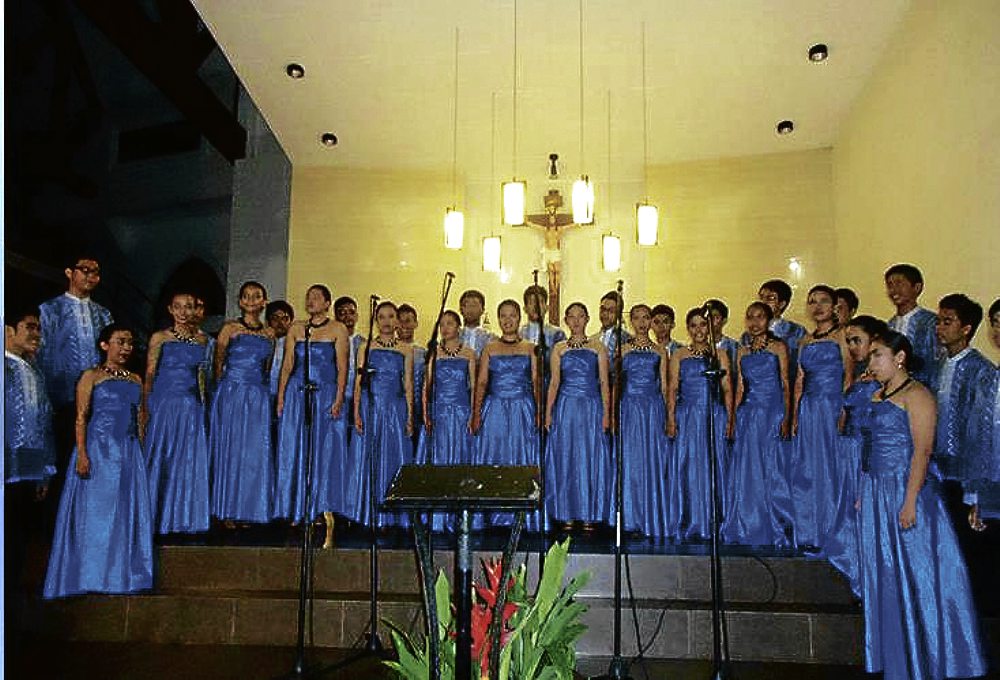
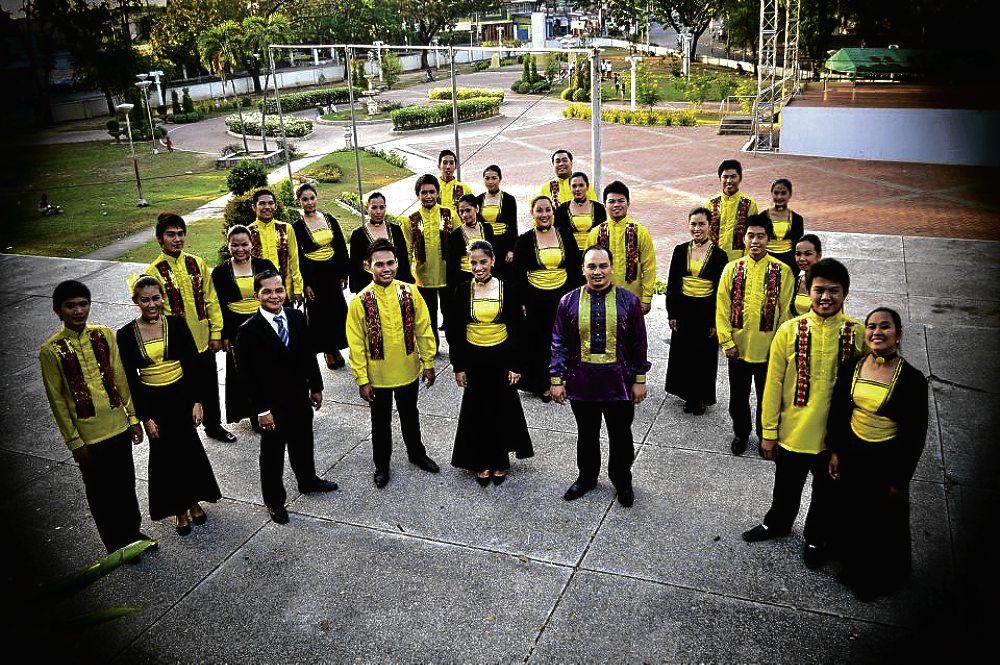
UNIVERSITY of Baguio Voices


The real explosion in local choral music, however, has occurred in the last 50 years, with the formation of groups reflecting social and musical emphases.

Today the Philippine choral community finds its members extending to both the public and private sector, with special-interest groups thrown in for good measure.

UP versus UST

The University of the Philippines has led the academic sector in putting a premium on choral music. Three of their groups—UP Concert Chorus; UP Singing Ambassadors; and what is now known as the Philippine Madrigal Singers—have taken the European circuit by storm.
 

PAMANTASAN ng Lungsod ng Maynila


With the help of alumni communities in the United States, Asia and the Middle East, they have made Filipino choristers a force to reckon with on the global musical stage. The Madz is the only choir to have won the European Grand Prix twice.

Not to be outdone, the University of Santo Tomas Singers has also been named Choir of the World at the Llangollen Eisteddfod in Wales twice. (Wales is a place in the United Kingdom where musicality seems to run in the blood.)

Being the oldest university in Asia, UST’s Dominican heritage links it to another ancient musical institution, the Tiples de Santo Domingo, which, having been founded in 1578, makes it also the oldest existing boys choir in the Philippines and, perhaps, in Asia.

The Dominican-Tiples shares honors with the Benedictine communities of Mendiola and Malaybalay in having produced the country’s finest all-male choruses.

Unsung heroes

Other schools such as the University of the East, Ateneo de Manila University, the University of San Agustin-Iloilo, University of the Visayas, Philippine Normal University, De La Salle University, Adventist University of the Philippines, Miriam College and Ilocos Norte National High School have earned their fair share of accolades overseas.

A slew of children’s choirs led by the Las Piñas Boys Choir, Loboc Children’s Choir, Mandaluyong Children’s Chorus, Vox Angeli, Hail Mary the Queen Children’s Choir, and the Calasiao Children’s Chorus have all taken their turns at competing—and winning—in the World Choir Games.

ST. MARY University

 
But since Filipino choirs have reaped awards from major festivals abroad, particularly in Europe, all things being equal, beating another Filipino choir on home ground is the ultimate test.

Many choristers remain unsung heroes, and are often taken for granted. But community choristers are also volunteers who give much of their time to come to rehearsals, usually needing to take leave from work just to be there. They buy, rent or have their costumes made for concerts, usually on personal funds.

Unlike athletes who sometimes receive living allowances from their teams, some choristers even have to pay dues for the privilege of being in a chorus.

Why do they do it then?

Choral music adds great meaning and richness to their lives. In today’s depersonalized world of rush and stress, choral activity is one source available for people to be inspired, refreshed and rejuvenated.

Singing allows them to sift through emotions and feelings, but being in a chorus allows them to make friends who could empathize with whatever situation they’re in.


TARLAC State


Choristership, indeed, is one way of answering questions relating to the nature and purpose of contemporary music. After all, it is considered by many as being halfway between art and life, between aesthetics and reality.

In this year’s MBC National Choral Competition, for instance, Claude Debussy will be given equal treatment as National Artist Felipe Padilla de Leon and Psy of “Gangnam Style” fame.

Contenders

A cursory look at this year’s roster of choirs which will be competing in the semifinals of the MBC National Choral Competition supports this view.

Seeing action in the Children’s Division will be Himig Bulilit of St. Paul Parañaque; Pasig Catholic College; Malate Catholic School; Juan Luna Elementary School; Batasan-Commonwealth Singing Voices; Himig Silangan; Himig ni Juan; Himig Pag-asa; Laoag City Children’s Choir; Fatirium Children’s Choir; Angelicus Children’s Choir; CES Himig ng Kabataan; GenSan’s The Voice; Banga Elementary School of Koronadal; Himig Hilaga of Lagao Central Elementary School; and the Angelicum Choir of San Fabian, Pangasinan.


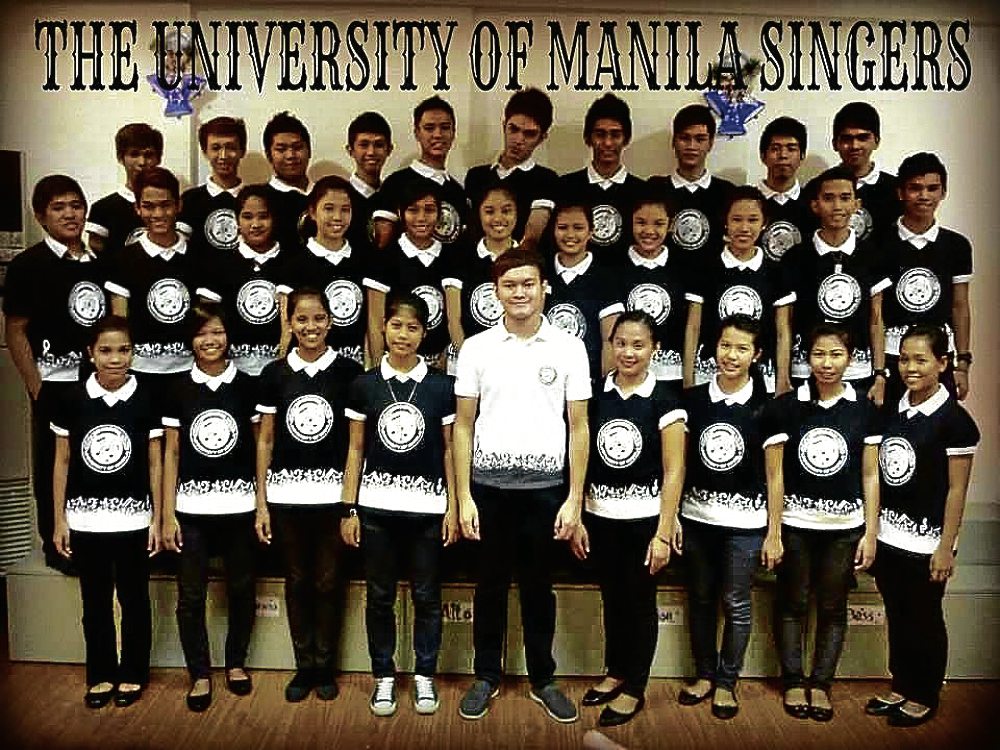
UNIVERSITY of Manila Singers


Semifinal qualifiers in the Open Category include Regina Coeli; Coro Obscento; FEU Chorale; OMPHP Youth Ensemble IV; Coro Amadeo; Vox Amigos; Chorus Vocales; St. Mary’s University Choral Society-Bayombong; Tarlac State University Chamber Choir; Gloria Patri Singers; ISU-Ilagan Rhythmic Society; Voices and Graces Cultural Federation of Nueva Vizcaya State University; Junior Teens Choir of San Antonio de Padua; Leviticus Chamber Singers; La Salle Bacolod Chorale; Kinaadman Chorale of John B. Lacson Foundation Maritime University of Iloilo; Himig Sanghaya; Kammerchcr Manila; 2nd Chronicle Singers; University of Manila; Centro Escolar University-Malolos; Capitol University of Cagayan de Oro; University of Baguio Voices; Coro de Manila; Mariano Marcos State University CTE Choral Society; New UMAK Chorale; Pamantasan ng Lungsod ng Maynila Student Choral Society; Philippine College of Criminology-Manila Law College Chorale.

Even with the incredible diversity of opportunities today, people still want to create music as a gift they can offer back to another entity—whether God or the community. Listening to a choir—whether in school, at work, while worshipping in church or watching a high-profile competition, still give immeasurable fullness to our daily lives.

Tuesday, November 27, 2012

...the top ICT-savvy cities

Manila among top 25 ICT-savvy cities


MANILA, Philippines -- Swedish telecommunications equipment and mobile services firm Ericsson recently ranked Manila as No. 22 of the top 25 largest cities in the world in terms of the ability to use information and communication technology (ICT) to benefit business.
 
 
Roxas Boulevard in Manila, Philippines (Agustin Rafael Reyes/Flickr).
 
In the release of Ericsson's third edition of Network Society City report and Index, New York, Stockholm and London emerged as the top three ICT-savvy cities in the ranking.
 
According to Patrick Regardh, strategic marketing head for Ericsson global, individuals, rather than businesses or institutions, drive development resulting from ICT maturity.
 
"We see the individual – rather than city institutions or businesses – as the drivers of development resulting from ICT maturity. Governments follow by adapting to citizens’ changing behavior, while businesses primarily adopt ICT innovations to increase internal efficiency. More importantly, government decisions help steer the business sector’s ICT development. Therefore, changes in policy, regulation and planning, paired with research and support for taking risks and funding, are some of the key factors for driving progress. These factors are crucial in helping organizations of all sizes to connect, collaborate and compete more effectively," Regardh said in a statement.
 
According to the report, ICT leads to an increased number of entrepreneurial opportunities, enabling new product innovations such as music and video streaming, e-commerce and cloud services.
 
The report also indicated that ICT improves access to markets by enabling entrepreneurs and specialized niche firms to reach larger geographical markets.
 
And another positive note about ICT is that it reduces cost of transactions between firms – for example by minimizing the need to be located geographically close to suppliers, partners and customers.
 
Legardh in an interview said it is easy to compare a city to another city than a nation to another nation comparing their ICT solutions. In doing a city to city type, it is easier to recommend those that work to one city to another city.
 
In explaining the positive correlation between ICT maturity and economic development, Legardh shared a report issued by the Stockholm School of Economics in 2012, where it was concluded that a "1 percentage point increase in broadband penetration increases new business registration by 3.8 percent."
\
Legardh said a city should be known for a few couple of things since technology alone will not do it and a follow up is important.
 
For Manila, he advised to make the most out of it, referring to collaboration between universities and industries and a review of its fiscal and legal framework.
 
Legardh added school is an area where many changes can happen in the near future. "Instead of future education, I call it future learning," he said.
 
The complete list of the Top 25 ICT-Savvy cities according to their ranks and scores, are: New York (52.1), Stockholm (51.9), London (48.7), Singapore (48.1), Seoul (47.9), Paris (44.1), Tokyo (40.3), Los Angeles (38.2), Sydney (31.7), Beijing (27.2), Shanghai (25.1), Moscow (24.4), Sao Paulo (18.3), Istanbul (17.1), Mexico City (16.1), Delhi (15.4), Cairo (14.9), Buenos Aires (14.2), Mumbai (13.1), Johannesburg (12.7), Jakarta (11.6), Manila (8.7), Dhaka (6.7), Lagos (6.6), and Karachi (8.0).
A total of 28 indicators have been used to measure the total benefits in the index for each city. The indicators can be categorized into two dimensions: cities’ ICT maturity and benefits from ICT investments from both a social, economic and environmental point of view.