Showing posts with label architecture. Show all posts

Tuesday, October 22, 2013

...the New 7 Wonder Cities finalists

Vigan among finalists in 'New 7 Wonders Cities' campaign


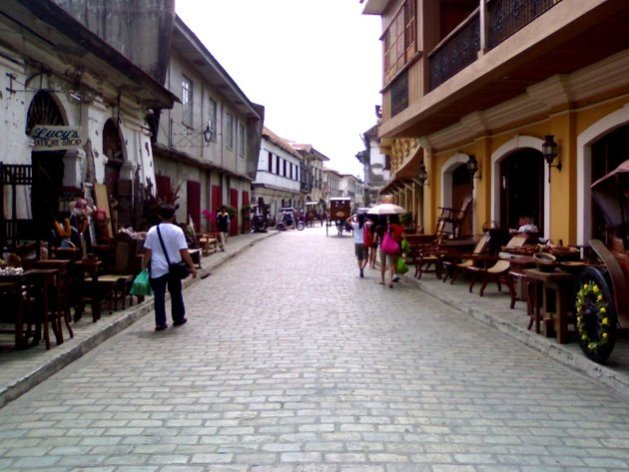
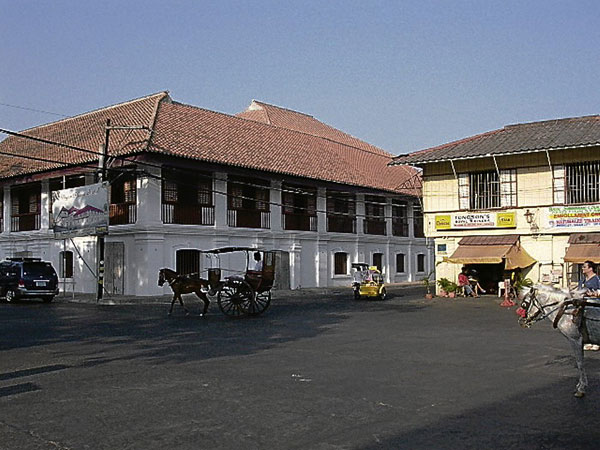
File photo of the Heritage Village in Vigan City. Val Rodriguez/The Philippine Star
 
MANILA, Philippines - The historic city of Vigan in Ilocos Sur has been included in the shortlist for the "New 7 Wonders Cities" in the world.

Vigan, a United Nations Educational, Scientific and Cultural Organization (UNESCO) World Heritage Site, is the only Philippine city in the list of 28 candidates that were selected as advised by a panel of experts.

Bernard Weber, founder-president of Swiss firm New7Wonders, said the selection of the finalists is "particularly exciting in its variety."

“This outstanding shortlist of 28 cities mirrors the diversity of urban society, especially when, for the first time in history, more than half of our planet’s population lives in cities," Weber said on the New7Wonders website.

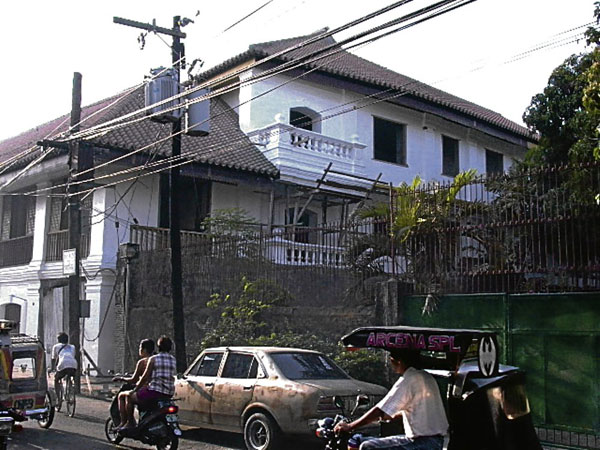
Vigan is one of the few Hispanic towns in the country and is best known for its well-preserved colonial architecture.

Like the other finalists, Vigan was selected from an initial long list of 77 voted candidates that also included the cities of Cebu and Iloilo.

The shortlisted cities will now undergo three elimination phases determined by public voting through the New7Wonders website, which will end on December 7, 2014.
 
The 28 finalists are (in alphabetical order):
Athens, Greece
Bangkok, Thailand
Barcelona, Spain
Beirut, Lebanon
Casablanca, Morocco
Chicago, USA
Doha, Qatar
Durban, South Africa
Havana, Cuba
Ho Chi Minh City, Vietnam
Istanbul, Turkey
Kuala Lumpur, Malaysia
Kyoto, Japan
La Paz, Bolivia
London, United Kingdom
Mendoza, Argentina
Mexico City, Mexico
Mumbai, India
Perth, Australia
Phnom Penh, Cambodia
Prague, Czech Republic
Quito, Ecuador
Reykjavik, Iceland
St. Petersburg, Russia
Seoul, South Korea
Shenzhen, China
Vancouver, Canada
Vigan, Philippines

Saturday, September 21, 2013

...the Pinoy architect in Bangkok

Pinoy architect bags 3rd place in Bangkok exhibition

GMA News
September 21, 2013


A Filipino architect brought recognition to the Philippines after bagging the third place in an Asia-Pacific exhibition in Thailand, the Department of Foreign Affairs said over the weekend.
 
The DFA said Allan Jay Quesada won third place at the launching of the “Learning to Live Together” Asia-Pacific Exhibition last Sept. 17.
 
 
"Quesada hails from La Union and finished BS Architecture at the Pamantasan ng Lungsod ng Maynila. He is currently working as an architect for DSFN Architects, an architectural design firm based in Makati," it said.
 
The "Learning to Live Together" exhibition was organized by UNESCO Bangkok and Haier Group China Global Business Organization at Bangkok Art and Culture Center.
 
 
Other winners included Alland Dharmawan and Masyudi Firmasyah of Indonesia, who placed first and fourth respectively.
 
 
Siddhant Mohanty from India won second place but was not present during the launching, the DFA said.
Winners were chosen from among 200 entries from Bangladesh, Cambodia. India, Indonesia, Malaysia, Myanmar, Nepal, Pakistan and the Philippines.
 
 
The tilt was organized within the framework of UNESCO’s program on “learning to live together.”
 
 
It featured the top 30 submission of photos, drawings and other images to a regional competition, reflecting the perspective of youth in the Asia-Pacific region on learning to live together.
 
 
The event, which runs from September until Sept. 22, will coincide with the International Peace Day on September 21, the theme of which is education and peace. — ELR, GMA News


Saturday, November 10, 2012

...the UN Heritage Site Management awardee

Vigan City bags UN award for heritage site management


Keeping history alive is apparently more fun in the Philippines, with Vigan City bagging a United Nations award for world heritage site management.

The UN Educational, Scientific and Cultural Organization (UNESCO) has recently given the city in Ilocos Sur its first-ever "Best practice in World Heritage Site Management" award as the international body ended the 40th World Heritage Convention in Japan Thursday.

Vigan City bested 27 other cities from 23 countries considered for the recognition, which UNESCO said is aimed at highlighting challenges to world heritage conservation, lessons learned, priorities and opportunities.

"Vigan's successful and sustainable management has been achieved with relatively limited resources, which should make it adaptable to sites in all countries..." UNESCO said.

"[T]he local community is well integrated into many aspects of the sustainable conservation and management of the property; and a multi-faceted approach to the protection of the site has been developed," it added.

This year’s convention theme "World Heritage and Sustainable Development: the Role of Local Communities" highlighted the need to marry conservation programs with local community growth.

Vigan City, famous for conserving early architecture and other features, was named a world heritage site in December 1999.
"Vigan is an exceptionally intact and well-preserved example of a European trading town in East and South-East Asia," UNESCO said in its website.

"The architecture is truly reflective of its roots in both materials and design, in its fusion of Asian building design and construction with European colonial architecture and planning," it added.

The case of Vigan City and other sites discussed in this year's World Heritage Convention, UNESCO said, may "enrich current debates about the implementation" of conservation projects the international body is set to name the 1000th world heritage site.

Wednesday, October 17, 2012

...the Zuellig

Makati building grabs international attention


Amid a construction boom that has seen high-rise buildings sprout all over Metro Manila, a development in Makati has grabbed the attention of an international real estate award-giving body.

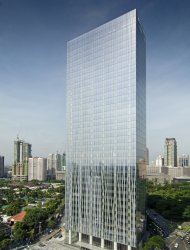
The newly constructed Zuellig Building has made it to the top three in the "Best Office and Business Development" category of MIPIM Asia Awards.

This qualifies the 33-storey office building to vie for gold against two other shortlisted development: the Tianjin Global Financial Center in China and the 50 Connaught Road Central Building in Hong Kong.

The building, located at the intersection of Makati Avenue and Paseo de Roxas, was developed by Bridgebury Realty Corp. and designed by architecture firm Skidmore, Owings & Merrill LLP.

It is the first real estate development in the Philippines to be recognized by MIPIM.

"The Zuellig Building's commitment to environmental responsibility, its distinctive facade, and superior finishes will enable it to become Metro Manila's premier business location," MIPIM said in its website.

The building has also earlier been awarded a gold pre-certification under the "Leadership in Energy and Environmental Design" program of the U.S. Green Building Council.

The Zuellig is "the first 21st-century Premium Grade office building in the Philippines," MIPIM said further.

MIPIM (Le marché international des professionnels de l’immobilier) is a group of industry leaders which recognizes "excellence and innovation in Asian real estate development," the group's website showed.

A jury composed of experts met in July to shortlist three winners in 10 categories.
 
Aside from Best Office and Business Development, other categories are Best Hotel and Tourism Resort, Best Industrial and Logistics Development, Best Refurbished Building, Best Residential Development, Best Shopping Centre, Best Futura Project, Best Futura Mega Project, Best German Project and the Special Jury Award.

For the first time this year, MIPIM will also determine the winner of a People's Choice Award through online voting.

Results of the poll will meanwhile comprise 50 percent of the final scores of the shortlisted buildings, thereby determining the gold, silver and bronze winners.

Wednesday, January 25, 2012

...the (architectural) firm

Palafox included in list of world's top architectural firms

01/25/2012


World Architecture described Palafox as having built a reputation as a sustainable designer of everything from apartment blocks to churches and embassies.

MANILA, Philippines - Palafox Associates was included in BD World Architecture Magazine of London's annual list of Top 100 architectural practices. 


The firm, managed by principal architect-urban planner Felino "Jun" Palafox, Jr., ranked 89 on the list. It was the only Filipino firm included.

"The 23-year-old Filipino practice has doubled the number of architects it employs in the past year and has catapulted itself well into the bottom of this year's table," the magazine said.

World Architecture described Palafox as having built a reputation as a sustainable designer of everything from apartment blocks to churches and embassies.

The magazine also noted how Palafox made headlines for turning "property whistleblower." "He spoke out about the environmental and safety records of some developers -- and invited the public to inspect his projects, confident they would withstand scrutiny," it said.

For the past 22 years, Palafox Associates has done over 800 international projects, which include the masterplan of more than 12 billion square meters of land and the architecture of more than 8 million square meters of building floor area in 35 countries.


Monday, October 24, 2011

...the Ten Commandments building

Prayer building earns Guinness record

By Vincent Cabreza
Inquirer Central Luzon


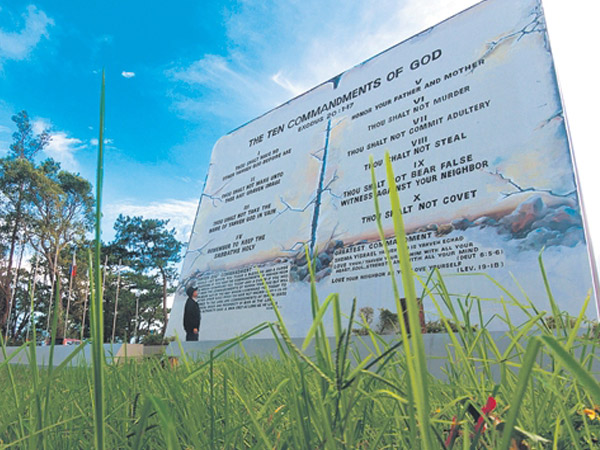
WORLD’S FIRST This 12-meter-high building shaped like the Ten Commandments tablets in Baguio City’s Dominican Hill earned a Guinness World Record. RICHARD BALONGLONG/INQUIRER NORTHERN LUZON


BAGUIO CITY—A 12.19-meter-high building painted like stone tablets containing the biblical Ten Commandments has earned for the summer capital a Guinness World Record, thanks to a businesswoman who also funded the unveiling of a giant Philippine flag here earlier this year.

Grace Galindez-Gupana seems to have a penchant for setting world records. Her company claims she now holds seven records, including being the creator of the biggest national flag and organizer of the biggest clinical sessions for diabetics and cholesterol watchers.

Gupana, chief executive officer of ABS Gen Herbs International Corp., turned over to the city government a P5.5-million, A-shaped “prayer building” featuring the Ten Commandments in July.

Gupana commissioned Nueva Ecija contractors in March to design and rush work on the structure located within the Diplomat Hotel compound, said Rafael Talokoy, executive secretary of Baguio Mayor Mauricio Domogan.

The fully furnished building has inclined 12-meter (40-foot) walls. One wall bears inscriptions of the Ten Commandments, portraying the two slabs of stone that were borne by Moses as described in the Bible.

Domogan on Friday said his office had confirmed the Guinness citation and that a representative from the organization would be coming here this week with the official document. “We were assured that the building is a world-record holder,” he said.

The mayor recalled that Gupana, who he said “considers Baguio the Philippine city of worship,” offered to build the facility in February. This was after she led the unveiling of a giant Philippine flag for a second time at the Baguio Athletic Bowl.

“After turning over the building, Gupana went on her own to apply and earn a certification from the Guinness organization that this is the world’s first and tallest facility (that features the) Ten Commandments,” Talokoy said.

Other records


According to ABS Gen’s website, Gupana holds seven Guinness World Records, among them the feat of developing the world’s largest national flag, an 18,847-square meter Israeli banner which can cover an area of two football fields.

The site claimed that Gupana earned world record citations for producing the longest banner (composed of giant flags representing the Philippines, Israel and the two Koreas), the longest drawing of the Biblical serpent, dragon and beast mentioned in the Book of Revelations (5 kilometers long and 7 m wide), and the largest blood pressure checkup session that gathered 2,302 people.

The site also credited Gupana for organizing the largest diabetes screening session for 503 people, the largest blood identification session involving 260 people, and the largest cholesterol test session for 527 people.

The Inquirer could not independently confirm the authenticity of the world records.

The Ten Commandments building will be officially unveiled on Oct. 26 in the presence of Israeli Ambassador to the Philippines Menashe Bar-On and the Guinness representative.

Domogan said the building would remain open to the public until the city council decides how the local government can regulate its use, Domogan said.


3-way land dispute

The location of Gupana’s facility earlier figured in a property dispute, after the 17-hectare Diplomat Hotel compound was relinquished to the city by the national government during the Arroyo administration in April 2004.

The property became the subject of a three-way tug-of-war. The Sandiganbayan antigraft court maintained that it was promised a portion of the compound for its summer courthouse, the city’s evangelical community wanted the facility turned into a “prayer mountain,” while another group planned to convert the old hotel into a mining museum.

Domogan said he was called to Malacañang recently because the Presidential Management Staff (PMS) wanted an explanation as to why Gupana’s building was built there although there was still conflict over the compound’s use.

The conflict arose from a proposal made to the city council by former Foreign Secretary Delia Albert and civic leader Maria Isabel Ongpin to convert Diplomat Hotel into an interactive mining museum and library.

The plan would exclude from the project a prayer facility being proposed by former Councilor Galo Weygan, an evangelical pastor. Weygan, who had been holding monthly religious assemblies in the compound, opposed the museum project.

Palace wants it back

Former Mayor Reinaldo Bautista Jr. said the PMS sent a deed of reconveyance to the city in 2008, indicating that Malacañang intended to take back the Diplomat compound because the city government had reneged on its obligation to develop it in five years.

“Malacañang was ready to take it back because it was convinced by officials backing the mining museum project that it would be better for them to transact with the Palace instead of the city government. But at the end of her term last year, Arroyo urged all parties to present their case before the new set of officials instead,” said Domogan, who was Baguio’s representative at the time.

Cordelia Lacsamana, a city environment officer who oversees the compound, noted that the Sandiganbayan had started building its summer compound on portions of the property.

Domogan said the city government had urged Albert to present her group’s plans again to the city council “so we can finally develop that property.”

But last week, proponents of the mining museum reportedly agreed to an alternative proposal to secure one of the three sequestered Baguio properties of the late dictator Ferdinand Marcos as their project site, Domogan said.

“I endorsed that proposal also,” he said. “This means that the government can offer the Diplomat Hotel as a Public-Private Partnership project. We need to develop a hotel there because the [Ten Commandments building] will start drawing tourists soon.”

Thursday, September 1, 2011

...the largest indoor arena

World's largest indoor arena to rise in Manila

09/01/2011
 
MANILA, Philippines - The world's largest indoor arena will rise in Manila soon, courtesy of the Iglesia ni Cristo (INC), TIME.com reported Thursday. 

Design of the the 50,000-seat stadium at Ciudad de Victoria has already started, according to Populous, a US architectural company firm behind the project.


The $213-million facility, dubbed by Populous as the "world's largest indoor arena," will be built in time for the Iglesia ni Cristo's centennial celebration in 2014, according to the architectural firm.

The building's form "uses simple geometry to create an elegant appearance," said Andrew James, Populous senior principal and project director.

The Iglesia ni Cristo plans to use the arena for church-related activities, sports, and concerts.

It can also host an additional 50,000 people outside the main ground.

"You have to give the Philippine church some credit: The group at least has tried to do something innovative and different. And with 50,000 seats, you too can likely have a chance to visit a worldwide first," TIME.com said.

Monday, July 25, 2011

...the heritage city

Vigan, a heritage success story


By: Augusto F. Villalon
Philippine Daily Inquirer


What has happened in Vigan since inscription on the Unesco World Heritage list has evolved into a heritage success story.

Vigan shows how heritage, when conserved properly, is a strong driver for economic and social development. While the Heritage Bill (Republic Act 10066) encourages setting up of heritage zones, we tend to look at foreign examples for inspiration without realizing that we have a successful heritage zone right at our doorstep.

Vigan is an excellent example of having achieved prosperity through heritage, a transformation done in our own Filipino way.

The early days of raising heritage awareness in Vigan during the late 1980s saw most residents and local government against conservation. Some were adamant. They saw conserving heritage as being restrictive, preventing development of their privately owned properties, and a move to freeze Vigan in 19th-century darkness.

Resistance gradually wore down. The Municipal government prepared the necessary documents and protective legislation required for World Heritage nomination. It must be pointed out that the legislation required by World Heritage is no more stringent than the normal laws needed to protect heritage well.


Heritage laws were written, thoroughly discussed with the resident community in a series of public consultations, and finally passed.

More energy

Toyota Foundation funded the documentation of Vigan heritage houses by groups of students. The city was mapped and zoned, with the help of a grant from the Spanish government.

Finally, World Heritage inscription happened in 1999. Despite Vigan’s being instantly identified with Spanish colonial heritage, more people took notice of Vigan.

Although statistics in Vigan are very sketchy, visitor arrivals have increased steadily each year.

Vigan today has an energy that the pre-World Heritage Vigan didn’t have. Those were the days when the quiet town appeared to be deserted even at noon.

Darkness in empty Vigan streets was another experience. Empty, unlit ancestral houses loomed on both sides of narrow streets, driving me back to the safety of my hotel room.

Vigan is vibrant today. Just a look around Vigan will show many new hotels, some still under construction. The construction industry has boomed, reviving the need for traditional skills like carpentry, masonry and ironwork, which had been out of demand for generations.

Once-shuttered heritage houses now have a new life as bed-and-breakfasts, shops, or business establishments, all happening within conserved heritage structures.

Authentic cuisine

Many restaurants now proudly serve authentic Vigueño cuisine. The empanada vendor and tricycle driver whom I talked to in the Plaza told me that since World Heritage inscription their businesses had improved.
They were proud to be part of Vigan and were doing their small bit toward conserving its heritage because they owed their livelihood to it.

Since World Heritage inscription, Vigan has gone from municipality to city solely on the merit of its heritage status. Conservation measures undertaken there are on the typical shoestring budget that Philippine government projects normally work with, although there was assistance from the Spanish government and Unesco.

The prosperity conservation has brought to Vigan is obvious to visitors. I was there last month after not having been there for about five years and was surprised at the progress brought about by adapting and enforcing strict conservation measures in the city.

The level of progress becomes more obvious if Vigan today is compared with Vigan of 10 years ago. Maybe a picture exhibition should be organized to bring out that difference, and documentation of its process needs to be done.

Check out Vigan. It is a heritage zone that works, and has achieved despite all Philippine mindset and budgetary constraints. Vigueños today have a terrific sense of pride of place.

In-depth study

But more than a photo exhibition to demonstrate Vigan’s progress, an in-depth study is needed to document with statistics the growth of Vigan since it decided to capitalize on its heritage for the future of its people.

Vigan is the kind of heritage zone that the Heritage Bill seeks to set up in specific places of the Philippines. A look at Vigan shows the benefits of setting up a heritage zone, and at this time Vigan has not yet reached its full potential of attracting more income-generating opportunities to the local community.

The World Heritage citation reads: “Established in the 16th century, Vigan is the best-preserved example of a planned Spanish colonial town in Asia. Its architecture reflects the coming together of cultural elements from elsewhere in the Philippines, from China and from Europe, resulting in a culture and townscape that have no parallel anywhere in East and South-East Asia.”

There should be an addendum to that citation, to say that, aside from having no parallel anywhere in East and South-East Asia, Vigan is testimony to the use of heritage for social and economic development.

Wednesday, June 22, 2011

...the Tel-Aviv chic

Budji designs new chic destination in Tel Aviv


From cold-industrial to warm eco-chic, the Layug +Royal Pineda firm upscales an Israel granary


By: Marge C. Enriquez
Philippine Daily Inquirer


In the mind of a gifted designer, a space can be distinctive and evocative even with the use of basic materials, simple shapes, an open floor plan and an integration with nature and humanity rather than technology.

Once again, design consultant Budji Layug and architect Royal Pineda interpret this design sensibility, this time in a commercial space in Tel Aviv, Israel.

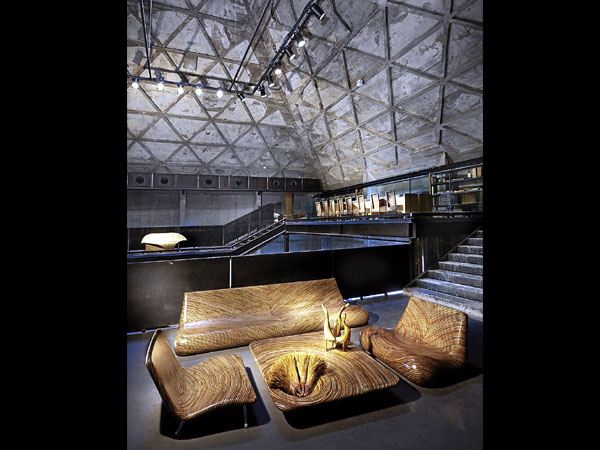
A midcentury wheat granary was upcycled into a high-end concept store called Mamgorha whose products reflect the green movement.

It all began when Israeli entrepreneur Ronit Grinberg, whose company Kane-Kash espouses sustainable living, began sourcing eco-friendly products from Asia. When she came to the Budji Living showroom in Makati, she was impressed with the overall experience so that she tapped them for her project.

Design brief


The design brief was to create a space that would project the company values of “design, preservation, authenticity, simplicity and integrity.”

The store, Mamgorha, would carry baskets and accessories, custom-made furniture, a sales area, raw materials for the home, and a flexible open plan for exhibits and special events.

The target market is composed of the design community and discriminating patrons.

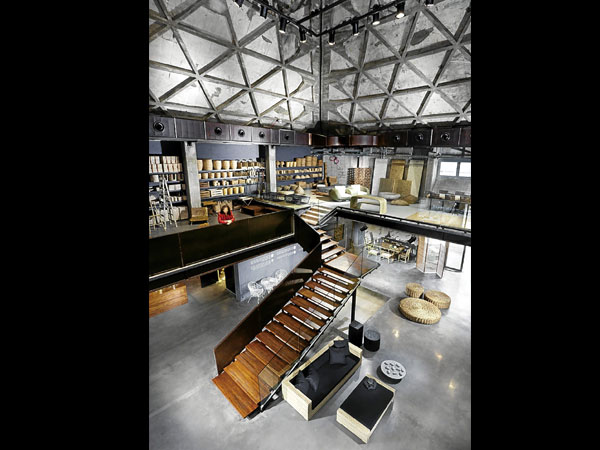
Grinberg acquired an old wheat granary which consists of a series of pyramidal, concrete storage silos with an overhead track. In the old days, a train would bring the sacks of grain to the adjacent tower. The sacks would be transported through overhead tracks, then dropped down the ceiling vents and into the silos.

At the onset, Layug and Pineda believed that the most attractive element of the granary was the structure itself. The absence of decorative detail and the exposed structural parts lent character.


“There was no change in the façade. You will still see the tracks on the roof and the patina of the cement,” says Layug.

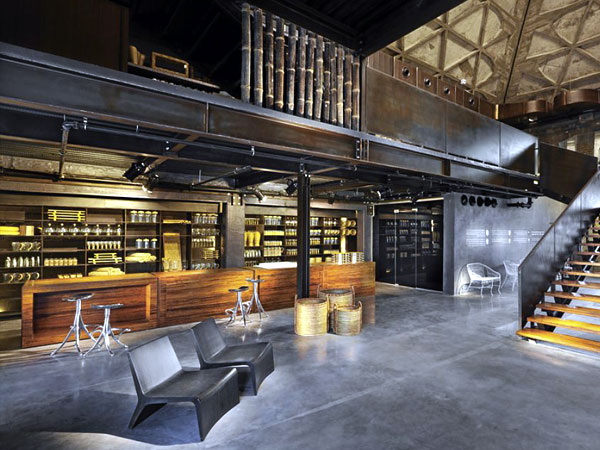
Pineda adds, “We also preserved the interiors. There are space-framed beams that strengthened the pitched roof, which is a slab. We reveled in the architecture, the texture of the structure and its colors, all of which became the major accent.”

“There’s the beautiful structural grid on the ceiling which is the main part of the design,” says Layug. “A raw design can still come out sophisticated.”

Decorative detail

Shelves and cabinets were installed and became part of the decorative detail. Their surfaces were enhanced in metallic finishes to let the products pop out. Ventilation openings on the pitched roof serve as the skylights.


The design duo says Kane-Kash acquired the granary, whose purpose was to transform something raw into something consumable. Mamgorha is a hub that provides sustainable products for the market. It augurs well that the philosophy of Budji + Royal is to adopt what is organic and sustainable.

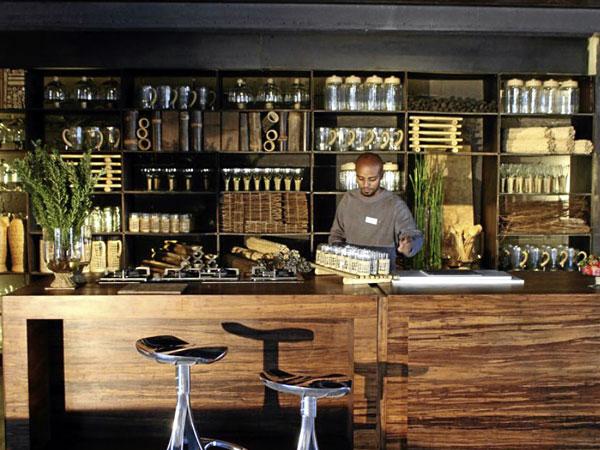
Layug points out that the owner didn’t want endangered wood. To add warmth to the concrete and glass materials, the design team favored bamboo, a renewable material. The bamboo has been processed and compressed to look like solid wood or hardwood.

The 380 sqm footprint of space is divided into four levels. The ground floor hosts an exhibition area for home products, an open-bar, kitchen, and café.

The levels are linked by a staircase made of bamboo and glass railings. The burnished colors of the shelves play against the cool, deep tones of the cement walls. The metallic finishes are highlighted by theatrical lighting.
The second floor hosts the home products.

The third level is devoted to furniture. A bridgeway connects to the top level, where sample materials such as bamboo are displayed; there is also a library and a negotiation space.

No dead-end


“It was important to imagine the movement of people. We avoided making a dead-end. The idea was to create a more fluid traffic so that visitors could explore the space and discover the surprises. One level overlaps another so they can see the pieces on a different perspective. As you walk up to the next level you will see the product from another angle. That’s the guest experience. On the third level, there’s a bridgeway that creates a feeling of floating. We want people to experience the elevation and the granary in its entirety,” says Pineda.

More than a showroom, the architecture makes a statement about its historical past and the present use of space. Pineda says the cavernous scale of the place and the dramatic lighting, a contrast of lights against the deep void, create drama.

“It’s like being in the church where Jesus was,” says Pineda. “With the high ceiling (15 by 50 meters) there’s the feeling of smallness. After the ascent, there is another route that will bring you back to the ground floor.

Your walk is a complete experience that doesn’t repeat itself. As you complete the course, it’s a complete showcase of the entire design.”

Monday, April 11, 2011

...the beauty behind the brain

PEP: Shamcey Supsup wins Bb. Pilipinas-Universe 2011

 
Shamcey Supsup was crowned Bb. Pilipinas-Universe at the Binibining Pilipinas 2011 pageant held last night, April 10, at the Araneta Coliseum.


Shamcey, who was Binibini No. 26, bested 39 other contestants who competed in this year's pageant.

She graduated Magna Cum Laude from the University of the Philippines College of Architecture. She also topped the Architecture board exam in July 2010.

Shamcey will represent the Philippines in the Miss Universe pageant to be held in Sao Paulo, Brazil on September 12, 2011.

Newly crowned 2011 Bb. Pilipinas Universe Shamcey Supsup (center), Bb. Pilipinas International Dianne Necio (second from right), Bb. Pilipinas Tourism Isabela Manjon (second from left), and runners-up Mary Jean Lastimoso (left) and Janine Tugunon (right) grace the stage at the coronation night at the Araneta Coliseum on Sunday. GMA News

Aside from winning Bb. Pilipinas-Universe, Shamcey also collected three special awards: Best in Talent, Miss PAL, and Miss Cream Silk.

Shamcey, 24, was not the only title holder at last night's pageant.

Last year's 1st runner-up, Dianne Necio (No. 33), returned this year and won the Bb. Pilipinas-International title; while Isabella Manjon (No. 25) was adjudged Bb. Pilipinas-Tourism (a replacement to the Bb. Pilipinas-World title, which has its own franchise).

Janine Tugonon (No. 27) finished 1st runner-up and Mary Jean Lastimosa (No. 34) was 2nd runner-up.

The other candidates who made it in the Top 15 are: No. 6 Patricia Tumulak; No. 8 Ma. Kristina Marasigan; No. 11 Diana Arevalo; No. 13 Queenierich Rehman; No. 16 Sabrine Al-Tawil; No. 19 Wendy Lucas; No. 23 Luzelle Felipe; No. 30 Kathleen Subijano; No. 32 Jenn Roe Gubat; and No. 37 Sarah Nicole Clenci.

The Best in Swimsuit was Binibini No. 13 Queenierich Rehman; Best in Long Gown was Binibini No. 23 Luzelle Felipe; and Face of Bb. Pilipinas 2011 was Binibini No. 7 Angela Ong.


Binibining Pilipinas 2011 was hosted by Derek Ramsay and KC Concepcion together with past winners Miriam Quiambao (1999 Miss Universe 1st runner-up and Bb. Pilipinas-Universe) and Precious Lara Quigaman (2005 Miss International and Bb. Pilipinas-International).

Sam Milby and Matteo Guidicelli serenaded last year's winners: Maria Venus Raj (Miss Universe 4th runner-up and Bb. Pilipinas-Universe), Krista Kleiner (Bb. Pilipinas-International), and Czarina Gatbonton (Bb. Pilipinas-World).

Karylle, Sitti, Princess Velasco, and Marie Digby also performed. — Erwin Santiago, PEP

Wednesday, March 16, 2011

...the restorer

Ilocos Norte to restore Paoay church

GMA News

Ilocos Norte province officials are planning to restore the ancient Paoay Church (St. Augustine Church), one of Ilocos region’s major attractions.

Ilocos Norte Governor Imee Marcos wants the project to make the province the country’s “northern gateway," a report of the Catholic Bishops' Conference of the Philippines (CBCP) said.


Back of Paoay Church by Neil Gratuita (Flickr.com)

“We have a lot of potential tourist attraction to be developed, enriched and appreciated, and to be enjoyed," the CBCP news site quoted Marcos as saying.

Paoay Church is currently a property of the Diocese of Laoag, Ilocos Norte, and is part of the United Nations Educational, Scientific and Cultural Organization's World Heritage List.

The CBCP said its renovation may boost tourism in the towns of San Nicolas and Currimao and the cities of Laoag and Batac.

Marcos said architect Felino Palafox was tapped to design a tourism plan that would consolidate Paoay’s existing infrastructures surrounding Paoay Church like the plaza, the ruins of the Catholic convent and the frontage of a state-run university.

“Tourism is the largest industry in the world, bigger than oil," Palafox said when he agreed to come up with a tourism design for Ilocos Norte.

A commercial arcade, which would feature the town’s unique products, along a stretch of the road lining the Paoay Church will also rise to generate more tourist activities.

The construction of Paoay Church was started by the Augustinian friars in 1694.

Led by Fr. Antonio Estavillo, it was completed in 1894 and was re-dedicated in the same year.

During the revolution in 1898, its coral stone bell tower was used by the Katipuneros as an observation post. – VVP, GMA News