Showing posts with label Mandaluyong City. Show all posts

Thursday, April 10, 2014

...the Asia's top models 2014

Filipina is 'Asia's Next Top Model' runner-up


04/10/2014
 
 
Jodilly PendrePhoto from the official website of 'Asia's Next Top Model'


MANILA - A Filipina finished runner-up in the second cycle of "Asia's Next Top Model," the Asia-Pacific edition of the hit reality show for aspiring models created by Tyra Banks.

Twenty-year-old Jodilly Pendre, who hails from Mandaluyong, placed second to Malaysia's Sheena Liam, who won a modeling contract with London-based Storm Model Management, among others, as "Asia's Next Top Model."

Another Filipina, 21-year-old Katarina Rodriguez from Makati, placed third among 16 contestants from 12 countries in Asia, including Singapore, Japan, China, and South Korea.

For their final challenge, the top three contenders had a photo shoot inspired by "kampong" or village life in Malaysia, where the entire season was held. They also took the runway in designs by Jonathan Liang, Ghea Panggabean, and Albert Andrada.


Sheena Liam. Photo from the official website of 'Asia's Next Top Model'


For the finale, the regular judges -- host Nadya Hutagalung, model Joey Mead King, photographer Mike Rosenthal, and movement coach Adam Williams -- were joined by Harber's Bazaar creative director Kenneth Goh and Asian supermodel Ling Tan.

Pendre, who broke down in tears after Liam was announced winner, dedicated her stint in "Asia's Next Top Model" to her mother.

"If I win this competition, my mom will be so proud of me," Pendre said in the earlier part of the show's 13th and final episode. "She actually doesn't know that this is for, because everything I do is for her."

"I want to give her a better future. I want to show her that she still has a daughter [who] is willing to give everything for her, because I really want to fulfill her dreams. I am not here for fame. I am here because I have a purpose to be here. I have a reason."


Katarina Rodriguez. Photo from the official website of 'Asia's Next Top Model'


While also emotional, Rodriguez considered her top-three finish an accomplishment, saying she never thought she would reach the end of the competition.

Get Flash Player
"I did reach the top three. I feel very accomplished," she said. "I didn't think I could ever make it this far. This is definitely farther than I ever could've dreamed of making."

Last year, the Philippines' Stephanie Retuya similarly placed second in the first-ever edition of "Asia's Next Top Model."

Apart from her modeling contract, 22-year-old Liam also took home a Subaru car, a contract as the 2014 endorser of haircare brand TRESemme, a chance to appear on the covers of Harper's Bazaar Singapore and Malaysia, and SGD 50,000.


Friday, June 21, 2013

...the preferred BPO site

'PH still among preferred sites for BPOs'


06/21/2013
 
 
MANILA -- The Philippines remains among the preferred sites for business process outsourcing (BPO), according to a leading US-based BPO and information technology (IT) company.
 
Shore Solutions Inc., one of the bigger players in the BPO business, said revenues from the BPO industry in the Philippines is expected to hit $16 billion this year, or almost 20 percent higher than the $13.4 billion last year.

It noted that with increasing demand from prospective investors and subscribers, the industry would need at least 1.3 million direct hires by 2016 from 720,000 last year.

“That should require 516,000 additional seats, and some 2.5 million square meters of additional office space,” Darcey Lalonde, Asia chief executive officer of Shore Solutions said in a forum yesterday.

The industry employed over 720,000 in 2012, with another 1.6 million indirectly.

Expansion has already been noted in the key urban centers outside Metro Manila such as Cebu and Davao.

In Metro Manila, the major BPO centers are in Makati, Quezon City, Manila, Taguig and Mandaluyong.

Lalonde said that the next or third wave of BPOs is targeting key cities in Laguna, Batangas and Bacolod.

However, he said government should consider anew opening up to a limited extent or to select sectors, ownership of land to foreign entities.

Wednesday, December 19, 2012

...the Filipino design and craftmanship


2012: Filipino design and craftsmanship continue to wow the world

By Marge C. Enriquez
Philippine Daily Inquirer


DESIGN icon Giulio Cappellini and Suyen Corp. chair Ben Chan at the new Cappellini store on Bonifacio High Street.
 
 
The world continues to look at the Philippines as a gold mine of talent and craftsmanship. And big international names see the country as an attractive place to forge business partnerships.
1. Cebuano designer Kenneth Cobonpue continues to reap international prizes. The Cabaret Collection has won two awards: Best of the Year Award in Outdoor Furniture Seating Category from the prestigious Interior Design Magazine. It won Top Pick Award for Innovation by the American Society of Interior Designers during the Architectural Digest Home Design Show, a four-day trade show in New York.


The Cabaret Collection is made of fabric tubes woven on steel framework, resulting in a web pattern.
 
“Outdoor furniture is usually made of woven plastic. The Cabaret Collection is different because it uses acrylic and outdoor foam. This one is a soft material and has a tactile feel,” says Cobonpue.
Cobonpue was one of the “game-changing” entrepreneurs who represented the Philippines in the global campaign of the whisky company John Walker & Sons. The online video series “City Portraits” showed celebrities in their milieu and what drove them to be forward-thinking.


BAGWIS Malacca by Tony Gonzales for Locsin International wins the Katha Award.

2. Design icon Giulio Cappellini launched the first mono brand store in Asia. The Italian designer with a knack for spotting talent graced the opening of the Cappellini store in partnership with Ben Chan’s Suyen Corp. on Bonifacio High Street.
 
On opening week, the designer pieces (with prices ranging from P50,000 to P1.2 million) were snapped up by style-centric buyers. Marcel Wanders’ Antiques Chair (from P70,000 to P120,000) was the most popular.
 
3. Local developer taps major designers. The world’s first branded Missoni Home will rise in the Philippines. Real estate firm Century Properties is collaborating with top designers to design public spaces for the towers in Acqua Private Residences, the residential condominium development in Mandaluyong.
 
Vittorio Missoni, scion of the knitwear fashion family and head of Missoni Home, liked the riverfront concept. Missoni Home will work on the 52-story Acqua Livingstone.


ITO Kish’s Gregoria chair,made of turned balusters, wins the Katha Award.

British celebrity developer John Hitchcox and co-founder of Yoo design firm, was attracted to the gentrification of Barangay Hulo in Mandaluyong, where Acqua is located. His partner, design icon Philippe Starck, gave his inputs for designing Iguazu, Acqua’s tallest residential tower.
 
4. Designer Tony Gonzales’ residential project and installation lands on the December cover of Habitus Living Magazine. Gonzales worked on the interiors of the designer-driven residence of architect-exporter Renato Vidal. The cover features Gonzales’ famous suspended rock garden, originally made for Yuchengco Museum. Habitus’ online edition also features some of the works of sculpture Impy Pilapil. Her “Bloom” collection is one of the focal points in Vidal’s house.
 
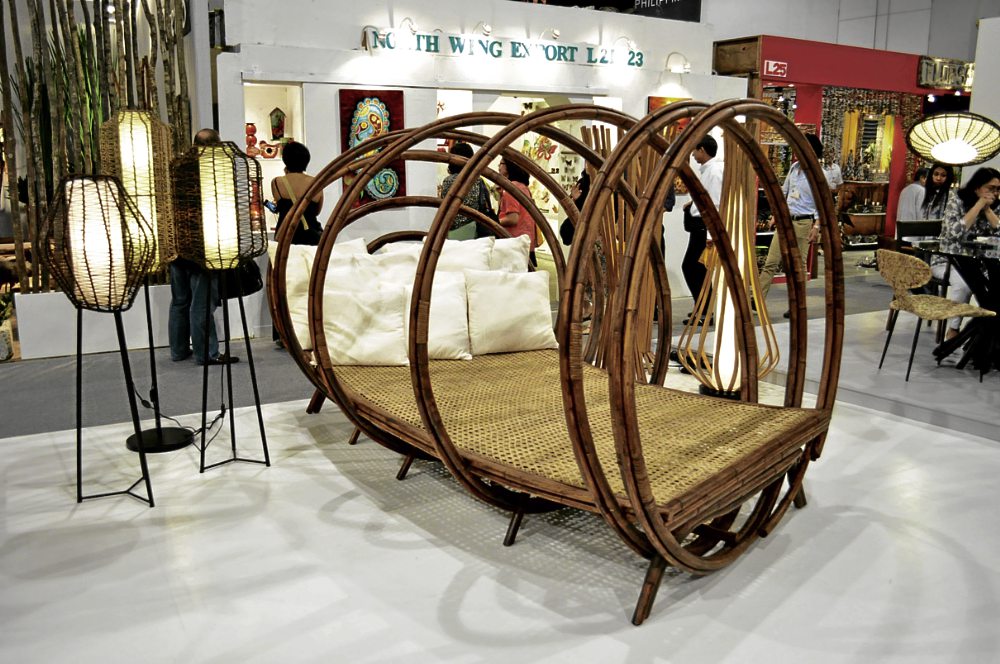
5. Going green. Sustainability and eco-friendliness are the latest criteria in evaluating design. This year, Manila FAME honored companies that used sustainable or recyclable materials. Katha Award winners Milo Naval’s Coco Lamp, made of coconut husks, Kinks and Curls rattan lamp made by Accessoria Inc., and Bagwis Malacca Daybed by Locsin International, used discarded materials and rapid-growing wood in their works, which injected a touch of humor and whimsy.
 
Another Katha winner, Ito Kish’s Gregoria two-seater, is made of balusters of different heights and a cane-seater. It is a reference to the architecture and airiness of ancestral homes. Kish’s chair uses Malay beech wood (Gmelina arborea) which is known for its rapid regeneration.


KENNETH Cobonpue’s Phoenix automobile of natural materialsmade it to the top picks of the American Society of Interior Designers.

Likewise, Kenneth Cobonpue’s Phoenix Car, touted as the World’s First Biodegradable Car, was chosen by the China-based Modern Decoration Magazine as Best in Design. Made of bamboo and rattan, the car is shaped like a leaf. It challenges the conventional car design using heavy industrial materials.
 
The owner has the option to replace the outer shell while the inner structure remains intact.
Cobonpue says the engine is being installed and a German factory is working on the car.
 
6. Dedon chair wins the Wallpaper* Design Award 2012. French designer Jean Marie Massaud’s SeaX chair got the nod from the judges, staffers and contributors of the London-based Wallpaper* Magazine.
 
Winner in the Best Backyard category, the SeaX collection was inspired by the director’s chair and racing sailboats. It uses innovative weather-resistant materials. The Dedon furniture company is based in Cebu.
 
7. Opening of Dedon Island in Siargao. It was once called Pansukian, the resort owned by Frenchman Nicolas Rambeau. Bobby Dekeyser, the Belgian-German founder of Dedon furniture company, bought it and transformed it into Dedon Island.
 
French designers Daniel Pouzet, Jean Marie Massaud and their local counterpart, Maritess Lampert, worked on the modern tropical interiors.
 
“The designers wanted to preserve our culture and designs. We used all local things such as handwoven fabrics from Baguio, iron wood, carved headboards made in Cebu and tinalak pillows from Davao,” says Lampert. The launch of this exclusive resort made a splash in the international press.
 
8. Architect Lorenzo Calma and his son Eduardo held a retrospective exhibit at LRI Plaza. The older Calma showed his minimalist sculpture and jewelry designs while Ed showed models and photographs of his works. Ed’s recent public space, Mind Museum, which opened in March, embodies the organic architecture trend.
 
9. Design duo Tony Gonzales and Tes Pasola refurbished the Jiyuan tea house in Shenzhen, China. The project was a renovation of an old building. Gonzales worked carefully to preserve its architecture while infusing modern elements. “The interior is ornate. It bridges the old and the new.”


GIANT paper lanterns designed by Gonzales dominate Jiyuan’s
dining area.

He worked on everything, from the logo to the menus, furniture and lighting.
 
10. Architect Calvin Tsao and celebrity events planner David Monn graced the Manila FAME. Two of the most influential names in design visited the Philippines upon the invitation of designer Josie Natori.
 
Tsao designed Mercer Hotel in New York, Joyce Boutique in Hong Kong and Suntec City in Singapore, among others. Monn has done big events for celebrities and White House state dinners.

He is the planner of choice of America’s billionaires. After seeing the Manila FAME show, they were impressed with Filipino design and craftsmanship works that celebrate Filipino ingenuity.
 
“Here I find playfulness and exploratory quality,” said Tsao in an interview.

Tuesday, December 18, 2012

...the World Memory Championship

PH team bags bronze at World Memory Championships


12/18/2012
 
 
LONDON - The Philippine memory team won bronze at the 2012 World Memory Championships (WMC) recently held in London.
 
The team of six males and five females, ranging from the ages of 11 to 39, finished third overall against 24 other nations including the USA, China, Poland, Norway, Indonesia, Singapore and Australia.

Nearly 80 competitors signed up for the tournament's 21st outing, which ran from December 14-16 at the Lilian Baylis Technology School in Vauxhall.

They faced ten tests focussing on different aspects like names and faces, abstract images, historic dates and numbers.

Among the Philippines' stand-out performers were 24-year-old pair Mark Castañeda, Erwin Balines, and 11-year-old Jamyla Domingo Lambunao.

Balines and Castañeda, both from Manduluyong, Manila, notched ninth and tenth respectively in the final individual rankings for adults.

Castañeda claimed gold in the Spoken Numbers discipline, whilst in the speed cards round, both he and Balines successfully memorized the order of 52 playing cards in under 55 seconds.

Additionally, both have now earned the title of international grandmaster of memory after satisfying three key requirements: one thousand random digit numbers in an hour, the order of 10 decks of cards in an hour and the order of one deck of cards in under two minutes.

Lambunao is the youngest member of the Philippine team. The kid from Marikina scooped seven awards in the children's category, which had four entrants this year.

She won two golds, three silvers and two bronze.

In the hour cards events, where Lambunao bagged one of her gold medals, she memorized seven decks of playing cards (364) in one hour.

It was the third time the Philippines sent a team to compete at the WMC.

Although they were unable to better last year's feat of winning second, team captain Almario Marlon Bernardino Jr. was proud of their achievements considering the tough opposition.

"Very proud ako kase last year sa Guangzhou, China, we finished 2nd place pero mga ibang player na hindi kasali kase medjo magastos, pero this year, nandito lahat ng best," Bernardino Jnr said.

"Naglaro ang USA, last year walang USA, then nag-improve yung Sweden, Germany," he added.

Roberto Racasa founded the team in 2008 and coaches its members.

"[It's a] great sense of pride for the Filipino people because once again we showed the world that Filipinos are at par with the world's best in terms of mind and memory," he said.

"Considering that we belong to a third world country, defeating the G4s, it's really challenging and exciting," said Christopher Carandang, who is two steps away from becoming a fully fledged grandmaster after memorizing 1,000 numbers in an hour.

Anne Bernadette Bonita added: "We feel so great and very happy for the Philippines, for getting the bronze."

The team from Germany, who favorites going into the tournament, finished first whilst Sweden claimed second.

Germany's Johannes Mallow was crowned this year's World Memory Champion.

Seven countries are currently bidding to host next year's WMC.

The Philippines has expressed an interest, but first it needs to conduct its own national memory championships as a requirement.

Sunday, October 21, 2012

...the e-vehicles in PH

E-vehicle usage in Philippines slowly growing

10/21/2012
 
 
MANILA - The usage of electric vehicles in the Philippines has been growing since they were introduced in 2007, albeit slowly due to cost and the unavailability of key parts in the local market.
 
Yvonne Castro of the Electric Vehicle Association of the Philippines is optimistic, however, there will be a boom in the industry because of support from the government and the growing consciousness about clean energy and climate change.

After the introduction of e-jeepneys five years ago, e-tricycles began plying some streets of the capital Manila and some other cities.

The country's first e-bus was launched a few months ago and early this month traffic constables in Manila were equipped with e-scooters.

According to Castro, the Philippines is leading among other Southeast Asian countries when it comes to actual usage of e-vehicles.

"The government is now more open and supportive," Castro told Kyodo News in a recent interview.

"Hopefully, more business will come in so that the whole industry will be developed."

The use of e-vehicles in the Philippines is strongly encouraged by government to help reduce gasoline consumption and carbon dioxide emissions.

The latest government records show there are more than 250,000 gasoline-powered public transport vehicles in the country, particularly buses and jeepneys, of which around 30 percent operate in Metro Manila.

Castro said that 150 e-jeepneys have been sold in the country since 2008 by one manufacturer, some of which are being used for hotel and resort services and other private establishments.

They are most visible though in the financial Makati district, ferrying shoppers and commuters.

E-tricycles that are currently operational, meanwhile, are estimated to be only a few dozen in number, most of them going around the Manila suburb Mandaluyong City for public transport, courtesy of the Asian Development Bank.

The ADB is providing a $300 million loan to the Philippine government for the delivery of 100,000 e-tricycles by 2016, aimed at reducing greenhouse gases, boosting drivers' income and stimulating the manufacture of e-vehicle motors locally.

According to the Philippine Energy department, gasoline consumption will be reduced by 561,000 barrels per year, avoiding 260,000 tons of carbon dioxide emissions annually if 100,000 diesel tricycle units are replaced with e-tricycles.

The around 3.5 million motorcycles and tricycles in the country, according to government, emit close to 10 million tons of harmful gases and use more than $2 billion worth of imported oil each year.

The ADB said last year that its study revealed 80 percent of air pollution in Metro Manila comes from the transport sector.

Rex Rejano, a 27-year-old driver in Mandaluyong City who was assigned one of the 20 e-tricycles from the ADB last year for pilot testing, said not only does he enjoy a smoke- and noise-free ride now he also takes home a bigger income than when he was driving a regular tricycle.

The 30 percent rise in his income is due to the increased passenger capacity by at least 50 percent and the cheaper by 65 percent electric charging cost compared to fuel rates.

"This is a very good project. The e-tricycle is better because the passengers are safer and more comfortable, and they are twice in number compared to my former tricycle," Rejano said.

The energy department has tried to allay fears that e-vehicles will put additional burden on the electricity supply by saying that charging is done "during low peak hours or in the evenings, which contributes to higher utilization of available generation capacities."

It also plans to establish solar-powered charging stations, hoping to make carbon footprint of e-vehicles close to zero.

While she views the e-vehicle project as "a solution, in principle," Greenpeace Philippines' Anna Abad is wary that it will not "provide the transformational change" it aims to achieve "if it is plugged to conventional power source like coal."

"For a sustainable transport to be truly sustainable, it should be powered with renewable energy. The project would be better off if married with renewable energy," Abad said.

If the ADB-assisted project succeeds, the Philippines is expected to generate around 10,000 new jobs by 2015 since local manufacturing of the e-tricycles will begin.

It will even allow the country to export the product to its neighbors in the region at a cost of $4,000 to $5,000 each, generating foreign currency, the bank said.

Last month, Japanese e-vehicle manufacturer Terra Motors Corp. announced its plan to open a Philippine factory by 2015 as it also expressed interest in joining in the country's e-tricycle project.

Castro said that aside from the cost of e-vehicles, the absence of appropriate government regulations for their manufacture and operation is preventing the industry from flourishing.

An e-tricycle currently costs more than 200,000 pesos ($4,762), two or three times more than conventional tricycles.

An e-jeepney is worth more than $16,000, around 35 percent more expensive than a traditional jeepney.

And the e-bus is reportedly around $286,000.

"Our lawmakers should craft laws to make it easier to manufacture e-vehicles here, particularly e-jeepneys and e-tricycles. We are not looking at e-buses because we have no capacity for that," Castro said. "One encouragement is zero-tax for parts that will have to be imported. And the government should start working on franchise license regulations for these."

Castro said most of the parts for e-vehicles, especially the controller and the lithium battery, are now sourced from China.

She urged the government to initiate efforts for the training of local technical experts and recommended proper education for drivers because "these are high-tech vehicles."

Without proper training, Castro fears drivers might cause e-vehicles to malfunction sooner than projected.

She also acknowledged the need to include in the development plan the proper disposal of lithium batteries once they reach their end-life, noting there is no recycling facility for lithium batteries in the Philippines, unlike other countries that have a "second-life program and recycling facilities."

"(Still) with the government now giving attention to this industry, hopefully, it will keep us ahead in the region," Castro said.
==Kyodo

Sunday, June 17, 2012

...the new PH air infrastructures

DOTC seeks bidders for airport projects

Philstar.com
15 June 2012


MANILA, Philippines - The Department of Transportation and Communications (DOTC) is looking for firms interested in the development of seven provincial airports worth over P300 million.

“The DOTC is inviting prospective bidders to be part of this initiative by joining the open and transparent bidding process for the construction, rehabilitation and/or expansion of seven airports in the Philippines,” the department said in a published notice yesterday.

The first project, it said, is the development of the Butuan airport in Agusan del Sur which has an approved budget of P45.5 million and will involve the expansion of the airport ramp, improvement of vehicle parking area and construction of hollow block fence and drainage system.

The second project is the development of the Cotabato airport in Maguindanao which serves 186,000 passengers each year.

The Cotabato airport development project with an approved cost of P58.1 million will involve the widening of taxiway and runway as well as the construction of a new perimeter fence.

For the development of the Dipolog airport in Zamboanga del Norte which will involve construction of a new passenger terminal building, the DOTC said the project has an approved budget of P55.2 million.

The government also wants to develop the Pagadian airport in Zamboanga del Sur, which serves about 118,000 passengers each year.

The Pagadian airport development project which has an approved budget of P42 million entails the rehabilitation and improvement of passenger terminal building, extension of runway, widening of taxiway, expansion of vehicle parking area and construction of perimeter fence and drainage system.

For the P63.9 million development of the Sanga-Sanga airport in Tawi-Tawi, the DOTC said the work will include putting up new passenger terminal building, expansion of airport ramp and construction of drainage system.

The government is also developing the Maasin airport in southern Leyte so that it can accommodate commercial flights.

The Maasin airport development project with an approved budget of P43.4 million will involve the construction of runway strip and runway subgrade extension.

In order to sustain the development of tourism in Palawan, the government wants to improve the San Vicente airport.

The development of the San Vicente airport which has an approved budget of P62.7 million will entail the construction of passenger terminal, runway extension with slope protection, hill obstruction removal, construction of fire station building and elevated 2,500-gallon water tank.

Interested bidders may obtain the bid documents for each airport development project from the DOTC office in Mandaluyong City or the websites of the Philippine Government Electronic Procurement System and the DOTC for P50,000 between June 13 to July 5.

A pre-bid conference for all the airport development projects is scheduled on June 22.

The deadline for submission and opening of bids for all the projects is on July 5.

“The DOTC is improving and expanding the passenger and airport traffic handling capacity of seven provincial airports in order to support growth in tourism and business activity in the country,” the department said.

The DOTC added that the projects will further ensure passengers are given a convenient, affordable, reliable, efficient and safe transport.

DOTC Secretary Manuel “Mar” Roxas II said the government was keen on improving the airports in San Vicente, Palawan; Pagadian City in Zamboanga del Sur; Butuan City in Agusan del Norte; Dipolog City in Zamboanga del Norte;  Sanga-Sanga in Bongao, Tawi-Tawi; Cotabato City in North Cotabato;  and Maasin in Southern Leyte.

“The government is committed to improve the airports in these areas where trade and tourism have been in an upswing for the past year,” Roxas said.

“And the government will not stop in implementing these programmed infrastructure projects, through a transparent public bidding, to improve the lives and welfare of the people in the rural areas.”

Roxas expressed belief that the local economy where the airports are situated will further grow.

“These projects will have a multiplier effect as more commercial establishments, factories and industrial plants are expected to be built in these areas, hence the creation of more jobs for rural folks.  It will also result in more consumer spending where these projects are located,” Roxas said. – With Rainier Allan Ronda - By Louella D. Desiderio (Philstar News Service, www.philstar.com)