Showing posts with label Muay Thai. Show all posts

Friday, March 1, 2013

...the emerging Asia's stable economies

Moody's sees PHL, Emerging Asia credit rating stable in 2013


March 1, 2013

 
The creditworthiness of emerging Asian markets, including the Philippines, is likely to remain stable this year while local currency debt will account for a chunk of financing needs indicating stability of state coffers, debt watcher Moody's Investors Service in its latest report on the region.
 
“The past decade has seen a mixed picture of creditworthiness among Emerging Asia ex. China sovereigns, although the overall trend suggests stability,” Moody's noted in the report “Emerging Asia 2013 Government Financing Needs” released Friday.
 
 
Emerging Asia, excluding China, comprises Bangladesh, India, Indonesia, Malaysia, Mongolia, Pakistan, Philippines, Sri Lanka, Thailand, and Vietnam.
 
 
“Of the 10 countries that comprise the group, six have shown the same rating since the beginning of the decade or since the ratings were assigned during the last 10 years,” the report read.
 
 
Moody's upgraded the Philippines at Ba1 or one notch below investment grade last year on based on improved fiscal position.
 
The country underwent a deterioration in creditworthiness, moving three notches down to B1 in 2005 from Ba1 in 2002.
 
 
Moody's noted the region is becoming more reliant on local borrowing to meet financing needs.
 
 
“During this year, the 10 sovereigns will continue to fund themselves overwhelmingly from their domestic markets, using foreign currency debt for just 5 percent of their total gross financing needs,” the report read.
 
“This relatively low dependence on foreign-currency denominated external financing imparts stability to government finances,” it added.
 
 
The debt watcher estimates the gross financing needs for Emerging Asia sovereigns at $660 billion or equivalent to 13.8 percent of the region's gross domestic product in 2013, up from $629 billion estimated for 2012, but lower as a share of GDP at 14.5 percent last year.
 
 
Debt restructuring to borrow more locally alongside intensified revenue collection have been in the forefront of the Aquino administration's fiscal reforms.
 
 
Domestic debt is comprised mostly of Treasury bills and bonds, while external debt is mostly of sovereign bonds and direct loans availed by government agencies.
 
 
The Philippine government debt rose by 9.8 percent year-on-year to P5.437 trillion last year. Despite the increase, the end-2012 debt level is lower than the P5.52 trillion last year.
Moody's, however, warned that weak infrastructure and governance may continue to stunt any rating upgrade for the 10 countries.
 
 
“India, Indonesia, Thailand and Philippines all face credit constraints in the form of weak governance, while governance and transparency weakness were factors behind the downward pressure on Vietnam’s rating,” the report read.
 
 
“Almost all the group’s sovereigns face infrastructure constraints,” it read. “In this context, infrastructural improvements and the concomitant boost to potential growth are cited as potential ratings lifts for Bangladesh, India, and Indonesia.
 
 
“While most sovereigns in the group maintain favorably strong external payments positions, Pakistan’s position has been a key weakness and driver of its credit deterioration, while Sri Lanka’s and India’s remain monitored risks,” the report added. — VS, GMA News


Tuesday, September 18, 2012

...the oldest Chinatown

Soup No. 5 in Manila cited in CNN's most scenic Chinatowns

 
September 17, 2012
GMA News

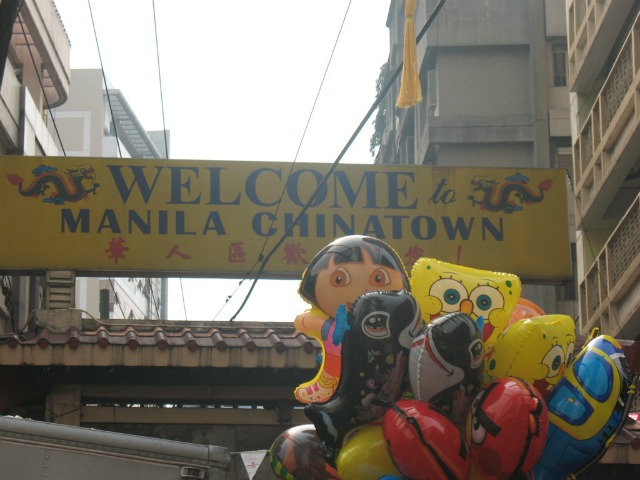
Binondo in Manila, established in 1594, is said to be the world's oldest Chinatown. Sophia Cuevas

Sneer at it all you want, but the "infamous" Soup No. 5 has been cited by an international travel guide as among the notable features of Manila's Chinatown.
 
 
Manila's Chinatown district was tagged by Cable News Network's CNNGo as one of the nine most scenic Chinatowns in the world.
 
 
It recommended the "infamous Soup No. 5, made from a bulls' testicles," as its Dish to Order.
 
 
Because of the main ingredient, the dish is believed to be an aphrodisiac.
 
 
BlurtIt.com lists it as among the world's weirdest aphrodisiacs, while OverseasPinoyCooking.net has instructions on how to prepare it.
 
On the other hand, CNNGo also recommended that visitors dine at Café Mezzanine above the Eng Bee Tin Chinese Deli across Binondo Church.
 
 
While Eng Bee Tin is famous for its hopia ube and other flavored hopias, CNNGo noted part of the restaurant’s income goes to Binondo’s fire volunteers.
 
 
The Ube Engine, the fire volunteers' iconic machine, is parked beside the Binondo Church.
 
 
Other features of Manila's Chinatown that CNNGo cited included the dragon decor in the area.
 
 
It also recommended that the best place to start a tour is on Carvajal Street, also known as "Umbrella Alley" due to the umbrellas at the small street stalls.
 
 
CNNGo also cited the Big Binondo Food Wok tour run by Old Manila Walks, co-owned by tour guide Ivan Man Dy.
 
 
"Each participant on the guided walk is given a souvenir Big Binondo Food Wok Map, which lists restaurant and shops, as well as coupons for businesses in the area," it said.
 
 
The Binondo Church itself was cited as another feature by CNNGo, which described it as the home of the Santo Cristo de Longos (Crucified Christ).
 
 
"In the 16th century, a deaf-mute Chinese supposedly regained the power of speech after finding the image," it said.
 
 
Other scenic Chinatowns cited by CNNGo were in:
  • Havana, Cuba
  • Kolkata, India
  • Bangkok, Thailand
  • Johannesburg, South Africa
  • Melbourne, Australia
  • Vancouver, Canada
  • San Francisco, US
  • London, UK

Sunday, July 29, 2012

...the Math wizzards in Taipei

Philippines wins 2nd overall, 41 awards in Taiwan math contest


July 29, 2012
GMA News

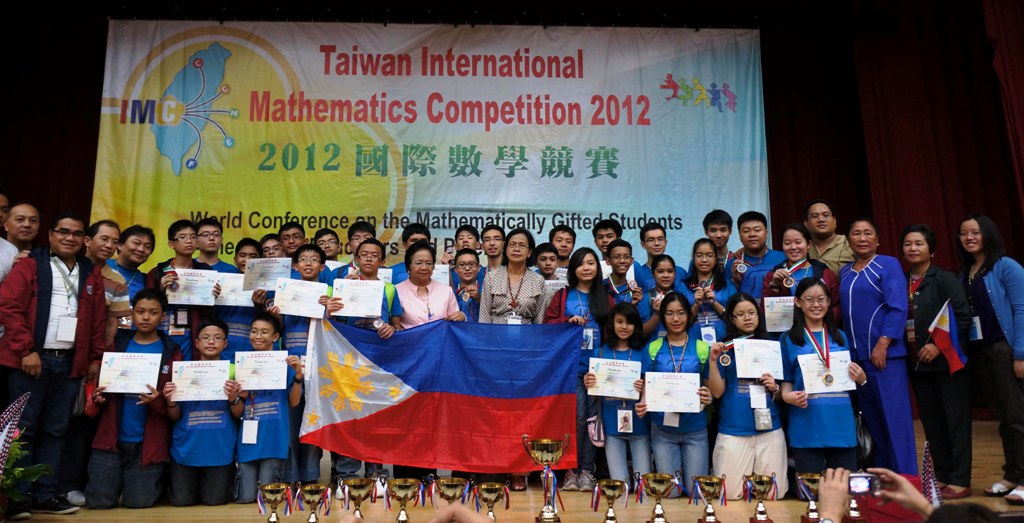
Filipino students won 41 medals and awards and wound up second overall in the elementary division in the Taiwan International Mathematics Competition (TAIMC) 2012 held from July 23 to 28 in Taipei.

The competition had 588 contestants from 28 countries including US, China and Canada, according to Dr. Simon Chua, head of the Philippine delegation and president of the Mathematics Trainers Guild-Philippines (MTG).

The TAIMC had two divisions: the 2012 Elementary Mathematics International Competition (EMIC 2012) and 2012 Invitational World Youth Mathematics Intercity Competition (IWYMIC 2012) for high school.


Filipino math wizards together with DOST-SEI Director Dr. Filma Brawner and DepEd Assistant Sec. Dr. Elena Ruiz (center) show the medals and trophies that they won at the awarding ceremony of the Taiwan International Mathematics Competition (TAIMC) 2012 in Taipei.


In the EMIC, gold medalists for the Philippines are Farrell Eldrian Wu of MGC New Life Christian Academy in Taguig City, Clyde Wesley Ang of Chiang Kai Shek College and Andrea Jaba of Saint Jude Catholic School.

Bronze medalists are Matthew Uy of Xavier School, Christian Philip Gelera of UP Integrated School and Cristiana Marie Calderon of Falcon School.

Wu, Ang, Uy and Gelera of Philippine Team A were declared second overall in the elementary division by winning first runner-up in the team and group contests. China was declared champion while Singapore was second runner-up.

Merit awardees are:
  • Albert Neil Dulay (Integrated Montessori Center-Taguig)
  • Lorems Yrol Pedeglorio (Butuan City SPED Center)
  • Christopher Banzon (Nemesio Yabut Elementary School)
  • John Aries Ceazar Hingan (San Beda College Alabang)
  • Justine John Serdoncillo (Elizabeth Seton School-South)
  • Emmanuel Pablo Santos (Colegio San Agustin-Biñan)
  • Hans Markson Tan (St. Stephen's High School)
  • Alyssa Guevarra (De La Salle Santiago Zobel School)
  • Angelika Tagupa (Colegio San Agustin-Makati)

Philippine Team A, composed of Hingan, Serdoncillo, Santos and Tan, won second runner-up in the team and group contests while Jaba, Guevara, Calderon and Tagupa won first and second runners-up in the team and group contests. In the IWYMIC, Filipinos won 2 gold, 2 silver, 9 bronze medals and 2 merit awards.

Gold medalists are Kelsey Lim Tiong Soon of Grace Christian College, and Ma. Czarina Lao of Saint Jude Catholic School, who was a member of the international team.

Winning silver medals are Jason Allan Tan of Jubilee Christian School and Deany Cheng of Grace Christian School.

Bronze medalists are:
  • Andrew Lawrence Sy (Xavier School)
  • Andrew Ong (Chiang Kai Shek College)
  • Judy Ann Donato and Joshua Taguinod (Valenzuela City Science High School)
  • Mario Antonio Ongkiko (Xavier School)
  • Matthew Ryan Tan (Saint Jude Catholic School)
  • Jonn Angel Aranas (Makati Science High School)
  • Nathanael Joshua Balete and John Thomas Chuatak (St. Stephen's High School)

Merit awardees are Jason Joseph Fernandez of Philippine Science High School-Main and Francis Concepcion of Philippine Cultural College Manila.

Sy, Tan, Ong and Ramon Galvan III of Iloilo Central Commercial High School won second and first runners-up in the team and group contests. Lim Tiong Soon, Tan, Aranas and Balete of Philippine Team C won first runner-up, and Philippine Team D members Chuatak, Cheng, Taguinod and Ethan Riley Chan of Zamboanga Chong Hua High School won second runner-up in the group contest. Other participating Filipino contestant was Lou Irish Gonzales of Pasig Catholic College.

Dr. Filma Brawner, director of the Science Education Institute of the Department of Science and Technology (DOST-SEI), and Dr. Elena Ruiz, assistant secretary for programs and projects of the Department of Education, were invited to the Taipei contest as lecturers in the World Conference on the Mathematically Gifted Students--the Role of Educators and Parents, which was part of the TAIMC.

Team leaders and deputies of the Philippine team are Dr. Eduardo Dela Cruz, dean of the Arellano University's School of Education; Dr. Alma Bella Bautista, Arvie Ubarro, Roberto Degolacion, Eugenia Guerra, Joseph Wee, Carmela Antoinette Lao, Jonathan Glorial, Jonathan Hicap and Ronnie Apari.

Besides the Philippines, other participating countries in the TAIMC are Australia, Bulgaria, Canada, China, Cyprus, Hong Kong, India, Indonesia, Iran, Japan, South Korea, Macau, Malaysia, Mexico, Mongolia, Netherlands, Nigeria, Russia, Singapore, South Africa, Sri Lanka, Taiwan, Thailand, US, Ukraine, Vietnam and Zimbabwe.


Tuesday, February 28, 2012

...the good payer

Japan: Philippines A Good Payer


OSAKA, Japan - The Philippines has yet to settle some ¥ 965 billion (P512.4 billion) worth of development packages it borrowed from Japan in the past years, making it the fourth country across the world with a huge outstanding loans based on the list of the Japan International Cooperation Agency (JICA).

But the good news is that the Philippines has no current pending loans from Japan and is assessed to be a good payer, according to Michino Yamaguchi, of the JICA-Media Division.

"The Philippines repays the outstanding loan steadily," said Yamaguchi.

Based on JICA records, most of the loan packages were spent to transportation-based projects like building of roads, bridges, ports, and airports across the Philippines.

From 1971, Japan has already infused some ¥ 757 billion in the transportation-based projects, accounting for 35 percent of the entire development loan assistance to the Philippines.

Commodity loans came next with 19 percent, followed by electric and power-related projects with 13 percent, Agriculture/Forestry/Fisheries with 11 percent and Irrigation and Flood Control with 10 percent.

A total of $20.5 billion has already been lent to the Philippines via Japan's Official Development Assistance (ODA) to the Third World Countries, but only ¥ 965 billion remain unpaid so far.

"As the Philippines is classified to be a Lower-Middle-Income country based on Income Category of the World Bank, the terms and conditions of Lower Middle Income Countries are applied," said Yamaguchi.

As a lower middle income country, the Philippines is accorded concessional terms on its ODA loan availment. These include a 1.4 percent interest with repayment period of 30 years, including a 10-year grace period.

Topping the JICA list is Indonesia, followed by China then India. Completing the Top 10 list are Vietnam, Pakistan, Thailand, Sri Lanka, Egypt, and Turkey.

Tsutomu Kudo, director of JICA-Media Division, said the ranking is as of 2010 as he explained that they are yet to wait until the end of next month to complete the figures for 2011.

"These loans have to be repaid," said Kudo, as he noted a downtrend on the amount being allocated by Japan for development assistance to the needy countries since 2005.

Kudo admitted that the downtrend was brought by the global financial crisis in the past years but he revealed Japan's plan to increase the ODA fund in the coming years.

But this time, he said the funds will be focused on countries that need most of foreign assistance like African countries.

JICA is the executing agency of Japan's ODA and works in more than 150 countries. Aside from granting loans, it also uses other ODA tools such as technical assistance and providing study grant to students and professionals of Third World countries.


Tuesday, January 3, 2012

...the year of the Azkals

2011: The year the Azkals revived Philippine football

 
December 30, 2011
 
 
The year 2011 will perhaps be remembered as the Philippine football's revival. The Azkals were known, or rather barely known, for losing consistently. Four years ago the Azkals weren't even entered for the World Cup qualifiers and other competitions and lost five games in a row, one to Singapore and two each to Malaysia and Thailand, conceding four goals in every game and scoring just one in all five.

The seeds of the team were already there, though, and after the losing record they went on an 11-match unbeaten run racking up five wins and six draws. Without making a mark in any major competition or beating a well-ranked team, the team was just competing for the title of the best of the minnows in Southeast Asia.

Since Manager Dan Palami took control of the team, however, they have improved their ranks and confidence and shocked Asia with a 2-0 victory over regional powerhouse Vietnam in the 2010 Suzuki Cup. This kick-started everything and set the scene for 2011 to become the biggest year in Philippine football history since the glory days of Paulino Alcantara and the Philippines' solitary trophy in 1913 when they beat China 2-1 to win the first ever Far Eastern Games.

The team went on to become at one stage the most improved nation in the world, based on ELO ratings. This is somewhat remarkable given football was virtually unknown to the general populace. TV networks hurriedly reorganized schedules to show matches, some networks just hearing for the first time that the Philippines had a football team. So here's the first part of a two-part series looking at how the Azkals have achieved that success and the forecast for 2012.

February: Challenge Cup qualifiers 1st round
Many nations didn't have to qualify for the group stage of the Challenge Cup in 2011, which was in itself the qualifying stage for the Challenge Cup in 2012. In their group only the Philippines had to go through the knockout qualifying stage which also saw Afghanistan, Taiwan and Cambodia enter the group stage. The first leg was played in Bacolod, considered by many to be Philippine football's home given the popularity of the sport. Indeed the official 20,000 capacity crowd is perhaps an underestimate and was by far the biggest audience of any of the qualifying matches.

The Philippines dominated the match after Mongolia went down to 10 men 25 minutes into the game after Pagamsuren Altantulga was sent off. Fittingly, Ilo-ilo native Chieffy Caligdong broke the deadlock as the first half was drawing to a close. With everyone thinking it would end goalless he popped up on the left wing to dink the ball over his defender and volley it through the goalkeeper's legs.
 
In control of the game but unable to kill it off, the Philippines seemed to be heading into a tricky away leg with only a single goal advantage for all the possessions and shots. Into the fourth minute of injury time, Phil Youngshusband sent the crowd into a frenzy as he squeezed the ball in on the rebound.
 
In the return leg in Mongolia, the Azkals got off to a flying start when James Younghusband scored in the 4th minute. This put the Azkals up 3-0 on aggregate and though Mongolia came back to score two first-half goals and bring the aggregate score to 3-2 to the Philippines, they couldn't managed to score again and the Azkals qualified for the next round.
 
Success: The Philippines were the only team in this knockout round to beat a higher ranked opposition on aggregate to qualify.
 
March: Challenge Cup qualifying group stage
Having beaten Mongolia, the team now entered the group stage of qualification, a round robin of four teams with the top two making it through to the final stage of the tournament in March, 2012.
 
Drawn against Bangladesh, Palestine and hosts Myanmar, it was a tricky group which got off to a disheartening start when leading for most of the match Myanmar scored a late free-kick to take a share of the points. Palestine beat both Myanmar and Bangladesh in their other games but failed to score against the Philippines as the two played out a 0-0 draw and left an all or nothing clash in the Philippines' final game of the group against Bangladesh.
 
Anything less than a win would see Bangladesh or Myanmar qualify while a victory would guarantee progression to the finals. As it was, the Philippines finally turned on the style and the team gelled to outclass their opponents to win 3-0. Qualifying behind Palestine in the group, the team made the Challenge Cup Finals in March, 2012.
 
Success: The Philippines were the only qualifiers of the knockout round to also qualify for the final stages.
 
June-July: World Cup qualification
The Philippines were drawn against Sri Lanka in the opening round of the AFC World Cup Qualification. Moving up in the rankings, the Philippines were rated higher than Sri Lanka though things got off to a sluggish start as Sri Lanka took the lead in Colombo through a deflected free kick before Nate Burkey scored the equalizer.
 
With their backs to the walls the Azkals showed their fighting spirit again and dominated a lackluster Sri Lankan side at the Rizal Memorial Stadium. Winning 4-0, the team advanced into the Second Round of World Cup Qualification, 5-1 on aggregate.
 
The draw saw the Azkals face Kuwait in the next round, a team ranked 67 places above them at the time. The start was sluggish again and the absence of Aly Borromeo and Stephan Schrock, due to suspensions, also didn't help the team in a 3-0 loss to Kuwait.
 
With little chance of progressing the Azkals came out strong in front of a home crowd in the second tie as Rizal Memorial Stadium started to become the team's fortress. The Philippines took the lead with what later became the Kaholeros' goal of the year: Stephan Schrock hammered the ball into the top of the net from 25 yards out.
 
Kuwait came back in the second half and equalized before having a man sent off. Pushing for an upset win, the Azkals were caught on the break and Kuwait took the lead with 10 men. The result meant that the team was knocked out of the World Cup Qualification 4-1 on aggregate but they won many plaudits along the way.
 
An honorable mention also goes to Yanti Barsales, who retired from international football in June, playing his last game for the Azkals against a UFL XI. The year 2011 has been the best for Philippine football, but the current stars owe much to standing on the shoulders of Barsales, who made his debut in 1992, and other Filipino veterans.
 
Success: The Philippines recorded their first victory in World Cup Qualification and battled to a 2-1 loss against the reigning Gulf Cup of Nations Champions, Kuwait, in the next round.
 
September-October: Long Teng Cup
Reaching the next round of World Cup Qualification had lifted the Azkals high in the public consciousness and television coverage was now almost guaranteed for each match. From being unknown, news about the team was starting to flood the nation's consciousness.
 
Tipped as potentially the Philippines' first trophy since 1913, the 2011 Long Teng Cup seemed to start in the worst possible way with Hong Kong scoring two early goals and asserting their dominance. Phil Younghusband converted a penalty to put the Azkals back into contention before half-time though and after the break Caligdong, so often the team's creative inspiration, scored twice to put the Philippines ahead. In the dying minutes of the game it seemed the Philippines had completed a remarkable comeback against the tournament's highest ranked team until Hong Kong equalized in the 86th minute.
 
In their next match, the Philippines faced Taiwan, which had already beaten Macau 3-0. Playing out a 0-0 draw the Philippines would repeat their feat in the Challenge Cup of drawing the opening two games before winning the last game to finish second in the group with five points. A 2-0 win over Macau gave the Philippines those points, though truth be told it wasn't the Azkals' best performance and the Philippines only won as Caligdong dragged his country into second place. Hong Kong meanwhile destroyed Macau 5-1 and Taiwan 6-0 to rule the Long Teng Cup for the second time.
 
Success: The Azkals improved on their position climbing to second place in the group with two draws and a win compared to a win, draw and a loss the year before.
 
Fun fact: Ian Araneta was the 2010 Long Teng Cup's top scorer, netting four goals in three games. This time around Caligdong was the only player in the tournament to score four goals to win the Golden Boot award.
 
October: Friendlies
With no tournaments left for the senior team in the year the Philippine Football Federation arranged friendly matches for the national side. First saw Singapore looking for revenge as the last encounter between the two nations ended in a 1-1 draw which eventually knocked Singapore out of the 2010 Suzuki Cup in the group stage for the first time since 2002. Singapore won the game 2-0 but they had to work for the result.
 
Ranked 30 places above the Philippines at the time it was still a worthy effort from the Azkals, who faced a Nepal side that is a place above Singapore in the FIFA rankings. Two goals from Phil Younghusband, one from his brother James and one from Matthew Hartmann had the visitors posting a 4-0 triumph.
 
Success: The Philippines established themselves as the most improved nation in the world based on ELO ratings. An arguably more accurate rating system, developed by a chess grandmaster, the ELO ratings showed the Azkals had been the most improved country in the world over the past 12 months at this point.
 
November: SEA Games
The SEA Games were perhaps the biggest disappointment of the year for football fans. Without adequate preparation, the Under-23 players struggled against their Southeast Asian rivals and recorded one win in five games.
 
The U23 team lost to Vietnam 3-1 in their opening game and was followed by a surprise 2-1 defeat to Timor Leste. The team defeated Laos in extra time as Joshua Beloya struck two late goals to turn around a 2-1 deficit and record their only points of the campaign. The Junior Azkals also suffered consecutive losses to Myanmar (5-0) and Brunei (2-1) as the Philippines dropped to the bottom of the group.
 
Success: Not much in this case though finding several younger players with great potential show Philippine football's future.
 
December: LA Galaxy
The game itself ended 6-1 in favor of the LA Galaxy, the Azkals' biggest loss of the year. Yet the result didn't matter as playing against the LA Galaxy in the first place was the achievement.
 
This capped the Azkals' year in style as David Beckham, arguably the biggest football star in recent football history, graced Manila by opening the scoring with a trademark curling shot and whipped in crosses to supply the next few goals. With teammates such as USA's top goal scorer Landon Donovan, Ireland's Robbie Keane and a host of other quality players, the spectacle was what was important this time around.
 
While it wouldn't be wise to have many such games, deflating the confidence of the Philippine players with heavy losses, as Weiss pointed out after the game, it was the perfect way to cap off the year.
 
Success: Originally the LA Galaxy had not intended to play in the Philippines. After the success of 2011, the newly crowned MLS champions were convinced that football had grown enough in popularity and quality to stop by the Philippines on the way to Australia. The LA Galaxy is the biggest club to visit the Philippines in decades. — JVP/HS, GMA News
Tuesday, October 4, 2011

...the Muay Thai gold, silver medalists

Pinoy wins gold in Muay Thai World tilt

 10/04/2011
 
2 other fighters get silver medals

MANILA, Philippines – The Philippine Muay Thai team brought home 1 gold and 2 silver medals from the prestigious Muay Thai World Championships in Uzbekistan.

Ilonggo Robin Catalan, brother of bemedalled Wushu artist Rene Catalan, won the gold medal in the 48-kilogram category.

Jojo Suello Pol (63.5 kg) and Preciosa Ocaya (51 kg) each nabbed silver medals in their respective divisions.
The three muay thai artists are part of an 8-man contingent sent to Uzbekistan for the competition which ran from September 22 to 27.

Small but terrible

Catalan is the smallest fighter in the 8-man muay thai team.

The 20-year-old defeated a taller Afghan fighter in the finals of the 48-kg division.

“Matangkad kasi yung kalaban ko eh… ako yung pinakamaliit, bumawi na lang po ako,” said Catalan.
Catalan said he is happy to win the gold on his first try of the competition. – With a report from Dyan Castillejo, ABS-CBN News