Showing posts with label FIBA. Show all posts

Friday, November 1, 2019

...the FIBA 3x3 Olympic Qualifyer

Philippines earns ticket to FIBA 3x3 Olympic Qualifying Tournament in India


Philip Matel
ESPN
01 November 2019


The Philippines booked a ticket in the FIBA 3x3 Olympic Qualifying Tournament in India from March 18-22 next year.

FIBA made the announcement in a gala in Utsunomiya, Japan on Friday, the site of the 2019 World Tour Final. Tokyo will play host to the Summer Games next August for the first time since 1964.
The Philippines is in Group Pool C, along with Slovenia, France, Qatar, and the Dominican Republic.


A total of 20 countries will be vying for three slots for Tokyo. An additional spot will be allotted to the winner of the Universality-driven Olympic Qualifying Tournament, to be held in Hungary in April.
Host Japan and top three countries Serbia, China, and Russia were given direct qualification to the inaugural tournament in the men's division. In the women's category, Russia, China, Mongolia, and Romania directly qualified.
Other countries that have qualified include India, the United States, Latvia, Poland, Mongolia, Netherlands, Lithuania, Brazil, Belarus, Canada, Croatia,South Korea, Turkey, Spain, and New Zealand in the men's division.
Meanwhile, for the distaff division, India, Hungary, France, Iran, Netherlands, Italy, Chinese Taipei, Estonia, United States, Germany, Ukraine, Belarus, Czech Republic, Switzerland, Uruguay, Turkmenistan, Indonesia, Australia, and Sri Lanka also advanced to the tournament.
"We're very happy that the Philippines will be competing in the upcoming Olympic Qualifying Tournament for a shot at making it to the 2020 Tokyo Olympics," said Samahang Basketbol ng Pilipinas (SBP) president Al Panlilio.
"3x3 is an area where Filipino basketball players can really excel and we're delighted that a Filipino basketball team will get to test their skills against the world's best."
The Philippines, which started 61st in the World Rankings at the start of 2019, leapt over 40 spots and went as high as 20 -- primarily due to a collective effort on numerous fronts.
Major players include the Chooks-to-Go Pilipinas 3x3 tournaments, which featured four conferences, and the Samahang Basketbol ng Pilipinas' Pambansang Tatluhan.
Also a contributor was the country's international involvement in this emerging variety, with several clubs like Pasig, Balanga, and Basilan participating in several high-level 3x3 competitions over the past nine months. Manila also played host to some high-profile 3x3 contests, including the first-ever Challenger tournament last September.
The pool for the 3x3 squads will be determined at a later date. However, FIBA rules stipulate that at least two of the four must be part of a country's Top 10 3x3 rankings.
To serve as tuneup for the OQT, Chooks-to-Go Pilipinas 3x3 will open its 2020 season in January.
"We would like to thank the [SBP], headed by chairman emeritus Manny V. Pangilinan and president Al Panlilio, the numerous private promoters, all the players from Chooks-to-Go Pilipinas 3x3, and of course, the Filipino people who supported us for the last nine months," bared CTG Pilipinas 3x3 league owner Ronald Mascariñas.
"The journey is far from over as the goal is to not just make it to the OQT. The endgame is to make it to Tokyo. We are all going all out to prepare our national team for this and we hope that everyone joins us in this journey."

Wednesday, September 25, 2019

...the PH 3x3 hoopers world ranking

Philippines rises to No. 21 in Fiba 3X3 Men's world ranking


Randolph B. Leongson
Spin.ph
25 September 2019


A SPOT in the Olympic Qualifying Tournament is within reach for the Philippines as it rose to 21st from 25th in the Fiba 3x3 Men's World Rankings.


Philippines 3x3 has amassed 8,156,366 points, putting it in play for the Olympic Qualifyng Tournament (OQT) a month before the October 31 Fiba-imposed deadline.

Pasig Chooks made it to the quarterfinals of the Kaohsiung Challenger on Sunday.

Balanga Chooks is also set to participate in the Jeju Challenger and the 2019 Fiba 3x3 World Tour Jeddah Masters next month as the country's last ditch effort to stay within the top 24.

The three highest-ranked federations will automatically qualify for the Olympics, while host Japan has gained automatic entry.

Twenty teams will compete in the OQT for four slots to the Olympics while the last slot will be disputed in a Universality OQT.

Chooks-to-Go Pilipinas 3x3 league owner Ronald Mascariñas said more 3x3 activities are set in October.  "We just can't wait and leave out fate to chance. We have to continue pushing until our goal is met." said Mascariñas.

Friday, May 8, 2015

...the Philippines paradox

Philippines' Economic Development and the 'Pacquiao Paradox': Shining Individually, Whimpering Collectively

Richard Javad Heydarian Headshot


For years, I have covered the emergence of the Philippines as the darling of global investors. (In fact, a number of my works on HuffPo have focused on this issue.) After countless exchanges with economists, consultancy agencies, and businessmen in the country and beyond, it is quite clear to me that there is a growing sense of optimism (Keynesian "animal spirits") in and over the long-term economic potentials of the Philippines. Business confidence is building up.
Undoubtedly, the Southeast Asian country is once again on the radar. Certain macroeconomic trends are highly encouraging, particularly in terms of inflation and interest rates, projected annual growth rates, fiscal reforms, debt payments, gross foreign reserves and trade and investment inflows. Recent years have also seen growing regulatory predictability in the government and sustained efforts at closing the country's gnawing infrastructure gap.
Yet, sustained economic development doesn't take place in a vacuum. For the Philippines to become a true "tiger economy" in the coming decades, it has to also experience some changes in its cultural foundations.
A Country of Stars
I vividly recall a poster advertising "Filipino singers" in the elevator of an upscale hotel in Beijing when I was there for an academic visit few years back. Of course, there was nothing surprising about Filipino singers performing in major hotel chains. After all, from the Middle East to East Asia and North America, I constantly came across affable, highly competent, and extremely nice Filipinos, who were at the forefront of the hospitality and tourism business.
But what struck me was how, especially when it comes to singing, being a "Filipino" alone represents a brand. If you are Filipino, you are expected to be a great singer. Countless Filipinos, from Charmaine Clarice Relucio Pempengco to Christian Bautista, have made it big on the international stage. When it comes to singing and dancing, the Filipinos can compete with the best in the world, and often emerge as the indisputable victors. Not to mention, the Philippines' superpower status when it comes to beauty pageants. I have lost count of how many Filipinas (pure- or part-Filipino) have managed to make it to the top 5-10 contestants in every major global beauty contest.
No wonder then that many see the Philippines as the extension of Latin America into the heart of Asia, an island nation filled with the Iberian spirit of musicality and overflowing talent. In certain sports, especially the "Four B's" of basketball, billiards, bowling and boxing, the Philippines has also showcased its ability to go toe-to-toe with the best in the world. From the Philippines' impressive performance in the latest FIBA World Championship, to globally-renowned billiard wizards such as Efren "Bata" Reyes, Francisco Bustamente, Dennis Ocrollo, as well as world bowling champions such as Rafael "Paeng" Nepomuceno, it is clear that there has been no shortage of world-class talent in the Philippines.
Above all, perhaps, stands Manny "Pacman" Pacquiao, who is widely considered as one of the best pound-for-pound boxers of his generation. He is the first and only boxer to have won world championships in eight divisions, and his recent (controversial) loss to Floyd "Money" Mayweather should take nothing away from his impeccable legacy.
Yet, astonishingly the Philippines stands among few counties which have yet to win a single gold medal in the Olympics. Despite having one of the most articulate and talented journalists, lawyers, and artists as well as an army of engineers, doctors, and scientists, the Philippines is yet to break out of its "lower-middle income trap". And despite having among the world's best singing and dancing talents, it is South Korea's"K-pop" phenomenon, which is transforming the entertainment landscape in Asia.
The Philippines is a paradoxical nation, where individual glories often clash with a long history of collective disappointment.
The Anti-Asian Values
Singapore's late-founder, Lee Kuan Yew, was fond of talking about the peculiarities of the so-called "Asian Values" (AV). He always insisted that unlike Western countries, Asians are more predisposed to thinking and behaving in collective-communitarian terms, putting the interest of the family and broader community above their individual impulses.
"I don't think there is an Asian model as such. But Asian societies are unlike Western ones... [an Asian person] is not pristine and separate," Lee Kuan Yew argued in an interview with Foreign Affairs back in 1994. To be fair, the legendary Singaporean leader had a more specific notion of "Asia" in mind, since he was primarily referring to "Confucian countries" of China, Taiwan, South Korea, Japan, Singapore and Vietnam.
His Malaysian counterpart, Mahathir Mohamad, was even more all-encompassing in conceptualizing of and passionate in his advocacy for the notion of "Asian Values", consistently questioning the universality of liberal democracy, which is primarily found upon the principles of individualism, procedural accountability, and freedom of expression. Instead of embracing democratic capitalism as the ideological end point of history, he envisioned an alternative episteme anchored by principles of deference to authority, limits on individual freedom, and emphasis on hard work and economic productivity.
Obviously, the concept of "Asian Values" has been largely discarded by the experience of countries such as India, Indonesia, Japan, Taiwan, South Korea, which have embraced liberal democracy, albeit with certain modifications, without necessarily becoming "un-Asian". For its critics, the AV concept has been largely dismissed as a thinly-veiled propaganda for autocratic leadership and, quite ironically, an orientalist perspective, which ignores the almost universal demand for Vox Populi and freedom of expression.

Among Asian countries, the Philippines perhaps stands as the extreme opposite of the so-called "Asian Values". It is a country where individualism and lively public discourse undergirds the body-politic, animating the conduct of day-to-day politics and the broader national political culture. It is a country where the mainstream media constantly prioritizes endless gossip about individual celebrities over deep strategic discussions about national interest and development.
It is a country where actors and entertainers are constantly overwhelmed by public attention, while intellectuals are constantly pushed to the margins of public discourse. It is a country where the interests of an individual and his/her family stand as concrete, tangible priorities, while notions of nation and nationalism are treated as largely abstract points of reference, fondly cited in poems, movies and history books.
Philippine Exceptionalism
To be honest, I am not very convinced with cultural theories on national development, always preferring to focus on the impact of trade and industrial policies, the state-building process, and the structure of opportunity in the global economic system. The concept of "culture" is itself too broad and imprecise, often interchangeable with religion, national psyche, or "institutions", which pertain to regularized practices that have gained value over time, shaping the behavior of societies and individuals.
A century ago, leading sociologist such as Max Weber dismissed the ability of Confucian countries such as China to ever catch up with the West, (mistakenly) arguing that Far Eastern cultures tend to emphasize submission, passivity, and spirituality over the mastery of nature and a hunger for material accumulation, which underpin capitalist modernization. Yet, the past decades have seen the likes of Singapore, South Korea, Taiwan, and China emerging as history's greatest (capitalist) economic miracles. Confucian Vietnam is obviously in the midst of its own industrialization bonanza.
As Fareed Zakaria cogently points out in his Foreign Affairs interview with the Singaporean leader, "Cultures change. Under the impact of economic growth, technological change and social transformation, no culture has remained the same. Most of the attributes that Lee sees in Eastern cultures were once part of the West. Four hundred years of economic growth changed things."
Few recall how in the past even Germany and Japan used to be dismissed as non-Western countries, predisposed to autocratic rule. The European intellectual giant Jurgen Habermas' post-World War II personal project was precisely about transforming Germany into a more Anglo-Saxon like democratic polity. Today, Germany and Japan stand as among the most stable democratic societies in the world, untouched by the bickering and political paralysis that afflicts old democracies such as the United States and France.
Obviously, culture is malleable and subject to change. But in the case of the Philippines, decades of economic stagnation has gone hand in hand with cultural immutability. While a predatory oligarchy has instituted a "shallow capitalism", and exploited hollow electoral institutions in the country, a persistently individualistic/family-centered culture, in turn, has come at the expense of building a collective, national spirit, which has been instrumental to development of most countries in the region.
Perhaps, instead of just creating global stars, the Philippines should also develop a socio-economic ecosystem, found upon a progressive national culture, which nurtures the talents of and provides opportunities for fruition of the vast potentials of the broader Filipino population -- that is to say, every Juan/Juana de la Cruz. And the Filipino political leadership, media, and intellectual class should play a key role in this transformation. This is their sacred duty.


Saturday, September 6, 2014

...the Pilipinas Gilas admirers

‘We were all cheering for Philippines’: FIBA sec gen Patrick Baumann expects Gilas back on world stage in 2019


News5 screencap
News5 screencap


After its impressive showing in the 2014 FIBA Basketball World Cup in Seville, Spain, the Philippine national men’s basketball team earned itself more than its fair share of foreign admirers.

Count FIBA secretary general Patrick Baumann among that number.

Baumann told News5 that he was impressed by Gilas Pilipinas’ showing in the championships after the team gave more experienced teams a good scare before finishing up its campaign with a 1-4 win-loss record in Group B.

“I think the Philippines proved they belong on the world level, the world’s elite,” Baumann said.
“I think with patience and with a lot of hard work back in the country to grow further talents and bring this team together more in the future, by next World Cup in 2019, Philippines will be back there and they will start to beat everybody that they meet on the court.”

Gilas surprised many foreign observers in near-upsets of Croatia, Argentina and Puerto Rico although Baumann believed that they showed their inexperience playing on this level as they failed to get over the hump in those games.

Their performance was a pleasant surprise to Baumann, who was able to watch the squad in the 2013 FIBA Asia Championship, which was held in Manila.

“Certainly if you compare the team as it played last year in the Asian championship and to compare with this team, there’s been a huge jump in quality and savoir faire in how to go a game,” he said.

“What we have mostly appreciated is it came on the court. They were unimpressed. They fought for their right to beat Croatia, beat Argentina.”

He added that there was “no doubt” that the Philippines would make a return to the world level given the skill and talent that they displayed in the tournament.

“There are young players there. There are players that shoot like hell. It’s just incredible to see them. There’s (naturalized NBA player Andray) Blatche, who’s playing an incredible World Championship, even injured. You have to give him a lot of credit for the heart he’s given to the team,” he said.

“We were all impressed.”

Baumann also said that the the FIBA officials enjoy having the Philippines in tournaments because of the passion and enthusiasm that their team and supporters bring to the table.

“We were all cheering for Philippines somehow because there’s a lot of spectators in the tribune that follow the team and always give incredible ambience to the World Cup,” he said.

“We think that the basketball federation in the Philippines, the whole basketball family deserves a lot of credit for the achievements of this team here in Sevilla.”
 

Saturday, September 28, 2013

...the Gilas world ranking

Thanks to FIBA Asia run, PH climbs 11 spots in world rankings

Buoyed by its magical run in the 27th FIBA Asia Championship last month, the Philippines made a big leap in the world rankings, moving up 11 rungs higher to the 34th spot with an accumulated 22.8 points.

The Nationals, as hosts, finished fighting runners-up to powerhouse Iran in the Manila cage joust and that proved enough to earn the points to leapfrog the likes of continental rivals Japan (35th with 22.6 points), Qatar (42nd with 17.3) and Chinese Taipei (44th with 15.9).

Collectively known as Gilas Pilipinas, the Nationals also emerged as one of the most improved squads in the world rankings and is now ranked sixth-best overall in Asia behind China (12th with 188.9 points), Iran (20th with 94.2), Lebanon (29th with 35.4), Jordan (30th with 33.8), and South Korea (31st with 30.6).

More than elation, national team coach Chot Reyes admitted Friday that the Nationals’ latest feat also serve as an added motivation as they gear up for future international tournaments, including next year’s FIBA Basketball World Cup in Spain.

The United States, the reigning Olympic champion, kept its firm hold on the top spot with 940 points followed by European titan Spain with 885. Argentina was a distant third with 490 while Lithuania and Greece traded places in fourth and fifth spots with 432 and 376 points, respectively.

The rankings are based on the performance of each country in three major tournaments that includes the Olympics, the FIBA World Cup (then known as the FIBA World Championship) and the continental championships. FIBA then makes calculations from those tourneys inside two Olympic cycles.


Tuesday, August 20, 2013

...the PH historic moments

Historic moments in Philippine basketball and stocks
            

Last Aug. 10, 2013, the Philippine national basketball team, Gilas Pilipinas, won against South Korea. It was a momentous game in Philippine basketball history, one that is considered a once-in-a-generation achievement. With the win, the team assured itself of at least a silver medal finish in the 2013 FIBA Asia Championship. More importantly, the win allowed the team to qualify for the World Championships after a 35-year absence. It also marked the 1st time that the Philippines defeated South Korea in a high-level basketball game since 1985.

Beating the perennial tormentor
Before this game, South Korea had been a perennial tormentor of the Philippines in basketball. South Korea defeated the Philippines in the 1986 Asian Games, 1987 Asian Basketball Confederation Championship, 1998 Asian Games, 2002 Asian Games, 2009 FIBA Asia Championship, 2010 Asian Games and 2011 FIBA Asia Championship.

This time around, the Koreans, with their size, seamless execution and smooth outside shooting, were poised to deal the Philippine squad another heartbreaking loss. The outlook got particularly bleak when the Philippine team’s naturalized center, Marcus Douthit, went down with a calf injury and sat down the game’s entire 2nd half. With the odds stacked against it, Gilas miraculously found a way to fight back and fight strong. The team rallied behind the strength of its 6th man – the hometown crowd.
The strength of a nation
The 20,000-strong crowd in the MOA Arena supported their team through and through. They cheered every time Gilas had possession and jeered every time Korea had the ball. The raucous crowd cheered with a purpose, repeatedly chanting the words “puso” and “laban.” The crowd’s support was so strong that the Korean coach later on admitted that the pressure affected their ability to focus and execute in the last quarter. As Gilas team captain Jimmy Alapag said, “We had the strength of a

All heart
Korea proved to be a formidable opponent. Even as it was playing against the hometown crowd, the Korean team continued its flawless execution and cold-blooded shooting down the stretch. But this time around, the heart of the Filipinos would not be denied. Gilas was spurred by the daredevil drives of guard Jayson Castro, the savvy plays of forward Ranidel de Ocampo, the clutch triples of guard Jimmy Alapag and the never-say-die attitude of injured forward Marc Pingris. The Filipinos more than matched the Koreans – basket for basket and hustle for hustle – in order to win the game. In the end, Marc Pingris summarized what drove the team’s efforts: “We did this for our country. We made a lot of sacrifices. In the PBA, we play for pay. But here, we’ll die to win for our country.”

Writing your own history
The Philippine team’s win against South Korea put Philippine basketball back on the world map. Below, we summarize some of the more memorable quotes from the players and coach of Gilas as they weighed in on this historic achievement.

Gilas team captain Jimmy Alapag: It’s the most precious moment in my career. This means more than a PBA championship. This is so much deeper. This is for our country.

Gilas forward Japeth Aguilar: It wasn’t only our dream that was fulfilled but the dream of every Filipino.

Gilas center Marcus Douthit: Everybody on this team and the organization are now part of history – that’s the most amazing feeling.

Gilas coach Chot Reyes: There’s no greater opportunity in life than to write your own history. This team just wrote it tonight.

Historic moments for the economy
Just like the Philippine team’s achievement in basketball, our country was able to deliver a number of historic feats in the financial and economic fronts. We are fortunate to have witnessed these in our lifetime. We enumerate these below.

1. Fastest growing country in Asia. In 1Q2013, the Philippines became the fastest growing country in Asia. Our country’s 7.8-percent 1Q2013 GDP growth edged China’s 7.7 percent. With problems hounding most emerging markets, our country’s high growth rate stands out as something exceptional.

2. Investment grade. In 1H2013, our country received its 1st and 2nd investment grade rating upgrades from Fitch Ratings and Standard & Poors. These credit rating upgrades are affirmations of the magnificent economic turnaround that our country has undergone.

3. Peso tops out. We saw the bottom of the peso vs. the US dollar at 56.50 in October 2005. We wrote about it and we cited the reasons why the peso will continue to strengthen for years to come (Peso, the Strongest Currency in Asia, Oct. 24, 2005). After eight long years of strengthening, we may have witnessed history again as the peso may have topped-out at 40.45 last March 2013 (The Peso Tops Out, May 27, 2013).

4. Worldwide recognition for finance leaders. Two of the country’s important finance leaders have recently received international acclaim. Department of Finance Secretary Cesar Purisima was named Finance Minister of the Year 2012 by Euromoney. Also, Bangko Sentral ng Pilipinas Governor Amando Tetangco Jr. was named Central Banker of the Year for Asia Pacific by the Banker, while being consistently rated as one of the world’s top central bankers by Global Finance.

Historic moments in the stock market
The resurgence of the Philippine economy has fueled the strong performance of our stock market. Below, we enumerate some of the important milestones that our stock market has achieved.
1. Opportunity of a generation. Amidst the carnage of the 2008 Global Financial Crisis, we said that the bear market would present a once-in-a-lifetime opportunity to make huge amounts of money in the stock market (Opportunity of a Generation, Nov. 3, 2008). The important and ominous bottom of the S&P500, which we correctly called in 2009 (666 on 3-6-9, April 13, 2009), marked the start of the very powerful bull market that we are witnessing now.

2. 111 new all-time highs. The PSE Index rebounded strongly from the 2008 global bear market and eventually topped its October 2007 high of 3,897. Past that previous record high, the PSE Index established 111 new record highs as it reached the new all-time high of 7,404. The current all-time high is 90 percent higher than the 2007 high and 339 percent higher than the last bear market bottom.

3. Silver medal in the stock market. Even as most global indices moved higher in 2012, the Philippine stock market still managed to stand out. Last year, the PSE Index delivered a return of 33 percent, 2nd best in the world.

4. Largest trading volume. The local stock market’s year-to-date value traded for 2013 has already exceeded P890 billion. Even though we are not yet done with the year, 2013 value traded has already surpassed the full-year trading volume of any of the previous years.

5. Largest IPO/re-IPO. Last April 2013, LT Group (LTG) set the record for the largest IPO or re-IPO in the Philippines. Its P37.7-billion equity offering was many times oversubscribed and was well-received by global investors. This showed the growing awareness and interest of foreign investors in the Philippines and the local stock market.

Selfless leaders write history

The monumental achievement of Gilas Pilipinas would not have been possible if not for the efforts, dedication and resources of Manny Pangilinan (MVP). His dream was to bring Philippine basketball back in the world map. More importantly, he had the long-term vision to stick with this dream through thick and thin. We are fortunate to have MVP because he is someone who has a deep love for country and is willing to work for something beyond himself. It was MVP that put the national team in the position to achieve beyond expectations and write history anew.

This is the same type of vision, dedication and love of country that has driven our country to turn. From the late President Cory Aquino to current President Noynoy Aquino, we benefited from the efforts of dedicated and selfless leaders who dreamed of a better Philippines. This is why our economy and our stock market can perform strongly and continue to defy expectations.

Learning from history
As we witness history unfold for Philippine basketball, it is important for us to appreciate the national team’s achievements and understand why these milestones were attained. This appreciation may similarly be applied to better understand the reasons behind the historic events that take place in the local stock market, the Philippine peso and our economy. A deeper understanding of history and the causes of the lows, highs and turns of the stock market and the Philippine peso, as we have explained in our previous Philequity Corner articles, can give one the rationale for one’s investment decisions.


Sunday, August 11, 2013

...the FIBA Asia Stunner

Gilas Pilipinas yields gold medal to Iran in FIBA Asia

By Celest R. Flores, Mark Giongco
INQUIRER.net
Sunday, August 11th, 2013


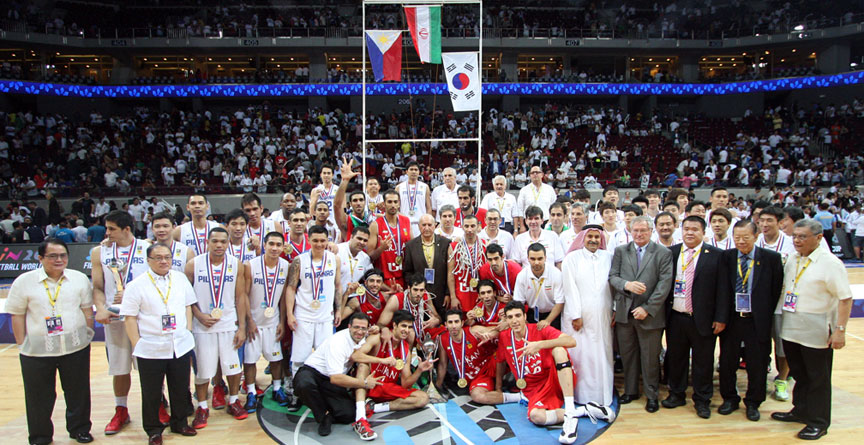
SATISFYING 2ND PLACE The top three teams Iran, champion; Philippines, in second place; and South Korea, third, pose with their respective officials during the award ceremony at the close of Fiba Asia in MOA Arena. Despite the runner-up finish, the Philippines secured a slot in next year’s Fiba World Cup in Spain. Nuki Sabio/PBA photo

MANILA, Philippines – After securing a slot for next year’s FIBA World Cup in Spain, the Philippines satisfyingly settled for second place following a 71-85 loss to Iran in their gold medal match at the 27th FIBA Asia Men’s Championship Sunday night at the Mall of Asia Arena in Pasay City.

Without the injured Marcus Douthit, Gilas Pilipinas was left without a legitimate center to contain Iran’s seven-foot-two center Hamed Hadadi.

Hadadi, who was named MVP for the third time, caused problems for Gilas on both ends of the floor as he easily came away with 29 points, 16 rebounds and two blocks.

Jayson William, who joined Hadadi in the mythical five, managed to squeeze out another impressive effort with a team-high 18 points, including two freebies that gave the Nationals a 36-35 lead to start the third quarter.

But it was all Iran from there after William’s charities.

Iran, the lone squad who went unbeaten all throughout the tournament, shifted to a higher gear in the second half behind Hadadi, who was just too big for Gilas’ undersized big men Japeth Aguilar, Ranidel de Ocampo and an ailing Marc Pingris to handle.

Down 10, Gilas saw its deficit balloon to 16, 56-72, after three straight inside baskets by the former Memphis Grizzlies reserve Hadadi with 5:08 left.

The 28-year-old Hadadi scored for the final time to put the outcome beyond doubt, 78-63, in the final 2:57 before fouling out 13 seconds later.

Forward Samad Nikkhah Bahrami also caused fits for the Philippines with 19 points and seven assists despite committing seven turnovers while veteran point guard Mahdi Kamrany chipped in 15 points, seven rebounds and five assists.

Jimmy Alapag chipped in 13 points while Jeff Chan had eight.


Wednesday, March 6, 2013

...the basketball mecca

The Philippines as a basketball mecca


Jeremy Lin and James Harden will hit town in October for a preseason game. (Getty Images)


The Philippines has been considered a generally basketball-loving country for decades now. There are leagues all over scattered into different categories (like the under 6-feet tall league), for different age groups, for members of a certain profession, intra and inter-company tournaments, etc. As you drive around on long road trips from province to province, you see basketball courts or goals, some well-built with strong material, some makeshift, all over the place. The PBA has prided itself on being Asia’s first play-for-pay league, and the resurgence in fan support and the highest quality of basketball is a sure sign that, despite the critics and crabs, the Filipinos’ love for basketball remains.
 
For many years, the PBA has employed imports to spice things up. Mostly Americans, they venture from far away to play basketball here. Even in the collegiate leagues, foreign student-athletes have journeyed from as far as Africa and are playing basketball while (hopefully) receiving a high level of education. Filipinos who were born and/or raised abroad have voyaged to the Philippines to play hoops, and many have excelled and endeared themselves to those who watch and appreciate good basketball. In one way or another, it is the love for the game of basketball that has brought all these people here.

Through the years, many have come back a few times either to play again (“balik-import”), or just enjoy the warmth of the Filipinos and the beauty of the Philippines. Some came and decided to stay, making the Philippines their home. Coach Norman Black of the Talk ‘N Text Tropang Texters is the primary example. Seven-time PBA Best Import Bobby Parks is another one who is based here now, and his son, Ray, is one of the primetime players in the UAAP for NU and is considered to be one of the foundations for the national team in the future. Even coaches have come to share their knowledge and ended up staying for years (Ron Jacobs, Rajko Toroman, and former NBA center Alton Lister).

Famous international basketball players and teams have travelled to the Philippines to promote certain products, conduct clinics, and/or play exhibition games. NBA stars past and present have been visiting the Philippines for many years in a row, especially because the NBA presence is strong here, with games televised live, and NBA merchandise is available in many stores, plus the fact that the NBA created a website specifically for Filipinos. Most, if not all these players and teams leave with the vivid image of Filipinos going crazy over their mere presence, applauding, cheering, or screaming at their magical moves and superb skills on the hardcourt.
 
An American, Rafe Bartholomew, even wrote a book called “Pacific Rims”, about what he calls “the Philippines’ unlikely love affair with basketball.” He came here, looked around, noticed the passion for the sport, and dedicated himself to write about it and all the different stories basketball has spun for Filipinos all around the country. Every Filipino fan who appreciates basketball should read the book. We may not agree with everything he says in it, but he surely has some enlightening perspectives.

So many people who come from far, far away end up in the Philippines because of basketball – to play it, to coach it, to watch it, or to experience it. Truly, basketball in the Philippines is quite an experience. It brings out passion and fuels up emotions.

In August, the FIBA Asia Championship will be held here in the Philippines, and the national teams of our Asian neighbors will make the trek to Manila with the objective of perhaps making it to the FIBA World Championships. Certainly, Filipino fans will come out in droves to cheer on Gilas Pilipinas as it takes on the other Asian basketball powers.

Then, as most of you already know, it was just announced that only two months after FIBA Asia, the NBA will hold, for the first time in history, a live pre-season game between the Indiana Pacers and Houston Rockets, here in the Philippines on 10 October 2013. The Mall of Asia Arena will be the venue, and the NBA promised that the lineups of both teams will be complete, and the mascots will be here, as well as the cheerdancers (very important) of both teams. No less than NBA Commissioner David Stern made the announcement on video, and Rockets Coach and NBA Hall of Famer Kevin McHale also shared his message.

It’s mind-blowing to think that the NBA decided to stage a game here, even if it’s not of the regular season variety. I am excited beyond words and intend to be there when it happens. It wasn’t something impossible, but it came sooner than I expected. The past few years indicated the high probability of having an actual game in Manila, with the constant NBA events being held here, and the active relationship between the PBA and the NBA, and the NBA with its local carriers (BTV and Studio 23).

There are many other countries all over the world that would gladly host an NBA game, countries who are commonly considered as “more popular” than the Philippines. The NBA has played in many cities in Europe, and recently played some games in China. Why here? Obviously, the NBA saw something in the Philippines that set it apart from other nations and put it on the same level as many other bigger countries, as far as basketball is concerned. The NBA felt the passion, the utter love for basketball that Filipinos have, despite it being a “tall man’s sport.” As I always say, there are millions of basketball “experts” here who watch the games in the different leagues here and abroad, and are very knowledgeable about them. The fight for tickets to this game will be almost as spectacular as the event itself.

So it seems that it isn’t just the Philippines’ beautiful beaches and natural wonders that entice visitors to come onto our shores. Sometimes, the reason is basketball.


Wednesday, September 19, 2012

...the hopeful FIBA Asia host

Phl looms best bet to host FIBA Asia


By Nelson Beltran
The Philippine Star
September 19, 2012


TOKYO – The Philippines has emerged as having the best chance to host the 2013 FIBA Asia Championship.


Talks making the rounds on the eve of the FIBA Asia executive board meeting Wednesday were favorable for the Philippines which is bidding to host the biennial regional event for the first time in four decades.

For one, Iran, another serious bidder, has conceded the Philippines would earn the rights to host the Asian meet with the Tehran Times already reporting on Tuesday that the event will be held in Manila.

China hinted at making a bid in the last minute, but it is unlikely to get the nod of the FIBA Asia board, having hosted the last two editions (in Tianjin in 2009 and in Wuhan in 2011) of the event.

Qatar has reportedly dropped its plan to join the bidding presentation set during the FIBA Asia executive board meeting at the International Convention Center of Grand Prince New Takanawa Hotel at 4 p.m. Wednesday.

At the start of the knock out stage Thursday, the Philippines plays Chinese Taipei which placed third in Group B following a 75-73 squeaker over Qatar.

Samahang Basketbol ng Pilipinas is determined to make good impression that it is sending a high-powered cast of Filipino cage officials in the meeting.

SBP executive director Sonny Barrios will make a presentation on behalf of the Philippine federation which intends to bring the event at the brand-new SM MOA Arena as the main venue and the Ninoy Aquino Stadium as the second venue.

 
SBP president Manny V. Pangilinan will also attend the meeting with PBA officials, led by commissioner Chito Salud and board chairman Robert Non, lending their presence on the sideline to show full backing on the Philippine bid.

The Philippines has never played host to this event since the 1973 meet which the country ruled with a team including Robert Jaworski, Mon Fernandez and Bogs Adornado among others. The event was still then called ABC (Asian Basketball Confederation) Championship.

The other only huge FIBA event the country hosted since then was the 1978 World Championship at the Araneta Coliseum.

In 2010, the SBP showcased the Philsports Arena in hosting the FIBA Asia Champions Cup.

The latest significant move done by the SBP was inviting FIBA Asia secretary general Hagop Khajirian to inspect the SM MOA Arena a few weeks back.

Khajirian told SBP officials then that, for him, SM MOA Arena “is more than acceptable as primary venue of the FIBA Asia Championship.”

The FIBA Asia leadership includes president Sheikh Saud Bin Ali Al-Thani from Qatar, chairman Xin Lancheng from China, first vice president Adel Al Assomi from Bahrain, second vice president Yushi Samuro from Japan, treasurer Quek Hiang Chiang from Singapore, assistant sec-gen Mahmoud Mashhoun from Iran and women’s representative Noviantika Nasution from Indonesia.

Meanwhile, defending champion Lebanon and reigning FIBA Asia titlist China rolled past Uzbekistan and Macau, respectively, to catch up with Smart Gilas Pilipinas at 3-1 at the close of the fourth FIBA Asia Cup group plays at the Ota Gymnasium.

The Lebanese blasted the Uzbeks, 84-49, while the Chinese ripped their Macau neighbors, 84-49.

Lebanon, the Philippines and China finished on that order following the application of the quotient tiebreak system. Uzbekistan was the fourth quarters qualifier from Group A.


UPDATE: Lebanon beats Philippines as FIBA hosts
http://www.philstar.com/sportsarticle.aspx?publicationsubcategoryid=69&articleid=850815&keyword=sp_pba

Saturday, September 15, 2012

...the PH Gilas

PH Gilas whips Lebanon in Asia Cup

09/15/2012
 
MANILA, Philippines – Smart Gilas Pilipinas crushed the Lebanon Cedars to notch their first win, 78-68, in the FIBA Asia Cup in Tokyo, Japan on Saturday.
 
Marcus Douthit led the Filipinos with a double-double performance of 25 points and 21 rebounds.

Douthit also received scoring support from his teammates and this enabled Gilas to upset Fadi El-Khatib’s high-scoring game.

Fadi El-Khatib led Lebanon with 24 points.

Gilas coach Chot Reyes was pleased with the performance of the Philippine team, which lost its opening game to a younger Chinese team, 71-68.

“We learnt from our mistakes last night,” Reyes said in FIBA.net.

“We were constantly reminding ourselves throughout the night, especially in the last few moments about last night. I think that kept us in good stead.”

Tuesday, December 27, 2011

...the FIBA model

Philippines is Fiba model for 3×3 tourney


By June Navarro
Philippine Daily Inquirer


MANILA, Philippines – Three-on-three basketball, a typical sight on Metro Manila’s densely populated streets and alleys, will soon be a major Fiba tournament.

And according to top Samahang Basketbol ng Pilipinas officials, the country will play a significant role in spreading the popularity of the discipline worldwide.

“We were chosen by Fiba as a model for its 3×3 event,” said SBP executive director Sonny Barrios.

Popularly known as three-on-three street basketball, Fiba, the world governing body in the sport, has renamed it 3×3.

The event is now a major Fiba tournament, which culminates in a world championship after the zonal and continental qualifiers.

Handpicked as the discipline’s ambassador, the Philippines is more than capable to host Fiba 3×3, Barrios pointed out.

“Basketball is being played here everywhere. Even on the streets,” said Barrios, who touched base with the Fiba top brass along with SBP consultant Moying Martelino in a meeting held in Geneva, Switzerland, last month.

“In fact, I was telling Fiba officials that 3×3 is regularly being played by people from all walks of life in the Philippines,” he added.

Fiba 3×3 first burst into global consciousness during the 1st Youth Olympic Games in Singapore last year where the Philippine team wound up ninth among 20 countries.