Showing posts with label trade. Show all posts

Thursday, October 10, 2019

...the Filipino seafarers

Importance of Filipino seafarers in international trade cited


LONDON—The Philippine Permanent Mission to the International Maritime Organization, led by Ambassador to the United Kingdom and the country’s Permanent Representative to the IMO Antonio M. Lagdameo, underscored the vital role played by Filipino seafarers in maintaining the safety, security, and progress of international seaborne trade, the global shipping industry, and the Philippine economy.

In his remarks at a luncheon hosted by the permanent mission at the IMO Headquarters, Lagdameo shed light on the theme of this year’s national day celebration, “Courage for the Nation, Compassion for the People.” It highlighted the values that President Duterte aims for every public servant to embody. He also mentioned Filipino seafarers exhibiting such values around the world.

The Maritime Safety Committee (MSC) of the IMO handles issues on maritime safety and security, covering both passenger ships and all kinds of cargo ships.  Part of its work includes updating the Safety of Life at Sea Convention and other related codes that deal with dangerous goods, life-saving equipment and fire-safety systems. The MSC also deals with amendments to the International Convention on Standards of Training, Certification and Watchkeeping for Seafarers, as well as those from Manila. DFA

Thursday, September 26, 2019

...the emerging trade war winners

Asia's emerging economies are winning US-China trade war

Robin Harding
Financial Times
25 September 2019


Asia’s emerging economies have been the big winners from the US-China trade war and they will gain even more if it escalates, according to the latest outlook from the Manila-based Asian Development Bank.
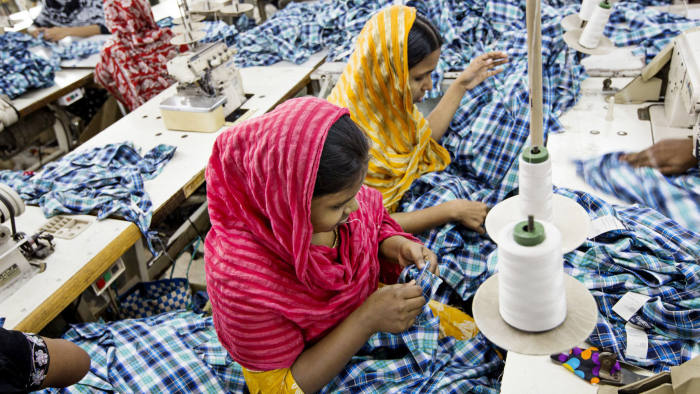

Workers sew plaid shirts on the production line of the Fashion Enterprise garment factory in Dhaka, Bangladesh, on Tuesday, April 30, 2013. Bangladesh authorities said they were accelerating rescue efforts at the factory complex that collapsed last week as hopes fade for more survivors after the nation’s biggest industrial disaster. Bangladesh’s labor law requires safety measures such as fire extinguishers and easily accessible exits at factories. Jeff Holt/Bloomberg
Bangladesh has seized market share in textiles © Bloomberg

Exports from developing Asian countries to the US rose by 10 per cent over the previous year in the first half of 2019, even as exports from China fell by 12 per cent. Exports from Vietnam to the US jumped by 33 per cent and from Bangladesh by 13 per cent.

The report shows how the huge trade diversion effects caused by the US-China tariff war are creating winners and losers as they reshape global supply chains, with Bangladesh seizing market share in textiles and Vietnam in electronics.

“Chinese products are encountering tariff measures so exports and production are slowing down.

Naturally, suppliers connected to these Chinese exports are also slowing down,” said Yasuyuki Sawada, chief economist at the ADB, which lends to developing countries in the region.“But at the same time we see this rather positive channel through trade redirection,” he said, at the launch of an update to the bank’s flagship Asian Development Outlook.The more serious trade tensions get, the bigger the trade redirection effect will become.

In a worst-case scenario, with 30 per cent tariffs on all US-China trade plus an extension of the trade war to automobiles, the ADB expects a drag on overall growth in developing Asia of 0.7 per cent over the next few years. Within that, however, Vietnam’s economy would grow by an additional 2.3 per cent, with Malaysia, Thailand, Bangladesh and the Philippines all coming out as winners too.

 The analysis does not include the impact of uncertainty over trade hurting investment, which could lead to a worse outcome in reality, Mr Sawada noted.For the region as a whole, the ADB trimmed its growth outlook for 2019 from 5.7 per cent to 5.4 per cent, reflecting the global slowdown, trade tensions and a “sharp contraction” in the global electronics cycle — especially for semiconductors.


The ADB cut its growth forecast for Hong Kong from 2.5 per cent to 0.3 per cent, reflecting the slowdown in global trade as well as political turmoil, and lowered its growth forecast for semiconductor-dependent South Korea from 2.5 per cent to 2.1 per cent.

On the other hand, it raised its growth forecast for Bangladesh from 8 per cent to 8.1 per cent, predicting it will be the fastest-growing economy in the region this year and next.

Mr Sawada said that risks to the region included the US-China trade conflict, the deepening growth malaise in advanced economies as well as a build-up of private debt in some emerging Asian economies. “The corporate sector in China and the household sector in Korea, Thailand and Malaysia have had a rising debt-GDP ratio. I think this is another risk,” he said.

Thursday, February 21, 2019

...the Regional leader in Antitrust laws

Philippines Steps Up Regional Edge In Antitrust Law Enforcement


Port in Zambales, Philippines
A view of nickel ore stockpiles at a port in Sta Cruz Zambales in northern Philippines February 8, 2017. (Photo: REUTERS/Erik De Castro/File Photo)

The Philippines is gradually transforming into a regional leader in the enforcement of antitrust laws as the Southeast Asian country jumped to 5th place in 2018's Asia-Pacific policy records.
According to local newspaper The Philippine Star, competition news and analysis firm Policy and Regulatory Report (PaRR) revealed in its 2019 "Global Trends Monitor" report that the Philippines stepped up three places higher in the top 10 Asia-Pacific list of economies that allow for fair competition in trade and business.
PaRR's report noted that the Philippine Competition Commission (PCC) enhanced its authority, thus strengthening the monitoring activities of markets or trade practices that could be hampering growth in some business sectors in the country.
"The Philippine Competition Commission is strengthening its enforcement framework this year with the introduction of a leniency program and the addition of rules on forbearance and dawn raids to its arsenal of investigative tools," part of the report stated.
Last year, the Philippine antitrust agency recorded a total of 40 acquisition transactions and mergers, accounting for PHP438 billion. Of the M&A transactions recorded, 33 were given the approval to proceed with the projects.
In April, the agency released a draft of guidelines that seek to benefit joint ventures. The merger notification threshold for Philippine exchange was also raised to PHP5 billion.
This year, the PCC is looking to focus on chain logistics, petroleum refining, sugar and pesticides manufacturing, corn milling and trading, and other trading programs that seek to enhance fair exchange in the Philippines, the report added.
Another country that made a significant rise in the ranks is Indonesia. The report found that Indonesia has climbed to 6th place, one level higher from its 7th spot record in 2017. The top three economies in antitrust enforcement practices are China, Australia, and South Korea respectively.
AEC News Today reported that Indonesia appointed new competition commissioners as part of its efforts in enforcing antitrust policies. This move also echoed the ASEAN member nations' October move of establishing the Asean Competition Enforcers Network - a program that encourages Asean states to cooperate on competition cases.
Other Asian countries also joined the fight against unfair trade standards as Myanmar eased its foreign investment rules last year and Singapore approved amendments to its competition law.
For its part in the global reinvention of antitrust policies, Vietnam fined companies that engaged in anticompetitive conduct, including Grab. In addition, Thailand finally granted conditional clearance to Glow Energy to imply its willingness in the Asia-Pacific region's goals of providing the trade industry with justifiable practices that will benefit both giants, small, and medium-sized operations.