Showing posts with label Egypt. Show all posts

Wednesday, October 9, 2019

...the Ju Jitsu next big hub

The Philippines could be the next big hub for Jiu-Jitsu superstars


With height and physical strength not much of a factor, and our longstanding heritage in combat sports, the grappling martial art can be the next big thing for Pinoy athletes. And, with its debut in the Southeast Asian Games next month, our fighters can showcase what they've got to the rest of the world.


Nissi Icasiano
ABS-CBN Sports
09 October 2019


Grappling is one of the oldest forms of combat in the world. Cave drawings in France from over 15,000 years ago appear to depict people engaged in acts of grappling. Babylonian and Egyptian artifacts show people employing most of the maneuvers known today. In Greece, wrestling served as the main attraction in the ancient Olympic Games. 


Various grappling disciplines evolved across the globe, including Sumo in Japan, Turkish oil wrestling, and Uzbekistan’s Kurash among others. In the Philippines, traditional indigenous martial arts are practiced in different regions like Bultong in the Cordilleras, Dumog in Western Visayas, and Layug in Central Visayas and Mindanao.

Due to American colonization, modern-style wrestling made its way into the country and has remained up to the present time. Many Filipinos have etched marks in this field, notably in the 1954 Asian Games, where Nicolas Arcales and Mansueto Napilay brought home silver medals, and Basilio Fabila captured bronze. It was the only year in Asian Games history that the Philippines claimed medals in wrestling. Filipino wrestlers were privileged to compete at the Summer Olympics from 1936 to 1988. Since the implementation of continental qualifiers the year after, not a single grappler has had the opportunity to set foot on an Olympic mat.

Next big thing

Through lifelong Filipino martial artist Alvin Aguilar in the mid-90s, Brazilian Jiu-Jitsu was formally introduced in the Philippines. The grappling art was formed from the Kodokan Judo fundamentals that were taught by a number of individuals, including pioneers Takeo Yano, Mitsuyo Maeda, Soshihiro Satake, and Isao Okano.

Brazilian Jiu-Jitsu eventually came to be its own discipline through the experiments, practices, and adaptation of Judo through Carlos and Helio Gracie in the 1900s. Though our nation is heavily engrossed with basketball, boxing, billiards, and currently volleyball, one Filipino practitioner believes that Brazilian Jiu-Jitsu could find a foothold in the Parthenon of Philippine sports.

Franco Rulloda, who earned his black belt in Brazilian Jiu-Jitsu under the tutelage of Aguilar last May, sees a bright future for Filipinos in the sport because, unlike basketball, it does not require height. It is built on the concept that a smaller person can successfully defend against a bigger and heavier assailant. This you can do by using proper technique, leverage, and taking the fight to the ground before applying joint-locks and chokeholds to subdue the opponent.

“The fighting spirit and passion for combat sports makes Brazilian Jiu-jitsu perfect for Filipinos,” Rulloda explains. “It is honing one’s physical attributes and using acquired knowledge to his or her advantage. It does not require too much strength, height, and athleticism.”

Rulloda points out that a lot of our prominent and successful athletes come from combat sports.

 “Manny Pacquiao, Nonito Donaire, Eduard Folayang, and the list goes on. Fighting has been ingrained in every Pinoy’s DNA,” he says. “Martial arts have deep roots in Filipino culture. History has proven that Filipinos have that warrior spirit.”

There are already a handful of Filipino competitors who have made a name for themselves internationally, including Meggie Ochoa and May Masuda. Ochoa captured three-straight gold medals from 2014 to 2016 at the World Jiu-Jitsu Championship or the Mundials. On the other hand, Masuda became the first Filipina to snare a gold medal at the Mundials in 2009.

Eros Baluyot, meanwhile, had his career-defining moment in 2010 by bagging a gold medal at the age of 17. Joey Lepiten, Gian Dee, Kaila Napolis, Annie Ramirez, Kim Custodio, Vince Ortiz, and Marc Lim have likewise made it to the podium in different overseas tourneys.

“Filipinos learn fast. We somehow have this gene attributed to absorbing techniques quickly and applying them right away. We are dedicated athletes. We put our heart and soul into whatever it is we are doing. We invest so much in our endeavors, and we are passionate about what we believe in,” Rulloda says.

Making a mark

The Philippines now houses the most number of Brazilian Jiu-Jitsu black belts in Southeast Asia: Aguilar, Rulloda, Masuda, John Baylon, Fritz Rodriguez, Pichon Garcia, Allan Co, Toffy Ilagan, Froilan Sarenas, among others.

Currently, there are 10 clubs in the country that have been recognized by the International Brazilian Jiu-Jitsu Federation including DEFTAC-Ribeiro, Atos Philippines, KMA-Fabricio, John Baylon BJJ, and Cobrinha BJJ Manila.

Aguilar, who holds the distinction as the first homegrown black belt here, says the sport has come a long way since he first piloted a small class in his garage. “Back then, Jiu-Jitsu was only comprised of four or five people. Right now, we have at least more than a thousand competitors,” he shares. “I am very happy with the level and the standard that we’ve already established here in the Philippines because we’ve produced a lot of champions.”

The pioneering fighter says that we are definitely number one in Southeast Asia, and top three in Asia. “These are the things we should take advantage of. We have so many good grapplers. Everybody here is so good, not just from my team,” he adds. “You put them in any gym around the world, and they will always be able to produce.”

Brazilian Jiu-Jitsu in the Philippines made significant strides last year when both Philippine Olympic Committee and Philippine Sports Commission declared the Jiu-Jitsu Federation of the Philippines as the sport's national governing body. The sport will also make its much-awaited debut at the Southeast Asian Games, which our country will host from November 30 to December 11.

Ochoa is more than excited to participate in the regional biennial meet, as she doesn’t get a lot of opportunities to compete in her country. “It is a big deal because we’re the host, and I’m definitely going to prepare for that,” she says, “Not just me but every Filipino athlete is going to prepare for that. We want to show what we are really capable of.”

 Spreading the gospel

Despite the success of a few homegrown talents in Brazilian Jiu-Jitsu, Rulloda admitted that it still has a lot of work to do to adapt to Filipino taste. “The growth has been steady through the years. However, the biggest hindrance to the growth of the art is the lack of awareness of what really happens in an actual self-defense situation and how Jiu-Jitsu can be an effective tool for it,” he stresses. “The sporting aspect has a slow progress because the low awareness level leads to low exposure and that results in difficulty of getting sponsorships for deserving athletes.”

To help in this cause, Rulloda stages a yearly tournament called Arte Suave Manila. It started in 2015, and aims to excite at a grassroots level. “Whatever noise this event will create is going to help the future of these athletes. I want them to get exposed, I want them to be discovered, and I want them to get sponsors,” he reveals.

The two-day competition originally focused on white and blue belters, but it opened its doors to purple belts in 2016. One of its main attractions is the submission-only super-fights, where combatants will contend in a ten-minute match. If there is no submission by the end of the given time, a draw will be declared.

Arte Suave Manila is set to hold its fifth annual event from October 19 to 20 at the Commercenter Alabang in Muntinlupa, and Rulloda is expecting a promising turnout. “It is a league by fighters, for fighters. The sport is growing in the country, and so we’re expecting to see high-level Jiu-Jitsu displayed on the mats again this year,” he promises.

Rulloda reiterates that Filipinos have the potential to do great things in the sport. “We can take Jiu-Jitsu to the next level, not only here in our country, but to the Asian level, and even worldwide,” he declares.

Friday, November 23, 2012

...the highest remittance recipients

PH third highest remittance recipient among developing nations


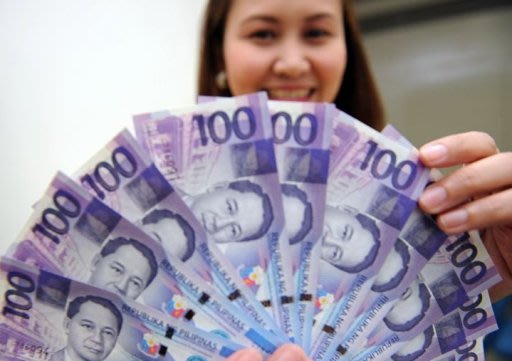
A bank employee displays 100 peso notes in Manila. The Philippine economy is facing major risks from abroad that could limit its growth prospects next year, the central bank governor said Wednesday
AFP News - A bank employee displays 100 peso notes in Manila. The Philippine economy is facing major risks from abroad that could limit its growth prospects next year, the central bank governor said Wednesday.


Despite a gloomy global economic climate, Filipinos may still count on a boost from overseas workers who will continue to send cash back home, new World Bank projections showed.

Among developing countries, The Philippines will be the third highest recipient of remittances from overseas workers this year, the World Bank said in its latest "Migration and Development Brief."

Cash inflows from Pinoys abroad are seen to reach $24.3 billion in 2012, up 5.4 percent from $23.1 billion last year.

Latest central bank data pegged OFW inflows at $15.6 billion as of the end of the third quarter, up 5.5 percent from year-ago levels.

The World Bank's forecast growth in remittances to the Philippines, however, is slower than 2011's expansion of 7.6 percent.

This may be attributed to an appreciation of the peso, which the World Bank says prods "migrants to delay sending remittances until exchange rates are more favorable."

Globally, inflows to developing countries are expected to grow by 6.5 percent to $403 billion in 2012.

"International migrants are weathering the effects of the ongoing global economic crisis..." the World Bank said.

India will be the top recipient of remittances this year, with inflows reaching $69.8 billion based on World Bank estimates, followed by China at $66.3 billion.

The Philippines is a far third, followed by Mexico ($23.5 billion), Nigeria ($20.6 billion), Egypt ($18 billion), Pakistan ($13.9 billion, Bangladesh ($13.7 billion), Vietnam ($9 billion) and Lebanon ($7.6 billion).

The World Bank also expects remittances to developing countries to spike further by 7.9 percent in 2013, 10.1 percent in 2014 and 10.7 percent in 2015, when it is seen to reach $534 billion.

"We expect growth of flows to remain robust in regions that rely on remittance flows from the US, the GCC (Gulf Cooperation Council) and Russia," the multilateral lender said.

Risks to remittances growth remain, however, with the World Bank citing "increasingly harsh rhetoric and policies hostile towards migrants in many destination countries, especially Europe."

Meanwhile, the World Bank cited the Philippines as one of the countries where innovations such as international mobile remittances effectively ease the cost of sending money.

This, as it noted that worldwide, only 20 percent of 130 mobile banking operators worldwide offered international remittance services as of early 2012.

The Philippines, as well as Kenya, "are ahead of the curve in fostering an ecosystem of mobile payment services," it added.

"They may provide fertile ground for adoption of international remittance services via mobile phones, but most other countries are much further behind at this point," the World Bank noted.

Saturday, November 10, 2012

...the PH diplomat to WTO board

PHL envoy appointed to WTO management board


November 10, 2012
GMA News
 
 
A Philippine diplomat has been appointed to the Management Board of the Advisory Center on World Trade Organization Law (ACWL), the Department of Foreign Affairs said Friday.


The DFA said Philippine permanent representative to the WTO Esteban Conejos Jr. will have a two-year term and may be reappointed for another two years.

"Conejos succeeded Ambassador Bozkurt Aran of Turkey. His term will be for two years, and he will be eligible for reappointment for a further two years," the DFA said.

ACWL aims to provide developing countries and Least Developed Countries (LDCs) with the legal capability necessary to enable them to take full advantage of the opportunities offered by the WTO.

Conejos was unanimously nominated by the ACWL's Category B member countries to be their representative to the board, the DFA said.

These countries include Colombia, Egypt, India, Indonesia, Mauritius, Oman, Pakistan, Philippines, Thailand, Turkey, Uruguay, Venezuela and Vietnam.

The Philippines has been a member of ACWL since its establishment in 2001.

It has benefited from services such as legal assistance in dispute settlement cases, legal opinions, training courses, and a secondment program for government trade lawyers.

During the past 10 years, ACWL had been involved in 21 percent of all new WTO dispute settlement proceedings.

WTO Director-General Pascal Lamy earlier said the ACWL helps make sure the legal benefits of the WTO are shared among all members.

Lamy added the ACWL contributes to the effectiveness of the WTO's dispute settlement procedures, and to the realization of the WTO's development objectives.

Management board

The Management Board makes decisions to ensure the efficient and effective operation of the ACWL and reports to the General Assembly.

It has six persons serving in their personal capacities who have been selected on the basis of their professional qualifications in the field of WTO law or international trade relations and development.

Three Board members are nominated by the developing country members, two by the developed country members and one by the LDCs. The Executive Director serves ex officio on the Board.

The DFA said Conejos attended his first Management Board meeting on Nov. 7, and was welcomed by other board members, including ACWL Executive Director Niall Meagher.

At the meeting, they discussed the operational and financial standing of ACWL, as well as the accession of Cuba.

G-33 meet

On behalf of Indonesia, the Philippines through Conejos chaired the G-33 Heads of Delegation meeting on November 7 – a tradition being observed every time the coordinator of the group is not available.

The G-33, previously known as the Alliance for Special Products and Special Safeguard Mechanism, is a coalition of 46 developing countries pressing for S&DT flexibility for developing countries in the agriculture Doha Round of talks for ensuring food security, livelihood security and rural development.

Its key members include Barbados, China, Dominican Republic, India, Indonesia, Nigeria, Pakistan, Kenya, Korea, the Philippines, Turkey and Zimbabwe.

The G-33 discussed the Indian proposal entitled "Some Elements... for Early Agreement to Address Food Security Issues," which India and the Philippines are seeking for G-33 sponsorship.

The proposal under "Green Box" of the WTO Agreement of Agriculture aims to exempt developing countries from factoring in government support payments for public stock-holding for food security purposes.

It particularly focuses on the procurement from "low-income or resource poor producers" and provision of subsidized food prices for urban and rural poor in their AMS ("trade-distorting subsidy") monetary limits.

The proposal is part of the considered "80 percent agreed and stabilized areas" in the 2008 Chair's agriculture modalities text which India and the Philippines hope to be harvested early during the 9th WTO Ministerial Conference in Bali in December 2012, in advance of the full conclusion of the Doha Round.

The proposal may be submitted to the COA-SS Chair John Adank and circulated to all WTO members before the agriculture talks resume on 16 November 2012 in Geneva. — LBG, GMA News

Tuesday, August 21, 2012

...the world's fastest growing economies

PH makes Top 10 list of 'fastest growing' economies

08/21/2012
 
MANILA, Philippines - The Philippines is predicted to be one of the top 10 fastest growing economies in the world in the next 40 years, according to Knight Frank and Citi Private Wealth's 2012 Wealth Report.
 
The Philippines is seen to be the 6th fastest growing economy in the world between 2010-2050, with gross domestic product (GDP) at 7.3%.

The Wealth Report's list of fastest growing economies is topped by Nigeria with 8.5% growth rate, followed by India with 8%, Iraq 7.7% and Bangladesh and Vietnam both with 7.5%.

On 7th spot is Mongolia with 6.9%, Indonesia with 6.8%, Sri Lanka with 6.6% and Egypt with 6.4%.

In contrast, the 10 countries that are predicted to grow the least in the next 40 years are Spain, France, Sweden, Belgium, Switzerland, Austria, Netherlands, Italy, Germany and Japan.

Citi research forecasts that developing Asia's share of world real GDP will increase to 49% in 2050 from 27% in 2010. Meanwhile, North American and Western European countries' share of global GDP will fall to 18% in 2050 from 41% in 2010.

China's economy is expected to overtake the US as the world's biggest economy by 2020. However, India is seen to overtake China by 2050.

"Citi research shows that while China and India are likely to grow rapidly over the next 40 years, there are other key countries with promising chances for growth that do not necessarily match the traditional assumptions about where future growth will emanate from," Grainne Gilmore, head of UK Residential Research at Knight Frank, said, in the report.

"For example, Russia and Brazil, which make up the so-called BRIC nations alongside China and India, do not make it on to Citi’s list of Global Growth Generators – or '3G' countries. Instead, Citi includes countries such as Bangladesh, Egypt, Indonesia, Iraq, Mongolia, Nigeria, Philippines, Sri Lanka and Vietnam on this list," she added.

The report also quoted Citi chief ecnomist Willem Buiter: "All of these (3G) countries are poor today and have decades of catch-up growth to look forward to. Some of them, including Nigeria, Mongolia, Iraq and Indonesia, also have large natural resources that we hope will be more beneficial than they so often have been in the past."

The Wealth Report noted that Asian economies, Singapore, Hong Kong, Taiwan and South Korea, are projected to be the world's richest economies on a per capita basis by 2050.

Singapore topped the list in 2010 and is expected to keep the top spot in 2050, when the city-state's gross domestic product (GDP) per capita would reach $137,710. Taiwan and South Korea were not even in the top 10 in 2010.

Gilmore said there are now around 18,000 "centa-millionaires" -- those with $100 million or more in assets -- in the region covering Southeast Asia, China and Japan, more than the 17,000 in North America and 14,000 in Western Europe.

By 2016, Southeast Asia, China and Japan are expected to have 26,000 centa-millionaires, compared with 21,000 in North America and 15,000 in Western Europe, Gilmore wrote, citing data from Ledbury Research. - With Agence France-Presse

Tuesday, February 28, 2012

...the good payer

Japan: Philippines A Good Payer


OSAKA, Japan - The Philippines has yet to settle some ¥ 965 billion (P512.4 billion) worth of development packages it borrowed from Japan in the past years, making it the fourth country across the world with a huge outstanding loans based on the list of the Japan International Cooperation Agency (JICA).

But the good news is that the Philippines has no current pending loans from Japan and is assessed to be a good payer, according to Michino Yamaguchi, of the JICA-Media Division.

"The Philippines repays the outstanding loan steadily," said Yamaguchi.

Based on JICA records, most of the loan packages were spent to transportation-based projects like building of roads, bridges, ports, and airports across the Philippines.

From 1971, Japan has already infused some ¥ 757 billion in the transportation-based projects, accounting for 35 percent of the entire development loan assistance to the Philippines.

Commodity loans came next with 19 percent, followed by electric and power-related projects with 13 percent, Agriculture/Forestry/Fisheries with 11 percent and Irrigation and Flood Control with 10 percent.

A total of $20.5 billion has already been lent to the Philippines via Japan's Official Development Assistance (ODA) to the Third World Countries, but only ¥ 965 billion remain unpaid so far.

"As the Philippines is classified to be a Lower-Middle-Income country based on Income Category of the World Bank, the terms and conditions of Lower Middle Income Countries are applied," said Yamaguchi.

As a lower middle income country, the Philippines is accorded concessional terms on its ODA loan availment. These include a 1.4 percent interest with repayment period of 30 years, including a 10-year grace period.

Topping the JICA list is Indonesia, followed by China then India. Completing the Top 10 list are Vietnam, Pakistan, Thailand, Sri Lanka, Egypt, and Turkey.

Tsutomu Kudo, director of JICA-Media Division, said the ranking is as of 2010 as he explained that they are yet to wait until the end of next month to complete the figures for 2011.

"These loans have to be repaid," said Kudo, as he noted a downtrend on the amount being allocated by Japan for development assistance to the needy countries since 2005.

Kudo admitted that the downtrend was brought by the global financial crisis in the past years but he revealed Japan's plan to increase the ODA fund in the coming years.

But this time, he said the funds will be focused on countries that need most of foreign assistance like African countries.

JICA is the executing agency of Japan's ODA and works in more than 150 countries. Aside from granting loans, it also uses other ODA tools such as technical assistance and providing study grant to students and professionals of Third World countries.


Tuesday, January 17, 2012

...the global economic driver

Philippines may become key global growth driver


The Philippines has the potential to become one of the top 10 countries that can greatly contribute to global growth within the decade, Goldman Sachs said.


By: Michelle V. Remo
Philippine Daily Inquirer


The Philippines has the potential to become one of the top 10 countries that can greatly contribute to global growth within the decade, Goldman Sachs said.

According to the investment bank, the Philippines is among the N-11 [Next 11] economies that are likely to advance to the stage of “growth countries,” or nations that account for at least one percent of global gross domestic product.

The N-11 economies are Mexico, Korea, Indonesia, Turkey, Iran, Egypt, Nigeria, Bangladesh, Pakistan, Philippines and Vietnam.

Goldman Sachs said that, except for Vietnam and Bangladesh, all N-11 economies could advance to the “growth” classification.

The investment bank’s projection is anchored on the relatively low incomes observed of most N-11 economies in the past. As a result, the countries have much room for growth and may improve their economic fundamentals significantly.

The nine economies from the N-11, along with the so-called BRICs (Brazil, Russia, India and China), are expected to contribute the most to global growth from 2011 to 2020.

“Growth markets have the potential to be among the top ten contributors to global growth over the next decade,” Goldman Sachs said.

The Philippines grew by 3.6 percent in 2011. In the past decade, it posted an average growth of close to 5 percent.

Goldman Sachs said the growth rate of N-11 countries and BRICs could accelerate further in the decade to 2020, driving much of the global economy.

For 2012, the investment bank expects the global economy to grow by 3.4 percent. Over the next eight years, the growth rate may average at 4.3 percent, led by the N-11 nations and BRICs.

“Average growth rates suggest that global growth is likely to be much stronger in the current decade, at 4.3 percent, than in the past 30 years. This is due to the impetus from the BRIC economies and the other growth markets,” Goldman Sachs said.

Sunday, December 18, 2011

...the PH wings

UN hails Philippine protection of migrant workers


By Tina G. Santos
Philippine Daily Inquirer

Logo taken from United Nations website


MANILA, Philippines—While the sob stories usually make the headlines, the country’s efforts to help thousands of overseas Filipinos, especially those caught in wars and calamities, have not gone unnoticed in the United Nations.

A UN executive speaking at a recent conference in Geneva has commended the Philippines for its exemplary efforts to protect its nationals caught in international crisis situations, according to the Department of Foreign Affairs (DFA).

Peter Sutherland, the special representative of the UN secretary general for international migration and development, “specifically mentioned the Philippines as rising to the challenge by setting up a system to protect and engage its migrants,” the DFA said.

Sutherland made the remarks at the Global Forum on Migration and Development (GFMD) held in the Swiss city earlier this month, where he said the forum participants “could learn from the Philippines’ initiatives and good practices,” the foreign office added.

The Philippines drew praise for its repatriation efforts in troubled countries like Libya, Yemen and Syria, among others, DFA spokesperson Raul Hernandez told the Inquirer on Saturday.

“He (Sutherland) probably saw that we’re proactive in protecting our people by taking them out of harm’s way,” Hernandez said.

In the forum, the UN official also drew attention to the plight of domestic workers, particularly the so-called “kafala” or sponsorship system which he said “constituted a modern form of slavery,” the DFA said.

More fleeing Syria

Hernandez said another batch of at least 51 Filipinos from Syria will be repatriated in the next few days. The last group that arrived in Manila over a week ago totaled 55, bringing the current number of Filipino repatriates to 240 since political violence escalated in the Arab state earlier this year.

“Our embassy in Damascus continues to negotiate for the release of the workers from their employers or agencies,” Hernandez said, adding that securing airline seats for the next batch had been difficult of late because of the peak Christmas season.

The year 2011 has been one of the busiest for the DFA in terms of evacuating Filipinos from strife-torn regions, starting with those fleeing Egypt in February, at the height of street protests against the regime of then President Hosni Mubarak.

From that same month to March, the repatriation efforts shifted to Libya, with no less than Foreign Secretary Albert del Rosario personally leading one of the missions across the Sahara desert to fetch compatriots fleeing the fighting between rebels and government forces under dictator Moammar Gadhafi.

The turmoil in Yemen also prompted Del Rosario to go there in March to assess the situation and offer voluntary repatriation to the less than 1,500 registered migrant Filipinos working in that country.

Review of ‘unsafe’ countries

Apart from the repatriation efforts, the DFA is currently conducting a review of the 41 countries earlier considered unsafe for overseas Filipino workers (OFWs) and could be covered by a labor deployment ban.

“At present, we have asked a review of the present status of each of the 41 countries to determine if they have already acceded or enacted laws that would protect our migrant workers,” Hernandez said in an earlier interview.

The DFA proceeded with the review after asking the Philippine Overseas Employment Administration (POEA) to defer the ban for three months.

“We will use the deferment period to revisit the 41 countries with the view of moving forward toward compliance with the amended Migrant Workers Act (Republic Act No. 10022),” which forbids the deployment of OFWs to countries certified as not protective of migrant workers, Hernandez said.

“We will submit new certifications after 90 days, taking into account results of DFA’s dialogue with countries concerned and new developments in those countries with respect to the protection of migrant workers,” Hernandez said.

9M in 200 countries

More than 1.4 million Filipino workers were deployed overseas last year, according to the POEA. Of this number, 1.1 million were land-based, while around 350,000 were sea-based workers.

For land-based OFWs, the top destinations were Saudi Arabia (293,049), United Arab Emirates (201,214), Hong Kong (101,340), Qatar (87,813) and Singapore (70,251).

Among the newly hired overseas Filipino workers deployed last year, the top occupational categories included household service workers (96,583), cleaners and related workers (12,133), nurses (12,082), caregivers and caretakers (9,293), and waiters, bartenders and related workers (8,789).

According to the latest estimates by the Commission on Filipinos Overseas, some 9 million Filipinos are in more than 200 countries around the world as of December 2009. With a report from Inquirer Research
Sources: Commission on Filipinos Overseas, POEA.

Saturday, December 3, 2011

...the hard earned money

Migrant remittances top $350bn—World Bank


Agence France-Presse
via Phil. Daily Inquirer


The Philippines is fourth largest recipient of remittances in the world for  2011 with est. $23 billion


GENEVA—Migrant workers from developing countries will have sent home more than $350 billion in remittances by the end of this year, a World Bank report said Friday.

The figure tops $400 billion for 2011 if money sent to high-income countries is included, said the report, released during the fifth meeting of the Global Forum on Migration and Development in Geneva.

The top recipients of officially recorded remittances were India, which took in $58 billion, followed by China ($57 billion), Mexico ($24 billion) and the Philippines ($23 billion).

Other top beneficiaries were Pakistan, Bangladesh, Nigeria, Vietnam, Egypt and Lebanon.

“Despite the global economic crisis… remittance flows to developing countries have remained resilient, posting an estimated growth of 8 percent in 2011,” said Hans Timmer, director of the bank’s Development Prospects Group.

“Remittance flows to all developing regions have grown this year, for the first time since the financial crisis.”


The World Bank expects a 7.3 percent rise in such payments in 2012 and a 7.9 percent increase in 2013.

The two-day Global Forum meeting — attended by 160 nations and 30 groups — was opened Thursday by Swiss minister Simonetta Sommaruga, who called for stronger international collaboration in asylum policy.

The body was set up in 2006 by then UN secretary general Kofi Annan to strengthen cooperation between migrants’ countries of origin, transit and destination.


Friday, September 23, 2011

...the good governance

WB commends Noy on good governance

By Jose Katigbak,
STAR Washington Bureau
(The Philippine Star)
 September 23, 2011

Photo is loading...
President Aquino exchanges pleasantries with World Bank Group President Robert Zoellick on the sidelines of the public lecture at the Annual Meetings of the World Bank Group and the International Monetary Fund at WB headquarters in Washington on Wednesday.| Zoom
WASHINGTON – World Bank President Robert Zoellick on Wednesday praised President Aquino for taking on the challenge of creating more transparent and accountable government to benefit the poor.

“At the heart of President Aquino’s policies is a belief in the power of citizens to hold their government accountable, and that this makes for better governance and a more just society,” Zoellick said.

In an exclusive interview with The STAR, Zoellick also said the World Bank and the International Monetary Fund (WB/IMF) are considering holding their annual conference in Manila in 2015.

He said five or six countries including the Philippines have applied to host the 2015 conference and these applications were under review.

“Obviously I can’t express favorites (wink, wink) but I am here today with President Aquino,” he told The STAR.

If the Philippines is selected to host the World Bank/IMF meeting, it will be a big boost to its lagging tourism industry.

Zoellick introduced Aquino to speak on reforms, good governance, and poverty reduction during the Annual Meetings of the World Bank/IMF.

He said that under the Aquino administration, the Philippines has seen extensive reforms in its budget management process, such as enhancing transparency and calling on more civil society participation.

“Under his leadership, the community-driven development program, which has provided poor Filipinos a voice in the development process, is set to become a national program,” Zoellick said.

Other reforms include the governance of state enterprises and strengthening anti-corruption authorities of the Philippines: the Supreme Audit Institution and the Ombudsman.

“Later this year, I am hoping to visit the Philippines, and I look forward to learning from some of the reforms President Aquino has put in place to improve governance and transparency,” Zoellick said.

In his speech, delivered to around 300 people, Aquino said that honest and transparent budgeting has reduced waste and discretionary spending and opportunities for corruption, so more money for higher social spending - including education, health, and social protection - is available for the poor.
“We are spending significant sums to provide basic healthcare services to the poor. We are also working to widen access to education, and to ensure that this education is of good quality,” said Aquino, highlighting that social services will take up 31.7 percent or nearly a third of Philippines’ national budget in 2012.

He said his government is also expanding the conditional cash transfer program that provides stipends to poor families to keep their children in school and seek health care.

“Governing with integrity, with transparency, and with accountability not only heals a national psyche that has long been characterized by cynicism and mistrust of government. It also provides the foundation for equitable progress. Good governance is good economics,” said Aquino.

Zero-based budgeting process

Aquino said that his administration has adopted a “zero-based budgeting process” that evaluates the effectiveness of government programs. Programs that are not delivering the desired results are eliminated and effective programs get increased funding, he said.

“Good governance is at the center of my country’s socioeconomic strategy, and the people are at the center of good governance.

“Their vigilance, their constant and adamant participation in public discourse, the strength they lend my administration as we dismantle the many obstacles - these, ultimately, are what fuels us on the straight and righteous path toward equitable progress,” Aquino said.

The continuing reforms have also earned the Philippines four credit rating upgrades over the past 15 months and a 10-point jump in the rankings of the World Economic Forum Global Competitiveness Report.

As a result, the country has seen significant commitments in foreign direct investments.

“These foreign investments, and the equally important investments coming from domestic sources, are in large part responsible for the jobs that have been created in the Philippines,” Aquino said.

Fight vs corruption

Underlying his administration’s economic strategy is a continuing campaign to fight corruption. Ending corruption means not only cleaning up the system, but holding accountable those who have done injustice to the Filipino people, he said.

“Without accountability, there will be no certainty that others will not follow in the footsteps of those who have wronged our people,” said Aquino. “Without accountability, the entrenched culture of impunity will remain, the corrupt will continue to flourish and steal, and the atmosphere of doubt and mistrust will continue to linger even as we rebuild our institutions.”

Finance Secretary Cesar Purisima and Bangko Sentral Governor Amando Tetangco sent the formal request for the Philippines to host the WB-IMF conference recently, sources said.

Zoellick did not disclose which other countries have offered to host the 2015 meeting.

The World Bank and the IMF generally hold their annual meeting in Washington. But every three years the meeting is held overseas usually in September.

Next year’s conference which was supposed to have been held in Cairo, Egypt has been moved to Tokyo, Japan because of security concerns following the overthrow of President Hosni Mubarak.
Previous World Bank triennial conference sites include Turkey, Istanbul (2009), Singapore (2006), Dubai, UAE (2003), Prague, Czech Republic (2000) and Hong Kong (1997).

Zoellick told The STAR the World Bank would expand its activities in the Philippines increasing its annual investments to $1.5 billion a year coupled with “another $300 million or so from our private sector.”
He said he would visit Manila next month to assess the situation.

In its country assistance strategy for fiscal 2010-2012 the bank said it was prepared to provide $700 million to $1 billion to combat poverty and promote growth in the Philippines coupled with an investment of $250-$300 million per year from the International Finance Corp. (IFC), the World Bank Group’s private financing arm.

Aquino arrived in Washington for a whistle-stop visit from New York where he spoke at the launch of an Open Governance Partnership forum and addressed a group of business leaders to drum up foreign investments.

On arrival at Dulles airport he was driven in a motorcade with six police outriders and four secret service vans to the Philippine embassy where he and his entourage had a takeout lunch of Fuddruckers’ hamburgers.

Aquino had only four engagements in Washington - visit Capitol Hill to thank Sen. Daniel Inouye for his consistent support of the Philippines, meet The Washington Post editorial board, speak at the World Bank and greet the Filipino community from the District of Columbia (DC), Maryland and Virginia.

After less than eight hours in Washington Aquino flew to San Francisco to take the PAL flight to Manila to recharge himself before going on an official visit to Japan Sept. 26-28.

Thursday, July 28, 2011

..the special prize awardee at Tokyo art fest

Pinay student recognized at intl arts fest in Tokyo

A 16-year-old Filipino high school student bagged a special prize at a recent international arts festival in Tokyo, the Philippine Embassy in Japan reported Thursday.

Jamille Bianca Tan Aguilar, 16, won a medal and certificate for a “Special Prize to International Artist" at the 12th International High School Arts Festival, according to the embassy.

It said Aguilar, a student of MGC New Life Christian Academy at Fort Bonifacio Global City, was awarded Wednesday at the Ueno Seiyoken in Tokyo.

Her painting titled “Me and My Country — Celebration of Nationalism and Patriotism" was selected by a panel of judges from the embassy as the best Philippine artwork.

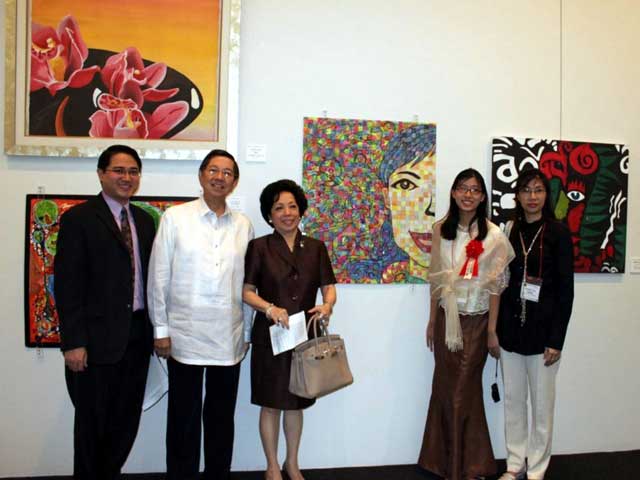
Ambassador Manuel Lopez and Madame Maria Teresa Lopez (2nd and 3rd from left) and 3rd Secretary & Vice Consul Hans Siriban (leftmost) join Jamille Bianca Tan Aguilar (2nd from right) and her mother Jocelyn Tan Aguilar beside her winning entry to the 12th International High School Arts Festival at the Ueno Royal Museum.

During the awarding ceremony, International Foundation for Arts and Culture of Japan (IFAC) chair Dr. Haruhisa Handa praised the potentials and high level of artistic skills shown by Aguilar and the other students, the embassy said.

For her part, Aguilar thanked her family as well as IFAC and others who made it possible for her to come to Japan to receive her prize.

The Philippines, which participated in the festival for the second time, submitted six paintings created by high school students from all over the country.

Aside from Aguilar, other Filipinos who took part included Patrick Prime AB Villaos (Palawan), Claire Magtuba (Zamboanga del Norte), Junel Cesar (Zamboanga del Norte), Loverson Saracho (Zamboanga del Norte), and Alia Julia Pablo (Laguna).

The Filipino students’ paintings were displayed along with artworks created by high school students from over 10 countries at the Ueno Royal Museum. This year’s festival runs until July 29.

The festival is an annual event that showcases the talents of young people from different countries in visual arts. It aims to promote goodwill and understanding among participating countries through the medium of art.

This year’s festival was participated in by high school students from Australia, Brunei Darussalam, Cambodia, China, Egypt, Indonesia, Ireland, Japan, Laos, Malaysia, Myanmar, the Philippines, Singapore, United Kingdom, and Vietnam. — JE, GMA News

Tuesday, May 24, 2011

...the top remittance recipient

WB: PHL remittances 2nd highest amid inflation


Despite its ballooning inflation rate, the Philippines posted the second highest growth of remittances among developing countries for 2010, the World Bank said in a report released to the Philippine media Tuesday.

In the WB Outlook for Remittance Flows for 2011 to 2013, economists Sanket Mohapatra, Dilip Ratha, and Ani Silwal reported that remittances to the Philippines, adjusted for inflation in local currency terms, grew by -1.4 percent in 2010. The top performer in this area was China, which grew by 1 percent.

Published under the WB Migration and Development Brief on Monday, the report places these figures in the context of the “quick" recovery of developing countries from the 2008 global financial crisis.

“Officially recorded remittance flows to developing countries recovered quickly to $325 billion in 2010 after the global financial crisis," the WB explained. “But they have not kept pace with rising prices in recipient countries."

Overall, the WB said remittances to developing countries grew 5.6 percent in US dollar terms in 2010, “but grew by a smaller 3.9 percent after accounting exchange rate changes, and fell by 2.7 percent after adjusting for inflation."

In 2010, the Philippines’ inflation rate grew to 3.8 percent from 3.2 percent in 2009, according to the National Statistics Office.

PHL among top recipients

With $21.4 billion in remittances, the Philippines took the fourth largest share of remittances among developing countries in 2010, the WB said. The largest recipient was India with $53.1 billion, followed by China with $51.3 billion, and Mexico with $22 billion.

In US dollars, the WB said remittances to the Philippines grew by 8.1 percent in 2010 — the fourth largest growth in US-dollar terms, next to Vietnam with 17 percent, Lebanon with 11.3 percent, and Pakistan with 11.1 percent. The Philippines’ growth in this area ties with that of Egypt.

In local currency terms, the Philippines fared as the 8th among the 10 largest recipient countries in 2010, the WB said. The country posted a growth of 2.3 percent in this area, trailing Vietnam, Pakistan, Lebanon, Egypt, Nigeria, China, and Bangladesh.

“The reduction in local currency value of remittances implies hardship for recipients, and increased pressure on migrants to send more to maintain the purchasing power of their remittances," the WB noted.

For the East Asia and Pacific region, which includes the Philippines, the WB projected a growth of 6.8 percent in remittance inflows last year, 8 percent for 2012, and 9.5 percent for 2013.

“Given the volume of remittances flowing to developing countries, innovative financing tools such as diaspora bonds and remittance-backed bonds are being viewed as potential sources that can finance infrastructure and development projects at lower cost and longer maturities," the WB added.

Effect of Middle East, North Africa crisis

The multilateral bank also said the effect on migration of the political turmoil in parts of North Africa and the Middle East “appears to have been largely localized within the region."

“Outside the North Africa and Middle East region, the remittance recipient region that could be affected by the crisis is South Asia," the WB said.

However, the bank noted a “lack of reliable and high-frequency data on both migration and remittances during the crisis in North Africa and the Middle East."

“Basic facts on the impacts of the crisis for migrants and recipient countries are simply not available," the WB said. “There is urgent need for rapid monitoring systems in both migrant-sending and -recipient countries through improved data collection and dissemination of high-frequency data on migration and remittances."

Earlier this month, the Bangko Sentral ng Pilipinas reported that overseas Filipino workers’ remittances rose by 5.9 percent in the first quarter of 2011 amid earlier fears of a decline due to the political unrest in Middle East and North Africa, and the disasters in Japan. — VS, GMA News