Showing posts with label Myanmar. Show all posts

Monday, February 10, 2020

...the 2nd ASEAN's fastest growing market for motor vehicle

Philippines 2nd fastest-growing market for motor vehicles in South East Asia


Louella Desiderio
Philippine Star
10 February 2020
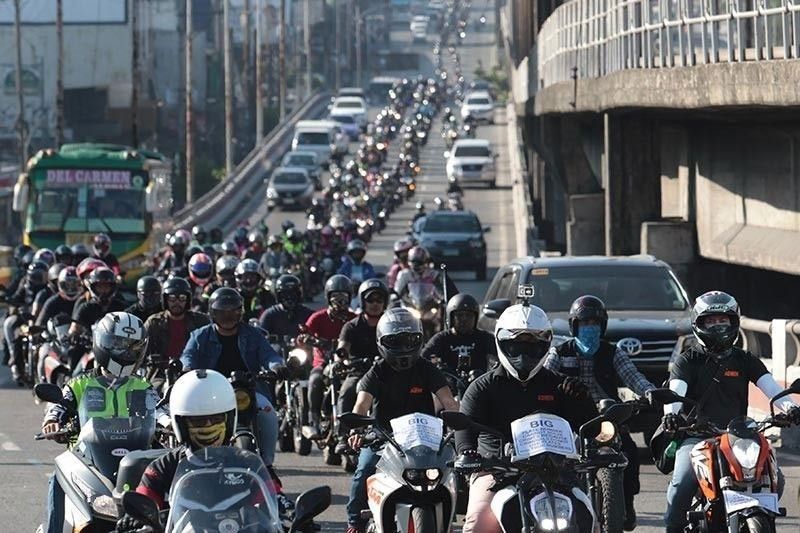

MANILA, Philippines — The Philippines was the second fastest-growing motor vehicle assembler in Southeast Asia last year, registering a 19 percent growth in output, according to the Association of Southeast Asian Nations Automotive Federation (AAF).
Data from AAF showed the Philippines assembled 95,094 motor vehicles last year, up from just 79,763 units in 2018.

Posting the fastest growth in motor vehicle output last year was Myanmar, which assembled 15,496 units, 26 percent higher than the 12,292 units in 2018.

Apart from Myanmar and the Philippines, the only country in the region with a higher motor vehicle output was Malaysia which produced 571,632 units last year, up 1.2 percent from the 564,971 units in 2018.

All other countries with motor vehicle assembly operations in the region registered declines.
Thailand, which serves as the region’s automotive hub, assembled 2.01 million units last year, seven percent lower than the 2.17 million units in 2018.

Indonesia’s motor vehicle output decreased by 4.2 percent to 1.29 million units last year from 1.34 million units in 2018, while Vietnam’s output went down by 12 percent to 176,203 units last year from 200,436 units in 2018.

Total motor vehicle output in Southeast Asia decreased by 4.8 percent to 4.16 million units last year from 4.37 million units in 2018.

In terms of motor vehicle sales, the Philippines was among those with higher sales last year.

AAF data showed the Philippines sold 369,941 units last year, 3.5 percent higher than the 357,410 units in 2018.

Other countries in the region with higher sales last year are Myanmar with a 25 percent growth in sales to 21,916 units, Vietnam with an 11.7 percent increase to 322,322 units, Brunei with a six percent uptick to 11,909 units, and Malaysia with one percent growth to 604,287 units.

Posting lower sales last year, meanwhile, are Indonesia with a 10.5 percent drop to 1.03 million units, Singapore with a five percent decrease to 90,429 units, and Thailand down 3.3 percent to 1.01 million units.

Total motor vehicle sales in the region reached 3.46 million units last year, 2.9 percent lower than the 3.56 million units sold in 2018.

Recently, the Department of Trade and Industry (DTI) launched a preliminary probe on a petition filed by workers group Philippine Metalworkers’ Alliance (PMA) to impose safeguard measure or duty on vehicles, a development which may affect both the production and sales performance of automotive firms in the country.

PMA filed the petition as increased vehicle imports are seen to pose threat to local car assembly, auto parts manufacturers, as well as employment in the sector.

A safeguard duty may be imposed by the government when a surge in imports of a certain product causes injury to local players.


Saturday, November 30, 2019

...The Southeast Asian Game host (opening)

Philippines showcases cultural heritage to kick off 30th Sea Games

New Straits Times
30 November 2019


MANILA: The Philippines staged a spectacular opening ceremony for the 30th SEA Games at the world’s biggest indoor arena, the Philippine Arena, in Bulacan, near here, tonight.


In a departure from tradition, the opening ceremony was held in an indoor arena rather than a stadium.


Also, for the first time in the biennial Games’ 60-year history, the games cauldron was placed at a different location, at the New Clark City Athletics Stadium, some 90km from Bulacan, and the lighting of the cauldron was shown on screen at the 55,000 capacity arena.

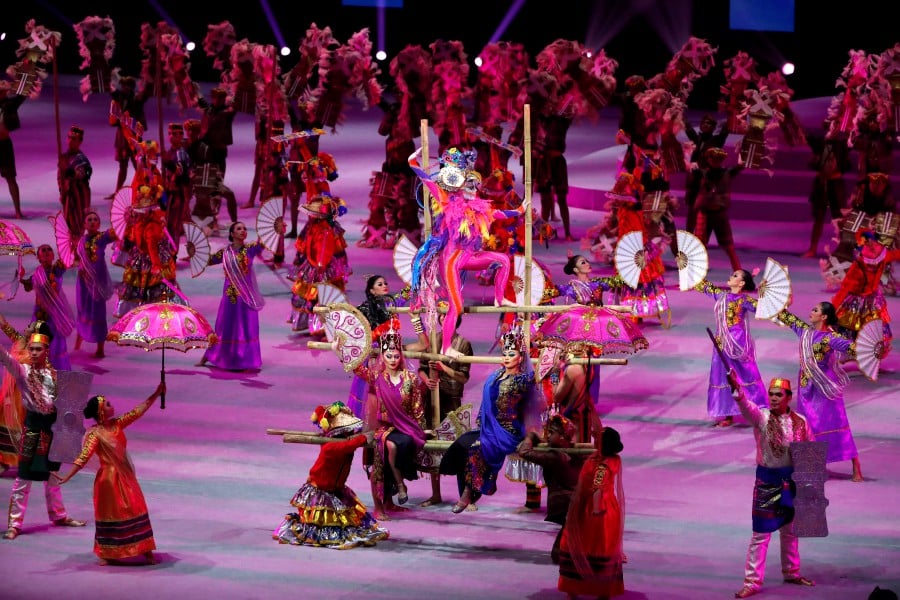
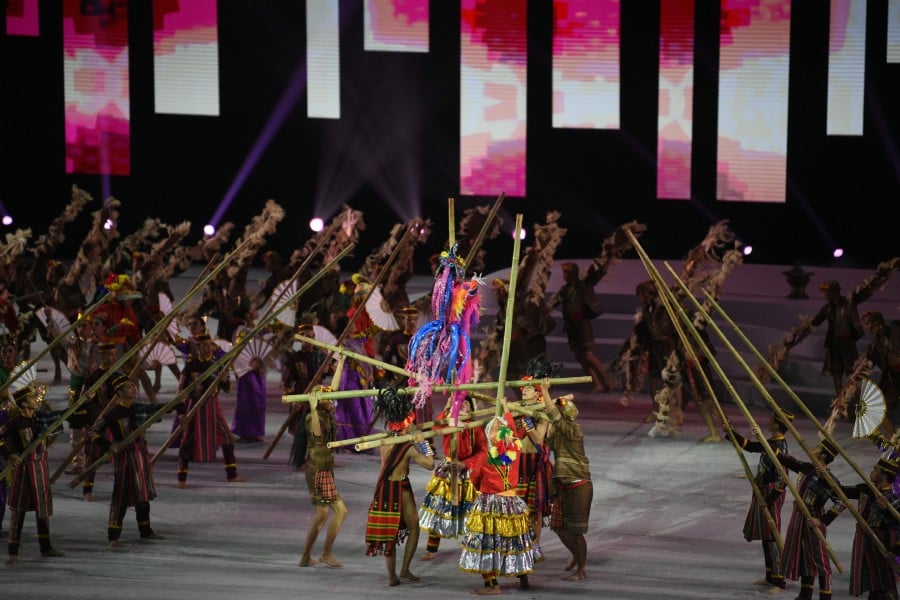
The extravaganza started after Filipino singer Lani Misalucha sang the republic’s national anthem, which was followed by an extraordinary performance themed “The Roots of our Strength”, showcasing the culture and heritage of the nation.
The spectators were treated to a series of warrior dances from the Bagobo, the Kalinga, the Maguindanao, Islamic and the pre-Hispanic Visayans.

The later part of the ceremony was powered by modern and hip-hop performances led by local artistes Inigo Pascual, Robert Sena, Apl.de.Ap and KZ Tandingan, among others.
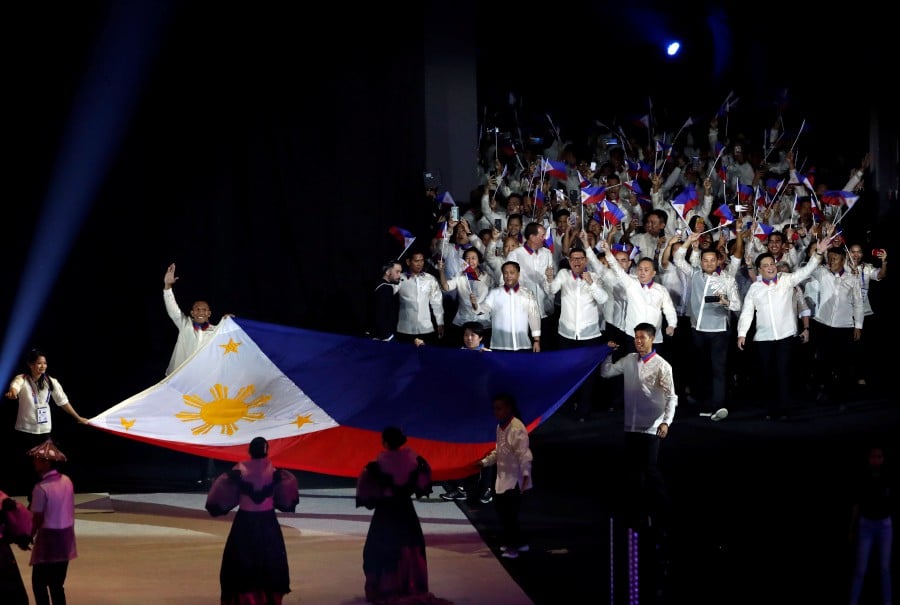
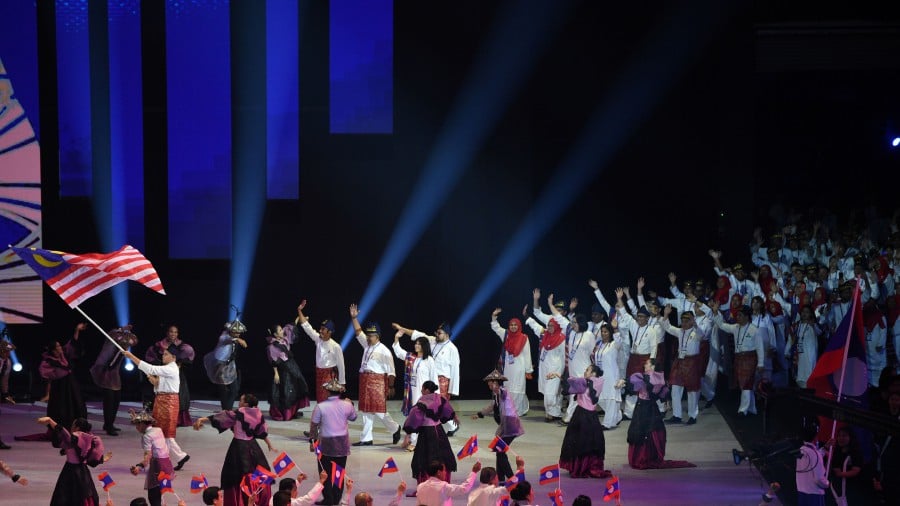
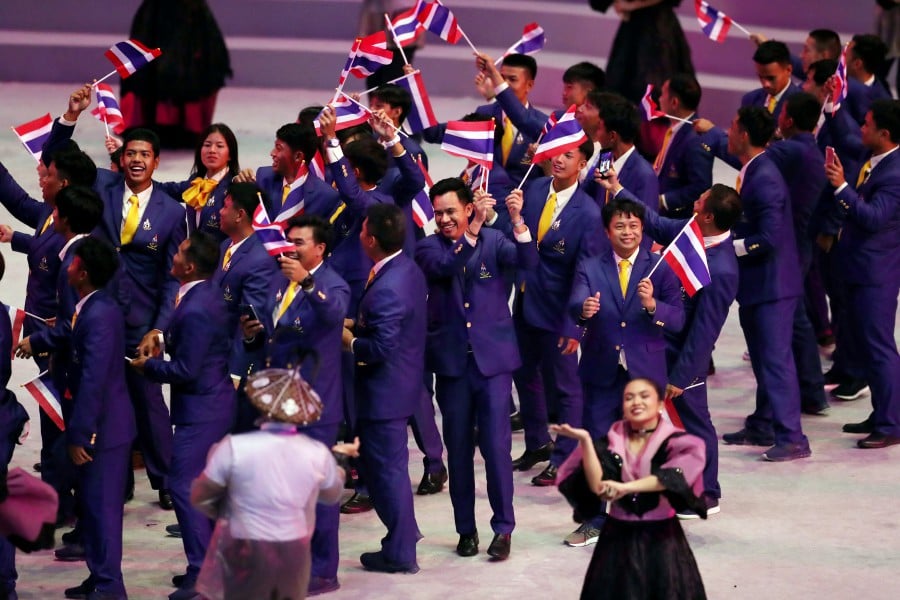
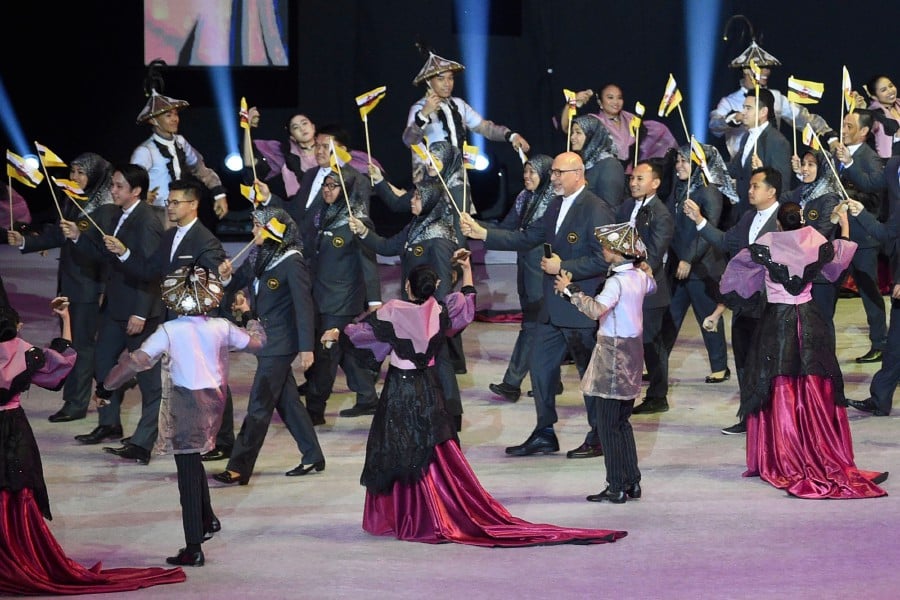
The contingents received loud cheers from the audience as they paraded into the arena in alphabetical order, starting with Brunei, Cambodia, Indonesia, Laos, Malaysia, Myanmar, Singapore, Thailand, Timor Leste and Vietnam, before host nation the Philippines ended the march.

Led by flag-bearer and 2018 bowling world champion Rafiq Ismail, the Malaysian contingent were represented by a delegation of about 100, including chef de mission Datuk Megat Zulkarnain Omardin and his two deputies, Nurul Huda Abdullah and Ahmad Faedzal Md Ramli.


With the men dressed in white baju melayu and red samping with tengkolok, and the women in white baju kurung and selendang with Jalur Gemilang motif, and black shoes, the multi-racial Malaysian contingent, the hosts of the previous games, walked past the crowd proudly, symbolising the multiculturalism of the country.

World renowned Filipino boxers Manny Pacquiao and Nesthy Petecio were given the honour as the torchbearers before they jointly lit the cauldron to officially mark the beginning of the 30th SEA Games, after Philippine President Rodrigo Duterte had declared open the Games.

Themed ‘We Win As One’, the Games will run for 12 days until the closing ceremony at the New Clark City Athletics Stadium on Dec 11.
More than 8,000 athletes from the 10 ASEAN countries and Timor Leste will compete in 530 events in 56 sports at the three main clusters, namely Manila, Clark and Subic.


The Philippines have hosted the SEA Games three times before – in 1981, 1991 and 2005.
This year’s Games see the introduction of a few new sports such as arnis, jujitsu, kickboxing, underwater hockey and esports.

Defending champions Malaysia have sent a strong contingent of 773 athletes and 339 officials to participate in 52 sports, targeting 70 gold, 51 silver and 105 bronze medals, which is expected to place them fourth overall.– BERNAMA

Friday, October 18, 2019

...the microconsumer lending countries

Laos, India, Philiipines, Myanmar and Vietnam the have highest prospects for the development of online microconsumer lending, according to Robocash Group study

Stephen Netto
theonlinecitizen.com
18 October 2019


With a growing attention to financial inclusion of the population lacking access to finance, countries in South and Southeast Asia are demonstrating the dynamic development of financial services.
According to a study by financial holding Robocash Group on the prospects for online micro consumer lending across countries in the region, Laos, India, the Philippines, Myanmar, and Vietnam have taken the highest positions in the company ranking.

The highest score in the ranking (20) belongs to Laos. It combines a high potential of the untapped demand with a positive attitude to short-term online lending from the government and population. The need for relevant products in Laos is similar to the situation in Myanmar, but it is free from some obstacles of the latter.

Over time, the new market will grow, and foreign investors may significantly contribute to this process. The underdevelopment of the legislation and the absence of financial institutes such as credit bureaus encourage experienced foreign companies with a fine-tuned scoring and reliable operation processes to support the efficient development of the market.

India holds second place with a score of 18. Despite a direct connection between the development level of a country and its place in the ranking, India is an exception. Although a significant part of local people already has access to credit products (79.9%), the rest include hundreds of millions of people. It correlates with the formed regulation.
After all, the market has a relatively small number of foreign companies, and not many Chinese startups have entered the market. Hence, the competition remains quite moderate.
Third place belongs to the Philippines (16). The country gives in the leading positions to other countries because of their hidden potential. However, other advantages compensate for it. The country has an established market of short-term lending services, flexible, and facilitative regulation.
Not forgetting, there is a balance between the high demand for relevant products and low debt load among the population. Moreover, the Philippine government is driving the digitization of financial services to decrease the factor of geographical fragmentation. It makes the country stand out on the regional background.
Myanmar is fourth in the ranking (14). As a country with a relatively large number of people below the poverty line and high demand for micro consumer loans, Myanmar stands out in comparison to the more developed countries in Southeast Asia. Still, some points are holding the market back.
Partly, this is due to its underdevelopment. The government has introduced strong regulation to get rid off illegal creditors, which activities have led to debt overload of the population. The latter reduces the attractiveness of the country for foreign companies significantly.
Fifth place belongs to Vietnam (12). Vietnam demonstrates significant demand for micro consumer online loans. With a large number of people living in rural areas (66%), only one-third of the population has access to credit products. Another stimulating factor is the growing GDP forecasted to increase by 6.6% by 2020.
Nonetheless, Vietnam should improve its regulation in terms of licensing of companies and control of financial statements. Overall, the country represents a bright example of the market with a medium position in the ranking. Vietnam is quite perspective but gives in the leadership due to the current difficulties for the business.

Tuesday, September 24, 2019

...the PH ranking in global trade facilitation

Philippines boosts global ranking in trade facilitation


Louella Desiderio
Philippine Star
24 September 2019


MANILA, Philippines — The Philippines saw its trade facilitation score go up in this year’s United Nations (UN) Global Survey on Digital and Sustainable Trade Facilitation amid improvements in four out of five categories tracked by the report.

This year’s report showed the Philippines got a trade facilitation score of 80.65 percent, up from 69.89 percent in 2017.

Covering 128 economies, the UN report looks at trade facilitation measures being implemented in relation to the World Trade Organization Trade Facilitation Agreement, digital trade, small and medium enterprises, agriculture and women, and trade finance.

The measures are grouped into five categories which are cross-border paperless trade, paperless trade, institutional arrangement and cooperation, formalities, and transparency.

In Southeast Asia, the Philippines had a better trade facilitation score than neighbors Indonesia (80 percent), Brunei Darussalam (77 percent), Cambodia (71 percent), Vietnam (61 percent), Myanmar (60 percent) and Lao People’s Democratic Republic (59 percent).

The Philippines, however, was behind Malaysia and Thailand which both got 83 percent, and Singapore which had a score of 94 percent.

Results of the survey showed the Philippines had higher scores in all the categories except in institutional arrangement and cooperation, where its rating was unchanged at 55.56 percent.

In the cross-border paperless trade category, the Philippines got a score of 55.56 percent this year from just 33.33 percent in 2017.

The Philippines’ score also rose to 77.78 percent this year from 70.37 percent in 2017 in the paperless trade category.

In terms of the formalities category, the Philippines had a rating of 100 percent this year from 87.50 percent last year.

The Philippines also had a 100 percent score in the transparency category this year, up from 93.33 percent in 2017.

In conducting the survey, the UN aims to help countries benchmark and reduce the time and cost of trading across borders.

It likewise seeks to provide information for policy makers to take advantage of trade in the implementation of the 2030 Agenda for Sustainable Development which aims to put an end to poverty.

Tuesday, September 10, 2019

...the Asean leader in gender-equality

PHL cited as gender-equality leader in government hiring - ADB, OECD


Business World | September 10, 2019

THE Philippines is a regional leader in terms of gender equality in job hiring, specifically in the public sector, the Asian Development Bank (ADB) and the Organization for Economic Co-operation and Development (OECD).
Asian Development Bank (ADB)
Speaking to reporters at the launch of the Government at a Glance Southeast Asia 2019 report issued by the ADB and OECD, Chiara Bronchi, an ADB Chief Thematic Officer from the bank’s Thematic Advisory Service Cluster, said the study found that 53.7% of public sector jobs in the Philippines were occupied by women in 2016, up from 50.7% in 2009.
The Philippines outperformed the the Southeast Asian average of 47% in 2016, while also employing larger proportions of women than Japan or South Korea, where less than 50% of public sector employees were women,
“That makes actually Philippines a leader… in terms of hiring [with] a gender balance if you are in the public sector,” Ms. Bronchi said.
Edwin Lau, Head of the Reform of the Public Sector division at the OECD’s, Public Governance Directorate, said the findings reflect “meritocratic” hiring in government service.
“You also see that the types of recruitment systems that are used are very meritocratic, so they’re really built to ensure top-quality people are rising in the public service,” Mr. Lau said.
He said the Philippines is “far above” the Southeast Asian average in terms of performance management systems.
“It’s [Philippines] even using more performance management systems than OECD countries… (In) public employment… the systems are fairly well developed,” he added.
The study also found that women are underrepresented in parliamentary bodies, with only 20% of these seats across the region held by women in 2018, just 1.7 percentage point higher from a decade earlier.
The report is the first of its kind that looked into the latest available data on public administration in Brunei, Cambodia, Indonesia, Laos, Malaysia, Myanmar, the Philippines, Singapore and Vietnam. — Luz Wendy T. Noble

Saturday, April 5, 2014

...the WEF PH jump

PH jumps 8 notches in WEF global trade index

 
The index measures how well countries facilitate the flow of goods and services over borders to their jurisdictions
 Rappler.com                      
Apr 03, 2014
UP 8 NOTCHES. The Philippines improves its ranking in the World Economic Forum's Enabling Trade Index 2014 report
MANILA, Philippines – The Philippines advanced 8 places in the World Economic Forum's (WEF) annual survey measuring how open countries are to international trade.

The Philippines ranked 64th out of 138 economies in WEF's 2014 Enabling Trade Index, up from 72nd in 2012. The country has risen 28 places since 2010, when it landed on 92nd spot.

In ASEAN, the Philippines was 5th, following Singapore, Malaysia, Thailand and Indonesia.

Following the Philippines were Vietnam, Cambodia, Lao PDR and Myanmar.

The Enabling Trade index "assesses the extent to which economies have in place institutions, policies, infrastructures and services facilitating the free flow of goods over borders and to their destination." These trade-enabling factors are classified under 4 categories: market access, border administration, infrastructure, and operating environment.

WEF said the Philippines did well on market access, but there was room for improvement with respect to the other categories. It said border administration was mired by corruption and red tape – two things that also weakened general operating environment in the country.

WEF added, "Like many countries in the region, the Philippines’ biggest weakness is the lack of adequate transport infrastructure." It cited shortcomings in airport and port infrastructure, and insufficient associated logistics services.

Despite persistent challenges, the Philippines enjoyed competitive advantages in several areas, according to Peter Perfecto, executive director of the Makati Business Club, which has been a partner institute of WEF in the Philippines for its trade and competitiveness surveys.

These areas included "specific tariffs, tariffs faced, cost to export, cost to import, tariff dispersion, ease and affordability of shipment, available international airline seats in kilometers per week, customs services index, access to finance, share of duty-free imports, number of distinct tariffs, efficiency of clearance process, tariff rate, number of days to import, and ICT use for business-to-business transactions.”

When it comes to exporting in the Philippines, the top 5 problematic factors were "high cost or delays caused by domestic transportation, access to imported inputs at competitive prices, technical requirements and standards abroad, identifying potential markets and buyers, and difficulties in meeting quality/quantity requirements of buyers."

When it comes to importing, the problematic factors were "burdensome import procedures, corruption at the border, tariffs, high cost or delays caused by domestic transportation, and high cost or delays caused by international transportation." – Rappler.com


Saturday, February 8, 2014

...the Miss Grandslam 2013

Megan Young is Miss Grand Slam 2013!


Miss Grand Slam 2013 could be no other than Megan Young, the first woman from the Philippines to be crowned Miss World. The woman who gave pride to her nation when she was crowned in Bali, was always a favorite for the Miss World title, right next to Brazil’s Sancler Frantz, for most her main competition in Miss World and in the Grand Slam. In Miss World, for some unknown reason, Sancler dropped from 2nd to 5th place at the last minute, but here she stands at a well-deserved 2nd position. Patricia Rodriguez of Spain, the Miss Universe favorite who finished 2nd, takes bronze (Miss Grand Slam’s 2nd runner-up).

Rounding out the Top 5 we have Miss Myanmar Supranational, Khin Wint Wah, who thanks to her fans’ support, won the award Miss Grand Slam Popularity 2013, and finished the competition in 4th place (the most voted among fans in this final round, would earn an extra position). Gabriela Isler, Venezuela’s 7th Miss Universe, finished in 5th place.

This is the first time since 1998, when the award was launched by Global Beauties, that a woman from the Philippines wins the Miss Grand Slam title.

See the complete results:

Miss Grand Slam 2013

Miss Grand Slam 2013 – Megan Young, Miss Philippines World
2nd place – Sancler Frantz, Miss Brazil World
3rd place – Patricia Rodriguez, Miss Spain Universe
4th place – Myanmar Supranational
4th place – Venezuela Universe

TOP 10
6th place – France World
7th place – Philippines Supranational
8th place – Ghana World
9th place – Ecuador Universe
10th place – Latvia Supranational

Regional winners:
Miss Grand Slam Africa – Ghana World
Miss Grand Slam Americas – Brazil World
Miss Grand Slam Asia – Philippines World
Miss Grand Slam Caribbean – U.S. Virgin Islands Supranational
Miss Grand Slam Europe – Spain Universe
Miss Grand Slam Oceania – Australia Supranational

Special Award:
Miss Grand Slam Popularity – Myanmar Supranational
Miss Grand Slam World – Philippines
Miss Grand Slam Universe – Spain
Miss Grand Slam Supranational – Myanmar
Miss Grand Slam International – Philippines
Miss Grand Slam Tourism Queen – Latvia

Congratulations, Megan Young of the Philippines! You are MISS GRAND SLAM 2013, the best among the very best in 2013!!


Megan Young is Timeless Beauty 2013 2nd Runner-up

Posted by:  Admin
Missosology.org


- 3rd PLACE -
PHILIPPINES WORLD
(Megan Young)
Ines Ligron – 1st
Tomas Haberl – 3rd
Rafa Delfin – 3rd
Donald West – 4th
Peter Sereno -3rd
Madusha Mayadunne – 4th
Yael Markovich – 3rd
Steve Haynes – 3rd
Internet Poll – 2nd
TOTAL POINTS: 76
Megan Young’s entry into the pageant world is one of the best things that ever happened in Philippine pageant history. She was hyped to death, and supported by many believers, even when speculations about her rumored application for Bb. Pilipinas (the pageant that crowns the Miss Universe Philippines winner) started to spread in Missosology. When news broke out that she was not accepted to compete at the Philippines’ premiere beauty pageant, a lot were disheartened. Not everyone knew that Megan had already cleared that rumor, and that, she actually did not apply for Bb. Pilipinas, and that, her real goal was set on the Miss World Philippines crown. The rest was history. 
A few weeks after winning her national title, she became an instant favorite in Indonesia. Local and international fans alike were expecting her to do well in all of the events leading to the pageant night. She delivered. The Philippines won their first ever Miss World crown in Bali, and a lot of her fans were jubilant and ecstatic about it. Because of this triumph, Megan Young’s local showbiz career may have been temporarily interrupted, but, when she comes back, she’ll surely be able to capitalize on her newly found fame. But of course, she has to finish her reign first as Miss World, and we all know that she is doing exceptionally well, raising funds for various charity works that benefit the less fortunate. 
In the meantime, in a sea of equally lovely and unforgettable beauties from the BIG 4 Pageants, Megan Young emerged as one of the Top 3 Timeless Beauties for 2013! And at third place, here’s another reason for her country to be truly proud of!


Friday, January 17, 2014

...the PH investment climate rank

Philippines ranks 2nd in Asia for improved investment climate


01/17/2014


But PH still not a top investment priority for MNCs


MANILA, Philippines - The Philippines ranked second in Asia for improved investment climate, according to a new survey by The Economist Corporate Network (ECN).

However, ECN's Asia Business Outlook Survey 2014 also showed the Philippines was not a top investment priority for multinational companies.

Myanmar ranked first in Asia for improved investment climate, while China ranked third.

ECN said the survey showed global multinational companies perceive the country's business environment has improved under President Aquino.

Based on the survey, 49.1% of the respondents said the investment climate is improving the Philippines, while 44% said it is staying the same. Only 6.4% said the business environment is worsening.

"The country’s macroeconomic fundamentals have strengthened, with the Philippines now enjoying one of the highest growth rates in the region, with low and stable inflation, as well as healthy government finances and positive trade balances. President Aquino has also made progress in tackling corruption, and promoting transparency and open government, which have traditionally been big deterrents for investment," the report said.

However, the report noted that the improved investment climate is coming from a low base. The World Bank ranked the Philippines 108th out of 189 countries in its last "Doing Business" report.

The Philippines jumped to 108th place from its previous ranking of 138, the biggest improvement among all countries last year.

But despite the improved investment climate, only 25% of the respondent companies said they are increasing the level of investment in the Philippines, while 27% of the respondents said they had no plans of investing.

On the other hand, 45% of the respondents said they are maintaining their level of investment in the Philippines.

Topping the list of investment priorities for 2014 is China, with almost 70% of companies planning to increase investments. Indonesia ranked second, followed by India, Myanmar and Thailand.

At the same time, the Asia Business Outlook survey showed corporate expectations for growth is high this year, with 46% of the respondents saying expectations have gone up, and only 12% said their expectations have declined.

"Concerns about under-investment are greatest in industries that serve more mature market segments, the sort that flourish as economies get richer, such as financial services, pharmaceuticals and healthcare, and professional services," said Justin Wood, director, South-east Asia, of the Economist Corporate Network.

"Conversely, executives in more established sectors in Asia, such as core economic infrastructure (construction and logistics), or first-order market opportunities (consumer and retail) are most likely to feel they have the investment mix right. It could be that markets for higher-end products and services in Asia Pacific are developing more rapidly than companies had anticipated, hence a sense of under-investment to keep up with the opportunity," he added.

ECN, the business advisory service of The Economist Group, conducted the survey of 500 companies in Asia Pacific in December 2013. Some 334 respondents completed the survey.


Thursday, November 28, 2013

...The Azkals FIFA ranking

Philippines rises four spots anew to 133 in latest Fifa rankings


By Celest R. Flores
INQUIRER.net
 
 
MANILA — The Philippines rose four spots anew in the International Football Federation (Fifa) World Rankings, and remained the highest squad in Southeast Asia at 133.
 
From 137 last month, the men’s football squad kept up with its meteoric rise even after a 4-0 loss to United Arab Emirates and a 1-1 draw to India — both higher ranked teams.
 
The Azkals also kept their distance over the SEA teams with Myanmar at 140, Thailand at 142, Singapore at 154, Malaysia and Vietnam at 158 and Indonesia at 162.