Showing posts with label Libya. Show all posts

Tuesday, December 3, 2013

...the PH corruption rank

PH improves in global corruption survey
Rappler.com
Posted on 12/03/2013
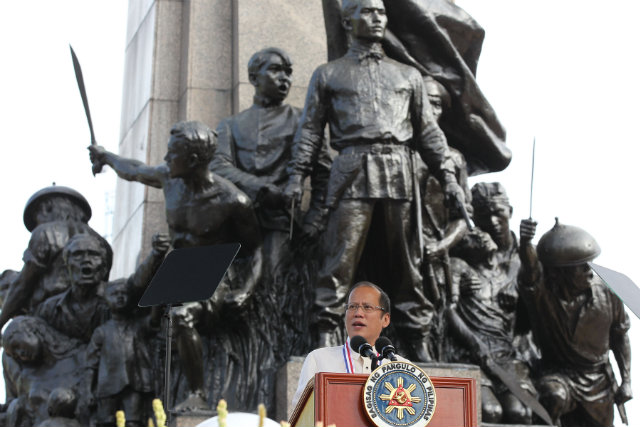
BETTER PERFORMANCE. The Aquino administration rises two notches in the Corruption Perceptions Index. Photo by Ryan Lim/Malacañang Photo BureauBETTER PERFORMANCE. The Aquino administration rises two notches in the Corruption Perceptions Index. Photo by Ryan Lim/Malacañang Photo Bureau
MANILA, Philippines (UPDATED) – Rising two notches, the Philippines' ranking improved in a global corruption survey at a time when Philippine politicians faced the worst corruption scandal in recent history.

The country rose 11 spots from 105th in 2012 to 94th this year out of 177 countries and territories, in the Corruption Perceptions Index for 2013 that was released Tuesday, December 3. The Philippines also scored 36, a rise from its rating of 34 the previous year. (READ: Corruption: How does the PH fare?)

In 2012, the Philippines jumped 24 spots from 129 in 2011 to 105.

Transparency International, which published the list, said the Corruption Perceptions Index “ranks countries and territories based on how corrupt their public sector is perceived to be.”

Transparency collates expert views on the problem from bodies such as the World Bank, African Development Bank, Economist Intelligence Unit, Bertelsmann Foundation, Freedom House, and other groups.

It then ranks countries on a scale of 0-100, where 0 means a country's public sector is considered highly corrupt and 100 means its is regarded as very clean.

In a statement, Malacañang welcomed the improvement saying the rise reflected the Aquino administration's reforms.

"This year’s improvement continues a trend—in which the reforms put in place result in an increasingly positive and encouraging perception of the country, where improvements are measured not only year-by-year, but by leaps and bounds on an annual basis," it said.

"This improvement is also a measure of the continued confidence of the international community in the Philippines, and likewise contributes to the virtuous cycle of empowerment as Filipinos from all walks of life work together to accomplish permanent change in the country."

The Philippines' better performance came amid protests over the pork barrel, discretionary funds that became a source of corruption.

No less than an Aquino ally, Customs Commissioner Rozzano Rufino Biazon, was implicated in the scam. Biazon resigned on Monday, December 2, 3 days after the justice department included him in a graft complaint filed with the Ombudsman.

The scam involves involves lawmakers endorsing discretionary funds to bogus non-governmental organizations of alleged scam mastermind Janet Lim Napoles, in exchange for hefty kickbacks. It has angered millions of Filipinos who have demanded reform.

'Corruption hurts the poor'

Under the index, Afghanistan, North Korea and Somalia are seen as the world's most corrupt countries while Denmark and New Zealand are nearly squeaky-clean.

Worldwide, almost 70% of nations are thought to have a "serious problem" with public servants on the take, and none of the 177 countries surveyed this year got a perfect score, said the Berlin-based non-profit group.

Transparency International's annual list is the most widely used indicator of sleaze in political parties, police, justice systems, and civil services, a scourge which undermines development and the fight against poverty.

"Corruption hurts the poor most," lead researcher Finn Heinrich told AFP.

"That's what you see when you look at the countries at the bottom. Within those countries, it's also poor people who get hurt the most. These countries will never get out of the poverty trap if they don't tackle corruption."

Among countries that have slipped the most on the group's 2013 Corruption Perceptions Index are war-torn Syria as well as Libya and Mali, which have also faced major military conflict in recent years.

"Corruption is very much linked to countries that fall apart, as you see in Libya, Syria, two of the countries that deteriorated the most," said Heinrich.

"If you look at the bottom of the list, we also have Somalia there. These are not countries where the government is functioning effectively, and people have to take all means in order to get by, to get services, to get food, to survive."

Huguette Labelle, chair of Transparency, said "all countries still face the threat of corruption at all levels of government, from the issuing of local permits to the enforcement of laws and regulations".

The group says that because corruption is illegal and secretive, it cannot be meaningfully measured.
The latest survey "paints a worrying picture," said Transparency. – Paterno Esmaquel II, with reports from Agence France-Presse/Rappler.com

 

Sunday, December 18, 2011

...the PH wings

UN hails Philippine protection of migrant workers


By Tina G. Santos
Philippine Daily Inquirer

Logo taken from United Nations website


MANILA, Philippines—While the sob stories usually make the headlines, the country’s efforts to help thousands of overseas Filipinos, especially those caught in wars and calamities, have not gone unnoticed in the United Nations.

A UN executive speaking at a recent conference in Geneva has commended the Philippines for its exemplary efforts to protect its nationals caught in international crisis situations, according to the Department of Foreign Affairs (DFA).

Peter Sutherland, the special representative of the UN secretary general for international migration and development, “specifically mentioned the Philippines as rising to the challenge by setting up a system to protect and engage its migrants,” the DFA said.

Sutherland made the remarks at the Global Forum on Migration and Development (GFMD) held in the Swiss city earlier this month, where he said the forum participants “could learn from the Philippines’ initiatives and good practices,” the foreign office added.

The Philippines drew praise for its repatriation efforts in troubled countries like Libya, Yemen and Syria, among others, DFA spokesperson Raul Hernandez told the Inquirer on Saturday.

“He (Sutherland) probably saw that we’re proactive in protecting our people by taking them out of harm’s way,” Hernandez said.

In the forum, the UN official also drew attention to the plight of domestic workers, particularly the so-called “kafala” or sponsorship system which he said “constituted a modern form of slavery,” the DFA said.

More fleeing Syria

Hernandez said another batch of at least 51 Filipinos from Syria will be repatriated in the next few days. The last group that arrived in Manila over a week ago totaled 55, bringing the current number of Filipino repatriates to 240 since political violence escalated in the Arab state earlier this year.

“Our embassy in Damascus continues to negotiate for the release of the workers from their employers or agencies,” Hernandez said, adding that securing airline seats for the next batch had been difficult of late because of the peak Christmas season.

The year 2011 has been one of the busiest for the DFA in terms of evacuating Filipinos from strife-torn regions, starting with those fleeing Egypt in February, at the height of street protests against the regime of then President Hosni Mubarak.

From that same month to March, the repatriation efforts shifted to Libya, with no less than Foreign Secretary Albert del Rosario personally leading one of the missions across the Sahara desert to fetch compatriots fleeing the fighting between rebels and government forces under dictator Moammar Gadhafi.

The turmoil in Yemen also prompted Del Rosario to go there in March to assess the situation and offer voluntary repatriation to the less than 1,500 registered migrant Filipinos working in that country.

Review of ‘unsafe’ countries

Apart from the repatriation efforts, the DFA is currently conducting a review of the 41 countries earlier considered unsafe for overseas Filipino workers (OFWs) and could be covered by a labor deployment ban.

“At present, we have asked a review of the present status of each of the 41 countries to determine if they have already acceded or enacted laws that would protect our migrant workers,” Hernandez said in an earlier interview.

The DFA proceeded with the review after asking the Philippine Overseas Employment Administration (POEA) to defer the ban for three months.

“We will use the deferment period to revisit the 41 countries with the view of moving forward toward compliance with the amended Migrant Workers Act (Republic Act No. 10022),” which forbids the deployment of OFWs to countries certified as not protective of migrant workers, Hernandez said.

“We will submit new certifications after 90 days, taking into account results of DFA’s dialogue with countries concerned and new developments in those countries with respect to the protection of migrant workers,” Hernandez said.

9M in 200 countries

More than 1.4 million Filipino workers were deployed overseas last year, according to the POEA. Of this number, 1.1 million were land-based, while around 350,000 were sea-based workers.

For land-based OFWs, the top destinations were Saudi Arabia (293,049), United Arab Emirates (201,214), Hong Kong (101,340), Qatar (87,813) and Singapore (70,251).

Among the newly hired overseas Filipino workers deployed last year, the top occupational categories included household service workers (96,583), cleaners and related workers (12,133), nurses (12,082), caregivers and caretakers (9,293), and waiters, bartenders and related workers (8,789).

According to the latest estimates by the Commission on Filipinos Overseas, some 9 million Filipinos are in more than 200 countries around the world as of December 2009. With a report from Inquirer Research
Sources: Commission on Filipinos Overseas, POEA.

Saturday, December 17, 2011

...the viral photo

Philippine killer picture tops Time Magazine’s best viral shots

By Tarra Quismundo
Philippine Daily Inquirer


INQUIRER EXCLUSIVE. Seconds after taking this picture of his smiling family outside his home in Caloocan City in the early hours of New Year’s Day, councilman Reynaldo Dagsa lay dead of a gunshot wound. The police did not have to look far for evidence of the killer’s identity. The Inquirer published the photo on its front page and it quickly went viral on the Web.


It’s that chilling shot of an amateur photographer that sent the world clicking the “share” button.

The last photo taken by Caloocan City councilman Reynaldo Dagsa of his family—which by a stroke of chance also captured the assassin aiming a gun at Dagsa—was selected by photo editors of the prestigious TIME magazine as among the world’s “best viral photos” of 2011.

First published in the Philippine Daily Inquirer frontpage  and uploaded on http://www.inquirer.net/ on Jan. 4, 2011, the photo taken by Dagsa just moments before he was killed on New Year’s Day eventually led to the arrest of the assassin and his accomplice.


Extraordinary story

Inquirer reporter Kristine Felisse Mangunay got a copy of the photo from the police file on Jan. 3, not thinking that doing the rounds of her beat that day would lead her to an extraordinary story.

“It was an ordinary day,” Mangunay recalled.  “I went to the police station to do the usual rounds.  The intelligence chief told me that a barangay councilor was shot dead and that ‘there is even a picture of it,’” Mangunay said.

“He showed me the entire case folder and everything was there, including the photo, a hard copy.”

The reporter, who had been covering the northern Metro Manila beat for just three months, felt an initial shock upon seeing the photo.

“I didn’t know what to do at first. I felt the picture was incredible, that it might be fake,” Mangunay said.
“The police told me the (Dagsa) family provided the photo so I had to look for the family to confirm it. When I spoke to his wife, I got the confirmation,” she added.

Sharing spree

The photo was published on the entire upper fold of the Inquirer a day after. Other media outfits eventually caught up and published the same photo, fueling a sharing spree online.

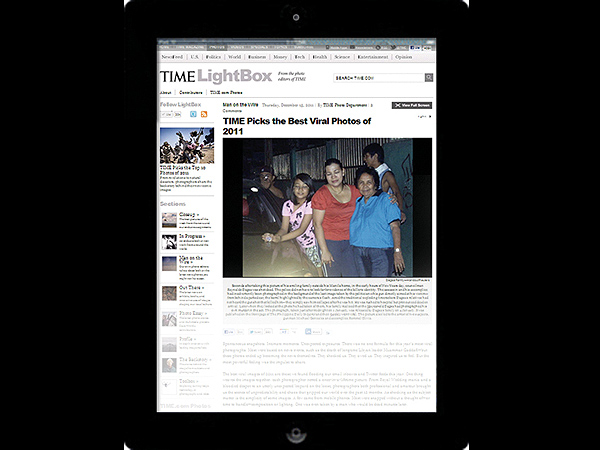
The list was published online on Thursday on TIME LightBox, the official blog of the US magazine’s photo department. While the list was posted in no particular order, Dagsa’s photo appeared first in the gallery.

Dagsa’s last shot shares the list with moments already bookmarked in history: a photo of a bloodied Libyan leader Moammar Gadhafi in his final moments in October; a picture of US President Barack Obama and top American leaders watching live the Navy Seals operation to capture Osama bin Laden in May; and a photo of British Prince William and Kate Middleton’s first kiss as a married couple on April 29.

“The photograph, taken just after midnight on 1 January, was released by Dagsa’s family on 4 January. It was published on the front page of The Philippine Daily Inquirer and then quickly went viral,” read the LightBox caption of the photo.

Once in a lifetime

Dagsa was taking a picture of his family minutes into the New Year when, apparently unknowingly, he captured his shooter, Michael Gonzales, taking aim at him.

The councilor of Barangay 35, Maypajo, Caloocan City, was felled by Gonzales’ shot after clicking his camera.

Fireworks drowned the sound of the gunshot, giving Gonzales and his accomplice, Rommel Olivia, time to flee.

Writing about the TIME photo editors’ picks, Nick Carbone, a TIME writer on technology, culture and society, described this year’s gallery as “once-in-a-lifetime” shots that “we couldn’t help but share.”

“As shocking as the subject matter is the simplicity of some images. A few came from mobile phones. Most were snapped without a thought of—or time to handle—composition or lighting. One was even taken by a man who would be dead minutes later,” said Carbone, described on TIME’s website as “a viral video fanatic and gadget connoisseur.”

Dagsa’s picture and the story of how he took it also made the news overseas. With a report from INQUIRER.net


View the photo list here: http://lightbox.time.com/2011/12/15/time-picks-the-best-viral-photos-of-2011/#1.