Showing posts with label community. Show all posts

Saturday, February 2, 2013

...the PInoy in NZ politics

Pinoy enters NZ politics


                                                                  Gazo


MANILA, Philippines - A Filipino has entered New Zealand politics, and he is just 23 years old.

Ephraim Gazo, who hails from Bacoor, Cavite, currently serves as a member of the Community Committee in Lower Hutt in the capital Wellington, the 10th largest city in New Zealand.

Gazo is bent on extending his public service to Philippine shores and is helping improve Filipinos’ lives through tourism.

“As far as I am aware, I am the only Filipino involved in the New Zealand government in my capacity as a council member. However, I have heard of various Filipinos who have been involved through running in previous elections but were not able to get elected or appointed to office,” Gazo told The STAR.

Gazo said the Community Committee serves as the bridge between the people and the city council.
“A community committee member’s working day normally involves meeting constituents and attending community groups, particularly those that the members are involved with through their portfolio,” he said.

Gazo is presently handling the Naenae Computer Clubhouse, the Keep Hutt City Beautiful Committee, Youth Affairs and Ethnic Affairs.

A committee member earns about $1000 per meeting. They have about six to seven meetings in a year, Gazo said.

“Another thing that I’m currently pursuing is how I could utilize my position and connections towards promoting the Philippines as an ideal tourist destination to many Kiwis – some of whom have never heard/been to the Philippines,” he said.

Gazo also wants to take advantage of the so-called “gap year,” which refers to the time out to travel between life stages. It is very popular among students in New Zealand, the United Kingdom, Australia, and Canada.

“It is part of the culture of the young people in New Zealand that after high school they do backpacking for a year,” Gazo said.

He said he feels disappointed whenever he meets people and they tell him that they have been to countries near the Philippines.

“Through my involvement in the council, together with some Filipino youth, we formed a network to promote the Philippines as a tourist destination,” Gazo said.

“I was also inspired by the recent visit of President Aquino in New Zealand when he called on leaders from both countries to strengthen their relation, particularly with the working holiday schemes in New Zealand,” he added.

“My first campaign began in 2007, a day after turning 18, I decided to run as a city councilor in the local body elections at Hutt City Council,” Gazo said.

In 2007, Gazo was elected to the Hutt City Youth Council, which is equivalent to the country’s Sangguniang Kabataan.

“One of the biggest challenges that I saw at the time was that I was the youngest candidate as well as the only Filipino,” he said.

There are also senior politicians who criticized him for being young and for being a Filipino.
“There would always be a certain stereotype of Filipino politicians, that they are corrupt. But instead of being discouraged, I keep my head up and make sure that my voice is heard.”

“A particular event which was quite memorable to me was when I attended a ‘meet the candidates’ event hosted by the local Grey Power, as there was an ongoing perception that most of the elderly in our community were not quite supportive of young people and people of different ethnicities,” Gazo said.

Grey Power is an advocacy group for people aged 50 and above.

“I was initially very nervous upon entering this forum, but all my worries and fears subsided when I realized how warm and welcoming this group was and how they were quite supportive of my candidacy and my purpose for running – which was to give young people and migrant communities a voice in the council,” Gazo said.

His interest in politics started when he was in high school at the Naenae College, after he participated in the Sir Peter Blake Youth Environment Forum.

In the forum, Gazo wrote an essay about environmental sustainability.

“In my essay I compared Bacoor, my hometown, and Manila to Wellington which is very clean and green. My article was one of the essays selected in the whole (Wellington) region,” he said.

“After that I opened my mind not only to environmental issues but also to helping the community.”
His performance as a member of the Youth Council was basically the reason for his appointment to the Community Committee.

“Our mayor is very supportive of the young people. Five former members of the Youth Council, including me, were appointed to the Community Committee. Our ages range from 20 to 25,” he said.
“Because the city councilors have no term limit, our mayor believes that it is time to give the young people a chance to serve,” he said.

Gazo migrated to New Zealand in 2004 when he was just 14.

Gazo had an opportunity to migrate to New Zealand through his mother, Feria, who works as a nurse for the local hospital in Hutt Valley District Health Board.

He lives with his mother and aunt Hedilisa Gazo, who works as a baker for Air New Zealand at the Wellington Airport.

“My mother is a single parent and I have no siblings. Although I have three half-brothers on my father’s side with whom I have had no contact with for a very long time,” Gazo said.

“I initially wanted to be a doctor as my mother is working as a registered nurse and so I saw health services as an avenue to help my community,” Gazo said.

He studied in a number of schools in the Philippines including Bacoor Unida Evangelical School, Child Development and Guidance Centre, Bacoor Parish School and Statefields School Inc.

“I left the Philippines after finishing second year high school and was a high achiever then, mostly ranging from 1st honor to 4th,” Gazo said.

Thursday, January 17, 2013

...the Queen's jubilee awardees

Three Fil-canadians receive Queen's jubilee award


GMA News
January 17, 2013
 
 
Three Filipina-Canadians did the Philippines proud after they were awarded the Diamond Jubilee Medal of Queen Elizabeth II at Toronto's Queen's Park last Dec. 12, the Department of Foreign Affairs (DFA) said on Wednesday.

In a news release posted Wednesday on its website, the DFA said the investiture ceremony was held at the Legislative Building at Toronto’s Queen’s Park.

Awarded the Diamond Jubilee Medal were:
  • Norma Carpio, president of the Philippine Independence Day Council (PIDC), for her leadership in fostering unity and collaboration among Filipinos and other ethnic groups, for promoting Philippine culture and heritage and for organizing cultural festivals and promoting young Filipino talent.
 
 
  • Amy Ada, for her leadership in advocating causes within the Filipino-Canadian community and for showing newcomers to Canadian society need not leave the heritage of their country behind, and
  • Minda Neri, former president of PIDC, for her volunteer work and contributions in promoting cultural understanding through appreciation of Philippine heritage and culture.
 
 
The DFA said the Ontario provincial government distributed around 2,000 Diamond Jubilee Medals to recipients in recognition of their remarkable accomplishments and important contributions to society.

Citizenship and Immigration minister Michael Chan, who presided over the investiture ceremony, lauded the awardees for making a difference, for their inspiration and example, and for their constant efforts to foster a better world.

Philippine Consul-General Junever West represented the Philippine Consulate General in Toronto at the ceremony. - VVP, GMA News

Sunday, November 4, 2012

...the Filipino spirit

‘Bayanihan’ Spirit Shines In Storm-Ravaged East Coast


By ELLSON QUISMORIO
Manila Bulletin
November 4, 2012
 
 
There’s Bayanihan on stage, and then there’s “bayanihan” on the streets.

The Philippines’ world-famous national folk dance company, the Bayanihan, performed last Thursday at the Jazz at the Lincoln Center in New York City as tales of mutual cooperation among Filipinos in the US East Coast cropped up in the aftermath of superstorm Sandy’s wrath.

Performing before a large audience, the Bayanihan took center stage on the same night the lights reopened in Broadway in a sign that New York was slowly picking itself up from the storm that brought it to its knees just a few days ago.

“What makes the performance particularly memorable is that it took place while Filipinos in various parts of the East Coast were performing their own acts of bayanihan to help each other rise on their feet,” Philippine Ambassador to the US Jose Cuisia Jr.

The envoy cited stories received by the Philippine Embassy in Washington D.C. and the Philippine Consulate General in New York of how Filipinos have opened the doors to their homes to assist their kababayans (compatriots) in getting over the effects of one of the worst storms in American history.

“True to its name, the bayanihan is a shining example of the can do spirit of the Filipino and that hope endures,” said Cuisia. “In its own special way, the Bayanihan was able to dance its way into the hearts of both Filipinos and Americans who came to see the performance.”

“It was spectacular,” said former Ambassador to Manila Frank Wisner who raved about the beautiful, creative, and energetic repertoire of the Bayanihan that included six dance suites showcasing the diversity of Philippine culture and traditions.

According to Consul General Mario De Leon, almost 2,000 Filipinos in the Country Village section of Jersey City, New Jersey are helping one another emerge from the storm-wrought devastation.

“The few Filipinos who have generators let kababayans who have no electricity charge their mobile devices,” he said. “Filipino store and restaurant owners also kept their establishments open despite fears of possible looting.”

In Staten Island, where two Filipino families lost their homes to storm surges, fellow Filipinos opened their doors to them and took them in. The same is true in New Jersey and Long Island where Filipinos whose houses were damaged by floodwaters, falling trees or violent winds found shelter in the homes of friends and relatives.

In Suffolk Country in Long Island, a Filipina said kababayans can come to her home where they can have hot meals, take their showers and do their laundry. In Manhattan, a family of Filipino doctors and nurses has been volunteering their services in local hospitals.

The Consulate General in New York itself had launched Operation Kapitbahay (Neighbor) that allowed Filipinos access to the Philippine Center on Fifth Avenue where they could charge their mobile devices and connect to the Internet.

Filipino organizations have also risen to the occasion. The Oriental Mindoro Association headed by Juliet Payabyab is gathering clothes and water for affected Filipinos in Staten Island, which is among the worst-hit in New York. The Handang Tumulong Foundation Inc. is also mobilizing assistance for relief efforts.

Even the militant Bagong Alyansang Makabayan has offered to a helping hand with its Operation Kaligtasan (Safety). Bayan leader Gary Labao visited the Philippine Consulate and volunteered to search for Filipinos who may have been in evacuation centers in hard-hit New York and New Jersey.

The Association of Filipino Teachers in America led by its Vice President Ronnie Mataquel are volunteering at a shelter in the Bronx that caters to displaced residents of City Island while members of the Filipino-American Amateur Athletic League in Connecticut are helping out at the Red Cross facility in Greenwich.

In Long Island, community leader Ramon Villongco is leading efforts to look into the situation of Filipinos in Long Beach, Mastic Beach, Babylon, Hempstead, Bayshore, Brentwood, Hicksville, Glen Cove and other areas that were badly struck by Sandy.

The East Coast-based Filforce airsoft group was the first to provide the Embassy with the first reports of the impact of Sandy on the Filipino Community as some of its members in Atlantic City, Jersey City and Long Island absorbed the brunt of the storm in terms of flood-damage to their homes and vehicles.

In Washington, the Filipino Migrant Heritage Commission also responded to the call of the Philippine Embassy for Filipino organizations to look into the situation of their members in the affected areas. FMHC leader Grace Valera said their group was in touch with members in Virginia, Pennsylvania, New York and New Jersey before, during and after Sandy’s onslaught to make sure that all of them are all right.

Saturday, November 3, 2012

...the kid global inspiration

Scavenger-turned-achiever Filipino kid a global inspiration


Philippine Daily Inquirer


VALDEZ


CAVITE CITY—Cris Valdez began life unwanted by his parents and was soon scavenging in a rubbish dump, an unlikely start for a boy now hailed as an inspiration for children around the world.

Valdez, 13, won this year’s International Children’s Peace Prize for his work as head of a charity organization that educates and hands out gifts to thousands of youngsters in his poverty-plagued hometown.

South African human rights activist and Nobel Peace Prize winner Desmond Tutu gave Valdez his award at a ceremony in the Netherlands in September, declaring him a “voice for the voiceless” and a “true inspiration.”

After returning to the streets of Cavite, Valdez spoke in a soft voice to Agence France-Presse about his noble philosophies that emerged from personal devastation and the people who turned his life around.

Seeing himself

“I help because I see myself in children who roam and live on the streets,” Valdez said during one of his weekend community outreach programs.

“Some good-hearted people showed me love and changed my life, and I am just paying it forward.”

Valdez, nicknamed “Kesz,” was born the third of nine children from a desperately poor couple who lived with hundreds of other squatter families on the fringes of a huge garbage dump in Cavite.

The city was once a picturesque, colonial Spanish enclave and fish port, but deteriorated into a mostly rundown urban mess in a familiar pattern across the country where a quarter of the population now live on less than a dollar a day.

His parents called him “bad luck” because they tried to sell him when he was a baby but failed, according to Harnin Manalaysay, the head of a local Christian youth charity who eventually rescued Valdez.

Manalaysay said Valdez was forced to start scavenging in the garbage dump from the age of two.

At ages three and four, Valdez was sleeping anywhere he could, including atop tombs at the city cemetery, because he frequently fled home to escape beatings by his rickshaw-driver father, according to Manalaysay.

At an age when children are just learning how to make friends, Valdez was learning to beg and steal.

“I found him sleeping on a curbside covered in flies. He was very dirty and being kicked by passers by,” Manalaysay said.

Manalaysay enrolled Valdez, then aged four, in his alternative learning program for street children, in which volunteer teachers use mobile classrooms on pushcarts to bring classes to the students.

In between lessons, Valdez still scavenged for scraps to help out his family.

Bad luck kid

Then bad luck struck Valdez again when he was five.

Fellow scavengers jostling around a dump truck accidentally shoved him into a pile of burning tyres, badly injuring his arms and back.

“My father was angry when I came home and said I deserved it for being stupid,” Valdez recalled.

Valdez said his mother took him to Manalaysay, who paid for his medical treatment and allowed him to recuperate at the charity worker’s shelter for street children, called Club 8586.

“She came back (months) later to tell me they did not want him back anymore,” Manalaysay said.

Manalaysay, a portly marine engineer whose club has been helping troubled youths for more than 27 years, became his legal guardian.

Under his tutelage, Valdez recovered, and his grades improved.

He also began volunteering as a 6-year-old to teach other street children about basic hygiene.

When Valdez turned seven, Manalaysay asked him what he wanted as a birthday gift.

“I told him I wanted other children to receive what I had: rubber slippers, toys and candies,” Valdez said.

So Valdez and his guardian spent the day giving various items to street children.

Tradition of giving

The giving became a yearly tradition and led to the creation of Valdez’s own charity, called Championing Community Children.

Under Manalaysay’s guidance, Valdez built the charity into one that raises funds from private donors to buy basic living items for children, including sandals, toys, food and clothes.

Volunteers, made up mostly of Valdez’s friends, also teach basic hygiene, nutrition and gardening, as well as educate children on their rights to help prevent abuse.

Valdez’s charity has helped 10,000 children in Cavite over the past six years, according to the judging committee of the

International Children’s Peace Prize, which was founded by Dutch organization KidsRights.

“Kesz is like any other normal kid. But his achievements, and the number of people he has helped, surpass those of most adults,” Manalaysay said.

Valdez’s plans for the immediate future are to continue with his charity, while making sure his school work does not suffer from his busy schedule.

Eventually, he wants to work in one of the toughest jobs of all, while expanding his charity work.

“I’m studying hard because I want to be a doctor… I want to help more children, not only in the Philippines, but also in other countries,” he said. AFP

Friday, October 26, 2012

...the Pinoys for CA assembly post

3 Pinoys running for California Assembly

10/26/2012
 
 
CALIFORNIA – US Census data show that there are about 1.3 million Filipinos living in the Golden state. But even after living in California for 400 years, Filipinos have never held any position in the state Senate or Assembly.
 
That could change this year.
 
Three Philippine-born Filipinos are vying for the California's highest positions.
 
Rob Bonta and Dr. Jennifer Ong of Alameda, and Chris Mateo of Lathrop are all running to become California's State Representatives.

Forty-one-year-old Bonta sits as the Vice Mayor of Alameda and the Deputy City Attorney for San Francisco.
 
He was born in Quezon City and moved to the US with his family when he was less than a year old.
 
Bonta's parents both worked with the United Farm Workers and were active in the civil rights movement.
 
Bonta describes himself as an advocate for public schools, public safety, job creation and equal rights for gays and lesbians.
 
“In California, we have 120 legislators, representing different districts with different interests. We need to work together to make things work for the state,” he said.


Forty-two-year-old Ong was also born in Quezon City and moved to California with her family at age 11.

Her mother sold hotdogs at the coliseum and her father worked at the grocery store.

Ong said her personal story shapes her policy interests. She wants every family in California to have good union jobs that provide health insurance. She wants to fight for public education.

An optometrist by trade, Ong campaigns against childhood obesity and Hepatitis B.

“To have the skills in state legislation --- why not run? It's the least I can do. I feel very obligated to California for all the opportunities for me and my family,” she said.

Meanwhile, 60-year-old Chris Mateo was born and raised in Baguio City to middle-class working parents.

He joined the US Navy in the 70s and was stationed in California.

For years, he worked for the San Joaquin County Public Works and currently serves as the Vice Mayor of Lathrop.

He said he wants to represent the poor, veterans, minorities, women and children by providing them access to education and career opportunities.

“I would like to instill in the next generation that Filipino Americans need representation and participation in government in order for our ethnicity to thrive,” he said.

For Bonta, Ong and Mateo, stepping up is not confined to running for public office. They all seek to make a difference in a state that has given so much for Filipinos.

Friday, September 21, 2012

...the Aussie media awardee

Pinoy wins media award in Australia


09/21/2012
 
MANILA, Philippines - A Filipino who established an online publication to serve the Filipino-Australian community won an award for its coverage of community affairs in Australia.
 
Romeo Cayabyab, editor and publisher of “The Filipino Australian”, received the award at ceremonies for the first New South Wales Multicultural Media Awards at the State Parliament last September 15.


An accountant by profession, Cayabyab migrated to Australia in 1981. He lives in Minchinburry, New South Wales with his family.

The native of Capas, Tarlac is a self-taught encoder, programmer and web publisher.

In 1998, Cayabyab co-founded emanila.com with multimedia specialist, Rom Zamora. Two years after, emanila.com became the first recipient of the Technology Award under Australia's National Multicultural Marketing Awards.

Cayabyab further used his expertise to establish "The Filipino Australian" in 2005 to provide online news services to the Filipino-Australian community.

Honorable Shaoquett Moselmane, Member of the Legislative Council, NSW Parliament, said it is fitting to recognize the multicultural and indigenous journalists who bring communities together and promote multiculturalism in Australia.

Moselmane founded and chaired the Awards.

Monday, July 9, 2012

...the faith that breaks (record)

Iglesia ni Cristo breaks 3 world records

07/09/2012
 
 
Residents receive a free dental examination during an event organized by Iglesia ni Cristo (Church of Christ), a local Christian movement in the Philippines. Photo by Cheryl Ravelo, Reuters


MANILA, Philippines – After gaining media attention for planning to put up what has been dubbed as the world’s largest indoor arena, Iglesia ni Cristo is at it again as it broke three Guinness world records.

The influential religious group achieved the feat during its medical-dental mission for informal settlers in Manila last Saturday, July 7.

Tarika Vara, Guinness World Records’ official adjudicator, said Iglesia ni Cristo broke the record for the largest dental health check, the most number of blood pressure readings taken in eight hours, and the biggest number of blood glucose level tests conducted in eight hours.

She said a total of 4,128 people benefited from the dental health check in Manila, breaking the previous record of 3,377 people recorded in India in 2009.

Vara said the Iglesia ni Cristo event also posted a record 8,026 blood pressure readings and 5,217 blood glucose level tests, higher than the previous Guinness records of 7,203 in Kuwait and 3,573 in India, respectively.

Last year, Time.com reported that the designing of a 50,000-seat stadium of Iglesia ni Cristo in Bulacan has already started.

The $213-million facility will be built in time for Iglesia ni Cristo’s centennial celebration in 2014, according to Populous, the US architectural firm behind the project.

Saturday, June 16, 2012

...the Happy Planet

Philippines ranks 25th on Happy Planet Index

06/16/2012

MANILA, Philippines - The Philippines has placed 25th on the 2012 Happy Planet Index rankings that rate nations based on their citizens' health, happiness, and environmental sustainability.

The Philippines' latest ranking marked a drop from placing number 14 in 2009 and number 17 in 2006.

The New Economics Foundation (NEF), compiled the Index, said the Philippines' score of 52.4 reflects a "middling" life expectancy, relatively low levels of experienced well-being, and a very low ecological footprint.

Filipinos have an average life expectancy of 68.7 years and "happy life years" of only 41.8, according to NEF data.

The country has a gross domestic product per capita $3,969 -- which is less than 10% of the United States -- and placed 97th on governance ranking.

Costa Rica, Vietnam and Colombia – the countries where  people live the longest, happiest, most sustainable lives -- topped the 2012 Happy Planet Index.

"Costa Ricans have higher average life expectancy and well-being than people living in the United States and the country has a per capita Ecological Footprint one third the size of that of the US," the NEF said.

The other countries in the top 10 are Belize, El Salvador, Jamaica, Panama, Nicaragua, Venezuela, and Guatemala.

The US only ranked 105th on the index.

Bro. Clifford Sorita, a sociologist, told ABS-CBN News that Filipinos experience relatively low levels of depression compared to other countries but other issues contribute to a person's well-being.

According to NEF fellow Nic Marks, the index shows that well-being data is an accurate reflection of the economic and political fortunes of a country.

"The Happy Planet Index measures what really matters – long and happy lives now and the potential for good lives in the future. For too long we have relied on incomplete measures of progress that focus only on economic activity, such as GDP," he said.

“Rich and poor nations face different challenges but their ultimate goal is the same. The HPI not only reveals how far every country has to travel before it achieves good lives that don't cost the earth [or within its fair share of planetary resources] but also the direction it needs to move in," he added. - with a report from Pia Gutierrez, ABS-CBN News

Saturday, May 19, 2012

...the honest Janitress rewarded


Honest Janitress Gets Cash Reward


MANILA, Philippines - The honest janitress who returned a plastic pouch full of foreign currency left behind at the Customs area at the Ninoy Aquino International Airport late last month received a cash reward for her good deed from a group of Filipino-Chinese philanthropists.

Jennifer Doroga, 32, contractual janitress of the Manila International Airport Authority received, the R50,000 cash reward from Manny Dy, honorary president of the Federation of Filipino Chinese Associations Foundation Inc.

Dy turned over the award to Doroga at the Board Room of the Ninoy Aquino International Airport in the presence of MIAA Assistant General Manager MGen Vicente Guerzon (ret.) and NAIA Terminal Manager Dante Basanta.

Dy also said that the Board of the Federation decided to reward Doroga as a gesture of the association's gratitude for the exemplary honesty of the janitress.

Upon receiving the cash, Doroga broke into tears while she profusely thanked Dy and the other members of the Federation.

Doroga said she intend to use the money for her family's personal needs.

Gen. Guerzon for his part thanked the Federation for rewarding the honest deed of their employee.

To date, the money returned by Doroga is still in the custody of the airport Authority because no one has still come forward to claim it.

Monday, May 7, 2012

...the everyday hero

Cleaning Lady Returns Pouch With P1.2 Million


''It would've been wrong to claim something that wasn't mine. That would not be good karma." - Mary Jennifer Doroga, NAIA Janitress 


MANILA, Philippines - Few people could have resisted such temptation.

In her hands, cleaning lady Mary Jennifer Doroga held an amount that could have made her an instant millionaire and answer for the medical needs of her ailing mother.


But as Doroga, 32, returned the pouch full of foreign denominations to the airport's lost and found section, her luck was farthest from her mind.

Instead, she worried for the pouch owner, who might have been listlessly searching for the lost bank notes - all P1.2 million worth of it.

''It would've been wrong to claim something that wasn't mine. That would not be good karma,'' Doroga said in Filipino.

She earned the admiration of airport officials, who are giving her a commendation today for her honesty.
Like most of her days, Thursday began rather ordinarily.

With a take home pay of P426 as a contractual janitress at the Ninoy Aquino International Airport (NAIA), she was thinking of rendering overtime work to add to her meager salary.

She needed the overtime to pay for the medical expenses of her mother, who's having knee and bowel movement problems. She had taken her to a hospital for a medical check-up and the bills are slowly mounting.

But no amount of financial difficulty can deny one's innate honesty. She was not even expecting any reward for her honesty.

While attending to her assigned duties at the Customs arrival area at the NAIA Terminal 1 last April 26, Doroga chanced upon the clear plastic pouch bulky with foreign money.

Instinctively, she thought about the owner who had left behind the small fortune.

''It did not cross my mind to keep the money. I was concerned for the person who lost it,'' she said.

Without bothering to count how much was inside the pouch, Doroga quickly proceeded to the lost and found section to surrender the money.

When the foreign currency notes have been sorted out, it amounted to P1.2 million.

Manila International Airport Authority (MIAA) General Manager Jose Angel Honrado described Doroga as one of the ''silent heroes in our midst.''

Amid the admiration and the accolade, Doroga said she was only doing what's right as taught by her parents.

Her sickly mother, who instilled in her the virtue of honesty, was only too happy for her when she told her about what happened, she said.

A janitorial service contractor, Doroga said financial difficulty had always been a problem for her family, like second skin.

But for someone who has simple joys and simple needs, monetary problems will always play second fiddle to her.

''All I want is to help my family with honey pay from honest work. That's my simple joy,'' she said in the vernacular.

In a way, Doroga said she is only paying it forward the goodness that other people have extended to her family.

She got employed at the NAIA with the help of MIAA finance division general manager Herminia Castillo, who her mother met in one church occasion. ''It was her who helped me find this job.''

She has not forgotten that simple act of kindness.

She may be a lowly janitress, but Doroga towers above all with her integrity and work ethics.

Tuesday, April 24, 2012

...the achievers in New Zealand

Seven Pinoy achievers feted in New Zealand

 
April 24, 2012
GMA News
 
 
Seven New Zealand-based Filipinos were feted for promoting the best of the Philippines at an event at the Philippine Embassy on April 13.
 
Philippine Ambassador Virginia Benavidez hosted the event dubbed an “Evening to Remember and Recognize Filipino Talents and Creativity” as part of the embassy’s cultural diplomacy.
 
In a news release on Monday, the Department of Foreign Affairs (DFA) said the event “showcased the positive image of the Philippines as the home of world-class talents and raised the profile of the Filipino community as among the best immigrant groups who have integrated themselves well in the local communities throughout New Zealand.” 
 
Those feted during the event were:
 
  • Sylvia Shirin Zonoobi, the first Filipino to be appointed Officer of the New Zealand Order of Merit for Services to Refugees and Migrant Communities in the New Year Honors List of New Zealand for 2003;
  • Dr. Antonio Noblejas, Queen’s Service Medal Awardee for Services to the Filipino Community in New Zealand’s 2008 New Year Honors List and Recipient of the “Banaag Award” of the Commission on Filipinos Overseas’ 2008 Presidential Awards for Individuals and Organizations Overseas 
  • Anita Mansell, Queen’s service medal awardee for services to the Filipino community in New Zealand’s 2011 Queen’s Birthday
  • Oscar and Miriam Batucan, the first ever Filipino-New Zealand couple to be awarded the Benemerenti Medal given by Pope Benedict XVI on July 20, 2009
  • Ivy Rose Padilla, Best Actress in a Leading Role – Musical North Area Performance Theatre Awards for 2011, and
  • Josephine Garcia-Jowett, finalist of the Open Section, 2007 and 2010 World of Wearable Arts Awards Show, Commended in the Red Section of the  2003 World of Wearable Arts Awards Show and AKLnzPINOYS, Print Journalism Awardees in the 1st Media and Migration Advocacy Awards of the Commission on Filipinos Overseas for 2011.
 
Benavidez also tendered a thanksgiving dinner for the honorees and their families.
 
Those present during the occasion were Cora Noblejas, Ken Mansell, Patrick Padilla, Carlo and Rhodora Jaminola representing the AKLnzPINOYS, Mico Santos, Cultural Officer Liza Jane Estalilla, and Cindy Santos.
 
The awardees conveyed their deep appreciation to the Philippine government for the acknowledgement of their inspiring testimonies to the good traits of Filipinos in New Zealand.
 
“They are the Philippine Embassy’s valuable partners in promoting the welfare and interests of Filipinos in New Zealand, supporting programs to highlight the rich and varied cultural, artistic and spiritual heritage of the Philippines and contributing, in their respective ways, to growth and progress in the Philippines,” Benavidez said. - VVP, GMA News

Monday, March 5, 2012

...the Mother of pro-life

Pinay nun, 'Mother of pro-life movement' in PHL, receives award in Korea

 
March 5, 2012
GMA News
 
 
A Filipino nun, Sr. Pilar Verzosa, called the mother of the prolife movement in the Philippines, received an award in Korea for promoting and defending the dignity of life.

According to a news release of the Catholic Bishops Conference of the Philippines (CBCP) on Monday, the Seoul Archdiocese's Committee of Life conferred the award on Verzosa near the Myeong-dong Cathedral in Seoul.

The “Mystery of Life Award 2012” was handed out by Seoul Archbishop Nicholas Cardinal Cheong Jinsuk on February 15.

Verzosa was also awarded 30,000,000 KRW (P11,496.49).

The CBCP said Versoza was chosen as the winner in the field of Social Action, "for her outstanding achievements in the promotion of the dignity, care and defense of human life."

The Seoul Archdiocese set up “The Mystery of Life Award” in October 2005 to support the scholars in the field of Bioscience and Humanities.
 
It also supported people in the field of social action who are acknowledged to have made great contribution to pro-life activities.

Aside from Versoza, the other awardees included:
 
  • Emma Freisinger, an 80-year-old Austrian nurse who has been working with the Koreans who have Hansen’s Disease (leprosy) since she was 27 years old;
  • Professor Oh It Wham of Catholic University of Seoul, who has been developing the adult stem cell therapy to prove its effectiveness over the embryo stem cell therapy, a procedure that the Catholic Church considers as "immoral," and
  • Fr. Cheon Hyun-Ho, an environmentalist activist.

Pro-life Philippines

During the awarding ceremonies, Verzosa gave a presentation about the projects of Pro-life Philippines, which she founded and served as national coordinator for 30 years.
 
Pro-Life Philippines has also lobbied against the introduction of so-called "D.E.A.T.H. (Divorce, Euthanasia, Abortion, Two-Child Policy, Homosexuality, Same-Sex Marriage) bills," particularly the reproductive health (RH) bill in Congress. - VVP, GMA News

Sunday, February 19, 2012

...the emerging Healthcare Force

PH As Emerging Healthcare Force

Number Don't Lie
 
 
By ANDREW JAMES MASIGAN
February 20, 2012
Manila Bulletin
 
 
MANILA, Philippines — Exciting things are afoot in the medical industry. In the heart of Quezon City will evolve a medical belt like no other in Asia. An integrated chain of medical institutions, each specializing in a specific field of discipline. From general medicine to cardiology, from Nephrology, Pediatrics and Pulmonology.

The vision that started some 30 years ago will now come to fruition, thanks to the headstrong determination of DOH Secretary Enrique Ona and his chief coordinating officer, Dr. Nestor F. Venida. The initial phase of the plan is to integrate the Philippine Heart Center, National Kidney Institute, Lung Center of the Philippines, Philippine Children’s Hospital and the East Avenue Medical Center. These institutions put together make the Philippines a regional force to be reckoned with in as far as depth and extent of medical services are concerned. No other country in the region offers medical facilities of this scale in one connected belt.

Subsequently, the plan is to fold in the Philippine Hematology Center, the National Brain and Nerve Institute (the first medical institution to be built under the PPP scheme) and the National Orthopedic Hospital. The latter is to be relocated from its current site to Quezon City’s medical belt as well. All these will make the Philippines even more competitive on a global scale.

When completed, the medical belt is said to be branded “The Philippine Center for Specialized Healthcare.” The fact that the DOH even talks about branding alludes to its direction to “sell” it as a hub for medical tourism.

This is a welcome development given that the Philippines is in desperate need of alternative sources of foreign exchange. At present, the country is dangerously dependent on the electronics and BPO industry (as sources revenues) and this leaves us defenseless against the volatilities in these sectors. Having the medical industry develop into a new source of revenue will do us good. We are, after all, known worldwide as highly skilled healthcare workers with excellent bedside manners.

Getting Integrated

The above-mentioned medical institutions were built during the Marcos era and operate under separate sets of management and operating systems. As government institutions, their respective by-laws mandate them to allocate a substantial chunk of their business to charity cases. As a result, none of them are financially self-sufficient today. Each still relies on government subsidies to cover anywhere from 20 to 40 percent of their operating expenses. Each varies in the degree of financial health, with the Lung Center in the best position, thanks to the prudent fiscal management of its executive director, Dr. Jose Luis Danguilan. Still, none of them can afford to finance equipment upgrades or facilities modernization on their own.

Secretary Ona’s plan, originally based on Dr. Venida’s thesis, calls for the eradication of expense duplicities. Duplicities can come in the form of common use equipment like x-ray machines, lab equipment, ambulances, etc., as well as backroom functions such as accounting, human resources, engineering and security. All these translate to tremendous savings that can otherwise be channeled to new equipment, new technologies, and above all, research.

As far as management is concerned, the integration envisions a single Board of Trustees to govern the entire medical belt, as opposed to the current framework where each unit operates separately. Not only will this generate savings in management fees, it also fosters more coherence, better coordination and better administration of the country’s medical program.

Sources tell us that the integration plan enjoys the full support of Malacañang and that it is being pushed for full execution before President Aquino ends his term in 2016. But as expected, certain parties are in opposition. We were told that some members of top management from affected hospitals are in strong resistance, as are many rank and file employees. Dr. Ona and his team still face a tough road ahead in gaining widespread buy-in of the plan.

While the good Secretary does his best not to displace anyone, the reality is full integration will always have its casualties. Those redundant, irrelevant and less competent will have to give up their turf in the name of greater efficiency and progress. I can only hope that the personalities involved will take the high road and support whatever is best for the country. This, after all, is the true essence of public service.

The Benefits Of Integration

The biggest beneficiary of the integration plan is us, the Filipino people. At long last, we will be given access to the best possible medical care without having to leave our shores.

As far as the poorest of the poor are concerned, they too will have access to world-class medical care, more so after integration than with the present setup. Despite being mandated to service the marginalized sector, less than 20 percent of patients in the QC medical belt are actually charity cases. This is because government subsidies only cover a fraction of their operating expense and hospitals still need to generate their own revenues to keep afloat. The integration plan aims to put our medical institutions in the pink of health (by slashing overhead expenses), and with this comes the ability to absorb more charity cases.

Cheaper medical care is yet another benefit. Economies of scale in the purchase of consumables like medical supplies and drugs are seen to drive prices down. Savings from this will be passed on to the consumer via cheaper toll charges. In addition, a centralized medical database will greatly reduce HMO and Philhealth fraud, a problem that is quite rampant today.

Finally, the financial benefits that medical tourism can bring are enormous. When fully realized, the entire medical belt will have the capacity to treat practically all kinds of maladies, save for mental illness, reconstructive and cosmetic surgery. The spectrum of care is far and wide.

The Original Vision

Imelda had a vision 30 years ago, but unfortunately her plan was not structured in a manner that made economic sense. Sec. Ona and Dr. Venida have a chance to do it over…a chance to do it right. Executed well, the Philippines can very well be the medical capital of Asia and the center of research as Imelda originally planned.

Dr. Venida dreams of a Philippines on the cutting edge of nano-technology and stem cell treatment. These fields, he asserts, are the wave of the future and nothing would make him happier than to see the Philippines in the center of it all.

With the integration now on its way, the Filipino has a chance to be famed not only for his excellent domestic care…but also as a provider of state-of-the-art health services.

Saturday, February 18, 2012

...the nursing board topnotch

Nursing board topnotcher: Top 10 was my only option

Michael Josh Villanueva
Rappler.com
02/17/2012


MANILA , Philippines - “Wala sa option ko na hindi mag-Top 10. Nandoon ang hopes ko,” said 22-year-old Jerald Pelayo, a graduate of Mountain View College in Valencia, Bukidnon. (Not placing in the Top 10 wasn’t an option for me. All my hopes were pinned on it.)

“I’m still in utter disbelief. I still have to keep reminding myself that it is not a dream,” Pelayo told Rappler in an interview. Rappler spoke with Pelayo 3 hours after he received the phone call from his clinical instructor who informed him about the exam results.

 He placed No. 1 in the Nursing Board Exams out of 67,095 who took it on Dec 18-19 in 2011.

 Born and raised in Masbate, Pelayo, however, started dreaming of becoming a doctor after seeing a lot of medical dramas on TV while he was growing up. And while he wasn’t sure about where to go for medical school, it appears that he has the rest of his life planned out.

“When I pass the board, I dream of becoming a missionary doctor to help those patients who are financially burdened. I want to take up a specialization -- either be a neurologist or a cardiologist. But I want to practice in other countries and then come back and help my countrymen,” Pelayo said.

Nursing was part of his plans to prepare himself for his medical ambitions.

Lifted all to Him

A deeply religious person, Pelayo said he had a covenant with the Lord.

If he finished in the Top 5 of the Nursing Board Exams he would attend medical school at the University of the East Ramon Magsaysay (UERM). If he placed anywhere between 6-10 then he’d attend the West Visayas State University.

His uncertainties about where to go for medical school became irrelevant when he received news that he had topped the board exams.

 While waiting for the results to be announced, Pelayo was working on editing a review book for nursing students called “FundaTips.” He said he didn't want his mind to remain idle while waiting for the results. His book co-editor is Weanne Estrada who topped the Nursing Board exams last year.

As if a foretelling of what was to come, the book’s author, Art Sarossa, teased him earlier this year, “Sana Top 1 ka rin, para back-to-back top notchers ang mga editors ko.” (I wish you’d top the exam too, so my editors would be back-to-back topnotchers).

To prepare for the exams, Pelayo formed a study group with 3 other Adventist students from Mountain View College in Valencia, Bukidnon. Pelayo said they all passed.

When the day of the exam came he had help from above. “The exam was so hard, so during the exam I lifted it all up to Him. I prayed that He’d use my knowledge and that God would do great things through me.” - Rappler.com

Thursday, February 9, 2012

...the Canadian Diamond Jubilee awardee

Canadian PM gives Diamond Jubilee medal to Pinoy

02/08/2012


CANADA - Canadian Prime Minister Stephen Harper recently presented a Diamond Jubilee Medal to a Filipino, along with 60 other Canadians who have made outstanding contributions to their communities and country.
 
“Tatay” Tom Avendano was honored during a ceremony at the Rideau Hall in Ottawa, Canada on Monday.
 
Avendano started the Multicultural Support Services Society in Vancouver in 2001, which aimed to help new Filipino immigrants adjust in Canada.
 
The former Pasay City Councilor has been helping new immigrants and migrant workers in British Columbia since 1996.
 
The Diamond Jubilee Medal was created in honor of Queen Elizabeth’s Diamond Jubilee, to recognize Canadians who have made significant contributions to Canada.
 

Sunday, February 5, 2012

...the Filipino of the year

Filipino of the Year 2011: The Volunteers

They’re the silver lining behind dark clouds, rainbow after a storm


Philippine Daily Inquirer
 
 
EVERYDAY PEOPLE. Filipinos from all walks of life come together to help victims of natural disasters.

(Editor’s Note: Now on its 21st successive year, the Inquirer’s Filipino of the Year honors a living Filipino who made the most positive impact in the past year as voted upon by the editors and assistant editors.  Aside from the one most voted upon, the other nominees in the order of their number of votes were Leila de Lima [some editors have been voting for her the past three years], the Indie Filmmaker, Dragonboat Team, President Aquino [last year’s winner], Azkals, Robin Lim, Netizen, Beauty Queens and Mommy “D.”)

Were an artist to piece together a collage of the names and faces of the rescuers, relief workers, volunteers and donors who stood and delivered during and in the aftermath of Tropical Storm “Sendong” and other calamities in 2011, the resulting artwork would look, without doubt, lit from within.

A good heart beating at its core would cause the collage to glow.

There is no master list of the volunteers and donors, none tracking their names, their hours, their deeds or their gifts (in the future, there should be an effort at keeping one). But they were there—when and where they were needed.

It was in the last quarter of 2011 that the most destructive typhoons hit the country. “Pedring” and “Quiel” blew into Luzon in September and October and left 101 dead. The first affected 3.03 million people in 35 provinces and the latter, 1.11 million people in 18 provinces.

Then one night in December, Sendong unleashed an unprecedented amount of rain on places in Visayas and Mindanao so unfamiliar with such fury that, instead of keeping watch, the villagers went to sleep as the rivers were swelling. The cities of Dumaguete, Cagayan de Oro and Iligan were the hardest hit.

At last count, 1,268 people were dead, 6,071 were injured and 52,435 houses were ruined, with almost 15,000 totally destroyed. The damage to infrastructure and agriculture was assessed at P1.71 billion.

Everyday people

The timing could not have been worse for a nation that was expecting Christmas in two weeks.  Caught in the throes of preparation for the holidays, people could not spare the time to help with calamity relief work.

But not everyone, thank heavens.  There were those who responded to the call for aid.

Everyday people took time off from their lives and loved ones to search for survivors, comfort the grieving, treat the wounded, bury the dead, pack relief goods, feed and shelter evacuees, tutor kids, haul away muck, gut and rebuild houses, fill in expected and unexpected roles in response to the crisis at hand.

Facebook denizens started pages for detailing what the storm victims needed, where to drop them off, where to volunteer manpower, where to deposit funds and other details that could help keep the crisis at bay. “We can do this!” urged the Facebook entries.

Amateur photographers posted grim photos on the Internet and worried the world to weeping because the lifeless bodies were mostly of children.

The emotional reaction to those images rippled out to move folks abroad to do the next best thing to “reaching out and being there”—they wrote checks.

According to reports, the Philippines received P1.12 billion from other countries, separate and apart from over P322 million that the United Nations had raised from its member nations.

College students postponed their trips home for the holidays to help pack goods at instant relief centers on campuses. Some even made a detour to Cagayan de Oro or Iligan to help distribute the same to Sendong survivors.

The University of the Philippines (UP) had a system-wide relief operation manned by faculty, staff, students and other volunteers. Although UP Mindanao was at the forefront, volunteers repacked hygiene kits over at Diliman in three shifts, from 6 a.m. to midnight.


Generous guard

A guard on the Loyola Heights campus of Ateneo de Manila University (ADMU) donated the Christmas pack he had received from his employers containing two tins of canned goods, instant noodles and some rice, even before the university could officially launch its relief drive.

ADMU synched its emergency operations with other Jesuit campuses, in particular Xavier University, which served as an evacuation center for Cagayan de Oro residents left homeless by the storm.

Xavier offered  5 hectares of its property to serve as a relocation site for the homeless survivors. Tents were put up at the relocation site in Barangay Lumbia to temporarily shelter displaced families. In time, according to the university spokesperson, materials for constructing homes would be provided.

Hurting, homeless

Dynamism animated most of the relief and evacuation centers. At Mindanao State University-Iligan Institute of Technology, students organized thousands of evacuees into clusters. A leader was appointed for each cluster to maintain order, with the evacuees expected to look after their respective groups.

The clusters made mealtimes easier without having to ask the evacuees to form lines three times a day. 

Sometimes, lining up for food can be demeaning, especially when you are hurting and homeless.

Many companies decided to forego their office Christmas celebrations and instead deposited their party funds into the Sendong accounts set up by the banks.

Some even gave their employees leave for volunteer work, in addition to starting a pot for cash donations. Various businesses gave goods, from coffins to tents to underwear.  Water companies delivered their product.

The Inquirer initiated a relief drive and distributed donations it received in kind on Christmas Eve through the Philippine Red Cross.

Other companies offered services.  Airlines picked up and dropped off donations. Doctors and nurses volunteered medical services. Psychologists held debriefing sessions for both victims and volunteers.

Employees of the companies under San Miguel Corp. (SMC) organized soup kitchens in over 21 evacuation centers, serving thousands of families in the cities in crisis. SMC also donated bottles of purified water and food packs to affected families.

‘Drop in the bucket’

All that would have been good enough, but SMC topped its donations with a P500-million check for the construction of houses for Sendong victims, in cooperation with Gawad Kalinga.

Now people will say that amount is a drop in the bucket for a conglomerate as big as SMC.  That is true, but it is also a drop in other companies’ buckets, yet none of them other than SMC gave in such proportion.

Although not quite as large, a Filipino-Chinese businessman, who wished to remain anonymous, offered to bankroll the building of initially 300 houses in Calaanan for Sendong victims in CDO and eventually 700 more.

An Inquirer columnist teamed up with the Rural Missionaries of the Philippines-Northern Mindanao Region for the “Yakapin: Batang Hilagang Mindanao (YBHM)” because she believed stuffed toys were comfort givers in times of trauma and could help heal the “children who have lost almost everything.”  From 12 drop-off centers, YBHM collected thousands of teddy bears and other plush animals.

Good begets good

As Cathy Babao was wrapping up the donations, a friend forwarded to her a YouTube video that showed Sendong images and a 7-year old American girl named Bronte pleading for 3,000 stuffed toys for the children affected by flash floods in the Philippines. “They have to be clean, lovable, plush and, most of all, they need to be there before Valentine’s Day,” appealed Bronte. Good, as they say, begets good.

The damage to schools wrought by Sendong totaled P114.93 million in 60 schools. It affected close to 37,000 students and almost 2,000 teachers and school officials in the razed towns of Mindanao.

Teachers—some of whom lost loved ones to the floods, many of whom lost homes—set aside  personal grief to cook at evacuation centers and to get the students back into the classrooms. Bayug Elementary School, of which only the flooring was spared by Sendong, had a 60-percent attendance on the first day of class after the calamity, thanks to the efforts of its principal and teachers who conducted classes at another site.

Regular guys turned titans

For the 1.17 million people affected by Sendong, these men, women and entities made up the rainbow that broke through after the storm and made a difference.

But even as the waters were raging during Sendong, there were people who, in the words of psychologist Philip Zimbardo, “moved from passive observers to take heroic action.”

Media photos and videos showed ordinary men who seemed to grow instant nerves of steel, regular guys who all of a sudden looked like titans, as they saved people from the perilous currents onto safety.

That the first contact with fellow human beings for these survivors was compassionate is an enormous blessing and a hopeful beginning.

Forever grateful

“We’ll be forever grateful,” said a barangay chair in Iligan, who was roused from sleep and saved with his family by four men just minutes before their home submerged and logs rammed through it.

“Pray to God but row to the shore,” goes the famous adage. This year’s Filipinos of the Year did more than that.  They helped others to the shore.  They gave time, strength, kindness, goods and money. Best of all, they gave of themselves.

The recent losses in this country has suffered will have far-reaching effects on the nation. Because the scope of destruction is so vast, rehabilitation will take a long time. This means volunteer activity will also have to continue.

It is time for the rest of us to roll up our sleeves and pick up where the first responders left off.  That will be the best tribute we can pay these Filipinos of the Year. With a report from Inquirer Research

Thursday, February 2, 2012

...the bayanihan paper

Sociological study touching on bayanihan bags int'l award

 
February 2, 2012
GMA News
 
Petilla’s paper was recognized as one the five best among the 52 papers presented at the conference, which had the theme “Social Science Perspective on Human Security”.
 
In his paper, Petilla discussed the reasons for internal migration (or the moving of people from rural to urban centers) and how it can pose a threat to home-base human security because it depletes the local community and hinders it from progressing and developing socially and economically.
 
To address this situation, Petilla suggested the development of a strategy called “indigenous volunteerism”, or bayanihan. It can be done through continuous or long-term action through various interventions, such as education and knowledge sharing, skill and competency development, leadership, good governance, and environmental literacy. These interventions empower the young and those left behind who serve as the home-base workforce that will sustain the community’s social and economic sides.
 
The 20th IFSSO conference was participated in by 269 social science professors, instructors, and government officials from Canada, China, Denmark, Germany, Ghana, Hungary, India, Indonesia, Japan, Nigeria, South Korea, Thailand, Turkey and the US. Petilla, currently the chief of NRCP’s Administrative and Finance Division, represented the Philippines, along with NRCP Social Sciences Division Chairperson Carmencita T. Aguilar and NRCP Social Science Division Regular Member Dr. Nestor T. Castro, who was elected the new President of the IFSSO during this assembly. — TJD, GMA News

Thursday, January 26, 2012

...the Big Apl

100% Made in the Philippines


By: Eric S. Caruncho
Philippine Daily Inquirer
(First Published 07 January 2012)


You can go home again.


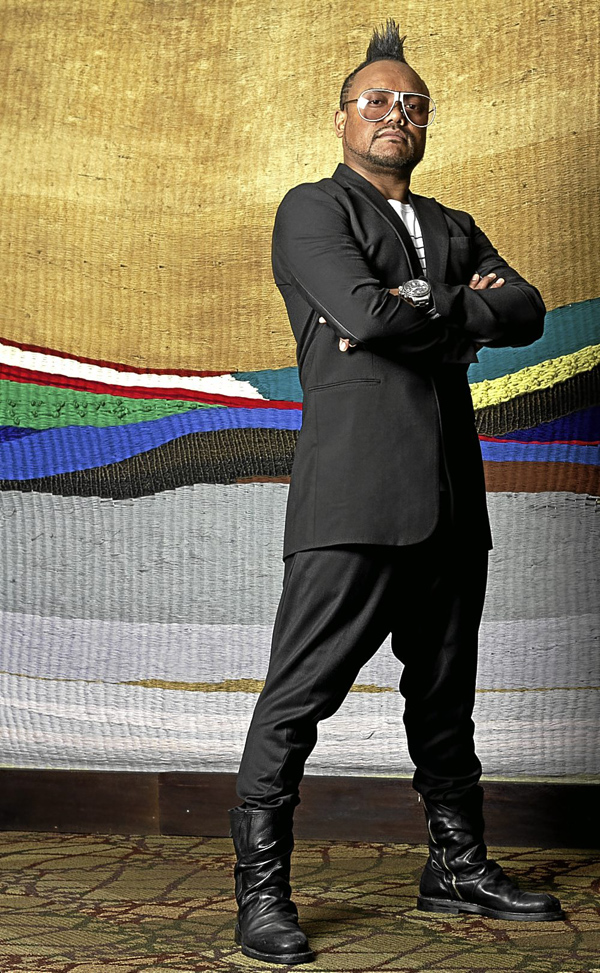
With his trademark Mohawk hairdo, and pimped out in an all black outfit and black, knee-high biker boots, Black Eyed Pea apl.de.ap a.k.a. Allan Pineda Lindo Jr. stands out in a sea of white barongs.

The cream of corporate Makati, mostly bank executives and their staff, have gathered together in a Legaspi Village penthouse ballroom to honor Apl who has been chosen one of the Bank of the Philippine Islands’ BPInoy awardees for 2011.

The annual accolade goes to Filipinos who have done their country proud in the international arena. apl has been chosen not only because of his membership in the Black Eyed Peas, a massive global pop franchise that has sold more than 56 million albums worldwide, but also because for the last few years, he has been coming home to the Philippines to give some of his blessings back to the land of his birth.

At first it was just an annual Christmas homecoming that saw apl giving out gift packages to the less fortunate residents of his hometown in Angeles City, Pampanga.



BIG APL: As BPInoy awardee (Inquirer Photo/Alanah Torralba)

The last couple of years, however, apl has made it more formal by establishing the apl.de.ap Foundation to serve as the vehicle for his humanitarian efforts.

Last August, he donated a computer lab and library to his old school, the Sapang Bato National High School in Pampanga. He also built a music studio at the Holy Angel University, also in Angeles City, where young Filipinos can hone their talents.

But apl has set his sights beyond his hometown: he plans to take his mission nationwide. In partnership with the Ninoy and Cory Aquino Foundation, which has appointed him a “special ambassador for education,” he has chosen to focus his efforts on an education advocacy campaign called “We Can Be Anything.”  It is a perfect fit for the man who once said: “dreaming big and doing something about it can get you really far.”

To help drive the message home, apl composed and recorded the single “We Can Be Anything,” complete with inspirational music video.

“I think that with an education, you can be anything,” he says.  “You could be a musician, you could be an artist, but with an education you always have a background to fall back on.  It’s really important for me to give the youth an equal opportunity. I want Filipino kids to compete around the world, with technology and computers and stuff.”



He plans to continue building more computer labs and music studios.

“I want talented kids that are into music to have an outlet, to have a place to go to and record demos, and practice,” says apl. “In the future I want to be able to discover talents from the Philippines, and that’s why it’s important for me to provide technology and music studios and library. You never know, I might find the next Black Eyed Peas.”

He has also pledged to help in building 10,000 new classrooms in the next two years, to help the Department of Education put a dent in the estimated shortfall of 68,000 classrooms throughout the country.  Among other things, he has been using his celebrity status to raise funds abroad for this purpose through various charities.

“I’ve also been talking to companies in the US like Google,” he says.  “There’s a Filipino team in Google who are planning to teach kids computer science and technology via the Internet.  Now that we’ve build these computer labs, we have to teach the teachers how to teach kids to work with these computers.”

Despite the Christmas rush, apl also took time out to visit calamity-stricken Cagayan de Oro, and to spend time in La Huerta, the underprivileged community in Parañaque where the video for “We Can Be Anything” was shot.

Like other celebrities who are driven to give back, he seems to be motivated by a deep sense of gratitude for the opportunities he has been given, and the realization that things could very easily have turned out differently.

Sapang Bato, where Allan Pineda Lindo Jr. was born on November 28, 1974, lies on the hilly outskirts of Angeles City, near Clark Air Base.  His biological father, a black American airman, abandoned the family right after Allan was born, leaving his mother Cristina Pineda to support him and six other siblings.



“We were poor, but my mom is like a superwoman—she’s just a great entrepreneur,” apl recalls.  “We used to have a store in front of the house, and she was great with turning money around.

Nevertheless, life was hard, and as the eldest, apl had to help feed the family from a young age.

“I remember when I was around 10 years old, I would go with my grandfather to the mountains to farm.

 Marunong akong magtanim ng mais, ng kamoteng kahoy (I know how to plant corn and cassava).  He taught me how to ride the kalabaw, and I know how to araro (to plough). And how to make charcoal.  I used to have to deliver the crops to the palengke at around 3 a.m.”

It was hard work, especially for a 10-year-old, but apl had imbibed the traditional Filipino family value that the eldest son had to share some of the responsibility for supporting the household.

“I used to like doing it,” he says.  “Being the panganay, I was just willing to help my grandpa and stuff.”

To make things even more difficult, he had been born with nystagmus, a condition that causes involuntary eye movements and which leads to impaired vision.  Although he was a good student, apl sometimes had to sit in front to be able to read the blackboard, or copy his seatmates’ notes.

“It was pretty hard, but I’ve learned how to adapt to my surroundings,” says apl, who is considered legally blind because of his affliction.  “When I was young I didn’t know how to control it, but since I’ve grown up I’ve learned to conquer it, I guess. It’s weird, sometimes I feel like I have selective sight, ’cause I’m very good at basketball, none of my friends can beat me in bowling, none of them can beat me in pool, I can break-dance, and pretty much do everything.  I just can’t drive.”

Being a “G.I. baby,” apl was eligible for assistance from the Pearl S. Buck Foundation, a US-based NGO founded by the author of “The Good Earth” and dedicated to helping Amerasian children.

Through the Pearl S. Buck Foundation, the young boy found a sponsor in Joe Ben Hudgens, a children’s rights attorney, who sent money for tuition and school supplies.  Eventually, his mother arranged for Hudgens to legally adopt her son.

apl had mixed feelings about being adopted: he was grateful for the opportunities that being in the US opened up for him, but he was also homesick and missed his family.

“When I first got adopted and brought to the US, I would write home, and sometimes I’d get my allowance and put it in the letter.  Sometimes it wouldn’t make it, so what I started doing was, every dollar I had I would write down the serial number in the letter, so at least if somebody took it, they would know that I tried to send some money back.”

Still, going from Angeles, Pampanga to Los Angeles, California was a culture shock for the 14-year-old boy.

“I remember when I first got to the US, there were a lot of gangs—Filipinos fighting other Filipinos.  It didn’t make sense to me.  I met a Filipino friend who used to dance, and he had a certain attire—long polo shirt, black pants and Vans, and I thought that was a dancer’s attire.  But when I tried to dress like him, I was chased home by other Filipinos.  I guess it was a gangster’s attire.

Music proved to be his salvation.  Back in Angeles, the year before he left for the States, he had gotten into break dancing after seeing youngsters at school doing the old school popping and locking moves.

“I didn’t come to the US to be a gangster, so I changed my whole attire and focused on break dancing and making music, and I became neutral with everybody.  I could hang out with the gangsters, I could hang out with the Fil-Ams, I could hang out with what they called the FOBs—fresh off the boat—because I was into music.  Music gave me that positive outlook instead of (me) getting caught up in gangs and fighting other Filipinos.  That wasn’t my purpose.  My purpose was to make it so I could help my family.”

apl also found a kindred spirit in future Black Eyed Pea William Adams, a.k.a. will.i.am—a nephew of his adoptive father’s roommate.

“My dad needed a babysitter for me, and Will’s uncle suggested Will’s mom Deborah.  They took me to Will’s house, and Deborah made Will stay home from school to hang out with the kid from the Philippines.

 He said, ‘So what do you guys do in the Philippines?’ and I said ‘I like to break-dance, I just learned this new move called the running man that I saw in a Pepsi commercial’ and he said ‘I dance too.’  We just started having conversations and the rest is history.  We became best friends.”

William lived in East LA, in the ghetto, and apl liked hanging out there, perhaps because it reminded him of home.  In any case, the pair got deeper and deeper into music, eventually forming a group called Tribal Nation, which later evolved into A Tribe Beyond A Nation or ATBAN.

“We would go to a lot of Filipino house parties in Glendale and West Covina and the Valley, and we would just start free-styling. From dancing we started rapping. And we wanted to learn, ‘where’s this music that we’re dancing to from,’ so we started researching that, and we got into producing and making beats and composing songs.”

Even in the eighth grade, apl already had that drive to make it.

“I made sure I surrounded myself with good friends, with the same values.  My whole purpose in being adopted and going to the US was for my family, so I never strayed from that.  I gotta make it.  I gotta pursue my dreams and be able to go back home to help my family—that was always in the back of my mind whatever I went through.”

It was a struggle, specially in the early days when hip hop was dominated by gangster rap and the whole East Coast vs. West Coast rivalry. Music business types didn’t know what to make of the multicultural stew that would become the Black Eyed Peas.

“I was influenced by groups like A Tribe Called Quest, De la Soul, the Jungle Brothers, Boogie Down Productions.  I gravitated more toward the old school and break dancing, and that’s really influenced how we wrote, because the way they made music was more for fun instead of killing and slapping girls, and ‘I got all this money.’  It was more about the art and the movement of hip hop and that’s why I think our music was positive. We didn’t have it in us to be gangsters.”

In a sea of bitch this and ‘ho that, apl’s music was actually a breath of fresh air.  But it would take time for the industry to catch up.

“It didn’t come overnight,” he recalls.  “It was hard to get signed by a record company because we weren’t gangsters and we were so different.  We had to prove ourselves—we would play at clubs, colleges, and what we would do was we would have a notebook with a mailing list, and we would call these people for the next show.  We had to actually create a following, and prove to the record companies that there is a market for that kind of music.  We would do shows for 5,000 people, and we had to prove to the record labels that there is room for eclectic and more progressive type of music.”

Finally, apl and Adams got themselves signed in 1992.  Three years later, after Jaime Gomez a.k.a. Taboo joined, they changed their name to the Black Eyed Pods, and then the Black Eyed Peas.  Their first two albums—“Behind the Front” (1998) and “Bridging the Gap” (2000) garnered critical acclaim, but after Stacy Ferguson a.k.a. Fergie joined in 2003, and the band released their third album “Elephunk,” critical mass was finally achieved, and the multi-platinum pop phenomenon that we know today as the Black Eyed Peas assumed its present form.

But apl’s elation at his band’s finally achieving success after years of struggle was tinged with personal tragedy.  Back home in Sapang Bato, his troubled brother Arnel had taken his own life.

“That was a dark period in my life,” he recalls.  “He had certain personal vices, and he suffered from depression.  I’m pretty sure he felt bad inside and couldn’t take it anymore.  I felt like if I had been there as a big brother, I could have stopped him.  Sometimes life just gets you down, and I wish he had somebody to run to.

These mixed emotions inspired apl to write what eventually became “The Apl Song” on “Elephunk.”

“I was in the studio experimenting with sampling, and I remembered that my mom used to listen to Asin all the time,” he says.  “That was the same time when my brother passed away, and I wanted to dedicate a song to him, and also tell my life story, and that chorus from [the] Asin [song ‘Balita’] just really touched how I was feeling, and I just kind of did it.  Will came over to the studio and I played it for him, and he said ‘That’s pretty dope, you should put that in the album yo.’  Really? But it’s in Tagalog—people wouldn’t understand.  But he said, it’s not about understanding it, it’s about the feeling.  You’re sharing your musical culture.”

The band’s wholehearted support strengthened apl’s inclinations to represent where he was from in his music.  While it wasn’t the worldwide hit that “Where Is The Love” was, “The Apl Song” endeared the Black Eyed Peas even more to their Filipino fans, and even gave the reunited Asin a boost for a time.

Even as the Black Eyed Peas’ star continued to rise, tragedy continued to dog apl.  In 2009, he lost another brother, Joven, this time to murder.

All of this darkness in his personal life only seemed to underscore how blessed Pineda has been, and has only strengthened his desire to share the fruits of his success with his countrymen.  Now that the Black Eyed Peas are on a hiatus, apl’s advocacy work has gone to the forefront.

“I’m going to focus on ‘We Can Be Anything,’” he reiterates.  “We’ve got two years to build 10,000 classrooms and I’m going to focus on that.  I’m also going to build my next computer lab from the apl Foundation.”

Also in the works is apl’s long-awaited solo project.

“It’s going to be more personal,” he says.  “I’m gonna try to write more Tagalog songs.   I’m Kapampangan so I wanna write a Kapampangan song in there. I like a lot of different music genres from dance music to drum and bass, so I’m going to mix it all up.

The solo project will likely reveal more of Apl’s Filipino roots

“I’m still into the classics. I love listening to Asin, Freddie Aguilar, Florante.  I like Gloc 9—big fan.  Also Bamboo, Slapshock.  Oh and I’ve just been researching Tito, Vic and Joey’s old stuff, all their dance disco stuff with VST and Co. I want to collaborate with them. I want to remix their song—I think it’s called ‘Magsayawan Tayo.’”

When he’s not performing with the Black Eyed Peas, apl is also a much-sought after DJ.

“My DJ career is getting bigger now,” he says.  “I’m apl.de.ap a.k.a. the Party Man.  I like to DJ around the world and play at festivals. I like going out to clubs and experiencing new types of music.  I think that’s how you stay fresh and how you can be current on what’s going on in the music world.”

But for all his globe-trotting, home for apl will always be here.

“I’m made in the Philippines all the way,” he says proudly.  “I grew up here until I was 14, and I could never change that.  It’s just a certain feeling.  When I’m here I feel at home.”

Monday, January 16, 2012

...the global shapers


9 Pinoys chosen Global Shapers
 By Helen Flores
The Philippine Star
January 16, 2012


MANILA, Philippines - Nine outstanding young Filipinos were chosen as among the 2012 “Young Global Shapers” of the World Economic Forum (WEF).

The young achievers are Anna Rosario Oposa, Mayor Maria Carmela Alvarez of San Vicente in Palawan, Ponce Ernest Samaniego, Jay Michael Jaboneta, Dr. Bryan Albert Lim, Eleanor Rosa Pinugu, Mildred Ople, television host Bianca Gonzalez, and Alexandra Amanda Eduque.

“The Young Global Shapers are exceptional achievers who initiated projects that have positive impact in the community,” said ABS-CBN news anchor Karen Davila, WEF Young Global Leader 2010 and Founding Curator for the YGS Manila Hub.

The nine individuals – whose ages range from 20 to 30 - have been accepted by the WEF as potential leaders because of their positive impact in their communities, said Davila.

Oposa, 23, co-founded the Save Philippine Seas movement to protect the world’s richest marine life, and “Isko Cleans UP,” a waste management program in the University of the Philippines-Diliman. She is the daughter of Ramon Magsaysay awardee, environmentalist lawyer Tony Oposa.

Alvarez, 24, the youngest female mayor of San Vicente, has a degree in International Business Administration with a concentration in Environmental Technology and Global Marketing Management from Babson College in Boston. She aims to transform the town into a tourist destination municipality using sustainable development technology to preserve its natural environment and help residents become self-reliant in terms of its present and future needs.

Samaniego, 21, is co-founder and chief executive officer of Outliers, a social enterprise that serves as an outsourced business expertise for non-profit organizations.

Jaboneta, 30, founded the movement Philippine Funds for Little Kids that helps schoolchildren in Zamboanga City who had to swim to go to school.  He was the first and former New Media Head of the Presidential Communications Operations Office under President Aquino. He is also a board member of the Kabayanihan Foundation and Team Pinoy, Inc.

Lim is a practicing physician in San Pablo, Laguna. He is a program consultant of the Asian Institute of Management Zuellig Center for Asian Business Transformation, a research associate of the UP Universal Health Care Study Group, and the proponent of the Quisumbing-Escandor Film Festival for Health and serves as adviser in various health-related projects.

Pinugu is the founder of Mano Amiga Academy, Inc, a non-profit school that provides underprivileged Filipino children access to fourteen years of high quality education (K-12th grade), and all other support they need to have a better life. After two years of raising funds for the students’ scholarships through private donations and corporate partnerships, she decided to establish a social enterprise that would generate a steady income for Mano Amiga, and at the same time give employment opportunities to the mothers of the students.

Ople, 25, is an advocate of countryside development through the adoption of innovative agricultural technology with profitable business concepts and ideas. She is also one of the founders of the Hagonoy Young Leaders Program and has worked with the Ayala Foundation on youth leadership and development projects. She is currently taking up law.

Gonzalez was recently appointed as Special Advocate for Children for the United Nations Children’s Fund-Philippines.

Eduque, 21, is involved with various humanitarian projects and endeavors in partnership with Habitat for Humanity Philippines. She has been working with the organization for about seven years now, and is the founder and chairperson of the Habitat for Humanity Philippines Youth Council.

Davila said of the nine achievers, only Oposa, Pinugu and Alvarez were invited by the WEF to the 2012 conference in Davos, Switzerland next week.

The WEF is a Geneva-based non-profit organization best known for its annual meeting in Davos. It is an independent international organization committed to improving the state of the world by engaging business, political, academic and other leaders of society to shape global, regional and industry agendas.

The organization launched last year the Global Shapers community aimed at providing the youth with a global platform to shape the future – integrating personal, community and global dimensions. This community will help youth develop their leadership potential to serve society.

The Global Shapers community includes extraordinary young individuals with great potential for future leadership roles in society. Aged between 20 and 30 years, they represent all walks of life and share a spirit of entrepreneurship in the global public interest, the WEF said.