Showing posts with label Leyte. Show all posts

Friday, April 25, 2014

...the Filipino strength


Down but not out... the stoical people of storm-hit Philippines

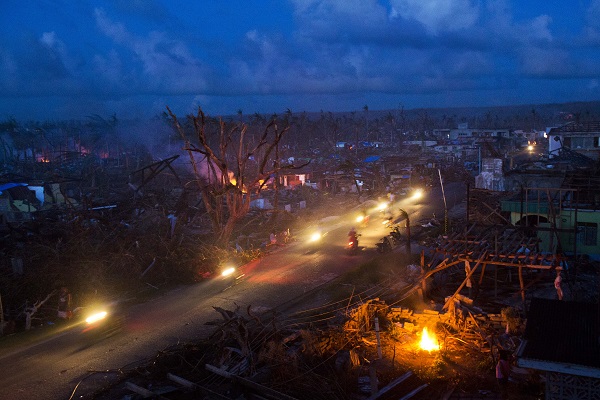
When Typhoon Haiyan struck the Philippines six months ago the images shocked the world and inspired a huge international aid effort.
Award-winning Belfast photographer Matt Mackey visited the area with Concern Worldwide shortly after the islands were devastated.
His pictures are now part of a major exhibition in Belfast's Waterfront Hall, capturing the moving stories of individuals whose lives were forever changed by the storm.
"The idea was to show the people of Northern Ireland where their money goes when they support humanitarian organisations such as Concern through their emergency appeals," said Matt (right).
"It constantly evolves in front of you as you talk to local people and find out their personal stories. That's how the pictures develop."
Matt visited three islands on his trip, taking over 15,000 photographs. He also spent time in Concepcion, where Concern is based.
He then faced the difficult task of trying to choose just 24 for the exhibition entitled: Faces Of The Philippines: 7,000 Islands, 1 Typhoon, 4 Lives.
Concern is still helping those whose lives were ripped apart when the typhoon struck and has so far reached over 110,000 people.
Peter Anderson, Northern Ireland director of Concern, said the exhibition is a testament to the people of the Philippines, who showed incredible resilience and determination to rebuild their lives.

Thursday, February 27, 2014

...the Pinay behind Malaysia's jingle

Voice behind Malaysia’s tourism jingle is Pinay

  
Kuala Lumpur – Many Pinoys can recognize the tune of the tourism jingle – Malaysia, Truly Asia – played many times on cable television. But not many know that the voice behind it is a Filipina singer who has become a Malaysian citizen. And fewer people know that she is one of the many Filipinos abroad who had led fund-raising campaigns to help the victims of super-typhoon “Yolanda.”


She is Maria Jazsmine, who remains a Filipino at heart. After leading a fund-raising campaign for the victims, she is now planning to establish a library for the children of Tacloban, one of the hardest hit areas.

“I’ve always said that we must not forget about the Philippines. We are still in the period of recovery,” Maria said in a media interview in Kuala Lumpur.

Raising Funds

“I’m in the midst of collaborating with many kind-hearted people who want to raise more funds for typhoon Haiyan. And I am so blessed to meet them after I spearheaded the ‘Artists United for Typhoon Haiyan’. I think we have raised more than a million for Tacloban,” the singer said.

Starting A Library

“Hopefully I would get the support of the government, or the private sector, or an NGOs to start a library in Tacloban. There are people who are willing to reach out and do more for our country,” she added.

While she appreciates the outpouring of aid to typhoon-hit Philippines, Maria Jazsmine pushed for the healing of the communities “as best as we can.” She admitted that one of her advocacies is protecting the welfare of orphan children.

Malaysia Tourism’s Voice

Maria Jazsmine put a voice to “Malaysia, Truly Asia” as part of the worldwide marketing campaign of Malaysia in 1999. Recently, she put a voice to “Heart of Blue,” another tourism campaign of the Malaysia Tourism Board.


Maria Jazsmine admitted that she is “flattered and honored” to sing the Malaysian tourism song that has been widely featured on CNN.

She recalled that she sang “Malaysia, Truly Asia” from the heart since Malaysia is home to different people and cultures.

“I really love Malaysia because they’ve been really good to me,” she said.

“I was easy to relate and to give the feeling of how Malaysia can really be ‘Truly Asia’. It’s multi-cultural, different religions, so it’s so colorful. I have to bring that out in my voice,” she added.

To date, Malaysia continues to use the popular jingle and its other versions to attract tourists.

Humility

Maria Jazsmine, also a ballet dancer, also revealed that she has been able to easily adjust to life in Malaysia mainly due to humility and an understanding of other people’s culture.

“I always believe that service starts with humility. When you humble yourself and just be true to yourself, the doors will open,” she said. “If you want to have peace, you just have to understand and tolerate,” she added.

Saturday, November 23, 2013

...the PH best Islands

The Philippines: a guide to the best islands


Six of the country's 7,000-plus islands were devastated by Typhoon Haiyan; many of the others badly need tourists to return. Local writer Aya Lowe picks the best places to go.
 
 
Aya Lowe
theguardian.com (United Kingdom)              


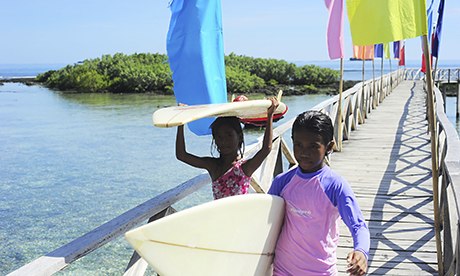
Young surfers at Cloud Nine surf point, Siargao, Philippines
Two young surfers carrying boards at Cloud Nine surf point, Siargao. Photograph: Alamy
 
For a country with thousands of idyllic islands, plus world-class surfing and diving, the Philippines is a relatively undiscovered travel destination. Tourism is crucial to the country's economy, accounting for eight per cent of its GDP, but compare the UK visitor numbers – 120,000 in 2012 – to those of Thailand (800,000 per year) and you get some idea of just how off the radar this vast archipelago is.

This month, of course, the country is firmly on the world's radar – for all the wrong reasons. Typhoon Haiyan caused wide spread destruction across the provinces of Leyte and eastern Samar on the mid-eastern side of the Philippines and some parts of Palawan and Cebu on the mid-western side. But while the areas in the path of the typhoon were devastated, much of the country was not damaged.

The storm caused havoc on six of the country's 7,107 islands, so most resorts and tourists activities are open and fully functional, and those that were hit are quickly getting back on their feet in the run up to December and January, two of their busiest months of the year.

The tourist board and tour operators are reassuring visitors that the country is not only safe, but in desperate need of visitors to bring a vital boost to the economy. Those who go will receive a very warm welcome. So, how do you choose which of those 7,000-plus islands to visit? Here's our guide to 10 islands, each offering something different.

1. Chill out in El Nido, Palawan
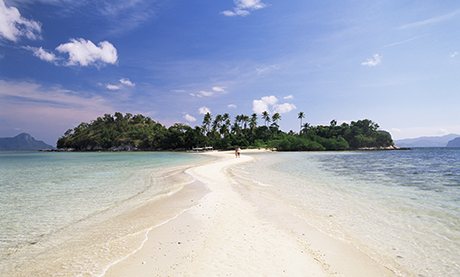
Bacuit Bay, Palawan, Philippines Bacuit Bay, Palawan, Philippines. Photograph: Alamy
 
This jungle beach town on the northern tip of Palawan hasn't changed much since before Spanish colonisation and has been cited as Alex Garland's The Beach. Explore the many islets of the nearby Bacuit archipelago on a boat-hopping tour, where the water so clear you can see the fish darting in between coral at 15 metres deep. Prices range from around £17-£20 per day for a tour and that usually includes lunch. There is grilled seafood is in abundance across the island.

Palawan was one of the islands in the path of Typhoon Haiyan, however it was only the city of Coron and the nearby island communities that were hit. El Nido has not suffered any damage and the surrounding coral reefs are intact, with only very shallow ones sustaining damage.

Where to stay: For beachfront living, Rainforest Beach Hotel offers rooms from £31 per night in high season. For a high-quality budget option, try Residencia Katrina , five minutes from the beach (from £21 per night).

How to get there: Local airlines fly directly to Palawan's capital, Puerto Princesa. From the city's main bus terminal, you can take a seven-hour Roll-On Roll-Off (RORO) bus to El Nido for £7, one way.

2. Shake your tail feather in Boracay
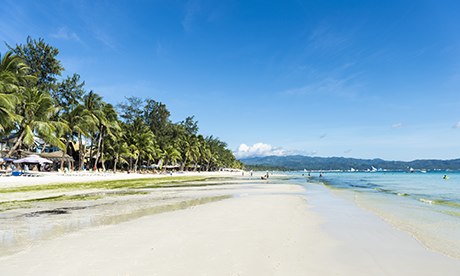
White Beach, Boracay, Philippines White Beach, Boracay Island, is often voted the best beach in Asia. Photograph: John Harper/Corbis


With endless beaches of powdery-white sand, long happy hours, abundance of restaurants and hotels to suit all budgets, and plenty of watersports, Boracay is the party island.

It has 12 beaches, the most popular being White beach and Bulabog. The island is divided up into "boat stations", which are used a reference points. Station One in the north is known for its high-end resorts and tranquillity; station two is the liveliest part, and station three is where all the budget accommodation can be found. While many locals look back longingly at good old days in the 70s before the hotels and restaurants started springing up, Boracay is still a Phuket in its infancy.

There was some storm damage to the island. Electricity still remains a problem for many parts of the island, but most hotels are up and running with generators.

Where to stay: Frendz Resort Boracay has one of the best beach locations out of all the midrange options (£50 for a beachside bungalow, sleeping four). Nigi Nigi Nu Noos has Balinese-style bamboo cottages furnished with handicrafts and wooden sculptures. Rooms are £70 per night.

How to get there: You can fly via Kalibo and then take a two-hour bus ride for £4, then a 15-minute ferry.

3. See a UNESCO World Heritage sight in Banaue, North Luzon

Rice terraces, northern Luzon, Philippines Amazing two thousand year old rice terraces, Banaue, northern Luzon. Photograph: Alamy
 
North Luzon, the biggest island of the Philippines, is a land of misty mountains, where pines replace palm trees. Head to Banaue and Batad to admire the 2,000-year-old rice terraces etched along plunging ravines. The 20,000km UNESCO-listed terraces still provide a livelihood for the various tribal groups that continue to live in relative isolation in the mountains. Treks along the rice terraces to various villages and waterfalls can be organised through the Banaue Tourist Information Center. Expect to pay around £10 for a guide for a whole day.

Where to stay: If you want to wake up to a view of the famous rice terraces, head to Batad, where a number of low-cost, basic guest houses line the mountains. Try Ramon's Homestay, where the owners are a great source of information about the local culture. It's £2.80 for a regular room or £3.50 to stay in a traditional Ifugao (local tribe) hut.

How to get there: North Luzon is best reached by bus, but be prepared for a long journey. Buses leave regularly from Manila and take nine hours to get to Banaue, costing £7.

4. See the curious in Bohol

Chocolate Hills Natural, Bohol, Philippines
Asia
Chocolate Hills, Bohol Island. Photograph: Per-Andre Hoffman/Alamy
 
Located just off Cebu, Bohol's most famous attraction is the surreal Chocolate Hills: over 1,500 mounds formed by coral deposits sculpted by a millennia of erosion. Depending on the season, they will either be green or brown. The island's famous resident is the camera-shy tarsier, the world's smallest monkey. Visit them in their protected enclosure at the Philippines Tarsier Foundation. Don't visit them in the cages kept along the river; they are mistreated and don't live long there. Either hire a motorbike or book a tour from a local company, such as Bohol Travel Tours, for around £35 with car, guide and lunch.

In October this year, the island suffered from a 7.2-magnitude earthquake, destroying many houses. Two weeks afterwards, Bohol was back on its feet, bringing in tourists as normal. The island was also hit by Typhoon Haiyan, but sustained little damage to its infrastructure. Tour operators and hotels remain fully open. The main issue being tackled by the island's authority is limited power supply, which is slowly but surely getting fixed.

Where to stay:Alumbung Bohol is a comfortable resort of beachside bungalows on popular Panglao island (from £20 per night). For something different head to Bohol Bee Farm , an organic vegetable and bee farm with rooms on Panglao, from £28 to £70 per person.

How to get there: Local airlines, including Cebu Pacific, fly to Tagbilaran airport from Manila, or you can catch a two-hour ferry from Cebu to Bohol (£7, one way).

5. Go surfing in Siargao

Facing the Pacific Ocean, just north of the island of Mindanao, is Siargao, one of the Philippines' surf centres. The town sees a steady stream of dedicated surfers who arrive to challenge themselves on the island's famous Cloud 9 reef break. The small beachside town hosts a number of international surfing competition, which make it a busy during surf season, but completely dead when the waves are down.

Novices can hire trainers, who you can find on the beach, for around £7 per hour, or you can book a package from a surf hotel, such as Kermit Surf Resort , which has a package for £394 per person per week, including accommodation, transfers and one-to-one surf lessons.

Where to stay: The no-frills, £5-a-night Bamboo Garden is popular among backpackers. Surfers tend to stay in Kermit Surf Resort (bungalows are £11 per night).

How to get there: There are direct flights to Siargao Island. Siargao airport is 45 minutes away from General Luna, the location of the popular Cloud 9 beach.

6. Get off the beaten track in Camiguin Island

Camiguin Island, Philippines Camiguin Island, Philippines. Photograph: Stuart Dee/Getty Images
 
This pear-shaped volcanic island, just off the northern tip of Mindanao, is often bypassed because of various Islamist uprisings that have been reported on Mindanoa. However, Camiguin itself has never had any incidents and those who make the effort to travel there are rewarded with an island barely touched by tourism. For such a small landmass, this tiny island packs quite a punch, its 29,187 hectares including seven volcanoes. It also offers good diving through an eerie sunken cemetery, waterfalls, a lagoon, and hot and cold springs. All of these can be reached easily by foot, or hire a motorbike (£11 a day with a driver,£7 without).

Where to stay: If you want to splurge, go to Bahay Bakasyunan sa Camiguin for £50 per night. If you are on a budget, try the Enigmata Tree House homestay at £15 per night (minimum of two people).

How to get there: The easiest way is to book a flight from Cebu, via Cebu Pacific Air, then take an 11-hour ferry to the island for (£2.30).

7. Go witch hunting in Siguijor

Cambugahay Falls, Siquijor, Philippines Cambugahay Falls, Siquijor. Photograph: Deddeda/Design Pics/Corbis

The magical Siquijor is both feared and revered by locals. It's the place to go, if you're looking for a boroboro, or witch doctor. The Provincial Tourism Department has a list of "official healers", or just ask any local and they'll be able to point you in the right direction. You'll need to rent a tricycle (a local motor taxi) for around £14 for half a day, as most of the healers live high in the mountains.

These witch doctors or healers welcome paying visitors – but be polite and respectful as it is an age-old tradition that is widely believed by locals. Away from all the magic, it's also a beautiful island for relaxing, snorkelling and diving.

Where to stay: Beachside bungalows at Coco Grove Beach Resort cost £19 per person.
How to get there: There are no direct flights. Fly to Dumaguete city, then take an hour-long ferry to Siquijor (£1.60).

8. Explore the misty mountains of Batanes
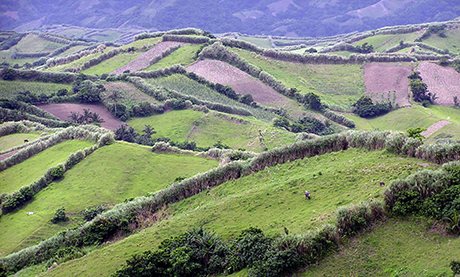
Batanes hills, Philippines Batanes, Philippines. Photograph: Ferdz Decena/Getty Images/Flickr RF

The Batanes Islands are found on the very northern tip of the Philippines archipelago, a land of gently sloping hills, thatched roof houses and locals who wear traditional straw hats. With weather reminiscent of drizzly British summers, locals visit the islands for some respite from the tropical heat, while tourists travel here for a completely different island experience from the rest of the Philippines. To get around, rent a bicycle or book a tour with a company, such as Batanes Travel and Tours , which charges £211 for a three-day trip including accommodation, transport and guide.

Where to stay: Batanes Resort offers comfortable, air-conditioned cottages for £25 per night.
How to get there: There are direct flights from Manila to Batanes, but being at the very tip of the country it's one of the more expensive islands to reach. Flights are often cancelled during bad weather.

9. Go diving in Mindoro
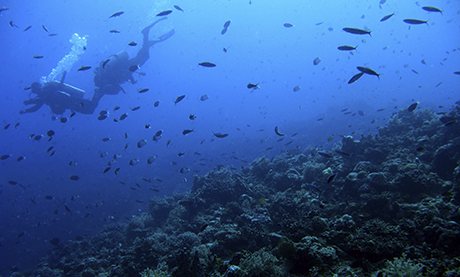
Apo Reef, Philippines Filipino divers swimming at the Apo Reef. Photograph: Dennis M Sabangan/EPA

Good dives spots are a dime a dozen in the Philippines, but the best scuba spots can be a bit harder to reach. Apo Reef is one of them. A mostly sunken atoll, two hours off the west coast of Mindoro, the 40 sq km reef is famous among the diving community for its abundance of larger creatures, such as sharks, rays and sea turtles. Most divers stay on Pandan Island (a 20-minute boat ride from Mindoro) and, from there, access the reef via a three-hour boat ride. Apo Reef Club is one of the closest dive operators to the reef. A package of five dives, including two night's accommodation and transfers, is £212.

Where to stay: As well as dive trips, Apo Reef Club offers clean, simple accommodation . Prices range from £10 to £46 per room.

How to get there: Domestic flights go from Manila to San Jose in Mindoro. Once you get on the island, head to Sablayan port (near the town market) and get a 30-minute boat ride to Pandan island (£7, one way).

10. Go hiking in Davao, Mindanao
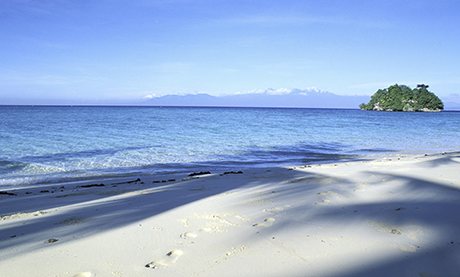
Mindanao island, Philippines Mindanao island, with Mount Apo in the background. Photograph: Alamy

Davao is the biggest city on the island of Mindanao, an area that is scarce of tourists due to the aforementioned Islamist insurgencies. Davao City is widely regarded as a safe haven on the island and has been ranked as one best places to live in the country. This is where the world's smelliest fruit, the Durian, originates from. It is also home to the rare Philippine eagle (pay a visit to the Philippine Eagle Centre for an educational tour).

But the island's crown jewel is the country's tallest peak and semi-active volcano, Mount Apo. A 2,956-metre climb to the top will take you through the full spectrum of Filipino biodiversity, from steamy jungle to pine forests, and belching sulphuric vents. Join a group tour with Climb Mt Apo for £56 per person. If you go independently you will need a permit from the city hall in Santa Cruz, an hour south of Davao (contact Julius Paner, +63 2 441 1467). The permit costs £4 per person. You can then hire a freelance guide and/or porter at a rate of £4 per day for the porter and £7 per day for the guide. The permit office will be able to put you in touch with a certified porter and guide.

Where to stay: Green Windows hostel in the city centre offers clean and spacious dorm beds for £2.60 per night. A smarter option is Casa Leticia, £40 per night.

How to get there: Davao is a 1.5hr flight from Manila and there are at least six flights servicing the city on a daily basis.

Getting to the Philippines: Philippine Airlines flies to Manila five times a week from Heathrow. Once in Manila, the cost of domestic flights to get to the different islands can vary depending on what time of year you are flying and where. Local airlines such as Cebu Pacific, Air Asia and Tiger Airways offer seat sales throughout the year, where you can often bag return flights for around £50. Outside of the sales, expect to payaround £100 return.


Friday, November 15, 2013

...the Filipino Spirit

Filipino diaspora rallies after Typhoon Haiyan

From Hong Kong to Dubai, pastors, teachers and consular officials describe an unprecedented outpouring of support from a diaspora that even in normal times is renowned for sending large amounts of money home to family and friends.

“Everyone is mobilising, everyone is raising funds for organisations and churches,” says Joyce Demetillo, a pastor at the Jesus is Lord church in Hong Kong.

Verna Fajilan, a former ballerina at Ballet Philippines who teaches dance in Hong Kong, says that while the Filipino “spirit for helping . . . is instinctive”, Haiyan has sparked an altogether different level of response from expatriates.

“Because of the enormity of the typhoon, there are more people now who want to mobilise the relief efforts,” says Ms Fajilan, who is organising charity zumba dance classes to raise money.
The Philippines foreign ministry says there are more than 10m Filipinos overseas who, according to the central bank, sent $21bn home in 2012.

Rosanna Villamor, the Philippines deputy consul-general in Hong Kong where there are 180,000 Filipinos, says she has been amazed by the “sheer number of people who have come forward with a number of fundraising events”. She adds that one difference from previous disasters is that people are sending the consulate names of relatives and loved ones that they cannot locate.
 
Daisy Mandap, editor of the Sun, a newspaper for Filipinos in Hong Kong, says this Sunday – the day most of the city’s 163,000 domestic helpers have a day off – will see a big response, as Filipinos arrange fundraising events across the territory.
 
Similar events are happening across the world, including in the United Arab Emirates, home to 500,000 Filipinos, most of whom live in the business hub of Dubai. They are the second most dense concentration of migrants in the oil-rich Gulf after Saudi Arabia, where an estimated 1.2m work.

Get Flash Player
 
 
Wendell Castro, chairman of Task Force Yolanda – as Haiyan is known in the Philippines – in Dubai, is leading one of dozens of campaigns launched by about 100 Philippine community associations in the UAE. They have set up collection points for food, clothing, medicine and blankets, and are hoping to organise musical and prayer gatherings once they receive official approval.

“We are targeting about $200,000-$300,000 in donations,” Mr Castro says.

Filipinos from the affected areas have also spent the past week scouring the internet and awaiting phone calls for news about their families.

Jessa, a 26-year-old receptionist, has social media to thank for the end to six torturous days of uncertainty after her home town of Isabel in Leyte province was devastated, reduced to “only five homes”, she says.

I’d been looking at Facebook 24/7 and I recognised the landscape. So I sent a comment – ‘Please help me’ – and they gave me a number of a neighbour who went to my mother - Jessa, receptionist
 
Some residents of the town of about 45,000 people managed to bring a generator from a nearby island to charge mobile phones. They scaled a nearby hill to get a signal and posted pictures online.
“I’d been looking at Facebook 24/7, waiting for something, and I recognised the landscape,” says Jessa. “So I sent a comment – ‘Please help me’ – and they gave me a number of a neighbour who went to my mother.”

Thousands of kilometres away in New York, Elmer Villaluz, 66, treasurer at San Lorenzo Ruiz Chapel – the city’s main Filipino church whose masses have been bustling – says that parishioners and the local community have come together to donate cash and clothes to the Red Cross.

“Filipinos are very religious . . . but they’re asking why did this happen to them?” Mr Villaluz says. “We are thankful because the global community is giving us aid.”

Frank Cimafranca, the Philippines consul-general in Dubai, says the consulate is “trying to raise awareness” by directing donations to government bodies and non-government organisations that are taking donations. While many Filipinos may want to return home to help, he says that in most cases, it is not possible.

Some people will return to the Philippines because they worry for their loved ones, but most will stay for practical reasons – there is nothing more they can do and it is better to send money - Frank Cimafranca, Philippines consul-general in Dubai
 
“Some people will return to the Philippines because they worry for their loved ones, but most will stay for practical reasons – there is nothing more they can do and it is better to send money,” he says
But some people have decided that staying away is too hard. Patrizia Villamore, a domestic helper who has lived in Hong Kong for two decades, flew to Manila and then made her way to Cebu where she met up with her husband Brian Delima, a construction worker in Saudi Arabia, who had also flown home after the typhoon.

Speaking by phone from Cebu, the couple said that after they arrived in the Philippines they learned that his uncle had died. Mr Delima says his uncle survived the typhoon only to die several days later from the cold. Ms Villamore explains that the scale of the disaster made it impossible for them not to return home.

“It is a very different feeling. We want to see our families – are they alive or not.”
Additional reporting by Camilla Hall in New York


...the PH fundamentals

Moody’s says PH fundamentals intact

Impact of ‘Yolanda’ on country’s economy said to be limited

By Paolo G. Montecillo
Philippine Daily Inquirer
Supertyphoon “Yolanda” (Haiyan) survivors ride motorbikes through the ruins of the destroyed town of Guiuan, Philippine, on Thursday, Nov. 14, 2013. Yolanda killed thousands and caused billions of pesos in damage, but international rating agency Moody’s Investor Service said the Philippines’ economic fundamentals remained intact. AP Photo/David Guttenfelder, File)

Supertyphoon “Yolanda” killed thousands and caused billions of pesos in damage, but a major international rating agency said the Philippines’ economic fundamentals remained intact.

Moody’s Investor Service in a report this week said Supertyphoon Yolanda may be the worst calamity to hit Southeast Asia in nearly a decade, rivaled in scale only by the 2004 Indian Ocean tsunami that struck Indonesia.

However, while the loss in human lives was overwhelming, the overall effect on the real economy was likely to be muted.

“The 2004 Indian Ocean tsunami that struck Indonesia could be most similar to Typhoon Yolanda (international name: Haiyan) in terms of the scale of devastation, but it, too, had a limited effect on overall economic conditions,” Moody’s said.

Moody’s said the local economies of Leyte and other provinces in the Visayas hit hard by Yolanda last week would take the brunt of the impact.

The damage to road infrastructure, power lines, communications systems, and farmlands would likely lead to a steep drop in output.

Moody’s noted that, as of Wednesday morning, the National Disaster Risk Reduction and Management Council’s running count of casualties showed 1,833 deaths.

The rating firm, which upgraded the Philippines to “investment grade” last October, cited the government’s own initial estimate that the damage brought by Yolanda would shave just half a percentage point off the country’s estimated growth for 2013.

“The relatively small hit to growth reflects the small contribution of Region VIII to the country’s economic output,” Moody’s said.

In 2012, Region VIII accounted for only 2.2 percent of the Philippines’ gross domestic product (GDP), down from 2.7 percent in 2009.

In the same year, Region VIII’s real gross regional domestic product (GRDP) contracted by 6.2 percent and subtracted 0.2 percentage points from the country’s 6.8 percent growth rate.

The most important regions in terms of their contribution to Philippine GDP, Moody’s said, were Metro Manila and the Southern Tagalog region, which together constituted 53 percent of GDP in 2012.

Fortunately, these areas were unaffected by Yolanda.

Moody’s expects the Philippine economy to grow by 7 percent this year, matching the top end of the government’s official forecast.

The asset quality of rated Philippine banks will also be minimally affected.

As of the end of 2012, loans to Region VIII constituted only 0.4 percent of total system loans.

Moody’s also expressed confidence that the Philippine government would be able to adequately finance out of its own coffers the reconstruction in typhoon-affected areas.

The government registered a primary surplus of P156.9 billion through the first three quarters of this year, 12.7 percent more than the balance in the same period in 2012.

In its annual budget, the government had provisioned P7.5 billion in a calamity fund, as well as embedded P3.9 billion in quick response funds in budgets for different line agencies, “although some of these funds had already been spent to address earlier disasters,” Moody’s said.

“President Aquino also has discretionary funds available at his disposal. In addition, assistance from the international community will mitigate stresses on the government’s fiscal position.”


Thursday, July 11, 2013

...the idea of internet

PHL the 'birthplace' of the internet?


July 11, 2013


The Philippines may have played a much more important role with regard to the Internet as we know it today other than being a mere .ph suffix in a Web address.
Douglas Engelbart, who died earlier this year, invented the mouse and devised an online setup to remotely fetch information—after he read an article in the Philippines.
Engelbart was a Navy technician when he read a 1945 article published at The Atlantic, "As We May Think," by mid-century science icon Vannevar Bush, The Atlantic reported.
Bush's essay had described the Memex, an information-retrieval system, where every "book, record, or communication" was microfilmed and catalogued.
The essay was published in LIFE magazine, a copy of which ended up in a Red Cross library in —guess where—Leyte.
Idea born in Leyte
Engelbart, then a Navy radar technician, never saw combat in World War II, as the war ended just as his boat left San Francisco Bay on its way to the Philippines.
It was in Leyte that Engelbart "stumbled across a Red Cross reading library in a native hut set on stilts, complete with thatched roof and plentiful bamboo," The Atlantic said.
"The ideas in the story plowed new intellectual terrain for Engelbart, and the seeds that he planted and nurtured there over the next twenty years grew, with the help of millions of others, into the Internet you see today," it added.
Engelbart eventually wrote Bush a letter describing how profoundly Bush's work affected him.
"I might add that this article of yours has probably influenced me quite basically. I remember finding it and avidly reading it in a Red Cross library on the edge of the jungle on Leyte, one of the Philippine Islands, in the fall of 1945," he wrote.
"I rediscovered your article about three years ago, and was rather startled to realized how much I had aligned my sights along the vector you had described. I wouldn't be surprised at all if the reading of this article sixteen and a half years ago hadn't had a real influence on my thoughts and actions," he added.
Obits
Engelbart had been lauded by the Los Angeles Times' obituary as the one whose work "inspired generations of scientists, demonstrated in the 1960s what could happen when computers talk to one another."
For his part, Apple co-founder Steve Wozniak credited Engelbart's 1960s research "for everything we have in the way computers work today."
"So, in one tangible and real sense, the Internet we know now began in that hut across the world. As Bush made new thoughts possible for Engelbart, Engelbart made it possible for us to imagine the rest of it," The Atlantic said. — VC, GMA News


Monday, February 25, 2013

...the beauty queen's purpose

Dutch-Pinay beauty queen eager to help poor kids in PH


02/25/2013


AMSTERDAM - Former Ms. Netherlands 2006 Sheryl Lynn Paderes Baas believes that her crown and scepter are tools to help improve the lives of children in far-flung areas in the Philippines.

With the help of the Miss Netherlands Foundation, Baas started the Sheryl Lynn Foundation (SLF) at age 23, an organization focused on helping children through education. Her initial projects were done in the province of Leyte where her mother Susan Baas-Paderes was born.


In addition to sending school supplies and granting scholarships, SLF raised funds for construction of school facilities like toilets, stage and function areas in St. Fe Iton, Tagos, San Isidro, Tab-ang and other schools in Leyte. Their biggest project yet is a three-classroom building in Hitoog Elementary School where children used to have lessons in a small hut under a bamboo tree.


Inspired by her mother

Baas said that her mission was inspired by the story of her mother Susan, herself a product of a family where children have to help their parents earn money by peddling wood on the street, sometimes skipping school to be able to afford a meal.

“My mother told me stories about how she and her 12 siblings would only have one egg and a little bit of rice to share during a meal. A lot of people also told her that she should not go to school but work instead. But despite their poverty she persevered and finished her studies, went abroad, became successful and helped her family have a better life,” she said during an interview at her parent’s house in Capelle a/d Ijssel.

Even in the Netherlands, Baas said that her mother is also very helpful to other Filipinos, from her neighbors to the church and even to strangers who only wrote her letters. She grew up in this environment of kindness and giving.

Unfortunately her mother suffered a stroke that almost killed her and left her in a wheelchair. Baas believes that it’s her mother’s kindness and the prayers of those people she helped that aided her miraculous survival.

Children and education

The story of her mother’s rise from poverty opened Baas’ eyes to the importance of education especially to young children. During her regular trips to the Philippines since she was three, she had also been exposed to the difficulties experienced by families from poor provinces.

“I wanted to do something about that (poverty). During my reign as Miss Netherlands, I got involved in a lot of charitable projects and I had a dream for the future. I saw that this is already an opportunity and thought I can already start something meaningful now even though I was still young so I grabbed the opportunity.”

Now 27, she is currently the reigning Mrs. Holland Globe and recently represented the Netherlands in Mrs. World Pageant 2012 in California, USA where she won second place.

She also juggles a modeling career, her studies and taking care of her mother. But this did not stop her from the cause which is nearest to her heart. She holds regular charity events to raise funds for the Sheryl Lynn Foundation with the support of her fellow beauty queens in the Netherlands and contacts that she makes as part of her functions as a beauty queen.

“It may sound as a cliche but children are the future and it is true. The story of my mother only proved what education can do for a child. They are the most vulnerable people in any developing country.”

Even though her foundation is still small, Sheryl hopes that in the future, she can also extend help to other provinces in the Philippines. This is also the reason why she took up a course in Anthropology and will go to the Northern Philippines to research problems with water management and how it affects the lives of the people in these areas.


Wednesday, January 30, 2013

...the Fil-foreign models

Filipino-foreign male models promote Pinoy pride on YouTube


GMA News
January 30, 2013


It’s not everyday that you encounter Westerners doing ordinary Pinoy jobs like driving pedicabs, selling balut on the streets or fish at the market. That’s the viral appeal of Island Media Asia, a group of seven half-Pinoy and half-Caucasian male models who love the Philippines so much that they decided to showcase the country's culture through their viral YouTube videos.

In one of Island Media Asia’s videos entitled “Foreigners Selling Buko Juice in the Philippines” (which has over 42,000 views to date), the group members actually did the work of coconut or buko juice vendors - from pushing the cart to slicing the buko, to serving the juice to their customers!

The boys of Island Media Asia

In a recent episode of the GMA News TV program "Tonight with Arnold Clavio," group members Daniel Marsh, Charlie Sutcliffe, Michael McDonnell, Matthew Edwards, Henry Edwards, Keys Cosido, and Brian Wilson spoke with Arnold Clavio about their love for the Philippines and their Filipino roots.

Island Media Asia members have different backgrounds. Michael, who is half-Boholano and half-Canadian, has already been in the country for ten years. Daniel, who is half-Cebuano and half-Irish, has been in the country for six years. Charlie, a half-Cebuano and half-British, has been in the country for three years. Keys, a half-Pinoy and half-British from Leyte, and Henry and Matt, both half-Kapampangan and half-British, have been in the country for over a year now.

The members of Island Media Asia first met each other through modeling. After becoming friends and discovering that they shared a common love for the Philippines, they came up with a project to showcase the country’s culture through the Internet.

The group is getting more and more popular online, offline, and even on air with numerous TV appearances such as their feature on “Reel Time,” a documentary-reality program of GMA News TV and on “Kape at Balita,” a morning news show of the same TV network.

Their mission is to educate the world about Pinoy culture. Michael says: "I find it amazing. The culture is quite diverse from province to province. You can keep coming back to the Philippines and still find something new each time you visit."

Making the videos

Each member of the group helps shoulder the cost of producing the videos. Without doing any prior research, the group spontaneously thinks of challenging jobs and randomly searches the streets for vendors willing to work with them. The group not only has fun shooting the videos, but are happy to give the vendors a much-deserved break.

"We wanted to help the vendors. We bought their products, sold them, and gave the profit to them," says Brian. “[We wanted to] spend some free time, immerse ourselves with locals [to] showcase the Philippines,” adds Daniel.

When people on the streets see them do the ordinary Pinoy jobs, some get really surprised. "Sasabihin nila, ‘Uy, foreigner yung pedicab driver!’" says Charlie, who appreciates the friendliness of the Filipinos.

“The people are great, friendly, helpful, and loving and whenever you need help, they will always be there to help you out,” says Matt.

It’s more fun in the Philippines

Island Media Asia members want their friends from other countries to see that it's really more fun in the Philippines–not only because the country has so many beautiful beaches, but because of the friendly and hardworking nature of many Filipinos.

“[We want to] show them what life in the Philippines is like - show them to our friends [and] family abroad,” says Keys.

“The culture here is so nice and wonderful - like riding trikes and jeepneys too and the food–wow! The food here is amazing,” says Henry. This coming summer, some of the group members' best friends are visiting the Philippines to see the country's beauty for themselves.

The group believes that Pinoy pride is about accepting the Philippines for what it is, both the good and the bad. "You stay in a place because you like it. It's the whole package, you don't just take the good but you take also everything else," says Michael.

Pinoy Pride

The group's love for the country is something the Filipinos also appreciate. During the airing of the group's guesting on “Tonight with Arnold Clavio,” some Pinoy Tweeps shared their opinions about the group’s project.


When asked about their future plans, Matt said they are not leaving the Philippines anytime soon.
 
“For now, oo, stay in the Philippines kasi gagawa ng videos [and modelling]. For now, we’re going to stay.”

To see more of Island Media Asia, check out their Facebook page.

—Ria Landingin/PF, GMA News

Friday, September 21, 2012

...the NASA project manager

Pinoy project manager at NASA at the front of space exploration

 
September 21, 2012
 
 
In 1969, it was said that “America conquered the moon, but the Philippines conquered the Universe.”
 
 
That was the same year Apollo 11 with three American astronauts from NASA —Neil Armstrong, Edwin “Buzz” Aldrin, and Michael Collin— successfully landed on the moon. The moon landing coincided with the Philippines’ first Miss Universe crown won by Gloria Diaz.
 
 
But more than 40 years later, Filipinos are moving to conquer the universe for real —through space exploration and research at the National Aeronautics and Space Administration (NASA).


Pinoy pioneers
 
In fact, one of the engineers who worked on the Mars rover Curiosity is Filipino-American Gregory Villar III, who went to high school at St. Louis University in Baguio City.
 
 
There's also Lloyd Manglapus, a former student of the University of Santo Tomas. He is Curiosity's flight software technical lead.
 
And now, here's yet another Filipino leading the way in space research: Dr. Ralph Basilio, the lead person behind NASA’s research on carbon dioxide in space.

 
Dr. Ralph Basilio (Photo: NASA)
 
 
Carbon dioxide in space
 
 
Carbon dioxide (CO2) is one of building blocks of life on Earth.
 
 
On the NASA website, the Orbiting Carbon Observatory-2 Project (OCO-2) is the “first Earth-dedicated remote sensing satellite to study atmospheric carbon dioxide from space.”
 
 
Talking about the importance of the project, Basilio said in an email interview, “Over the last 60 years or so, scientists have determined that only about one-half of the carbon emitted into the atmosphere stays in the atmosphere. Where is the other one-half going? Is it being absorbed, for example, by the southern oceans?”
 
 
Other than OCO-2 Project, Basilio also handles OCO-3 mission of Opportunity. OCO-3, on the other hand, intends to investigate about the “distribution of carbon dioxide on Earth in relation to its growing population and changing patterns of fuel combustion.” It is set to be launched on 2014.
 
 
Typical day(s) at NASA
 
 
Because Basilio’s responsibility extends from technical to administrative aspects, he believes there is not really a “typical” day at the Jet Propulsion Laboratory, where he holds office.
 
 
“Some days I spend attending to technical challenges, some days I work on evaluating budget and schedule performance, and some days I do advanced planning,” said Basilio.
 
 
Previous works
 
 
Basilio worked for other NASA projects, such as the Mars Pathfinder where they landed a small remote-controlled robot on The Red Planet, Deep Space 1 where they were able to demonstrate advanced technologies in space, and on CloudSat, where they operated a radar system to analyze the structure of clouds for climate and weather forecasting.
 
 
“Each of these projects allowed me the opportunity to work in relatively small teams and to take on increasing roles on responsibilities that helped me to eventually become a project manager,” said Basilio.
 
 
Basilio was also able to get his hands on the Space Shuttle Program while working for Rockwell International, a major American manufacturer of aircrafts and space vehicle components.
 
 
On that, Basilio said, “I enjoyed working on the manned space program and meeting the astronauts.”
 
 
Truly Filipino
 
 
Basilio migrated to the United States with his parents and brother when he was three years old. Basilio’s dad was an accountant and his mother, an optometrist. His parents are now retired, and are still happily staying in the US.
 
 
“I think the greatest Fil-Am trait that has allowed me to succeed is hard-work and perseverance. I may not be the most brilliant engineer/scientist, but no one has a better work ethic,” shared Basilio.
 
 
His father hails from Tacloban City, Leyte, and his mother from Lamitan, Basilan.

 
“I credit my parents and our culture…. They brought with them from the Philippines the Filipino culture and our Catholic faith,” added Basilio.
 
 
Basilio took up Aerospace Engineering at the California State Polytechnic University. After that, he took up his Master’s and PhD from the University of Southern California.
 
 
Basilio said his work ethic helped him obtain his PhD on a part-time basis over seven years. He was also proud to say that his Filipino traits helped him to be able to attain a deputy position at NASA, and now project-manage while in his 40s.
 
 
Since migrating to the United States, he had only been back to the Philippines thrice.
 
 
“I definitely wanted to return,” Basilio said. — TJD, GMA News

Sunday, August 5, 2012

...the next Tiger Economy (US expert)

2 US experts see PH under Aquino Asia’s next tiger economy


By Michael Lim Ubac
Philippine Daily Inquirer


President Benigno Aquino III. INQUIRER FILE PHOTO


The Philippines is now out of the doldrums and on the verge of an economic takeoff, according to two visiting foreign economists.

The Philippines under President Benigno Aquino III has the “best chance” of becoming a tiger economy in Asia as emerging markets led by China have started slowing down, while the debt crisis in the euro zone and the faltering United States economy continue to spook the markets, said Drs. Tyler Cowen and John Nye.

Cowen and Nye, who are both professors at the George Mason University in Washington, D.C., were two of several foreign speakers at the inaugural conference on Friday of the Angara Center for Law and Economics, a think tank founded by Sen. Edgardo Angara that will undertake economic research and innovative public policy solutions.

Nye, who has been named executive director of the Angara Center, is also research director at the Higher School of Economics in Moscow, Russia, a founding member of the International Society for the New Institutional Economics, and in 1997 became a National Fellow at the Hoover Institution in Stanford University.

Cowen’s most recent book, “The Great Stagnation: How America Ate All the Low-Hanging Fruit, Got Sick, and Will (Eventually) Feel Better,” was one of the most debated nonfiction books in 2011.

Economic liberation

“The Philippines has strong economic fundamentals,” said Cowen, citing the economic gains of the two-year-old Aquino administration, English proficiency and the Filipinos’ belief in education as the key ingredients for economic liberation.

“I would say, maybe, it has the best chance. It really depends on human agency and human volition and making [the] right choices,” he said.

“If you’re asking what should we look for in a country to be a future winner, I would say look for rising growth, look for a relatively stable fiscal situation. I think skills in English will become increasingly important, a belief in education even though a country’s educational institutions may have problems.

“And if I ask myself those starting questions, and then I look out there in the world, and I look at the globe and turn it around, guess which country my eyes stop on?” Cowen said.

Nye cited the “hot money flowing into the Philippines” and the rapid transformation of the country’s telecommunications industry—from very few telephone landlines in the 1980s to almost 80 to 90 percent of Filipinos owning cellular phones today.

Seize the moment

Recalling how he had witnessed the ebb and flow of the country’s economy as the longest-serving senator in the post-martial law era, Angara called on Filipinos to seize the moment.

He noted that successive governments after President Fidel Ramos failed to follow through on reforms that earned for the country the title of “Asia’s next economic tiger” before the advent of the Asian financial crisis in 1997.

“I remember very distinctly—I was Senate president in the mid-1990s—that because of close collaboration between the executive and the legislature, we pursued a common agenda and nearly made it,” said Angara.

“For the first time in history, we had a surplus because we introduced the value-added tax, we revamped the central bank, the education system, the health system and such. But in the end, the promise of the Philippines becoming the new tiger economy didn’t materialize because, I think, we dropped the ball at the last minute, and in many cases that has been the story of the Philippines,” he said.

“We were unable to sustain because we didn’t pursue the structural reforms that would have pushed it and would have sustained it and made us a true tiger. Now, we’re back to that potential, that promise. The potential can only be achieved by a series of key interventions,” he said.

The senator mentioned key reforms in the economy such as in human capital, health, education, science and technology, research, renewable energy and infrastructure as the areas to support to achieve the sustainable growth that would trickle down to the poor.

Angara singled out infrastructure development as the one that would speed up the “momentum of change” since this would connect economic zones and big islands in the country.

“Unless you provide mobility to labor, then you get stuck in Samar or Leyte, and they’ll do anything to get to Metro Manila and create those slums. Infrastructure is key. How many airports do we have that are unflyable because there are no connecting roads?” he said.

Poor policymaking

Angara personally invited Cowen and Nye, among other experts in law and economics, both foreign and local, to tackle global economic reforms and to identify the key factors for achieving economic growth.

“Now is an auspicious time to launch the center. President Benigno Aquino III is projecting a strong economic takeoff for the Philippines—and the center is in a position to contribute toward making growth sustainable,” he said.

“This is a small, initial step toward trying to open the Filipino mind to the outside world. As all the speakers have said, we try to create new ideas, new insights so that we can join the global conversation,” he said.

Angara said he had seen the “poor quality of policymaking in this country.”

Opportunities in recession

“We have really good research and researchers, but we have no organized research on strategic areas—research that will support lawmaking and administrative and executive policymaking.”


The conference tackled wide-ranging issues such as global investment, human capital, corruption, international arbitration and enforcement, dispute settlements, and public policy issues in international trade and investment.

Cowen, ranked one of the world’s most influential thinkers by Foreign Policy magazine, led the panel discussion on “Globalization, Innovation and Economic Growth.”

He enumerated the current economic opportunities for developing countries as well as the issues on institutional reform and how to take advantage of the slowdown in the largest economies.

“Recession creates opportunities. What is it you are doing now to move forward?” he said.

According to Cowen, the Philippines has joined the ranks of a select group of emerging economies that global fund managers and investors are seriously taking notice of. The others are Indonesia and a few sub-Saharan countries.

Cowen’s plenary address was followed by lectures from eminent scholars in the field.

Focus on 2 areas

Nye explained the interaction among human capital, social norms and the creation of institutions, and the importance of simple and consistent rules that are clearly enforced to address corruption.

To achieve long-range changes, he said the Philippines should focus on two areas: simplify the rules and further open up the market.

“The most important change is the mindset of protection and nationalism. There are good reasons to protect the Philippine economy, but there are also bad reasons,” he said.

“Isn’t there some compromise where we loosen up these laws a little bit? I’m not talking about removing these laws, just opening up enough to attract more investments, more development, more decentralization so we can hire more of those workers here in the Philippines,” Nye said.

He talked of ways to “transition” the agriculture industry.

“If you look at China’s development, a lot of their developments over the past 40 years boils down to helping more people move from the countryside to the city and turning more cities into development areas,” he said.

He ended with a question better answered by President Aquino and his economic advisers: “How do you make the policy good and credibly consistent?”

Other guest speakers included Dr. Alberto Simpser, professor Benito Arruñada, professor Tom Ginsburg, Dr. Yas Banifatemi, Dr. J. Romesh Weeramantry, Dr. Nils Eliasson, Dr. Chiann Bao and Prof. Jeff Waincymer. The day-long program was hosted by Cheche Lazaro of Probe Productions.

Sunday, June 17, 2012

...the new PH air infrastructures

DOTC seeks bidders for airport projects

Philstar.com
15 June 2012


MANILA, Philippines - The Department of Transportation and Communications (DOTC) is looking for firms interested in the development of seven provincial airports worth over P300 million.

“The DOTC is inviting prospective bidders to be part of this initiative by joining the open and transparent bidding process for the construction, rehabilitation and/or expansion of seven airports in the Philippines,” the department said in a published notice yesterday.

The first project, it said, is the development of the Butuan airport in Agusan del Sur which has an approved budget of P45.5 million and will involve the expansion of the airport ramp, improvement of vehicle parking area and construction of hollow block fence and drainage system.

The second project is the development of the Cotabato airport in Maguindanao which serves 186,000 passengers each year.

The Cotabato airport development project with an approved cost of P58.1 million will involve the widening of taxiway and runway as well as the construction of a new perimeter fence.

For the development of the Dipolog airport in Zamboanga del Norte which will involve construction of a new passenger terminal building, the DOTC said the project has an approved budget of P55.2 million.

The government also wants to develop the Pagadian airport in Zamboanga del Sur, which serves about 118,000 passengers each year.

The Pagadian airport development project which has an approved budget of P42 million entails the rehabilitation and improvement of passenger terminal building, extension of runway, widening of taxiway, expansion of vehicle parking area and construction of perimeter fence and drainage system.

For the P63.9 million development of the Sanga-Sanga airport in Tawi-Tawi, the DOTC said the work will include putting up new passenger terminal building, expansion of airport ramp and construction of drainage system.

The government is also developing the Maasin airport in southern Leyte so that it can accommodate commercial flights.

The Maasin airport development project with an approved budget of P43.4 million will involve the construction of runway strip and runway subgrade extension.

In order to sustain the development of tourism in Palawan, the government wants to improve the San Vicente airport.

The development of the San Vicente airport which has an approved budget of P62.7 million will entail the construction of passenger terminal, runway extension with slope protection, hill obstruction removal, construction of fire station building and elevated 2,500-gallon water tank.

Interested bidders may obtain the bid documents for each airport development project from the DOTC office in Mandaluyong City or the websites of the Philippine Government Electronic Procurement System and the DOTC for P50,000 between June 13 to July 5.

A pre-bid conference for all the airport development projects is scheduled on June 22.

The deadline for submission and opening of bids for all the projects is on July 5.

“The DOTC is improving and expanding the passenger and airport traffic handling capacity of seven provincial airports in order to support growth in tourism and business activity in the country,” the department said.

The DOTC added that the projects will further ensure passengers are given a convenient, affordable, reliable, efficient and safe transport.

DOTC Secretary Manuel “Mar” Roxas II said the government was keen on improving the airports in San Vicente, Palawan; Pagadian City in Zamboanga del Sur; Butuan City in Agusan del Norte; Dipolog City in Zamboanga del Norte;  Sanga-Sanga in Bongao, Tawi-Tawi; Cotabato City in North Cotabato;  and Maasin in Southern Leyte.

“The government is committed to improve the airports in these areas where trade and tourism have been in an upswing for the past year,” Roxas said.

“And the government will not stop in implementing these programmed infrastructure projects, through a transparent public bidding, to improve the lives and welfare of the people in the rural areas.”

Roxas expressed belief that the local economy where the airports are situated will further grow.

“These projects will have a multiplier effect as more commercial establishments, factories and industrial plants are expected to be built in these areas, hence the creation of more jobs for rural folks.  It will also result in more consumer spending where these projects are located,” Roxas said. – With Rainier Allan Ronda - By Louella D. Desiderio (Philstar News Service, www.philstar.com)