Showing posts with label global Pinoy. Show all posts

Thursday, September 26, 2019

...the Pinoy Fighters in World Ratings

44 Pinoy Fighters in World Ratings


Teodoro Medina Reynoso
Philboxing.com
26 September 2019


Aside from the country's five currently reigning world champions led by Senator Manny Pacquiao, a total of forty four more Pinoy fighters are included in the latest rankings of the four major world boxing sanctioning bodies in ten out of eleven weight divisions from minimumweight to welterweight. 

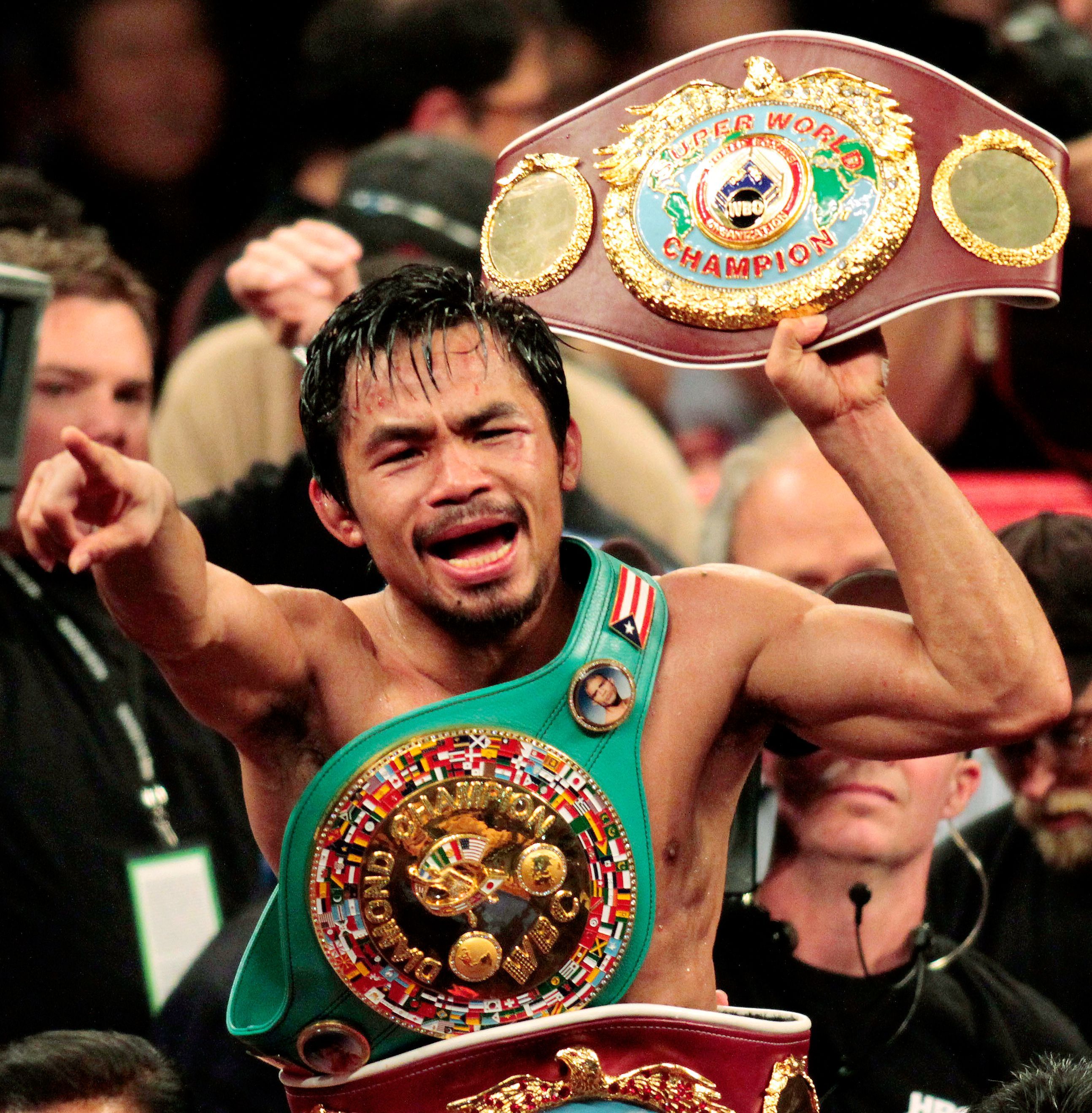
Pacquiao and Nonito Donaire are super champions respectively in the welterweight and bantamweight divisions under the World Boxing Association (WBA) while Jerwin Ancajas and Pedro Taduran are regular champions in the super flyweight and the minimumweight classes respectively under the International Boxing Federation (IBF). Johnriel Casimero presently is the Interim world champion in the bantamweight class under the World Boxing Organization (WBO).

Related image
Manny Pacquiao

Image result for donaire
Nonito Donaire


Image result for john riel casimero
John Riel Casimero

There are no current Pinoy titleholders in the World Boxing Council (WBC) although Pacquiao at 112, 130 and 135 lbs, Donaire at 118 and 122 lbs and Casimero at 108 and 112 lbs. once reigned as champions under the WBC.

Per sanctioning body, the WBO has the most number of rated Filipino fighters with a total of 22, followed by the IBF with 19, the WBC with 18 and the WBA with just 12.

Many of our top local fighters are in the ratings of more than one boxing bodies.

Highest rated are Robert Paradero, Edward Heno, Geimel Magramo, Michael Dasmarinas and Marlon Tapales who are all the top ranking contenders in the minimumweight (WBO), light flyweight (IBF), flyweight (WBO), bantamweight (IBF) and super bantamweight (WBO), respectively. 


Former champions Donnie Nietes and Vic Saludar are both ranked highest at fourth in super flyweight and minimumweight respectively by the WBC and the WBO while Milan Melindo is ranked ninth at light flyweight by the WBC.

The other Pinoy fighters include the following (highest rated by organization in parenthesis):

Minimumweight- Melvin Jerusalem (#2 WBC), Vic Saludar, Rey Loreto, ArAr Andales, Mark Anthony Barriga, Rene Cuarto, Joey Canoy, Lito Dante, John Marco Rementizo, Jonathan Refugio and Samuel Salva who was erstwhile number one at IBF but was beaten for the vacant title by Taduran.

Again, Paradero is ranked number one by WBO in this division.

Light Flyweight- Jonathan Taconing (#7 WBC), Melindo, Ivan Soriano, Mark Vicelles, Christian Bacolod, Randy Petalcorin and Jaysever Abcede. Christian Araneta was formerly the highest rated after Heno at number three by he was recently defeated in a title eliminator fight in Mexico hence his rating will likely fall.

Edward Heno is rated number one by WBO. at light flyweight.

Flyweight- Rene Baldonado (#8 WBA), Jayson Mama, JR Raquinel, Jobert Alvarez, Genesis Libranza and Alphoe Dagayloan.

Geimel Magramo is highest rated Pinoy flyweight at number one by WBO.

Super Flyweight- Donnie Nietes (#4, WBC and IBF), Aston Palicte, KJ Cataraja, Froilan Saludar and Jade Bornea.

Jerwin Ancajas is current IBF titlist.

Bantamweight- Reymart Gaballo (#4, WBA), Kenny Demecillo and Vincent Astrolabio.

Nonito Donaire is WBA super champion, Johnriel Casimero is interim IBF titlist and Michael Dasmarinas is IBF top and mandatory contender.

Super Bantamweight- Marlon Tapales and Albert Pagara are rated # 1 and 2 by WBO with Jeo Santissima rated sixth. Juan Miguel Elorde who lost in his recent title try fell out.

Featherweight- Former interim titlist Jhack Tepora is rated third by WBA while Mark Magsayo is eighth with WBC. Tapales is also rated at featherweight at #11 in the WBA. Conspicuously absent in the ratings is Genesis Servania.

Super Featherweight- Asian champion Joe Noynay is the lone rated Pinoy at number six with WBO.

Lightweight- Romero Duno is also the only rated Pinoy at number four with WBO.

No Pinoy is world rated at junior welterweight after Jheritz Chavez also fell out.

Manny Pacquiao is the lone Pinoy at welterweight and he holds the WBA super belt in the division.

Who among these rated Pinoy fighters will become world champion is worth watching out for next year.

Thursday, September 19, 2019

...the world class Pinoy singers


Pinoy pride!


By MARK BONIFACIO
MANILA tIMES
19 September 2019


The Filipino singer’s talent is well known the world over. Most foreigners in fact perceive that every Filipino can sing or carry a tune. They believe so what with the likes of Tony Award winner Lea Salonga, Charice (now known as Jake Zyrus), Joanna Ampil, Rachel Ann Go, Jed Madela, KZ Tandingan, Darren Espanto, Morissette Amon, Elha Nympha and the TNT Boys, among so many others, making the nation proud.

And now, two new additions are on the Pinoy pride list in music — the a capella group Acapellago and YouTube sensation Reneé Dominique.
Earning Asian honors

Award-winning a capella group Acapellago brought pride anew to the Philippines when they bagged another victory at the Asian Cup A Capella Competition in Kagawa, Japan.
Acapellago, whose members include Michelle Pascual, Almond Bolante, Joshua Cadeliña, Bogart Laderas and Happy Lemon Laderas, bested other groups from Asia on August 9 at the Rexxam Hall of the Kagawa Prefectural Hall in Takamatsu, Kagawa.
Besides being grand champions, the group was also hailed as the VoiceJam Awardee, which earns them the privilege to perform in next year’s VoiceJam Festival in the United States.
Acapellago
This year has indeed been great for Acapellago. They also won the first place at the Medium Vocal Ensemble Category in the Moscow Spring Acapella Festival last May.
The group is now looking forward to a concert tour of Taiwan. This is a return engagement due to insistent public demand after their sold-out tour last May. They are also excited for the results of this year’s Awit Awards where their single “Kariton” is a finalist for Best Vocal Arrangement. They won the same award last year for their song “Peroplano.”
Acapellago is now getting ready to record their second album which will carry some of their award-winning pieces and tracks they will sing at their extensive performing tour of Europe early 2020.
Duet with Jason Mraz

Another Pinoy Pride who is making waves around the world is the young singer Renee Dominique who not only signed with Virgin Records/Universal Music Germany but also collaborated with famous a American Grammy award winning singer/songwriter for her new single.
Renee Dominique

Weeks before his concert in Manila, American singer-songwriter Jason Mraz told Music Geek in a phone interview that he was in the process of collaborating with a young artist based in Manila. She was none other than Renee.


“She’s such a great talent and a great writer. Beautiful voice!” Mraz praised the Pinay singer whom he had never met before his concert on here on May 8. Naturally, the collaboration was made possible via the Internet.

“It’s as if we were sending messages in a bottle across the sea, working in different time zones between different schedules to make this dream collaboration become a reality. Though we had never met, I feel like I knew Reneé simply through the quality of her voice. I was drawn to her tone and vocal attitude, and through the process of co-writing the song, felt drawn to harmonize and appear on the track. It’s an honor to be featured. But I’m here because I’m a fan.”

The result of this collaboration is the single “Could I Love You Any More” which they first performed during his Manila concert then released on May 31. The track is a conversation put in song between a woman and a man, both realizing the magic of love. The peaceful and touching duet combines the beautiful voices of both artists and delivers a dose of romantic vibes with breezy, calm guitar sounds.

Reneé Dominique is known for her creative music and beautifully designed videos on YouTube. In December 2009, she started uploading videos of cover songs of various classic hits (The Beatles, Carpenters) as well as self-written songs on her channel. She stands out for her uniquely soft and soulful vocals, which combined with her ukulele, add a dreamy and distinctive touch to her music. One of her most successful covers, “Somewhere Only We Know,” by Keane counts over 5 million views on Youtube and was chosen by Samsung for one of their global campaigns.

Reneé says about the love song: “Love can never be stopped, it never runs out, because with the right person love exists in abundance. Love is kind and patient, never boastful, proud or rude. Love is not selfish or quick tempered, it does not keep a record of wrongs that others do. Love rejoices in the truth not in evil. Love is always supportive, loyal, hopeful, and trusting. Love never fails.”

Their music video was shot in Manila and Singapore and was directed by Jeff Coffman. She is currently on tour with Mraz in the US to promote the single.


Friday, May 8, 2015

...the Philippines paradox

Philippines' Economic Development and the 'Pacquiao Paradox': Shining Individually, Whimpering Collectively

Richard Javad Heydarian Headshot


For years, I have covered the emergence of the Philippines as the darling of global investors. (In fact, a number of my works on HuffPo have focused on this issue.) After countless exchanges with economists, consultancy agencies, and businessmen in the country and beyond, it is quite clear to me that there is a growing sense of optimism (Keynesian "animal spirits") in and over the long-term economic potentials of the Philippines. Business confidence is building up.
Undoubtedly, the Southeast Asian country is once again on the radar. Certain macroeconomic trends are highly encouraging, particularly in terms of inflation and interest rates, projected annual growth rates, fiscal reforms, debt payments, gross foreign reserves and trade and investment inflows. Recent years have also seen growing regulatory predictability in the government and sustained efforts at closing the country's gnawing infrastructure gap.
Yet, sustained economic development doesn't take place in a vacuum. For the Philippines to become a true "tiger economy" in the coming decades, it has to also experience some changes in its cultural foundations.
A Country of Stars
I vividly recall a poster advertising "Filipino singers" in the elevator of an upscale hotel in Beijing when I was there for an academic visit few years back. Of course, there was nothing surprising about Filipino singers performing in major hotel chains. After all, from the Middle East to East Asia and North America, I constantly came across affable, highly competent, and extremely nice Filipinos, who were at the forefront of the hospitality and tourism business.
But what struck me was how, especially when it comes to singing, being a "Filipino" alone represents a brand. If you are Filipino, you are expected to be a great singer. Countless Filipinos, from Charmaine Clarice Relucio Pempengco to Christian Bautista, have made it big on the international stage. When it comes to singing and dancing, the Filipinos can compete with the best in the world, and often emerge as the indisputable victors. Not to mention, the Philippines' superpower status when it comes to beauty pageants. I have lost count of how many Filipinas (pure- or part-Filipino) have managed to make it to the top 5-10 contestants in every major global beauty contest.
No wonder then that many see the Philippines as the extension of Latin America into the heart of Asia, an island nation filled with the Iberian spirit of musicality and overflowing talent. In certain sports, especially the "Four B's" of basketball, billiards, bowling and boxing, the Philippines has also showcased its ability to go toe-to-toe with the best in the world. From the Philippines' impressive performance in the latest FIBA World Championship, to globally-renowned billiard wizards such as Efren "Bata" Reyes, Francisco Bustamente, Dennis Ocrollo, as well as world bowling champions such as Rafael "Paeng" Nepomuceno, it is clear that there has been no shortage of world-class talent in the Philippines.
Above all, perhaps, stands Manny "Pacman" Pacquiao, who is widely considered as one of the best pound-for-pound boxers of his generation. He is the first and only boxer to have won world championships in eight divisions, and his recent (controversial) loss to Floyd "Money" Mayweather should take nothing away from his impeccable legacy.
Yet, astonishingly the Philippines stands among few counties which have yet to win a single gold medal in the Olympics. Despite having one of the most articulate and talented journalists, lawyers, and artists as well as an army of engineers, doctors, and scientists, the Philippines is yet to break out of its "lower-middle income trap". And despite having among the world's best singing and dancing talents, it is South Korea's"K-pop" phenomenon, which is transforming the entertainment landscape in Asia.
The Philippines is a paradoxical nation, where individual glories often clash with a long history of collective disappointment.
The Anti-Asian Values
Singapore's late-founder, Lee Kuan Yew, was fond of talking about the peculiarities of the so-called "Asian Values" (AV). He always insisted that unlike Western countries, Asians are more predisposed to thinking and behaving in collective-communitarian terms, putting the interest of the family and broader community above their individual impulses.
"I don't think there is an Asian model as such. But Asian societies are unlike Western ones... [an Asian person] is not pristine and separate," Lee Kuan Yew argued in an interview with Foreign Affairs back in 1994. To be fair, the legendary Singaporean leader had a more specific notion of "Asia" in mind, since he was primarily referring to "Confucian countries" of China, Taiwan, South Korea, Japan, Singapore and Vietnam.
His Malaysian counterpart, Mahathir Mohamad, was even more all-encompassing in conceptualizing of and passionate in his advocacy for the notion of "Asian Values", consistently questioning the universality of liberal democracy, which is primarily found upon the principles of individualism, procedural accountability, and freedom of expression. Instead of embracing democratic capitalism as the ideological end point of history, he envisioned an alternative episteme anchored by principles of deference to authority, limits on individual freedom, and emphasis on hard work and economic productivity.
Obviously, the concept of "Asian Values" has been largely discarded by the experience of countries such as India, Indonesia, Japan, Taiwan, South Korea, which have embraced liberal democracy, albeit with certain modifications, without necessarily becoming "un-Asian". For its critics, the AV concept has been largely dismissed as a thinly-veiled propaganda for autocratic leadership and, quite ironically, an orientalist perspective, which ignores the almost universal demand for Vox Populi and freedom of expression.

Among Asian countries, the Philippines perhaps stands as the extreme opposite of the so-called "Asian Values". It is a country where individualism and lively public discourse undergirds the body-politic, animating the conduct of day-to-day politics and the broader national political culture. It is a country where the mainstream media constantly prioritizes endless gossip about individual celebrities over deep strategic discussions about national interest and development.
It is a country where actors and entertainers are constantly overwhelmed by public attention, while intellectuals are constantly pushed to the margins of public discourse. It is a country where the interests of an individual and his/her family stand as concrete, tangible priorities, while notions of nation and nationalism are treated as largely abstract points of reference, fondly cited in poems, movies and history books.
Philippine Exceptionalism
To be honest, I am not very convinced with cultural theories on national development, always preferring to focus on the impact of trade and industrial policies, the state-building process, and the structure of opportunity in the global economic system. The concept of "culture" is itself too broad and imprecise, often interchangeable with religion, national psyche, or "institutions", which pertain to regularized practices that have gained value over time, shaping the behavior of societies and individuals.
A century ago, leading sociologist such as Max Weber dismissed the ability of Confucian countries such as China to ever catch up with the West, (mistakenly) arguing that Far Eastern cultures tend to emphasize submission, passivity, and spirituality over the mastery of nature and a hunger for material accumulation, which underpin capitalist modernization. Yet, the past decades have seen the likes of Singapore, South Korea, Taiwan, and China emerging as history's greatest (capitalist) economic miracles. Confucian Vietnam is obviously in the midst of its own industrialization bonanza.
As Fareed Zakaria cogently points out in his Foreign Affairs interview with the Singaporean leader, "Cultures change. Under the impact of economic growth, technological change and social transformation, no culture has remained the same. Most of the attributes that Lee sees in Eastern cultures were once part of the West. Four hundred years of economic growth changed things."
Few recall how in the past even Germany and Japan used to be dismissed as non-Western countries, predisposed to autocratic rule. The European intellectual giant Jurgen Habermas' post-World War II personal project was precisely about transforming Germany into a more Anglo-Saxon like democratic polity. Today, Germany and Japan stand as among the most stable democratic societies in the world, untouched by the bickering and political paralysis that afflicts old democracies such as the United States and France.
Obviously, culture is malleable and subject to change. But in the case of the Philippines, decades of economic stagnation has gone hand in hand with cultural immutability. While a predatory oligarchy has instituted a "shallow capitalism", and exploited hollow electoral institutions in the country, a persistently individualistic/family-centered culture, in turn, has come at the expense of building a collective, national spirit, which has been instrumental to development of most countries in the region.
Perhaps, instead of just creating global stars, the Philippines should also develop a socio-economic ecosystem, found upon a progressive national culture, which nurtures the talents of and provides opportunities for fruition of the vast potentials of the broader Filipino population -- that is to say, every Juan/Juana de la Cruz. And the Filipino political leadership, media, and intellectual class should play a key role in this transformation. This is their sacred duty.


Wednesday, June 22, 2011

...the Ifugao sculptor

Ifugao sculptor wins 2 prizes in Switzerland

06/22/2011

BERN, Switzerland- A Filipino sculptor from Ifugao won the top two prizes in an international sculpture symposium which ended Sunday in Switzerland.

Gilbert Bergano Alberto won the Silver Award and the Prix du Public (Audience Choice Award) at the 10th International Sculpture Symposium held this year in Morges in Geneva.

The 45-year old Gilbert, a native of Hapao, Hungduan, Ifugao province, was one of the 30 artists from around 20 countries invited to showcase their talents at the annual stone sculpture competition.

The participants worked on a uniform-sized block of limestone weighing around 300 kilos for eight days at the gardens of Morges Castle along the Geneva lake.

Gilbert won the Silver Award for his sculpture entitled: "A sitting old Igorot Man playing a Gong."

"Everyone is a seed with much potential for greatness in it. Still, that potential, like a seed, needs elements to trigger its sprout and coax it to mature and bloom to its fullest. My sculpture may reflect such growth. It may inspire or communicate, or touch one's life," said Gilbert in explaining his works to the public.

Gilbert also won the public's choice, the Audience Choice Award.

Anny Misa Hefti, one of the numerous Filipinas who viewed the symposium, said one of Gilbert’s winning attributes which endeared him to the audience and judges was his unassuming personality.

"Gilbert is an epitome of humility. He mingles well without being boisterous. He is friendly in a shy way and he won the public in this manner," said Hefti.

Gilbert meanwhile, commented that he was amazed at the tools used by many of the artists at the competition, saying he only used four sculpting tools.

He also gave thanks to the support of the Filipino community, including many members of the Bibak-Switzerland, a women’s group with roots from the Bontoc-Ifugao-Benguet and Kalinga-Apayao provinces in the northern Philippines.

Friday, June 17, 2011

..the business challenger winner

Pinay wins business challenge award in Netherlands

06/17/2011

NETHERLANDS - For the second time, a Filipina took home the grand prize in the BiD Network Women in Business Challenge, a yearly competition for women entrepreneurs from around the world held here.

Hailing from Bukidnon, Philippines, Nathalie Arsonillo bested 140 businesswomen from Asia, Africa and South America with her organization Sustainable Growth for Rural Venture Inc. (SUGRUVI), which aims to better the lives and income of cassava farmers in her home province, particularly the Matinsalog-Manobo tribe.

Her goal to bring mobile cassava processing units to remote mountains in Bukidnon, in order to minimize spoilage and increase farmers' profits, earned the nod of judges from Dutch Bank ING, and business organizations United Success and iCCO.

“I’m very happy but this is just icing on the cake. My coming here and their efforts to connect me to future investors, I would not get it if I’m alone or if I’m just staying in the Philippines. I made a lot of contacts, I met a lot of people so the future looks great, not only for me but also for all the cassava farmers in the Philippines,” said Arsonillo in Tagalog.

The overwhelmed Arsonillo received 5,000 euros worth of business coaching from and membership to United Success, a women-only business network helping women entrepreneurs all over the world. She would also receive assistance in finding possible investors.

Advancing the lives of cassava farmers

A banker for 11 years, Arsonillo left her job at an international bank in the Philippines in 2008 to start SUGRUVI. Whenever she comes home to Bukidnon, she frequently sees cassava being grown in small patches in the province. She learned that cassava is not only for human consumption but for other productions as well. She thought of uniting cassava farmers into a community making cassava produce.

“Aside from being food on the table, cassava is also being made into noodles, one of the main components of glue, made into chalk, textile and many others. It has a lot of uses and now, one of the big markets for it is the production of ethanol. It’s like corn but only cheaper,” explained Arsonillo.

They partnered with a rural bank and sought other financing schemes to buy the good variety of cassava and distribute it to the farmers for free. She approached San Miguel Corporation to sell cassava chips but the company did not respond very early. For two years, the cassava farmers booked high costs, but no income. Because cassava rots in 48 to 72 hours, the farmers had little time to make them into something useful, thus lowering their income considerably.

“What we want is to make a transport unit that will go from the center to the mountains so the processing will take place there. This will avoid spoilage, lower transportation and labor costs and increase the productivity of the farmers and the organization,” she continued.

Fortunately, after two years of waiting, San Miguel started ordering from SUGRUVI. This inspired Arsonillo even more, as well as the farmers in her organization. She is proud of her kababayans' solidarity as they produce the amount of order that their clients demand.

SUGRUVI now has 278 members, 48% of whom are women and 23% are from the Matinsalog, Manobo tribe.

Social and environmental impact

The BiD Women in Business Challenge, now on its second year, was established to focus on women who are already in business but want to expand. According to Thierry Sanders, director and founder of BiD Network, 27% of all the business pitches they are receiving each year come from women entrepreneurs. Since there wasn't any international competition for these women, to help them assist in the expansion of their businesses, BiD Network pioneered one for them.

“There’s a lot of women entrepreneurs out there and they just need to put their business plans together, find a coach and get financed. They have great business ideas,” said Sanders.

Last year, it was Marianne Olano from Naga City who won the grand prize for her business Baycrafts Jewerly.

“The most important thing we are looking for is an entrepreneur who has growth ambitions. They must have social impact and we are looking for environmental businesses as well. So if you can have that combination of 20% of income growth, social impact and environmental impact you're in the right spot and you're looking for finance because we can help you look for finance,” continued Sanders.

According to Sanders, they do not entertain businesses which have lower that 20% predicted growth income in one year because these will not generate jobs that are needed in the community. He cited the statistics in the United States where 90% of jobs generated in the last 20 years were from companies which had start-up of $250,000 and more than 20% yearly growth.

All the five finalists, including four from Peru and Uganda, got business coaching from BiD and ING especially in areas like finance and investor match-making, marketing, women leadership, overcoming cultural barriers and finding export partners.

They were also advised to find business partners or investors who have solid background to build trust and track records, in addition to having perseverance.

Going International

SUGRUVI is currently only producing for domestic distribution but Arsonillo said that their end goal would be to go international. A few Dutch companies have already expressed interest in looking at their products and using tapioca starch instead of corn starch.

“The cassava chips are still on the starting level but starch is the end of the line. When the selling prices are high, the buying prices are also high so hopefully we can go and reach that goal (of going international),” said Arsonillo.

There is also a possibility of acquiring mobile units and other kinds of technology for their cassava processing. Some investors are also willing to buy SUGRUVI shares, prompting Arsonillo to turn the organization into a corporation.

“We waited for a long time but we didn’t think expect that it will this worth it,” she ended.