Showing posts with label Muslim. Show all posts

Friday, September 13, 2019

...the ties that binds Singapore and Philippines

Opportunities abound for Singapore-Philippines collaboration: Halimah Yacob


Buena Bernal 
Channel News Asia
13 September 2019


MANILA/DAVAO: Singapore and the Philippines can collaborate in many areas, Singapore President Halimah Yacob said as she concluded on Thursday (Sep 12) a five-day state visit to the Philippines, during which she met Philippines President Rodrigo Duterte in Manila and headed to his home city of Davao in Mindanao.

Singapore's President Halimah Yacob and Philippine President Rodrigo Duterte shake hands
Singapore's President Halimah Yacob (left) and Philippine President Rodrigo Duterte shake hands following the official Palace Guest Book signing on Monday, Sep 9, 2019 at the Presidential Palace in Manila, Philippines. (Photo:AP/Bullit Marquez)

Madam Halimah said that as founding members of ASEAN, the two countries' close ties, resulting in public and private collaboration, is ultimately about raising the quality of life for people in the region.

Singapore and the Philippines can collaborate in human capital development, innovation and infrastructure, not just in the megacities but also in the provinces, she added.

"I think that our businesses which have niche core capabilities in the areas of sustainable town development, urban development will find opportunities, particularly in the areas of smart city, waste management, water supply and other areas related to urban town development," she said.

In his opening remarks during a meeting between Singapore and Philippines officials, Mr Duterte admitted there is much to learn from Singapore.

"The Singapore story dating back to its beginning as a trading port in 1819 is truly remarkable. It is by itself an inspiration for many nations around the world," said Mr Duterte.
Among the highlights of Madam Halimah's trip was a stop in Davao, Mr Duterte's hometown. 

The southern Philippine islands of Mindanao are home to dozens of tribes and to most of the Muslim population in the Philippines, a country where 80 per cent are Roman Catholics.

Madam Halimah and her spouse, Mr Mohamed Abdullah Alhabshee, were welcomed at the Davao airport by performers dancing to tribal rhythms that she said showcased the diversity of the country's south, where not many heads of state have set foot. The southern part of the Philippines houses the country's poorest provinces.

"Diversity is also something that teaches us tolerance, teaches us magnanimity, teaches us understanding ... It makes you a better human being. And it makes the whole society better," she said.
She is the third head of state to visit Mindanao since Mr Duterte took power, after Japanese Prime Minister Shinzo Abe and Indonesian President Joko Widodo in 2017.

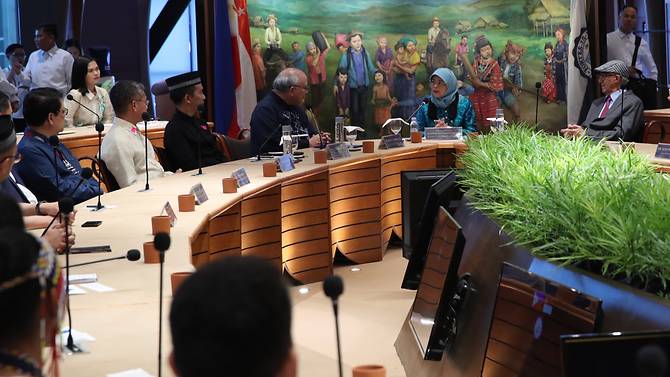
Halimah at Mindanao youth dialogue
Singapore President Halimah Yacob speaks during a dialogue with Mindanao youth. (Photo: MCI)

In a dialogue with Mindanaoan youth of different religious backgrounds, Madam Halimah emphasised the need for engagement to counter ignorance and prejudice.

"A society is fragile if one group views another as a threat. It is important to overcome the forces of division, and build bridges instead of walls," she said.

Prejudice against the Philippines' Muslim minority is a flashpoint in Mindanao, which saw an armed Muslim rebellion half a century ago after decades of land-grabbing, marginalisation and even massacre of their kin.

Bangsamoros, Muslim natives in the country's south, now have greater autonomy after a law resulting from a peace deal with the country's largest Muslim rebel group was ratified.

In their meeting, Philippines President Rodrigo Duterte told Madam Halimah about the ratification of this law that is seen to help end decades-long conflict and open up the region to outside investments.
"It was my pleasure to share with President Yacob our gains in peace and development in Mindanao, particularly our progress in establishing the Bangsamoro Autonomous Region in Muslim Mindanao,” said Mr Duterte in a joint press conference with Madam Halimah after their meeting.

“We discussed ways by which our cooperation could help contribute in bringing just and lasting peace and meaningful progress and development in Mindanao."
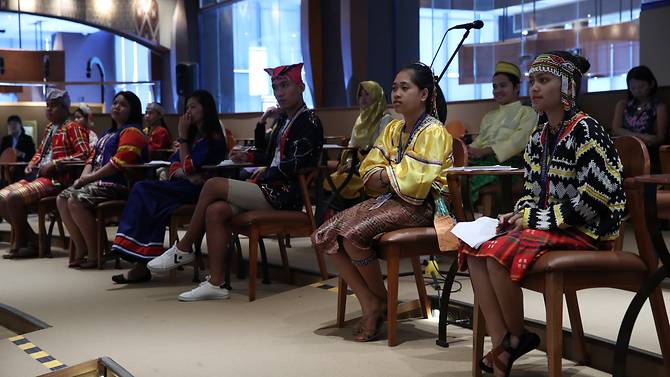

Mindanaoan youth of different religious backgrounds are pictured during a dialogue


At Davao City, Madame Halimah also visited an eagle centre where she saw up close the critically endangered bird of prey known as the Philippine Eagle.

The rare biological heritage can only be found in the Philippines and only lays a single egg every two years. Its numbers are dwindling due to the clearing of forests that destroy their habitat.

A pair of Philippines Eagles are on a 10-year loan to Singapore. or conservation and breeding.
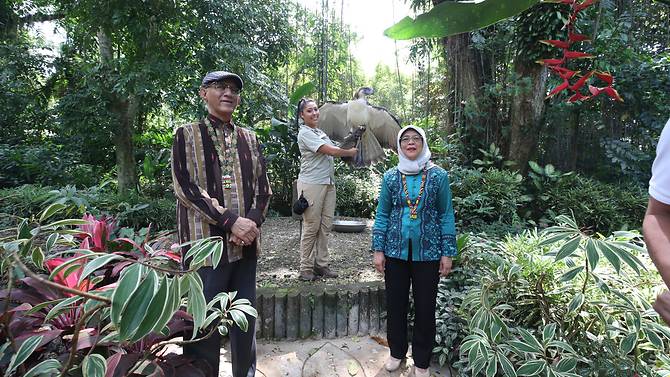
Halimah and Philippine Eagle
Singapore President Halimah Yacob (right) and her spouse, Mr Mohamed Abdullah Alhabshee (left), pose for a photo with a Philippine Eagle at the Philippine Eagle Center in Davao in Davao City. (Photo: MCI)

SINGAPORE BUSINESSES IN THE PHILIPPINES

High on the agenda of President Halimah's visit was for Singapore corporations as well as its small and medium enterprises (SMEs) to venture and expand in the Philippines.

Eight memoranda of understanding between the Philippines and Singapore were exchanged during Madam Halimah's state visit, ranging from agri-tech, water management and electricity supply in rural areas, to arts and culture, data protection, and training people for the next industrial revolution.
Madam Halimah also graced the opening of The Podium, an office and retail complex in Metro Manila developed by Singapore and Philippine firms Keppel Land and BDO Unibank.

“We also like to see more integrated mixed use development happening in Philippines. This is applying the concept that we learned in our Singapore Marina Bay financial centres where we incorporate office, residences and retail together so that's fulfilling the live, work, play scenarios," Keppel Land CEO Tan Swee Yiow told CNA.

Madam Halimah cited the Philippines' young, tech-savvy population as a reason to venture into the country.

"There is a strong consumer demand for goods and services. Our Singapore brand - in terms of our products and services - do have a reputation, largely also because we have a large Filipino community in Singapore. They have had opportunities to try out our Singapore brand, and they like it," she told Singapore media.

Singapore was the Philippines’ largest foreign investor among Southeast Asian countries and the second largest worldwide last year. Bilateral trade between the two countries grew by 18.6 per cent compared with the previous year.

Moving forward, Madam Halimah says she hopes to see progress in two particular areas - updating an existing agreement to avoid double taxation, as well as expanding a bilateral air transport deal.


APEX OF 50 YEARS OF DIPLOMATIC TIES
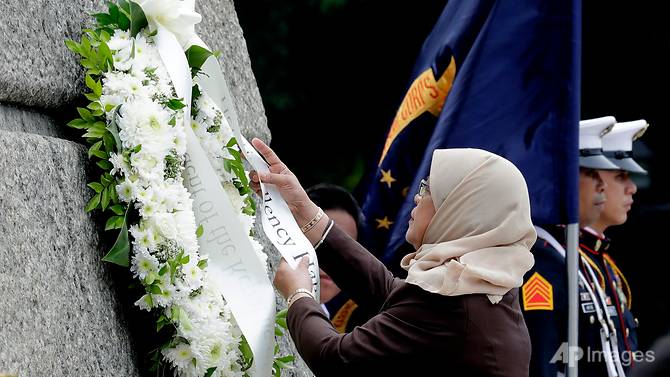

Singapore's President Halimah Yacob adjusts the wreath at the foot of the monument of Dr Jose Rizal
Singapore's President Halimah Yacob adjusts the wreath at the foot of the monument of Dr Jose Rizal, the country's National Hero, in ceremony on Sep 9, 2019 in Manila, Philippines. (Photo: AP/Bullit Marquez)

Prior to her meeting with Mr Duterte, Madam Halimah also paid her respects to the late Philippine national hero Jose Rizal, the novelist who believed in the power of words to help liberate the Southeast Asian nation from colonial powers. 

It is customary for visiting heads of state to the Philippines to offer flowers at the monument of Rizal.
The Philippines foreign ministry described Madam Halimah's state visit to the Philippines as an apex in the two countries’ celebration of 50 years of diplomatic ties this year.

Wednesday, September 4, 2019

...the Bangsamoro charm

Philippines’ new region turns to Middle East for investment


Ellie Aben
Arab News
03 September 2019


MANILA: The interim chief minister of the Bangsamoro Autonomous Region in Muslim Mindanao (BARMM), Murad Ibrahim, told Arab News on Monday that he was encouraging the international business community to consider investing in the newly established region


Rebels turned troopers finish the basic military training. (AN photo)
It is designed to provide enhanced self-governance to the Muslim-majority provinces

The BARMM is the new regional and political entity established under a peace agreement between the Moro Islamic Liberation Front (MILF) and the Philippines government early this year.

It is designed to provide enhanced self-governance to the Muslim-majority provinces. “It is very important for investors to come, in order to create job opportunities and also for the international community to see that something is happening on the ground,” Murad said.

In an interview conducted at his office in Cotabato City, Murad told Arab News that plans were afoot to hold an investors’ forum. “We are just finalizing our development plan.”

When questioned on how they would lure foreign businesses to invest in the region, Murad said that there is now relative peace in the region. “In fact, gradually many investors are now coming here to visit. So, I think it’s because of the situation, we now have relative peace in the area and they’ve also seen the conduct and turn out of the plebiscite (last January). There was overwhelming support from the people,” he said.

Murad also cited the decommissioning of an estimated 40,000 former Bangsamoro Islamic Armed Forces (BIAF) combatants, the military wing of the MILF, which he also chaired. The process will allow the smooth transition of BIAF members to civilian life.

It is very important for investors to come, in order to create job opportunities and also for the international community to see that something is happening on the ground.
Murad Ibrahim, BARMM interim chief minister

“All of this sends the signal that the situation here is improving,” he stressed, adding that a recent meeting with an official from a Saudi delegation to the region had given him great encouragement.

“He gave his commitment that he will help convince the business community in Saudi Arabia to try to invest in the BARRM. He even asked for our development plan so he can present it to them,” Murad said.

“I could see they are really interested, especially given Saudi shortages of animal feeds. They need suppliers and they’re looking at us as a possible source. We have the potential to produce halal food, too so we can supply halal products as well.”

Last month, Murad led officials at a meeting with Malaysian representatives to discuss the possibility of strengthening development ventures between Malaysia and the BARMM.

Lawyer Wencelito Andanar, MalacaƱang’s special envoy to Malaysia, accompanied the Malaysian delegation comprising the Malaysian Embassy’s Charge D’Affaires Rizany Irwan Muhammad and Assistant Trade Councilor Irvin Francis, as well as officials of the Malaysian Chamber of Commerce and Industry headed by its president, Edward Ling in the two-day visit to Cotabato City.

Murad cited the importance of the meeting, which he said could “elevate the strategic partnership between BARMM and Malaysia from being peace partners to being development partners.”

He told reporters: “Helping BARMM as a brother and a relative is part of Malaysian Prime Minister Mahathir Mohammad’s ‘prosper-the-neighbors’ policy.”

Aside from Saudi Arabia and Malaysia, the government of Turkey has also vowed to extend assistance to the BARMM, particularly in its agricultural sector.

Monday, March 18, 2013

...the Filipino work ethic

Prince Faisal commends Filipino work ethic


RIYADH: Rodolfo C. Estimo Jr.
Arab news
Saturday 16 March 2013


“Their (Filipino workers') efficiency and hard work has contributed to the national development of both Saudi Arabia and the Philippines." - Prince Faisal Bin Salman, Governor of Madinah
 

Tuesday, February 12, 2013

...the next potential popes

Cardinal Tagle in Reuters list of potential popes


02/11/2013  


PARIS - With Pope Benedict's stunning announcement that he will resign later this month, the time may be coming for the Roman Catholic Church to elect its first non-European leader and it could be a Latin American.

The region already represents 42 percent of the world's 1.2 billion-strong Catholic population, the largest single block in the Church, compared to 25 percent in its European heartland.

After the Pole John Paul and German-born Benedict, the post once reserved for Italians is now open to all. Who gets the nod depends on the profile of the new pope that the cardinals who elect him at the next conclave think will guide the Church best.

Two senior Vatican officials recently dropped surprisingly clear hints about possible successors. The upshot of their remarks is that the next pope could well be from Latin America.

"I know a lot of bishops and cardinals from Latin America who could take responsibility for the universal Church," said Archbishop Gerhard Mueller, who now holds the pope's old post as head of the Congregation for the Doctrine of the Faith.

"The universal Church teaches that Christianity isn't centred on Europe," the German-born archbishop told Duesseldorf's Rheinische Post newspaper just before Christmas.

Swiss Cardinal Kurt Koch, head of the Vatican department for Christian unity, told the Tagesanzeiger daily in Zurich at the same time that the Church's future was not in Europe.

"It would be good if there were candidates from Africa or South America at the next conclave," he said, referring to the closed-door election in the Vatican's Sistine Chapel.

Asked if he would vote for a non-European over a European candidate if they were equally qualified, he responded: "Yes."

If the next conclave really is Latin America's turn, the leading candidates there seem to be Odilo Scherer, archbishop of the huge diocese of Sao Paolo, or the Italian-Argentine Leonardo Sandri, now heading the Vatican department for Eastern Churches.

Peter Turkson from Ghana, now head of the Vatican's justice and peace department, is often tipped as Africa's frontrunner.

About half the cardinals who can vote are from Europe, even though only a quarter of the world's Catholics live there. If the conclave tilts to the Old Continent, Vatican watchers say Angelo Scola of Milan is in pole position.

Vienna Cardinal Christoph Schoenborn, a former student and close ally of Benedict, is also considered a strong candidate.

FRONTRUNNERS FOR NOW

While there are no official candidates, here are "papabili" (potential popes) the most frequently mentioned recently. The list is in alphabetical, not in order of their chances, and will probably change between now and when the conclave is held, most likely in March.


- Joao Braz de Aviz (Brazil, 65) brought fresh air to the Vatican department for religious congregations when he took over in 2011. He supports the preference for the poor in Latin America's liberation theology, but not the excesses of its advocates. Possible drawbacks include his low profile.


- Timothy Dolan, (USA, 62) became the voice of U.S. Catholicism after being named archbishop of New York in 2009. His humour and dynamism have impressed the Vatican, where both are often missing. But cardinals are wary of a "superpower pope" and his back-slapping style may be too American for some.


- Marc Ouellet (Canada, 68) is effectively the Vatican's top staff director as head of the Congregation for Bishops. He once said becoming pope "would be a nightmare." Though well connected within the Curia, the widespread secularism of his native Quebec could work against him.


- Gianfranco Ravasi (Italy, 70) has been Vatican culture minister since 2007 and represents the Church to the worlds of art, science, culture and even to atheists. This profile could hurt him if cardinals decide they need an experienced pastor rather than another professor as pope.


- Leonardo Sandri (Argentina, 69) is a "transatlantic" figure born in Buenos Aires to Italian parents. He held the third-highest Vatican post as its chief of staff in 2000-2007. But he has no pastoral experience and his job overseeing eastern churches is not a power position in Rome.


- Odilo Pedro Scherer (Brazilia, 63) ranks as Latin America's strongest candidate. Archbishop of Sao Paolo, largest diocese in the largest Catholic country, he is conservative in his country but would rank as a moderate elsewhere. The rapid growth of Protestant churches in Brazil could count against him.


- Christoph Schoenborn (Austria, 67) is a former student of Pope Benedict with a pastoral touch the pontiff lacks. The Vienna archbishop has ranked as papal material since editing the Church catechism in the 1990s. But some cautious reform stands and strong dissent by some Austrian priests could hurt him.


- Angelo Scola (Italy, 71) is archbishop of Milan, a springboard to the papacy, and is many Italians' bet to win. An expert on bioethics, he also knows Islam as head of a foundation to promote Muslim-Christian understanding. His dense oratory could put off cardinals seeking a charismatic communicator.


- Luis Tagle (Philippines, 55) has a charisma often compared to that of the late Pope John Paul. He is also close to Pope Benedict after working with him at the International Theological Commission. While he has many fans, he only became a cardinal in 2012 and conclaves are wary of young candidates.


- Peter Turkson (Ghana, 64) is the top African candidate. Head of the Vatican justice and peace bureau, he is spokesman for the Church's social conscience and backs world financial reform. He showed a video criticising Muslims at a recent Vatican synod, raising doubts about how he sees Islam. (Additional reporting by Philip Pullella; Editing by Giles Elgood)


Tuesday, October 9, 2012

...the Bangsamoro

UN Chief Hails Aquino Over ‘Bangsamoro’ Deal


Manila Bulletin
October 9, 2012
 
 
UNITED NATIONS (AFP) — UN Secretary General Ban Ki-moon Monday Ban commended President Benigno S. Aquino III for his vision and courage, as well as the commitment of the Moro Islamic Liberation Front (MILF) leadership in reaching a framework peace accord ending a decades-long Muslim separatist insurgency that killed 150,000 people.

This developed as MalacaƱang said nobody, not even the Moro National Liberation Front (MNLF), will be left out in the government’s consultations on the proposed creation of the new autonomous Bangsamoro region.

The agreement would see the establishment of a new semi-autonomous Muslim area in the resource-rich Mindanao, which the 12,000-strong MILF regards as its ancestral homeland.

Ban expressed “his heartfelt wishes for peace and prosperity to the government and the people of the Philippines,” and in particular the people in the new semi-autonomous region, called Bangsamoro.

Mindanao served as a base for the MILF, the biggest and most important remaining rebel group, after the Moro National Liberation Front signed a peace pact with the government in 1996.

It is one of the most fertile and resource-rich parts in the archipelago -- but decades of violence and unrest have left it into one of the poorest regions of the Philippines.

The rebellion, which began in 1978, has left 150,000 people dead and displaced hundreds of thousands more.

Senate President Juan Ponce Enrile said the framework agreement is doable without a constitutional amendment. This agreement must be “given a chance to work” and must be studied “carefully before shooting it down,” he stressed.

In a brief talk with Senate reporters, Enrile said the creation of Bangsamoro, a political entity that will replace the current Autonomous Region in Muslim Mindanao (ARMM), does not require amendments to the 1987 Constitution.

Chief Philippine negotiator Marvic Leonen, in an interview with Manila Bulletin, allayed fears about the framework peace deal, clarifying fears that the Moro National Liberation Front (MNLF) will be disregarded in the crafting of the peace agreement.

Leonen is certain that all Bangsamoro organizations such as the MNLF will play a crucial role in the crafting of the peace agreement.

He noted that the government peace panel (GPH) is certain to provide a seat for the MNLF in the creation of a Transition Commission that will work in the drafting of a Bangsamoro Basic Law to jumpstart the agreement. “We are definite that the MNLF will have a seat in the GPH,” Leonen said, citing that Cotabato City Vice Mayor Muslimin Sema, one of the founding members of the MNLF, has expressed his support to the framework agreement. Leonen also maintained that the agreement will push through this time following the stalling of a previous agreement five years ago on the memorandum of agreement on ancestral domain.

Leonen expressed confidence that there will no longer be any more delays in the creation of a Bangsamoro government. “How can you be wrong in this kind of approach? Look at the big picture.

The big picture is independence. They turned down to Cha-cha. They did not ask for an Islamic state.

We have been fair with respect to their territory, which is smaller than the MOA-AD, and culture such as applying the Shar’iah Court to the Muslims,” he said.

Deputy presidential spokeswoman Abigail Valte said the government has already posted the preliminary peace agreement with the MILF on its official website precisely to encourage public discourse prior to its formal signing next week.

Valte made the remarks after the MNLF reportedly expressed concern over the framework deal that seeks to create a new autonomous political entity by 2016.

Even former MNLF chief Nur Misuari has questioned the draft GRP-MILF peace agreement, insisting the government has not yet fully complied with the pact signed with the MNLF in 1996.

“The draft framework agreement was precisely announced even before the signing because we want to engage the public. We want to have discussions and consultations with the stakeholders,” Valte said in a Palace press briefing.

Meanwhile, various nations throughout the world has congratulated the Philippines and the MILF on the successful conclusion of the negotiations on the framework deal.

According to Catherine Ashton, the High Representative of European Union for Foreign Affairs and Security Policy and Vice-President of the Commission, "the early signature of this truly historical document is a major step towards a long-lasting peace in Mindanao, which will lead the island to stability and prosperity."

Ashton added that the EU recognizes the contribution of the Malaysian facilitator of the peace talks, Tengku Dato' Ab Ghafar Tengku Mohamed as well as the members of the International Contact Group, to the successful conclusion of the peace negotiations.

Earlier, United States Ambassador to Manila Harry K. Thomas, Jr. welcomed the announcement by the Philippines and the MILF that the two sides finalized a framework peace agreement.

UK Foreign Secretary William Hague said the UK believes the framework agreementhas the potential to bring peace, stability, and development for Muslims in Mindanao.

British Ambassador to Manila Stephen Lillie said the peace process between the GPH and the MILF has taken a huge step forward with this framework agreement. —wth reports from Sarah H. Velasco, Genalyn D. Kabiling, Mario B. Casayuran, and Roy C. Mabasa

Thursday, August 25, 2011

...the Zonta Club awardee

Pinay teen wins Zonta global award

08/25/2011
 
 
Arriza Ann Sahi-Nocum, the first Filipina recipient of Zonta International's YWPA award. Photo from Zonta International's website
MANILA, Philippines - A Filipino Muslim woman was globally recognized for her work in helping build libraries and distribute books in war-torn areas.

Arriza Ann Sahi-Nocum, 16, is one of the 5 recipients of the Young Women in Public Affairs (YWPA) award of Zonta International, a global organization that aims to advance the status of women through service and advocacy.

The 4 other awardees are Emily Kvalheim of the United States, Nasma Dasser of Switzerland, Anjali Chandrashekar of India and Mehitabel Markwei of Ghana.

An awarding ceremony will be held on August 27 at the Sofitel Philippine Plaza in Pasay City.

"I dedicate this award to our Christian and Muslim scholars and library users whose determination to pursue their dreams amid war, hunger and extreme poverty inspires me to work harder to improve myself and to pursue our advocacy work amid my busy school schedules," said Nocum, who is the first Filipina to receive the YWPA award.

The 5 awardees will receive $3,000 each from the Zonta International Foundation.

Nocum will get an additional $1,000 for besting other finalists in the Zonta International District 17, which comprises the organization's clubs in Hong Kong, Singapore, Thailand, Malaysia and the Philippines.

Kris Library

Nocum earned the YWPA award for her work in Kristiyano-Islam Peace Library (Kris Library), which was put up by her Roman Catholic father and Muslim mother in 2001. The non-profit organization aims to eradicate poverty and conflict by educating the youth.

The Kris Library has so far established 5 libraries: in a slum area in Quezon City; in a resettlement area for victims of typhoon "Ondoy" in Montalban, Rizal; in a suspected jump-off point of the Abu Sayyaf in Zamboanga City; and 2 others in a Moro Islamic Liberation Front stronghold in Tungawan, Zamboanga del Sur.

It has also awarded 101 scholarship grants to poor children in these areas, provided free computer use and basic computer lessons, and donated thousands of books and school supplies with the help of donors.

As an administrator, Nocum sorts books at the libraries, writes news articles and letters to donors, facilitates activities with children, and interacts with volunteers, donors and partners of the organization.

"My dad always tells me: every book we get from our donors and send to the kids takes them one step away from poverty and one step towards a better life. That's what I believe in, too," she said.

Nocum is an honor graduate of the Philippine Science High School. She is currently a freshman and Oblation Scholar at the University of the Philippines, taking up industrial engineering.

The YWPA award is given to young women aged 16 to 19 years old who demonstrate a commitment to leadership in public policy, government and volunteer organizations, Zonta International said.

Saturday, July 30, 2011

...the Quran festival

PHL bags awards in intl Qur'an event in Malaysia


The Philippines was recognized in an international Qur’an recital assembly in Malaysia last July 16 to 23, the Department of Foreign Affairs said Saturday.


Philippine delegates won second and fifth place in the men and women’s category, respectively, at the 53rd International Qur’an Reciters’ Assembly at the Dewan Merdeka, Putra World Trade Centre in Kuala Lumpur.

“Saudi Gandisa of Cotabato won second place in the men’s category, while Rahima Panondiongan of Marawi City won fifth place in the women’s category," the DFA said in a news release.

Malaysia won first place both in men and women’s categories, the DFA said, adding that 81 male and female participants from 50 countries competed in the event.

Accompanying the Filipino Qur’an readers were National Commission of Muslim Filipinos commissioner Raida Maglangit and Second Secretary and Consul Gonaranao Musor. — JE, GMA News

Monday, June 13, 2011

...the Moro Westpointer

A Moro Filipino shines at West Point


By Benjamin Pimentel
Philippine Daily Inquirer


Uzi Ibrahim, Filipino American, Moro, Filipino, Philippines, United States, history, war, US, West Point

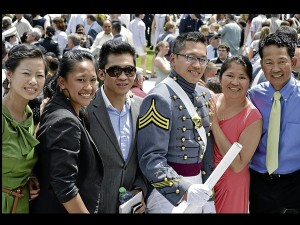
A hundred years ago, Uzi Ibrahim’s forefathers were fighting for their lives, defending Mindanao against invading US forces led by Gen. John J. Pershing. Last month, Uzi, who was born in Mindanao, marched as a member of the graduating Class of 2011 of West Point, the military academy where Pershing trained to be a soldier and where he is still highly regarded as a distinguished alum.

Uzi even won an award named after Pershing.

“I was both in disbelief and hopeful,” he told me on receiving the honor given to graduating cadets.

“If a hundred years later the descendant of one of America’s fiercest opponents could enter the same halls as General Pershing to become a leader,” he added, “it gives me hope that a lot of things can change in the world.”

Unique odyssey

In 21-year-old Uzi Ibrahim, we find a unique odyssey.

It is a journey of a young man who proudly considers himself a Moro Filipino. He is a child of Sept. 11, who is eager to serve as a soldier of the United States, but also looking to give back to the country, to the island where his people fought bravely for their freedom a century ago.

In many ways, his story and his beliefs underscore the complexities of the US and the world after Sept. 11, which reached another turning point with the killing of Osama bin Laden.

Some may disagree with Uzi’s views. But he tells his story with sincerity and quiet conviction.

Pride and prejudice

Uzi was three years old when his family moved to the United States. He was 11 when terrorists hijacked the planes that slammed against the Twin Towers in New York on Sept. 11, 2001, killing nearly 3,000 people.

Two days after the attacks, he felt the sting of the tragedy. In a moment that he still recalls vividly, a close of friend of his yelled out in class, “I hate Muslims!”

“I was completely blown away by this, and very upset to the point that I left the classroom in tears,” he told me. “I remember that I went through a time of self-searching and I was wondering what I did wrong.”

But the outburst led to a teaching moment for him and his friend who later came up to him and apologized.

“The thing was that he never even knew that I was a Muslim, or really understood what being a Muslim was all about. It was then I realized that, it wasn’t them but it was my fault that events had led up to that point. I think this was a very defining moment in my life.”

Uzi moved on. Though prejudice against Muslims intensified in the US after Sept. 11, he says his identity has “never been an issue.”

Youth leadership

He became class president of his high school in West Virginia, a state known for its conservatism. He even became governor of Boy’s State, the West Virginia leadership academy.

“What this shows is you can dwell on the differences all you want,” he told me. “But at the end of the day is it making the situation any better? Am I being a wall or am I being a bridge?”

His parents—his father is Muslim, his mother, Catholic—stressed two important lessons, he said: “To be tolerant of other people and to fight for what you believe in.”

Moros don’t quit

With those values and an intensifying interest in leadership, Uzi set out for West Point.

It wasn’t easy.

His father, Oscar Ibrahim, recalled how there were times when the thought of quitting entered his son’s mind. Oscar encouraged him to keep going, joking with his son, “Well, where’s your Moro blood if you quit?”

At West Point, father and son even saw reminders of their forefathers’ struggles against the Americans. On display at the academy were weapons recovered from the Mindanao campaign, the US military’s first major war against a Muslim foe.

The kris and the Colt .45

Uzi remembers one particular item on display—a Moro sword of war, called kris.

“Time heals a lot of things and my reaction that day wasn’t anger or frustration, but amazement and a sense of pride. To me, the sword was a symbol of the fighting spirit of the Moro people, and the presentation of the sword was also a symbol of American respect for their adversary.”

That respect was even underscored in one of his classes on the history of the US military. It was during the Moro campaign that the Colt .45 was made standard issue for American troops. The reason: US forces needed more firepower to stop the Moro fighters.

It’s a fact Uzi reflects on with pride. “I come from a tough bunch of people, something that I have a lot of pride in. I mean, the Colt .45 is a really powerful weapon, and the fact that Moro warriors could take .38 cal. bullets and still have the determination and willpower to take down their enemy is nothing short of amazing. Ultimately, when I’m going through hard times, I like to reflect on stories such as this as it inspires me to attack problems or issues with the same amount of spirit, [to believe] that I can take pain and I can keep going.”

Remembering Mount Dajo

In fact, the war that the US waged in Mindanao and the rest of the Philippines was hardly an honorable campaign. There were atrocities. No less than Mark Twain, the great American writer, spoke out against one of the most vicious abuses, the mass killing of hundreds of Moros trapped in a crater on Mount Dajo in Jolo in 1906.

“The enemy numbered six hundred,” Twain wrote, “including women and children-and we abolished them utterly, leaving not even a baby alive to cry for its dead mother… Our uniformed assassins had not upheld the honor of the American flag… They had dishonored it.”

But Uzi said these should be viewed in its historical context. “It was a hundred years ago. It should be judged in that respect. The Americans back then had a very different world view, had very different assumptions and beliefs.”

Moving on

Despite the challenges of his early years at West Point, Uzi pushed on.

He studied engineering, majored in East Asian studies, and even became president of the West Point Asian Pacific Awareness Club. He learned Mandarin, adding to his knowledge of Spanish and Cebuano.

As in the past, he said, his Muslim identity never became an issue at West Point.

“It never was. People have bent over backward to help me out. There is a chapel here for Muslim services. People are very professional around here. I’m very proud of this organization.”

A military career awaits him after West Point. But Uzi is also considering other long-term plans that may not involve a military career. A recent visit to this family’s home province of Lanao made him more aware of the poverty in that part of the Philippines.

An officer and a scholar

His own scholarly work on the histories of other Asian countries has made him interested in development issues, specifically the question: How do poor nations eventually get out of poverty?

It’s a personal question, in many ways. For he has seen his own family back in Lanao struggling.

“You see the family in poor conditions and it makes you think: Why do you have to go to another country to send money back when you shouldn’t have to do that if the problems don’t exist?”


The road ahead

He has no set roadmap right now, he says. But whatever path he eventually takes, he knows his West Point training in leadership will come in handy when he does return to Mindanao.

“It’s a skill that I can take with me anywhere, that I can apply to any situation to make it better.”

He is aware that the situation in the Philippines, and in Mindanao in particular, is complex. And the reality of the Philippines is not even clear to some Filipino Americans.

He has even met Filipino Americans who were surprised to learn that there are Muslims in the Philippines.

With amusement he recalls being asked by FilAms, who apparently found it hard to imagine a non-pork-eating Filipino: “You’re Filipino, but you don’t eat lechon?”