Showing posts with label Laos. Show all posts

Saturday, November 30, 2019

...The Southeast Asian Game host (opening)

Philippines showcases cultural heritage to kick off 30th Sea Games

New Straits Times
30 November 2019


MANILA: The Philippines staged a spectacular opening ceremony for the 30th SEA Games at the world’s biggest indoor arena, the Philippine Arena, in Bulacan, near here, tonight.


In a departure from tradition, the opening ceremony was held in an indoor arena rather than a stadium.




Also, for the first time in the biennial Games’ 60-year history, the games cauldron was placed at a different location, at the New Clark City Athletics Stadium, some 90km from Bulacan, and the lighting of the cauldron was shown on screen at the 55,000 capacity arena.

The extravaganza started after Filipino singer Lani Misalucha sang the republic’s national anthem, which was followed by an extraordinary performance themed “The Roots of our Strength”, showcasing the culture and heritage of the nation.
The spectators were treated to a series of warrior dances from the Bagobo, the Kalinga, the Maguindanao, Islamic and the pre-Hispanic Visayans.

The later part of the ceremony was powered by modern and hip-hop performances led by local artistes Inigo Pascual, Robert Sena, Apl.de.Ap and KZ Tandingan, among others.
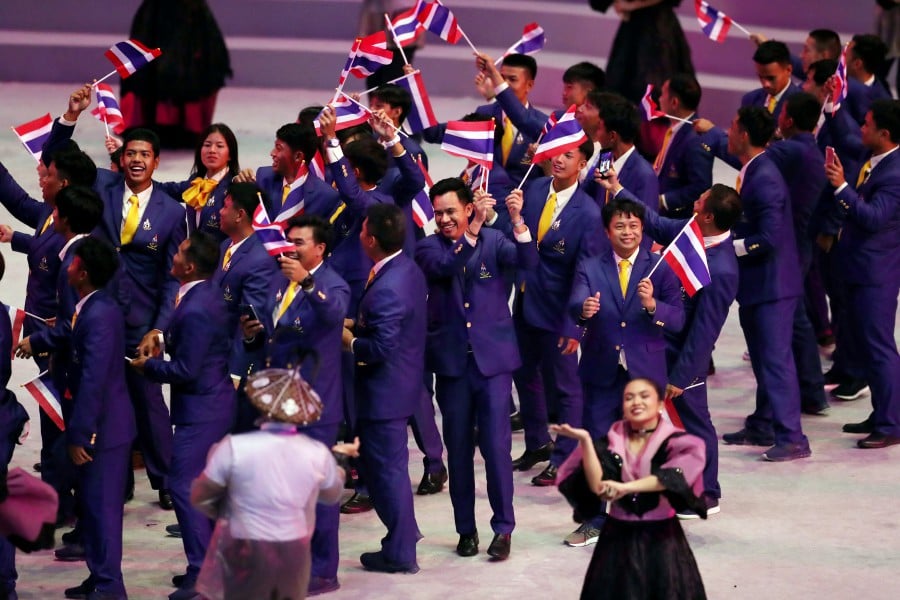
The contingents received loud cheers from the audience as they paraded into the arena in alphabetical order, starting with Brunei, Cambodia, Indonesia, Laos, Malaysia, Myanmar, Singapore, Thailand, Timor Leste and Vietnam, before host nation the Philippines ended the march.

Led by flag-bearer and 2018 bowling world champion Rafiq Ismail, the Malaysian contingent were represented by a delegation of about 100, including chef de mission Datuk Megat Zulkarnain Omardin and his two deputies, Nurul Huda Abdullah and Ahmad Faedzal Md Ramli.
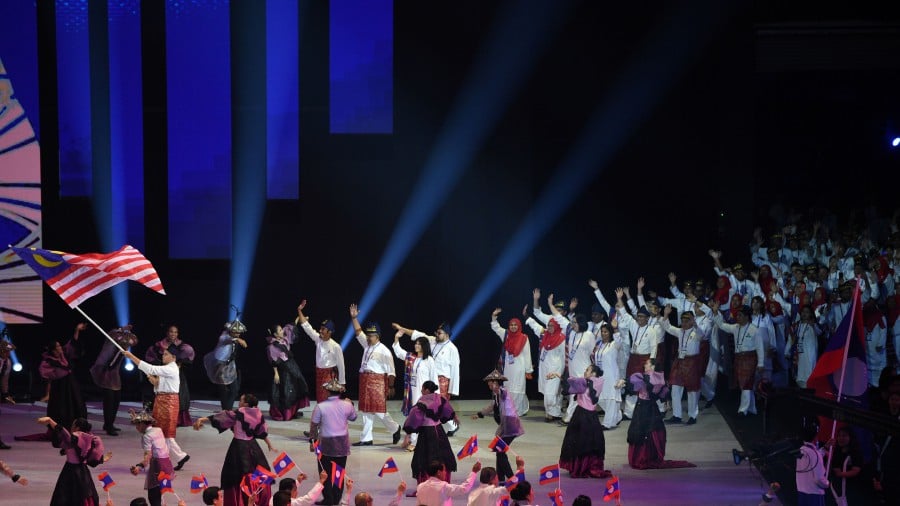

With the men dressed in white baju melayu and red samping with tengkolok, and the women in white baju kurung and selendang with Jalur Gemilang motif, and black shoes, the multi-racial Malaysian contingent, the hosts of the previous games, walked past the crowd proudly, symbolising the multiculturalism of the country.

World renowned Filipino boxers Manny Pacquiao and Nesthy Petecio were given the honour as the torchbearers before they jointly lit the cauldron to officially mark the beginning of the 30th SEA Games, after Philippine President Rodrigo Duterte had declared open the Games.

Themed ‘We Win As One’, the Games will run for 12 days until the closing ceremony at the New Clark City Athletics Stadium on Dec 11.
More than 8,000 athletes from the 10 ASEAN countries and Timor Leste will compete in 530 events in 56 sports at the three main clusters, namely Manila, Clark and Subic.


The Philippines have hosted the SEA Games three times before – in 1981, 1991 and 2005.
This year’s Games see the introduction of a few new sports such as arnis, jujitsu, kickboxing, underwater hockey and esports.

Defending champions Malaysia have sent a strong contingent of 773 athletes and 339 officials to participate in 52 sports, targeting 70 gold, 51 silver and 105 bronze medals, which is expected to place them fourth overall.– BERNAMA

Friday, October 18, 2019

...the microconsumer lending countries

Laos, India, Philiipines, Myanmar and Vietnam the have highest prospects for the development of online microconsumer lending, according to Robocash Group study

Stephen Netto
theonlinecitizen.com
18 October 2019


With a growing attention to financial inclusion of the population lacking access to finance, countries in South and Southeast Asia are demonstrating the dynamic development of financial services.
According to a study by financial holding Robocash Group on the prospects for online micro consumer lending across countries in the region, Laos, India, the Philippines, Myanmar, and Vietnam have taken the highest positions in the company ranking.

The highest score in the ranking (20) belongs to Laos. It combines a high potential of the untapped demand with a positive attitude to short-term online lending from the government and population. The need for relevant products in Laos is similar to the situation in Myanmar, but it is free from some obstacles of the latter.

Over time, the new market will grow, and foreign investors may significantly contribute to this process. The underdevelopment of the legislation and the absence of financial institutes such as credit bureaus encourage experienced foreign companies with a fine-tuned scoring and reliable operation processes to support the efficient development of the market.

India holds second place with a score of 18. Despite a direct connection between the development level of a country and its place in the ranking, India is an exception. Although a significant part of local people already has access to credit products (79.9%), the rest include hundreds of millions of people. It correlates with the formed regulation.
After all, the market has a relatively small number of foreign companies, and not many Chinese startups have entered the market. Hence, the competition remains quite moderate.
Third place belongs to the Philippines (16). The country gives in the leading positions to other countries because of their hidden potential. However, other advantages compensate for it. The country has an established market of short-term lending services, flexible, and facilitative regulation.
Not forgetting, there is a balance between the high demand for relevant products and low debt load among the population. Moreover, the Philippine government is driving the digitization of financial services to decrease the factor of geographical fragmentation. It makes the country stand out on the regional background.
Myanmar is fourth in the ranking (14). As a country with a relatively large number of people below the poverty line and high demand for micro consumer loans, Myanmar stands out in comparison to the more developed countries in Southeast Asia. Still, some points are holding the market back.
Partly, this is due to its underdevelopment. The government has introduced strong regulation to get rid off illegal creditors, which activities have led to debt overload of the population. The latter reduces the attractiveness of the country for foreign companies significantly.
Fifth place belongs to Vietnam (12). Vietnam demonstrates significant demand for micro consumer online loans. With a large number of people living in rural areas (66%), only one-third of the population has access to credit products. Another stimulating factor is the growing GDP forecasted to increase by 6.6% by 2020.
Nonetheless, Vietnam should improve its regulation in terms of licensing of companies and control of financial statements. Overall, the country represents a bright example of the market with a medium position in the ranking. Vietnam is quite perspective but gives in the leadership due to the current difficulties for the business.

Tuesday, September 10, 2019

...the Asean leader in gender-equality

PHL cited as gender-equality leader in government hiring - ADB, OECD


Business World | September 10, 2019

THE Philippines is a regional leader in terms of gender equality in job hiring, specifically in the public sector, the Asian Development Bank (ADB) and the Organization for Economic Co-operation and Development (OECD).
Asian Development Bank (ADB)
Speaking to reporters at the launch of the Government at a Glance Southeast Asia 2019 report issued by the ADB and OECD, Chiara Bronchi, an ADB Chief Thematic Officer from the bank’s Thematic Advisory Service Cluster, said the study found that 53.7% of public sector jobs in the Philippines were occupied by women in 2016, up from 50.7% in 2009.
The Philippines outperformed the the Southeast Asian average of 47% in 2016, while also employing larger proportions of women than Japan or South Korea, where less than 50% of public sector employees were women,
“That makes actually Philippines a leader… in terms of hiring [with] a gender balance if you are in the public sector,” Ms. Bronchi said.
Edwin Lau, Head of the Reform of the Public Sector division at the OECD’s, Public Governance Directorate, said the findings reflect “meritocratic” hiring in government service.
“You also see that the types of recruitment systems that are used are very meritocratic, so they’re really built to ensure top-quality people are rising in the public service,” Mr. Lau said.
He said the Philippines is “far above” the Southeast Asian average in terms of performance management systems.
“It’s [Philippines] even using more performance management systems than OECD countries… (In) public employment… the systems are fairly well developed,” he added.
The study also found that women are underrepresented in parliamentary bodies, with only 20% of these seats across the region held by women in 2018, just 1.7 percentage point higher from a decade earlier.
The report is the first of its kind that looked into the latest available data on public administration in Brunei, Cambodia, Indonesia, Laos, Malaysia, Myanmar, the Philippines, Singapore and Vietnam. — Luz Wendy T. Noble

Saturday, April 5, 2014

...the WEF PH jump

PH jumps 8 notches in WEF global trade index

 
The index measures how well countries facilitate the flow of goods and services over borders to their jurisdictions
 Rappler.com                      
Apr 03, 2014
UP 8 NOTCHES. The Philippines improves its ranking in the World Economic Forum's Enabling Trade Index 2014 report
MANILA, Philippines – The Philippines advanced 8 places in the World Economic Forum's (WEF) annual survey measuring how open countries are to international trade.

The Philippines ranked 64th out of 138 economies in WEF's 2014 Enabling Trade Index, up from 72nd in 2012. The country has risen 28 places since 2010, when it landed on 92nd spot.

In ASEAN, the Philippines was 5th, following Singapore, Malaysia, Thailand and Indonesia.

Following the Philippines were Vietnam, Cambodia, Lao PDR and Myanmar.

The Enabling Trade index "assesses the extent to which economies have in place institutions, policies, infrastructures and services facilitating the free flow of goods over borders and to their destination." These trade-enabling factors are classified under 4 categories: market access, border administration, infrastructure, and operating environment.

WEF said the Philippines did well on market access, but there was room for improvement with respect to the other categories. It said border administration was mired by corruption and red tape – two things that also weakened general operating environment in the country.

WEF added, "Like many countries in the region, the Philippines’ biggest weakness is the lack of adequate transport infrastructure." It cited shortcomings in airport and port infrastructure, and insufficient associated logistics services.

Despite persistent challenges, the Philippines enjoyed competitive advantages in several areas, according to Peter Perfecto, executive director of the Makati Business Club, which has been a partner institute of WEF in the Philippines for its trade and competitiveness surveys.

These areas included "specific tariffs, tariffs faced, cost to export, cost to import, tariff dispersion, ease and affordability of shipment, available international airline seats in kilometers per week, customs services index, access to finance, share of duty-free imports, number of distinct tariffs, efficiency of clearance process, tariff rate, number of days to import, and ICT use for business-to-business transactions.”

When it comes to exporting in the Philippines, the top 5 problematic factors were "high cost or delays caused by domestic transportation, access to imported inputs at competitive prices, technical requirements and standards abroad, identifying potential markets and buyers, and difficulties in meeting quality/quantity requirements of buyers."

When it comes to importing, the problematic factors were "burdensome import procedures, corruption at the border, tariffs, high cost or delays caused by domestic transportation, and high cost or delays caused by international transportation." – Rappler.com


Tuesday, April 2, 2013

...the Filipinos in ASEAN Film fest

Filipino talents shine in ASEAN Film Festival


Philippine Information Agency
April 2, 2012


MANILA, April 2 -- Filipino film talents proved once again that they are world-class in their chosen field as they reaped honors during the first ASEAN International Film Festival and Awards (AIFFA 2013) in Kuching, Sarawak from March 28 to 30.

Best Picture - Sta. Niña

During the awards night held on March 30 at the Borneo Convention Center and attended by prominent ASEAN film personalities, Filipino actors Alessandra de Rossi, Anita Linda and Bugoy Carino took home the Best Actress, Best Supporting Actress and Best Supporting Actor awards, respectively. The movie Sta. Niña garnered the Best Picture-Drama honors.


Best Actress Alessandra de Rossi - Sta. Niña
 
Best Supporting Actress Anita Linda - Sta. Niña

Best Supporting Actor Bugoy Cariño - Alagwa


De Rossi and Linda were honored for their performance in Emmanuel Quindo Palo’s Sta. Niña, while Mr. Carino took home the prize for the Ian Dean Loreños’-directed Alagwa.


The Philippines tied with Malaysia for the number of awards at four, Indonesia bagged three awards, while Singapore garnered one award. Brunei Darussalam, Laos, Myanmar and Hong Kong also participated in the AIFFA 2013, a statement from the Department of Foreign Affairs said.

Malaysian director U-wei Haji Saari was given a Special Honour award, while Malaysian-born Hollywood actress Michelle Yeoh was bestowed the AIFFA Lifetime Achievement Award.

“Once again, Filipino artistry in film shone brightly in this festival. With these honors, we have uplifted the profile of the Filipino community here in Malaysia and in the entire ASEAN. I extend to them my warmest congratulations,” Philippine Ambassador to Malaysia J. Eduardo Malaya said.

“Here in Malaysia, the Philippines and Filipino actors are well-admired because of their talent and charisma. Malaysian channels have bought rights to and screen Filipino soap operas here, which are actively watched and enjoyed by audiences here. In fact, some Filipino actors enjoy a huge following in this country,” the Ambassador added.

Eleven Filipino feature films joined over 100 films made by ASEAN artists in the the maiden edition of the film festival, including Tyrone Acierto’s The Grave Bandits, Whammy Alcazaren’s Colossal, Lawrence Fajardo’s Posas, Marie Jamora’s Ang Nawawala, Gutierrez Mangansakan II’s Qiyamah, Vincent Sandoval’s Aparisyon, Richard Somes’ Supremo and Paul Sta. Ana’s Oros.

A student’s short film, Juan Paulo Reyes’ “Ode to Home,” was also screened.

A 25-member Philippine delegation was present during the film festival, led by cinematographer Rain Yamson II. Other notable Filipino personalities who attended were popular Filipino actors Ricky Davao, who was member of the five-man jury, and Jericho Rosales, who was also nominated for Best Actor honors for his role in Alagwa.

Filipinos also played vital roles during the awards ceremonies, with actors Alfred Vargas and Dominic Roco presenting the awards and Miss Saigon star Ima Castro performing in one of the intermission numbers.

Embassy Cultural Attaché Helen Grace Cuisia and Filipino community leaders Justin Yntig Bersales Jr. and Audry Wan Ullok-Bersales were present during the awards ceremonies.

The AIFFA 2013 aims to draw attention to and raise the profile of ASEAN films. The festival hopes to contribute towards the development of films within ASEAN, providing an avenue for its filmmakers to showcase their work to a global audience and most importantly, have these films recognised on an international scale.

It was endorsed by the Sarawak Tourism Ministry and fully supported by the Malaysian Ministry of Information, Communications and Culture, the Malaysian Foreign Ministry’s ASEAN-Malaysia National Secretariat and the National Film Development Corporation Malaysia. (DFA/ASEAN)

Tuesday, March 26, 2013

...the PHL vision

Gov't aims to make PHL a major hub in SE Asia


Philippine Star
March 26, 2013


MANILA, Philippines - Finance Secretary Cesar V. Purisima reiterated the Aquino administration’s goal to turn the Philippines into a major hub in Southeast Asia.

During Standard Chartered’s 2013 Singapore Forum, Purisima highlighted the Philippines’ commitment to integrate with Asean members and enhance its business environment to become a major hub in the region.

“We in the Philippines look forward to Asean Integration in 2015. Our hope is that the Philippines will be the Northern and Pacific Gateway to Asean. The Aquino Administration is committed to ensuring that we continue to invest in infrastructure, our people, and address the constraints to growth to ensure that our people are ready to take full advantage and be part of an integrated Asean,” Purisima said.

The Southeast Asian region, with a population of over 600 million people, is seen to become a major economic growth force in Asia when the planned regional common market of Asean countries is established by 2015.

This will significantly reduce the cost of production for the businesses and economic growth of member-countries.

“The ASEAN demographic places the region in a very strong position for growth. It is important that ASEAN integrates because our collective strengths are more formidable than our individual competencies,” Purisima said.

The region, comprising the Philippines, Singapore, Malaysia, Indonesia, Cambodia, Brunei, Laos, Thailand, Vietnam, and Myanmar, collectively makes up the world’s third largest population behind only China and India. Its population is also one of the youngest in the world, with an average age of 27, which Purisima said puts the region at an advantage versus the rest of the world.
 
Purisima likewise underscored the importance of Asean’s initiatives in connectivity, “we have to be connected with each other, not just through infrastructure, but also connectivity through common standards for trade and investments.”

Wednesday, January 30, 2013

...the Philippine president

Aquino Takes On World Heavyweight


By William Pesek, (Bloomberg)
Repost: Manila Bulletin
January 29, 2013


MANILA, Philippines --- Say what you want about President Benigno S. Aquino III, but the Philippines top official has some brass.


First he arrested former President Gloria Macapagal Arroyo on corruption charges and ousted her Supreme Court chief justice Renato C. Corona. Then he took on the powerful Catholic Church, shepherding free-contraception laws that enraged the Vatican. Next he ran afoul of the local tycoons by backing higher taxes on cigarettes and alcohol. By tackling these issues along with economic reforms, Aquino’s country is on the way toward an investment-grade credit rating.

Now Aquino is taking on an immeasurably bigger target: China. The Philippines will challenge China’s maritime claims before a United Nations-endorsed tribunal. This isn’t going over well in China, and it’s sure to raise tensions as Asia vies for oil, gas, and fisheries resources and a ruling on competing views of history in contested waters.

Much of it really is an argument over China’s controversial “nine-dash” map. First published in the late 1940s, the map extends China’s territorial claims as much as 800 miles from Hainan Island to the equatorial waters off the coast of Borneo. China says the map proves its “indisputable sovereignty” over more than 100 islands, atolls and reefs that form the Paracel and Spratly Islands. The rest of Asia disagrees.

Geopolitical Risk
This dispute represents something more for political scientists, such as Ian Bremmer. As leaders and investors alike try to navigate a world they no longer understand, they are turning to Bremmer, the president of Eurasia Group in New York, and his ilk for perspective. And when Bremmer considers the biggest threats in the year ahead, East Asian brinkmanship is near the top of the list.

“At risk here is the decades-long pattern of East Asia as a zone where positive-sum commerce and economics trumps zero-sum geopolitical tension,” Bremmer says.

US Secretary of State Hillary Clinton and Defense Secretary Leon Panetta are right to worry about military conflict. The intensifying spat over a group of tiny islands that Japan calls Senkaku and China calls Diaoyu is the most dangerous flash point.

Strains rose last year after Japan effectively nationalized the islands. At first, it was just about fishing rights and coast guard vessels squaring off. From April to December, there was a disturbing trend: Tokyo’s Self-Defense Force scrambled fighter jets 160 times against Chinese aircraft approaching Japanese airspace. That’s the highest number of aerial contacts since Japan began releasing such data and is a significant proxy for escalating tensions.

Markets seem convinced that pragmatism will rule the day. China needs rapid growth to ensure the Communist Party’s grip on power, and Shinzo Abe, Japan’s new prime minister, aims to revive his nation’s moribund economy. The primacy of commerce, the conventional wisdom says, will prevail. This sunny view ignores how nationalism clouds Asia’s judgment.

China doesn’t deserve all the blame. Japan, too, has a disproportionate number of territorial quarrels – with Russia, South Korea, and Taiwan. Abe, a nationalist, wants to alter Japan’s pacifist Constitution. But China’s assertiveness and fast-growing military apparatus, which now includes an aircraft carrier, is generating concern throughout the region as well as the US.

Asia has never been closer economically, yet it’s growing further apart diplomatically. It lacks a credible forum where disagreements can be aired, a void that strengthens China’s hand. China has been adept at using its economic leverage over tiny nations such as Cambodia and Laos to block multilateral talks or actions. This forces the US into the uncomfortable position of balancing competing economic and security priorities with a fast-rising rival.

Something Bigger
By resorting to international law, Aquino is taking a positive step. The way to address and resolve the dispute is through diplomacy, not with navy ships or hot tempers that risk turning minor confrontations into something much bigger.

Yet this is only the beginning. Last year marked a turning point as an economically dominant China shifted from charm-offensive mode to political and military assertiveness. This is playing out against the backdrop of the ascension of Xi Jinping as China’s leader, and what that will bring in 2013 and beyond.

Confronted by a daunting list of domestic challenges, Xi will focus on consolidating domestic power. It is farfetched to think he would yield ground on diplomatic issues if it risks an internal backlash.
“If Beijing faces a foreign policy test, Xi will have a strong incentive to demonstrate his foreign-policy mettle and avoid being seen as capitulating to outside interests,” Bremmer says. “That dynamic suggests less chance of compromise from Asia’s emerging strategic powerhouse and heightened risk throughout the region.”

Tests could come from many places – a new Japanese government anxious to flex its muscles; US President Barack Obama’s pivot to Asia; provocations from North Korea that put the onus on China, Pyongyang’s crucial supporter; or nations like the Philippines taking diplomatic frustrations to the UN.

Aquino is the first Asian leader willing to call China’s bluff and risk economic retaliation. How he navigates this showdown will be instructive for others when their turn comes.

Friday, January 18, 2013

...the Japanese investment in PH

PH to reel in $20B in foreign investments from Japan, says economic analyst


By Gil C. Cabacungan


Albay Gov. Joey Salceda, an economist, said that Japan’s fear of China’s increasing military and financial might would likely trigger the second massive outflow of Japanese direct investments. INQUIRER FILE PHOTO


MANILA, Philippines—The Philippines is well poised to profit from Japan Prime Minister Shinzo Abe’s move to steer clear of China and move to Southeast Asia for capital expansion.

Trade and Industry Secretary Gregory L. Domingo told the Philippine Daily Inquirer: “I agree we will benefit, we are already seeing some of it now.”

Japan is the country’s biggest business partner with total trade and investments of $13 billion and the third biggest source of tourists.

Albay Gov. Joey Salceda, an economist, said that Japan’s fear of China’s increasing military and financial might would likely trigger the second massive outflow of Japanese direct investments.

Salceda noted a repeat of the effect of the 1987 Plaza Accord where the United States, France, West Germany, United Kingdom and Japan agreed to force the appreciation of the yen from 248 to 78 per US dollar to help the American economy recover.

“The Philippines was not able to optimize the benefits due to coup-driven political instability post-EDSA and aggressive competitive marketing by Malaysia, Thailand and Indonesia. We cannot afford to lose out again on this FDI (foreign direct investment) bonanza which I consider to be the single most important economic factor in the Philippine horizon,” said Salceda.

Salceda said that if the Philippines played its cards right, it could haul in at least $20 billion in Japanese investments in manufacturing over the next six years.

“I started to be an analyst during 1989, one year after the Plaza Accord. I remember quite distinctly that this was the number the analysts community were projecting,” said Salceda.

“This is the most benevolent economic and external discrete factor ever to happen in favor of the Philippines, only the Asian pivot of the US geopolitics comes second,” said Salceda.

Salceda suggested that given this massive opportunity, the Aquino administration should push for “more articulate ambition in infrastructure and more aggressive visioneering and faster execution.”

Another major concern of Japanese investors is the high cost of electricity in the country.

“Since power rates are even higher here than Japan’s — making us the highest in the world — so definitely it must be lower than Japan but the comparison should be with our competitors (not with China) like Malaysia, Thailand and Indonesia on the first tier and on the second tier – Vietnam and on the 3rd tier — Myanmar, Laos PDR and Kampuchea. On my many trips to Japan for our JICA project, I think we would have a normalized market share at P7.50 per kilowatt hour,” said Salceda.

Thursday, November 15, 2012

...the destinations on the rise


Metro Manila named among 'destinations on the rise'


Pinoys don't have to look too far for places to explore, as an international travel website named Metro Manila as one of the destinations in Asia that are getting more and more fun.

Trip Advisor ranked the Philippines' capital region fourth in the list of the top 10 Asian "destinations on the rise."

It followed Jakarta, Indonesia; Kathmandu, Nepal; and Calcutta, India.

Rounding out the list of 10 are Bangalore, India; Luang Prabang, Laos; Phnom Penh, Cambodia; Chiang Mai, Thailand; and the Japanese cities of Kobe and Osaka.

Sunset on Manila Bay, one of the best natural harbors in the region. (Yen Baet)

"Located on Manila Bay in the South China Sea, and bisected by the Pasig River, the capital of the Philippines is historic and modern, rich and poor," the website said.

Intramuros, the seat of power during Spanish colonization, is now a park and a popular tourist destination. (Yen Baet)

It highlighted the walled city of Intramuros as one of Metro Manila's popular sights.

"The capital during Spanish colonization, Intramuros has retained old dungeons and gunpowder rooms but added art galleries and theaters," the website said.

The Manila skyline at night. (Yen Baet)

"The city is filled with museums, shops, parks and churches, plus enough nightlife to last until dawn," it added.

This recent accolade for Manila comes as the Department of Tourism on Wednesday launched a new international television campaign promoting entertainment and lifestyle offerings in Metro Manila.

The video dubbed "Sleepless Nights," shows travel, shopping, food options; Manila's clubs and bars at night; as well as other fun events to watch out for.


Trip Advisor meanwhile noted that Manila acts as the gateway to other destinations in the country.

Among the nearby must-see sites it recommended is Corregidor.

"It is called 'The Rock' because it served as the major bastion of Philippine's Allies during World War II," the website said.

In March, Trip Advisor also ranked Boracay Island at the top beach destination in Asia and the sixth in the world.

Globally, Boracay was rated higher than a number of well-known beach destinations in Hawaii, Miami and Mexico.

Monday, November 12, 2012

...the Education for Sustainable Development Awardee

Philippine Elementary School Wins In Southeast Asian Ministers of Education Organization Japan Education For Sustainable Development Award


Editorial
Manila Bulletin
November 12, 2012
 

A Philippine school won second place in the recent 2012 Southeast Asian Ministers of Education Organization (SEAMEO)-Japan Education for Sustainable Development (ESD) Award, besting entries from the Southeast Asian countries of Indonesia, Lao PDR, Malaysia, Myanmar, Thailand, and Vietnam.

The Iliranan Elementary School in Barangay Codcod, San Carlos City, Negros Occidental, led by its Principal, Gary P. Magnanao, won for its Disaster Education Program. The school is located in an upland barangay at the foot of Mt. Kanlaon where most of the sitios are part of the Mt. Kanlaon National Park, making them vulnerable to volcanic eruption and landslide. Iliranan Elementary School, was also awarded as one of the ASEAN Eco-Friendly Schools on July 17, 2012, in Kuala Lumpur, Malaysia.

First placer was State High School No. 1 of Kungyangon, Myanmar and the third place went to MIN Jejeran (Jejeran State Islamic Elementary School) of Indonesia. A Special Prize from the Bank of Tokyo-Mitsubishi UFJ, Ltd. for the best Disaster Risk Reduction activity carried out in small schools of less than 150 students went to Wat Soumpouathong School, Thailand. The award ceremonies will be held at the SEAMEO High Officials Meeting in Thailand this month.

The SEAMEO-Japan ESD Award was organized by the SEAMEO and the Ministry of Education,Culture, Sports, Science and Technology (MEXT), Japan, in cooperation with UNESCO Asia and Pacific Regional Bureau for Education and the Bank of Tokyo-Mitsubishi UFJ, Ltd. The Award is held every year to promote and share best practices in ESD in schools around Southeast Asia.

We greet the Department of Education headed by Secretary Bro. Armin A. Luistro and the Iliranan Elementary School headed by its Principal, Gary P. Magnanao, in winning second place at the 2012 Southeast Asian Ministers of Education Organization-Japan Education for Sustainable Development Award. CONGRATULATIONS AND MABUHAY!

Saturday, August 4, 2012

...the ASEAN quiz winner

PH wins 5th ASEAN regional quiz
 
 
August 4, 2012
GMA NEWS
 
 
The Philippine team won the fifth Association of Southeast Asian Nations (ASEAN) Quiz Regional Competition in Cambodia last Friday, the Department of Foreign Affairs said Saturday.

Members of the team beat 27 other contestants from Brunei, Cambodia, Indonesia, Laos, Malaysia, Myanmar, Thailand and Vietnam.

"The Philippine team grabbed a total score of 71 points. Cambodia came close with 70 points while Thailand scored 68 points," the DFA said.

Members of the team included:

- Franchesca Anne Inacay of St. Albert the Great School in Dagupan City (Region I)
- Kristiyanne Paul de Pedro of Koronadal National Comprehensive High School (Region XII)
- Maria Angela Krizelle Rubin of San Joaquin National High School in Calbayog (Region VIII)

In the first round, the Philippine Team got a perfect score of 20 points. It got 19 in the second round, and 32 in the third.

The first round had true-or-false items, the second had multiple-choice items, while the third round consisted of the "Fill in the Blanks" items for 40 points.

According to the DFA, the Philippines has been consistent in winning the ASEAN Quiz Regional Competition.

In 2002, the Philippines won first and second places in the individual delegate category of the competition.

In 2004, the country got the first place while in 2006, the Philippines won the second place. The Philippines won the first place again in 2009.

Meanwhile, schools that wish to participate in the next ASEAN Quiz Competition may e-mail the Department of Foreign Affairs' ASEAN Secretariat at asean.philippines@dfa.gov.ph. — LBG, GMA

Saturday, July 7, 2012

...the UNCTAD report

UNCTAD Report Shows Positive Outlook For PH


By MADEL R. SABATER
July 6, 2012
Manila Bulletin

MANILA, Philippines – Malacañang said on Friday that the United Nations Conference on Trade and Development (UNCTAD) World Investment Report 2012 on the Philippines is a step in the right direction toward having higher foreign direct investments (FDIs) for this year.

The UNCTAD reported that while the Philippines has $850-million in FDIs for the first quarter of 2012 alone, up by 75 percent in the same quarter in 2011, it failed to maximize its potential to attract FDIs.

Presidential spokesperson Edwin Lacierda said the country’s FDI in the UNCTAD report was based on the 2011 figure. He expressed optimism that the 2011 figures can be exceeded this year.

“The figures posted by UNCTAD were based on 2011 figures and those figures were culled from the Bangko Sentral ng Pilipinas (BSP),” he said.

“The figures stated by the UNCTAD were that for FDI in 2011 (at) $1.262-billion. Just for the first quarter alone of 2012, our FDI was already at $850-million,” he added.

Last June, the BSP revised the FDI target for 2012 to $1.2 billion from $2 billion due to the slowdown in the United States economy and crisis in the European Community.
 
The UNCTAD report revealed that the Philippines has the potential to attract FDIs but received “less FDIs than could be expected based on economic deterrents.”

But the Philippines received higher FDIs than Laos, Brunei, Myanmar, and Cambodia but still lagged behind other neighboring countries in Southeast Asia.

Saturday, June 23, 2012

...the smart awardee

Smart Communications bags 3 int’l awards


Philippine Daily Inquirer
 
 
MANILA, Philippines—Mobile telecoms giant Smart Communications Inc. recently bagged three major international awards, including top honors as Operator of the Year, at the  2012 Asia Communication Awards (ACA), winning over Singapore’s Singtel and StarHub, Australia’s Telstra Global, and Laos’ Unitel.


The only Philippine telecom company recognized at the ACA’s Annual Awards Dinner held in Singapore, Smart reaped the biggest number of operator accolades. It also won awards for the Netphone (the world’s first smartphone backed by an operator-managed system) under the Innovation Award category, and Secured Health Information Network and Exchange (SHINE) (Smart’s flagship mHealth program), under the Best Emerging Market Initiative category.

Smart is no stranger to the ACA, having been recognized by the prestigious telecom tilt in 2011 as Operator of the Year and Best in Green Technology.

Its key programs made it to the list of finalists of this year’s ACA: Green Merchandising Program, under the Green Technology Award; Jump Experience Center (the Philippines’ first multidimensional experience center of Smart and mother firm PLDT) under the Customer Service Initiative category; and SmartCares (the country’s first customer care channel on social media for a telco) under the Social Media Initiative category.
Smart president and CEO Napoleon L. Nazareno was also nominated for CEO of the Year.

Smart officials Perry Bayani and Gio Bacareza received the awards from Paul Michael Scanlan, Huawei vice president for solution, sales & marketing.

The ACA recognizes the achievements of Asian telecom companies and individuals responsible for the innovations, achievements and new services that are helping shape the future of the industry.

Organized by Total Telecom, the ceremony is one of the highlights of CommunicAsia, the annual information and communications technology exhibition and conference held in Singapore that showcase key and emerging technologies.