Showing posts with label Costa Rica. Show all posts

Friday, October 11, 2019

...the Pinoy world surfing champ

Surfing: PH’s John Mark Tokong tops world competition in hometown Siargao


Kleeseter Macasero
ABS-CBN News
11 October 2019

GENERAL LUNA, Surigao del Norte—Local surfer John Mark Tokong on Wednesday afternoon won the 25th Siargao Cloud 9 International Surfing Cup in this town's world-renowned Cloud 9 surf break with only 45 seconds remaining in the heat.
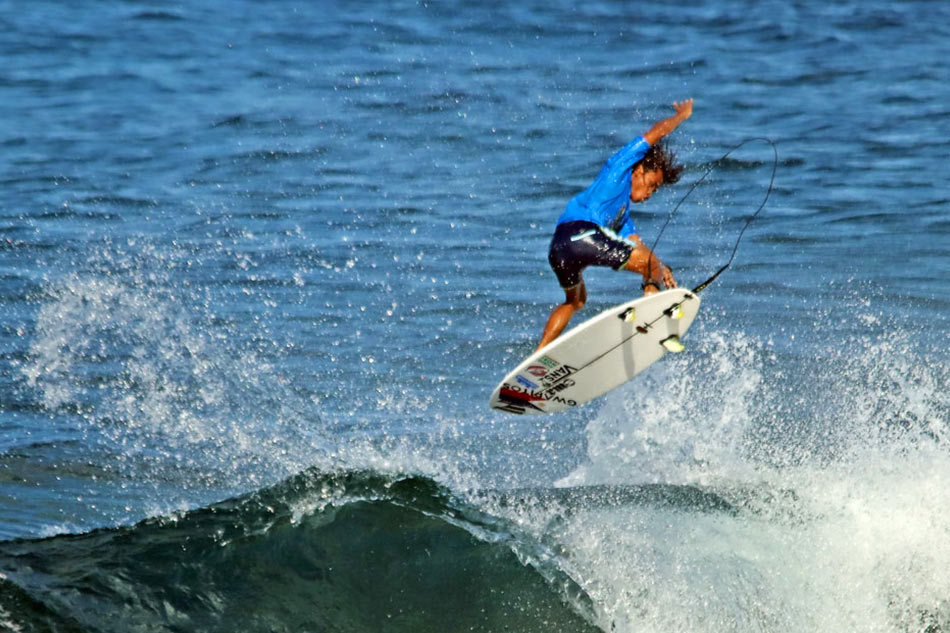
John Mark Tokong of the Philippines nails a 360 air reverse after a successful barrel over the renowned Cloud 9 break, keying his win during the finals of the 25th Siargao Cloud 9 International Surfing Cup in General Luna town, Surigao del Norte, on Wednesday. Kleester Macasero, ABS-CBN News
The Siargao competition is part of the World Surfing League (WSL) qualifying series.

Tokong's win is his second after the WSL-Asian Surfing Championship QS 1,500 Siargao International Surfing Cup in 2015, and it enabled him to redeem himself of a 2018 loss.

Tokong, 23, locally known as Marama, thrilled fans in a late comeback during the final heat of the competition, edging out a few points 16.80 to 16.75 against island surfer Noah Beschen from Hawaii, and besting 64 competitors from 13 countries to win. 

“I just had to stay calm and cool amid the pressure, I did not push or rushed, but of course I gave it my best,” Tokong said.

The victory came as a sweet redemption for Tokong after a loss to Skip McCullough of the US in the 2018 finals of the WSL Siargao Cloud 9 International Surfing Cup.

McCullough returned to Siargao, but he and Koby Oberholzer of South Africa were eliminated in Round 3 of the competition sending Tokong and Australian Thomas Cervi to the quarterfinals. 

In the quarterfinals, Tokong beat Indonesia’s Oney Anwar 18.75 to 9.50 points to give the Filipino surfer a lead toward the semifinals.

In the semifinals, Tokong gave his best run with a 9.50, 9.55, 8.60 and capping off with a 8.75 to top Tomas King of Costa Rica 19.05 to 15.30. 
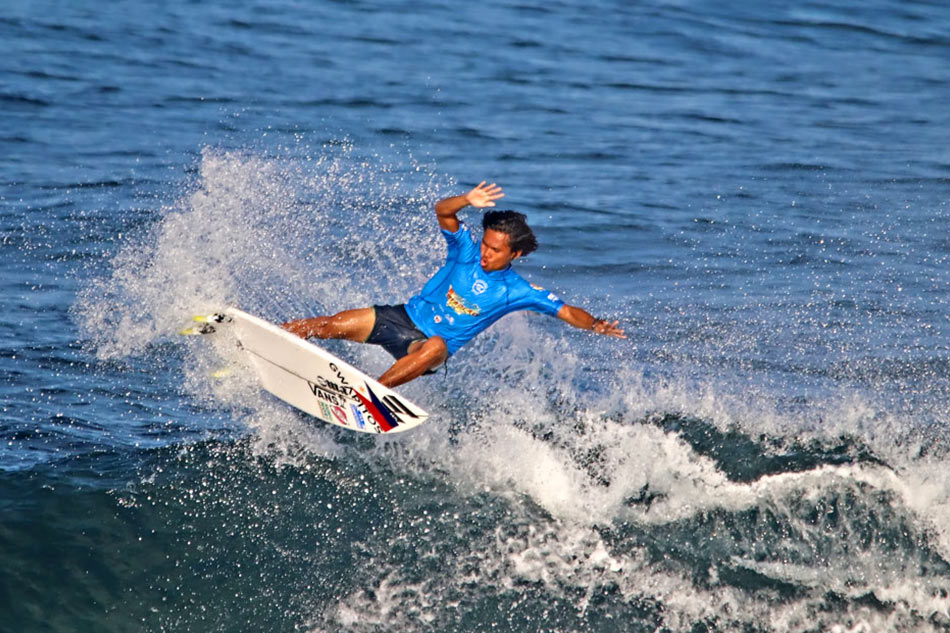
John Mark Tokong of the Philippines nails a 360 air reverse after a successful barrel over the renowned Cloud 9 break, keying his win during the finals of the 25th Siargao Cloud 9 International Surfing Cup in General Luna town, Surigao del Norte, on Wednesday. Kleester Macasero, ABS-CBN News
Spectacular finals

In the finals, even with a few good barrels, Tokong and Beschen began to look more to the air for scores as the classic Cloud 9 tubes became harder to find. The two went toe to toe, with Tokong holding the upper hand a majority of the 40-minute matchup.

Tokong's first two waves initially gave him the lead, 9.00 and 5.75 respectively, but Beschen made a series of quick rides on the wave giving him 8.15 and 6.25 and several more waves than what Tokong was giving.

With only two minutes left, Beschen took off on a set and lined up for a tube that never eventuated, forcing him to launch a massive straight air slob grab. Beschen landed the air smoothly and posted an 8.60 to take the lead and what looked to be his first qualifying series victory.

Then Tokong swung on a set wave with 45 seconds and pulled into a deep tube as the 20-second countdown started, came out and bashed the lip, posting a 7.80 and taking the final by just 0.05 of a point.

"In the end, I almost gave up because there was no time left and then when that wave came I knew exactly what I had to do,” Tokong said.

"Noah is such a crazy surfer, he does so many airs and is so good in these kinds of waves so it was sick to have a final with him. Being from Hawaii he's so good in the barrel and at hitting big sections so I loved surfing with him at Cloud 9.”

On its 25th year, the Cloud 9 competition is part of the WSL Asia sanctioned men’s qualifying series. This year, the WSL Asia has given the event a QS-1,500 category, giving surfers on the circuit a chance to gain additional QS points with a total $15,000 in prize money up for grabs.

“With the QS ranking, surfers are expecting more WQS points, giving competitors a chance to gain higher overall WQS ranking points. Everyone wants a slice of the points, the prize money is more of an added icing on the cake,” event director Gerry Degan said.

The winning surfer will bring home $5,000, while the second spot $3,000 and third spot $1,500.

In the first round kick-off on October 4, surfers from the Philippines, Australia, Argentina, Costa Rica, Ecuador, Hawaii, Japan, Indonesia, South Africa, Spain, Sweden, the US, and Venezuela advanced to Round 2 of the competition. By the third round, only Tokong was left of the 21 Filipino surfers who competed. 

The WSL plans to make the event bigger next year, as the Philippine Sports Commission promised to help organize and raise funds for the event in 2020. 

Sunday, April 21, 2013

...the pilot countries for WB green accounting project

PH picked for WB ‘green accounting’ project

By DJ Yap
Philippine Daily Inquirer

 
  "...the Philippines was selected (by the World bank) as a pilot country for the WAVES program because it was one of the very few nations that had been conducting an accounting of natural resources since the 1990s." - Environment Secretary Ramon Paje  


Environment Secretary Ramon Paje
 

MANILA, Philippines—The Philippines has been chosen along with four other countries for the pilot implementation of a World Bank-led project to develop “green accounting,” or the inclusion of the value of natural resources in measuring a nation’s economic progress.

Environment Secretary Ramon Paje made the announcement on Saturday from Washington D.C., where he represented the country at a high-level ministerial meeting on “natural capital accounting (NCA)” or “green accounting” organized by the WB on April 18.

Paje said the Philippines, along with Botswana, Colombia, Costa Rica and Madagascar, were selected as the implementing partners of the Wealth Accounting and Valuation of Ecosystem Services (WAVES) project of the World Bank.

WAVES is a global partnership that aims to promote sustainable development by ensuring that the national accounts used to measure and plan for economic growth include the value of natural resources.

In a statement, Paje said the Philippines was selected as a pilot country for the WAVES program because it was one of the very few nations that had been conducting an accounting of natural resources since the 1990s.


Accurate information

“The country was noted for accounting for our natural resources such as minerals and forests to provide policy makers with accurate information that could help them make better decisions regarding development priorities and investments that are feasible and sustainable,” he said.

Paje said his participation at the meeting underscored the Aquino administration’s focus on preserving the environment while pursuing sustainable, inclusive and resilient growth.

“It is very important for us to account for our natural wealth, to uphold the principle of intergenerational equity wherein we protect the interest of future generations by protecting our natural resources, especially those that are finite such as minerals,” he said.


Classic example

Paje cited Executive Order No. 79, which institutionalizes and reforms the mining industry, as a “classic example of accounting for natural wealth for future development.”

“While increasing excise taxes from mining companies makes sure that the state gets its rightful share from mineral resources … there is a need to account for the resulting increase in government revenues by investing them in certain long-term infrastructure and programs, such as education and research,” he said.

“This way, even though the nonrenewable resources are extracted, future generations can still, though indirectly, enjoy them through improved goods and services and additional infrastructure,” he said.

The four-year project costs $1.45 million and will begin implementation in the second half of this year, with the National Economic and Development Authority, National Statistical Coordination Board and the Laguna Lake Development Authority as collaborating agencies.


Program of action

WAVES was launched in October 2010 during the Conference of Parties to the Convention on Biological Diversity in Nagoya, Japan. The partnership was able to formulate and propose a program of international action on ecosystems accounting at the Earth Summit held in June 2012.

Advocates argue that “green accounting” is more accurate in determining economic growth and its sustainability, rather than relying on traditional economic indicators such as gross domestic product.

With the GDP, for example, while income from mining or timber harvesting is recorded in national accounts, the simultaneous depletion of natural forest assets and mineral reserves is not accounted for.

The GDP also fails to explicitly identify critical ecosystem services such as tourism, regulating water cycles, preventing erosion and flooding, and carbon sequestration, resulting in misleading economic signals about economic growth and development.


Thursday, February 14, 2013

...the lovers' paradise

Pinoys top global 'love ranking' - report


02/14/2013 
 
 
 MANILA, Philippines - Pinoys have been identified as the most emotional in the world, and now another survey said they are the ones who get the most love.
 
In keeping up with Valentine's Day, Bloomberg.com said the Philippines topped a Gallup survey of 136 countries which asked: "Did you experience love for a lot of the day yesterday?"

The following are where most of the respondents felt most loved:

1. Philippines - 93%
2. Rwanda - 92%
3. Puerto Rico - 90%
4. Hungary - 89%
5. Cyprus - 88%
6. Trinidad and Tobago - 88%
7. Paraguay - 87%
8. Lebanon - 86%
9. Costa Rica - 85%
10. Cambodia - 85%

Meanwhile, these are the countries that occupied the bottom of the list:

136. Armenia - 29%
135. Uzbekistan - 32%
134. Mongolia - 32%
133. Kyrgyzstan - 34%
132. Georgia - 43%
131. Belarus - 43%
130. Morocco - 43%
129. Kazakhstan - 45%
128. Moldova - 46%
127. Tajikistan - 47%

The Gallup survey was conducted in 2006 and 2007.

Tuesday, January 8, 2013

...the top retirement destinations

PH among world's top retirement destinations


Not only is the Philippines more fun for young tourists looking for adventure but also for foreign retirees seeking refuge for old age.

The country has been ranked 15th out of 22 of the "World's Top Retirement Havens in 2013" released by Ireland-based website International Living.

The ranking grew from only 19 countries in the previous list, which did not include the Philippines.

The Philippines got a score of 79.5 point in the Retirement Index, based on eight categories crucial for retirees, including discounts and other perks.

These include real estate, retirement benefits, cost of living, ease of integration, entertainment and amenities, health care, retirement infrastructure and climate.

The Philippines' highest performance was in terms of cost of living (100 points). It ranked highest among the 22 countries in this criterion.

It scored lowest in the special benefits area, getting the lowest score in the list (57 points). Spain and Thailand got the same score.

"Among the top retirement spots in the world this year, you'll find great variety in the cultural offerings, climates and lifestyles," the website said.

Ecuador sat on top of the list, with a score of 91.9 points.

"Ecuador's major cities have top notch hospitals, clinics and well-trained physicians," the website said.

"All residents are eligible to participate in the country’s Social Security health care system for incredibly low monthly premiums," it added.

Ecuador was followed by Panama (89 points), Malaysia, (87.6 points), Mexico (85.1 points), Costa Rica (84.4 points).

"Each destination is desirable in its own way, but they all offer something increasingly hard to come by at home: A good quality of life for a reasonable price," the website said.

It noted, however, that "no 'formula' can spit out the name of the place that's just right for you."

Retirees should consider what's most important to them, "maybe climate, maybe language, maybe cost, maybe distance from home," it added.

Friday, December 21, 2012

...the world's most positive people

Pinoys among world's most positive people


Pinoys may not be the richest based on "traditional economic indicators," but they didn't have to be rich at all to be counted among the world's most positive people, results of a new poll showed.

The Philippines was ranked 7th out of 148 countries in terms of "highest positive emotions worldwide" in a list put out by U.S. pollster Gallup.

Results of the survey, which Gallup said showed that "higher income does not necessarily mean higher well-being," are based on telephone and face-to-face interviews conducted in 2011 with 1,000 adults globally

Respondents were asked "whether they experienced a lot of enjoyment the day before the survey and whether they felt respected, well-rested, laughed and smiled a lot, and did or learned something interesting."

Despite their penchant for melancholic soap opera, the percentage of Pinoy respondents who admitted experiencing positive emotions is higher than the global average according to the survey.

This, even as Gallup noted a "relatively upbeat world," with results showing that 85 percent of total respondents worldwide felt treated with respect, 72 percent smiled and laughed a lot, 73 percent felt enjoyment and 72 percent felt well-rested.

"The only emotion that less than half of people worldwide reported experiencing was getting to learn or do something interesting the previous day, at 43 percent," Gallup said.

"Despite many global challenges, people worldwide are experiencing many positive emotions," it noted.

Latin Americans are found to be the most positive people in the world, with eight countries in the region landing in the top 10 of the list.

Panama and Paraguay shared the top spot with 85 percent of respondents admitting feeling positive emotions.

They were followed by El Salvador and Venezuela, tied at 84 percent; as well as Trinidad and Tobago and Thailand, 83 percent.

The Philippines shared the 7th spot with Guatemala.

Rounding out the top 10 in the list are Ecuador and Costa Rica, which both posted positivity scores of 81 percent.

"These data may surprise analysts and leaders who solely focus on traditional economic indicators," Gallup said.

It noted that Panama, which topped the list of countries with positive emotions, ranks 90th in the world with respect to gross domestic product per capita.

Residents of Singapore, on the other hand, which ranks 5th in the world in terms of GDP per capita, are the least likely to report positive emotions.

Singapore emerged as the country with the "least positive emotions worldwide," with less than half (46 percent) of respondents saying they experienced positive emotions.

It was followed by Armenia at 49 percent; Iraq, 50 percent; Georgia, Yemen and Serbia, 52 percent; Belarus, 53 percent; as well as Lithuania and Madagascar, 54 percent.

Sharing the 10th spot in terms of being least positive are Afghanistan, Azerbaijan, Togo and Macedonia, all at 55 percent.

Gallup said the survey showed that "leaders who are looking for ways to further improve the human condition in their… need to do more to incorporate wellbeing into their leadership strategies."

Thursday, December 20, 2012

...the happiest countries

Philippines among 10 'happiest' countries


MANILA, Philippines - The Philippines is among the 10 happiest countries in the world, according to a recent survey by a US-based polling firm.
 
US based polling firm Gallup Inc. said that the nation with "highest positive emotions worldwide" were Panama and Paraguay with 85 percent answering YES to the questions: Did you feel well-respected yesterday? Were you treated with respect all day yesterday? Did you laugh or smile a lot yesterday? Did you learn or do something interesting yesterday? Did you experience the following feelings during a lot of the day yesterday? How about enjoyment?
 
Next to Panama and Paraguay were El Salvador and Venezuela with 84 percent and on third place were Trinidad and Tobago and Thailand with 83 percent.
 
The Philippines shared the 4th place with Guatemala, where 82 percent of the surveyed persons answered YES to the six questions.
 
The last pair on 5th place was Ecuador and Costa Rica, which both got 81 percent.
 
An Associated Press news article quoted one of the surveyed Filipinos: a 35-year-old security guard named Felicio Sayat.
 
Sayat commented in the survey: "Just being with my family makes me happy ... We have fun together as a family. ... We have bonding time and we say prayers together. ... They are my inspiration. As long as we are all healthy, I am happy. There is nothing better than that."
 
Sayat works as a security guard at a parking lot in Manila.
 
Gallup Inc. said that the surveys were conducted in 148 countries in 2011.
 
"Results are based on telephone and face-to-face interviews with 1,000 adults, aged 15 and older, conducted in 2011 in 148 countries and areas," it said.
 
Meanwhile, the polling firm reported that the country with the "lowest positive emotions worldwide" was Singapore, where only 46 percent answered YES to the six questions.
 
Following Singapore was Armenia with 49 percent; Iraq with 50 percent; Georgia, Yemen and Serbia, with 52 percent; Belarus with 53 percent; Lithuania and Madagascar, both with 54 percent; Afghanistan, Azerbaijan, Haiti, Togo and Macedonia with 55 percent.

Friday, November 30, 2012

...the top choice for offshoring

PH is top choice for ‘offshoring’


Study notes emergence of competing locations

By Doris C. Dumlao
Philippine Daily Inquirer

Employees work on a construction site in Manila on Sept. 17, 2012. The International Monetary Fund has kept its 2012 growth projection for the Philippines, but reduced its figure for next year as it sees a weaker global economy. AFP PHOTO/JAY DIRECTO


THE PHILIPPINES, India and China are the top three global shoring locations for corporations based on the number of jobs created in shared service centers, call centers and technical support centers from 2008 to 2011, according to a new report from global real estate adviser Jones Lang LaSalle.

The Philippines attracted 115 projects during that period, creating more than 72,000 jobs; India attracted 105 projects with 64,370 jobs and China, 56 projects with 25,455 jobs, said the JLL report “Onshore, Nearshore, Offshore: Still Unsure?” released last week.

The other top locations and the number of jobs created were: 4. United Kingdom (22,304); 5. United States (18,594); 6. Brazil (13,964); 7. Poland (13,476); 8. Mexico (11,515); 9. Romania (11,438), and 10. Costa Rica (8,878).

The JLL study said the changing global economic landscape was affecting corporate strategy and location decision-making. “The threat of recession, political uncertainty and rise of global emerging nations are causing international corporations to re-assess their location strategy. Companies are increasingly selecting from three ‘shoring’ options: onshore, offshore and near-shore,” it said.

Commenting on the decision companies faced, Ian Mackenzie, head of solutions development for JLL in Asia Pacific said: “A longer term focus on improving business productivity, operational efficiency and future scalability is now driving corporate real estate decision-making, rather than straight cost-savings in the short term. Corporations are undertaking comprehensive and early initial business case-and-option analysis” in designing their location strategies.

“For Asia Pacific-based corporations, a growing number are seeking the cost and productivity benefits associated with shoring, often sticking to offshoring or near-shoring options within the region. At the same time, in order for emerging nations such as India, Philippines, China and Malaysia to attract greater foreign direct investments (FDI), greater transparency is needed as well as access to quality labor and better location options,” he added.

Lylah Fronda, associate director for markets of JLL Philippines, added: “We see first-hand that the Philippines continues to be the preferred choice for offshoring. A highly skilled English-speaking population, coupled with a responsive real estate market with the right infrastructure creates a perfect mix for companies that understand the efficiency of going abroad for many business processes and call center operations.”

As to real estate conditions, the cost of offshoring operations in Manila was estimated by the study at $222 a square meter a year, more expensive than $187 in Bangalore or even $189 in Kuala Lumpur. But this was cheaper than the $300 in Mexico City, $606 in Sao Paolo or $372 in Buenos Aires.

The overall vacancy rate in the Philippines was estimated at 3.6 percent, suggesting less choice of office space compared to other typical offshoring destinations. In Bangalore, for instance, the vacancy rate was estimated at 7.7 percent while in Mexico and Sao Paolo, the rates were 13 percent and 11.9 percent. Buenos Aires’ rate was closer to that of the Philippines at 4.2 percent.

Meanwhile, the study noted that onshoring in mature markets was one trend that had re-emerged in recent months with a clear increase in strategic analysis and activity, particularly in the United States.

“Rebalancing within mature economies, as well as weakening currencies and growing availability of skilled labor, have led to a growth in the attractiveness of onshore locations. Locating business functions and supply chains onshore means companies can be closer to their customers, reducing supply chain complexity and risk and potentially allowing greater responsiveness to changes in demand,” the study said.

The study said paradoxically, the same logic of being close to the customer was also driving offshoring activity. “For international companies, particularly those in the pharmaceutical, and FMCG (fast-moving consumer goods) sector, seeking to align business functions and supply chains to high-growth emerging markets, an agile offshore location strategy can be a critical point of entry into a major market,” the study said.

Thursday, November 22, 2012

...the world's most emotional societies


PH named 'most emotional society' in global list

 
It has been dubbed as a "bright spot" amid a global slowdown and a "rising tiger" in Southeast Asia, and now the Philippines is also deemed the best in a criteria money can't buy: emotions.

This, as the Philippines is named "most emotional society" in over 140 countries surveyed by U.S. pollster Gallup, a Businessweek report Wednesday said.

Asked questions aimed at determining recently felt emotions, 60 percent of Filipino respondents answered "yes."

But that doesn't necessarily make most Pinoys drama queens, as it could also easily mean that they are the clowns.

Among the questions in the Gallup survey, Businessweek said, are: "Did you feel well rested yesterday? Were you treated with respect all day yesterday? Did you smile or laugh a lot yesterday?"
 
Respondents were also asked if they experienced enjoyment, physical pain, worry, sadness, stress or anger "during a lot" of the previous day.

Next to the Philippines in terms of feelings are El Salvador, where 57 percent admit to expriencing a lot of emotions; Bahrain, 56 percent; and Oman, 55 percent.

Tied at 55 percent "yes" are Chile, Costa Rica, Guatamala, Bolivia, Ecuador, Dominican Republic, Peru, Nicaragua and the U.S.

Singapore, meanwhile, emerged as the "most emotionless" society with only 36 percent of respondents saying they experienced a lot of feelings in the previous day.

It was followed by Georgia and Lithuania at 37 percent; and Russia, Madagascar, Ukraine, Belarus, Kazahkstan, Nepal and Kyrgystan, which are tied at 38 percent.

Earlier this year, the Philippines figured in the group of countries deemed "happy" in a separate global survey dubbed the "Happy Planet Index."

The country ranked 25th in the latest Happy Planet list, dropping from being 14th in 2009, with an index score of 52.4.

Meanwhile, official government measure of happiness was pegged at 66.2 index points in 2010, down from 67.24 in 2008.

Pinoys are happiest in the areas of education, love life, friends, family and work, data from the National Statistical Coordination Board showed.

However, Filipinos think that the "most important" sources of happiness are family, health, religion or spiritual work, work as well as peace and security.

Friday, October 26, 2012

...the Pinoy doc to UN post


Pinoy doctor elected to UN committee vs. torture


A Filipino doctor is among the 12 new members of a committee in the United Nations (UN) in Geneva, Switzerland, a local group disclosed on Friday.

Dr. June Pagaduan Lopez, founder of Medical Action Group (MAG), was elected as a member of UN Anti-Torture Committee’s Subcommittee on Prevention of Torture and Other Cruel, Inhuman or Degrading Treatment or Punishment (SPT).


In a statement, MAG congratulated Lopez for bringing Pinoy honor, by serving as one of the experts who will monitor detention conditions in more than 60 countries around the world until 2016.

"This will considerably strengthen the mandate of the SPT in torture prevention particularly in the field of mental health rehabilitation of torture survivors and their families," the group said.

The SPT has a preventive mandate focused on an innovative, sustained and proactive approach to the prevention of torture and ill treatment.

Lopez was elected during the fourth meeting of Optional Protocol to the Convention against Torture and other Cruel, Inhuman or Degrading Treatment or Punishment (OPCAT) on Thursday.

She will be working with other experts from Switzerland, United Kingdom, Argentina, New Zealand, Lebanon, Serbia, Mauritius, Costa Rica, Brazil, Germany and Republic of Moldova.

A professor at the University of the Philippines (UP) in Manila, Lopez exemplified “outstanding commitment” to the promotion and defense of human rights, MAG said.

She has been using her expertise in psychiatry for the rehabilitation of torture survivors for many years, the group noted.

The Philippines became the 63rd State Party to the Optional Protocol to the Convention against Torture and Other Cruel, Inhuman or Degrading Treatment or Punishment (OPCAT) in April.

Tuesday, May 1, 2012

Pinay crowned Miss Teen Universe 1st runner-up

05/01/2012
 
 
MANILA, Philippines – The Philippines' representative to the international Teen Universe pageant was crowned first runner-up at the contest's recently held coronation night in Managua, Nicaragua.
 
Clarisse Obia, first runner-up in the 2012 Teen Universe pageant
Clarisse Marie Obia, 19, won first runner-up during the coronation night at the Hall of the Ruben Dario National Theater on April 30, besting hopefuls from Costa Rica, Canada, Margarita Island, and Brazil, who were also among the top six finalists.

Emerging as the 2012 Teen Universe titlist is Panama's Sasha Nikyta Kam.

Obia, who is a student from Lyceum of the Philippines University, was chosen by the Bb. Unibersidad organization to represent the country after earning a top ten spot in its inaugural pageant last year.

Born in Biñan, Laguna, Obia wore a national costume by designer Kim Gan in the international contest in Nicaragua.

During the send-off gathering for Obia in April, the the 5-foot-6 beauty said she plans to represent the Philippines by highlighting Filipino hospitality.

“I’ll just show how much I love my country, and I’ll prove to them that it really is more fun in the Philippines.

I’ll show them how hospitable Filipinos are, and that there are many great things about the Philippines, the places, the food, and us Filipinos ourselves,” she said at the time.

“I’m pressured and I’ve gone into extensive training, so hopefully, with the support of my family and my Bb. Unibersidad family, I can bring home a crown,” she added.

The Bb. Unibersidad organization hopes to follow up Obia’s success as it gears up to crown her successor.
The 2012 Bb. Unibersidad Pageant will see 35 university hopefuls vying to represent the Philippines in the next international Teen Universe competition.

The coronation night for the 2012 Bb. Unibersidad Pageant will be held on May 18 at the AFP Theater in Camp Aguinaldo, Quezon City.

Thursday, March 22, 2012

...the strong performer

Philippine Environmental Policies' Strong Performance


March 21, 2012
Manila Bulletin
Editorial

MANILA, Philippines — The Philippines is ranked as a “strong performer” in environmental policies in the latest biennial Environmental Performance Index (EPI). The Philippines was ranked 42nd among 132 countries under the "strong performer" category in 2012. It retained its ranking of 8th in the Asia-Pacific Region. It gained perfect scores in the indicators for outdoor air pollution, change in forest cover, and growing stocks in forests.

The government attributes the country’s strong performance to several factors, among them, intensified regulatory efforts, issuance of Executive Orders 23 and 26 dealing with forest protection, more stringent motor vehicle emission standards, tighter monitoring of private emission testing and vehicle inspection centers, and better enforcement of laws against smoke belching.

The EPI ranked 132 countries on 22 performance indicators across 10 policy categories under two policy objectives – Environmental Health and Ecosystem Vitality. These indicators gauge how close countries are to achieving environmental policy goals. A higher EPI rank, such as “strong” indicates that a country or region is close to achieving its established goals in environmental policy.

The EPI, developed by the Yale Center for Environmental Law and Policy of Yale University and the Center for International Earth Science Information Network of Columbia University, in collaboration with the World Economic Forum and the Joint Research Center of the European Commission, analyzes how the global community is doing on policy issues against environmental pressures, and steers countries toward environmental sustainability. The index, designed to supplement the environment targets set forth in the United Nations Millennium Development Goals, is being used as benchmark by governments, policy and decision makers, environmental scientists, advocates and the general public. For 2012, the EPI’s “strongest” performers that ranked first to 10th are Switzerland, followed by Latvia, Norway, Luxembourg, Costa Rica, France, Austria, Italy, the United Kingdom, and Sweden.

Government, the private sector, and civil society continue to exert efforts for cleaner air in Metro Manila and other urban centers of the country, and to fully implement the Clean Air Act and Clean Water Act. Local government units assist by stepping up their anti-smoke belching campaigns and strict implementation of emission tests prior to vehicle registration to help the national government succeed in its goal of a pollution-free environment. CONGRATULATIONS!

Tuesday, January 24, 2012

...the best beach

Boracay named world's 2nd best beach

01/24/2012
 
MANILA, Philippines - Boracay island in Aklan province is the second best beach destination in the world and the No. 1 in Asia for the second year in a row, according to travel website TripAdvisor.


"At only 4.5 miles long, Boracay is small enough to navigate by rented bicycle or motorbike. But don't let its small size fool you -- you'll have several excellent beaches to choose from," TripAdvisor said in its website.

"Yapak beach is known for beautiful white shells; White beach has picture-perfect sunsets; and Balinghai beach is a secluded spot, perfect for honeymooners. As long as you visit during dry season, you'll agree this is one of the best beach destinations in the world," it added.

The tiny island of Providenciales in Turks and Caicos remains the world's best beach destination according to TripAdvisor's list, which is based on travelers' reviews and ratings.

Palm/Eagle beach in Aruba island ranked third, followed by Negril in Jamaica, Tulum in Mexico, Myrtle Beach in South Carolina, Seven Mile Beach in Grand Cayman island, Punta Cana in Dominican Republic, Cape May in New Jersey, and Santa Teresa in Costa Rica.

Other PH destinations

Baguio, known as the summer capital of the Philippines, meanwhile, ranked 22nd in TripAdvisor's list of best destinations in Asia this year.


"Baguio, perched high in the Cordillera Central Mountains, is a great place to escape the heat of the Philippine lowlands. Camp John Hay, originally built as a recreation area for US soldiers, now is a full-fledged resort complete with a world-class golf course. Definitely stop at the city market, where you can buy almost anything (just be prepared to haggle)," the travel website said.

Topping the list of best destinations in Asia is Hong Kong and globally, Cape Town in South Africa.

Meanwhile, two hotels and a resort in the country were also cited in TripAdvisor's Hotel Awards this year.

Dave's Straw Hat Inn in Boracay and Padre Burgos Castle Resort in Southern Leyte were named top hotels for service in Asia. They ranked 14th and 18th, respectively.

Alegre Beach Resort in Cebu, on the other hand, rounded out the list of top 25 all-inclusive resorts in the region.

Thursday, June 30, 2011

...the UNHRC council member

PHL assumes UN rights council membership

The Philippines formally assumed last week its membership in the prestigious United Nations Human Rights Council (UNHRC), the Department of Foreign Affairs said Tuesday.

Philippine Permanent Representative Ambassador Evan Garcia said it was an honor for the Philippines to serve as a member of the UN body.

A news release on the DFA website quoted Garcia as saying the Philippines "looked forward to working closely with all members and relevant stakeholders of the Council."

The Philippines had received 183 votes in elections held in the UN General Assembly in May 2011 to re-enter the UN human rights body.

It previously served as a founding member of the UNHRC from 2006 to 2010.

Garcia reported on Philippine initiatives at the recently concluded 17th session of the Human Rights Council. Among the items reported are:1. The HRC adopted by consensus the Philippines and Germany's resolution on combating trafficking in persons, especially women and children, which strengthens the mandate of the UN Special Rapporteur on trafficking in persons.At least 87 countries, including the United States, the European Union, and Japan co-sponsored the resolution.2. The Philippines teamed up with Bangladesh to issue a landmark joint statement on the negative impacts of climate change on human rights, particularly on peoples living in developing countries and small island states.The statement called on the HRC and the Office of the High Commissioner for Human Rights (OHCHR) to give more attention to the implications of climate change on human rights.

Over 100 countries co-sponsored the joint statement, including all the members of the African Group and Organization of the Islamic Conference (OIC), as well as Chile, Costa Rica, Peru, Guatemala, Cuba, Peru, Sri Lanka, and Singapore.

Philippine Mission Second Secretary Hendrik Garcia led negotiations on the RP-Germany resolution on combating trafficking in persons and the joint statement on climate change and human rights.3. University of the Philippines Professor Virginia Bonoan-Dandan was appointed by the Human Rights Council as Independent Expert on human rights and international solidarity. Dandan previously served as the Chairperson of the UN Committee on Economic, Social and Cultural Rights.

4. Garcia chaired a consultation organized by the OHCHR on draft guiding principles on extreme poverty and human rights.In her opening remarks, UN High Commissioner for Human Rights Navanethem Pillay stressed extreme poverty was both a cause and consequence of human rights deprivation.

For her part, UN Special Rapporteur on extreme poverty and human rights Magdalena Sepulveda played a leading role in the development of the draft guiding principles.

She received inputs from states and relevant stakeholders, including persons living in extreme poverty.
"She emphasized that empowering persons living in extreme poverty through human rights could help eradicate extreme poverty," the DFA said.

Meanwhile, Garcia said the Philippine government under President Benigno Aquino III attaches highest priority to poverty alleviation.

Garcia also underscored the continuing need to enhance international cooperation and assistance to developing countries to fulfill the Millennium Development Goals and build capacities. — LBG, GMA News

Wednesday, June 22, 2011

...the Ateneo glee

Ateneo choir triumphs in Europe

06/22/2011

MANILA, Philippines - The Ateneo de Manila College Glee Club (ACGC) returned this week to Manila from their European tour bearing good news.


The ACGC, one of the oldest and most distinguished university choirs in the country, bagged several awards in Europe: grand prize and champion at the 33rd Varna International May Choir Competition in Bulgaria; first prize at the 47th Montreux Choral Festival in Switzerland; 3rd prize (Mixed Choir Category) at the Harmonie Festival 2011 in Germany, and; 2nd place at the 11th Mednarodno Zborovsko Tekmovanje Maribor (International Choral Competition Maribor) in Slovenia.

At the Varna competition, the group also won the 1st prize in the Mixed Choir Category and Best Interpretation of a Bulgarian piece. They also qualified for the European Chorale Grand Prix in 2012.

At the Montreux contest, meanwhile, ACGC also clinched the People's Choice, the Compulsory Work's Prize, and the Program's Choice and its Interpretation Prize.


Besting 11 other choirs from Belarus, Costa Rica, the Czech Republic, Singapore, Slovenia, Uganda, Ukraine and Germany, ACGC took home the 1st Prize in Folk Song rendition at the Harmonie Festival 2011 held in Lindenholzhausen, Limburg/Lahn in Germany.

Composed of 17 girls and 17 boys, ACGC also performed at Heidelberg and Wilhelmsfeld in Germany for the 150th birth anniversary of Filipino national hero Dr. Jose Rizal.

They capped their European tour by joining the International Choir Days in Mainhausen, Germany.

ACGC choir director Ma. Lourdes V. Hermo said their success is due to the team's hard work and dedication to bring honor to the country.