Showing posts with label Vietnam. Show all posts

Saturday, November 30, 2019

...The Southeast Asian Game host (opening)

Philippines showcases cultural heritage to kick off 30th Sea Games

New Straits Times
30 November 2019


MANILA: The Philippines staged a spectacular opening ceremony for the 30th SEA Games at the world’s biggest indoor arena, the Philippine Arena, in Bulacan, near here, tonight.


In a departure from tradition, the opening ceremony was held in an indoor arena rather than a stadium.




Also, for the first time in the biennial Games’ 60-year history, the games cauldron was placed at a different location, at the New Clark City Athletics Stadium, some 90km from Bulacan, and the lighting of the cauldron was shown on screen at the 55,000 capacity arena.

The extravaganza started after Filipino singer Lani Misalucha sang the republic’s national anthem, which was followed by an extraordinary performance themed “The Roots of our Strength”, showcasing the culture and heritage of the nation.
The spectators were treated to a series of warrior dances from the Bagobo, the Kalinga, the Maguindanao, Islamic and the pre-Hispanic Visayans.

The later part of the ceremony was powered by modern and hip-hop performances led by local artistes Inigo Pascual, Robert Sena, Apl.de.Ap and KZ Tandingan, among others.
The contingents received loud cheers from the audience as they paraded into the arena in alphabetical order, starting with Brunei, Cambodia, Indonesia, Laos, Malaysia, Myanmar, Singapore, Thailand, Timor Leste and Vietnam, before host nation the Philippines ended the march.

Led by flag-bearer and 2018 bowling world champion Rafiq Ismail, the Malaysian contingent were represented by a delegation of about 100, including chef de mission Datuk Megat Zulkarnain Omardin and his two deputies, Nurul Huda Abdullah and Ahmad Faedzal Md Ramli.
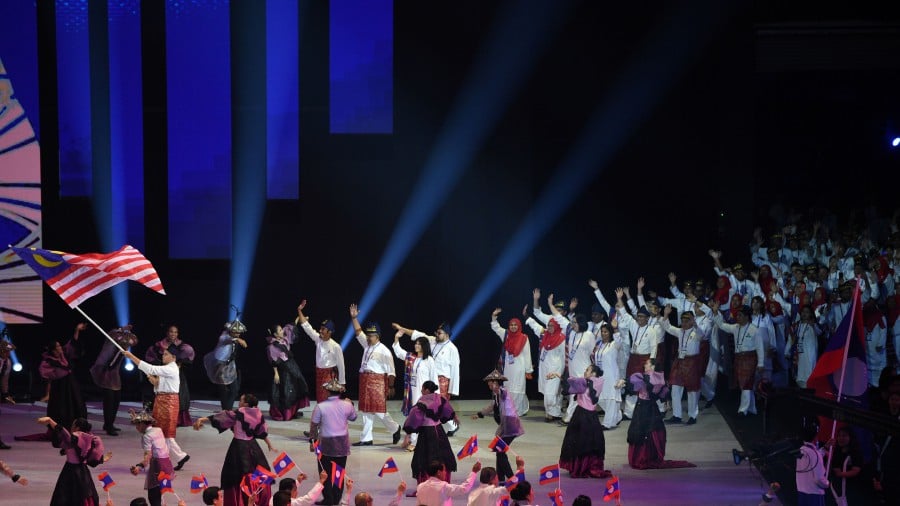

With the men dressed in white baju melayu and red samping with tengkolok, and the women in white baju kurung and selendang with Jalur Gemilang motif, and black shoes, the multi-racial Malaysian contingent, the hosts of the previous games, walked past the crowd proudly, symbolising the multiculturalism of the country.
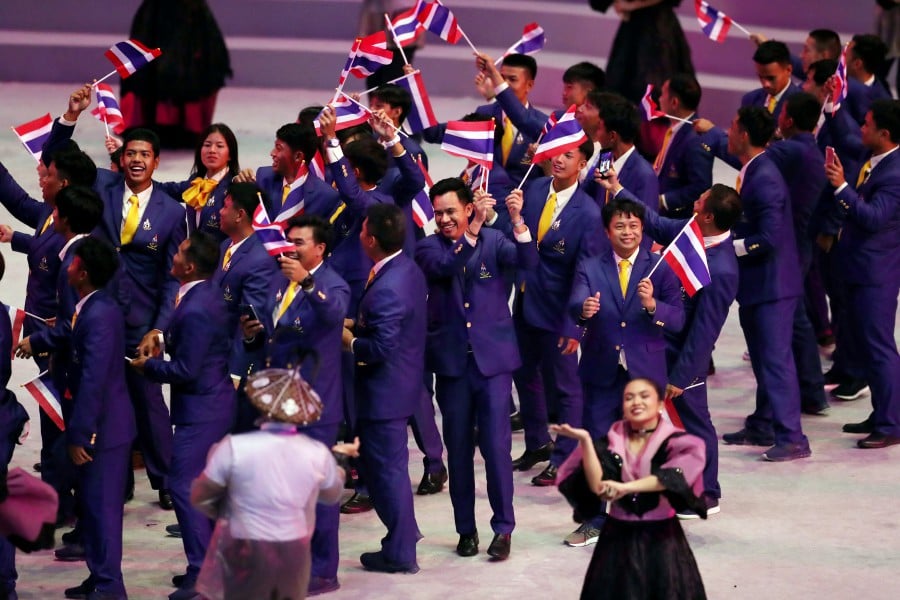

World renowned Filipino boxers Manny Pacquiao and Nesthy Petecio were given the honour as the torchbearers before they jointly lit the cauldron to officially mark the beginning of the 30th SEA Games, after Philippine President Rodrigo Duterte had declared open the Games.

Themed ‘We Win As One’, the Games will run for 12 days until the closing ceremony at the New Clark City Athletics Stadium on Dec 11.
More than 8,000 athletes from the 10 ASEAN countries and Timor Leste will compete in 530 events in 56 sports at the three main clusters, namely Manila, Clark and Subic.


The Philippines have hosted the SEA Games three times before – in 1981, 1991 and 2005.
This year’s Games see the introduction of a few new sports such as arnis, jujitsu, kickboxing, underwater hockey and esports.

Defending champions Malaysia have sent a strong contingent of 773 athletes and 339 officials to participate in 52 sports, targeting 70 gold, 51 silver and 105 bronze medals, which is expected to place them fourth overall.– BERNAMA

Tuesday, November 5, 2019

...the World E-Sports Games SEA champion

PH still overall World Electronic Sports Games SEA champion


Gabriel Pe
Spin.ph
05 November 2019


THE PHILIPPINES  was names overall champion in the World Electronic Sports Games (WESG) Southeast Asia for the second year in a row, after getting three podium finishes out of four events.


TNC Predator repeated as regional champ for DOTA 2 after beating Vietnamese team 496 Gaming in a thrilling three-game title series,

The predominantly Filipino squad looked out of form in the opening match, losing key team fights in the late game and ultimately crumbling against their SEA rivals. Backs against the wall, TNC bounced back with a quick sub-30-minute Game 2 to set up a rubber match.
The winner-take-all appeared to be going in 496's favor, as the Viets picked off heroes in the early and mid-game. However, Kim "Gabbi" Villafuerte's Naga Siren was left unchecked and the reigning champions were able to turn the game around with crucial team fights.

TNC, which swept the group stage (4-0), pocketed 7,500 USD — about P379,000 — for coming out on top of the regionals and now have the chance to defend their title in the WESG Global Finals, which will happen March next year.
It was a different story for the country's StarCraft II representative in the upcoming SEA Games, though, as Caviar "EnDerr" Acampado failed to secure back-to-back WESG regional championships and fell to last year's runner-up, Tran "MeomaikA" Hong Phuc from Vietnam. Both players qualified for the global finals.

EnDerr, who netted $2,000 or about P100,000, managed to take the opener, but MeomaikA maintained composure to go all the way in the Zerg versus Zerg matchup.
Meanwhile, female CS:GO Team Amplify took home bronze and the same prize money as EnDerr.

The group of Kyung In "Tr1cks" Lee, Tiara "Alluka" Pleno, Pat "c0ffee" Lagua, Aya "Kuchii" Kashikawa, and Daisy "Dzai" Madulin lost to Indonesian squad Celeste in the semifinals, then beat Thailand's Mystery to finish third.

Thursday, October 24, 2019

...the PH ranking in Ease of Doing Business

Philippines climbs to 95th spot in World Bank’s ‘Doing Business’ rankings

Ian Nicolas Cigaral
Philippine Star
24 October 2019

MANILA, Philippines — Ease of doing business in the Philippines improved over the past year, with the Southeast Asian country climbing 29 notches in World Bank’s “Doing Business 2020” report released Thursday.
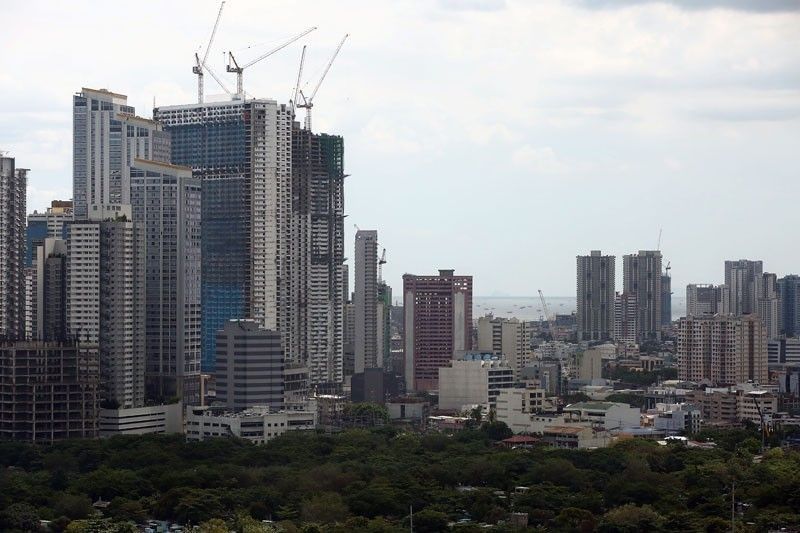
Philippine economy
Out of 190 economies, the Philippines advanced to the 95th spot from 124th place in 2019. The country’s score improved to 62.8 from 60.9 previously.

Compared to its peers in the East Asia Pacific, the Philippines ranked below Singapore (2nd), Hong Kong (3rd), Malaysia (12th), Taiwan (15th), Thailand (21st), China (31st), Brunei (66th), Vietnam (70th), Indonesia (73rd) and Mongolia (81st).

The Washington-based multilateral lender’s annual report looks into the regulations that enhance business activity and those that constrain it.

Quezon City was used as a benchmark for the Philippines.
According to World Bank, starting a business in the Philippines became easier following the abolition of the minimum capital requirement for domestic companies.

The country also made dealing with construction permits easier by improving coordination and streamlining the process for obtaining an occupancy certificate.

“The Philippines strengthened minority investor protections by requiring greater disclosure of transactions with interested parties and enhancing director liability for transactions with interested parties,” World Bank added.

Worldwide, 115 economies made it easier to do business, World Bank said, with New Zealand remaining the most business-friendly country in the world.

Somalia was the worst with a score of 20.

Meanwhile, the economies with the most notable improvement in Doing Business 2020 are Saudi Arabia, Jordan, Togo, Bahrain, Tajikistan, Pakistan, Kuwait, China, India and Nigeria.

“The Doing Business 2020 study shows that developing economies are catching up with developed economies in ease of doing business,” World Bank President David Malpass said.

“Still, the gap remains wide,” he added.

Wednesday, October 23, 2019

...the Philippines in Asian Century


The opportunity for the Philippines in the Asian century 

The Corner Oracle
Andrew J. Marasigan
Philippine Star 
23 October 2019


The 300-year reign of the west as the world’s economic epicenter is coming to a close.

By next year, the collective size of all Asian economies will eclipse that of the rest of the world combined. Thus, the year 2020 marks the official beginning of the Asian Century, declared the United Nations Conference for Trade and Development (UNCTAD).

Asia is now the new center of the world as it is home to more than half of the world’s population and half of the world’s middle class consumers. It is also where 21 out of the world’s 30 largest global cities are located. Experts agree that the average growth rate of Asian economies will be more than double that of the rest of the world in the next 20 years.

Driving Asia is the phenomenal rise of China, India and ASEAN as economic powerhouses. To provide perspective on the phenomenal rise of the continent, Asia accounted for only one-third of global output in the year 2000. It now comprises 50 percent of the planet’s gross domestic product.

On a purchasing power parity (PPP) perspective, China’s economy is now bigger than that of the United States. India has overtaken Japan to become the 3rd largest economy. Within ASEAN, Indonesia is well on its way to becoming the 7th largest economy while Vietnam has overtaken 17 countries to take 32nd position. The Philippines, despite challenges in its manufacturing sector, has overtaken seven countries and it now has 26th largest economy. If the Philippines plays its cards right, it can be the 16th largest economy by the year 2050.

Prospects are promising for ASEAN. With China and India slowing down due to the trade war, ASEAN is in the position to take center stage as the world’s engine of growth. ASEAN’s economy is now bigger than that of Great Britain.

ASEAN’s development came in waves with Singapore and Brunei being the first to achieve high income status. Thailand and Malaysia achieved rapid growth in the 90’s and are now counted among upper middle income economies. In the last ten years, however, Indonesia, Vietnam and the Philippines have lead the way in as far as economic development is concerned. The three nations have clocked-in an average annual growth rate of between five and six percent since 2010. The Philippines is seen to graduate to upper-middle income status next year.

As I mentioned, China and India’s slowdown have made Indonesia, Vietnam and the Philippines the most dynamic global economies today. All three are in stiff competition to attract foreign investments. But to compete on an equal footing, the Philippines must resolve several structural weaknesses.

The gaping hole in the Philippines’ growth story is its manufacturing sector. It is weak, to say the least. For context, our merchandise exports revenues of $67 billion is less than a fourth of Vietnam’s $297 billion. We have become a nation dependent on imports – from simple ball pens to heavy equipment. This is why our budget deficit (and current account deficit) is growing at an alarming rate every year.

Deficits are covered by debt so it goes without saying that the country’s debt load is growing at an alarming rate too. Sure, it is still manageable today, but if government fails to balance the national budget soon, we could face a serious debt crisis.

To put it simply, we need to export more to pay for the debts government is amassing for its infrastructure program and for its massive importations of consumer goods.

The crux of our woes is our inability to attract foreign investments. Again, for context, the Philippines attracted $9.8 billion worth of investment last year while Vietnam attract $35.5 billion. Foreign investments are the silver bullet to our problems since they bring both capital and technologies needed to build factories. These factories export goods and provide the local market with what it needs, thus, making the country less import-dependent.

The structural weaknesses I referred to earlier are those that contribute in making the Philippines unattractive to foreign investors. They include the constitutional provisions that restrict foreign investments in certain industries, expensive power cost, insufficient infrastructure and difficulty to do business (due to bureaucratic red tape). Exacerbating matters is that corporate income tax in the Philippines is 30 percent, compared to only 20 percent in Vietnam and 25 percent in Indonesia.

The Philippines must address these structural weaknesses if it is to compete. Our economic managers have numerous reforms waiting to be approved by Congress.Whether our legislators have the political will to enact these reforms without watering them down is another story.

On corporate income tax, the CITIRA Law proposes to gradually reduce corporate income tax from 30 percent to 20 percent over a ten-year period. I reckon, however, that 10 years is too long. If we are to be a real contender, this should be accelerated to just three years. Indonesia just passed a law to reduce its rate to 20 percent next year. The CITIRA Law is now pending in the Senate.

As far as infrastructure is concerned, while construction of several roads, rails and ports are ongoing, it is still grossly insufficient. Only 9 out of the 75 projects in Build Build Build are under construction today. Government must work faster and with more urgency lest it fail to deliver its promise of a “golden age of infrastructure”.

Another reform we must undertake is to open up more industries in which foreigners can participate as a majority stakeholder. Unfortunately, the 1987 Constitution was written with a protectionist intent and it has been a great impediment to attracting investors. That said, only an amendment of the Constitution can fix this. Even if politically contentious, we must confront this issue eventually.

The transport and telecommunications backbone of the country needs to be strengthened if we are to be truly competitive, especially in the information and communication technology space. The Open Access in Data Transmission Act and the amendment to the Public Services Act will address this. Both bills are pending in Congress.

As for bureaucratic red tape goes, the Ease of Doing Business and Efficient Government Service Delivery Act has already been passed into law and is now awaiting implementation. When completely rolled out, it is envisioned that all front-line government services will be fully automated, making it easier to conduct business. Again, the devil is in the execution.

Apart from this, Congress must revisit the EPIRA Law which has proved ineffective to bring down power cost.

Conditions are right for the Philippines to break away economically. However, we must first get our house in order before investors come. It would be a shame if the Asian century happens and we are left behind.

Friday, October 18, 2019

...the microconsumer lending countries

Laos, India, Philiipines, Myanmar and Vietnam the have highest prospects for the development of online microconsumer lending, according to Robocash Group study

Stephen Netto
theonlinecitizen.com
18 October 2019


With a growing attention to financial inclusion of the population lacking access to finance, countries in South and Southeast Asia are demonstrating the dynamic development of financial services.
According to a study by financial holding Robocash Group on the prospects for online micro consumer lending across countries in the region, Laos, India, the Philippines, Myanmar, and Vietnam have taken the highest positions in the company ranking.

The highest score in the ranking (20) belongs to Laos. It combines a high potential of the untapped demand with a positive attitude to short-term online lending from the government and population. The need for relevant products in Laos is similar to the situation in Myanmar, but it is free from some obstacles of the latter.

Over time, the new market will grow, and foreign investors may significantly contribute to this process. The underdevelopment of the legislation and the absence of financial institutes such as credit bureaus encourage experienced foreign companies with a fine-tuned scoring and reliable operation processes to support the efficient development of the market.

India holds second place with a score of 18. Despite a direct connection between the development level of a country and its place in the ranking, India is an exception. Although a significant part of local people already has access to credit products (79.9%), the rest include hundreds of millions of people. It correlates with the formed regulation.
After all, the market has a relatively small number of foreign companies, and not many Chinese startups have entered the market. Hence, the competition remains quite moderate.
Third place belongs to the Philippines (16). The country gives in the leading positions to other countries because of their hidden potential. However, other advantages compensate for it. The country has an established market of short-term lending services, flexible, and facilitative regulation.
Not forgetting, there is a balance between the high demand for relevant products and low debt load among the population. Moreover, the Philippine government is driving the digitization of financial services to decrease the factor of geographical fragmentation. It makes the country stand out on the regional background.
Myanmar is fourth in the ranking (14). As a country with a relatively large number of people below the poverty line and high demand for micro consumer loans, Myanmar stands out in comparison to the more developed countries in Southeast Asia. Still, some points are holding the market back.
Partly, this is due to its underdevelopment. The government has introduced strong regulation to get rid off illegal creditors, which activities have led to debt overload of the population. The latter reduces the attractiveness of the country for foreign companies significantly.
Fifth place belongs to Vietnam (12). Vietnam demonstrates significant demand for micro consumer online loans. With a large number of people living in rural areas (66%), only one-third of the population has access to credit products. Another stimulating factor is the growing GDP forecasted to increase by 6.6% by 2020.
Nonetheless, Vietnam should improve its regulation in terms of licensing of companies and control of financial statements. Overall, the country represents a bright example of the market with a medium position in the ranking. Vietnam is quite perspective but gives in the leadership due to the current difficulties for the business.

Wednesday, October 16, 2019

...the improved PH FIFA Ranking

FIFA Rankings 2019: Thailand, Philippines set for rise, Indonesia to fall after poor display


Fox Sports Asia
16 October 2019


Thailand and Philippines are set to rise up the FIFA Rankings table after their latest exploits in the 2022 FIFA World Cup Qualifiers while Indonesia, Cambodia and Singapore are set to fall down.

Thailand registered a massive 2-1 win over the United Arab Emirates while Philippines produced a fine defensive display to hold the mighty Chinese side for a goalless draw. Indonesia, on the other hand, lost 3-1 to Vietnam, Cambodia suffered a 4-0 defeat to Iraq and Singapore went down 3-1 against Uzbekistan.


With their win over UAE, Thailand are expected to move up six spots to 109, while Philippines will gain one spot and will move up to 126. Indonesia will lose one spot and go down to 171 while Singapore will lose two spots and will go down to 159. Cambodia, who were hammered 14-0 by Iran last week, will go down to the 172nd spot after the loss against Iraq.

Thursday, September 26, 2019

...the emerging trade war winners

Asia's emerging economies are winning US-China trade war

Robin Harding
Financial Times
25 September 2019


Asia’s emerging economies have been the big winners from the US-China trade war and they will gain even more if it escalates, according to the latest outlook from the Manila-based Asian Development Bank.


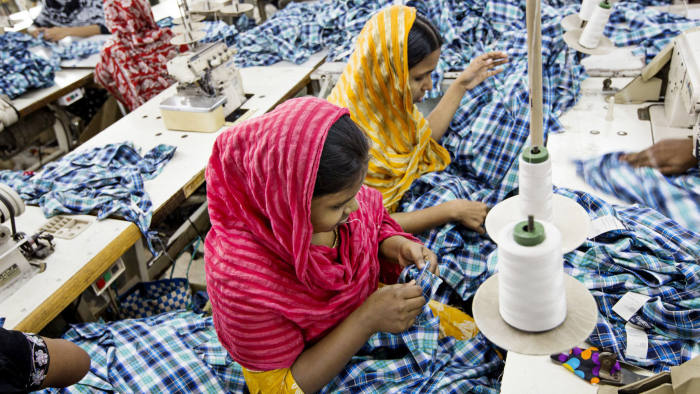
Workers sew plaid shirts on the production line of the Fashion Enterprise garment factory in Dhaka, Bangladesh, on Tuesday, April 30, 2013. Bangladesh authorities said they were accelerating rescue efforts at the factory complex that collapsed last week as hopes fade for more survivors after the nation’s biggest industrial disaster. Bangladesh’s labor law requires safety measures such as fire extinguishers and easily accessible exits at factories. Jeff Holt/Bloomberg
Bangladesh has seized market share in textiles © Bloomberg

Exports from developing Asian countries to the US rose by 10 per cent over the previous year in the first half of 2019, even as exports from China fell by 12 per cent. Exports from Vietnam to the US jumped by 33 per cent and from Bangladesh by 13 per cent.

The report shows how the huge trade diversion effects caused by the US-China tariff war are creating winners and losers as they reshape global supply chains, with Bangladesh seizing market share in textiles and Vietnam in electronics.

“Chinese products are encountering tariff measures so exports and production are slowing down.

Naturally, suppliers connected to these Chinese exports are also slowing down,” said Yasuyuki Sawada, chief economist at the ADB, which lends to developing countries in the region.“But at the same time we see this rather positive channel through trade redirection,” he said, at the launch of an update to the bank’s flagship Asian Development Outlook.The more serious trade tensions get, the bigger the trade redirection effect will become.

In a worst-case scenario, with 30 per cent tariffs on all US-China trade plus an extension of the trade war to automobiles, the ADB expects a drag on overall growth in developing Asia of 0.7 per cent over the next few years. Within that, however, Vietnam’s economy would grow by an additional 2.3 per cent, with Malaysia, Thailand, Bangladesh and the Philippines all coming out as winners too.

 The analysis does not include the impact of uncertainty over trade hurting investment, which could lead to a worse outcome in reality, Mr Sawada noted.For the region as a whole, the ADB trimmed its growth outlook for 2019 from 5.7 per cent to 5.4 per cent, reflecting the global slowdown, trade tensions and a “sharp contraction” in the global electronics cycle — especially for semiconductors.


The ADB cut its growth forecast for Hong Kong from 2.5 per cent to 0.3 per cent, reflecting the slowdown in global trade as well as political turmoil, and lowered its growth forecast for semiconductor-dependent South Korea from 2.5 per cent to 2.1 per cent.

On the other hand, it raised its growth forecast for Bangladesh from 8 per cent to 8.1 per cent, predicting it will be the fastest-growing economy in the region this year and next.

Mr Sawada said that risks to the region included the US-China trade conflict, the deepening growth malaise in advanced economies as well as a build-up of private debt in some emerging Asian economies. “The corporate sector in China and the household sector in Korea, Thailand and Malaysia have had a rising debt-GDP ratio. I think this is another risk,” he said.

Tuesday, September 24, 2019

...the PH ranking in global trade facilitation

Philippines boosts global ranking in trade facilitation


Louella Desiderio
Philippine Star
24 September 2019


MANILA, Philippines — The Philippines saw its trade facilitation score go up in this year’s United Nations (UN) Global Survey on Digital and Sustainable Trade Facilitation amid improvements in four out of five categories tracked by the report.

This year’s report showed the Philippines got a trade facilitation score of 80.65 percent, up from 69.89 percent in 2017.

Covering 128 economies, the UN report looks at trade facilitation measures being implemented in relation to the World Trade Organization Trade Facilitation Agreement, digital trade, small and medium enterprises, agriculture and women, and trade finance.

The measures are grouped into five categories which are cross-border paperless trade, paperless trade, institutional arrangement and cooperation, formalities, and transparency.

In Southeast Asia, the Philippines had a better trade facilitation score than neighbors Indonesia (80 percent), Brunei Darussalam (77 percent), Cambodia (71 percent), Vietnam (61 percent), Myanmar (60 percent) and Lao People’s Democratic Republic (59 percent).

The Philippines, however, was behind Malaysia and Thailand which both got 83 percent, and Singapore which had a score of 94 percent.

Results of the survey showed the Philippines had higher scores in all the categories except in institutional arrangement and cooperation, where its rating was unchanged at 55.56 percent.

In the cross-border paperless trade category, the Philippines got a score of 55.56 percent this year from just 33.33 percent in 2017.

The Philippines’ score also rose to 77.78 percent this year from 70.37 percent in 2017 in the paperless trade category.

In terms of the formalities category, the Philippines had a rating of 100 percent this year from 87.50 percent last year.

The Philippines also had a 100 percent score in the transparency category this year, up from 93.33 percent in 2017.

In conducting the survey, the UN aims to help countries benchmark and reduce the time and cost of trading across borders.

It likewise seeks to provide information for policy makers to take advantage of trade in the implementation of the 2030 Agenda for Sustainable Development which aims to put an end to poverty.