Showing posts with label communication. Show all posts

Thursday, July 11, 2013

...the idea of internet

PHL the 'birthplace' of the internet?


July 11, 2013


The Philippines may have played a much more important role with regard to the Internet as we know it today other than being a mere .ph suffix in a Web address.
Douglas Engelbart, who died earlier this year, invented the mouse and devised an online setup to remotely fetch information—after he read an article in the Philippines.
Engelbart was a Navy technician when he read a 1945 article published at The Atlantic, "As We May Think," by mid-century science icon Vannevar Bush, The Atlantic reported.
Bush's essay had described the Memex, an information-retrieval system, where every "book, record, or communication" was microfilmed and catalogued.
The essay was published in LIFE magazine, a copy of which ended up in a Red Cross library in —guess where—Leyte.
Idea born in Leyte
Engelbart, then a Navy radar technician, never saw combat in World War II, as the war ended just as his boat left San Francisco Bay on its way to the Philippines.
It was in Leyte that Engelbart "stumbled across a Red Cross reading library in a native hut set on stilts, complete with thatched roof and plentiful bamboo," The Atlantic said.
"The ideas in the story plowed new intellectual terrain for Engelbart, and the seeds that he planted and nurtured there over the next twenty years grew, with the help of millions of others, into the Internet you see today," it added.
Engelbart eventually wrote Bush a letter describing how profoundly Bush's work affected him.
"I might add that this article of yours has probably influenced me quite basically. I remember finding it and avidly reading it in a Red Cross library on the edge of the jungle on Leyte, one of the Philippine Islands, in the fall of 1945," he wrote.
"I rediscovered your article about three years ago, and was rather startled to realized how much I had aligned my sights along the vector you had described. I wouldn't be surprised at all if the reading of this article sixteen and a half years ago hadn't had a real influence on my thoughts and actions," he added.
Obits
Engelbart had been lauded by the Los Angeles Times' obituary as the one whose work "inspired generations of scientists, demonstrated in the 1960s what could happen when computers talk to one another."
For his part, Apple co-founder Steve Wozniak credited Engelbart's 1960s research "for everything we have in the way computers work today."
"So, in one tangible and real sense, the Internet we know now began in that hut across the world. As Bush made new thoughts possible for Engelbart, Engelbart made it possible for us to imagine the rest of it," The Atlantic said. — VC, GMA News


Friday, May 10, 2013

...the New Frontiers Awardee 2013

Philippines recognised for efforts after 2012 typhoon


AMEinfo.com
United Arab Emirates
10 May 2013


"The Philippines, its government and its people, have shown remarkable fortitude and a stoic determination to get both communities and the local economy back on track following the devastation wreaked by Typhoon Bopha late last year, and their resilience in the face of such a monumental crisis is commendable," - Mark Walsh, Portfolio Director, Reed Travel Exhibitions


Arabian Travel Market (ATM), the Middle East's premier travel and tourism exhibition, has named the Philippines as the recipient of the New Frontiers Award 2013 during a special seminar event held on the second day of the show.


L-R Mr. Benito C. Bengzon, Jr., Assistant Secretary, International Tourism Promotions, Department of Tourism Middle East office - Philippines, receiving his award from Mark Walsh, Portfolio Director, Reed Travel Exhibitions.

Mr. Benito C. Bengzon, Jr., Assistant Secretary, International Tourism Promotions, Department of Tourism Middle East office - Philippines, accepted the award on behalf of the country's Department of Tourism from Mark Walsh, Portfolio Director, Reed Travel Exhibitions, with previous recipients, Japan and Chile, represented respectively by Daisuke Matsunaga, Consul General of Japan, and Carlos Salas, the Chilean Trade Commissioner.
"The Philippines, its government and its people, have shown remarkable fortitude and a stoic determination to get both communities and the local economy back on track following the devastation wreaked by Typhoon Bopha late last year, and their resilience in the face of such a monumental crisis is commendable," said Walsh.

The award was made in recognition of the Philippines' ongoing efforts to rebuild physical infrastructure and its tourism economy in the wake of the December 2012 typhoon, which affected 6.2 million people in the south of the country leaving close to one million displaced persons.

Accepting the award, Benito C Bengzon Jr, said, "The Philippine government, under the administration of President Aquino, and the Department of Tourism have worked hand-in-hand to establish tourism as a major generator of income for the people and the country. At times of adversity, such as this, the determined spirit of our countrymen, supported by assistance from the international community, shines through and, it is this same spirit that is driving our tourism industry forward."

Typhoon Bopha was the deadliest in the world in 2012, damaging more than 216,000 houses and leveling large tracts of land including key public infrastructure and agricultural communities.

The subsequent development of the Typhoon Bopha Action Plan for Recovery requested $65m to provide immediate life-saving aid and support to the most-affected communities, with a total of $76m required to administer 46 projects through to the end of H1 2013 in order to fast track economic regeneration.

According to the latest figures released by the country's Department of Tourism, tourist traffic to the Philippines from the Middle East is showing steady growth with visitor arrivals for the first three months of the year showing a 22.1% growth against the same period last year.

Emirates has also announced that it will commence daily direct flights to Clark International Airport located in the north of the country on 1st October 2013, the second Philippines destination for the carrier. Cebu Pacific will also begin daily non-stop flights from Dubai to Manila in the same month.

A major initiative under the ATM brand, and now in its seventh year, the New Frontiers Award 2013 reinforced the overall focus of the programme, communicated under the theme 'Recover, Repair, Rebuild'.

Awarded to destinations that have overcome great adversity to bring much needed tourism back to their shores, the award also honours the strength and determination of the local people who work tirelessly to rebuild lives and communities following disaster as well as highlighting the crisis management capabilities of local tourism authorities.

"This year, as well as acknowledging the efforts of the Philippines in rebuilding its tourism infrastructure, we also looked back at past award recipients' Japan and Chile, and heard how the New Frontiers recognition has helped them on their road to recovery, and how they have rebuilt, or are continuing to reconstruct their respective tourism industries," remarked Walsh.

In addition to the prestigious crystal trophy, the New Frontiers Award comprises ATM exhibition space valued at US$10,000 along with additional marketing support in promoting the outstanding tourism opportunities offered by the recipient nation.

The Philippines was selected as winner of the New Frontiers Award 2013 by a panel of judges consisting of industry professionals from across the globe. From an original selection of 10 countries, which was then refined to a shortlist also comprising New York state (Hurricane Sandy) and Pakistan (2012 floods).


Sunday, April 21, 2013

...the place of action

Expats: PH is where the action is

By Alena Mae S. Flores
Apr. 21, 2013


”There’s nowhere else in this industry like anywhere else in the world, not China, India, US. This is where the action is. This is the forefront of all innovation, and change and growth and excitement if this is your chosen industry,” - Jason Lock, Transcom Senior Vice President for North America and Asia


Jason Lock
Jason Lock
 
 
Two foreign executives of Transcom, a leading global outsourcing service provider, are bullish about the growth of the business process outsourcing industry in the Philippines, which has created a new middle class.

New Zealand native and Transcom executive Jason Lock has been in the Philippines for five years and says he has grown to love the country like his own. Lock, who holds the position of senior vice president for Transcom’s client delivery for North America and Asia, says his intention was to work for only two years in the country, but ended up staying much longer, which he enjoys to this day.

His decision, according to Lock, was influenced by both professional and personal reasons.”There’s nowhere else in this industry like anywhere else in the world, not China, India, US. This is where the action is. This is the forefront of all innovation, and change and growth and excitement if this is your chosen industry,” he says.

Lock has been with Transcom since July 2009. Prior to that, he worked with a different business process outsourcing firms in the Philippines. Lock says he decided to transfer to Transcom because of the company’s potential for growth at the time.

“This company Transcom had all the hallmarks of an organization that had lots of key things in place and look like they will expand and grow. I was excited to come here and build something,” he says.

Lock believes the Philippine BPO industry will continue to grow. “The Philippines is unique in the world. Nowhere else in the world have you got such a large, English speaking, well educated, service-oriented, labor force, community, culture that can, because of the exchange rate, provide service to the rest of the world,” he says.

Lock considers the Philippines as his second home, especially as his daughter, his “little Filipina”, was born at the Makati Medical Center in 2010. “I love living in the Philippines, as a country that has so much to offer to the world,” he says.

Lock says his wife who works at the New Zealand embassy and his two boys also love their stay in the country.

He says he feels the responsibility, being in a privileged position, “to give back to the country that has welcomed us.” He and his wife are involved in numerous charitable organizations and promotes rugby as a sport in the country. Lock in fact coaches a team of 75 Filipino young kids from ages 4 to 16 called the Makati Young Mavericks.

“Rugby is one of my personal passions. It’s almost like a religion in New Zealand. We’ve gotten involved in the youth development of rugby in the Philippines and I coach a team comprised of 95 percent of Filipinos,” he says.

Lock handles the operations at Transcom Center Building in Frontera Verde, Pasig City, which houses around 4,000 employees.” He believes in Transcom’s mission of putting the needs of people first to propel the growth of the company. “The organization has always had a philosophy of putting its people first and the view that if the people are happy, our company will be successful. We invest heavily in facilities, in different programs, charities, community outreach programs,” he says.

“We focus on family. I love it when we have members of the same family or friendship groups working in the organization. Transcom feels that it’s the way to go. If you’re working with people that you care about then it becomes an extension of home. If you can create big friendship groups, you’ve gone a long way to create an environment that feels like home,” he says.

Transcom organizes family day events, when it opens the company and its facilities to the family members of its employees. Transcom also sponsors events for the kids, hires rock bands and holds other fun-filled activities that make the day memorable.

Lock also recently led the donation of 50 “trisikads” or pedicabs to the city government of Bacolod where Transcom has a facility.

Meanwhile, Neil Rae, who joined Transcom in 2004, as a key account manager and has since accumulated significant experience in the organization, sees “something special” in the Philippines.

“Part of the reason is not just tech, not just process, it’s truly our people, and our commitment is to be here in the Philippines,” he says.

He says Transcom’s investment in the Philippines “represents a passion and commitment and dedication” to this industry that ultimately is the reason it has grown. The executive says the Philippines is among the top five countries with the highest level of customer experience among English-speaking countries. “It’s the excellence in customer experience that you can get [in the Philippines],” he says.

Rae is now the regional general manager and executive vice president for North America and Asia.

He says Transcom goes beyond compensation to look at its employees’ personal and professional development.”You optimize it by respecting and understanding the people by empowering the people locally to become our future leaders. It’s not bringing expats into the organization. This is about building something, future leaders. Filipinos leading Filipinos to show the true success,” Rae says.

Rae says Transcom’s strength lies in its employees where the company has put premium in caring for its employees.”To me, there is a direct correlation between our staff and our people and the level of customer experience we deliver. I firmly believe, and the organization believes that we need to focus in first on our people,” he says.

“How we care for them, that’s the most important thing. And this is something that I view as our number one priority in differentiating our organization in the Philippines from other organizations,” he says.

Rae says the BPO industry has created the new middle class in the Philippines. “It’s more than just a job. If you compare the Philippines to North America, it’s a career here. It’s created the middle class.

It has created something so powerful, I have not seen it globally. There’s a lot of factors, social, economic but if you strip that, it’s truly the people,” he says.


Tuesday, April 16, 2013

...the UAE's New Pinoy Radio


New Pinoy radio channel makes waves in the UAE


The presenters on the Filipino radio station TAG 91.1 include, left to right, Louaaeeeeise da Costa, Joselito Bluebird Echivarria, Jonaphine 'Maria Maldita' Caraan and Nathalia Junbie 'Chikay' Cermino.
Courtesy TAG 91.1
 

Music brings people together. And for the thousands of Filipinos living in the UAE, homegrown songs remind them of anything that is distinctly Pinoy – from the jeepney (passenger vehicle) to halo-halo (shaved-ice dessert) to adobo (meat in a sauce of vinegar, soy sauce and garlic) – and the smiles of loved ones who are thousands of miles away.

And this is exactly what inspired the founding of the country’s first radio station that is devoted to the large and still-growing Filipino expatriate community.
 
TAG 91.1 was the product of long and meticulous planning by the Arabian Radio Network (ARN) group, which was looking to tap into an enormous yet overlooked market in the country’s widely varied demographics.
 
“ARN has spent more than two years conducting wide-ranging -research to determine the under-served communities,” explains Louise da Costa, one of the station’s stable of presenters.
 
Brought over from Virgin Radio where she was dubbed the station’s “Filipina Queen”, da Costa joined the fledgling station to boost its young staff.
 
The station has an all--Filipino team and the management made it a point to visit the Philippines to scout for the right talent to represent its new project.
 
Studying Manila’s radio scene, ARN representatives zeroed in on the presenters from the country’s three leading stations. A Filipino music manager and a production manager were also hired.
 
In hindsight, the station is a grand offshoot of the 10pm to 6am Filipino radio programme heard over the past five years on Dubai Eye 103.8.
 
“Nearly 645,000 Filipinos live in the UAE and because of the strong demand, developing TAG 91.1 was a natural choice for ARN,” explains da Costa.
 
The Filipino community has welcomed the new station and social networking sites are already spreading the news. In fact, TAG 91.1 had more than 5,000 visits on its website during its debut broadcast on March 25. “Hundreds of thousands of listeners have already interacted with this programme,” says da Costa. “It has 10,000 Facebook likes, a number that is increasing by the minute.”
 
TAG 91.1 is also a multi-platform radio station: it broadcasts 24 hours a day, is online at www.tag911.ae, has dedicated iPhone, Android, Nokia and BlackBerry apps and a built-in player on all Samsung Smart -televisions.
 
The station’s line-up includes music, celebrity gossip, games and news, all dished out in a distinctly Pinoy fashion.


Saturday, January 12, 2013

...the best researcher in Malaysia conference

Pinoy cited for best research paper in Malaysia conference


January 12, 2013


A Filipino recently won one of the top awards in a communication conference in Malaysia for his work on the impact of information and communications technology (ICT) on the rural youth.

According to an article of the Philippine Information Agency, the study done by Philippine Rice Research Institute (PhilRice) communication research Jaime Manalo IV won the Best Qualitative Conference Paper Award at the 2012 International Conference on Communication and Media (i-COME) in Penang, Malaysia.

Manalo’s winning study was entitled “Beyond Facebook: The undocumented experiences on ICTs of young rural Filipinos” and tackled notions of the ICT proficiency of the Filipino youth.

Jaime was an Australian Leadership Awards scholar from the Philippines who graduated from the University of Queensland, where he took his master’s degree, in 2011.

Centre for Communication and Social Change at the University of Queensland in Australia co-director and Associate Professor Elske van de Fliert, co-authored the paper with Manalo.

According to Manalo, the experiences of Filipino youth in rural areas are different compared to their urban counterparts, and that portrayals of Filipino youth in the media as tech-savvy need to have a second look.

“Issues of the rural youth in the Philippines can easily be glossed over if the attention is fixated on the experiences of their urban counterparts,” Manalo pointed out.

He also highlighted the need for the country’s solons to prioritize “needed ICT infrastructure” to guide the youth and eventually help the country in various areas, among them agriculture.

“Policymakers should pin their attention on providing the needed ICT infrastructure, and a conducive environment for the students to learn how to use ICTs,” Manalo said.

According to the PIA article, i-COME ’12 “aimed to address communication and media issues such as challenges in the socio-economic and political agenda, cultural integration, and social reengineering” and that around 120 people from 25 countries participated in the conference.

No stranger to research field

Manalo is no stranger to success in the field of research.

In April 2012, Manalo’s study, ‘Really, they don’t want to farm? Challenging existing orthodoxies on youth perceptions on rice farming in the Philippines,’ emerged as the best paper in the Technology Extension, Dissemination, and Education category of the annual Crop Science Society of the Philippines (CSSP) conference.

This study by Manalo once more urged people to take another look at existing notions, this time the assumption that young Filipinos no longer want to farm and instead look for other avenues related to the process.

“The belief that the younger generation is not interested in farming has resulted in almost zero efforts to engage the youth on rice farming and fears that Philippines might encounter a scarcity of future food producers” said Jaime.

“The fear that the youth will abandon farming someday might easily happen if we do not engage them. The paper calls for the public, private and non-governmental sectors to invest on initiatives that will indirectly involve the educated youth in rice farming,” he also said.

The study was also co-authored with Elske van de Fliert. - VVP, GMA News

Tuesday, November 27, 2012

...the top ICT-savvy cities

Manila among top 25 ICT-savvy cities


MANILA, Philippines -- Swedish telecommunications equipment and mobile services firm Ericsson recently ranked Manila as No. 22 of the top 25 largest cities in the world in terms of the ability to use information and communication technology (ICT) to benefit business.
 
 
Roxas Boulevard in Manila, Philippines (Agustin Rafael Reyes/Flickr).
 
In the release of Ericsson's third edition of Network Society City report and Index, New York, Stockholm and London emerged as the top three ICT-savvy cities in the ranking.
 
According to Patrick Regardh, strategic marketing head for Ericsson global, individuals, rather than businesses or institutions, drive development resulting from ICT maturity.
 
"We see the individual – rather than city institutions or businesses – as the drivers of development resulting from ICT maturity. Governments follow by adapting to citizens’ changing behavior, while businesses primarily adopt ICT innovations to increase internal efficiency. More importantly, government decisions help steer the business sector’s ICT development. Therefore, changes in policy, regulation and planning, paired with research and support for taking risks and funding, are some of the key factors for driving progress. These factors are crucial in helping organizations of all sizes to connect, collaborate and compete more effectively," Regardh said in a statement.
 
According to the report, ICT leads to an increased number of entrepreneurial opportunities, enabling new product innovations such as music and video streaming, e-commerce and cloud services.
 
The report also indicated that ICT improves access to markets by enabling entrepreneurs and specialized niche firms to reach larger geographical markets.
 
And another positive note about ICT is that it reduces cost of transactions between firms – for example by minimizing the need to be located geographically close to suppliers, partners and customers.
 
Legardh in an interview said it is easy to compare a city to another city than a nation to another nation comparing their ICT solutions. In doing a city to city type, it is easier to recommend those that work to one city to another city.
 
In explaining the positive correlation between ICT maturity and economic development, Legardh shared a report issued by the Stockholm School of Economics in 2012, where it was concluded that a "1 percentage point increase in broadband penetration increases new business registration by 3.8 percent."
\
Legardh said a city should be known for a few couple of things since technology alone will not do it and a follow up is important.
 
For Manila, he advised to make the most out of it, referring to collaboration between universities and industries and a review of its fiscal and legal framework.
 
Legardh added school is an area where many changes can happen in the near future. "Instead of future education, I call it future learning," he said.
 
The complete list of the Top 25 ICT-Savvy cities according to their ranks and scores, are: New York (52.1), Stockholm (51.9), London (48.7), Singapore (48.1), Seoul (47.9), Paris (44.1), Tokyo (40.3), Los Angeles (38.2), Sydney (31.7), Beijing (27.2), Shanghai (25.1), Moscow (24.4), Sao Paulo (18.3), Istanbul (17.1), Mexico City (16.1), Delhi (15.4), Cairo (14.9), Buenos Aires (14.2), Mumbai (13.1), Johannesburg (12.7), Jakarta (11.6), Manila (8.7), Dhaka (6.7), Lagos (6.6), and Karachi (8.0).
A total of 28 indicators have been used to measure the total benefits in the index for each city. The indicators can be categorized into two dimensions: cities’ ICT maturity and benefits from ICT investments from both a social, economic and environmental point of view.

...the Asia's fastest growing enterprise telephony

PH seen as fastest-growing enterprise telephony market in Asia


11/27/2012
 
 
MANILA, Philippines - The country's enterprise telephony market is foreseen to be the fastest-growing in the Asia-Pacific region, communications services provider DTSI Group said in a statement.
 
"Despite the turbulent global economy leading to reduced telephony spend in general, the $497.9-million Asia-Pacific regional market is expected to grow by almost US$2 million by end of 2012, a modest but positive growth rate of 6.2% over the past year. Within the region, the Philippines is the fastest-growing market," DTSI Group said, quoting a study by Frost & Sullivan.

The study showed the Philippines' enterprise telephony market, currently estimated to be worth $8 million, expanded by an annual 24% in the first half of the year, DTSI Group said.

"Growth in telephony in the Philippines reflects the positive spending outlook and the overall thriving economy of the Philippines as well as the impact of the booming IT-BPO industry on telephony," Miguel Garcia, president and chief executive officer of the DTSI Group, said in the statement.

DTSI Group, a member of the NTT Communications Group, is a provider of communications facilities, services and technology.

Friday, November 23, 2012

...the fastest growing data users

PHL is world's 4th fastest growing mobile data user — Ericsson

 
GMA News
November 23, 2012


Smart phones made up some 40 percent of all phones sold globally in the third quarter of 2012, according to Ericsson's latest Mobility Report.
 
The mobile tech company said that mobile subscriptions are expected to hit 6.6 billion by the end of 2012, and to top 9.3 billion by 2018 —excluding machine-to-machine (M2M) subscriptions.
 
 
In terms of new subscribers in the third quarter, the Philippines was the fourth largest contributor worldwide at 5 million new subscriptions, after Brazil (9 million) and Indonesia (7 million). But China topped the list with 40 million new subscriptions, accounting for 35 percent of the world total.
 
 
Worldwide mobile penetration hit 91 percent in the first three quarters of the year, with total mobile subscriptions up to 6.4 billion in the same period —a growth of 9 percent year-on-year, or 2 percent quarter-on-quarter.
 
Data traffic skyrocketed 100 percent in Q3 2012 over the same period the previous year. The compound annual growth rate (CAGR) for mobile data is expected to reach 50 percent in the next five years, spurred by increased video consumption.
 
 
Online video consumption was found to be the key driver of rising mobile traffic volumes, accounting for 25 percent of all smartphone traffic and 40 percent of all tablet traffic.
 
 
“Expectations of mobile-network quality have been elevated by the availability of smartphones and tablets that have changed the way we use the internet,” said Douglas Gilstrap, Senior Vice President and Head of Strategy at Ericsson.
 
 
“Mobility is becoming an increasingly significant part of our daily lives. We always have devices within arm’s reach, allowing us instant access to information, entertainment and social interaction,” he added.
 
 
This year, Ericsson provided LTE coverage for some 455 million people globally as of June, and expects more than half the world’s population to be covered within five years. “There were an additional 13 million LTE subscriptions in Q3 2012, and numbers are predicted to reach 1.6 billion by 2018,” the company said in a press statement.
 
 
Thus, Ericsson revealed that “LTE is currently being deployed and built out in all regions, and total subscriptions will increase from around 55 million at the end of 2012 to an estimated 1.6 billion in 2018. WCDMA/HSPA networks currently provide coverage to more than half the world’s population and continue to grow faster than LTE in terms of absolute numbers, adding 65 million subscriptions in Q3 2012 compared with 13 million for LTE. — TJD, GMA News

Thursday, November 22, 2012

...the consumer electronic expo hub

Philippines eyed as consumer electronics expo hub


Yahoo! to host TechnoStorm trade event

By Paolo G. Montecillo
Philippine Daily Inquirer


MANILA, Philippines—Internet pioneer Yahoo! is pushing for the Philippines to be one of the region’s centers for consumer electronics technology given the young population’s love for gadgets, from computers and mobile phones to high-end cameras.

Yahoo! Philippines will hold its first consumer electronics exposition, called TechnoStorm, where the company plans to bring under one roof the biggest names in technology such as Nokia, Samsung and Apple to show off their latest products for the local market.

“The dream is to host an event like CES [Consumer Electronics Show],” Yahoo! Philippines country ambassador and sales director Arlene Amarante said, referring to the Las Vegas tech show known as the world’s largest exposition for the latest in consumer electronics.

Amarante said TechnoStorm would be at a much smaller scale, but it was aimed at eventually competing with Computex, an annual information technology expo hosted by Taiwan for more than a decade now.

“To get Smart, Globe, PLDT and Wi-Tribe in the same event is hard. It’s also hard to have Nokia, Samsung and other companies in the same arena. But they look at it as an industry push,” Amarante said.

“If the industry is able to do this with the help of all the parts, as a whole, it would be a lot better. Yahoo is there to be a core platform to help them out,” she said.

The TechnoStorm expo, to be held at the TriNoma mall in Quezon City from November 26 to December 2, comes just in time for the holiday season, when millions of Filipinos are expected to shop for gifts for friends and relatives.

Complementing the physical event is the launch of an interactive online site featuring cutting-edge products and services from leading global and local brands.

Aside from featuring latest gadgets, the site ph.news.yahoo.com/technostorm will also have latest news and updates on tech companies, as well as “expert” columns for consumer questions.

“Technostorm is a celebration of all things tech. Yahoo’s digital capabilities provide a unique platform for Filipinos to explore, discover and understand the world of technology, and bring them face to face with gadgets and devices that create connectivity,” Amarante said

Monday, September 17, 2012

...the fastest growing smartphone market

Philippines fastest growing market for smartphones in SE Asia


1 in 4 mobile devices in PH a smartphone, says GfK

By Paolo G. Montecillo
Philippine Daily Inquirer

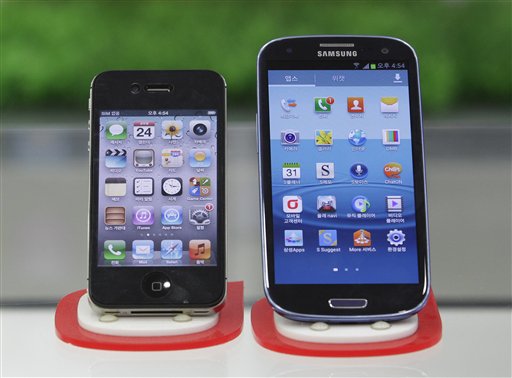
Samsung Electronics’ Galaxy S III, right, and Apple’s iPhone 4S are displayed at a mobile phone shop in Seoul, South Korea, Friday, Aug. 24, 2012. South Korea’s Samsung won a home court ruling in its global smartphone battle against Apple on Friday when Seoul judges said the company didn’t copy the look and feel of the U.S. company’s iPhone, and that Apple infringed on Samsung’s wireless technology. However, in a split decision on patents, the panel also said Samsung violated Apple technology behind the bounce-back feature when scrolling on touch screens, and ordered both sides to pay limited damages. AP/Ahn Young-joon


MANILA, Philippines—The Philippines remained the fastest-growing market for smartphones in Southeast Asia, with the number of devices jumping more than four-fold as of July from the same period last year.

Singapore-based research firm GfK in a report released Monday showed that one in four mobile devices sold in the Philippines as of July was a smartphone.

“The Philippines continues to report exponential three-fold growth of 326 percent in smartphone volume sales, rendering it the fastest-growing market for smartphones in Southeast Asia region,” GfK said.

“(The Philippines was) also the country with the highest jump in smartphone market share within a year, from 9 to 24 percent,” the report said.

The sales growth in the country was significantly higher than the 78-percent growth recorded in Southeast Asia’s seven major markets, namely the Philippines, Singapore, Malaysia, Thailand, Indonesia, Vietnam and Cambodia.

“Feature phones still reign as the more prevalent mobile phone type used by consumers in the region’s emerging markets,” GfK digital technology account director Gerard Tan said in a statement, “However, smartphones adoption is escalating at a rapid pace.”

Total mobile-phone sales, which include low-priced “feature phones,” grew in the seven countries by 24 percent year on year as of July.

While more feature phones were sold in the region, GfK said more money was spent on smartphones. Of the total $13.7 billion spent on new phones in the seven-month period, $8.75 billion went to smartphones.

GfK said the smartphone growth in the region was driven primarily by the entry of more affordable devices worth $100 to $200 each, which are now dominating the market.

“With major manufacturers recently announcing their intentions to launch low-end smartphones priced below $100, the device will be within the reach of an even larger pool of consumers and the market is expected to grow even faster when these models are made widely available,” Tan said.

“This move is likely to significantly expedite the demand surge for smartphones in the region’s yet to be converted feature phone user population, which we expect to see continued robust growth for at least the next two years,” he said.

In a previous report, GfK said the relatively low penetration of smartphones in the Philippines was a major factor behind the high growth rates.

The region’s most mature markets are Malaysia and Singapore, where penetration rates are at 90 percent.

In markets like the Philippines, three-quarters of phones sold are still feature phones, which are mainly used to call and send text messages.

The country’s top telcos Globe Telecom, Smart Communications and sister Sun Cellular have all started to bundle smartphone models with their affordable post-paid plans in a bid to make it easier for consumers to decide to switch phones.

Thursday, September 6, 2012

...the Asia's first iPhone 5 country

PHL may be first in Asia to get iPhone 5


September 6, 2012
GMA News
 
 
The Philippines is likely to be among the first countries in Asia to get the much-awaited iPhone 5, which is expected to be launched in the US sometime next week.
 
 
Local telco Smart Communications Inc.'s chief wireless advisor, Orlando Vea, said in an interview at the Asian Carriers’ Conference (ACC) Apple Inc. that Apple Inc. is eyeing the Philippines as one of its first markets for the new phone.
 
“Hopefully we are the first in Asia,” Vea said.
 
He explained that the Philippines' high consumption of social media such as Facebook and Twitter make it a "digital literate country" that is well positioned to become an initial market for the iPhone 5.
 
 
The iPhone 5 has been much anticipated as it is rumored to sport a larger and thinner form factor than its predecessors, and is Apple's first flagship phone since the demise last year of its visionary leader, Steve Jobs.
 
 
Smart's parent company, Philippine Long Distance Telephone Co. (PLDT), claims a total subscriber base of 67.4 million, of which 3.1 million are broadband subscribers. For its part, Smart has a 26.9 million-strong subscriber base, with an additional 24 million subscribers under its Talk 'N Text subsidiary brand.
 
 
Smart's newly-acquired subsidiary, Digital Telecommunication (Digitel), has 15.9 million subscribers under its Sun Cellular brand. — TJD, GMA News


Tuesday, July 17, 2012

...the PH phone ratio

Philippines cited for mobile phone use


By: Ana G. Roa
Philippine Daily Inquirer


The use of mobile phones in the Philippines has brought better information access for farmers, broader citizen engagement and link to traffic data for taxi drivers, according to a new World Bank report.


The use of mobile phones in the Philippines has brought better information access for farmers, broader citizen engagement and link to traffic data for taxi drivers, according to a new World Bank report.

The country also witnessed one of the first uses of text messaging as a medium for social change during the EDSA II revolt in 2001 that led to the ouster of then President Joseph Estrada, the study cited.

According to the report “Information and Communications for Development: Maximizing Mobile,” which was released on Monday, there were 101 mobile cellular subscriptions for every 100 people in the Philippines in 2011, a jump from 41 subscriptions for every 100 people in 2005.

The report defined mobile cellular subscriptions as subscriptions to a public mobile telephone service using cellular technology, which provided access to the public switched telephone network. Postpaid and prepaid subscriptions were included. But it said that mobile subscriptions did not reflect actual mobile phone ownership since there could be multiple subscriptions.

Worldwide, the number of mobile subscriptions grew from one billion in 2000 to more than six billion in 2011, of which nearly five billion were in developing countries, the report said.

In 2011, 96 percent of the total mobile cellular subscriptions in the Philippines were prepaid.

In 2010, mobile cellular network in the Philippines covered 99 percent of the population and 80 percent of households reported ownership of a mobile telephone.

The World Bank cited the Philippines as an example in using mobile’s potential to strengthen accountability and transparency in public services and processes.

In particular, it said that the Department of Education has worked with the Affiliated Network for Social Accountability in East Asia and the Pacific to set up a website that allowed the citizens to view significant statistics on local schools.

The site, called checkmyschool.org, is a government-to-citizen online and mobile-based interactive tool that includes information such as budget allocations, teacher and textbook information and test scores for about a fifth of the 44,000 schools in the country, the report said.

It is also an avenue for teachers and parents to express areas of concern that they feel should be addressed.

The site, which seeks to improve education service delivery through transparent and accountable behavior by school staff, has improved community participation and vigilance and teacher behavior, the World Bank said.
“These efforts are typically innovative because they often change the delivery or management of a conventional service or process,” the report said.

Commercial farmers in the Philippines also benefited from accessing price information through mobile phones, reporting income gains and increase in trust of traders, the report cited.

Prior to the expansion of mobile networks, agricultural producers were often unaware about prices and had to rely on information from traders and agents, the report said.

“Delays in obtaining this data or misinterpretation of second-hand pricing information has serious consequences for agricultural producers, who may end up underselling their products, delivering too little or too much of the product, or having their products wither away,” the World Bank said.

The study also mentioned Cebu City where taxi drivers use mobile phones with global positioning systems to receive traffic data and dispatch information.

The report added that social media, along with messages, videos and pictures sent from mobile phones, were useful tools for organizing protests and monitoring democracy and freedom.

“Mobile communications offer major opportunities to advance human and economic development—from providing basic access to health information to making cash payments, spurring job creation, and stimulating citizen involvement in democratic processes,” said World Bank vice president for sustainable development Rachel Kyte.

“The challenge now is to enable people, businesses and governments in developing countries to develop their own locally relevant mobile applications so they can take full advantage of these opportunities,” Kyte added