Showing posts with label Europe. Show all posts

Monday, October 14, 2019

...the Pinoy summa cum laude in Europe

Filipino scholar graduate s summa cum laude in Europe


Neil Arwin Mercado
Inquirer.net
14 October 2019


MANILA, Philippines — Not only did a Filipino scholar return from Europe with new learnings from a foreign land, he was also able to finished his degree summa cum laude.


While many would think that studying abroad, especially in Europe, comes at a hefty price, Kent Tangcalagan would tell you otherwise as he finished his degree as a beneficiary of a scholarship program.

Tangcalagan learned about the Erasmus+ scholarship program, formerly known as Erasmus Mundos, from one of the delegates at a conference he attended abroad.


“There was an Indonesian delegate there, she applied for Erasmus for two years already and she gave me the website,” Tangcalagan said in an interview with INQUIRER.net.

“So when we went back to the Philippines, I asked my mentors, my advisors that I met from work—like advice, some of their recommendations regarding applying for studies abroad. I also asked people to write my recommendation letter,” he added.

The scholarship covers tuition fee, annual travel allowance, establishment allowance to help scholars in their adjustment period in a foreign land, and a monthly contribution cost which includes accommodation.


During the application, applicants are allowed to select three education programs. Should they be accepted in all three, they will have the option to select which program they would like to enter.


Tangcalagan was accepted under the Erasmus Joint Masters Degree in Comparative Local Development in May 2017, a two-year program where he would study in one university in a European Union (EU) country per semester.


In his first semester, he studied in Corvinus University of Budapest in Hungary, University of Regensberg in Germany in his second semester, and University of Trento in Italy for his third semester.


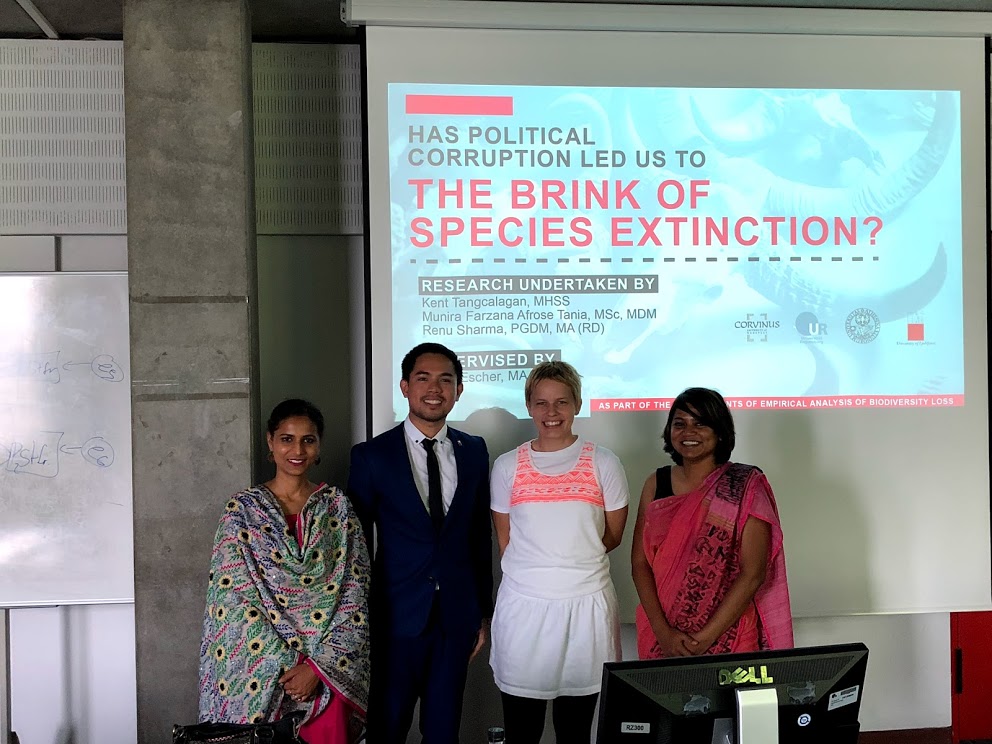
Filipino scholar Kent Tangcalagan presents one of his research outputs in one of his classes at the University of Regensberg in Germany during the second semester of his masters degree.
“When I got there, it was very different because all of my classmates came from different countries as well. We came from different countries so you have different nationalities, different cultures, different opinions,” Tangcalagan said.

“Since our program was on development sector, we got to talk about social, economic, and political issues in class. In my case I got shocked because there are very differing opinions on different things,” he added.


But instead of seeing the cons of being surrounded by varying perspectives, especially on the complex topic of his program which is development, Tangcalagan saw it as an opportunity to challenge his own views.


“There was a sense of ‘culture shock’ at first but when you go through it after a few months, you get used to it and you see how advantageous it is and how beneficial it is for you,” he said.


Living and studying abroad


Tangcalagan said that being a student in Europe is very convenient, but this also comes with living away from your family for some time.


“You are away from the traffic that we have here in Manila. The public transport is very convenient. It’s very cheap for students because as a student you get to have a transport card so you can travel easily in different cities,” Tangcalagan said.


“It is also fairly cheap to travel across countries because we have this student resident’s permit so it allows us to cross different borders, we get to visit other countries during breaks,” he added.


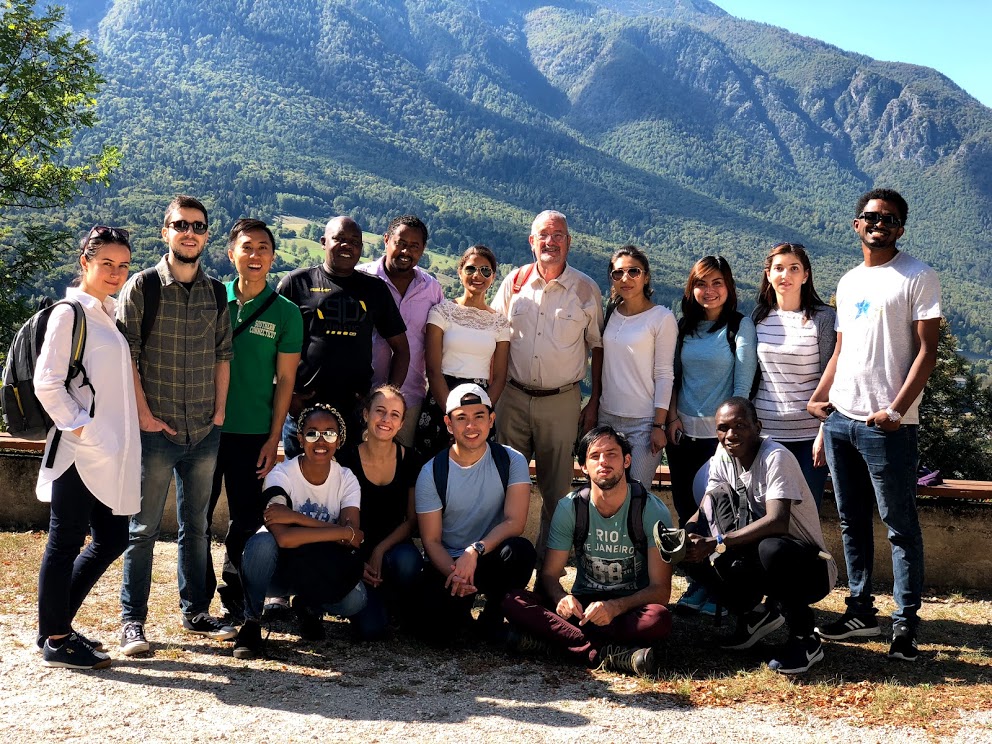
Tangcalagan (center, seated) travels with his classmates and the head of the scholarship program in Italy in the area of University of Trento in Italy.

As per the education system, he narrated that there are more than 15 professors per subject. The professors came from different areas in the world, which helped in providing different perspectives in the context of development.


“That’s also very beneficial because some of our professors come from different countries, even outside Europe so we get different perspectives on our subject matter which is development,” Tangcalagan said.

“You get to hear about development projects that they implemented in Africa, or in the US, or Latin America, also in Asia. You get to discuss different things with people who really implemented these projects so for me, it is one of the part of the European education that makes it very unique… That’s also another aspect of the diversity that Europe provides in terms of education,” he added.
More than education, an added bonus..


In his last semester, Tangcalagan did his internship at a research institution called Max Planck Institute for the Study of Societies in Germany before working on his thesis and defense.


Every semester, they are shown their grades. So when he saw that he is getting excellent grades from his courses, Tangcalagan pushed himself to strive for something bigger—finishing his degree with flying colors.
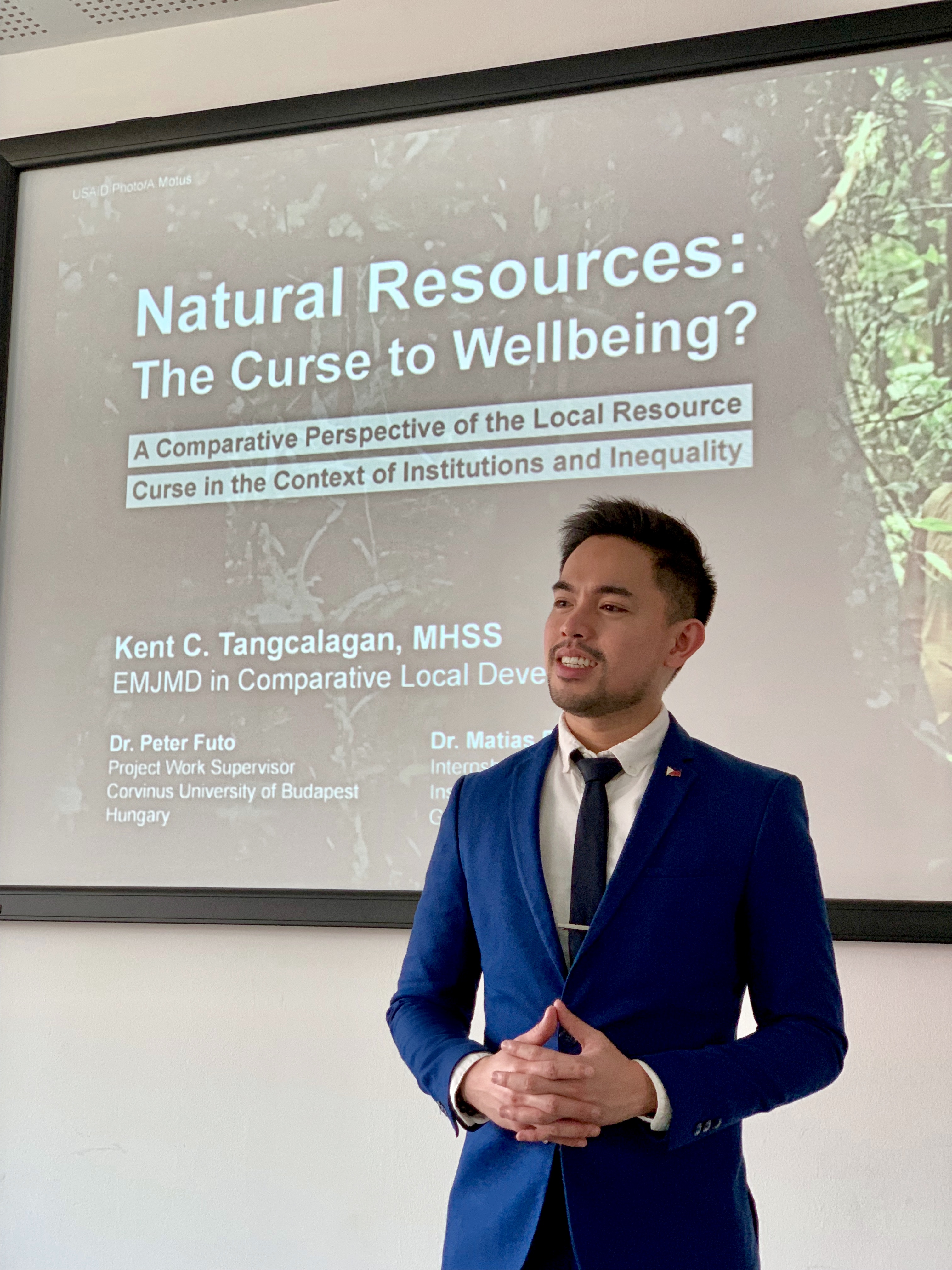


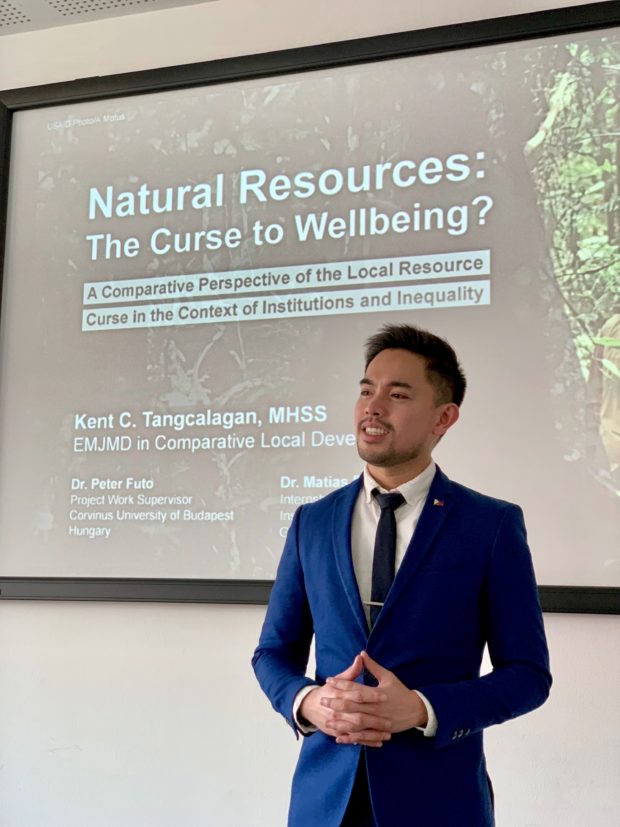
Tangcalagan presents his thesis titled, “Natural Resources: The Curse to Wellbeing? A Comparative Perspective of the Local Resource Curse in the Context of Institutions and Inequality” to complete his masters degree.

“I was nervous for the thesis and defense since we are aiming for the best. All of my grades—I got all excellent. I have to maintain that with my thesis and defense so after I finished my thesis and defense and I also got five (highest in Hungarian education), I was really really happy since all my hard work, and the sacrifices of being away from the Philippines [paid off],” he said.


But for him, it was only an added bonus as his mere goal was to make the most out of his experience.

“My goal was to make the best out of the scholarship. AS a scholar, I feel I was very privileged and honored to be studying in Europe. I am not spending any money, it’s the European taxpayers’ money that I was using for my education so I felt like I have the responsibility to make the best out of the education and scholarship that I am getting,” he said.


“Also I wanted to make my family and friends back home proud and even my colleagues at work since I left the Philippines for this education so at least by the end of the program there is something—this is what I did,” he added.
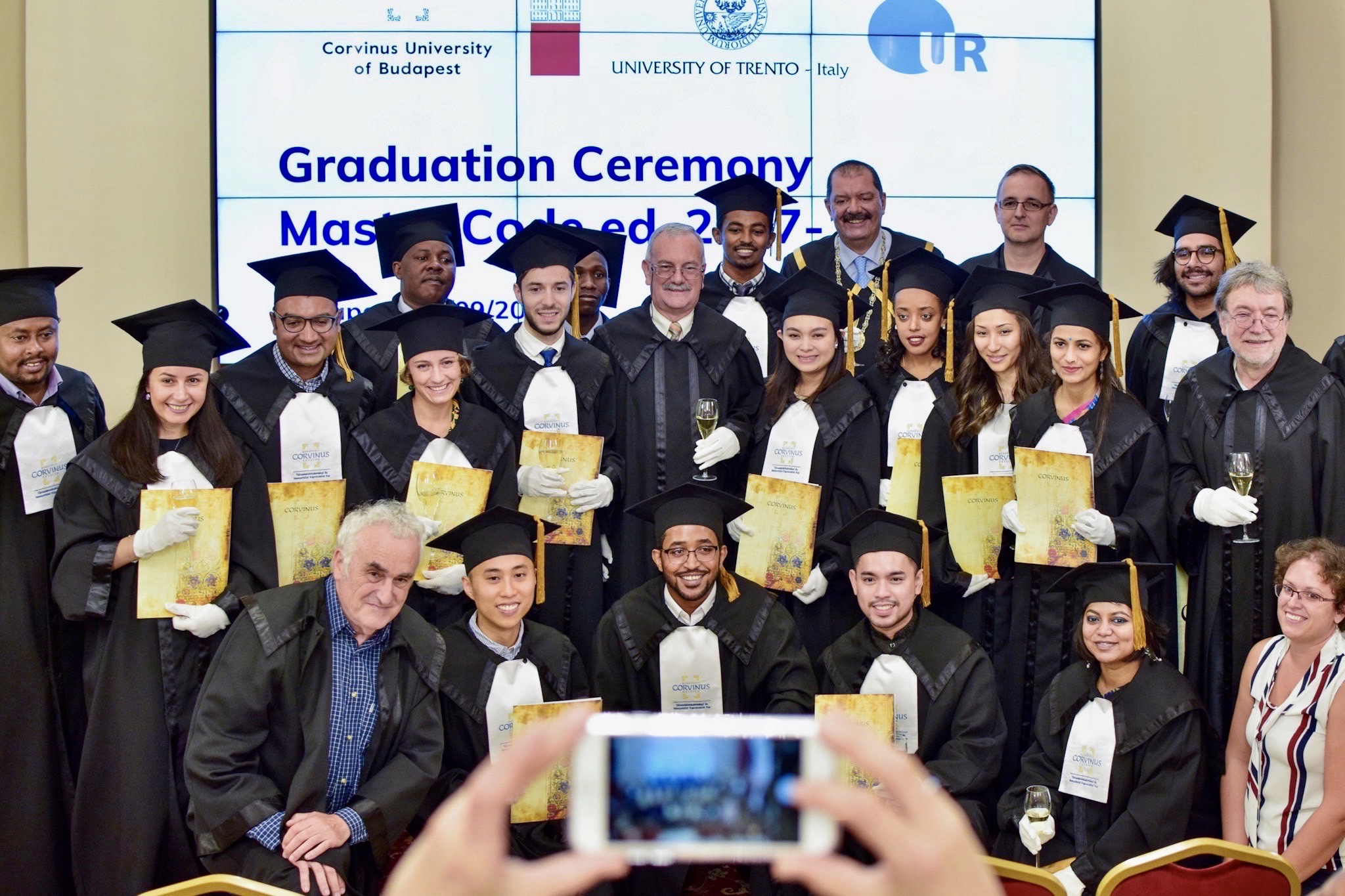


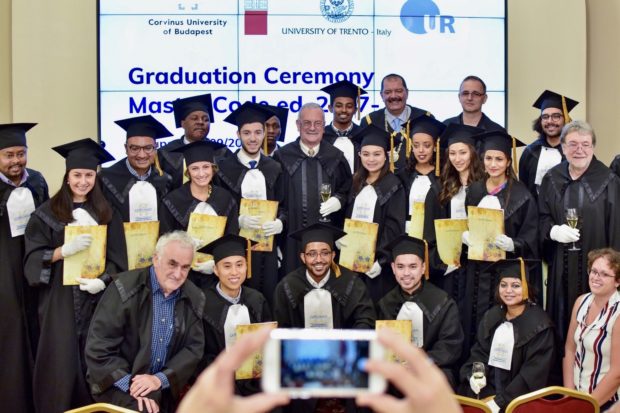
Tangcalagan (third from right, seated) finishes his masters degree as summa cum laude.

His advice to those who want to have the similar experience as his and study abroad? “Forget about all your doubts, don’t be afraid to try.”


Scholarship program of the EU


Thelma Gecolea, the public affairs officer of the EU Delegation to the Philippines, said that Erasmus+ is the scholarship and mobility program of the EU and managed by the European Commission.


Under the program, masteral and doctorate students from third world countries such as the Philippines are offered the chance to study in two to three EU member states.

As of 2019, there had been over 400 Erasmus scholars from the Philippines, 66 of whom were accepted this year.


“The Philippines has been ranking first in Southeast Asia in terms of scholars’ intake for the past three to four years,” Gecolea told INQUIRER.net.


Information about higher education opportunities in the EU are discussed in gatherings such as the European Higher Education Fair (EHEF).


Gecolea said that during EHEF, representatives 48 universities from the EU will be in attendance to inform the public about the advantage of “learning in a borderless Europe.”


In this year’s EHEF, universities from Austria and Finland will be participating in the event.

The event will be held on October 28 at the Lyceum of the Philippines University – Cavite from 9 a.m. to 3 p.m. and at the Grand Atrium in Shangri-La Plaza on October 26 from 11 a.m. to 6 p.m.


“There are the advantages of immersing in the EU’s charming past and the cutting-edge technology of the future,” Gecolea said. /je

Friday, May 8, 2015

...the Philippines paradox

Philippines' Economic Development and the 'Pacquiao Paradox': Shining Individually, Whimpering Collectively

Richard Javad Heydarian Headshot


For years, I have covered the emergence of the Philippines as the darling of global investors. (In fact, a number of my works on HuffPo have focused on this issue.) After countless exchanges with economists, consultancy agencies, and businessmen in the country and beyond, it is quite clear to me that there is a growing sense of optimism (Keynesian "animal spirits") in and over the long-term economic potentials of the Philippines. Business confidence is building up.
Undoubtedly, the Southeast Asian country is once again on the radar. Certain macroeconomic trends are highly encouraging, particularly in terms of inflation and interest rates, projected annual growth rates, fiscal reforms, debt payments, gross foreign reserves and trade and investment inflows. Recent years have also seen growing regulatory predictability in the government and sustained efforts at closing the country's gnawing infrastructure gap.
Yet, sustained economic development doesn't take place in a vacuum. For the Philippines to become a true "tiger economy" in the coming decades, it has to also experience some changes in its cultural foundations.
A Country of Stars
I vividly recall a poster advertising "Filipino singers" in the elevator of an upscale hotel in Beijing when I was there for an academic visit few years back. Of course, there was nothing surprising about Filipino singers performing in major hotel chains. After all, from the Middle East to East Asia and North America, I constantly came across affable, highly competent, and extremely nice Filipinos, who were at the forefront of the hospitality and tourism business.
But what struck me was how, especially when it comes to singing, being a "Filipino" alone represents a brand. If you are Filipino, you are expected to be a great singer. Countless Filipinos, from Charmaine Clarice Relucio Pempengco to Christian Bautista, have made it big on the international stage. When it comes to singing and dancing, the Filipinos can compete with the best in the world, and often emerge as the indisputable victors. Not to mention, the Philippines' superpower status when it comes to beauty pageants. I have lost count of how many Filipinas (pure- or part-Filipino) have managed to make it to the top 5-10 contestants in every major global beauty contest.
No wonder then that many see the Philippines as the extension of Latin America into the heart of Asia, an island nation filled with the Iberian spirit of musicality and overflowing talent. In certain sports, especially the "Four B's" of basketball, billiards, bowling and boxing, the Philippines has also showcased its ability to go toe-to-toe with the best in the world. From the Philippines' impressive performance in the latest FIBA World Championship, to globally-renowned billiard wizards such as Efren "Bata" Reyes, Francisco Bustamente, Dennis Ocrollo, as well as world bowling champions such as Rafael "Paeng" Nepomuceno, it is clear that there has been no shortage of world-class talent in the Philippines.
Above all, perhaps, stands Manny "Pacman" Pacquiao, who is widely considered as one of the best pound-for-pound boxers of his generation. He is the first and only boxer to have won world championships in eight divisions, and his recent (controversial) loss to Floyd "Money" Mayweather should take nothing away from his impeccable legacy.
Yet, astonishingly the Philippines stands among few counties which have yet to win a single gold medal in the Olympics. Despite having one of the most articulate and talented journalists, lawyers, and artists as well as an army of engineers, doctors, and scientists, the Philippines is yet to break out of its "lower-middle income trap". And despite having among the world's best singing and dancing talents, it is South Korea's"K-pop" phenomenon, which is transforming the entertainment landscape in Asia.
The Philippines is a paradoxical nation, where individual glories often clash with a long history of collective disappointment.
The Anti-Asian Values
Singapore's late-founder, Lee Kuan Yew, was fond of talking about the peculiarities of the so-called "Asian Values" (AV). He always insisted that unlike Western countries, Asians are more predisposed to thinking and behaving in collective-communitarian terms, putting the interest of the family and broader community above their individual impulses.
"I don't think there is an Asian model as such. But Asian societies are unlike Western ones... [an Asian person] is not pristine and separate," Lee Kuan Yew argued in an interview with Foreign Affairs back in 1994. To be fair, the legendary Singaporean leader had a more specific notion of "Asia" in mind, since he was primarily referring to "Confucian countries" of China, Taiwan, South Korea, Japan, Singapore and Vietnam.
His Malaysian counterpart, Mahathir Mohamad, was even more all-encompassing in conceptualizing of and passionate in his advocacy for the notion of "Asian Values", consistently questioning the universality of liberal democracy, which is primarily found upon the principles of individualism, procedural accountability, and freedom of expression. Instead of embracing democratic capitalism as the ideological end point of history, he envisioned an alternative episteme anchored by principles of deference to authority, limits on individual freedom, and emphasis on hard work and economic productivity.
Obviously, the concept of "Asian Values" has been largely discarded by the experience of countries such as India, Indonesia, Japan, Taiwan, South Korea, which have embraced liberal democracy, albeit with certain modifications, without necessarily becoming "un-Asian". For its critics, the AV concept has been largely dismissed as a thinly-veiled propaganda for autocratic leadership and, quite ironically, an orientalist perspective, which ignores the almost universal demand for Vox Populi and freedom of expression.

Among Asian countries, the Philippines perhaps stands as the extreme opposite of the so-called "Asian Values". It is a country where individualism and lively public discourse undergirds the body-politic, animating the conduct of day-to-day politics and the broader national political culture. It is a country where the mainstream media constantly prioritizes endless gossip about individual celebrities over deep strategic discussions about national interest and development.
It is a country where actors and entertainers are constantly overwhelmed by public attention, while intellectuals are constantly pushed to the margins of public discourse. It is a country where the interests of an individual and his/her family stand as concrete, tangible priorities, while notions of nation and nationalism are treated as largely abstract points of reference, fondly cited in poems, movies and history books.
Philippine Exceptionalism
To be honest, I am not very convinced with cultural theories on national development, always preferring to focus on the impact of trade and industrial policies, the state-building process, and the structure of opportunity in the global economic system. The concept of "culture" is itself too broad and imprecise, often interchangeable with religion, national psyche, or "institutions", which pertain to regularized practices that have gained value over time, shaping the behavior of societies and individuals.
A century ago, leading sociologist such as Max Weber dismissed the ability of Confucian countries such as China to ever catch up with the West, (mistakenly) arguing that Far Eastern cultures tend to emphasize submission, passivity, and spirituality over the mastery of nature and a hunger for material accumulation, which underpin capitalist modernization. Yet, the past decades have seen the likes of Singapore, South Korea, Taiwan, and China emerging as history's greatest (capitalist) economic miracles. Confucian Vietnam is obviously in the midst of its own industrialization bonanza.
As Fareed Zakaria cogently points out in his Foreign Affairs interview with the Singaporean leader, "Cultures change. Under the impact of economic growth, technological change and social transformation, no culture has remained the same. Most of the attributes that Lee sees in Eastern cultures were once part of the West. Four hundred years of economic growth changed things."
Few recall how in the past even Germany and Japan used to be dismissed as non-Western countries, predisposed to autocratic rule. The European intellectual giant Jurgen Habermas' post-World War II personal project was precisely about transforming Germany into a more Anglo-Saxon like democratic polity. Today, Germany and Japan stand as among the most stable democratic societies in the world, untouched by the bickering and political paralysis that afflicts old democracies such as the United States and France.
Obviously, culture is malleable and subject to change. But in the case of the Philippines, decades of economic stagnation has gone hand in hand with cultural immutability. While a predatory oligarchy has instituted a "shallow capitalism", and exploited hollow electoral institutions in the country, a persistently individualistic/family-centered culture, in turn, has come at the expense of building a collective, national spirit, which has been instrumental to development of most countries in the region.
Perhaps, instead of just creating global stars, the Philippines should also develop a socio-economic ecosystem, found upon a progressive national culture, which nurtures the talents of and provides opportunities for fruition of the vast potentials of the broader Filipino population -- that is to say, every Juan/Juana de la Cruz. And the Filipino political leadership, media, and intellectual class should play a key role in this transformation. This is their sacred duty.


Sunday, February 16, 2014

...the walk of faith

INC bags Guinness for walkathon

            
Thousands of Iglesia ni Cristo members join the ‘Worldwide Walk’ for Typhoon Yolanda victims along Roxas Boulevard in Manila yesterday. JOVEN CAGANDE


MANILA, Philippines - The Guinness World Record announced that the Iglesia ni Cristo is the new record holder of the biggest charity walk in a single venue, with 175,000 INC members pouring into Manila’s seaside avenue yesterday to join the Worldwide Walk aimed to raise funds for Typhoon Yolanda survivors.

Guinness adjudicator Kristy Bennet said INC beat Singapore’s The New Paper Big Walk 2000 that had 77,500 participants on May 21, 2000.

“INC, you are officially amazing,” Bennet said when she announced the result at the Quirino Grandstand last night.

The INC’s Worldwide Walk kicked off at the Cultural Center of the Philippines and ended at the footbridge along Roxas Boulevard near the United States embassy.

All those taking part bought special white t-shirts each costing P250 to wear during the march, with all the proceeds donated to help the typhoon victims.

“We would like to collect extra funds in order to continue helping the survivors of the super typhoon, of which the primary beneficiaries would be members of the church in the Visayas region, but that does not mean that they would be the only ones who would benefit from the funds generated… From the proceeds of the walk we would do the same even for the non-members,” said INC event spokesman Edwil Zabala.

The INC’s Worldwide Walk is also competing for the largest charity walk in a 24-hour continuous worldwide walk in multiple venues.
 
The current record holder is the one organized by the Green Communities in Canada that had 231,635 participants who walked for a minimum of one kilometer at 1,011 different locations in Canada on Oct. 2, 2007.

For the Worldwide Walk, the INC identified 140 sites including Metro Manila for the multiple sites category, of which 85 sites are in the Philippines and 55 sites are in other countries: 34 in the United States, six in Europe, 10 in Australia, and five in Asia.

Zabala said the 24-hour continuous walk started in New Zealand at 2 a.m. Philippine time yesterday and would end in Hawaii at 1 a.m. Philippine time today.

The Guinness is yet to announce the result for the largest charity walk in the multiple venues category.

About 800 policemen from the Manila Police District and the National Capital Region Police Office were deployed at the INC event. Based on MPD’s estimate, there were about 1.5 million people in the area, including the marshals.

Chief Senior Superintendent Gilbert Cruz, directorial staff of the MPD, said no untoward incident in connection with the event was monitored.

With the total closure of a stretch of Roxas Boulevard and several adjacent streets, the volume of traffic in Manila yesterday was lighter than expected. Classes in affected areas in Manila were suspended yesterday.

Chief Inspector Olivia Sagaysay, head of Manila’s traffic police, likened the flow of vehicles to that of a “regular day.”

She said although the traffic flow on Roxas Boulevard and other roads near the venue was affected, the participants cooperated with the police, making it easier for the authorities to handle the traffic situation. – With Aie Balagtas See, Eva Visperas