Showing posts with label global community. Show all posts

Saturday, November 30, 2019

...The Southeast Asian Game host (opening)

Philippines showcases cultural heritage to kick off 30th Sea Games

New Straits Times
30 November 2019


MANILA: The Philippines staged a spectacular opening ceremony for the 30th SEA Games at the world’s biggest indoor arena, the Philippine Arena, in Bulacan, near here, tonight.


In a departure from tradition, the opening ceremony was held in an indoor arena rather than a stadium.


Also, for the first time in the biennial Games’ 60-year history, the games cauldron was placed at a different location, at the New Clark City Athletics Stadium, some 90km from Bulacan, and the lighting of the cauldron was shown on screen at the 55,000 capacity arena.

The extravaganza started after Filipino singer Lani Misalucha sang the republic’s national anthem, which was followed by an extraordinary performance themed “The Roots of our Strength”, showcasing the culture and heritage of the nation.
The spectators were treated to a series of warrior dances from the Bagobo, the Kalinga, the Maguindanao, Islamic and the pre-Hispanic Visayans.

The later part of the ceremony was powered by modern and hip-hop performances led by local artistes Inigo Pascual, Robert Sena, Apl.de.Ap and KZ Tandingan, among others.
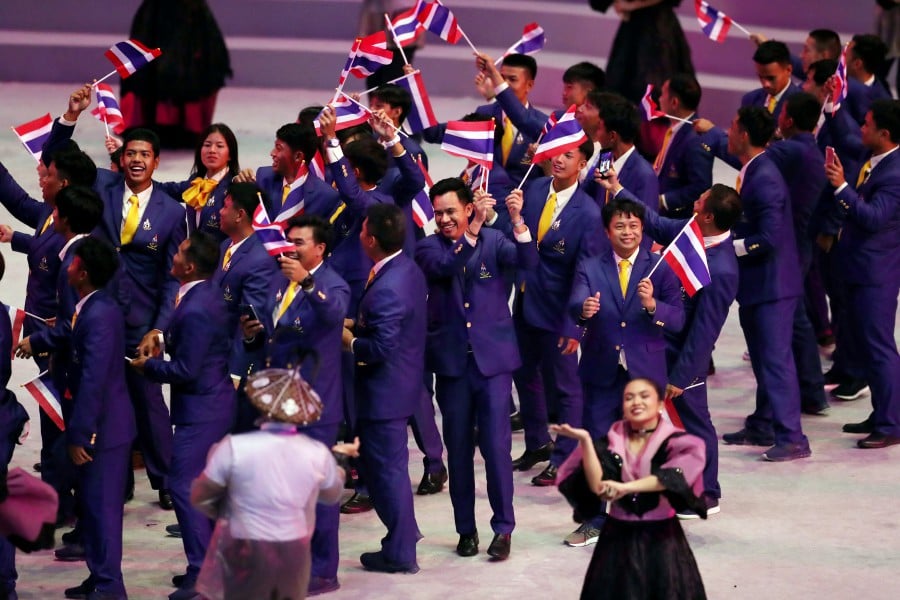
The contingents received loud cheers from the audience as they paraded into the arena in alphabetical order, starting with Brunei, Cambodia, Indonesia, Laos, Malaysia, Myanmar, Singapore, Thailand, Timor Leste and Vietnam, before host nation the Philippines ended the march.

Led by flag-bearer and 2018 bowling world champion Rafiq Ismail, the Malaysian contingent were represented by a delegation of about 100, including chef de mission Datuk Megat Zulkarnain Omardin and his two deputies, Nurul Huda Abdullah and Ahmad Faedzal Md Ramli.


With the men dressed in white baju melayu and red samping with tengkolok, and the women in white baju kurung and selendang with Jalur Gemilang motif, and black shoes, the multi-racial Malaysian contingent, the hosts of the previous games, walked past the crowd proudly, symbolising the multiculturalism of the country.

World renowned Filipino boxers Manny Pacquiao and Nesthy Petecio were given the honour as the torchbearers before they jointly lit the cauldron to officially mark the beginning of the 30th SEA Games, after Philippine President Rodrigo Duterte had declared open the Games.

Themed ‘We Win As One’, the Games will run for 12 days until the closing ceremony at the New Clark City Athletics Stadium on Dec 11.
More than 8,000 athletes from the 10 ASEAN countries and Timor Leste will compete in 530 events in 56 sports at the three main clusters, namely Manila, Clark and Subic.


The Philippines have hosted the SEA Games three times before – in 1981, 1991 and 2005.
This year’s Games see the introduction of a few new sports such as arnis, jujitsu, kickboxing, underwater hockey and esports.

Defending champions Malaysia have sent a strong contingent of 773 athletes and 339 officials to participate in 52 sports, targeting 70 gold, 51 silver and 105 bronze medals, which is expected to place them fourth overall.– BERNAMA

Wednesday, October 16, 2019

...the Filipino Princess

Filipino princess champions humanitarian efforts in Cambodia


Anith Adilah Othman
Khmer Times
16 October 2019


Glamorous yet graceful - these are the best words to describe Princess Dr. Maria Amor Torres, a member of the Philippines 'Royal House of Baloi who is recognized globally for her philanthropy work.


Image result for maria amor torres


As a Mindanao royalty, Princess Dr Maria is aware of the ‘voice she commands’, therefore she chose to make it count by advocating sustainable social developments and promoting universal humanitarianism.
“As one of the Sultans of my region, I have bigger responsibilities as far as social developments and peace-building are concerned,” she told Khmer Times in a recent interview. “These are the duties given to me by the royal authorities who enthroned me.”
“I accept these duties wholeheartedly as it aligns to my aspirations as a humanitarian. There is nothing that will make me happier than to serve humanity, especially our own people,” she added.
Despite having had a life full of glitz and glam as a celebrity formerly, the princess admitted that there is nothing more rewarding than bringing about positive change to the lives of others. She added that her determination to serve humanity remains her biggest motivation.
“Life has never been better and sweeter as I am living the dream now. Living a selfless life with a purpose, building a bright future for our children, fighting for human rights, promoting equality, empowering women and the youth, promoting health and wellness and protecting our environment. This is the best kind of life to live,” she quipped.
Regardless, Princess Dr Maria is showing no signs of stopping. She is now leading a non-profit group that she founded in 2011, ‘We Care For Humanity’, to continue to make changes for the betterment of the world.
“We are an internationally-recognised organisation focusing mainly on the seven United Nations Sustainable Development Goals. They are: zero poverty, good health and well-being, quality education, gender equality, reduced inequalities, climate action and peace and justice,” she said.
Thanks to her active participation in the field of philanthropy, Cambodia can now hopefully benefit from the latest collaboration between ‘We Care For Humanity’ and ‘Save Nature Cambodia’, a local group aimed at raising awareness on eco-friendly initiatives among citizens.
“Cambodia is a fast progressing country with very strong culture and passion for the environment. Its people are equally beautiful, resilient and faithful to their motherland.
“Cambodia is also a big advocate of climate change, that is why we are very happy to collaborate with ‘Save Nature Cambodia’. As the Royal Advisor of the latter, I can extend the mission and vision of our organisation concerning matters related to climate change,” she added.

Monday, September 16, 2019

...the China's Belt & Road biggest beneficiaries

Property development poised to win big with belt and road


RI investments in Southeast Asia are giving rise to huge oppurtunities in construction and real estate sectors.


Syed Ameen Kader
Zawya
16 September 2019 


China's ambitious Belt and Road Initiative (BRI) embarked on a new phase with the unrolling of BRI 2.0 by Chinese president Xi Jinping during 2nd BRI Forum in April. As China promises to address transparency concerns and open BRI to wider participation, one of the regions that can immensely benefit from this revamped programme is Southeast Asia.

BRI investments in new ports, railroads and highways in the region are expected to drive construction and real estate (CRE) developments in logistics, manufacturing and industrial sectors along those routes.
The biggest beneficiaries in BRI-related investments over recent years have been Thailand, Malaysia, the Philippines and Cambodia, said real estate consultancy Knight Frank in its report 'New Frontiers 2019.'
"For these markets and China, a capital injection brings mutual benefit: with infrastructure funding, the host country speeds up its economic expansion, while China gains new trading partners," said Justin Eng, Associate Director at Knight Frank Asia Pacific.
The report noted, over the past five years since the BRI's launch, $59.25 billion in Chinese-linked capital has been invested across the Southeast Asian transportation, real estate and logistics sectors; almost 3.5 times the $17.1 billion invested in the five years prior to BRI.
Accounting firm KPMG agrees that countries across Southeast Asia are experiencing rapid economic growth and high levels of public infrastructure expenditure.
"These dynamics are leading to an attractive and diverse range of opportunities in the construction and real estate sectors," said Andrew Weir, Regional Senior Partner, KPMG Hong Kong and Vice Chairman, KPMG China.
He said specific countries which are expected to see strong volumes of real estate development and construction activity in coming years include Vietnam, Thailand, the Philippines and Indonesia.
Within the real estate sectors, the logistics and industrial sectors will be the biggest initial beneficiaries, according to Knight Frank.
When a new port is built, Eng explained, there is a corresponding rise in demand for warehouses to store incoming goods prior to being transported inland.
"We are witnessing an uptick in client interest - especially from the global 3PLs - in exploring build-to-suit opportunities within these markets, especially around current major BRI projects," he said.
Trade connectivity
A major theme that is being observed right now in several Southeast Asian markets is investment in infrastructure that enhances people and trade connectivity to increase the scope for growth in domestic trade as well as industrial and agricultural exports.
"Thailand and the Philippines are good examples of this dynamic," said Michael Camerlengo, Partner, Infrastructure Advisory at KPMG Transaction Advisory Services.
In Thailand, he said, the Eastern Economic Corridor (EEC) is a special economic zone development initiative that is attracting a lot of attention. There are plans underway to connect the country with China, via Laos through high-speed rail infrastructure as well as the expansion of the U-Tapao airport and Laem Chabang Port.
"These connectivity projects will lead to significant industrial and logistics development and construction opportunities along the corridor," said Camerlengo.
Whereas, in the Philippines, he said the government has been embarking on its 'build, build, build' programme which is directed at improving and expanding infrastructure across the country. This includes a high volume of expressway and bridge projects related to better connecting the archipelago as well as reducing flood-related risks across the country.
"Similar to Thailand, these projects will lead to increasing transaction volumes in industrial and agricultural real estate in areas that are proximate to these enhanced and new networks," said Camerlengo.
Real estate investment
Over the last couple of years, Chinese real estate investors have shifted their focus away from the US to Europe and Asia as the country's economy and currency gained strength.
Chinese investment in US property assets dropped 64 percent in 2017 from 2016, to $5.9 billion, according to Real Capital Analytics (RCA) data, highlighted by Colliers in its report titled: The Dragon Spreads its Wings over Asia, released last year.
Conversely, the report added, Chinese investment in Asian property assets increased 34 percent to $12.5 billion, while Chinese investment in European property assets surged 336 percent to $18.7 billion, during the same period.
The report further noted that Chinese investment in Southeast Asia and South Asia reached $2.5 billion in 2017, nearly four times the level of 2016 and the second highest level ever (after $4.1 billion in 2013).
Looking ahead over five years, Colliers said China's ambitious "One Belt, One Road" project, coupled with the firm Chinese economy and RMB (Renminbi) strength, ought to drive Chinese investment in emerging Southeast and South Asian markets.
This was reflected in CBRE's China Investor Intentions Survey 2019 which revealed that Chinese buyers retain strong intentions to invest within Asia, partly due to opportunities to purchase assets in sectors expected to benefit from the BRI.
"Emerging Asian countries, such as Vietnam and Thailand, registered increasing interest from Chinese investors. The survey found 46 percent of respondents chose Emerging Asia as a most preferred investment region, 4 ppts higher than last year," said Sam Xie, Head of Research at CBRE China.
He said Southeast Asia continued to benefit as labour intensive manufacturers relocate supply chain out of China.
"Riding on this trend, Chinese logistics developers and investors continue to develop logistics infrastructure and build supply chains in emerging Southeast Asia in anticipation of growing demand," said Xie.
Meanwhile, he added, the residential markets in many Belt and Road countries are emerging to be preferred destinations for Chinese investors.
While there's currently no forecast or projection in terms of investment volumes (as all outbound investment activities are subject to state approvals), Zhang of Cushman & Wakefield pointed out that China outbound real estate investment into belt and road averaged around $3 billion (excluding infrastructure) for the past six years.
Daniel Yao, Head of Research East China at JLL agreed that there are increasing interests from Chinese developers (but not many from domestic institutional funds so far) seeking opportunities of buying land plots over the past couple of years in Southeast countries, including Vietnam, the Philippines, Cambodia, and Indonesia.
According to RCA data, Chinese real estate investment volume for development sites in Malaysia and Thailand has been $73.84 million and $25.78 million respectively in the first half of 2019.
This comes after Chinese investors spent $87.69 million and $27.62 million in Cambodia and Indonesia respectively for real estate transactions for the whole of 2018, according to RCA.
"China, and its key cities, in particular, are growing connections with other countries and cities, not only under the umbrella of BRI but also in more organic ways," said Yao.
For Chinese developers, he said, residential and commercial (especially for office-use) land plots in both mature and emerging locations are the most sought-after.
Mitigating risks
While most of the concerns about BRI including debt trap are primarily related to mega infrastructure projects involving government entities, real estate projects executed through joint ventures (JV) between Chinese and local companies are also prone to risks.
"One major risk we see is political in nature such as a change in government," said Eng of Knight Frank.
Richard Fu, Senior Associate Director, Belt and Road Outbound Consulting Team, Consulting Department, Cushman & Wakefield, said political risks are difficult in BRI investments.
"Getting China investors and local partner to reach an effective partnership is also difficult. To ensure economic feasibility, we would suggest investors to have deep and systematic study before conducting actual investment," he said.
Eng pointed out that the 'debt trap' concern mainly involves local governments who undertake the project with a Chinese state-owned enterprise partner.
In order to safeguard themselves, he suggested that local companies undertaking BRI projects should conduct their proper due diligence before making major capital expenditure decisions.
"While major projects are unlikely to be cancelled once announced, they could face major delays in completion which in turn will lower returns to investors," warned Eng.
KPMG's Weir pointed out that there are always risks associated with development projects, BRI included.
"Whether construction-related, regulatory, commercial or people related, all risks need to be carefully identified, assessed, quantified and mitigated before proceeding with a new development," he said.
By way of example, Weir said, a common people-related risk on BRI projects includes navigating cultural differences and similarities as a foreign investor into a new market.
When it comes to commercial risks, he said identifying the customer demand profile for the project is key - whether it be office, residential, hotel or retail development, adding that identifying who the end-users will be, what their requirements are and expected demand levels will ultimately determine the prospects for financial success and key risk factors to address.
"Once this dynamic is well understood, assessing the optimal debt and capital structure that will be sustainable in the long run becomes a more straightforward proposition," said Weir.
From an investment perspective, said Zhang of Cushman & Wakefield, forming a JV with the local developer seems to be a most effective way of adapting to local markets and mitigating potential risk in planning, construction and sale/lease.
Additionally, Knight Frank's Eng said they are starting to see greater scrutiny now on how the BRI label is being used on projects across the region and how their structures (both debt and partnerships) are being assembled.
(Reporting by Syed Ameen Kader; Editing by Anoop Menon)
(anoop.menon@refinitiv.com)


Saturday, September 14, 2019

...the environment-friendly country

Philippines joins Southeast Asian nations rejecting plastic waste


Jun Endo
Nikkei Asian Review
14 September 2019


MANILA -- The Philippines is getting serious about plastic waste imported illegally from developed countries, announcing in August that it would impose a three-month moratorium on waste-related imports.

Plastic waste is sorted at a new recycling plant in Metro Manila. The Philippines has seen its plastic waste imports rise 150% from 2016 to about 11,800 tons in 2018.

It has even sent some back to Canada, which had been discovered shipping waste illegally to the country for years -- a revelation that so infuriated President Rodrigo Duterte that he recalled his ambassador to Canada and threatened war.

"We are not the world's dump site," the outspoken president said.

To help deal with the problem, a new 25 million peso ($481,877) garbage-disposal plant in Metro Manila is scheduled to go online soon. The project is being headed by the Philippine Alliance for Recycling and Materials Sustainability, a nonprofit organization consisting of global food and consumer goods giants such as Nestle, Coca-Cola and Unilever.

The facility will pulverize about 1 ton of plastic a day -- equal to about 400,000 sachets of shampoo and instant coffee -- to make sidewalk blocks and other products.

But while every bit helps, the plant will hardly put a dent in the roughly 60 billion plastic sachets said to be in circulation, the vast majority of which are destined for dumps. And because making road blocks from recycled plastic is about 14% more expensive than from concrete, the facility will encourage environmentally conscious infrastructure and construction companies to buy them.

"Our first goal is to make projects like this investable," said PARMS Executive Director Paolo Gonzales. "If we can prove that it will be profitable -- that we can gain a return on our investment -- we will be able to get other sources of funding and replicate it, maybe in other cities in Metro Manila."


More than 8 million tons of plastic is dumped into the world's oceans each year, with China and four other Asian nations accounting for the majority of this. Meanwhile, the mountains of plastic waste produced globally had largely gone unnoticed until China began reducing waste imports in 2014 before banning them outright in 2018.

With nowhere to go, the waste found its way to Southeast Asia, with the Philippines seeing plastic waste imports rise 150% from 2016 to about 11,800 tons in 2018.

But the country has had enough. Following Duterte's tirade, the Department of Environment and Natural Resources announced the three-month moratorium. A department official urged businesses to take the waste matter seriously and promised to cooperate with them in their efforts to tackle the problem.

The Global Alliance for Incinerator Alternatives has heavily criticized multinationals' reliance on single-use plastics, saying that nearly 60% of plastic packaging in the Philippines comes from 10 multinational companies, including Nestle, Unilever and Procter & Gamble.

Moreover, investors are beginning to focus on environmental, social and governance -- or ESG -- investment principles so businesses cannot afford to ignore the issue.

Many other Southeast Asian countries are also unhappy with multinationals over the vast amounts of plastic waste they generate. This has prompted about 40 companies -- including Dow Chemical and BASF -- to establish in January the nonprofit Alliance to End Plastic Waste.

At an August meeting in Bangkok, the Alliance announced it will invest $1 billion in Southeast Asia and elsewhere over the next five years to improve waste control systems and infrastructure needed to collect plastics.

"While our effort will be global, the Alliance can have the greatest impact by focusing on parts of the world where the challenge is greatest -- such as Southeast Asia, where more than half of the world's plastic waste has been found -- and by sharing solutions and best practices so that these efforts can be amplified and scaled-up around the world," said Antoine Grange, CEO of Recycling and Recovery of SUEZ Asia, an Alliance member.
The Alliance's ultimate goal is to build recycling-oriented economies in the region in cooperation with member companies.global

Researcher Ella Hermonio contributed to this report.

Sunday, September 8, 2019

...the PH top grossing film of all time

How Hong Kong-set ‘Hello, Love, Goodbye’ became the Philippines’ top-grossing film of all time

  • The film, which was also shot in the city, is the tale of a domestic worker and a playboy bartender, both Filipinos, who fall in love
  • Experts and fans say it captures the lives of overseas Filipino workers, who finally feel seen after often being regarded as invisible in their daily jobs
Crystal Tai
South China Morning Post 
08 September 2019


Hello, Love, Goodbye is the hit film about the romance between a millennial
domestic worker
and a playboy bartender – and it’s now
the Philippines
’ top-grossing film of all time. Filmed and set in Hong Kong, the movie stars Kathryn Bernardo as Joy and Alden Richards as Ethan, a Filipino couple who inadvertently fall for each another while chasing their dreams and trying to make ends meet in the city.

‘Hello, Love, Goodbye’ stars Kathryn Bernardo as Joy and Alden Richards as Ethan. Photo: YouTube


Since its July 31 release, the film has earned more than US$44.8 million worldwide. Besides the Philippines, Hello, Love, Goodbye has also become the
highest-grossing Philippine film
in Australia, New Zealand and Britain.
In the Southeast Asian nation, 10 million people – a tenth of the population – work abroad, searching for better pay and opportunities to support their families. These overseas Filipino workers (OFWs) send home up to US$31 billion every year, roughly 10 per cent of the nation’s GDP, according to a 2018 National Geographic report.
Toni Magsaysay, a Manila-based graphic designer in her 20s who did her bachelor’s thesis on the lives of OFWs, said many Filipinos would be able to relate to the film.
“Many families have relatives working overseas,” she said. “They know the sacrifices made by each end. But at the same time, they do not entirely share all of the hardships from both sides, as to not make both sides worry too much.


While many OFWs are nurses, engineers and ship workers, Magsaysay adds that the majority are domestic workers.
Hong Kong, which employs 213,000 Filipinos as domestic workers according to 2019 statistics, is one of the top destinations for OFWs. E.J.R. David, a Filipino-American professor who teaches cross-cultural psychology at the University of Alaska, Anchorage, said many Filipinos see more opportunities in the likes of Hong Kong and Singapore than they do at home.
“In addition to featuring the plight of overseas domestic workers, which many folks can relate with, [Hello, Love, Goodbye] also tackles issues that are more universal like love, family, individuality, responsibility, and how they are all intertwined,” he said.
“Many of us can relate to these universal themes, because many of us in the diaspora are constantly trying our best to navigate this delicately tangled web of in our lives.”
David said that while the film was popular among Filipinos because it gave them a glimpse of what their loved ones might be going through, OFWs themselves would also find it powerful because they would “finally feel seen and appreciated when they are often regarded as invisible in their daily work”.
Hello, Love, Goodbye also breaks down stereotypes surrounding OFWs, according to Eian John Pascua, a graphic designer and fan of the film who is based in the Philippines. He said OFWs are often assumed to be earning a significantly higher amount of money, and are therefore expected to foot the bill for their families when it comes to items like new cellphones or shoes.
“That was one of the issues discussed subtly in the movie, when Joy’s siblings were asking if she could buy them stuff that was a bit pricey,” Pascua said.
For graphic designer Magsaysay, the film was also realistic in its depiction of the more gritty aspects of being a domestic worker living in Hong Kong. She cites a scene in which the characters picnic in crowded Victoria Park on their day off. “I remember my sister, who once lived in Hong Kong for a teaching job, telling me, ‘How they sit on cardboard [in the park] is really real’ when we watched the movie together.”
Due to their sacrifices, OFWs are often regarded as modern day heroes by their families, said David, the academic. “The country recognizes that it is largely dependent on the money that overseas Filipino workers send back,” he said, adding that research suggests more than a third of the Philippines’ population receives money from relatives working abroad.
David also points out the problem with many Filipinos having to part from their families just to survive.
“It is unfortunate the Philippines as a country has become dependent on this sacrifice, [that its] largest export is its people [and] providing for their family means having to leave them behind,” he said. “It’s a sad life when you realize that in order for your family to survive, then you need to serve others.”