Showing posts with label national interests. Show all posts

Monday, November 26, 2012

...the Cory's legacy

Walesa: Cory made impact on Poland's democracy


Nobel Peace Prize laureate and former President of Poland Lech Walesa on Sunday recognized the influence of the late Philippine President Corazon Aquino on his country's own fight for democracy.

"For sure there were a lot of solutions which she [Cory] gave to us which we could also use in our own building up of democracy," Walesa said on the sidelines of the 9th Media Nation Summit in Tagaytay, where he spoke with the aid of a translator.

Walesa, 69, also spoke of his admiration for the 1986 People Power revolution and its leader Cory, mother of the current president Benigno Aquino III.

Walesa, along with Cory Aquino, Nelson Mandela, and only a few others, is considered one of the symbols of the democratization that swept the world in the late 20th century.

He received the Nobel Peace Prize in 1983 for leading a workers' movement against the communist regime.

He was elected President of the Republic of Poland in 1990 and, during his term, saw Poland through privatization and its transition to a market economy.

Walesa did not elaborate how Cory influenced Poland but said in his speech delivered before journalists at the summit that "in this world nothing happens by accident."

"We always have an impact better or less. It's very difficult to measure what impact it did have," he said.

Also part of his admiration of Cory stems from the Catholic wellspring of Aquino’s faith.

Walesa, as well as the majority of Poles, is a devout Catholic.

Beautiful Philippines


But in his speech, Walesa said there is still a lot to be "corrected" in the Philippines.

"You can do much more here. I see your possibilities," he said.

He specifically said that the country has "so many beautiful things which are not yet used."

"How much beauty there is here... how beautiful the girls here. If I could be a little bit younger I'd stay here," he added with a laugh.

He likewise said that in issues concerning the future of the country, the media plays a big role.

"Media have the most important role in today's world. You have to provoke a discussion. So now media move a little bit," he said.

After losing his re-election bid in 1995, Walesa established the Lech Walesa Institute, enabling him to remain active both on the international stage. — BM/HS, GMA News

Sunday, November 11, 2012

...the rising Asian Tiger

PH is rising Asian ‘tiger’


Canadian PM bullish, vows more investment

By Michael Lim Ubac
Philippine Daily Inquirer


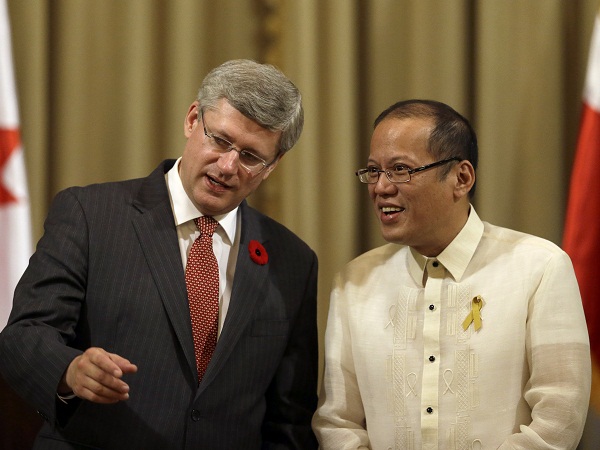
BULLISH OUTLOOK. Visiting Canadian Prime Minister Stephen Harper, left, gestures following a joint news conference with President Benigno Aquino III on Saturday, November 10, 2012 at MalacaƱang Palace grounds in Manila, Philippines. It was the first visit by a Canadian head of state in 15 years which was aimed at strengthening relations between the two countries. Canada is home to hundreds of thousands of Filipino immigrants. AP/Bullit Marquez


Visiting Canadian Prime Minister Stephen Harper sees the Philippines as “an emerging Asian tiger,” agreeing with the bullish outlook on the country of political and business leaders from many other parts of the world.

To demonstrate Canada’s confidence in the Philippine economy, Harper pledged to increase Canadian investment in the country during his meeting with President Aquino in MalacaƱang on Saturday.

Bilateral trade between Canada and the Philippines amounts to US$1.5 billion.

Mr. Aquino and Harper agreed to cooperate on defense and trade, and committed to people-to-people exchanges between the Philippines and Canada.

At a joint news conference, Mr. Aquino and Harper announced that the Philippine Department of National Defense and the state-run Canadian Commercial Corp. had signed a deal to help Manila buy military equipment to defend its territory.

The deal was signed amid a territorial dispute between the Philippines and China over islands and waters in the West Philippine Sea (South China Sea).

President Aquino said the deal would help the Philippines build up its defense and security capabilities. He declined to elaborate.

But Harper said the deal would “enable the Philippines to acquire the equipment and expertise it needs to fulfill the country’s defense and security agenda.”

Under the deal, Philippine purchases of equipment and expertise from Canada’s C$12.6 billion (US$12.6 billion) defense industry are guaranteed by the Ottawa government, according to a Canadian government statement.

Mr. Aquino and Harper discussed the progress in the Aquino administration’s good government program and the gains in the peace process, particularly the signing of framework agreement for peace with the Moro Islamic Liberation Front.

At the news conference, Mr. Aquino and Harper did not cite specific amounts for Canadian investment, but Harper described the Philippines as an “important economic partner” and an “emerging Asian tiger.”

Mr. Aquino said the Philippines was open for business under a new management, and that he saw the visit of Harper as a “recognition of the change of atmosphere in the Philippines.”

“We do see increased commercial trade ties between our countries,” Mr. Aquino said.

He said it was “logical to assume” that the $1.5 billion two-way trade between the two countries is “just the starting point.”

Defense cooperation

The two leaders witnessed the signing of the defense deal by Defense Secretary Voltaire Gazmin and Canadian Minister for International Trade and Asia-Pacific Gateway Ed Fast.

“This will help us in our efforts to build our defense and security capabilities,” Mr. Aquino said, welcoming Canada’s help in the much-delayed modernization of the Philippine armed forces.

The Canadian Commercial Corp. serves as a go-between for Canadian suppliers and foreign governments to transact defense and security contracts.

The Philippines has been in the market for patrol vessels to protect its waters, including areas that overlap with territory claimed by China.

Manila’s military treaty ally the United States is set this year to deliver a second refurbished Hamilton-class cutter, previously used by the US Coast Guard, to the Philippine Navy.

Last month, the Philippine Coast Guard announced it would buy five patrol boats from France for about 90 million euros (US$116 million), partly to guard disputed areas in the West Philippine Sea.

Harper and his lean delegation arrived in Manila Friday night.

He was accorded military honors on the Palace grounds when he showed up at 10:30 a.m. Saturday.

He then proceeded to sign the presidential guestbook before he and Mr. Aquino sat for discussions in the Music Room.

This was followed by an expanded bilateral meeting at the Aguinaldo State Dining Room and the signing of the defense deal and issuance of a joint press statement at the Reception Hall.

A state luncheon at the Rizal Hall hosted by Mr. Aquino in honor of Harper and his wife, Laureen, ended the official visit of the Canadian prime minister.

Harper was scheduled to fly back to Canada at 9:30 a.m. Sunday.


Ties that bind

Harper’s visit is the first by the highest Canadian official in 15 years. The last Canadian head of government to visit the Philippines was Prime Minister Jean Chretien, who brought a business delegation to Manila in 1997.

Besides Fast, Harper’s delegation included Joseph Oliver, minister for Natural Resources; the first Filipino-Canadian senator Tobias Enverga Jr.; and 10 Filipino-Canadian community leaders.

“Our government is taking actions to aggressively expand commercial relations with the entire Asia-Pacific region. We’re doing so to help create jobs, economic growth and a better quality of life both in Asia and in Canada,” Harper said at the official reception.

Harper disclosed the “many ties that bind” Canada and the Philippines such as the Foreign Investment Promotion Protection Agreement signed in 1995, and the growing people-to-people links.

There are nearly 800,000 Canadians of Filipino descent living and working in Canada. With a report from AFP

Thursday, June 14, 2012

...the most improved peace index countries

PH is world’s 5th most improved country, says study


The Philippines was cited as the fifth most improved country in the world, rising two notches to rank 133 from 135th last year, in the 2012 Global Peace Index (GPI).

The Institute for Economics and Peace on Tuesday released the 2012 GPI, an annual measure of global peacefulness ranking 158 nations based on their ongoing domestic and international conflict, safety and security in society and militarization.

The report said the Philippines showed improvements across a number of indicators including homicide rate, the number of deaths from internal conflict, the likelihood of violent demonstrations, and the incidence of terrorist acts.

Presidential Spokesperson Edwin Lacierda said the GPI affirms the report of the Philippine National Police that the crime rate in the country has declined this year.

“This is international recognition of our collective effort to address the safety and security of our people. Gains in the rank of the Philippines are indicative of our continuing commitment towards improving peace and promoting amity in our country,” Lacierda said in a statement.

Meanwhile, the report showed that Iceland and Somalia remain the world’s most and least peaceful nation, respectively, for the second year running.

Sri Lanka and Syria are named the biggest riser and loser, respectively, both moving 30 places.

Across regions, Western Europe is still the most peaceful region for the sixth consecutive year with the majority of its countries in the top 20 while the Middle East and North Africa is now the least peaceful region, reflecting the upheaval and instability caused by the Arab Spring.

The Asia Pacific, on the other hand, is the most improved region, the report noted.

“The world has become more peaceful for the first time since 2009. All regions excluding the Middle East and North Africa saw an improvement in levels of overall peacefulness,” it added.

GPI’s top 10 most peaceful countries:
1. Iceland
2. Denmark
3. New Zealand
4. Canada
5. Japan
6. Austria
7. Ireland
8. Slovenia
9. Finland
10. Switzerland

GPI’s bottom 10 least peaceful countries:
158. Somalia
157. Afghanistan
156. Sudan
155. Iraq
154. Democratic Republic of Congo
153. Russia
152. North Korea
151. Central African Republic
150. Israel
149. Pakistan

Monday, May 14, 2012

...the Pinoy influence in the US

Obama cites Asian, Filipino contributions

 
14 May 2012


Manila (Philippine Daily Inquirer/ANN) - US President Barack Obama recently cited the achievements of the more than 17.3 million Asian-Americans in all facets of American life, including 3.2 million Filipinos "whose talents and contributions strengthen our economy, protect our security and enliven our country every day."

A report posted on the website of the US Embassy in Manila quoted Obama as praising the "wide-ranging group (of Asian-Americans) that includes athletes and public servants, entrepreneurs and artists and also proud members of the US Armed Forces."

"From our earliest days, intrepid men and women from the Asia-Pacific region have forged enduring links between America and other nations as they moved across the Pacific," the US leader said in an April 29 statement on the observance this May of Asian-American and Pacific Islander Heritage Month.

Obama called on all Americans to "visit www.AsianPacificHeritage.gov to learn more about the history of Asian-Americans and Pacific Islanders and to observe this month with appropriate programmes and activities."

"Throughout the US, Asian-American and Pacific Islander Heritage Month is celebrated with community festivals, traditional food, parades and cultural performances. Many schools and government offices hold educational and cultural events," the report said.

Recognition

The US Congress officially recognised the contributions of Asian-Americans in 1978 by passing a joint resolution establishing Asian-Pacific American Heritage Week. In 1992, Congress made it official by passing a law that designated May as Asian and Pacific American Heritage Month.

According to the embassy report, "the Library of Congress states that the month of May was chosen because the first Japanese immigrants arrived in the US on May 7, 1843."

"May also marks the anniversary of the completion of the transcontinental railroad in 1869. The majority of the workers who laid the tracks were Chinese immigrants."

Citing US Census Bureau records, the report said that at 3.8 million, "Chinese-Americans were the largest Asian group, followed by Filipinos (3.2 million), Indians (2.8 million), Vietnamese (1.7 million), Koreans (1.6 million) and Japanese (1.3 million)."

Of the 17.3 million US residents of Asian descent, "14.7 million were considered Asians alone while another 2.6 million were Asians in combination with one or more additional races."

The report noted that "Asians are the third-largest minority group and the second-fastest growing group in the US."

The Census Bureau has projected a 161-per cent increase in the Asian-American population between 2008 and 2050.

"This compares with a 44-per cent increase in the US population as a whole over the same period," it said.
According to the report, US$68,780 was the "median household income for single-race Asians in 2009."

More data

Other Asian-Americans-related data:

In 2010, the largest population of Asian-Americans was found in California, with 5.6 million, followed by New York (1.6 million) and Texas (1.4 million).

The poverty rate for single-race Asians in 2008 and 2009 was 12.5 per cent. On the other hand, the rate increase for non-Hispanic whites was 8.6 per cent to 9.4 per cent; for blacks, 24.7 per cent to 25.8 per cent; and for Hispanics, 23.2 per cent to 25.3 per cent.

"Tagalog, Vietnamese and Korean were each spoken at home by more than one million people," the report said.

Eighty per cent of Asians lived in a household with Internet use, "the highest rate among race and ethnic groups" in the entire United States, the report said.

Wednesday, May 2, 2012

...the Benham rise

PH claim to Benham Rise arises

05/02/2012

MANILA, Philippines - An area just off the coast of Aurora province that could be rich in natural gas and mineral deposits now officially belongs to the Philippines, the Department of Foreign Affairs (DFA) said on Wednesday.


DFA spokesman Raul Hernandez said the UN has verified that Benham Rise, the a 13-million-hectare area, belongs to the Philippines' continental shelf and territory.

"We were awarded the extension of continental shift in that area of Luzon which actually is believed to have lots of minerals and therefore would help for the development. We are happy that shows UNCLOS [United Nations Convention on the Law of the Sea] supports our plans with regard to the continental shelf," Hernandez said briefing.

The Philippines' extended continental shelf was approved 3 years after the country filed an official claim on the area.

Scarborough dispute

Meanwhile, Hernandez  confirmed on Wednesday that China has around 23 boats at Scarborough shoal just off Zambales province.

He said the boats include 4 government ships, 8 fishing vessels and 11 service boats.

 The Philippines has 2 ships in the area -- the  BRP EDSA and a vessel sent by the Bureau of Fisheries and Aquatic Resources.

Tuesday, May 1, 2012

...the improving press freedom


Global survey shows positive gains in press freedom in Phl

By Jose Katigbak
02May 2012

STAR Washington Bureau
The Philippine Star
 

It said the Philippines jumped in the world rankings to 88th place from 93rd previously.


WASHINGTON – Freedom House gave the Philippines a shout out in its global survey of media independence for continuing to make positive gains in press freedom.

It said the Philippines jumped in the world rankings to 88th place from 93rd previously.

The country also improved its rating to 42 points from 46 points previously after a major decline in 2009 – due to a reduction in violence against journalists, attempts by the government to address impunity and expanded diversity of media ownership.

Of 197 countries and territories assessed in 2011, a total of 66 were rated free, 72 were rated partly free, and 59 were rated not free.

Freedom House assigns a numerical ranking to each country based on the legal environment in which media outlets operate, political influences on reporting and access to information and economic pressures on content and the dissemination of news.

Each country in the rankings receives a score from 0 (the most free) to 100 (the least free) which serves as the basis for an overall press freedom designation of free, partly free, or not free.

Finland, Norway and Sweden tied in 1st place with 10 points each in the latest ranking. At the bottom in 197th place was North Korea with 97 points.

The Asia-Pacific region as a whole exhibited a relatively high level of press freedom in 2011, with 15 countries and territories rated free, including Australia, Japan and Taiwan.

Thirteen countries were rated partly free, including ASEAN members Philippines, Indonesia and Thailand.
Other ASEAN members Cambodia, Malaysia, Singapore, Brunei, Laos, Vietnam and Myanmar were among the 12 countries in the Asia-Pacific region rated not free.

Freedom House is a Washington-based independent watchdog organization that supports democratic change, monitors the status of print, broadcast and Internet freedom around the world and advocates for democracy and human rights.

Wednesday, September 21, 2011

...the best countries for women

Newsweek rankings: PHL is 17th 'best country for women'


The Philippines is among the 20 best countries for women, ranking 17th out of 165 countries, according to a ranking done by American news publication Newsweek.

The publication conducted the study, whose results were released earlier this week, to measure the state of women's progress in 165 countries around the world. To rank the countries, five areas affecting women's lives were considered:


  • Justice and treatment of women under the law;


  • Access to health;


  • Access to education;


  • Economics and workforce participation; and


  • Political power.

    An article on The Daily Beast, a partner publication of Newsweek, said that data used in the rankings were from the United Nations and the World Economic Forum, among others, and experts and academics were consulted in measuring 28 factors for the rankings.

    According to the rankings, the best country for women is Iceland, garnering a perfect 100 overall score. Sweden, Canada, Denmark, and Finland were second, third, fourth, and fifth, respectively.

    United States of America, meanwhile, was ranked eighth, with an overall score of 89.9.

    Best Countries for Women
    (Top 20)
    1. Iceland
    2. Sweden
    3. Canada
    4. Denmark
    5. Finland
    6. Switzerland
    7. Norway
    8. United States of America
    9. Australia
    10. Netherlands
    11. New Zealand
    12. France
    13. Luxembourg
    14. Portugal
    15. Republic of Macedonia
    16. Republic of Moldova
    17. Philippines
    18. Belgium
    19. United Kingdom
    20. Romania

    Click here to view full list
    The Philippines, which scored 86.3 out of a total 100 points, was ranked number 17, and is also the highest ranking Asian country on the list. The second highest ranking Asian country is China, which is 23rd.

    The lowest ranked countries on the list are Yemen (163rd), Afghanistan (164th), and Chad (165th), where only 20 percent of adult women can read.

    The Philippines scored the following in the five categories:


  • Justice: 88.4


  • Health: 57.0


  • Education: 92.2


  • Economics: 89.1


  • Politics: 85.6

    The results of the study released to the public, however, did not elaborate on the 28 factors used to measure each category for the rankings.

    Equal rights, open economic opportunities

    "Countries with the highest scores tend to be clustered in the West, where gender discrimination is against the law, and equal rights are constitutionally enshrined," wrote The Daily Beast. It added that in some low-raking countries like Saudi Arabia (147th), women are not even allowed to drive.

    The rankings also noted that the top 20 countries, including the Philippines, all have democratically elected governments, while the countries that ranked last are poor and largely dependent on aid from the West, with some ripped apart by war.

    But no index can account for everything, The Daily Beast said. "Declaring that one country is better than another in the way that it treats more than half its citizens means relying on broad strokes and generalities... and cross-cultural comparisons can't account for differences of opinion," it wrote.

    However, it said that the results of the rankings back up a statement made by US Secretary of State Hillary Clinton at the Asia-Pacific Economic Cooperation summit last week. Clinton said that when the economic potential of women is liberated, it produces a "ripple effect" where economic performances of nations and countries are also elevated.

    "There is a stimulative and ripple effect that kicks in when women have greater access to jobs and the economic lives of our countries: Greater political stability. Fewer military conflicts. More food. More education opportunity for children," Clinton said.

    "By harnessing the economic potential of all women, we boost opportunity for all people," she added. — RSJ, GMA News


  • Thursday, September 15, 2011

    ...the street in Chicago

    Street renamed Rizal Avenue in Chicago

    09/15/2011
     
    A street in the "Windy City" has recently been given the honorary name Dr. Jose Rizal Avenue, according to the Philippine Consulate General in Chicago, Illinois.
     

    Consul-General Leo M. Herrera-Lim and Illinois Rep. Mike Quigley led the rededication ceremony last September 10 for Dr. Jose Rizal Avenue, the honorary name for Irving Park Road that which runs from Block 1300W to Block 1400W in Chicago.

    Also attending the ceremony were two descendants of Rizal - Dr. Ramon G. Lopez and Willi Buhay, as well as Alderman Amaya Pawar, who represents the 47th Ward of Chicago.

    The rededication of the street as Rizal Avenue was part of the various activities in the City of Chicago to commemorate the 150th birth anniversary of the Philippine national hero. Other upcoming events include Philippine story-telling sessions at Chicago public libraries, screenings of films about Rizal and donation of Rizal's famous novels Noli Me Tangere and El Filibusterismo to various colleges.

    The world premiere of Rizal's Sweet Stranger the Musical (Untold Stories of Josephine Bracken), a contemporary musical theater production by Anton Juan will be held at the St. Scholastica Academy Theater in Chicago on September 23.

    A Rizal monument can even be found at 4739 N. Marine Drive, Chicago.

    Meanwhile, Quigley and Pawar also met members of the Filipino-American community at the Rizal Heritage Center, which is located at 1332 W. Irving Park Road.

    In a speech at the event, Herrera-Lim emphasized the aspiration and dreams of Rizal to his beloved country. He also campaigned for the SAVE Our Industries Act, which hopes to save jobs in the US textile and Philippine apparel industries.

    Quigley said he will consider the proposed bill. The SAVE Act would allow for apparel products manufactured in the Philippines using US-made products to enter the US duty free.

    Thursday, June 9, 2011

    ..the Heritage city

    Dapitan City declared as ‘Heritage Zone’


    Marlo Cueto/NPPA Images

    Dapitan City in northern Mindanao was declared a Heritage Zone by the National Historical Commission of the Philippines (NHCP) in commemoration of the sesquicentennial or 150th birth anniversary of Dr. Jose P. Rizal on June 19.

    "Because of its ancient beginning and Rizal's four-year exile in Dapitan, the district has become historically and culturally significant," NHCP said in its resolution.

    Also known as the "Shrine City of the Philippines," this historic location in Zamboanga del Norte is where the national hero spent his years of exile from 1892 to 1896. During these years, Rizal acquired a 16-hectare sanctuary now the Rizal Shrine which is considered a major historical landmark in Dapitan.

    "Every generation seeks and finds new meaning in the life and example of Rizal. His vision of nationhood continues to serve as an inspiration and challenge to all Filipinos who work to fight corruption and make inroads against poverty in our society," the Office of the Presidential Spokesperson said in its press statement.

    Thursday, May 26, 2011

    ...the books

    50 PHL books donated to Peking university library

    Philippine officials in China have donated to the Peking University (PKU) Library 50 books on various fields.

    “Because we want to provide you with a comprehensive and well-rounded view of the Philippines, we have brought here today 50 books on various fields - politics, history, socio-cultural, arts, literature, and foreign relations of the Philippines," Philippine ChargĆ© d’ Affaires (CDA) Alex Chua said at turnover ceremonies at the PKU’s Philippine Studies Center on May 20.

    “Through these books, we hope that the students of PKU will be able to understand and appreciate the complexities of the Philippines and the uniqueness of the Filipinos," he said, according to a news release on the Department of Foreign Affairs (DFA) website .

    PKU’s School of Foreign Languages Vice Dean Zheng Qingwen accepted the books, the DFA said.

    The donation aims to let PKU students understand the Philippines and its people.

    Chua also told students of Philippine Studies at PKU who attended the ceremony that they play an important role in the future of Philippines-China relations.

    “We in the Philippine Embassy in Beijing sincerely hope that you will be agents of friendship and understanding between the peoples of the Philippines and China," he said.

    “We look to you to share with your friends and family the real Philippines, including its sincere desire to forge a stronger and deeper relationship with China," he added.

    Philippine First Secretary Noel Novicio also gave an overview of Philippines-China relations while First Secretary Myca Fischer delivered a briefing on Philippines-China cultural exchanges. - VVP, GMA News

    Monday, February 21, 2011

    ...the graft buster

    President commits to go after corrupt in government

     
    By GENALYN D. KABILING
    February 21, 2011
    Manila Bulletin
     
     
    MANILA, Philippines — President Aquino Monday pledged before the top officials of Asian Development Bank (ADB) that his administration is committed to file cases against persons involved in corruption and to repair leakages in the revenue system.

    The President also highlighted his government’s campaign to address poverty while allaying concerns of the ADB Board of Directors on anti-corruption efforts as well as fiscal management during a close-door meeting in MalacaƱang.

    The Asian Development Bank executives used the opportunity to ask the President about his programs on good governance, poverty alleviation, and fiscal management policies during the one-hour meeting.

    “It was an opportunity for the President to inform the board the efforts being done by this government towards poverty reduction, anti-corruption efforts specifically on judicial reforms,” Presidential Spokesman Edwin Lacierda told reporters in the Palace.

    He said the President told the Asian lender that his government is gathering evidence against some personalities involved in corruption to make them accountable in the justice system. “We are resolving all of these landmines that we have discovered. In due time, we will be filing the necessary cases against them,” he said.

    In the same meeting with the ADB executives, the President did not mention any imposition of new taxes but cited government’s efforts to improve the tax administration and collection system. “We have to fix the leaks in the system first before we impose any revenue measures,” Lacierda said.

    He said the government will also look into a proposal by one of the ADB directors for a tax reduction for credit card holders but immediately admitted it is not a priority.


    Thursday, February 3, 2011

    ...the hope of the nation

    Young Pinoys learn diplomacy at Model United Nations

    02/03/2011
     
    THE NETHERLANDS - Eighteen students from the International School of Manila, majority of them Filipinos, joined this year’s The Hague International Model United Nations (THIMUN) in Netherlands.
     
    The annual gathering of high school students from all over the world is being organized by the The Hague International Model United Nations Foundation to instill in the young minds of the students the core values of the United Nations Organization.

    Unique in its concept, the students were assigned to represent another country to be able to develop a more global approach to solving economic and social problems.

    The Filipino delegation represented Albania this year. In the five-day conference, students are tasked to discuss, pass resolutions, negotiate, debate and understand deeper various global issues like human rights violations, youth and refugees, environmental problems, economic development, war and peace, among others.

    This year has been extra special for the Filipino delegation because they have the most number of students from non-Dutch school selected for chairmanship and officer positions.

    Among the delegates are Michelle Ferreol, Economic and Social Council Deputy President, Ayesha Dayaram International Court of Justice President, Kimberly Rodriguez, Advisory Panel President, Anthony Gokianluy who became MUNITY Newspaper Editor, and Leandro Leviste, son of Senator Loren Legarda, who chaired the controversial Human Rights Commission.

    “We really need to listen to representatives from different countries about what they can say on the issues that are great importance to the youth. In that, you get to realize how much energy the young people have nowadays, how committed they are on making a difference especially in this commission, we have in human rights. It was inspiring to find out how opinionated young people can be on issues of great importance,” said Leviste of his experience.

    Influenced by her mother to be concerned, especially with issues of human rights, Leviste said that one of the most widespread human rights violations happening in every part of the world has to do with children.

    “I think what really stands was the rights of children both in post-disaster areas in terms of child labor even sometimes child soldiers. In the Philippines where we have such a large population, I think that’s what the youth can take great interest in and hopefully we can have some advances in the welfare of children there.

    Their welfare is always ignored so it would be great if we can have more attention paid to the most vulnerable members of our society,” he added.

    Meanwhile for Blanca Villanueva, being in the environment commission made her appreciate more the biodiversity and natural resources of the Philippines as well as learn about other problems the world is facing.
    “There was a wide range of topic we can talk about and all of them were definitely interesting. We were a large delegation so we have topics ranging from environment, disarmament and human rights. It was a very good experience especially the debates,” said Villanueva.

    Aside from serious daily discussions, the students were also encouraged to interact and make friends with fellow participants.

    “It’s great to see everyone, all the countries and different issues that we are debating today. This is one of the best experiences in my life” said Daniel Viray.

    Other delegates include Isabel Agudo, Shloka Sharan, Alonzo Virata, Daniel Tan, Patrick Younes, Mahek Tulsiani, Chris Ong, Akshar Bonu, Myung-in Sohn, Mariella Salazar, Esther Park and Gaea Morales.

    According to Leviste, they are trying to promote Model United Nations in the Philippines by organizing conferences for different schools in the country with the help of private organizations like the Rotary Club of Makati. Currently Model United Nations conferences are being held only in The Hague and Singapore.

    Tuesday, February 1, 2011

    ...the youth for peace

    Thousands of youths participate in conference for peace


    By FRANCIS T. WAKEFIELD
    Manila Bulletin
    February 1, 2011

    MANILA, Philippines – Thousands of Muslim and Christian students Tuesday participated in a mass video-conference that aims to build understanding towards peace among youths of different cultures and religions through the power of technology.

    Dubbed “Building Understanding through Technology,” the video-conference was held at the Polytechnic University of the Philippines (PUP) in Manila and Mindanao State University-Iligan Institute of Technology (MSU-IIT) in Iligan City.

    According to the Office of the Presidential Adviser on the Peace Process (OPAPP), the event served as a venue to connect and tackle issues that confront the peace process, as well as to find solutions to bring peace between Muslim and Christian communities.

    It added that about 4,000 students from both schools attended the event.

    OPAPP Undersecretary Luisito Montalbo served as one of the resource speakers, while broadcast journalist Atom Araullo and United Nations (UN) Ambassador Baicon Macaraya co-hosted the event in PUP and MSU-IIT, respectively.

    The PUP and MSU-IIT event is the second mass video-conference organized by PeaceTech, a non-profit organization that intends to build peace among the youth throughout the country by promoting an understanding of the causes and consequences of conflicts in the Philippines and the common challenges young Filipinos face.

    The first was held last Dec. 1, 2010 at the De La Salle University in Manila and Western Mindanao State University in Zamboanga City.

    The OPAPP and the academe have been collaborating with PeaceTech in this endeavor to engage the youth in the peace discourse.

    Aside from the video-conference, the OPAPP said the students were also invited to participate in the activities lined up by civil society groups and government agencies in support of the upcoming peace talks with the Moro Islamic Liberation Front (MILF) and the National Democratic Front (NDF) this month.