Showing posts with label Global Filipina. Show all posts

Saturday, November 9, 2019

...the Miss Tourism International 2019

Filipina wins Miss Tourism International 2019 pageant in KL


Bernama/New Straits Times
09 November 2019

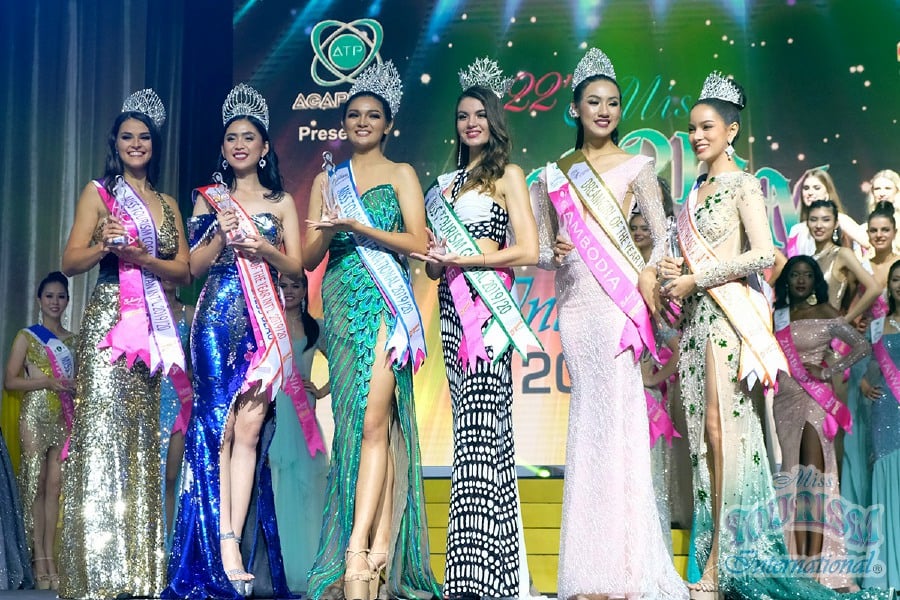
KUALA LUMPUR: Cyrille Payumo of the Philippines was crowned Miss Tourism International 2019/2020, beating 39 other contestants at the pageant finals held here, on Friday night.

Charming her way into the judges’ hearts, the 22-year-old will now be realising her dream of pursuing her studies in Mass Communications, as the pageant crown comes with a prize of a scholarship for a course of her choice at any LimKokWing University of Creative Technology, worldwide.
The four-year tertiary study sponsorship for Miss Tourism International 2019/2020 winners and runners-ups was formalised through a memorandum of understanding (MoU) inked between the university and Miss Tourism International at the university’s main campus on Nov 1.
Overjoyed Payumo later said: “It is a good stepping stone for me to win, as I would love to pursue my higher studies in Mass Communications and to be able to interact and to touch people’s hearts by being a tourism advocate not only to my country, but to the world.”
She added that she is a language enthusiast, and singled out Malaysia as the best place to learn new languages such as Bahasa Malaysia, Mandarin and Tamil.
This year’s competition – the 22nd edition of the pageant – was themed “Embracing Visit Truly Asia Malaysia 2020” aimed at promoting Visit Malaysia Year 2020.
The pageant was first held in Sarawak in 1994.
Meanwhile, 23-year-old Malaysian contestant, Cheryl Loo Wen Nee, managed to make it into the top 10. She won three out of 16 subsidiary titles – Miss Gintell Wellness, Miss Glamorous Carlo Rino and Miss Glorious Beautiful. – BERNAMA

Sunday, November 3, 2019

...the Pinay farmer turned UN Nutrition Ambassador

This Pinay farmer Is Now A UN Nutrition 

Ambassador


Cheeky Albay
Cosmopolitan Philippines
03 November 2019


We first featured Cherrie D. Atilano earlier this year for her mission of “Making Farming Sexy”—encouraging young Filipinos, women especially, to go into farming like she has. But it wasn’t just that catchy slogan that got us hooked.


Cherrie’s inspiring story makes her life peg material: She grew up working on a sugarcane farm in Negros Occidental, graduated magna cum laude with a degree in agriculture from the Visayas State University, gave up a Fulbright scholarship in the US so she could stay in the Philippines and help local farmers, and founded AGREA, an award-winning Marinduque-based social enterprise which aims to help eradicate poverty for farming and fishing families, alleviate the effects of climate change, and help establish food security in the Philippines.
Impressed yet? There’s more. The 33-year-old Pinay has just been appointed by United Nations (UN) Secretary-General António Guterres as a Lead Group member of the UN’s Scaling Up Nutrition (SUN) Movement, the goal of which is to ensure a world free from malnutrition by 2030.
As a SUN Lead Group member - one of only 27 from around the world and only Southeast Asian on the list! - Cherrie is now a high-level ambassador for the UN , a role she will hold until 2021.

Below, Cherrie tells us how her trip to the UN Headquarters in New York went, how she'll serve as a newly-minted UN Nutrition ambassador, and how YOU can make your own mark like she has.


What she’s been up to since her last Cosmo interview:

"We launched AGREA programs in Siargao—both More Love for Women Farmers, which makes the island the first women-led agriculture island in the Philippines; and The Garden Classroom Program for public elementary schools, which will allow pupils to learn how to grow their own food, harvest organic vegetables for their feeding program, and love nature at the same time. We will be replicating the AGREA Farm School and Farm Business in the island by next year. 
I grew much wisdom, I must say. So many beautiful things have happened and most of them had me overcoming challenges and waking up every morning with so much hope."

How she and AGREA got the attention of the UN:

"AGREA received the UN Global Compact Agriculture Business Excellence Award in 2017. I also met some people in the UN when I spoke at the World Economic Forum’s New Vision for Agriculture event in Switzerland in 2014. I’ve also been invited several times to UN events in New York and Rome, and also to sustainability conferences around the world.
However, the main reason they chose me is my 21-year advocacy in agriculture, one I’ve had since I was young. As the SUN secretariat said to me, my movement of “Making Farming Sexy” should reach every corner of the world.
I also embody what it’s like to be a female leader in a male-dominated industry, I’m young, and I’m from the ASEAN, which has been called the next frontier."

About the SUN Movement:

"The principle of the SUN Movement is that everyone has the right to food and nutrition, and these two should go hand in hand. The movement addresses the problem of 149 million children who are suffering from malnutrition—which has devastating consequences for health, learning, future earning potential, economic development, resilience, and security. The mission is to work towards a world
free from malnutrition, in all forms, by 2030, nourishing people and planet together."

Her responsibilities as a SUN Movement Lead Group member:

"I support the 60 member countries and five Indian States as they pursue their goals to scale up nutrition. I will also provide strategic oversight on the movement, encouraging coherence and collective accountability for results. With this, I can influence in strengthening both policy and action in terms of solving malnutrition across the globe, while focusing and giving emphasis on our policy and efforts here in the Philippines and the ASEAN region."

What she’s excited to contribute to the SUN Movement:

"I made my commitment to secure nutrition by securing food sufficiency and security. I always make farming sexy by mentoring a lot of young people to venture into agriculture, empower women in agriculture to make sure proper nutrition starts from home, work on multi-stakeholder partnerships in making sure nutrition will be a serious business to lower stunted growth and boost our human capital productivity, and invest in impactful agri-foods."

How it feels to be one of 27 global leaders in the SUN Movement:

"It’s humbling. At the same time, I am so grateful for the privilege to be among them as they are amazing leaders whom I look up to. They created bold changes in their sphere of influence and inspired the world by their great accomplishments. They bring a wealth of experiences that I can learn from, and I am so fortunate to have that network of people I can collaborate with to expand my advocacy and work in the future. It is so good to brainstorm in a room full of intellectuals who are humble enough to solicit your ideas and open-minded enough to collaborate."

How her time at the UN Headquarters in New York went:

"It was the experience of a lifetime. For me, it was not about the special treatment, which was a bonus, but more of recognizing the fact that you are with a group of people who are so hardworking and passionate about creating positive changes in the world. New York during the UN General Assembly was a bustle of brains, hearts, and hands working together to make the world a better place to live in. You come out exhausted from all the events, but with a heart full of inspiration and a lot of concrete steps for taking action."

What she wishes more young Filipinos knew about nutrition and agriculture:

"Every day, 95 children in the Philippines die from malnutrition. 27 out of 1,000 Filipino children do not get past their fifth birthday. A third of Filipino children are stunted, or short for their age. Stunting after two years of age can be permanent, irreversible, and even fatal, according to UNICEF.
Additionally, the right food is not easily accessible, especially to our poor fellow men. We have 12 million hectares of underproductive lands, farmers are getting old, there is a declining interest among young people to go into agriculture, and our population is exponentially growing.
With all these, I think we have enough reasons to knock on the hearts of our young Filipinos and encourage them to help in boosting our agriculture sector. It will greatly help in establishing food sufficiency and security in the country, which could help in solving our malnutrition problem."

Her advice for other women who want to make a mark in their advocacies:

"Focus! I have been in this advocacy for 21 years, never disturbed by all other great opportunities. I was lucky to find my passion and purpose in agriculture.
Practice excellence and be authentic in what you choose to advocate. Immerse yourself in the community and have the humility to realize that at the end of the day, we are not superheroes who can solve all their problems; we are mere facilitators who can open opportunities for them or guide them in unleashing their potential so they can be the solutions to their own problems.
And at the end of every good job, the sweetest thing to do is pamper yourself. Self-love is a necessity."

Saturday, October 26, 2019

...the Banana Ketchup Inventor

She Invented Banana Ketchup & Saved Thousands of Lives. Why Have we Never heard of Her?

Amelia Rampe
Food52
26 October 2019

I’ve seen the look on my friends’ faces when the words banana ketchup are uttered. Confusion, maybe even disgust. How can two things with such different flavor profiles exist in one product? Despite its seeming incongruity, banana ketchup is a pantry staple that rings nostalgic to many Filipinos all over the world.
a vintage photo of a person wearing a costume
Magdalo V. Francisco, Sr. is credited with mass-producing banana ketchup in 1942, thus making it a fixture in the Filipino household. To this day it’s used as a condiment that accompanies many popular dishes such as tortang talong (an eggplant omelet), fried chicken, Filipino spaghetti (pasta with banana ketchup and sliced hot dogs), as well as a sauce for hamburgers.
You can even find some refined versions of banana ketchup in modern Filipino cuisine. At Toyo Eatery in Manila, Jordy Navarra makes a “Banana Catsup” using fermented bananas, banana peel vinegar, banana blossom, tomatoes, and spices. True to tradition, he also serves his alongside tortang talong.
But to truly understand the roots of banana ketchup, it’s important to understand the person behind the innovation, as well as the environment in which it was produced.
Her name? Maria Orosa.
a close up of a white background
As Chef Navarra says, “Growing up in Manila, we always knew the name of Maria Orosa as a pretty famous and busy street. After getting into food and learning about the history of banana catsup, we stumbled upon her story.”
A food chemist and innovator, Maria saw that the Philippines was heavily reliant on imports like tomatoes. At the same time, she understood and envisioned the vast potential of a great many products endemic to the island nation that, when used properly, could make the country more self-sufficient. She was passionate about a self-sustaining Philippines and made it her life’s work to study native food, and the use of fermentation and various preserving techniques to educate and uplift people in need. She would eventually become a war heroine through her food innovations. Most notably: banana ketchup.
One day, she created a banana sauce with mashed bananas, vinegars, and spices. The brownish-yellow color was not very appetizing, so a little red dye was added, turning it to what is today known as banana ketchup.
But her story is far vaster than her most popular invention.
Maria moved to the United States at the age of 23 (some accounts say she was a stowaway). She was a government-sponsored scholar at the University of Washington in Seattle. There, she earned a bachelors and a masters degree in pharmaceutical chemistry, as well as one in food chemistry. During her education, Maria would spend her summer breaks working in the Alaskan canneries.
In the end, she earned a position as an assistant chemist for the state of Washington, but instead chose to return to the Philippines in 1922. Upon her return, she taught home economics at Centro Escolar University and would later transfer to the Bureau of Science organizing the food preservation division.
A humanitarian at heart, Orosa had a vision of empowering the Filipino family. She launched Health, Heart, Head and Hand (4-H) Clubs. This organization brought herself and other educators into rural areas and barrios to teach women how to raise poultry and preserve food, as well as how to prepare and plan meals. By 1924, the organization had over 22,000 members. Part of her initiative was to introduce one of her inventions, the palayok oven—a clay oven intended for people who did not have access to electrical appliances.
She used her background in food chemistry to run experiments in fermenting, dehydrating, and preserving native plants and animals. The innovations that emerged are said to still be used in laboratories today. The ultimate goal? Make the Philippines more self-sufficient and sustaining.
Local fruits like tamarind, santol, and calamansi provided her with foundations to make wine, jams, and jellies. Cassava and green banana flour would replace the need for wheat. Coconuts would yield vinegars; she was the first to preserve macapuno, a jelly-like product of coconut that is used in Southeast Asia to this day. She was also the first to freeze mangos, enabling distributors to send the famous Filipino fruit throughout the world.
The Bureau of Science recognized her efforts and promoted Maria to head of the Home Economics Division and the Division of Food Preservation. Her work with the bureau would send her all over the world to research canning and preserving technologies.
She was passionate about a self-sustaining Philippines and made it her life’s work to study native food, and the use of fermentation and various preserving techniques to educate and uplift people in need.
Some of Maria’s most known contributions to the food world came during World War II. She was beloved within Filipino households for her banana ketchup, but she would become a war hero for her food inventions: Soyalac and Darak. Soyalac is a protein-rich, highly nutritious powdered soybean product. Darak is a rice by-product that is high in B vitamins, thiamine, and vitamins A, D, and E (intended to fight the vitamin B deficiency disease, beriberi).
During World War II, Orosa was a captain in Marking’s Guerrillas, a group of Filipinx soldiers who would fight alongside the United States against the Japanese during the war. Legend says that she devised a system for smuggling Soyalac and Darak in bamboo into Japanese-run concentration camps. These internment camps, which housed mostly Guerrillero and American prisoners of war, were known for poor sanitation and lack of food. Many would perish as a result of malnutrition. Freedom fighters disguised as carpenters would deliver Maria’s “magic food,” saving countless POWs and civilians.
Despite pleas from her family and colleagues to leave Manila during the war, she stayed until she was killed by shrapnel from fratricide in 1945.
Maria Orosa was a scientist, an activist, a humanitarian, and a war hero who loved her country and dedicated her life to uplifting the Philippines through food innovation. Many of her recipes and experiments were compiled by her niece, Helen Orosa del Rosario, in a posthumous book called Maria Orosa: Her life and Work. The book contains over 700 recipes, some of them unedited since Maria wrote them.
Banana ketchup, while probably the most beloved of Maria’s creations, is just a small part of her great and many contributions to food history. Her creations were intended to bring forth self-sufficiency and empowerment for her nation—and yet, in this day and age, it’s hard not to see that Maria symbolizes so much more.
As Chef Navarra says, “It’s amazing that she basically is the Filipina food hero. Ingenuity in a time of need which I think captures the Filipino spirit.”
Wednesday, October 23, 2019

...the Miss Globe 2019 runner-up

Leren Mae Bautista is Miss Globe 2019 2nd runner-up

ABS-CBN News
22 October 2019


MANILA—Leren Mae Bautista was named 2nd runner-up in the Miss Globe 2019 held in Ulcinj, Montenegro early Tuesday (Manila time).

Alejanda Diaz De Leon Soler of Mexico won the title, succeeding Miss Globe 2018 Yu Yizhou of China.

Here are the winners:

Miss Globe 2019 - Alejanda Diaz De Leon Soler of Mexico

1st runner-up - Carla Jean Lares of Trinidad and Tobago

2nd runner-up - Leren Mae Bautista of Philippines

3rd runner-up - Shauna Griffiths of Canada

4th runner-up - Kristýna Malírová of Czech Republic

Bautista was hoping to be the Philippines’ second Miss Globe titleholder after Anne Lorraine Colis in 2015.

Wednesday, October 16, 2019

...the Filipino Princess

Filipino princess champions humanitarian efforts in Cambodia


Anith Adilah Othman
Khmer Times
16 October 2019


Glamorous yet graceful - these are the best words to describe Princess Dr. Maria Amor Torres, a member of the Philippines 'Royal House of Baloi who is recognized globally for her philanthropy work.


Image result for maria amor torres


As a Mindanao royalty, Princess Dr Maria is aware of the ‘voice she commands’, therefore she chose to make it count by advocating sustainable social developments and promoting universal humanitarianism.
“As one of the Sultans of my region, I have bigger responsibilities as far as social developments and peace-building are concerned,” she told Khmer Times in a recent interview. “These are the duties given to me by the royal authorities who enthroned me.”
“I accept these duties wholeheartedly as it aligns to my aspirations as a humanitarian. There is nothing that will make me happier than to serve humanity, especially our own people,” she added.
Despite having had a life full of glitz and glam as a celebrity formerly, the princess admitted that there is nothing more rewarding than bringing about positive change to the lives of others. She added that her determination to serve humanity remains her biggest motivation.
“Life has never been better and sweeter as I am living the dream now. Living a selfless life with a purpose, building a bright future for our children, fighting for human rights, promoting equality, empowering women and the youth, promoting health and wellness and protecting our environment. This is the best kind of life to live,” she quipped.
Regardless, Princess Dr Maria is showing no signs of stopping. She is now leading a non-profit group that she founded in 2011, ‘We Care For Humanity’, to continue to make changes for the betterment of the world.
“We are an internationally-recognised organisation focusing mainly on the seven United Nations Sustainable Development Goals. They are: zero poverty, good health and well-being, quality education, gender equality, reduced inequalities, climate action and peace and justice,” she said.
Thanks to her active participation in the field of philanthropy, Cambodia can now hopefully benefit from the latest collaboration between ‘We Care For Humanity’ and ‘Save Nature Cambodia’, a local group aimed at raising awareness on eco-friendly initiatives among citizens.
“Cambodia is a fast progressing country with very strong culture and passion for the environment. Its people are equally beautiful, resilient and faithful to their motherland.
“Cambodia is also a big advocate of climate change, that is why we are very happy to collaborate with ‘Save Nature Cambodia’. As the Royal Advisor of the latter, I can extend the mission and vision of our organisation concerning matters related to climate change,” she added.

Wednesday, October 2, 2019

...the first Asian-American Virginia judge

Filipina becomes Virginia's first Asian American female judge


inquirer.net
02 October 2019


WASHINGTON – Maha-Rebekah Abejuela, a Filipino American former prosecutor, became the first Asian American woman judge in the state of Virginia on Sept. 27.


Abejuela is the daughter of Filipino immigrants, according to the Washington Post. She pursued a law career after watching juvenile court judges at work.
“They were in a position to affect children and families at the most critical parts of their lives,” Abejuela said to the Washington Post. “I wanted to be part of that.”

A 2017 Fairfax Bar Association post ranked Abejuela as a “recommended” candidate among a list of potential candidates for judicial office.
Abejuela was an Assistant County Attorney for Fairfax County representing the Department of Family Services in abuse and neglect cases involving both children and incapacitated adults.
“She prosecuted numerous felonies and misdemeanors, and specialized in domestic violence cases for the majority of her time there,” according to the Fairfax Bar Association.

Tuesday, October 1, 2019

...the Royal Cambodia awardee

Sultana from the Philippines, the First International Woman to Receive the Royal Monisarapown Award from the Royal Government of Cambodia


By MENAFN
01 October 2019 


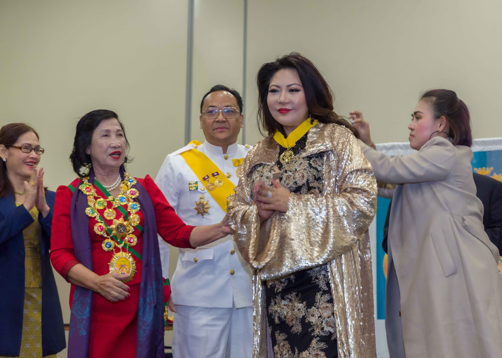
We Care for Humanity Founder and G.O.D. Chairman, Maria Amor received an award given by the Prime Minister of Cambodia, Samdach Hun Sen for her unwavering support to Save Nature Cambodia for planting almost a million trees in the Kingdom.


H.E. Oknah Sam Dararath, PhD , founder of Save Nature Cambodia and Adviser to Samdach Prime Minister felicitated the Monisarapown Award from the Royal Government of Cambodia to HRH Maria Amor onthe occasion of the8th Global Order of Dignitaries and Philanthropists (G.O.D.) AwardsCeremony and Dinner Gala at the Anaheim Convention Center, one of California’s landmark last September 21, 2019. Dr. Dararath was enjoined on the stage by other Cambodian delegates and honorees of the said function: H.E. Iv Sry, Advisor to the Ministry of Interior who received the Woman of Honor of Asia from G.O.D.; Mrs. Kimly Lim, President of Family Agricultural Development Community who also G.O.D. recipient as Humanitarian Icon of Cambodia; and Dr. Siphal Pheng, a businessman.

Thursday, February 21, 2019

...the Nuclear Science Director

International nuclear science group hails Filipina scientist as new director

By Jan Carlo Anolin
21 February 2019

The International Atomic Energy Agency (IAEA) has recently appointed a Filipina scientist to be one of its new directors in Vienna, Austria, the Department of Foreign Affairs (DFA) said.
Dr. Jane Gerardo-Abaya officially assumed her new position on January 1, 2019 as IAEA’s Department of Technical Cooperation Asia and the Pacific Division Director.

Philippines Ambassador to Austria Maria Cleofe R. Natividad (second from the left) congratulates new IAEA Division Director Dr. Jane Gerardo-Abaya (second from the right). They are joined by Consul General Deena Joy Amatong (far left) and Vice Consul Allen Carillo (far right). (Vienna PM photo / DEPARTMENT OF FOREIGN AFFAIRS / MANILA BULLETIN)
Dr. Abaya is an Austria-based scientist who has worked for various capacities of IAEA since 1994.
The University of the Philippines alumna contributed her works on isotope hydrology and water and geothermal energy resources to the state university’s National Institute of Geological Sciences.
Dr. Abaya finished her bachelor’s and master’s degree in Geology in 1981 and 1988, respectively.
She completed her doctorate in Applied Geology and Geothermal in 2004 at the Universitat Fur Bodenklultur in Vienna, according to DOST’s profile.
Dr. Abaya became a recipient of “Balik Scientist Award” and had a research grant from the Department of Science and Technology in 2008.
In 2017, she received a “Superior Achievement Award” from IAEA Director General Yukiya Amano while former IAEA Director General Mohamed ElBaradei granted her a “Distinguished Service Award” in 2008.
The new IAEA Director paid a courtesy call with Ambassador to Austria Maria Cleofe R. Natividad in the Philippine Permanent Mission in Vienna’s chancery last January 18.
According to DFA, Natividad said Dr. Abaya’s appointment is a “remarkable achievement in the Philippines’ efforts towards increasing women’s representation at the higher echelons of the IAEA.”
Natividad is confident that Dr. Abaya will fulfill her new role as director given her “exemplary qualifications and extensive experience.”
IAEA is the world’s central intergovernmental forum for scientific and technical cooperation in nuclear science, according to its official website.
The agency works for the safe, secure, and peaceful uses of nuclear science and contributes it to international peace and security and the United Nations’ Sustainable Development Goals.