Showing posts with label technology. Show all posts

Tuesday, October 8, 2019

...the fintech and digital awardee

Union Bank of the Philippines bags prestigious fintech and digital awards, 3 years running


SINGAPORE – Media OutReach – 8 October 2019 – Union Bank of the Philippines (UnionBank), with its vision of transforming into “A technology company, also a bank,” recently made waves as its top executives won big at the Singapore Fintech Awards 2019. 

UnionBank Chairman Justo A. Ortiz and Senior Vice-President and Fintech Business Group Head Arvie de Vera each won the Asia Fintech Leaders Award which recognizes remarkable leaders across the region for their continuing commitment to excellence, developing best practices and pursuing innovative strategies.

The Awards aims to highlight those across Asia who have made extraordinary contributions to the fintech industry’s meteoric rise on the global stage. Indeed, Ortiz and de Vera have been making strides globally, advocating for smart banking as a way to realize the bank’s purpose of elevating lives, fulfilling dreams and enabling communities. 

The Awards were hosted by the Singapore Fintech Association, while the rigorous judging process was helmed by none other than PwC Singapore. 

The winners were announced at a Gala Night graced by Ravi Menon, Managing Director of the Monetary Authority of Singapore (MAS) and Minister Ng Chee Meng, Secretary-General of the National Trades Union Congress (NTUC) of Singapore. 

In addition, UnionBank also won, for the third year in a row, the Best Digital Bank — Philippines award at the Asiamoney Best Bank Awards 2019 in Singapore on September 25. Asiamoney also identified UnionBank as one of 30 financial institutions to watch out for in Asia, and among 5 on its radar for digital banking. 

In awarding the bank for the third year straight, Asiamoney considered the long list of innovative initiatives UnionBank is pursuing, some of which include the first fully digital branch The Ark, a tokenized fiat cross-border transaction pilot from OCBC Bank in Singapore to a rural bank in the Philippines, and the country’s first central bank-compliant two-way virtual currency ATM among many others.

Friday, August 30, 2019

...the Filipino scripts in Google keyboard

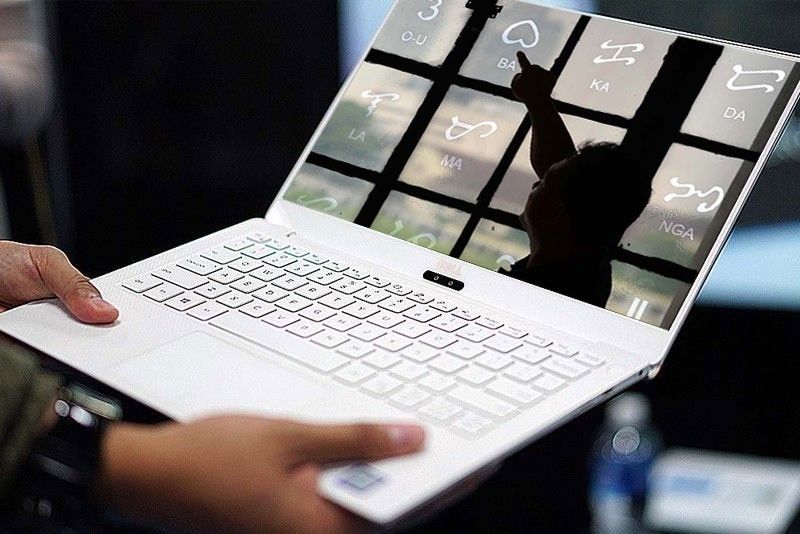
Indigenous Filipino scripts now available on Google keyboard

Janvic Mateo
Philippine Star
30 August 2019


MANILA, Philippines — Four indigenous Filipino writing systems are now available for users of Google’s virtual keyboard for Android users.

The technology company announced yesterday the inclusion of indigenous scripts Baybayin, Buhid, Tagbanwa (Aborlan) and Hanunuo in Gboard for Android, a virtual keyboard app developed by Google.

The technology company announced yesterday the inclusion of indigenous scripts Baybayin, Buhid, Tagbanwa (Aborlan) and Hanunuo in Gboard for Android, a virtual keyboard app developed by Google.


“We are committed to helping preserve the country’s local languages and scripts through relevant technology. Adding more Filipino languages and scripts on helpful products such as Translate and Gboard is one of the many ways we show this commitment,” said Google Philippines marketing head Gabby Roxas.

“To keep our indigenous languages alive, it is important that we try to continue using them. Today, where typing on our smartphones is a common behavior, making more native scripts available on Gboard will play a vital role in helping preserve them,” he added.

With the introduction of the Philippine scripts in Gboard, the company said it is now easier for users to discover and try writing in some of the country’s ethnic writing systems.

Gboard is an app developed by Google to enhance the keyboard of messaging apps and devices.
It enables users to search and send information right from their keyboard through a dedicated Google search feature.

Aside from the four indigenous Filipino scripts, the virtual keyboard also supports 19 languages from the Philippines.

These include Tagalog, Central Bikol, Koronadal Blaan, Rinconada Bikol, Chavacano, Cebuano, Capiznon, Cuyonon, Hiligaynon, Ilocano, Itawit, Kankanaey, Kinaray-a, Maguindanao, Maranao, Pangasinan, Kapampangan, Tausug and Waray.

Cebuano in Word Lens


Aside from the four indigenous scripts in Gboard, the technology company said it has also introduced Cebuano in its Word Lens, a feature within Google Translate that gives an instant camera translation.

The feature works by letting users hold their phones in front of a sign written in an unfamiliar language and instantly see the translation through an overlay in the screen.

Google said Cebuano is among the 88 source languages that can now be instantly translated into more than 100 languages.

Word Lens also supports Tagalog, with company officials saying they intend to include more Philippine languages in the feature.

“This update is helpful for tourists to communicate with the locals better and understand Cebu’s culture more. Users who are familiar with Cebuano can still use the tool to learn other languages as well,” added the company.

It noted that 175 of the 185 officially listed languages of the Philippines are indigenous, citing Ethnologue: Language of the World, an annual reference on global languages. Experts fear that at least 11 languages would soon vanish.

Google announced the inclusion of new Philippine languages and scripts in its products for the celebration of the National Language Month or Buwan ng Wika.


Tuesday, June 10, 2014

...the teen inventor

This 15-Year-Old Invented A Way To Charge Your Phone With Your Shoes


By Taylor Trudon


There's nothing quite as annoying -- or panic-inducing -- as having a dying phone battery with no charger in sight. But thanks to one 15-year-old whiz kid, that problem might soon be solved.

Filipino teen Angelo Casimiro has invented a special kind of footwear that can generate electricity simply by walking. By doing so, it can charge small battery-operated devices like smartphones.

"The average human takes 7,000 steps a day. So I asked myself, 'Maybe it's possible to harvest electricity through our footsteps. Maybe I can charge my phone or my flashlight with it,'" says Casimiro in his Google Science Fair 2014 entry.

Watch Casimiro describe his project above.

According to InterAksyon.com, one of Casimiro's experiments gave his phone 10 minutes of battery power by playing basketball for two hours straight.

"I'm a Filipino. I live in the Philippines. And just by looking around my surroundings, I can see that a lot of people are suffering from poverty," explains Casimiro. "A simple source of light is a big deal for people who don't have electricity."