Showing posts with label Germany. Show all posts

Tuesday, November 19, 2019

...the world's most diverse football team

Philippines taking multicultural dream on to global stage

FIFA.com
19 November 2019


There is not a national squad like that of the Philippines anywhere else on the planet. This statement can only be understood by delving a bit deeper into the team’s recent history.


In 2005, an anonymous video games fan got in touch with the Philippine Football Federation (PFF) to inform them that Phil and James Younghusband, two English brothers coming through Chelsea’s youth set-up, had a Philippine mother and were eligible to play for the Azkals.

In a region where basketball and boxing tend to take centre stage, it was essential for the PFF to find a way of boosting football’s profile and popularity. And that is where history plays a decisive role: throughout the last century, Filipinos were long associated with searching for opportunities far outside their borders. As a consequence, thousands of Filipino citizens and their descendants play in countries with a richer footballing history.

The Miracle of Hanoi


The idea of unearthing players in far-flung parts of the world began to take shape, but results did not initially follow. The PFF decided not to enter the qualifying campaigns for the 2006 and 2010 FIFA World Cup™ tournaments, because, despite the significant economic and logistical efforts being made, the team’s level of play was still too low. In the end, the transformation of the Filipino national team was achieved through a focus on improving competitiveness, which would eventually bear fruit at major tournaments.

One of the most striking examples of tangible progress came at the AFF Championship, a competition which pits some of the best nations in south-east Asia against each other every two years. In 2010, Vietnam – hosts and defending champions – were drawn to play Philippines in the second match of the group stage – a daunting challenge for a side that had lost five and drawn one of their last six games.

However, an eye-catching performance by the Azkals led to what is now commonly known as the 'Miracle of Hanoi'. Goals from the English-born pair of Chris Greatwich and Phil Younghusband silenced the 40,000 home fans, in the new mixed-race generation’s first landmark victory.


From video games to social networks

Following that memorable success, a number of players with Filipino parentage expressed a desire to represent the national team.

Sometimes, it was the PFF that took the first step. “My mum is from the Philippines, and they contacted me to find out if I wanted to be part of the team,” forward Angel Guirado – born in Spain, and a Filipino international since 2011 – told FIFA.com.

On other occasions, word of mouth and the emergence of social networks provided the link. “I had a friend who played with Angel Guirado in Spain, and I’d heard the story,” explained Carli De Murga, who is another Spaniard with a Filipino mother, and who has also represented Philippines since 2011. “I contacted Angel through Facebook, and he put me in touch with the Federation. I sent them a video and they called me up straight away.”

Currently, the squad includes footballers born in 12 different countries: Germany, England and Spain make up the majority, but Denmark, Norway, the Netherlands, Scotland, Australia, Italy, Switzerland, Japan and the United States also feature.

What is it actually like to be part of such a multicultural squad? “The atmosphere is brilliant,” said De Murga. “Personally speaking, playing in the same jersey as people with so many different cultures and customs has really helped me to mature. It broadens your horizons. And I love that everyone’s also quite alike, and that we all feel comfortable in each other’s company.”


Syria showdown key to World Cup dream


Playing in this diverse and familiar environment has started to pay dividends. In January the Filipinos competed in the AFC Asian Cup for the first time, and they currently find themselves in an advantageous position in the second round of Asian qualifying for Qatar 2022.

Philippines lie third in Group A, with the same number of points as China PR. A draw in their upcoming match with Syria would be enough to move them up into second spot (based on their record, the runners-up may qualify for the third round), at least until the next round of games in March.

“That would be amazing – a fantastic achievement!” said Guirado from the team’s camp in Dubai, where the match is due to take place. “In football, nothing is impossible. The result in our first game with Syria (a 5-2 defeat) did flatter them quite a bit.”

“It’s now or never,” said De Murga. “We have an historic opportunity. Syria have a lot of talent up front, but they sometimes leave themselves open at the back. We have to play as a unit, try to frustrate them, and do them damage any time we get a chance.”

Curiously, Phil Younghusband, the youngest of the two long-serving siblings, announced his retirement from football on Monday. He bids farewell to the game as Philippines’ most capped player (108 appearances) and their all-time top scorer (52 goals), and will likely look on with great excitement as the world’s most multicultural team attempt to pull off another impressive result on Tuesday.

Wednesday, October 16, 2019

...the PH golden day in sports

Two golds in one day


Inquirer.net  Editorial
16 October 2019

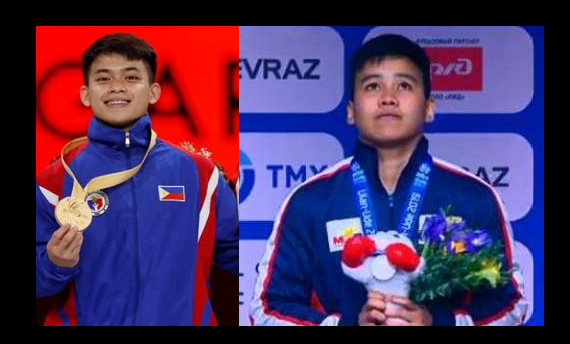
There’s a lot to celebrate about the triumphs of Carlos Yulo and Nesthy Petecio in the world stage very recently.

Image result for carlos yulo boxing gold russia


Yulo scored the more celebrated victory, becoming the first Filipino world champion in gymnastics, after ruling the floor exercise in the sport’s world championships in Germany.

But not to be overlooked is Petecio, who ruled her division in the women’s competition of the boxing world championships in Ulan-Ude, Russia, beating local bet Liudmila Vorontsove in a sport notorious for hometown bias.

Their gold medal feats, achieved barely 24 hours of each other, not only polished the country’s image in the international scene, they also helped shatter sports’ stubborn sex stereotypes.

Yulo, after all, triumphed in a sport generally seen as feminine, whose women champions are more often heralded as iconic than their male counterparts. Meanwhile, it is not a stretch to say that you’d be in the hundreds when counting down the most influential boxers in history before coming up with a woman’s name.

Yulo and Petecio got their just due from the government, with the Philippine Sports Commission (PSC) shelling out a cool million for each athlete as reward.

There is, however, the need to go beyond the cheering and the toasting when looking at the feats of Yulo and Petecio. Their victories in the world stage usher in new hope for the country as it hosts the Southeast Asian Games later this year and, more importantly, navigates its way to next year’s Summer Olympics in Tokyo.


Yulo and Petecio reinforce the change needed in our country’s national sports program, highlighting the need to funnel limited resources to focus sports.

PSC commissioner Ramon Fernandez is a staunch advocate of focus sports, disciplines where the Filipino athlete isn’t hamstrung by physical limitations like height and heft and can flourish on talent and hard work. Upon his appointment in 2016, Fernandez crafted a blueprint called “Change the Game,” which seeks to resuscitate Philippine sports.

 Among his plans was to focus on less popular sports where he believes the country has potential to succeed, such as open water swimming — for the Olympic event, known as marathon swimming —
given the country’s vast water bodies.

Sen. Manny Pacquiao also supports the idea of shifting focus to “weight-classed sports and other sports that does not give undue advantage to bigger and taller athletes.” Examples of weight-classed sports are boxing, taekwondo, judo, wrestling and weightlifting.

Filipino athletes can also excel in gymnastics, marathon, synchronized swimming, diving, cycling, shooting, archery, chess and other similar sports that require intelligence, balance, strength, flexibility, agility, coordination and endurance.


Monday, October 14, 2019

...the Pinoy summa cum laude in Europe

Filipino scholar graduate s summa cum laude in Europe


Neil Arwin Mercado
Inquirer.net
14 October 2019


MANILA, Philippines — Not only did a Filipino scholar return from Europe with new learnings from a foreign land, he was also able to finished his degree summa cum laude.


While many would think that studying abroad, especially in Europe, comes at a hefty price, Kent Tangcalagan would tell you otherwise as he finished his degree as a beneficiary of a scholarship program.

Tangcalagan learned about the Erasmus+ scholarship program, formerly known as Erasmus Mundos, from one of the delegates at a conference he attended abroad.


“There was an Indonesian delegate there, she applied for Erasmus for two years already and she gave me the website,” Tangcalagan said in an interview with INQUIRER.net.

“So when we went back to the Philippines, I asked my mentors, my advisors that I met from work—like advice, some of their recommendations regarding applying for studies abroad. I also asked people to write my recommendation letter,” he added.


The scholarship covers tuition fee, annual travel allowance, establishment allowance to help scholars in their adjustment period in a foreign land, and a monthly contribution cost which includes accommodation.


During the application, applicants are allowed to select three education programs. Should they be accepted in all three, they will have the option to select which program they would like to enter.


Tangcalagan was accepted under the Erasmus Joint Masters Degree in Comparative Local Development in May 2017, a two-year program where he would study in one university in a European Union (EU) country per semester.


In his first semester, he studied in Corvinus University of Budapest in Hungary, University of Regensberg in Germany in his second semester, and University of Trento in Italy for his third semester.


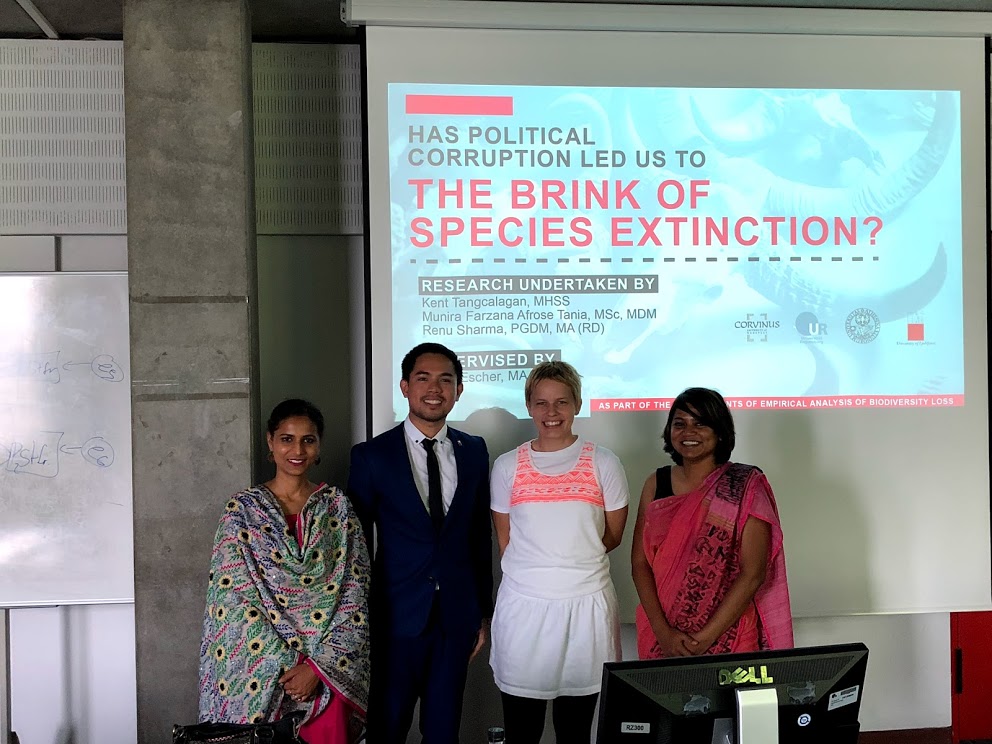
Filipino scholar Kent Tangcalagan presents one of his research outputs in one of his classes at the University of Regensberg in Germany during the second semester of his masters degree.
“When I got there, it was very different because all of my classmates came from different countries as well. We came from different countries so you have different nationalities, different cultures, different opinions,” Tangcalagan said.


“Since our program was on development sector, we got to talk about social, economic, and political issues in class. In my case I got shocked because there are very differing opinions on different things,” he added.


But instead of seeing the cons of being surrounded by varying perspectives, especially on the complex topic of his program which is development, Tangcalagan saw it as an opportunity to challenge his own views.


“There was a sense of ‘culture shock’ at first but when you go through it after a few months, you get used to it and you see how advantageous it is and how beneficial it is for you,” he said.


Living and studying abroad


Tangcalagan said that being a student in Europe is very convenient, but this also comes with living away from your family for some time.


“You are away from the traffic that we have here in Manila. The public transport is very convenient. It’s very cheap for students because as a student you get to have a transport card so you can travel easily in different cities,” Tangcalagan said.


“It is also fairly cheap to travel across countries because we have this student resident’s permit so it allows us to cross different borders, we get to visit other countries during breaks,” he added.


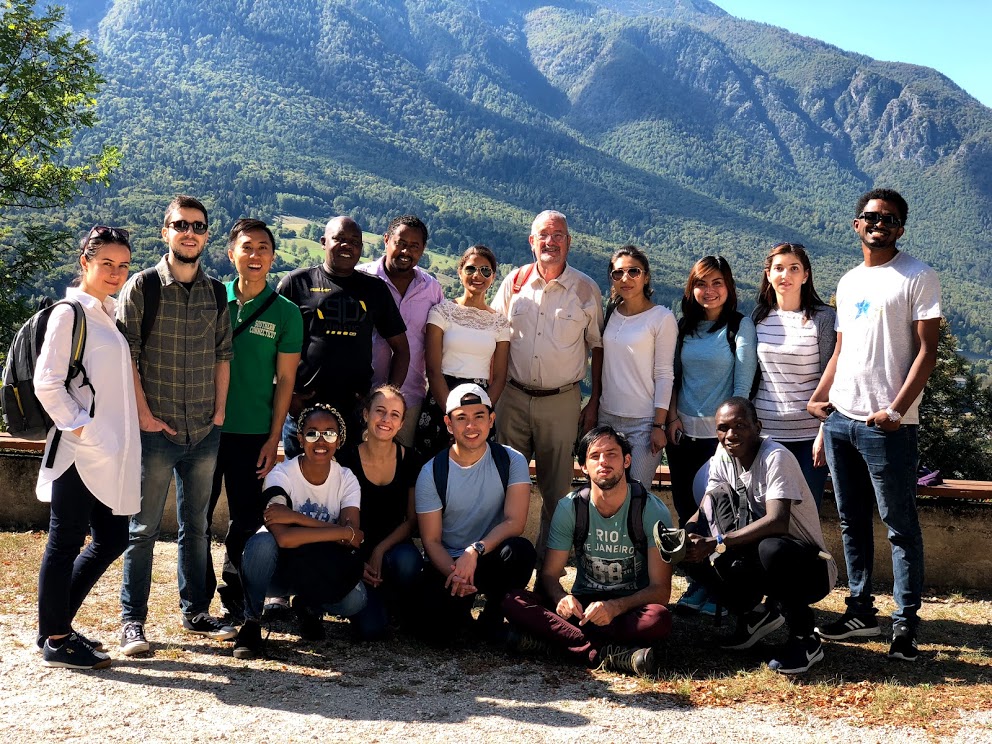
Tangcalagan (center, seated) travels with his classmates and the head of the scholarship program in Italy in the area of University of Trento in Italy.

As per the education system, he narrated that there are more than 15 professors per subject. The professors came from different areas in the world, which helped in providing different perspectives in the context of development.


“That’s also very beneficial because some of our professors come from different countries, even outside Europe so we get different perspectives on our subject matter which is development,” Tangcalagan said.

“You get to hear about development projects that they implemented in Africa, or in the US, or Latin America, also in Asia. You get to discuss different things with people who really implemented these projects so for me, it is one of the part of the European education that makes it very unique… That’s also another aspect of the diversity that Europe provides in terms of education,” he added.


More than education, an added bonus..


In his last semester, Tangcalagan did his internship at a research institution called Max Planck Institute for the Study of Societies in Germany before working on his thesis and defense.


Every semester, they are shown their grades. So when he saw that he is getting excellent grades from his courses, Tangcalagan pushed himself to strive for something bigger—finishing his degree with flying colors.


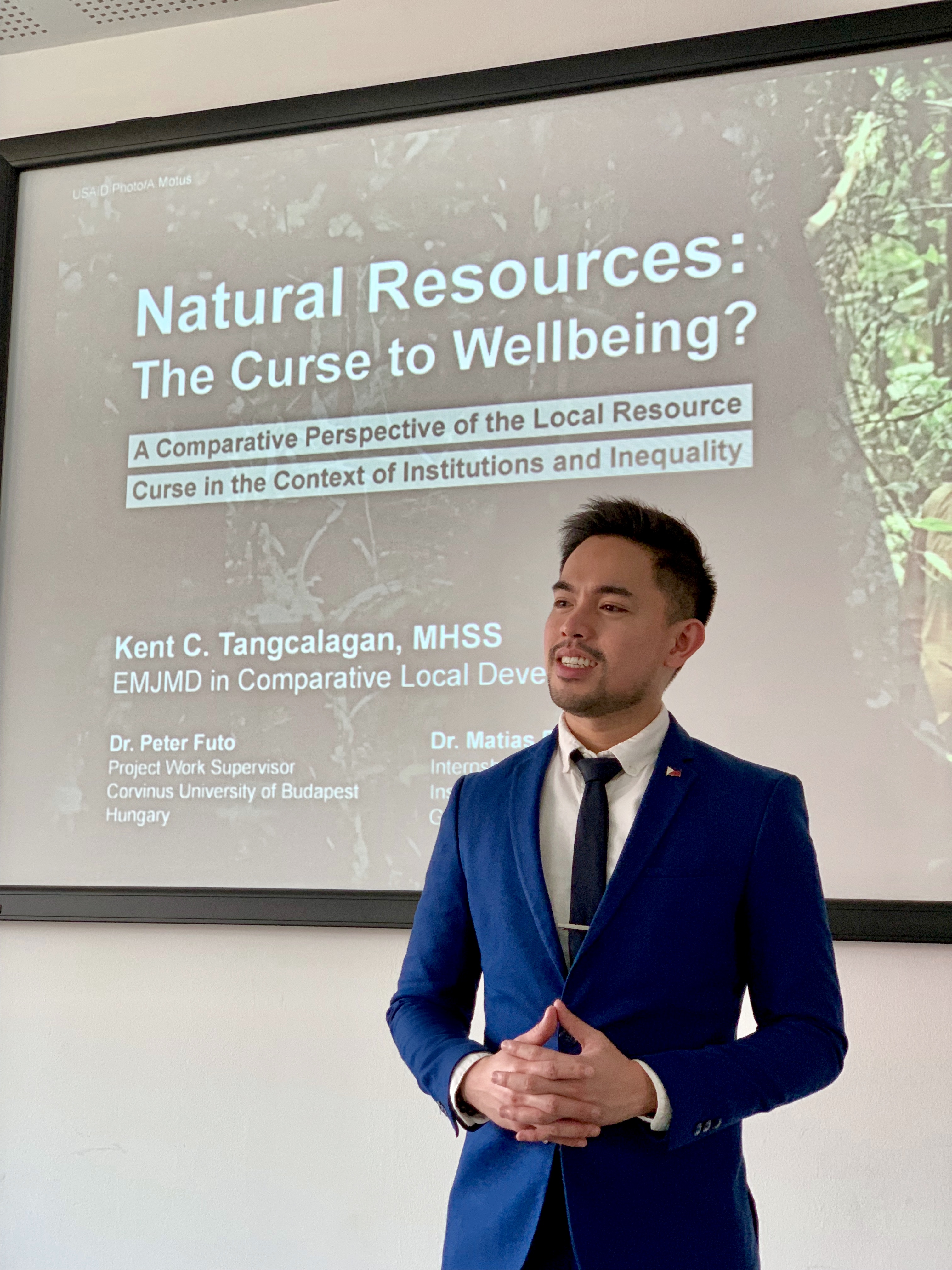
Tangcalagan presents his thesis titled, “Natural Resources: The Curse to Wellbeing? A Comparative Perspective of the Local Resource Curse in the Context of Institutions and Inequality” to complete his masters degree.

“I was nervous for the thesis and defense since we are aiming for the best. All of my grades—I got all excellent. I have to maintain that with my thesis and defense so after I finished my thesis and defense and I also got five (highest in Hungarian education), I was really really happy since all my hard work, and the sacrifices of being away from the Philippines [paid off],” he said.


But for him, it was only an added bonus as his mere goal was to make the most out of his experience.

“My goal was to make the best out of the scholarship. AS a scholar, I feel I was very privileged and honored to be studying in Europe. I am not spending any money, it’s the European taxpayers’ money that I was using for my education so I felt like I have the responsibility to make the best out of the education and scholarship that I am getting,” he said.


“Also I wanted to make my family and friends back home proud and even my colleagues at work since I left the Philippines for this education so at least by the end of the program there is something—this is what I did,” he added.


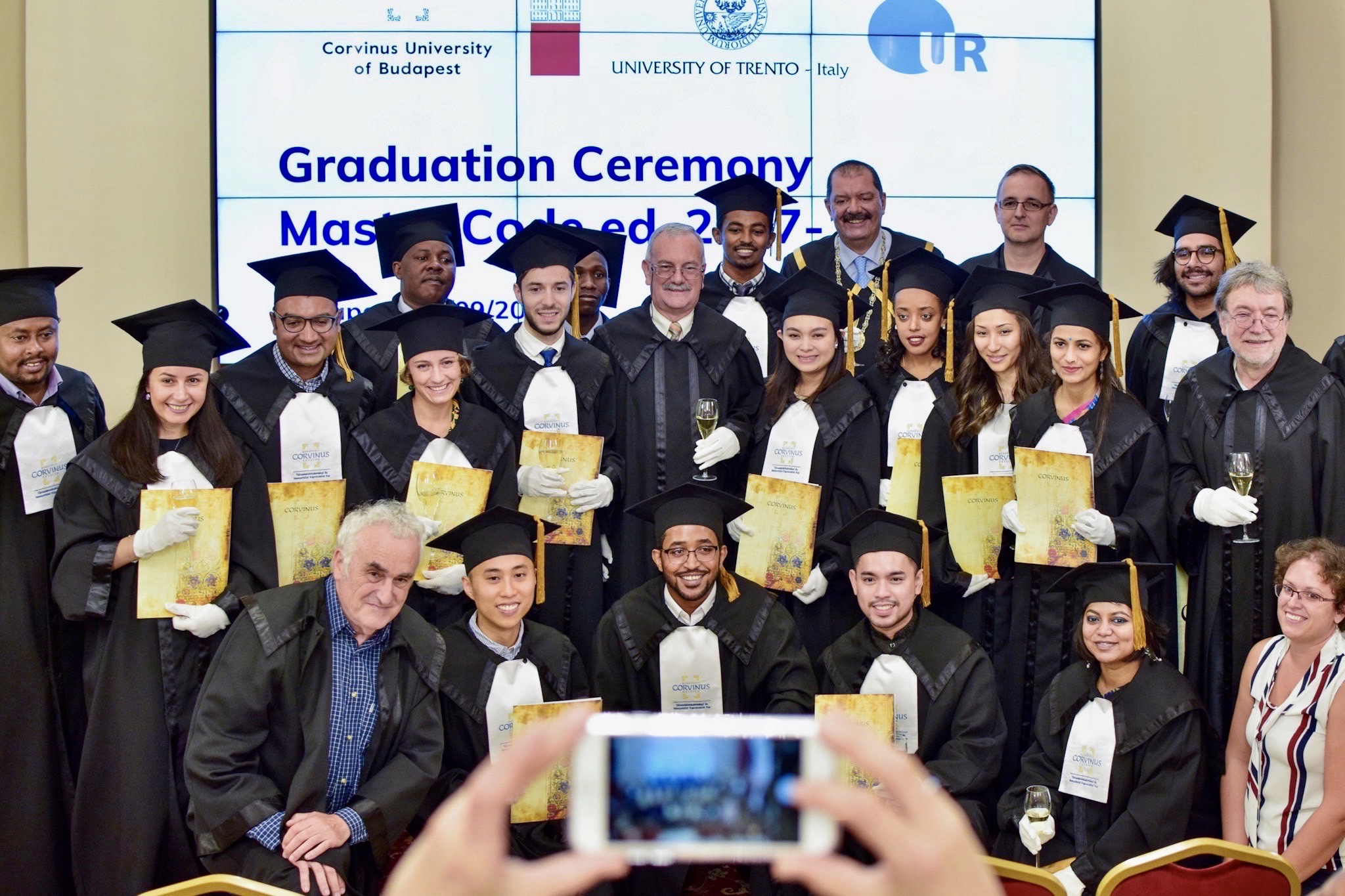
Tangcalagan (third from right, seated) finishes his masters degree as summa cum laude.

His advice to those who want to have the similar experience as his and study abroad? “Forget about all your doubts, don’t be afraid to try.”


Scholarship program of the EU


Thelma Gecolea, the public affairs officer of the EU Delegation to the Philippines, said that Erasmus+ is the scholarship and mobility program of the EU and managed by the European Commission.


Under the program, masteral and doctorate students from third world countries such as the Philippines are offered the chance to study in two to three EU member states.

As of 2019, there had been over 400 Erasmus scholars from the Philippines, 66 of whom were accepted this year.


“The Philippines has been ranking first in Southeast Asia in terms of scholars’ intake for the past three to four years,” Gecolea told INQUIRER.net.


Information about higher education opportunities in the EU are discussed in gatherings such as the European Higher Education Fair (EHEF).


Gecolea said that during EHEF, representatives 48 universities from the EU will be in attendance to inform the public about the advantage of “learning in a borderless Europe.”


In this year’s EHEF, universities from Austria and Finland will be participating in the event.

The event will be held on October 28 at the Lyceum of the Philippines University – Cavite from 9 a.m. to 3 p.m. and at the Grand Atrium in Shangri-La Plaza on October 26 from 11 a.m. to 6 p.m.


“There are the advantages of immersing in the EU’s charming past and the cutting-edge technology of the future,” Gecolea said. /je