Showing posts with label innovation. Show all posts

Monday, November 4, 2019

...the Japanese innovation investment in PH

Japanese firms to invest $215 million in Philippine innovation projects

Business Mirror
04 November 2019


Japanese firms are investing $215 million in new projects and expansions in the Philippines, as they seek to take advantage of the growing innovation environment here.

On the sidelines of a business forum in Tokyo, Trade Undersecretary Rafaelita M. Aldaba met with Japanese manufacturers to pitch investment opportunities in the Philippines. A total of $215 million worth of projects, most of which related to innovation, were secured during these meetings.

The projects include the opening of the first MOS Burger, Japan’s second-largest burger joint, by March of next year, and the interest of Assemblepoint to develop smart four-wheel electric vehicle using latest Internet of Things technologies.

Also, Satelight is eyeing to outsource animation work from the Philippines, while Kanepackage is planning to build a new factory. Further, Sumitomo Wiring presented during the meetings its expansion projects on wiring harness and components production.
Marubeni Corp. also shared its joint-venture project with two local firms to put up 30 primary care clinics and 10 cancer centers, as well as install five centralized laboratory testing hubs in strategic urban areas.

“There are many potential opportunities for the Philippines and Japan to deepen trade and investment partnership through innovation. I am delighted that the companies I met during this trip are making significant contributions in the areas of creating new industries, products and leapfrogging to Industry 4.0 by adopting smart manufacturing to transform our industries,” Aldaba said in a news statement issued on Monday.

Aside from those who committed to invest, there were investment intentions in infrastructure development, railways, electric vehicle public transport system, retail, manufacturing, logistics, warehousing, factory automation, construction and real estate.

Last week Aldaba presented the government’s Inclusive Innovation Industrial Strategy to over 600 Japanese investors at the Philippine-Japan Business Investment Forum organized by the Nikkei Business Publications Inc. Aldaba discussed the areas where Manila and Tokyo can collaborate under the i3s, which is geared toward improving the manufacturing, agriculture and services sectors of the country.

“In the context of these trade and investment trends between the Philippines and Japan, along with global developments, such as the entry of new technologies, we feel the need to focus our efforts on innovation to address the opportunities and challenges arising from Industry 4.0, but also from increasing global competition, United States-China trade war and regional economic integration,” Aldaba added.
Last year Japan is the country’s third-largest foreign source of investments. Based on records from the Philippine Statistics Authority, Japanese investments in 2018 declined 38.33 percent to P19.72 billion, from P31.98 billion in 2017.

Friday, October 25, 2019

...the World Smart Cities Awards finalist

Makati finalist in World Smart Cities Awards


Jan Arcilla 
Manila Times
25 October 2019


MAKATI City is the lone Philippine city that has been selected as a finalist for the World Smart Cities Awards, according to Mayor Mar-len Abigail Binay.
The award will be presented during the Smart City Expo World Congress to be held in Barcelona, Spain from November 19 to 21.
“Makati City is proud to have the opportunity to represent our country at a global event that features the best practices of smart cities around the world to promote the sustainable development of cities,” Binay said.
The city was selected as a finalist in the Innovative Idea category.
We have gladly accepted the invitation, and we look forward to having a meaningful exchange of ideas and experiences with fellow advocates of sustainability and inclusivity from other parts of the globe. We are also eager to explore avenues for international collaboration, particularly with cities, academic institutions and corporate leaders that share the vision of thriving, future-proof cities worldwide,” the mayor said.
Makati has been invited to present its project entry titled, “Use of technology to improve city disaster preparedness and communication to and from city citizens” during the awarding ceremony on November 20 at the Fira de Barcelona Gran Via, one of the largest fair venues in Europe.
The annual SmartCity Expo World Congress, which started in 2011, is the meeting point for companies, public sector, startups, academia and citizens working together for the sustainable development of cities.
With the theme, “Cities Made of Dreams,” this year’s congress will focus on five tracks — Digital Transformation, Urban Environment, Mobility, Governance and Finance, and Inclusive and Sharing Cities.
Last month, Binay presented the city’s disaster management plans and strategies at the International Urban Resilience Forum held in Seoul, South Korea.

Sunday, July 7, 2013

...the PH Global Innovation ranking

PH ranking in Global Innovation Index improves

By Amy R. Remo
Philippine Daily Inquirer
 
 
The Philippines was ranked the 90th most innovative economy in the world this year, according to the Global Innovation Index 2013.

This was an improvement from its 95th position last year, which was attributed to the perceived positive changes in the country’s business institutions and market sophistication.

Global Innovation Index is an annual publication of a composite indicator that ranks countries/economies in terms of their enabling environment to innovation and their innovation outputs. It is published by Cornell University, INSEAD and the World Intellectual Property Organization and covers 142 countries.

It recognizes the “key role of innovation as a driver of economic growth and prosperity, and the need for a broad horizontal vision of innovation applicable to developed and emerging economies.”

According to the GII 2013, the Philippines scored 31.18 out of 100, based on 84 indicators that gauged the innovation capabilities and policy performances of 142 nations.

This year’s report, according to a statement, “casts additional light on the local dynamics of innovation, an area which has remained under-measured globally.”

“Dynamic innovation hubs are multiplying around the world despite the difficult state of the global economy. These hubs leverage local advantages with a global outlook on markets and talent,” WIPO director general Francis Gurry said in a statement.

The top 5 in the GII 2013 are Switzerland, Sweden, United Kingdom, the Netherlands and the United States.

Based on the GII 2013, the Philippines showed improvement in the “Institutions” indicator, scoring 44.8 and placing 128th, up from last year’s score and ranking of 34.6 and 132nd, respectively.

The country was also perceived to have advanced in terms of market sophistication (with a score of 41.75 and ranking of 95th). Among the factors gauged are the ease of getting credit, ease of protecting investors, market capitalization and trade and competition.

In terms of “creative outputs,” the Philippines rose to the 91st place from 108th last year. This measured the intangible assets of the economy, creative goods/services and online creativity.

The Philippines, however, fell in the infrastructure ranking to 78th from 69th place in 2012. This measures the country’s access and use of information and communication technologies, general infrastructure (in terms of electricity and logistics), and ecological sustainability (environmental performance).

Some of the country’s strengths cited by GII 2013 were the availability of graduates in science and engineering; market capitalization; research and development financed by business; innovation linkages, and communication, computer and information, services exports.


Thursday, April 18, 2013

...the pollution-free Philippines

Painting a pollution-free Philippines

By Bayani San Diego Jr.
Philippine Daily Inquirer


“This Filipino invention has caught the attention of first-world countries. It’s inspiring. We wanted to tell our countrymen and the world that air pollution is a major concern and that there is a Filipino invention that can help combat pollutants especially in urban centers” - Marnie Manicad


MARNIE Manicad filmed on Edsa for several days and nights

 
Quite appropriately, a new documentary on an environment-friendly Filipino invention will premiere on Sunday on National Geographic Channel—a day before Earth Day.
 
The docu, entitled “Asian Innovation: Knoxout,” is part of the NGC’s series “Innovasians.”
 
Documentarian Marnie Manicad, the docu’s director, told the Inquirer: “The ‘Innovasians’ series features different inventions from all over Asia. I wanted to showcase a unique invention from the Philippines: air-cleaning paint.”
 
Manicad was tasked to make the 10-minute docu on a type of paint that contains photocatalytic titanium dioxide (TiO2) which turns ordinary water vapor to free radicals that break down two components of smog: NOx (highly reactive gases containing nitrogen and oxygen) and VOCs (volatile organic compounds).
 
A Filipino company Pacific Paint is behind this innovation—which it developed with United Kingdom’s Cristal and is now available in the market under the brand name, Boysen KNOxOut, Manicad clarified.
 
Solid info
 
Manicad made sure that the docu’s informative component was solid—so that it wouldn’t come across as mere propaganda or an advertorial piece.
 
“From the very start, we made sure that we balanced the facts and information that will be included in the docu,” she explained. “Of course, it is factual to mention the product and what it can do to the environment, but we made it a point [to ensure] that our resource persons’ interviews were backed by studies.”
 
Rest assured, the docu passed through the network’s stringent screening process—the same drill that Manicad had become familiar with when she directed the docu “Inside: Malacañang” for  NGC last year.
 
“The channel is very strict with content and technical quality.
 
Our script was screened by NGC teams in Hong Kong and Washington DC before it was voiced by (narrator) Joonee Gamboa,” she recalled.
 
As such, she made certain that she was equipped with “extensive research” before embarking on this project.
 
“NGC is one of the most credible documentary channels in the world,” she said. Since the docu will be aired on NGC, it will “highlight a Filipino achievement and invention to combat air pollution” on an international platform.                                                  
 
Telling this story in an engaging manner was a big challenge, she owned up. “We not only needed to come up with the best visuals, but viewers need to be able to feel, smell and appreciate those images.”
 
Feel-good docu
 
“This Filipino invention has caught the attention of first-world countries. It’s inspiring. We wanted to tell our countrymen and the world that air pollution is a major concern and that there is a Filipino invention that can help combat pollutants especially in urban centers,” she explained.
 
Last year, Manicad and her team began filming all over Edsa, Metro Manila’s main thoroughfare, which now features murals that used the air-cleaning paint. “We shot on Edsa for several days and nights while the murals were being painted.”


Wednesday, December 19, 2012

...the Filipino design and craftmanship


2012: Filipino design and craftsmanship continue to wow the world

By Marge C. Enriquez
Philippine Daily Inquirer


DESIGN icon Giulio Cappellini and Suyen Corp. chair Ben Chan at the new Cappellini store on Bonifacio High Street.
 
 
The world continues to look at the Philippines as a gold mine of talent and craftsmanship. And big international names see the country as an attractive place to forge business partnerships.
1. Cebuano designer Kenneth Cobonpue continues to reap international prizes. The Cabaret Collection has won two awards: Best of the Year Award in Outdoor Furniture Seating Category from the prestigious Interior Design Magazine. It won Top Pick Award for Innovation by the American Society of Interior Designers during the Architectural Digest Home Design Show, a four-day trade show in New York.


The Cabaret Collection is made of fabric tubes woven on steel framework, resulting in a web pattern.
 
“Outdoor furniture is usually made of woven plastic. The Cabaret Collection is different because it uses acrylic and outdoor foam. This one is a soft material and has a tactile feel,” says Cobonpue.
Cobonpue was one of the “game-changing” entrepreneurs who represented the Philippines in the global campaign of the whisky company John Walker & Sons. The online video series “City Portraits” showed celebrities in their milieu and what drove them to be forward-thinking.


BAGWIS Malacca by Tony Gonzales for Locsin International wins the Katha Award.

2. Design icon Giulio Cappellini launched the first mono brand store in Asia. The Italian designer with a knack for spotting talent graced the opening of the Cappellini store in partnership with Ben Chan’s Suyen Corp. on Bonifacio High Street.
 
On opening week, the designer pieces (with prices ranging from P50,000 to P1.2 million) were snapped up by style-centric buyers. Marcel Wanders’ Antiques Chair (from P70,000 to P120,000) was the most popular.
 
3. Local developer taps major designers. The world’s first branded Missoni Home will rise in the Philippines. Real estate firm Century Properties is collaborating with top designers to design public spaces for the towers in Acqua Private Residences, the residential condominium development in Mandaluyong.
 
Vittorio Missoni, scion of the knitwear fashion family and head of Missoni Home, liked the riverfront concept. Missoni Home will work on the 52-story Acqua Livingstone.


ITO Kish’s Gregoria chair,made of turned balusters, wins the Katha Award.

British celebrity developer John Hitchcox and co-founder of Yoo design firm, was attracted to the gentrification of Barangay Hulo in Mandaluyong, where Acqua is located. His partner, design icon Philippe Starck, gave his inputs for designing Iguazu, Acqua’s tallest residential tower.
 
4. Designer Tony Gonzales’ residential project and installation lands on the December cover of Habitus Living Magazine. Gonzales worked on the interiors of the designer-driven residence of architect-exporter Renato Vidal. The cover features Gonzales’ famous suspended rock garden, originally made for Yuchengco Museum. Habitus’ online edition also features some of the works of sculpture Impy Pilapil. Her “Bloom” collection is one of the focal points in Vidal’s house.
 
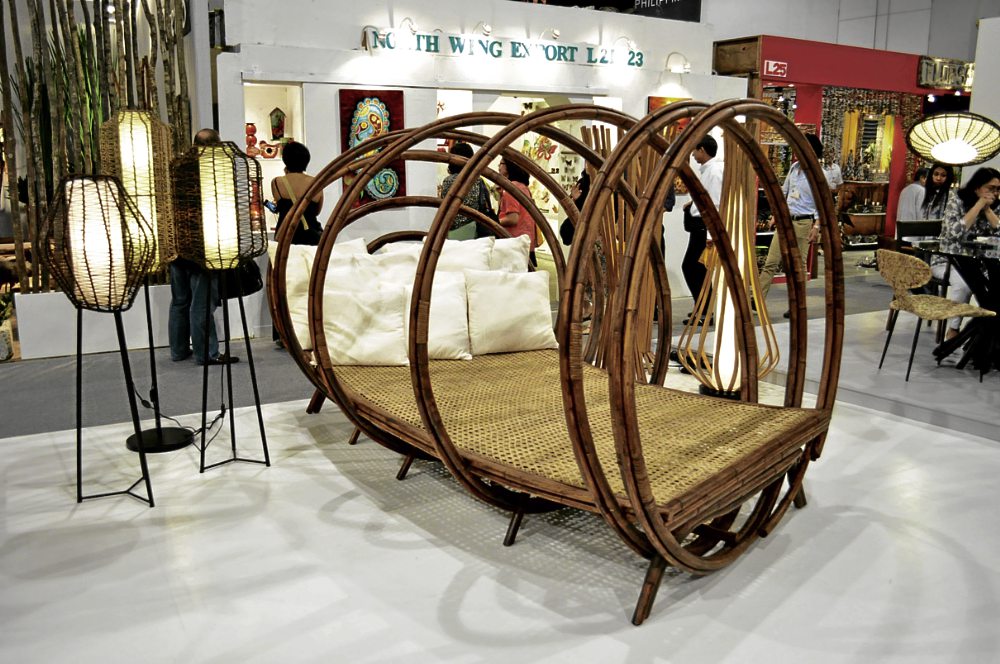
5. Going green. Sustainability and eco-friendliness are the latest criteria in evaluating design. This year, Manila FAME honored companies that used sustainable or recyclable materials. Katha Award winners Milo Naval’s Coco Lamp, made of coconut husks, Kinks and Curls rattan lamp made by Accessoria Inc., and Bagwis Malacca Daybed by Locsin International, used discarded materials and rapid-growing wood in their works, which injected a touch of humor and whimsy.
 
Another Katha winner, Ito Kish’s Gregoria two-seater, is made of balusters of different heights and a cane-seater. It is a reference to the architecture and airiness of ancestral homes. Kish’s chair uses Malay beech wood (Gmelina arborea) which is known for its rapid regeneration.


KENNETH Cobonpue’s Phoenix automobile of natural materialsmade it to the top picks of the American Society of Interior Designers.

Likewise, Kenneth Cobonpue’s Phoenix Car, touted as the World’s First Biodegradable Car, was chosen by the China-based Modern Decoration Magazine as Best in Design. Made of bamboo and rattan, the car is shaped like a leaf. It challenges the conventional car design using heavy industrial materials.
 
The owner has the option to replace the outer shell while the inner structure remains intact.
Cobonpue says the engine is being installed and a German factory is working on the car.
 
6. Dedon chair wins the Wallpaper* Design Award 2012. French designer Jean Marie Massaud’s SeaX chair got the nod from the judges, staffers and contributors of the London-based Wallpaper* Magazine.
 
Winner in the Best Backyard category, the SeaX collection was inspired by the director’s chair and racing sailboats. It uses innovative weather-resistant materials. The Dedon furniture company is based in Cebu.
 
7. Opening of Dedon Island in Siargao. It was once called Pansukian, the resort owned by Frenchman Nicolas Rambeau. Bobby Dekeyser, the Belgian-German founder of Dedon furniture company, bought it and transformed it into Dedon Island.
 
French designers Daniel Pouzet, Jean Marie Massaud and their local counterpart, Maritess Lampert, worked on the modern tropical interiors.
 
“The designers wanted to preserve our culture and designs. We used all local things such as handwoven fabrics from Baguio, iron wood, carved headboards made in Cebu and tinalak pillows from Davao,” says Lampert. The launch of this exclusive resort made a splash in the international press.
 
8. Architect Lorenzo Calma and his son Eduardo held a retrospective exhibit at LRI Plaza. The older Calma showed his minimalist sculpture and jewelry designs while Ed showed models and photographs of his works. Ed’s recent public space, Mind Museum, which opened in March, embodies the organic architecture trend.
 
9. Design duo Tony Gonzales and Tes Pasola refurbished the Jiyuan tea house in Shenzhen, China. The project was a renovation of an old building. Gonzales worked carefully to preserve its architecture while infusing modern elements. “The interior is ornate. It bridges the old and the new.”


GIANT paper lanterns designed by Gonzales dominate Jiyuan’s
dining area.

He worked on everything, from the logo to the menus, furniture and lighting.
 
10. Architect Calvin Tsao and celebrity events planner David Monn graced the Manila FAME. Two of the most influential names in design visited the Philippines upon the invitation of designer Josie Natori.
 
Tsao designed Mercer Hotel in New York, Joyce Boutique in Hong Kong and Suntec City in Singapore, among others. Monn has done big events for celebrities and White House state dinners.

He is the planner of choice of America’s billionaires. After seeing the Manila FAME show, they were impressed with Filipino design and craftsmanship works that celebrate Filipino ingenuity.
 
“Here I find playfulness and exploratory quality,” said Tsao in an interview.

Friday, December 7, 2012

...the packing invention

Filipino invents innovative packaging


Philippine Daily Inquirer
 
 
A poorly packaged product may lead consumers to think that it is of inferior quality.

This is why manufacturers have been seeking out attractive yet cost-efficient packaging.

Most manufacturers consider the following questions in choosing the packaging that suits them: Does the packaging make your product safe when they’re on display? Does it give your product a longer life, keeps it fresh and not vulnerable to contamination? Is the packaging convenient and appealing?

If a manufacturer replies yes to all the questions, then it will soon earn a space in its dealers’ minds and consumers’ hearts.

A case study

Filipino businessman and inventor Wilson D. Go recently developed and patented an exciting alternative to expensive packages.

Made of soft plastic material, Wise-Pack™ is pliable and compact, slim and lightweight, as well as economical—an important consideration for producers in a developing country like the Philippines.

Take a 240-ml container—a brand-new glass bottle of that size costs P12, an aluminum can costs P9, while a rigid plastic bottle costs P6.

Apart from the high cost of the packaging material, distributors and retailers are also mindful of the fact that beverages represent significant logistics cost because of the large volume of space and weight eaten up by traditional containers for delivery and warehousing, shelf and cooler space, labor and power costs.

In developing a total solution that will provide Filipino consumers a superior beverage experience at an affordable price, Go saw that the key lay in significantly reducing the combined direct and indirect costs associated with traditional packaging.

It is a problem that weighs down manufacturers, distributors, retailers and, most of all, the consumers.

Go undertook an extensive search for packaging alternatives around the world until he found a container made of soft plastic and shaped like a pillow that significantly reduced the packaging material. Unfortunately, it did not have the capability to stand on its own.

Go then worked with packaging engineers to develop their own version. After years of investing time and money, Go and the engineers came out with a minimalist design—a pouch that’s perfect for stacking horizontally and can also stand on its own like a bottle.

The spout was also extended to serve as a built-in straw, eliminating the cost, hassle and hazards of using a straw.

For this innovation, Go was awarded 2 patents for industrial use and design for 21 years.

7 benefits

Consumers may expect the following benefits:

– Lower packaging cost, higher product quality. The savings generated from eliminating glass and plastic bottles, aluminum cans and carton bricks can now be plowed back into the product itself, enhancing the quality of the beverage. Maximum taste for minimum waste.

– Safer than glass, cleaner than plastic. Wise-Pack™ eliminates the hazards and risks, accidents and injuries that come with glass bottles. Furthermore, it is more hygienic than the plastic bags used by consumers who cannot afford to pay for a glass bottle. It also eliminates the need for costly and unwieldy glass bottle deposits.

– Easier to open, easier to use. Even against aluminum foil, the Wise-Pack™ is easier to open because there is no need to puncture it with a sharp object. There is built-in perforation that even children can open.

– Chill it, freeze it. Consumers now have the option to chill their beverage and drink it ice cold, or freeze it and munch on it as frozen delight, just like the popular “ice candy” or “ice drop.” A fruit juice drink that uses Wise-Pack™ can offer a more nutritious frozen dessert than ice cream.

Also, trade partners are in for some rewards:

– Less space, less weight. Because Wise-Pack™ is minimalist in design, distributors and retailers will be able to significantly reduce their logistics expenses—delivery and warehousing, high rental expenses, labor and electric power consumption.

– Cools faster, cools more. Because of the size, shape and material of Wise-Pack™, retailers can optimize the electricity consumption of their coolers and maximize profits more than if they were to stock up on traditional packaging containers.

– Environment-friendly. Wise-Pack™ is environment-friendly because it is 100-percent recyclable. And since it’s pliable, it can even be rolled up after use and kept in one’s pocket to avoid littering.

The name

The name offers an integrated solution—a packaging innovation that allows higher product quality at an affordable price.

It delivers maximum value to consumers while it provides maximum profits to retailers.

Go is quick to disown full credit for the invention, invoking an old proverb: “Nothing is truly original because everything already exists in nature.”

And true to the marketing adage, “Do not just extol the virtues of your product; but the virtues of your user,” it makes a statement for the wise user who “pays for the content, not the container.”

The first beverage brand to utilize Wise-Pack™ is Chooga™ Fruit Juice, which was launched in a limited test market in January this year.

Based on internal market surveys, the consumer response has been overwhelmingly favorable to the extent that the brand’s offtake has already exceeded other brands in stores where it is available.

Chooga™ is a fruit drink that has higher juice content than most brands, and comes in orange, mango, pineapple, pomelo and tamarind.

While it is too early to say, it appears that Chooga™ in Wise-Pack™ promises to be revolutionary and game-changing because it offers consumers the taste of a superior fruit juice drink at an affordable price.

The company behind Chooga Fruit Juice is Refreshment Republic Inc. (RRI).

Saturday, September 15, 2012

...the walkable city

Making Metro Manila a 'walkable city'

 
September 14, 2012
 
 
Progress may be slow, but advocates for inclusive mobility will keep going until Metro Manila becomes a walkable city.
 
 
"We have to move people, not cars… not only does this have positive impact on the environment, but also on a personal basis, on our individual health. We have to encourage people to walk, run, and bike, rather than commuting," said Dr. Mario Villaverde, associate dean of the Ateneo School of Government, during the Inclusive Mobility Research Forum held on September 4.
 
 
In Metro Manila, private motor vehicles contribute to 53.2 percent of all traffic composition, while catering only to 21.6 percent of transport demand, Tieza Santos of the Ateneo Center for Social Entrepreneurship (ACSEnt) said during the forum.
 
 
"Because of these challenges in how we move people, goods et cetera, we're incurring losses of P140 billion annually due to wastage of fuel and loss of productivity," she said.
 
 
Wanted: sustainable innovations like e-jeepneys


The e-jeepney is among the Social Innovation Models for Inclusive Mobility. GMA News
Sustainable forms of innovations, businesses, and social enterprises are needed for inclusive mobility, Santos said. In her presentation on Social Innovation Models for Inclusive Mobility, Santos gave concrete examples such as Julie's mobile bakeshop, cashless transactions such as Gcash or Smart Money, and the e-jeepney.
 
 
"These are not implemented nationwide, but can serve as our peg for coming up with an inclusive mobility system in Metro Manila," she said.
 
 
Another problem, according to Santos, is a lack of proper implementation of policies, as well as barriers like economics, development, and culture. "We have this culture of individualized mobility. We prioritize cars, so the construction of car ownership as a form of status symbol is another barrier," she said.
 
 
Transportation economist Randolph Carreon also shared that some households resort to sacrificing food, electric and water bills, and health care in order to meet transport requirements.
 
 
This was one of the findings in the study on Mobility Characteristics, Costs, and Issues of the Poor and Vulnerable groups that was conducted among households in Old Balara, Barangay Bagong Pag-asa, and Barangay Payatas.
 
 
Carreon also shared that persons with disabilities (PWDs) said they preferred public transport modes were tricycles and taxis, which provide door-to-door service. The study also revealed that not all PWDs are aware that they are entitled to a 20 percent discount on public transport fares, as stated in R.A. 7277.
 
 
The study also showed that PWDs view pedestrian facilities as inadequate in responding to their needs. On overpasses, PWDs think "the locations are inappropriate and were selected mainly for the benefit of private establishments; the steps are too high making it difficult for them to climb; it needs cover; and the location is too distant."
 
 
Understanding transport conditions


Bryan Benitez McClelland and his bambike, which is one of the entries in the Inclusive Mobility Challenge. Monina Eugenio
Dr. Jun Castro of the UP School of Urban and Regional Planning said effective transportation planning requires a reliable database, preferably in Geographic Information System (GIS) format.
 
 
"The developed GIS database can be used to understand transport conditions, and some of the socio-economic or demographic conditions as well," he said during his presentation on Mapping of the Public Transport System of Metro Manila: Responding to the Needs of the Poor and Vulnerable Sectors.
 
 
The study showed that public transport facilities are quite "friendly" to the poor and vulnerable sectors, as public transport terminals are quite accessible, and there is a wide range of available public transport modes.
"Pagka may squatter colonies, marami ring informal public transport terminals. Very obvious naman, kasi sila ‘yung market ng terminals na ito. Sila rin ang may ari ng sasakyan," Castro said.
 
 
In her discussion of the presentation on mapping, Engineer Reina Macababad said there is a need for data sharing, and to reconcile databases from various agencies such as the Department of Transportation and Communications, and the Land Transportation Franchising and Regulatory Board (LTFRB).
 
 
Macababad noted that public transport in Metro Manila is complicated. "There is perhaps a need to simplify it... Perhaps the question that needs to be asked is whether we should tolerate tricycles and pedicabs," she said.
 
 
"It can be done. Guangzhou was like Metro Manila before, but there, you will not see a motorcycle. Bawal ang motorsiklo, bawal ang tricycle. Nakakita kami ng electric bike, sabi nila, colorum ang electric bike na ‘yan," Dr. Segundo Romero, director of Ateneo School of Government’s iBoP Asia Program, said during the forum. Romero said that housing was up to eight floors, and residents would use a Bus Rapid Transport (BRT) system.
 
"Without the BRT it would be bedlam," he said, noting that it would take a long time to untangle the transport system in Metro Manila, which, as was pointed out during the forum, is not run the way places like Guangzhou are.
 
 
"It's really difficult if not all the entities will follow and observe," shared Trina Cortez-Tolentino, who has been working with homeowners, schools and establishments along Katipunan Avenue to make the road a model area.
 
 
She said their goal is to make Katipunan pedestrian- and commuter-friendly, with covered walkways with good lighting and 24-hour security.
 
 
The research forum was one of the activities of the Inclusive Mobility Project. On September 21, there will be an Inclusive Mobility Conference.
 
 
There is also an ongoing Inclusive Mobility Challenge, which looks for social innovations that make it easier for the poor and vulnerable to move around Metro Manila. Finalists include the eJeepney, an onboard self-recharging system for electric vehicles, PEDALA bike messengers, and the UP Padyak Project. –KG, GMA News

Monday, December 19, 2011

...the world class innovator

Caviteño doc is worldclass innovator

By Candice Yvette Palenzuela-Dalizon
Philippine Daily Inquirer
 
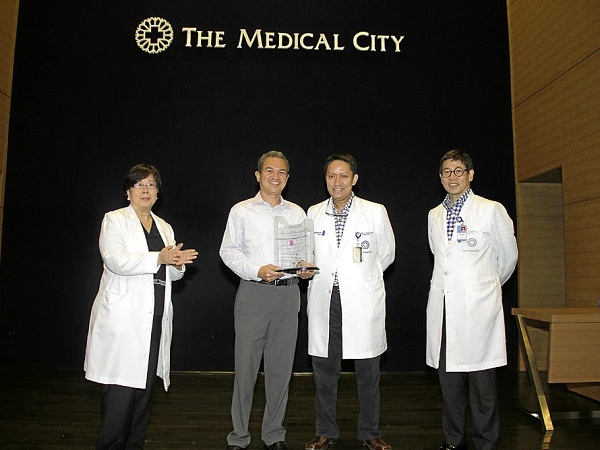
OUTSTANDING INNOVATOR Dr. Melvin A. Sarayba (second from left) receiving the Oustanding Innovator award for his work in eye laser technology. Cheering him are top officials of The Medical City (from left): Professional Staff Development Office head Dr. Blesilda E. Concepcion, Medical Services Group head Dr. Eugene F. Ramos, and Dr. Victor Caparas, chair of TMC Department of Ophthalmology


“It’s nice to be back home.”

Home to 43-year-old Dr. Melvin A. Sarayba is The Medical City (TMC) in Pasig City where he finished his residency training in Ophthalmology in 1999.

Sarayba came back to the Philippines early last month in time for the awarding of The Medical City Outstanding Innovator Award. The award was presented to him in recognition of his outstanding contributions and innovations in Ophthalmology, particularly in laser eye surgery.

During the awarding, TMC’s Chair Dr. Augusto P. Sarmiento told Sarayba: “You have given the country and TMC great honor because of your dedication and devotion.”

Sarayba is a research scientist in the United States. He is currently the Director of Clinical Affairs of LenSx Lasers, Inc, which developed the first femtosecond laser to receive US Food and Drug Administration (FDA) clearance for use in cataract surgery. Located in Aliso Viejo, California, LenSx Lasers, Inc. is now owned by Alcon Laboratories, one of the world’s largest eye care companies.

Femtosecond laser technology is considered among the most advanced and precise methods available today which could revolutionize minimally invasive eye surgery.

Exciting opportunities

Sarayba left for the US in 2001 for a research fellowship in cornea and refractive surgery at the University of California at Irvine (UCI).

After completing his fellowship, he joined Intralase Corp., the developer of the first femtosecond laser system for LASIK eye surgery, a procedure to correct near or far-sightedness.

“The plan was to do my fellowship training in UCI for one year and return to the Philippines to rejoin my group practice. It was during my fellowship training when I met Dr. Ron Kurtz, the cofounder of Intralase who presented me with the opportunity to pursue a career as a clinical scientist,” he said.

At first, Sarayba admitted he and his wife were hesitant to make such a bold move so they decided to give it a try for six months.

A backstage pass

“My experience took me to a place that I was never exposed to while I was back in the Philippines. It was like a backstage pass in the world of Ophthalmology. I got to see how the products I used as a clinician were developed and commercialized. I was hooked,” he said.

Sarayba narrated how he and Kurtz, his boss at Intralase, met and subsequently became partners. Kurtz was a retina surgeon working at UCI while Sarayba was then completing his cornea and refractive surgery subspecialty training.

“He (Kurtz) asked for my help on a small research project and I provided a quality research study. That initiated our collaboration.”

Sarayba then progressed from clinical consultant to Clinical Scientist to Senior Scientific Product Manager while he conceived and developed clinical applications of IntraLase-Enabled Keratoplasty (plastic surgery of the cornea) and advanced keratoplasty techniques.

He became Global Marketing Manager for Advanced Medical Optics when it acquired Intralase Corp in 2007.  After a year, Sarayba rejoined Kurtz in LenSx, Inc., a start-up formed to develop a femtosecond laser for cataract surgery.

The femtosecond laser

He was the key man in developing the clinical applications for the LenSx, running multi-nation clinical trials, and eventually getting it through FDA approval. Alcon Laboratories later on acquired LenSx with Sarayba staying on as Director of Clinical Affairs.

The development of a femtosecond laser for cataract surgery is indeed a remarkable achievement considering the prevalence of cataract cases worldwide. Cataract refers to the clouding of the lens inside the eye.

Cataracts generally occur as part of the aging process, but they can have other causes as well. In the Philippines, researches reveal that cataracts are one of the leading causes of blindness in adults.

Refractive cataract surgery allows the patient to be free or minimally dependent on eyeglasses after surgery.

Looking Back

Sarayba recalled that in 1997, when he was just a resident at TMC, the residency program was in its infancy.

“I was part of the 4th batch. We wanted to be a world-class training facility and we took it upon ourselves to make the change. The residents and the consultants in the Ophthalmology Department rolled up their sleeves and got to work. We wore many hats. It was like a little start-up company that showed great promise,” he said.

Sarayba believes the traits he acquired during his residency were instrumental in his success. He was always motivated to think outside the box. Thus, the term innovator fits him perfectly. His thirst for continuous learning brought him to UCI for fellowship training. And cliché as it is, the rest is history.

On being a Filipino

“Working in a start-up company required employees to wear many hats. Since Filipinos are known to be ingenious and resourceful, I fit right in. I found working with other nationalities easy. In fact, I can see many Filipinos would fit in well working with other nationalities because of our pakikisama(camaraderie, a traditional value)” he said.

Working alongside foreign engineers, doctors, and research scientists, Sarayba said “I never doubted my skills while working abroad. My training in the Philippines and further training in California provided me with superior knowledge in the field I was working in.”


On being an innovator

“Ask yourself this question: Can you live with the best things the world has to offer? If the answer is no, then you have the mind of an innovator,” he said.

The California-based doctor and research scientist said he would often hear people say, “I had that idea before” or “I could have invented that.”

“There is a big difference between coming up with an idea, turning that idea into concept and successfully commercializing a product. You have to go through all the stages,” he explained.

Sarayba likewise belied the common belief that opportunity to develop products is only available in advanced countries.

“That is not true. Doctors in the Philippines can be innovators too. They can find other applications for already available products and be innovators,” he said.

He stressed that being an innovator was not exclusive to people working in his field or in medicine.

“I would urge other people to ask themselves the same question. It doesn’t matter what you are: politician, public servant, entrepreneur, employee, etc. There are many things, I’m sure you’ll find, that need change. No one will do it for you. Wear the hat and take it all the way,” Sarayba advised.

Cavite born

Sarayba was born in Cavite City. He and his family visit the Philippines every two years. They spend time with family, relatives and friends, enjoying the Filipino food they terribly miss when they are in the US.

“My wife and I grew up with strong ties to our families and we would like our children to have the same experience. My kids enjoy spending time with their cousins while we are here, and we miss them terribly when we return to the US,” he said.

Tuesday, December 13, 2011

...the NY Times awardee

New York Times honors Pinoy nurse

12/13/2011


NEW YORK CITY - Filipino-American nurse received the "New York Times 2011 Tribute to Nurses Award" for innovation and leadership at the New York Times headquarters in Manhattan.
 
Michael Tagadaya, a nurse manager at the New York University (NYU) Hospital, was nominated in three different categories.
 
 
With his unique contributions to the nursing field, the awards organizers said they created a new award category for the Filipino nurse – the Innovation and Leadership Award.
 
“For me, to come from the Philippines and out of the almost a million of Filipino nurses here sa buong America, it’s a huge honor, napakalaking karangalan,” Tagadaya said.
 
As a nurse manager at the Ambulatory Surgery unit of the NYU Hospital for Joint Diseases, Tagadaya created paddle pagers to ease the family members’ concerns about their loved ones’ surgeries.
 
He also created new staff positions to bridge the gap between operating room and recovery room.
 
Tagadaya’s superiors at the NYU Hospital said patient satisfaction soared, thanks to those innovations.
 
“It’s no surprise that a lot of our nurses are of Filipino background and we really have a lot of respect for them. And they’re wonderful colleagues and they really make our medical center special, It’s a pleasure to have them,” said Joseph Basco, vice-chairman of the Orthopedic section of the NYU Hospital for Joint Diseases.
 
“Congratulations on achieving this honor. It’s a beginning of your path in nursing leadership and we are very proud of you,” said Ann Vanderberg, Vice President for Nursing and Patient Services.
 
Tagadaya said he was shining shoes and working in a deli to pay for his education back in the Philippines. After becoming a registered nurse, Tagadaya came to the US in 1991 to chase his "American Dream".
 
Tagadaya, who now has a Master’s Degree in Nursing, said he owes the honor to his father.
 
“This honor is really dedicated to my Father, because he, at a very young age, talagang in-emphasize niya sa akin yung importansya ng pagiging tunay na leader and to go above and beyond,” he said.
 
The “Tribute to Nurses Program” is the New York Times’ way of bringing the attention to the outstanding contribution of nurses in the healthcare field in the tri-state area.

Sunday, October 16, 2011

...the Sikat

Solar-powered PHL car racing against world's best


A Philippine-made car is competing in one of the most revolutionary racing events in the world... and also among the quietest. The Sikat II solar car developed by De La Salle University engineering students and faculty will be racing in the 3,000-kilometer 11th World Solar Challenge (WSC) in Australia starting Sunday.


The biannual race draws innovators from all over the globe to show what long-distance transport can be in an oil-depleted future. It also promises to be an adventure for the racing teams, with camping in the desert and the occasional kangaroo darting onto the race route, which stretches from Darwin in Australia's northern tip to Adelaide on the country's southern coast.

Unlike the roar of conventional internal combustion engines that run on fossil fuels, electric cars powered by solar energy like the Sikat II simply hum even at its top speed of 110 kilometers per hour.

The Sikat II is also a statement of solar energy's state of the art in the Philippines, where university researchers are harnessing the cutting-edge advantages of solar cells made locally. The country is a growing exporter of solar panels and other technologies.

The Philippines’ solar car and the team running it, Team Solar Philippines, are competing against vehicles backed by some of the world’s leading universities.

Tokai University, Stanford University, the Massachusetts Institute of Technology, University of Michigan, Cambridge University, University of Toronto are among the top-notch institutions registered in the race.

When the country joined the race for the first time in 2007, it placed 12th in a field of 40. Tokai University's "Tokai Challenger" won the race in 2009.

DLSU professor and Sikat II team leader Jose Antonio “Jack" Catalan told GMA News Online via phone interview that their solar car passed the pre-race “dynamic tests" to determine vehicle stability and road-worthiness.

Those tests covered steering, braking and performance. A “hot lap" on the track of the Hidden Valley Motorsport Complex near Darwin in northern Australia followed the dynamic scrutiny to determine the starting position on Sunday.

Catalan said the team will strive to achieve optimum energy efficiency so that Sikat II's solar cells will have enough power to last until the end of the race.

Energy challenge

The race has another wrinkle. The solar cars are only allowed five kilowatt-hours maximum of stored energy in their batteries.

“Having demanded the world’s most efficient electric vehicles to travel the route we make things more difficult by adding the concept of ‘man vs. the elements’ by regulating the stored energy component to a nominal 10% of that required to complete the journey," WSC event director Chris Selwood said.

"Each team will travel as far as it can each day and camp in the desert each night. The exact progress is of course subject to the intensity of the sun, the condition of the road and whether there is any prospect of cloud," Selwood added.

Race timetable

Sikat II will be the 32nd solar car to leave the Darwin state square, where the competing vehicles will be flagged off at 8:30 a.m. local time (10 a.m. Manila time).

From Darwin in the north, the solar cars will travel south and are expected to reach the finish line in Adelaide by late Wednesday afternoon.
Organizers said the competing teams must observe local traffic rules, including the speed limits, and non-Australians must have their international drivers' licenses with them.

“Finish of Timing is a point established outside of the Adelaide urban area. Effectively this will determine the winner, however the solar car must still proceed under its own power to the ceremonial finish line in Victoria Square, the centre of Adelaide," organizers of the World Solar Challenge also said.
Solar power plus Lasallian spirit
Team Solar Philippines is made up of about a dozen faculty and students of DLSU. They operate Sikat II, the third generation of Philippine solar cars to compete in the WSC.

The team and their colleagues in the DLSU College of Engineering, with the support of collaborators in the Philippine Solar Car Challenge Society (PSCCS), spent at least seven months to prepare for the race from Darwin to Adelaide through the Australian Outback.

Sikat II, which cost about P6 million to build, sports a more aerodynamic design, weighs 180 kilograms, and has more efficient solar power mechanisms, according to the DLSU team.

Sikat II runs on a 1.8-kilowatt motor and has top speed of 110 kilometers per hour (kph). The maximum speed limit at some sections of the Stuart highway, through which the race will run, is 130 kph.

Sinag, the vehicle that ran the race in 2007, was heavier at 290 kilograms and had a solar array that was two percentage points less efficient than Sikat II's.

The president and CEO of De La Salle Philippines, Bro. Ricardo Laguda, FSC is in Australia to support the team on behalf of the Filipino Lasallian community.

Also in Australia to support the team is PSCCS president Ramon Agustines, team manager of the Philippine contingent, and the World Wide Fund for Nature (WWF) – Philippines, which sent Nini Conwi, the winner of an essay writing contest about Sikat II, to write about the team’s experience in the 11th WSC.

Weather in the Land Down Under
Strong thunderstorms and mostly cloudy skies are forecast over Darwin on Sunday. More clouds are also expected over Katherine, the first checkpoint along the race course.

However, sunny skies are expected up ahead over Tennant Creek and Alice Springs as the course goes through the desert sections of the Australian Outback.


View The Journey of Sikat II in the World Solar Challenge 2011 in a larger map

Safety always

Organizers advised the registered teams and media covering the WSC to practice road safety while on the course.

"In stage one of the race, the road from Darwin to Katherine is windy and undulating for the first 200 kms with minimal overtaking lanes," event director Chris Selwood said.

"The drive is long and monotonous. Speed, fatigue and wildlife on the roads are factors that can lead to dangerous situations," Selwood cautioned. "Do not underestimate the danger of driving during hours of darkness as cattle and kangaroos are just two of the obstacles that you may experience sharing the road with you."

He further warned that "(w)hen a road train hits a kangaroo it makes a mess. When your car hits a kangaroo you could be dead too!" — ELR/HS, GMA News