Showing posts with label religion. Show all posts

Saturday, October 19, 2019

...the land of believers

China has the most atheists, Indonesia and Philippines the most believers


Tanutam Thawan| The Thaiger.com
19 October 2019

“According to the survey there is a connection between religiosity, beliefs and socio-demographic characteristics like age, income and education level.”
China has the most atheists, Indonesia and Philippines the most believers | The Thaiger

China is the least believing country in the world but belief in a God gets 100% mention in countries like Indonesia, Bangladesh and Philippines, according to the survey by Gallup International.

According to the survey exploring religious tendencies of 66,000 people in 68 countries across the world, 62 per cent of people in the world define themselves as religious, 74% of people globally believe we have a ‘soul’ and 71% believe in a God. Another 56% believe in heaven, 54% in life after death and 49% in hell.
China has the highest percentage of atheists in the world with 67% not believing in any religion. Every seven out ten people are atheists, more than double than any other country. 23% consider themselves as non-religious. Less than 10% identify themselves as religious in China.
China’s atheist percentage is followed by Japan, a long way behind in second place at 29%, Slovenia (28%) and Chech Republic (25%). Despite rapid industrialisation and urbanisation religion has stayed relevant in the South Korean region with only 23% identifying as atheist.
European countries like Belgium (21 %), France (21%) , Sweden (18%) and Iceland (17%) also have a large percentage of believing population.
Bangladesh, Indonesia and Philippines are the most believing countries with entire population claiming to believe in God, soul, hell and heaven. Thailand and Pakistan have 99% believing population, followed by India, Vietnam and Mongolia.
The survey shows that the levels of religiosity diminish as income and education levels increase. While 66% of people with low income affirm to be religious, this percentage drops to 50% among people with higher incomes. The same trend is verified in relation to education levels: 83% of people with lower education level are religious against 49% of higher level.
According to the survey there is a connection between religiosity, beliefs and socio-demographic characteristics like age, income and education level. As education and income levels grow higher, religiosity levels tend to go down. Also, the expression of different beliefs is higher among young people.
The level of education has a considerable influence on the perception of religion by the society. Women and young children show higher percentage for spiritual forces.

Saturday, March 16, 2019

...the Filipino amulets in Paris

The Philippine flag is raised in this famed Paris museum—all because of our anting-antings


The playwright and curator Floy Quintos has exposed part of our secret soul in the City of Light. At the Musée du Quai Branly along the banks of the Seine, the exposition he put together explores the story of our amulets and the complex, hybrid nature of the Filipino faith .

Renee Ultado | Mar 16 2019 
ABS-CBN News


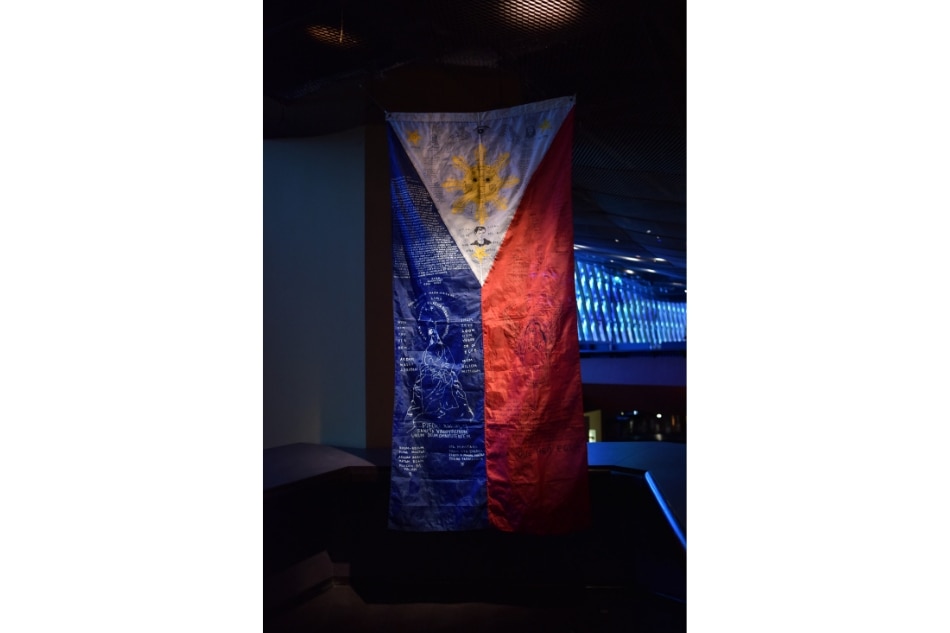
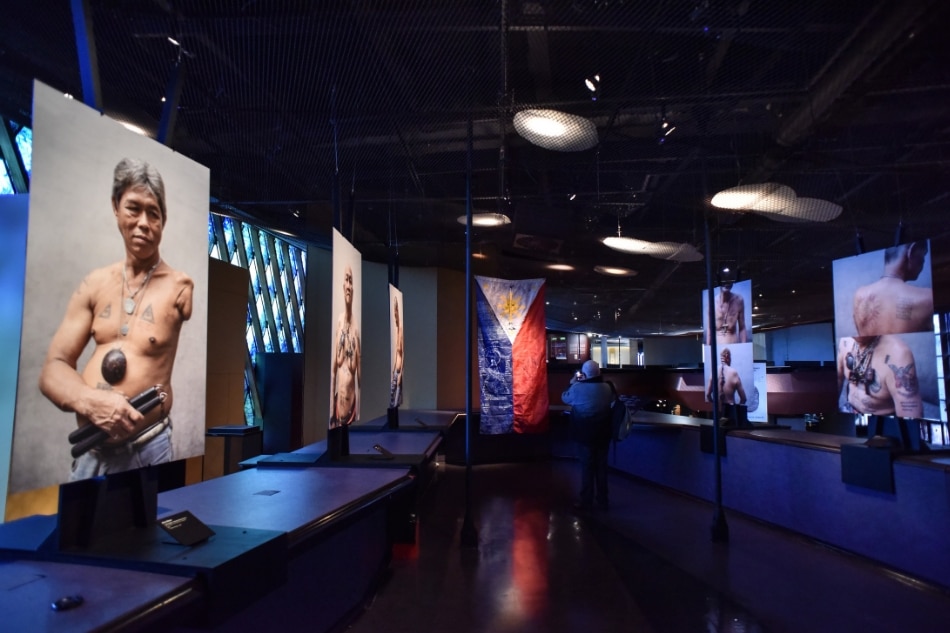
The Philippine Flag stenciled with sacred symbols and incantations, flanked by Dino Dimar photographs of current cult members wearing their anting-antings.

It was a windy Monday morning when the Musee du Quai Branly opened its doors to the press, collaborators, friends, and select patrons for the opening of two exhibitions for Spring. The buzzy Oceania assembles almost 200 archaeological objects and art pieces representative of the Pacific island cultures, while Anting-Anting—to which I was invitedis a more intimate installation telling the story of the historical and contemporary use of protective amulets, talismans, and charms in the Philippines. 


This feels like coming home,  " I said, soliciting a genuine noddy smile from a docent as she ushered me into the exhibit space, an obscure area floating above the museum's permanent collection. It was a half-lie. Whie Santo Niño, the Nazareno handkerchiefs and the odd bits of brass jewelry looked familiar, the whole ensemble felt very foreign to me. Eerie and ominous. A physical manifestation of things I have only heard before.


The exposition entitled Anting-Anting: The Secret Soul of Filipinos explores and demystifies these “charged objects” utilized by a myriad of Filipinos to this very day, from policemen to cult members. An offshoot from a previous exhibit at the Yuchengco Museum in Manila, the collection was built and curated by playwright, director, and antique dealer Floy Quintos.

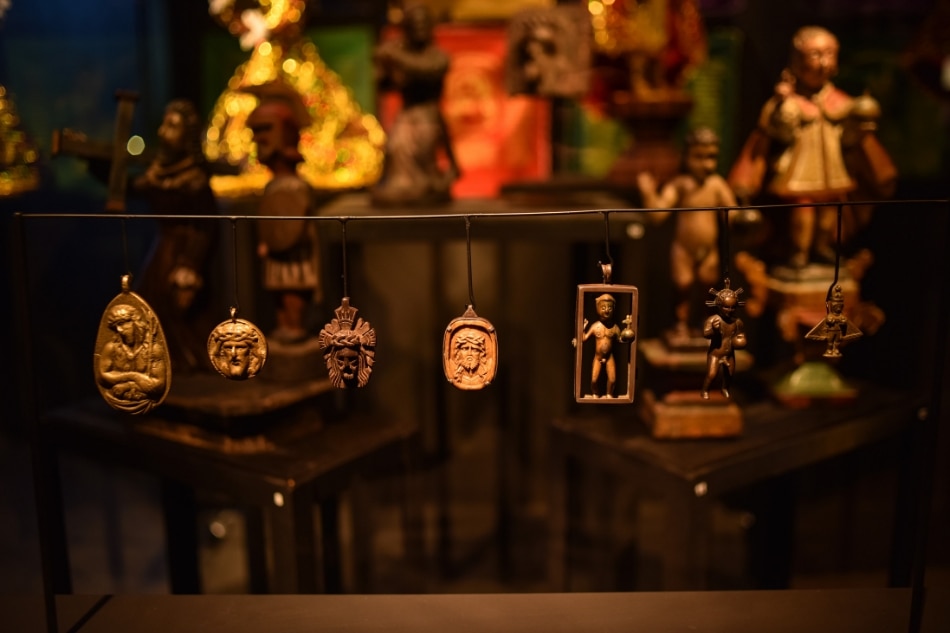
Images of Jesus Christ and the Santo Niño figure into these ancient amulets in brass and ivory, highlighting the Catholic influence on the animist nature of the anting-anting.

The invitation to show here in Paris came with challenges, mostly reworking the storytelling for a predominantly European audience. “My French colleagues would ask me, okay, how do the objects talk to me? How do we make them engage?” Quintos shares. He had to make the exhibit relatable and transportative even to people who have never been to our islands.

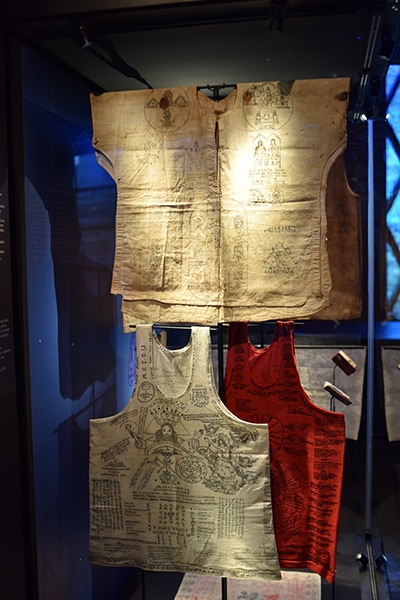
And transportative it was. Utilizing the Atelier Martine Aublet, a space designed to be a “contemporary cabinet of curiosities,” Quintos repackaged the exhibit into smaller pockets of stories. One corner shows Rizalista cult paraphernalia, another reveals blood-stained linen vests with pearl buttons believed to bestow protection against bullets.


In 1967, socio-political cult Lapiang Malaya marched into Malacañang, equipped only with bolos, anting-anting, and these stenciled shirts believed to make the wearer invincible against bullets.

On the other side, a wall glows with images from a Dino Dimar documentary following the journey of pilgrims to Mount Banahaw. The space is then infused with noises both familiar (the hypnotizing sound of a waterfall hitting the plunge, a solemn rendition of Ama Namin) and unfamiliar (orations in Pig Latin murmured from sacred booklets). One is given the impression of being in the caverns with the faithful as they pray, light candles, slither into crevices, and collect blessed water.

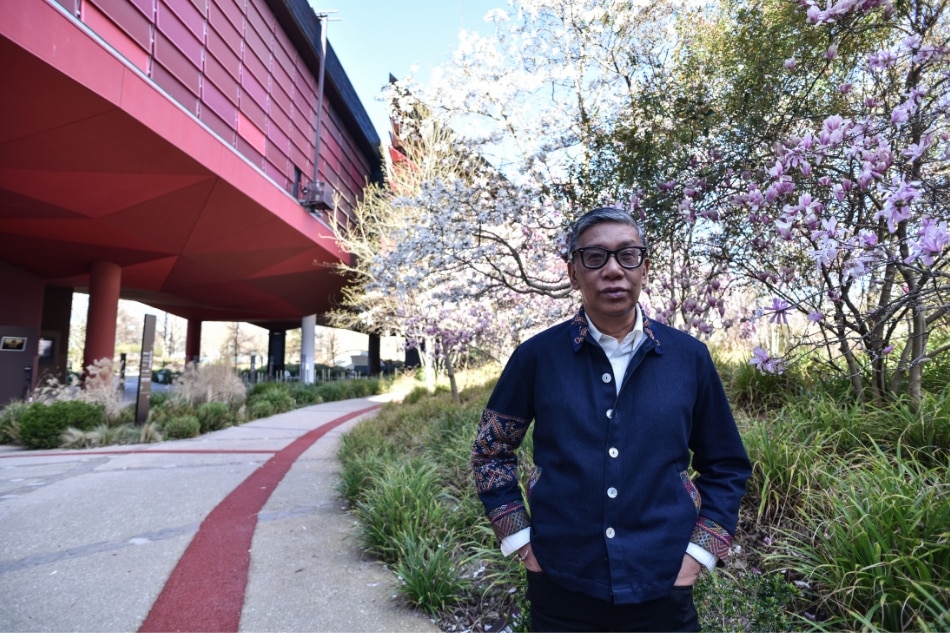
Quintos photographed outside the Musée du Quai Branly in Paris. “My French colleagues would ask me, Okay, how do the objects talk to me? How do we make them engage?” Photographs by Claudio Fleitas.
Some bearing iconographies from the Catholic religion, the anting-anting is one of the many portraits of Hispano-Filipino postcolonial hybridity. Did the Spanish try to make their Gospel more relatable, and the process of evangelization smoother, by incorporating bits and pieces from the native religion? Or did the Filipinos feign allegiance to the Catholic faith while discreetly continuing their animistic ritual under the nose of the colonizer? “That’s the question. It was the kind of dialogue we wanted to highlight,” says Quintos.

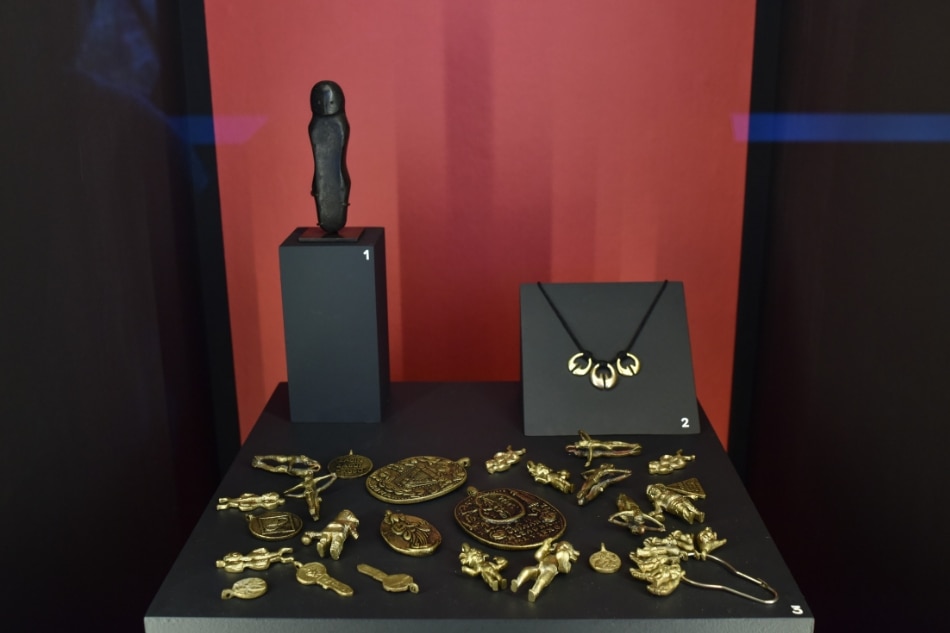
The hi'wong is an Ifugao shaman's amulet functioning as a portable idol (1) while the Lingolingo, also from the Ifugao, is a golden pendant worn to ensure good health, fertility, safety, and bounty. Towering over a collection of commercially-produced amulets (3), it shows the potent pre-colonial origins of the anting-anting and its still-widespread use in contemporary society.
A special nook stripped of protective glass is transformed into a tienda of modern anting-anting, open for people to look closely and even touch. Here, they are less spiritual and somehow devoid of a deeper meaning. Quintos wanted to show how they are today more recognized as popular charms, tailored to augment the spirit or help fix daily woes. It is truly revelatory of the multiple ways we practice our faith in the present. I think of my mother, probably the most Catholic person I know, who keeps her Vatican rosaries next to a Buddha sculpture, or my peers who hear mass on Sundays but wander around with a rose quartz crystal in their coat pocket the rest of the week.
The Philippine flag stenciled with sacred symbols and incantation

The show ends in a juxtaposition of cheap, commercially-made trinkets stacked in a pile under an ancient portable idol carved from stone by the Ifugaos. It shows that the need to always carry a tangible piece of the divine, be it for protection or for luck, is universal and distinctly Filipino. It transcends class, languages, and cultures, and reminds us that everyone, from lovestruck tweens to jittery dispatched soldiers, could use a little help from beyond.

Photographs by Claudio Fleitas
The exhibit Anting-Anting : L'Âme secrète des Philippins runs from March 12 to May 26, 2019 at the Musée du Quai Branly - Jacques Chirac 37 Quai Branly, 75007 Paris, France

Thursday, March 7, 2013

...the Asian candidate for Pope

Asia's 'humble' candidate for pope, Cardinal Tagle


Asia's best hope for the papacy, Cardinal Luis Antonio Tagle of the Philippines, is a young, electric orator who has been outspoken about the need for Catholic Church leaders to be more open and humble.
 
Born to a working-class couple in a then-rural town two hours' drive south of the Philippine capital, Tagle rose to become Archbishop of Manila in 2011 at the age of just 54.

He was named a cardinal in November last year, becoming the official chief spiritual leader to the Philippines' more than 80 million Catholics.

This came shortly after Tagle was summoned to Rome for a synod to map out the way forward for the Church, which has been rocked by scandals over sexual abuse by paedophile priests going back decades.

"The Church must learn humility from Jesus," Tagle said in a speech to the synod, arguing that spreading the faith in a secularising world would be more effective if the Church learned to listen to the people.

"(You) may be saying the right things but people will not listen if the manner by which you communicate reminds them of a triumphalistic, know-it-all institution," he said according to an account of the speech by Vatican Radio.

At another Vatican conference last year, Tagle urged the Church in Asia to tackle the sex abuse issue before it became a full-blown crisis there, and put in place safeguard measures that take into account the region's cultural norms.

Tagle, 55, is widely regarded as enthralling speaker, eloquent and with a soothing voice.

He has refused to discuss his chances for the papacy but, at a public seminar in Manila last month, said Church leaders needed to do a better job of reaching out to people within their communities, particularly the youth.

"The young want to be connected," Tagle said at the forum.

"That is the basic of the faith -- (to be) connected to God, connected to others, to the Church. We need to go back to that fundamental."

Tagle showed remarkable empathy, discipline and intellect as a boy, according to one of his mentors, Father Romeo Ner, 72.

"He was always number one in school. He was very interested in helping the poor even at a young age, and he was very close to the Church," Ner told AFP.

"I was amazed because he knew how to recite the rosary and all of its mysteries when he was just three."

Tagle is well known in the Philippines for not riding in his official car when he was a bishop, chatting with all comers after mass, and even regularly inviting beggars to dine with him at his residence.

Ner said that as a young priest, Tagle was involved in raising money for parishes that served poor areas, where he developed a taste for braised chicken feet -- a staple in the slums.

"Giving the poor their true dignity is his passion. He loves them," said Ner, who as then vicar general of Tagle's hometown was instrumental in making him one of the country's youngest bishops in 2001.


Sunday, February 24, 2013

...the anthem singer for World Youth Day in Brazil

Pinoy vocalist to sing World Youth Day anthem in Brazil

 
GMA News
February 23, 2013


Ooberfuse, a London-based electro-pop band fronted by a Filipino-British vocalist, has been chosen to record the English version of the official anthem for this year’s World Youth Day from July 23 to 28 in Rio de Janeiro, Brazil.

Composed of singer Cherrie Anderson, keyboardist Hal St. John, and guitarist Nico Cox, the band translated “Hope of the Dawn” from the original Portuguese composition “Esperanca do Amanhecer.”

“We are very happy, honored and humbled to have been given the opportunity to sing the official World Youth Day song in English,” Anderson said in an e-mail interview with GMA News Online.

Translating the song was “daunting,” Anderson said, because the band members are not fluent in Portuguese.

“[The song] is as much a tribute to a trans-Atlantic spirit of collaboration as it is to the power of the Internet and modern media,” said Cox.

“After multiple Twitter and e-mail messages recommending improvements and refinements, and numerous large music-data file downloads and uploads in Rio and London, ‘Hope of the Dawn’ was eventually born,” Cox added.

The result: a version that “remains loyal to the Portuguese original, but still reflects the style and ambience of the group,” said Phil Ross, national coordinator for the UK World Youth Day attendees.

Ooberfuse was formed in 2010 when its three members met at a church event, started to play music together, and joined the “Live and Unsigned” competition, where it was named Most Original Band and One of the Best Unsigned Live Musical Acts in the UK.

After singing the youth anthem for Pope Benedict’s UK visit in 2010, the band performed before an audience of 2 million at the 2011 World Youth Day in Madrid.

Now working on its third album, the band will be performing in Portugal, the US, Germany, and Italy this year.

Filipino influences

With one band member being Filipino—Anderson’s mom is from Leyte—it’s inevitable that Filipino influences would weave their way into Ooberfuse’s music.

“In some of our songs, we incorporate a Filipino instrument—the kulintang—which many of the UK people love,” said Anderson.

Anderson, who confesses to enjoying Filipino food like inihaw na baboy, tortang talong, pandesal, and taho, regularly visits the Philippines, where her parents are now based.

“I admire Filipinos’ love for God and family, love for all things musical, and their positive outlook in life,” Anderson said. - VVP, GMA News

Tuesday, February 19, 2013

...the international peace awardee 2012

Pinay named 2012 international peace awardee


Balazo


MANILA, Philippines - A Filipino-Australian has joined the list of distinguished international peace awardees after receiving the World Methodist Peace Award for 2012.

Joy Balazo, who hails from Mindanao, has been recognized for over 20 years of work as a mediator and builder of peace by the World Methodist Council at ceremonies held last week at the Wesley Mission in Sydney.

World Methodist Council general secretary Bishop Ivan Abrahams presented the award to Balazo, who has been working with the Uniting Church in Australia and Uniting World, an aid organization, to help build peace in communities caught in conflict and violence.

Ten years ago, she established the Young Ambassadors for Peace, and worked with local communities to establish eight peacemaking centers in various parts of the Asia-Pacific.

During the awarding ceremony, Abrahams spoke of Balazo’s inspiring dedication and commitment to sowing peace even in the most difficult of situations, as her work took her across the Asia-Pacific region including Ambon, Indonesia, the Southern Highlands of Papua New Guinea, the Solomon Islands, Sri Lanka, Myanmar, Northeastern India, Timor Leste and Bougainville.

Last year, Balazo returned to the Philippines to work and support efforts for peace and sustainable livelihood for the indigenous Subanen people of Zamboanga.


Tuesday, February 12, 2013

...the next potential popes

Cardinal Tagle in Reuters list of potential popes


02/11/2013  


PARIS - With Pope Benedict's stunning announcement that he will resign later this month, the time may be coming for the Roman Catholic Church to elect its first non-European leader and it could be a Latin American.

The region already represents 42 percent of the world's 1.2 billion-strong Catholic population, the largest single block in the Church, compared to 25 percent in its European heartland.

After the Pole John Paul and German-born Benedict, the post once reserved for Italians is now open to all. Who gets the nod depends on the profile of the new pope that the cardinals who elect him at the next conclave think will guide the Church best.

Two senior Vatican officials recently dropped surprisingly clear hints about possible successors. The upshot of their remarks is that the next pope could well be from Latin America.

"I know a lot of bishops and cardinals from Latin America who could take responsibility for the universal Church," said Archbishop Gerhard Mueller, who now holds the pope's old post as head of the Congregation for the Doctrine of the Faith.

"The universal Church teaches that Christianity isn't centred on Europe," the German-born archbishop told Duesseldorf's Rheinische Post newspaper just before Christmas.

Swiss Cardinal Kurt Koch, head of the Vatican department for Christian unity, told the Tagesanzeiger daily in Zurich at the same time that the Church's future was not in Europe.

"It would be good if there were candidates from Africa or South America at the next conclave," he said, referring to the closed-door election in the Vatican's Sistine Chapel.

Asked if he would vote for a non-European over a European candidate if they were equally qualified, he responded: "Yes."

If the next conclave really is Latin America's turn, the leading candidates there seem to be Odilo Scherer, archbishop of the huge diocese of Sao Paolo, or the Italian-Argentine Leonardo Sandri, now heading the Vatican department for Eastern Churches.

Peter Turkson from Ghana, now head of the Vatican's justice and peace department, is often tipped as Africa's frontrunner.

About half the cardinals who can vote are from Europe, even though only a quarter of the world's Catholics live there. If the conclave tilts to the Old Continent, Vatican watchers say Angelo Scola of Milan is in pole position.

Vienna Cardinal Christoph Schoenborn, a former student and close ally of Benedict, is also considered a strong candidate.

FRONTRUNNERS FOR NOW

While there are no official candidates, here are "papabili" (potential popes) the most frequently mentioned recently. The list is in alphabetical, not in order of their chances, and will probably change between now and when the conclave is held, most likely in March.


- Joao Braz de Aviz (Brazil, 65) brought fresh air to the Vatican department for religious congregations when he took over in 2011. He supports the preference for the poor in Latin America's liberation theology, but not the excesses of its advocates. Possible drawbacks include his low profile.


- Timothy Dolan, (USA, 62) became the voice of U.S. Catholicism after being named archbishop of New York in 2009. His humour and dynamism have impressed the Vatican, where both are often missing. But cardinals are wary of a "superpower pope" and his back-slapping style may be too American for some.


- Marc Ouellet (Canada, 68) is effectively the Vatican's top staff director as head of the Congregation for Bishops. He once said becoming pope "would be a nightmare." Though well connected within the Curia, the widespread secularism of his native Quebec could work against him.


- Gianfranco Ravasi (Italy, 70) has been Vatican culture minister since 2007 and represents the Church to the worlds of art, science, culture and even to atheists. This profile could hurt him if cardinals decide they need an experienced pastor rather than another professor as pope.


- Leonardo Sandri (Argentina, 69) is a "transatlantic" figure born in Buenos Aires to Italian parents. He held the third-highest Vatican post as its chief of staff in 2000-2007. But he has no pastoral experience and his job overseeing eastern churches is not a power position in Rome.


- Odilo Pedro Scherer (Brazilia, 63) ranks as Latin America's strongest candidate. Archbishop of Sao Paolo, largest diocese in the largest Catholic country, he is conservative in his country but would rank as a moderate elsewhere. The rapid growth of Protestant churches in Brazil could count against him.


- Christoph Schoenborn (Austria, 67) is a former student of Pope Benedict with a pastoral touch the pontiff lacks. The Vienna archbishop has ranked as papal material since editing the Church catechism in the 1990s. But some cautious reform stands and strong dissent by some Austrian priests could hurt him.


- Angelo Scola (Italy, 71) is archbishop of Milan, a springboard to the papacy, and is many Italians' bet to win. An expert on bioethics, he also knows Islam as head of a foundation to promote Muslim-Christian understanding. His dense oratory could put off cardinals seeking a charismatic communicator.


- Luis Tagle (Philippines, 55) has a charisma often compared to that of the late Pope John Paul. He is also close to Pope Benedict after working with him at the International Theological Commission. While he has many fans, he only became a cardinal in 2012 and conclaves are wary of young candidates.


- Peter Turkson (Ghana, 64) is the top African candidate. Head of the Vatican justice and peace bureau, he is spokesman for the Church's social conscience and backs world financial reform. He showed a video criticising Muslims at a recent Vatican synod, raising doubts about how he sees Islam. (Additional reporting by Philip Pullella; Editing by Giles Elgood)


 

Monday, July 9, 2012

...the faith that breaks (record)

Iglesia ni Cristo breaks 3 world records

07/09/2012
 
 
Residents receive a free dental examination during an event organized by Iglesia ni Cristo (Church of Christ), a local Christian movement in the Philippines. Photo by Cheryl Ravelo, Reuters


MANILA, Philippines – After gaining media attention for planning to put up what has been dubbed as the world’s largest indoor arena, Iglesia ni Cristo is at it again as it broke three Guinness world records.

The influential religious group achieved the feat during its medical-dental mission for informal settlers in Manila last Saturday, July 7.

Tarika Vara, Guinness World Records’ official adjudicator, said Iglesia ni Cristo broke the record for the largest dental health check, the most number of blood pressure readings taken in eight hours, and the biggest number of blood glucose level tests conducted in eight hours.

She said a total of 4,128 people benefited from the dental health check in Manila, breaking the previous record of 3,377 people recorded in India in 2009.

Vara said the Iglesia ni Cristo event also posted a record 8,026 blood pressure readings and 5,217 blood glucose level tests, higher than the previous Guinness records of 7,203 in Kuwait and 3,573 in India, respectively.

Last year, Time.com reported that the designing of a 50,000-seat stadium of Iglesia ni Cristo in Bulacan has already started.

The $213-million facility will be built in time for Iglesia ni Cristo’s centennial celebration in 2014, according to Populous, the US architectural firm behind the project.

Tuesday, June 12, 2012

...the Pinoy identity

THE LIST: Pinoy pride and identity
 
What defines the Filipino?

Here are some of the Philippines' defining symbols of cultural and national identity as well as sources of national pride.

by Francin Cruz for abs-cbnNEWS.com 
 
 
by Francin Cruz for abs-cbnNEWS.com 
 
 
by Francin Cruz for abs-cbnNEWS.com 
 
by Francin Cruz for abs-cbnNEWS.com 
 
by Francin Cruz for abs-cbnNEWS.com by Francin Cruz for abs-cbnNEWS.com
by Francin Cruz for abs-cbnNEWS.com 
by Francin Cruz for abs-cbnNEWS.com by Francin Cruz for abs-cbnNEWS.com
 

Wednesday, April 18, 2012

...the ONE

Belief in God strongest in PH, Catholic countries - survey

04/18/2012
Belief in God grows as mortality nears


CHICAGO - Belief in God is highest among older people and increases with age, perhaps due to the growing realization that death is coming closer, University of Chicago researchers said on Wednesday.

Summarizing data from surveys performed in 1991, 1998 and 2008 in 30 countries from Chile to Japan, the university's National Opinion Research Center found that, on average, 43 percent of those aged 68 and older were certain that God exists.

By comparison, an average of 23 percent of people aged 27 and younger were firm believers in God, according to the report, which gathered data from the International Social Survey Program, a consortium of the world's leading opinion survey organizations.

"Looking at differences among age groups, the largest increases in belief in God most often occur among those 58 years of age and older. This suggests that belief in God is especially likely to increase among the oldest groups, perhaps in response to the increasing anticipation of mortality," researcher Tom Smith said in a statement.

Over the past two decades, belief in God has decreased in most countries, but the declines were modest, Smith said.

Belief was highest in strongly Catholic countries such as the Philippines, at 94 percent, and lowest in Western Europe, with only 13 percent of former East Germans believers.

Israel, Slovenia and Russia were three exceptions where belief in God had grown. For instance in Russia, non-believers who became believers outnumbered by 16 percent those who had lost their belief in God.

In the United States, 81 percent of people surveyed said they had always believed in God, and 68 percent support the concept that God is concerned with people in a personal way.

People were asked about their range of beliefs, from atheism to strong belief in God; their changing beliefs over their lifetimes; and their attitudes toward the notion that God is concerned with individuals.

The countries surveyed were Australia, Austria, Chile, Cyprus, Czech Republic, Denmark, France, Germany, Britain, Hungary, Ireland, Israel, Italy, Japan, Latvia, The Netherlands, New Zealand, Northern Ireland, Norway, The Philippines, Poland, Portugal, Russia, Slovakia, Slovenia, Spain, Sweden, Switzerland, and the United States.