Filipina nominated "Architect of the Year" in UAE Manila Bulletin 08 November 2019
Filipina Christine Espinosa-Erlanda, a Dubai-based architect, was nominated for the “Architect of the Year” award in the 12th annual Middle East Architect Award.
Architect Christine Espinosa-Erlanda (Photo via MPIO / MANILA BULLETIN)
Erlanda was also nominated for the Big 5 Women in Construction Award.
In an interview with the Kabayan Weekly, a Filipino newspaper based in the United Arab Emirates (UAE), Erlanda shared how she was able to achieve her dreams.
“I am fortunate that my humble beginnings in Tondo, once I was a little girl sketching my dreams on the wall, I have culminated my creative instincts, have met mentors along my way, flew from Manila to Dubai and now I am part of building the future of the Middle East, designing and working on noteworthy award-winning projects, master plans, heritage, residential, commercial, hospitality, and heritage projects, turning visions into reality.”
Erlanda graduated from Pamantasan ng Lungsod ng Maynila (PLM) with a degree in Bachelor of Science Major in Architecture.
She spent her internship at the Manila City Planning and Development Office.
Erlanda is now an associate architect in UAE for 11 years, working for Godwin Austen Johnson.
Erlanda explained how she survived to work in a foreign country despite all the challenges that she had encountered.
“I am a Filipino. I smile a lot. Being Filipino helped me cope with the challenges of working abroad. We Filipinos are like water; versatile and can adjust to any shapes or forms and like water, they are necessary to life. Filipinos have the hunger for development and better future. We are not bounded by our race, gender nor financial situation. We Filipinos need to lift each other up, raise our flag and show the rest of the world our ingenuity, resilience and skills, all of those while radiating with the sincerest smiles,” she explained.
One of her missions as an architect was to empower women and promote gender equality: “As an architect my mission is to design and build something valuable that will last even after my own lifetime and in doing so elevate the position of women in what is, still, a male-dominated arena. Being part of the industry that creates and shapes the present and future cities keeps me close to that mission.”
The 12th annual Middle East Architect Award recognizes the great architects behind the best projects in the architecture community in the Middle East. The awarding ceremony will be on November 20.
William Depasupil The Manila Times 21 September 2019
Eon Insight: Focus on the Filipino in the UAE, revealed highly skilled Filipinos are now represented across all industries contributing to the country’s economy, with 64 percent of Filipino workers being college graduates and 6.7 percent holding post-graduate degrees.
A large number of overseas Filipino workers in the United Arab Emirates (UAE), who are professionals and highly skilled workers, are employed in industries and economic activities that fuel the Emirates’ engine of growth and hub of economic activities, a recent study by a communications firm showed.
The study, released on Tuesday by EON Group, showed there are now more than 750,000 Filipino workers across the seven-state UAE, namely Dubai, Abu Dhabi, Sharjah, Ajman, Umm Al Quwain, Ras Al Khaimah and Fujairah.
Photo: filipinotimes.net
“We are very proud of our relationship with the UAE thus far and we continue to be optimistic that our people to people exchanges and our economic ties will even deepen as the years go on,” Paul Raymund Cortes, Philippine consul general in Dubai and Northern Emirates, said.
“Our ties with the UAE are one of our most strategic relationships, be it trade, cultural and human relationship,” he added.
The study, titled Eon Insight: Focus on the Filipino in the UAE, revealed highly skilled Filipinos are now represented across all industries contributing to the country’s economy, with 64 percent of Filipino workers being college graduates and 6.7 percent holding post-graduate degrees.
It is the first ever study into the contribution of the Filipino community in the UAE. The study sought to understand the size, scale and contribution of the UAE’s third largest expatriate demographic.
According to the study, 62 percent of Filipinos surveyed could be found in sectors that are seen to contribute to UAE’s economic diversification and expansion.
The top 5 sectors they work in are architecture, engineering and construction (17 percent); tourism and hospitality (16 percent); customer service (13 percent); health and medical fields (10 percent); and marketing and advertising (8 percent).
An increasing number of Filipino workers are further providing semi-skilled and highly skilled labor, shifting away from low-skilled work areas. In job positions, 46 percent of Filipinos were in associate, supervisory and mid-senior level manager roles, according to the survey.
It also showed 37 percent of Filipinos earn at least AED 8,000 a month or roughly P112,000, with 20 percent earning AED 13,000 a month or P182,000.
Aside from the high demand for their skills, Filipinos workers, with their big salaries, also help boost economic activities in terms of spending habits.
According to the study, Fillipinos are big spenders, with 48 percent going to malls at least once or twice a month; with 45 percent willing to spend up to AED 50 for one meal and 16 percent willing to spend more than AED 80.
It added that the Filipino community in UAE has a long-term commitment, with Filipinos increasingly looking to invest and build deeper interlinked roots in the country.
The survey showed that 41.3 percent of Filipinos have been living in the UAE for two to five years and 37 percent for more than six years, while 31.5 percent plan to stay for another three to five years.
Survey data showed that their home country’s culture plays a key role in shaping Filipinos’ activities in the UAE like spending their free time participating in church activities such as Bible studies and community service programs.
The Filipino weekly Mass, held every Friday at St. Mary’s Catholic Church in Dubai, sees an average weekly attendance of more than 2,000.
During the Christmas season, simbang gabi (midnight Mass), a Filipino tradition of daily masses over a nine-day period, has attendees between 30,000 and 35,000 per day.
Also, the social media connectivity and positive promotion of the UAE by the Filipino community there has contributed to the country being a top 10 destination for traveling compatriots.
It said Filipinos were an untapped force of marketing in the UAE as they are constantly connected online.
By Dr Jasim Ali,
Special to Gulf News
First Published: May 24, 2014
"Much to their credit, OFWS have made the first impression with respect to working habits and ethics.
They are admired for possessing traits of productivity, discipline, customer service, attention to detail, and ease of communicating in English, and presentable.
It is not unfair to claim that Filipinos have emerged as a factor in local economic activities in all GCC countries. And it can be asserted that quality of life in the GCC cannot be the same without the OFWs on the back of their significant presence in diverse sectors." - Dr. Jasim Ali, Member of Parliament, Bahrain
The Gulf countries are home to the largest number of Overseas Filipino Workers (OFWs) and it’s an arrangement which benefits both sides. For instance, for the Philippines, the workers send home billions of dollars.
GCC airlines benefit from the traffic to the Philippines, with Emirates dominating the Manila route.
Fact is, a sizable number of Filipinos live and work abroad for economic reasons, with their number estimated at around 10.5 million and comprising around 11 per cent of the country’s total population. The stats include some 5 million permanently living abroad and about 1.5 million irregulars.
However, this piece focuses on OFWs, officially estimated at more than 2.2 million by end 2012, including some 0.45 million working on the high seas. Yet, thousands of Filipinos were exposed for overstaying their work permits following the implementation of the Nitaqat scheme in Saudi Arabia in July. The controversial project is meant to make Saudi nationals, rather than immigrant workers, employees of choice in the private sector.
Notably, five of the six Gulf countries are on the list of top 10 destinations for OFWs, an evidence of openness of the economies of the grouping.
Saudi Arabia continues to maintain its position as the top destination for OFWs, which has been the case since 2004, followed by the UAE. In 2012, Saudi Arabia and the UAE accounted for 20 and 16 per cent of OFWs, respectively. Qatar emerges in fourth popular place after Singapore in third position. Qatar alone boasts some 200,000 Filipinos.
Service workers
The increasing significance of Gulf countries for Filipinos partly reflects the changing composition of OFWs, with more emphasis placed on household services workers. Unlike the GCC, Western countries are known for applying relatively strict conditions on employment of live-in housemaids.
To a degree, the changing make up of OFWs is in response to difficulties surrounding employment in the Philippines. The challenges include an unemployment rate of 7 per cent, and under-employment of nearly 20 per cent. More than 40 per cent of the employed work in the informal sector.
The Philippines enticed some $24 billion (Dh88 billion) in remittances in 2012, the third highest worldwide after India and China, according to the World Bank. The amount represents around 10 per cent of the country’s gross domestic product (GDP). This sum is inclusive of money sent via financial institutions, cash carried by returning and visiting Filipinos and others in-kind.
The figure could be higher for the lifestyle of Filipinos, who are known to spend in the local economies. The habit of spending a considerable amount of their salaries in local markets adds to the attraction of having Filipinos in the GCC workforce.
Much to their credit, OFWS have made the first impression with respect to working habits and ethics.
They are admired for possessing traits of productivity, discipline, customer service, attention to detail, and ease of communicating in English, and presentable.
It is not unfair to claim that Filipinos have emerged as a factor in local economic activities in all GCC countries. And it can be asserted that quality of life in the GCC cannot be the same without the OFWs on the back of their significant presence in diverse sectors.
MANILA, Philippines - The Philippines was among the top performers in terms of growth in housing prices worldwide, according to a survey by research house Global Property Guide (GPG).
In GPG’s global house price survey for 2013, the Philippines was the fourth top performer with the average price of three-bedroom condominium units in the Makati central business district rising 10.56 percent in 2013 following annual increases of 4.85 percent in 2012 and two percent in 2011.
“Demand remains strong, as indicated by soaring real estate loans,” the research house said.
It noted that based on data from the Bangko Sentral ng Pilipinas, the volume of real estate loans rose 38.5 percent year-on-year to P776.65 billion in September last year.
Citing real estate advisory services firm CBRE Philippines, GPG said the Philippine housing market is expected to accelerate this year, to be supported by the rising number of foreign investors as well as growing business process outsourcing industry.
The growth in the local housing market is seen amid the country’s favorable economic conditions.
The economy grew 7.2 percent in 2013, faster than the 6.8 percent expansion posted in 2012.
For this year, the government has set a 6.5 to 7.5 percent economic growth target.
Topping GPG’s list of countries with rising housing prices was United Arab Emirates with average prices of housing units in Dubai growing 21.52 percent in 2013.
This was followed by Estonia with average housing prices up 16.55 percent, while Taiwan came in third with average housing prices increasing 14.46 percent last year.
China placed fifth on the list as the average cost of housing units in Shanghai climbed 10.13 percent in 2013.
Out of the 42 countries covered by GPG’s survey, 27 markets showed housing price increases
“House prices are rising in many more countries than not, and the momentum trend is strongly upwards,” GPG said.
GPG which provides information on residential property development covers market trends in 101 countries.
MANILA — The Philippines rose four spots anew in the
International Football Federation (Fifa) World Rankings, and remained the
highest squad in Southeast Asia at 133.
From 137 last month, the men’s football
squad kept up with its meteoric rise even after a 4-0 loss to United Arab
Emirates and a 1-1 draw to India — both higher ranked teams.
The Azkals also kept their distance over
the SEA teams with Myanmar at 140, Thailand at 142, Singapore at 154, Malaysia and Vietnam at 158 and Indonesia at 162.
From Hong Kong to Dubai, pastors, teachers and consular officials describe an unprecedented outpouring of support from a diaspora that even in normal times is renowned for sending large amounts of money home to family and friends.
“Everyone is mobilising, everyone is raising funds for organisations and churches,” says Joyce Demetillo, a pastor at the Jesus is Lord church in Hong Kong.
Verna Fajilan, a former ballerina at Ballet Philippines who teaches dance in Hong Kong, says that while the Filipino “spirit for helping . . . is instinctive”, Haiyan has sparked an altogether different level of response from expatriates.
“Because of the enormity of the typhoon, there are more people now who want to mobilise the relief efforts,” says Ms Fajilan, who is organising charity zumba dance classes to raise money.
The Philippines foreign ministry says there are more than 10m Filipinos overseas who, according to the central bank, sent $21bn home in 2012.
Rosanna Villamor, the Philippines deputy consul-general in Hong Kong where there are 180,000 Filipinos, says she has been amazed by the “sheer number of people who have come forward with a number of fundraising events”. She adds that one difference from previous disasters is that people are sending the consulate names of relatives and loved ones that they cannot locate.
Daisy Mandap, editor of the Sun, a newspaper for Filipinos in Hong Kong, says this Sunday – the day most of the city’s 163,000 domestic helpers have a day off – will see a big response, as Filipinos arrange fundraising events across the territory.
Similar events are happening across the world, including in the United Arab Emirates, home to 500,000 Filipinos, most of whom live in the business hub of Dubai. They are the second most dense concentration of migrants in the oil-rich Gulf after Saudi Arabia, where an estimated 1.2m work.
Wendell Castro, chairman of Task Force Yolanda – as Haiyan is known in the Philippines – in Dubai, is leading one of dozens of campaigns launched by about 100 Philippine community associations in the UAE. They have set up collection points for food, clothing, medicine and blankets, and are hoping to organise musical and prayer gatherings once they receive official approval.
“We are targeting about $200,000-$300,000 in donations,” Mr Castro says.
Filipinos from the affected areas have also spent the past week scouring the internet and awaiting phone calls for news about their families.
Jessa, a 26-year-old receptionist, has social media to thank for the end to six torturous days of uncertainty after her home town of Isabel in Leyte province was devastated, reduced to “only five homes”, she says.
I’d been looking at Facebook 24/7 and I recognised the landscape. So I sent a comment – ‘Please help me’ – and they gave me a number of a neighbour who went to my mother - Jessa, receptionist
Some residents of the town of about 45,000 people managed to bring a generator from a nearby island to charge mobile phones. They scaled a nearby hill to get a signal and posted pictures online.
“I’d been looking at Facebook 24/7, waiting for something, and I recognised the landscape,” says Jessa. “So I sent a comment – ‘Please help me’ – and they gave me a number of a neighbour who went to my mother.”
Thousands of kilometres away in New York, Elmer Villaluz, 66, treasurer at San Lorenzo Ruiz Chapel – the city’s main Filipino church whose masses have been bustling – says that parishioners and the local community have come together to donate cash and clothes to the Red Cross.
“Filipinos are very religious . . . but they’re asking why did this happen to them?” Mr Villaluz says. “We are thankful because the global community is giving us aid.”
Frank Cimafranca, the Philippines consul-general in Dubai, says the consulate is “trying to raise awareness” by directing donations to government bodies and non-government organisations that are taking donations. While many Filipinos may want to return home to help, he says that in most cases, it is not possible.
Some people will return to the Philippines because they worry for their loved ones, but most will stay for practical reasons – there is nothing more they can do and it is better to send money - Frank Cimafranca, Philippines consul-general in Dubai
“Some people will return to the Philippines because they worry for their loved ones, but most will stay for practical reasons – there is nothing more they can do and it is better to send money,” he says
But some people have decided that staying away is too hard. Patrizia Villamore, a domestic helper who has lived in Hong Kong for two decades, flew to Manila and then made her way to Cebu where she met up with her husband Brian Delima, a construction worker in Saudi Arabia, who had also flown home after the typhoon.
Speaking by phone from Cebu, the couple said that after they arrived in the Philippines they learned that his uncle had died. Mr Delima says his uncle survived the typhoon only to die several days later from the cold. Ms Villamore explains that the scale of the disaster made it impossible for them not to return home.
“It is a very different feeling. We want to see our families – are they alive or not.” Additional reporting by Camilla Hall in New York
SNOW WHITE. Sandy Talag in a brave role. Screen grab from the trailer
MANILA, Philippines - "Once upon a time," opens the film's trailer, "there was a girl in the Philippines named Snow White. But one day, her mother and stepfather made her eat a poisoned apple."
"Lilet Never Happened," a riveting narrative on the Philippines' underground sex trade, won Best Youth Film at the 2013 Copenhagen International Film Festival held September 5 to 15.
The film, by Dutch director Jacco Groen, stars Sandy Talag, as 11-year-old Filipino-American streetgirl Lilet.
The young girl, introduced as Snow White to "clients," has big dreams of becoming an actress in order to lift herself and her brother from poverty.
Meanwhile, Gloria, a foreign social worker, tries desperately to save Snow White.
In an interview with Filmz TV, Groen recalled meeting a real-life Lilet who inspired him to make this film. He met the young girl in a mental hospital a day after she tried to commit suicide.
Despite the film's earnest and complex themes, Groen said the movie is not meant to be depressing.
"This story never left my mind," he said. "It's not a depressing type of film because the girl I met is a tough kind of girl."
Groen said a psychologist was on the set for consultation.
Sandy Talag, the film's 15-year-old lead actress, said her imagination helped her to act out the scenes.
"I would imagine, 'Okay, Sandy, this is not a taping, this is real. You're on the streets and you're selling your body just to have money, just to eat something.' I just imagine things and, voilà," she told Filmz TV.
Groen said the film is meant to reach out to the youth.
“'Lilet Never Happened' is made for the younger audience, you need to reach the new generation who will say enough is enough, we cannot accept this anymore in a society that we call civilized.”
“With this movie, we really hope to raise awareness about the sad reality of child prostitutes not only in the Philippines, but all over the world."
Watch the trailer here:
"Lilet Never Happened" has already been shown in more than 22 international film festivals in 2012.
In the coming months, the film will travel to Switzerland, Australia, Armenia, Dubai, and India. It will be shown in the Philippines in December.
Others in the cast are John Arcilla, Marife Necesito, and Dutch actress Johanna ter Steege. - Rappler.com
MANILA, Philippines - The Philippine stock market is one of the "hottest" in the world so far this year, according to a CNN report.
On the CNN Money website, the Philippine Stock Exchange index (PSEi) was ranked the 5th "hottest" stock market in the world, after Kuwait, Argentina, United Arab Emirates and Japan.
The PSEi has rallied 20% so far this year, as it breached the 7,000 level for the first time ever. The main index has reached 27 new all-time highs so far this year.
Investors have flocked to the Philippines as the country earned its first ever investment grade credit rating from any ratings agency last March.
CNN Money quoted Ashraf Laidi, chief global strategist at City Index in London, as saying investors have been attracted to the Philippines "because it's shielded from the economic slowdown in China."
"The economy doesn't depend on exports to China like many other countries in the region... It's more tied to domestic consumption," Laidi said.
As of 12 noon Tuesday, the PSEi was up 0.46% to 7,060.81.
Barely four months after it first breached the 6,000 level, the PSEi breached the 7,000 level last April 22. Analysts and fund managers are betting the PSEi will continue to rise, driven by optimism on the Philippine economy and further cut in interest rate of special deposit accounts (SDA).
The Palace earlier said the PSEi's record highs is a "manifestation of continued confidence in the prospects of our economy, not only from the international community, but also from Filipinos who are raising their stake in our country’s success."
The presenters on the Filipino radio station TAG 91.1 include, left to right, Loueise da Costa, Joselito Bluebird Echivarria, Jonaphine 'Maria Maldita' Caraan and Nathalia Junbie 'Chikay' Cermino. Courtesy TAG 91.1
Music brings people together. And for the thousands of Filipinos living in the UAE, homegrown songs remind them of anything that is distinctly Pinoy – from the jeepney (passenger vehicle) to halo-halo (shaved-ice dessert) to adobo (meat in a sauce of vinegar, soy sauce and garlic) – and the smiles of loved ones who are thousands of miles away.
And this is exactly what inspired the founding of the country’s first radio station that is devoted to the large and still-growing Filipino expatriate community.
TAG 91.1 was the product of long and meticulous planning by the Arabian Radio Network (ARN) group, which was looking to tap into an enormous yet overlooked market in the country’s widely varied demographics.
“ARN has spent more than two years conducting wide-ranging -research to determine the under-served communities,” explains Louise da Costa, one of the station’s stable of presenters.
Brought over from Virgin Radio where she was dubbed the station’s “Filipina Queen”, da Costa joined the fledgling station to boost its young staff.
The station has an all--Filipino team and the management made it a point to visit the Philippines to scout for the right talent to represent its new project.
Studying Manila’s radio scene, ARN representatives zeroed in on the presenters from the country’s three leading stations. A Filipino music manager and a production manager were also hired.
In hindsight, the station is a grand offshoot of the 10pm to 6am Filipino radio programme heard over the past five years on Dubai Eye 103.8.
“Nearly 645,000 Filipinos live in the UAE and because of the strong demand, developing TAG 91.1 was a natural choice for ARN,” explains da Costa.
The Filipino community has welcomed the new station and social networking sites are already spreading the news. In fact, TAG 91.1 had more than 5,000 visits on its website during its debut broadcast on March 25. “Hundreds of thousands of listeners have already interacted with this programme,” says da Costa. “It has 10,000 Facebook likes, a number that is increasing by the minute.”
TAG 91.1 is also a multi-platform radio station: it broadcasts 24 hours a day, is online at www.tag911.ae, has dedicated iPhone, Android, Nokia and BlackBerry apps and a built-in player on all Samsung Smart -televisions.
The station’s line-up includes music, celebrity gossip, games and news, all dished out in a distinctly Pinoy fashion.
Furne One works with Heidi Klum for Germany's Next Top Model
By Majah Moralde
ABS-CBN Europe News Bureau
03/18/2013
DUBAI - Dubai-based fashion designer Furne One, who hails from Cebu City in the Philippines, is again making waves in the fashion scene in Europe as his designs have recently been featured in the pilot episode of Europe’s top-rating reality TV show, Germany’s Next Top Model (GNTM).
Prior to this, fashion models also donned his haute couture designs in the season finale of the US reality TV show, America’s Next Top Model (ANTM), hosted by renowned supermodel Tyra Banks last November.
Furne designed more than 40 pieces for the season opening of GNTM, hosted by world-famous supermodel Heidi Klum, who personally visited him in Dubai for the location shoot of the TV show.
He has been designing for Klum and her TV program for around seven years now.
“Working with Heidi, to begin with, is really a privilege for me considering that she’s a superstar. She’s a supermodel and it’s a top-rating showing in Europe in Germany,” he said.
Klum, and her popular show GNTM, has helped him carve a niche in the international fashion scene. He is now one of the sought-after designers in Hollywood.
“Aside from the European market, it also opened doors for me with the celebrities in America like Katy Perry, because every season Heidi is bringing in pop superstars to perform in Germany. It’s a huge thing. It’s a very big event. It’s a live show and held in a stadium of about 25,000 people watching,” he said.
Furne also counts Shakira and Jennifer Lopez among his long list of famous clientele.
At this stage, he is preparing his awe-inspiring designs for the season finale of GNTM, which will be aired in May.
Philippines dubbed 'Most popular destination in Asia' in Guangzhou, China
Philippine Information Agency
15 March 2013
MANILA, March 15 -- The Philippines was chosen "Most Popular Destination" by Guangzhou Information Times and the Guangzhou International Tourism Fair (GITF) in separate ceremonies held on March 7 in Guangzhou, capital of Guangdong in southern China.
In a press conference/awarding ceremony held at the Nanhu Travel Display Center, the Philippines was presented the "Most Popular Destination in Asia" award by Mr. Li Xinzhang, Vice President of Guangzhou Information Times, a statement from the Department of Foreign Affairs said.
Guangzhou Information Times is a subsidiary of Guangzhou Daily, the most influential news daily in Guangzhou.
Philippine Tourism Undersecretary Daniel G. Corpuz and Consul General to Guangzhou Raly L. Tejada received the award.
An interview by the Information Times and Guangzhou TV followed the ceremony.
The Philippines was also one of the recipients of the "Most Popular Destination" Awards during the Guangzhou International Travel Fair (GITF) Awards Night held at the China Marriott Hotel. The Philippines was the lone recipient from Southeast Asia. The other co-winners include Dubai (United Arab Emirates), Chicago (United States), Korea, Seychelles, Mauritius, Turkey, Sri Lanka, Macau, and Italy.
Consul General Tejada accepted the award on behalf of the Philippines.
The GITF is organized by the Guangdong Provincial Tourism Administration through the Tourism Administration of Guangzhou Municipality in cooperation with Hannover Milano Fairs Shanghai Ltd..
Held every year in Guangzhou, Guangdong, China, the GITF has been recognized as one of the most significant annual international travel fairs in the Asia-Pacific Region for its extensive influence upon the tourism industry and related industries.
The Philippine Consulate General in Guangzhou issued a total of 59,861 visas to Southern Chinese visitors to the Philippines in 2012.
The Philippines continues to hold a strong appeal to the Chinese market as the Consulate General posted an increase of 6.45% in visa issuance for January 2013 over the same period last year. (DFA)
Philippines tourism slogan promoted at Global Village
Expats encouraged to visit the Philippines
By Carolina D’Souza, Staff Reporter
February 23, 2013
Dubai: With folk dances and traditional performances, the tourism arm of the Philippines government began to promote the country at Global Village on Friday.
The aim was to market the tourism slogan -- It’s more fun in the Philippines.
The international slogan was rolled out in international markets by the Philippines’ Department of Tourism (DOT) in 2012, the year that the country attracted more than 4,272,811 million tourists.
Speaking to Gulf News, Vice Consul Geronimo Suliguin said, “We are hoping to exceed the number of tourists in 2013.”
Global Village, a premier outdoor cultural, shopping and entertainment venue in the UAE, is visited by more than five million people annually.
The Philippines’ Department of Tourism – Middle East Office, in cooperation with the Filipino community in Dubai and the northern emirates, hopes that the cultural event at Global Village will entice international tourists to visit the Philippines.
Targeted at non-Filipino expatriates, the series of performances at the World Cultural Stage highlight the tourism slogan and campaign and promote the Philippines as a top tourist destination, Suliguin said.
The performances, which involve 65 Filipino organisations and 15 performing groups, will end on March 1.
“These provide a window into the cultural history of the Philippines. We want to drum up awareness about our cultural history,” he said.
Some places like Manila, Bohol, Cebu and Davao are already popular tourist spots, he added.
The performances included Philippine folk dances, Pandanggo Sa Ilaw (dance with lights) and Cariñosa (courtship dance).
Angeline Rivera, Manager at the Philippine Department of Tourism - Middle East Office, told Gulf News, “We are making concerted efforts to push our tourism strategy. It is the first time we are hosting performances at Global Village.”
Gulf News spoke to a few Filipinos expatriates on the tourism strategy.
“Our hospitality is part of our nature. I would be proud to see expatriates from Dubai experience our hospitality and see our country that has much to offer,” said Arlyn Lansang, a Dubai-based professional in finance.
Another expatriate, John Samson, a client services professional in Dubai, added, “Given the large Filipino community here, most nationalities have interacted with us. It would be a privilege to show them our country.”
The Philippines' robust economic growth has made it among the
''resilient'' countries in the Asia Pacific region and the Middle East, the
worldwide survey revealed.
In its latest Insights Report, MasterCard
survey revealed that the Philippines along with Japan and Hong Kong ranked
highest on the index as ''relatively resilient.''
The MasterCard survey
assesses the extent to which a slower growing global economy and specifically a
slowdown in merchandise exports, will impact the resilience of consumer
confidence in key markets in Asia Pacific and the Middle East.
Following
the three nations are Singapore, Saudi Arabia and Kuwait. UAE was ranked lowest
or ''very vulnerable.''
The index and its accompanying reports do not
represent MasterCard's financial performance, the company
said.
''Markets with the highest level
of consumer confidence, as well as those that are most resilient to a slowdown
in merchandise exports have the strongest potential to weather the economic
downturn,'' MasterCard said.
''At the opposite end of the spectrum,
markets with very low consumer confidence and those that are also most
vulnerable to a slowdown in merchandise exports have the least potential,'' the
company added.
Yuwa Hedrick-Wong, MasterCard global economic advisor and
co-author of the report said the strong growth in global demand that they saw
during the decade of 2000 to 2010 was unique in many ways.
Hedrink-Wong said this
was underpinned by an unprecedented increase in global liquidity which provided
a tremendous boost to the export-oriented economies in Asia/Pacific and Middle
East.
''But growth in global demand will be a lot weaker than before.
Putting it bluntly, a repeat performance is highly unlikely,'' he
said.
For many markets in the Asia Pacific and the Middle East,
especially the export-oriented ones, Hedrink-Wong said the outlook of a slower
growing global economy will mean weaker demand for exports.
''Their
ability to leverage domestic demand, especially private consumption, will be
critical in supporting stronger economic growth. The extent to which they may
succeed will in turn depend on how resilient consumer confidence is in these
markets,'' he added.
The report, meanwhile, found Hong Kong, Indonesia,
Thailand, Philippines, India and China to be well positioned with the strongest
potential to leverage private domestic consumption to support economic
growth.
PHL consumer confidence one of highest in
world – Nielsen
GMA News
February 5, 2013
The Philippines is one of
the most optimistic countries when it comes to consumer confidence, said a new
survey released by international research firm Nielsen on Tuesday.
Nielsen's Fourth Quarter Global Survey of Consumer Confidence and Spending
Intentions gave the Philippines a score of 119 for the last quarter of 2012, one
point higher than its score in the third quarter.
The total ranks the
Philippines second only to India in the global tally, with the latter scoring
121 to lead the pack for the second straight quarter.
The survey,
which was conducted from November 10 to 27, 2012, tallied the online responses
of 29,000 respondents from 58 countries. The survey's baseline is 100; countries
scoring below that is seen as having a "pessimistic" outlook when it comes to
consumer confidence.
Only 10 countries of the 58 registered an
"optimistic" outlook; after India and the Philippines, the top 10 is rounded out
by Indonesia (117), Thailand (115), the United Arab Emirates (113), Saudi Arabia
(112), Brazil (111), China (108), Malaysia (103), and Norway (102).
The 10 countries with the lowest scores in consumer confidence are Bulgaria
(61), Japan (59), Slovakia (57), France (52), Spain (46), Croatia (42), Italy
(39), South Korea and Portugal (tied at 38), Hungary (37) and Greece (35).
“While consumers around the world struggled with increasing economic
concerns, consumers in the Philippines continue to have a positive outlook. This
optimism can be attributed to the strong performance of the economy in 2012
which was driven by real estate, construction, manufacturing, services, and
trade sectors,” said Nielsen Philippines managing director Stuart Jamieson in a
statement.
According to the study, in the fourth quarter of 2012
Filipinos felt confident about:
- local job prospects: 76 percent are
optimistic about job prospects in 2013. The rate is four points higher than the
rate in the previous quarter, and is one of the highest in the world; and
- personal finances: 77 percent feel confident about their personal
finances, a one-percent drop quarter-on-quarter. 2013 will be a good time to buy
products, said 51 percent.
Beefing up their savings was a priority
for 65 percent of the respondents, but the rate is two points off from the
percentage recorded in the third quarter.
Filipinos' top concern is
job security, followed by work/life balance, health, the economy, parents'
welfare and happiness, and increasing utility bills.
The top global
concern is the economy.
Optimism dropped in eight of 14 Asia-Pacific
economies on the survey — a sign of "an increasingly polarized Asia-Pacific
region," said Cambridge Group chief economist Venkatesh Bala, that divides the
region into high-population economies with robust domestic consumption and
developed markets that are more export-dependent that are therefore more exposed
to volatile international fluctuations.
Global consumer confidence in
the fourth quarter of 2012 fell slightly to 91 from 92 in the third quarter.
— BM, GMA News
For 1st time, Sinulog festival to be held in
Dubai
GMA News
January 15, 2013
Cebuano families in the
United Arab Emirates (UAE) may get their first taste of the famous Sinulog
Festival there this Friday, Jan. 18, at the Al Safa Stadium in Dubai.
Dubbed the “Sinulog sa UAE Festival 2013,” the festival is expected to bring
the Cebuano families in the UAE a brief sense of home.
“It will be
celebrated with a Sinulog Dance Festival Competition from 8 a.m. to noon, to be
followed by Festival Queen Contest from 1 to 3 p.m.,” United Cebuanos-UAE
president Wendell Castro said in an interview with the UAE news site Khaleej Times.
Castro said “Sinulog
sa UAE Festival 2013” is the group's first major event and a replica event of
the Sinulog Festival in Cebu.
United Cebuanos—UAE is a civic
organization of active professional and non-professional Cebuanos residing and
working in the UAE.
Castro said Cebuanos in the UAE have had no
chance to go home to join the Sinulog celebration held every third Sunday of
January.
“We have decided to bring the festivity in Dubai
highlighting the acronym C.E.B.U. as Camaraderie among Cebuanos, Engagement in
social activities via Filipino Community, Business collaboration and employment
opportunity, and Unselfish service to humanity,” he said.
Castro said
the festival has been approved by the Sinulog Foundation Inc. and the Cebu City
Tourism Commission, the organizers of the Sinulog annual event in the
Philippines.
Sinulog promotional materials and photos featuring Cebu
as a tourist destination will also be displayed at the exhibition area of the
stadium.
Contests
Meanwhile, three Filipino groups will vie for the Sinulog Festival Dance
Competition: St Mary’s Dance Group, Filipino Digirati Association and the
Filipino Dance Sport Club.
At stake is Dh5,000 cash prize and a
trophy.
“We will also give away Dh1,000 as a consolation cash prize
for the other participating groups," he said.
A dance parade inside
Al Safa Stadium will usher in the “Sinulog sa UAE Festival 2013,” followed by
the Festival Queen Competition will start with 10 candidates.
Meanwhile, a bazaar which offers Filipino food will be held at the open
stadium that can accommodate 5,000 people.
“This will celebrate the
‘Kainan’ or the eating portion of the festival,” Castro said.
During
the festival, Higantes or giant papier maches - though stationary compared to
the moving versions in Cebu - and banderitas will show the festive atmosphere of
the Sinulog Festival. - VVP, GMA
News
By Eunice Barbara C. Novio Philippine Daily Inquirer
Sunday, January 13th, 2013
DIAL 999 Geoffery Panganiban in front of one of the
smaller ambulances of the Dubai Corporation of Ambulance Services, where he
works as a prehospital emergency nurse.
DUBAI, UAE—A man dials 999. Hazel Margarita Parado takes the call. Geoffrey
Panganiban, part of a three-man ambulance team, prepares for dispatch. It is an
emergency hotline in Dubai.
Hazel Margarita and Geoffrey are Filipino nurses, a growing presence in the
government-backed Dubai Corporation for Ambulances (DCAS), one of the most
modern ambulance services in the world.
“As an ambulance nurse, I have to attend to different kinds of emergencies.
Most patients are those involved in road accidents and work or house
emergencies. Most common cases are trauma, cardiac case, and diabetic
emergencies,” explains Geoffrey.
Technically, they are pre-hospital ambulance nurses or paramedics. They are
the first to respond and bring the victim to the hospital for further treatment.
Another overseas Filipino, Robert Fortinez of North Cotabato, has been
working for 14 years as an emergency medical technician.
“We often work with the police and firefighters, since some emergency cases
are accidents,” he says.
In the early ’80s, ambulance service in Dubai was under the police and the
department of health services. In 2006 the government merged and unified all the
ambulance services. In 2010, the Ruler of Dubai
established the Dubai Corporation for Ambulances (DCAS), which now has more
than 60 ambulance stations working 24/7.
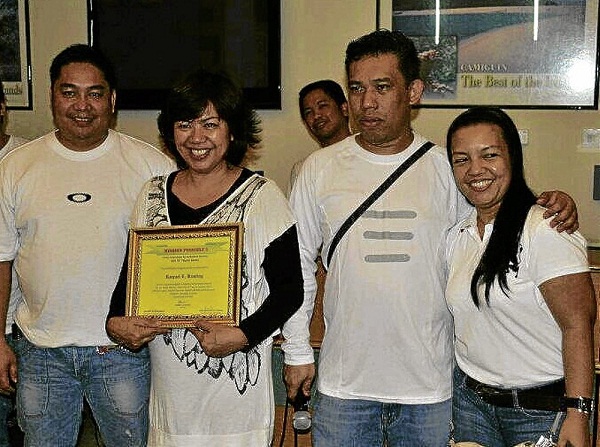
BADGE OF SERVICE From left: Robert, a staffer of the
Philippine Overseas Labor Office with Hazel Margarita Parado and Geoffrey during
ceremonies last October recognizing outstanding OFWs
Aside from giving first aid and transporting victims to hospitals, DCAS also
has big mobile intensive care ambulances.
What they call “Mama units” are ambulances exclusively for emergencies
involving a female patients, mostly obstetric or childbirth emergencies.
World’s biggest ambulance
Dubai, by the way, holds the Guinness record for having the largest ambulance
in the world. The rich kingdom acquired in 2009 three Mercedes Benz Citaro
bus-clinics comprising an operating theater, three intensive care units and
eight immediate care units. Two of the clinic-
buses have a length of 12 meters while another is 18 meters long. They are
available for rapid medical assistance, particularly in the event of major
emergencies with a large number of injury victims. The DCAS has also licensed
private air ambulances, also equipped with intensive care units.
Joining DCAS
Geoffrey, from Abra de Ilog, Occidental Mindoro, has been working with the
ambulance service for five years now. In the Philippines, he had gained
experience in rescue operations as a Red Cross nurse and a member of the UP
Mountaineering Society.
“My work is very similar to paramedics in the TV series 911. I am under the
ambulance operation department of DCAS. My office is my ambulance rig. An
ambulance in Dubai is manned by two nurses and a driver,” explains Geoffrey.
He says weather conditions in the Middle East also make their work
challenging.
“Can you imagine responding to a car accident under direct sun of almost 50
degrees Celsius? I have to carry a 20-kilo kit, kneel on concrete hot pavements
and lift patients that are sometimes double my weight,” says Geoffrey.
Challenges at work
Hazel Margarita, who takes the calls, has been working six years as an
emergency medical dispatcher. She immediately guides callers on first aid steps
while locating and dispatching the nearest available ambulance.
Margarita’s job requires her to have knowledge of the Arabic language as well
as familiarity with the streets and landmarks in Dubai to be able to guide the
ambulances to the caller’s location.
A nurse needs to be able to imagine or picture the situation and guide the
caller through initial first aid steps while he or she waits for the ambulance.
Confidence, patience and better judgment are needed in this kind of work,
sums up Hazel Margarita.
Staying cool
The Filipino sense of humor and natural adaptation to any environment make
them stand out among others, believes Hazel Margarita.
“We are hard working. In spite of the difficulties of any emergency
situations, we show coolness and manage to smile and laugh,” she asserts.
Geoffrey, for one, is more than just an ambulance nurse. He has organized a
mission for distressed OFWs housed at the Philippine labor office in Dubai. The
project is implemented in coordination with Migrante Dubai, a private
organization for the protection of Filipino migrants.
Geoffrey has also initiated humanitarian activities like the packing of goods
for relief in troubled areas in Gaza and Pakistan. He was endorsed by the
operations manager of DCAS to the Dubai Red Crescent where he has become one of
its few Filipino volunteers.
“Wherever we are, we love what we are doing. We are always motivated, not
only by financial gain, but even more by our commitment to service to others,”
adds Robert.