Showing posts with label economy. Show all posts

Saturday, December 19, 2020

The PH world rank in financial promo

Philippines ranks 2nd in Asia, 8th worldwide for financial inclusion promotion

By TED CORDERO
GMA News
December 18, 2020

The Philippines remains among the top leaders in financial inclusion, according to the 2020 Global Microscope on Financial Inclusion of the Economist Intelligence Unit (EIU), the research arm of The Economist Group.

The country ranks second in Asia, next to India; and eight worldwide, tied with Brazil, in the EIU study, which assessed the financial inclusion environment in 55 countries.

The EIU study rated countries across five dimensions, namely Government and Policy; Stability and Integrity; Products and Outlets; Consumer Protection; and Infrastructure.

Together with Thailand and Russia, the Philippines posted the highest improvement in Asia and Eastern Europe, in view of the government’s push to promote digital channels as part of its responses to the COVID-19 pandemic, according to the study.

The Philippines got a perfect score of 100 points in Products and Outlets dimension, which covers Bangko Sentral ng Pilipinas (BSP) regulations on e-money, simplified accounts like the Basic Deposit Account (BDA), and financial outlets such as cash agents.

Focusing on the role of financial inclusion in the COVID-19 response, the EIU study recognized the initiatives of the Philippines to mitigate the adverse economic impact of the pandemic.

The report cited the regulatory relief measures of the BSP to ease liquidity constraints in the financial system, restore business confidence, and sustain the flow of credit amid the unprecedented health crisis.

These include the temporary relaxation of compliance to reporting requirements, easier access to rediscounting facility, and waiver of licensing fees and charges for financial institutions setting up their electronic payment and financial services.

It also cited the initiative of financial service providers to suspend fees for electronic fund transfers during the community quarantine period.

In addition, the EIU report highlighted measures to promote MSME financing such as allowing banks to include loans granted to MSMEs as alternative compliance with reserve requirements, reducing the credit risk weight of MSME loans that are current in status to 50% from 75%, and reducing the minimum liquidity ratio (MLR) for stand-alone thrift banks, rural banks and cooperative banks to 16% from 20% until end-December 2020.

While the Philippines scored lowest in the Infrastructure dimension with 69 points, there is noted improvement from last year’s level owing to ongoing initiatives on digital connectivity, digital identification, and digital payments infrastructure.

The report emphasized the importance of digital infrastructure that includes access to identification, mobile phones, and financial accounts to facilitate efficient delivery of cash assistance to vulnerable segments.

It also noted that better data integration is needed for proper targeting of cash aid program beneficiaries.

The Global Microscope is an annual cross-country assessment of the enabling environment for financial inclusion. Since 2009, the Philippines consistently belongs to the top-ranked countries in terms of having a supportive framework for inclusive finance.

Latin American countries namely Colombia, Peru, Uruguay, Argentina, and Mexico dominated the top five spots of 2020 Global Microscope. —KBK, GMA News

Monday, November 25, 2019

...the PH economic gain with China

Philippines reaping economic benefits from harmonious ties with China: Finance Chief

Xinhuanet.com
25 November 2019
MANILA, Nov. 25 (Xinhua) -- Philippine Finance Secretary Carlos Dominguez has said that the 
Philippines is reaping the benefits from building a harmonious relationship with China, reiterating 
the Philippines' full support for China's Belt and Road Initiative (BRI).
In a finance forum held in Guangzhou, China over the weekend, Dominguez pointed out that as a 
result of this warming of relations between the two countries on President Rodrigo Duterte's 
watch, China has become the Philippines' biggest trading partner and one of the largest 
tourism markets.
Since 2016, he said, the Philippines' total trade with China increased at an average of 15 percent 
annually. Last year, the total trade with China reached 52 billion U.S. dollars, which was 15 
percent higher than the 2017 level.
Chinese tourist arrivals in the Philippines, meanwhile, grew at an average of 27 percent per 
year since the start of the Duterte administration, he added. "It reached 1.63 million arrivals in 
2018, or 23 percent higher than the visits recorded in 2017."
Moreover, he said the Philippines obtained the best terms - a very tight spread of 32 basis points 
over  the benchmark - for its maiden and subsequent "Panda" bond issuances in the Chinese 
market.
The China Lianhe Credit Rating also rated the Philippines' Panda bond issuances as Triple A, 
which is its highest rating, he said.
"The synergy created by closer Philippines-China economic cooperation is true for all the rest 
of the region. This is the reason we see even closer economic integration between China and
 the ASEAN economies," Dominguez said.
During the forum, Dominguez reiterated the Philippines' full support for China's Belt and Road 
Initiative (BRI), which, he said, will open the vast economic potentials of all countries in the region.
"Improved infrastructure will enhance trade among our economies. Enhanced trade will encourage 
more efficient investment flows. Improved connectivity will enhance the inclusiveness of our 
growth patterns. We have everything to gain from this."
Dominguez noted that the Philippines also has its version of the BRI dubbed the 
"Build, Build, Build" program, which involves 100 highly strategic infrastructure projects as 
well as thousands of infrastructure and logistics improvements all over the country.
This infrastructure modernization strategy, aimed at lowering the Philippines' poverty incidence 
from 27.6 percent in the first half of 2015 to just 14 percent by 2022, will lower the costs of 
moving people and goods, bring remote communities closer to the economic mainstream, and 
"create numerous  investment opportunities that will unleash the latent strengths of our economy," 
he said.
"We are relying on this program to induce internally generated growth that will enable us to 
expand despite a challenging global environment brought about by protectionist policies 
in the West," Dominguez said.

...the future of ASEAN

South Korea's Moon says the Philippines is 'future of Asean'


Pathricia Ann Roxas
Inquirer.net
25 November 2019

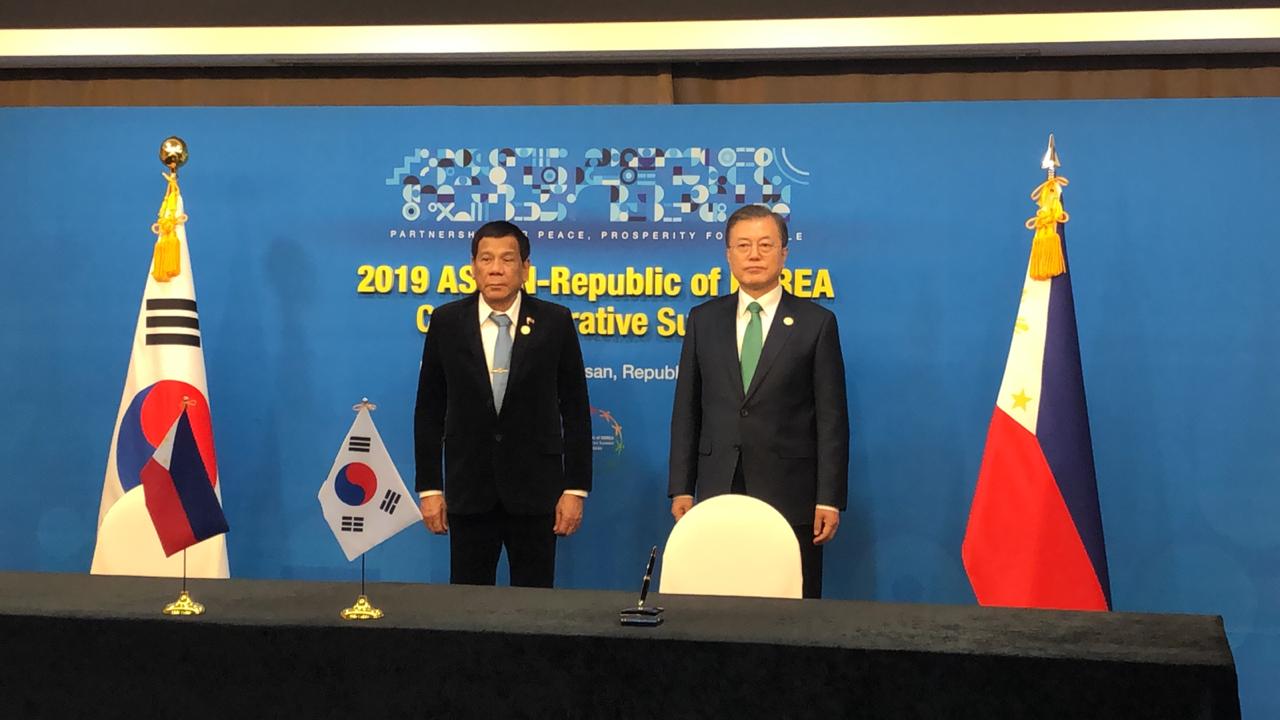
BUSAN, South Korea — South Korean President Moon Jae-in has described the Philippines as “the future of Asean” as President Rodrigo Duterte met him in a bilateral meeting here Monday.


South Korea's Moon says Philippines is ‘future of Asean’

“The Philippines is the future of Asean as it continues to achieve an impressive growth rate of 6 percent each year thanks to your outstanding leadership,” Moon said in his opening speech.

“Through our meeting today I hope to strengthen my friendship with you and extend our bilateral cooperation to contribute further to the development of Asean,” he added.


For his part, Duterte expressed gratitude to the Korean government for their 70 years of cooperation in various areas like trade, industry, agriculture, infrastructure, and technology.


Duterte said the two nations “took diverging paths and fortunes,” with South Korea rising “as one of Asia’s economic and technological powerhouse.”


“Ours faltered, but with perseverance, the Philippines has since recovered and is now an emerging economy,” Duterte said.


He further noted that South Korea was the Philippines’ 4th largest trading partner in 2018 as well as a major source of foreign and direct investments.


“I assure you that the Philippines will find common cause and purpose with the Republic of Korea towards enhancing our bilateral engagement and promoting peace and stability in your region,” Duterte promised.


This bilateral meeting is anticipated to result in the two leaders’ signing of agreements on education, tourism, social security, and fisheries.

Edited by KGA

Friday, November 22, 2019

...the top foreign investment destination

Philippines a top foreign investment destination  with 613% surge in approved investments

PR  Newswire Asia
22 November 2019

BOI Figures Show +600% Rise by September 2019 with South Korea Topping Foreign Investments from East Asia

MANILA, Philippines, Nov. 22, 2019 /PRNewswire/ -- New data has unveiled a surge in BOI approved foreign investments which are expected to flow into the Philippines over the next 2-3 years.

These initiatives have made the Philippines a top investment destination, largely attributable to its continuing digital transformation and combined information and communications technology (ICT) and infrastructure efforts.

Skyline of Makati City, Manila, Philippines, Asia

Approved foreign investments by the end of September 2019 reached USD4.7 billion, a 613% rise from USD659 million in the same period in 2018, BOI figures show. Investment approvals as of September 2019 totaled USD15 billion, a 105% jump from USD7.31 billion in the same period of the previous year. 

The tourism sector also continues to rise with USD186.3 million worth of hotel and accommodation projects, while manufacturing is seeing consistent growth of USD1.24 billion of approvals, a 190% increase on last year. 

Trade and Industry Secretary and BOI chairman Ramon M. Lopez applauded the results, commenting: "This data shows that big-ticket projects are now rolling in, proving the strength and resilience of the Philippines economy in attracting foreign investors despite the global slowdown. 

"The results are a testament to the Philippines as a great place for foreign investment where business can thrive."

Explore investment opportunities in the Philippines

Investors can explore business opportunities in the Philippines at Invest ASEAN 2019 in Busan, South Korea on November 25-26 where the BOI will represent the country considered by the US News and World Report in 2018 as the best to invest in.

At this event, BOI will showcase opportunities in specific priority sectors: manufacturing, specifically electric vehicle and auto parts; infrastructure and construction; and tourism

"This growth, together with a suite of incentives such as tax holidays and exemptions from duties on imported spare parts makes the Philippines an enviable investment destination and one-stop-shop for business within Asia and beyond," added Lopez. 

Friday, November 8, 2019

..the Philippine FDI 2019

Investments in Philippines double up in January -September 2019, hitting 15.14 bln dollars

Xinhuanet.com
08 November 2019

MANILA, Nov. 8 (Xinhua) -- The Philippine Board of Investments (BOI) said on Friday it has recorded cumulative investments worth 764.7 billion pesos (roughly 15.14 U.S. dollars) as of September 2019, a 105 percent increase from 327.9 billion pesos (roughly 6.50 billion U.S. dollars) approved in the same period of 2018.

"The sustained high growth of investments is a proof of the business sector's strong confidence in both the Philippines' economic fundamentals as further shown by the acceleration of the third-quarter gross domestic product (GDP) growth to 6.2 percent and the reform agenda of President Rodrigo Duterte," Philippine Trade Secretary and BOI Chairman Ramon Lopez said.

The BOI said approved investments from domestic sources topped 524.9 billion pesos (10.40 billion U.S. dollars), a 54.7 percent increase from 339.3 billion pesos (roughly 6.7 billion U.S. dollars) in the same period in 2018.

On the other hand, the BOI said approved projects by foreign investors amounted to 239.9 billion pesos (roughly 4.8 billion U.S. dollars) or 613 percent increase from just 33.6 billion pesos (roughly 665.7 million U.S. dollars) a year ago.

According to the BOI, Singapore continues to set the pace among all foreign entities with 170 billion pesos (roughly 3.37 billion U.S. dollars) in the capital. It added that South Korea is now second with 34.1 billion pesos (roughly 675.62 million U.S. dollars), while The Netherlands places third with 9.2 billion pesos (roughly 182.3 million U.S. dollars).

According to the BOI, all projects once operational will generate employment of 41,862, which is 38.5 percent higher than last year's figure of 30,218.

"We are particularly pleased to highlight that the share of foreign investments in BOI projects have increased from just eight percent during January to September 2018, to already 31.4 percent this year," Lopez added.

This is expected to continue as Lopez noted that Duterte's policy of furthering relations with non-traditional partners has been yielding results.

Philippine Trade Undersecretary and BOI Managing Head Ceferino Rodolfo said investments from the information and communications technology (ICT) and power sectors accounted for 85 percent of the total figure or 652.9 billion pesos (roughly 12.94 billion U.S. dollars).

"This massive infrastructure buildup for more power and connectivity across the archipelago is critical towards addressing binding constraints to the Philippines' competitiveness," he added.

Thursday, November 7, 2019

...the PH GDP growth in Q3 2019

Philippine growth accelerates on public spending and rate cuts

But 6.2% expansion in Q3 means year-end pick up needed to hit 2019 growth target

MANILA -- The Philippine economy grew 6.2% in the third quarter, as government spending and lower interest rates contributed to a recovery from weak expansions in the first half of the year.


The expansion was faster than the median forecast in a Reuters survey of economists of 6%, and up from the previous quarter's pace of 5.5%. The data released Thursday puts growth for the first nine months of 2019 at 5.8% -- still below the government's 6%-7% target.

The data is a boost to the administration of President Rodrigo Duterte, as it seeks to safeguard the domestic economy from the impact of the U.S. -China trade war, which has dented the growth of other Southeast Asian countries. Indonesia, the largest economy in the region, announced a 5.02% expansion earlier this week.

Government spending, which jumped 9.6% was a big factor in the acceleration. President Rodrigo Duterte's 2019 budget was not signed until mid-April after congressional wrangling over pork barrel funds delayed its passage. This forced the government to operate based on the 2018 budget, crimping state spending by nearly 1 billion pesos (around $20 million) a day, according to Finance Secretary Carlos Dominguez.

On the supply side, services rose 6.9%, the industrial sector climbed 5.6%, while agriculture improved 3.1% despite an outbreak of African swine fever that killed tens of thousands of pigs.
The economy must grow 6.7% in the fourth quarter to achieve the full-year growth target. 

Socioeconomic Planning Secretary Ernesto Pernia said Thursday this was "very achievable."

"We have seen the economy surging and the momentum will continue for us to reach that," Pernia told reporters in Manila.

The Philippine economy historically sees faster growth in the final quarter, as remittances from 10 million overseas Filipino workers help power a Christmas spending splurge.

Yet, Pernia said external factors could imperil growth. "The trade war between the U.S. and China is the biggest threat not only to the Philippines, but to the whole global economy," he said.

The Philippine central bank has cut the benchmark interest rate by a total of 75 basis points to 4.0% this year amid stabilizing inflation. The central bank also reduced reserve requirements for banks by 400 basis points to 14% in an attempt to pump money into the financial system.

Central bank Benjamin Diokno has signaled that the monetary easing has ended, ahead of the next policy meeting on Nov. 14.

Asked to react to Diokno's stance, Finance Secretary Dominguez, who is also a member of the monetary board, said on Monday that rate cuts were "sufficient" and they "will do the job" for now.

Monday, November 4, 2019

...the Japanese innovation investment in PH

Japanese firms to invest $215 million in Philippine innovation projects

Business Mirror
04 November 2019


Japanese firms are investing $215 million in new projects and expansions in the Philippines, as they seek to take advantage of the growing innovation environment here.

On the sidelines of a business forum in Tokyo, Trade Undersecretary Rafaelita M. Aldaba met with Japanese manufacturers to pitch investment opportunities in the Philippines. A total of $215 million worth of projects, most of which related to innovation, were secured during these meetings.

The projects include the opening of the first MOS Burger, Japan’s second-largest burger joint, by March of next year, and the interest of Assemblepoint to develop smart four-wheel electric vehicle using latest Internet of Things technologies.

Also, Satelight is eyeing to outsource animation work from the Philippines, while Kanepackage is planning to build a new factory. Further, Sumitomo Wiring presented during the meetings its expansion projects on wiring harness and components production.
Marubeni Corp. also shared its joint-venture project with two local firms to put up 30 primary care clinics and 10 cancer centers, as well as install five centralized laboratory testing hubs in strategic urban areas.

“There are many potential opportunities for the Philippines and Japan to deepen trade and investment partnership through innovation. I am delighted that the companies I met during this trip are making significant contributions in the areas of creating new industries, products and leapfrogging to Industry 4.0 by adopting smart manufacturing to transform our industries,” Aldaba said in a news statement issued on Monday.

Aside from those who committed to invest, there were investment intentions in infrastructure development, railways, electric vehicle public transport system, retail, manufacturing, logistics, warehousing, factory automation, construction and real estate.

Last week Aldaba presented the government’s Inclusive Innovation Industrial Strategy to over 600 Japanese investors at the Philippine-Japan Business Investment Forum organized by the Nikkei Business Publications Inc. Aldaba discussed the areas where Manila and Tokyo can collaborate under the i3s, which is geared toward improving the manufacturing, agriculture and services sectors of the country.

“In the context of these trade and investment trends between the Philippines and Japan, along with global developments, such as the entry of new technologies, we feel the need to focus our efforts on innovation to address the opportunities and challenges arising from Industry 4.0, but also from increasing global competition, United States-China trade war and regional economic integration,” Aldaba added.
Last year Japan is the country’s third-largest foreign source of investments. Based on records from the Philippine Statistics Authority, Japanese investments in 2018 declined 38.33 percent to P19.72 billion, from P31.98 billion in 2017.

Friday, October 25, 2019

...the Hunger status

Hunger in Pinoy families lowest in 15 years — SWS 


Janvic Mateo
Philippine Star
25 October 2019


MANILA, Philippines — The number of Filipino families who said they have experienced hunger at least once in the past three months dropped to its lowest in the past 15 years, according to the third quarter survey conducted by Social Weather Stations (SWS).


The survey, conducted from Sept. 27 to 30 with the results released Wednesday, showed 9.1 percent of the 1,800 adult respondents said their families have experienced involuntary hunger due to lack of food to eat.

This translates to an estimated 2.3 million families, the lowest since the 7.4 percent hunger rate obtained in a similar survey conducted in March 2004.

The SWS said the drop in hunger rate was due to decreasing number of families who experienced moderate hunger, or those who experienced involuntary hunger only once or a few times in the last three months.

Moderate hunger fell from 8.7 percent in June to 7.4 percent in September, also the lowest in 15 years.

Meanwhile, the number of people who said their families experienced severe hunger – or those who experienced it often or always – in the past three months have slightly increased from 1.3 percent to 1.7 percent.

Based on the survey, the hunger rate fell among those who classify their families as poor, from 16.2 percent in June to 14 percent in September.

Meanwhile, the number of families who do not consider themselves as poor but have experienced hunger increased from 4.9 percent to 5.6 percent.

By geographic location, the number of families who experienced hunger in Metro Manila and the rest of Luzon went down, from 15.7 percent to 8.3 percent and from 9.3 percent to 8.1 percent, respectively.

Meanwhile, it went up in Mindanao, from nine percent in June to 11.9 percent in September. It remained unchanged among respondents from the Visayas at 8.7 percent.

The country’s hunger rate has spiked to over 20 percent several times during the term of former presidents Gloria Macapagal Arroyo and Benigno Aquino III.

It reached the record-high 23.8 percent in 2012, before going down towards the end of the previous administration.

The hunger rate has stayed relatively low during the present administration, with its highest at 15.9 percent in December 2017.

The latest survey has 1,800 respondents and an error margin of +/- 2.3 percent for national percentages.

Thursday, October 24, 2019

...the PH economic optimism

Optimism amid dark global economic clouds highest in PH, says think tank


Daxim L. Lucas
INQUIRER.NET
24 October 2019


Global uncertainty may be on the rise but Philippine companies have kept an optimistic outlook on the domestic economy, according to a recent business survey by accounting and consulting firm Grant Thornton International.


In the Asia-Pacific region, emerging markets including the Philippines are holding up well, Grant Thornton’s International Business Report said.

Related image


The report was based on a quarterly global survey of nearly 5,000 mid-market companies in over 30 countries interviewed in May and June this year.


Data on the first half of 2019 showed that optimism, revenue expectations, and profitability forecasts were down in economies around the globe compared with second-half 2018 data, “with most of the main measures of growth at levels not seen since 2016,” the report said.

Yet pockets of resilience were seen across mid-sized companies, such as in export expectations, which are expected to fare well globally amid the threat of a US-China trade war.

The outlook continued to vary between emerging and developed economies in the Asia-Pacific, reflecting varying levels of exposure to the trade war. Optimism was generally down in the region, falling 8 percentage points since the second half of 2019 and more than 50 percent lower than the first half of 2018.

Less developed economies like the Philippines, however, had rosier prospects. Philippine businesses were more upbeat than anywhere else in the region, with 84 percent of those polled being optimistic about the domestic economy.

Expectations for revenue and profit growth in the ASEAN mid-market, too, rose and were now among the highest globally.

“It’s important to heed the signs of volatility and uncertainty in global financial markets, but it’s also worth highlighting that local business leaders choose not to be paralyzed or get sidetracked by the grim possibilities,” P&A Grant Thornton chair and CEO Maria Victoria Espano said.

She also cited bigger capital spending, especially by the government, and the steady flow of remittances from overseas Filipino workers that continued to boost overall economic growth and optimism.

In September, a slowdown in the global economy and domestic investment prompted the Asian Development Bank to offer a slightly lower economic growth forecast for the Philippines.

In an update of its flagship annual economic publication, the ADB changed its forecast for the country’s gross domestic product growth to 6 percent in 2019 and 6.2 percent in 2020, against earlier forecast of 6.4 percent for both years. The International Monetary Fund has a slightly lower projection of 5.7 percent GDP in 2019, 6.2 percent in 2020, and 6.5 percent by 2024. The World Bank’s updated projection for 2019 is at 5.8 percent GDP growth.

Investor sentiment in the country was generally positive paired with a pickup in business confidence, as reflected in the Bangko Sentral ng Pilipinas’ third-quarter consumer expectations survey./TSB