Showing posts with label Filipino spirit. Show all posts

Wednesday, August 28, 2019

...the top travel pick

10 Reasons Why The Philippines Needs To Be TOP Of Your Travel Bucket List


Eadaoin Fitzmaurice
lovin.ie
28 August 2019


Travelling comes in trends.


You see places come into fashion and similar age groups flocking to specific locations. You start at age 18 in Magaluf/Santa Ponsa/Aya Napa followed by a summer hopping across European countries on an interrailing trip. Next, you're probably heading to Thailand for a piss-up or on a J1 and before you know it, you and your moh are heading to either Canada or Australia for a year...

Sound about right? 

Well, let me tell you about the HOTTEST destination that I guarantee will be the place to be within the next year - The Philippines.


I'm just back from this stunning country and I've honestly never loved a place more. It's like walking into a Pinterest feed - white beaches, crystal blue waters, palm trees and coconut vendors aplenty.

Best of all, it's not bombarded with tourists - get over there before they flock!

Still not convinced?

Here are 10 reasons why you'd be thick not to put this on the TOP of your travel bucket list this year:

1. Filipinos Are The Friendliest People Ever


I have never met a friendlier bunch of people.

The Filipino people are so lovely, always smiling, laughing and having the craic. We had multiple tour guides and we loved each one even more than the last.

They're also really helpful, whenever we got lost they'd always cop it and ask if we needed assistance.


2. You Can Swim With Whale Sharks

During my trip, we travelled to Oslob in Cebu to swim with whale sharks; it was honestly one of the coolest things I've ever done.
The whale sharks were absolutely HUGE and they just swim about, not a bother to them, while we watched in awe from beside our boat.
There are strict rules in place – you can't touch them, wear sun cream in the water or use flash photography and there were marine biologists on-site to make sure the animals were cared for, which I liked.
We had to get up at 3am to do the tour as it gets booked up very quickly and they stop permitting tourists early in the day, so be prepared.
One of the best experiences I had during my trip, hands down.


3. The Beaches Are 10 Times Better Than Any Other In The World
Everyone that travels to The Philippines says that the beaches are the most beautiful they've ever seen and I couldn't agree more.
The whitest sand you can imagine and clear blue waters - it's proper dreamy.
My favourite beach we visited was Nacpan Beach, north of El Nido in Palawan - truly stunning.

4. There Are Over 7,000 Islands To Explore
You could travel this place 100 times and there would still be somewhere new to see. Best of all, they are all so different from one another.


We travelled between four different islands and every single one was completely unique; they all had their own cultures, language, traditions and delicacies.


5. It's Really Affordable


Sure, it's cheap as chips!

Meals will usually cost €3-4, no more than €6, and that'd be for a really fancy place. Hostels will cost you between 700-1000 pesos a night which is just under €20.

You also don't have to purchase a visa to visit which will save you some quid compared to other similar destinations.

The main expense is getting there and back!

6. It's Super Safe


I have to admit, I was a little nervous travelling so far across the world to this country with a completely different culture, but from the moment I stepped off the plane, I felt so safe.

Walking down the street at night was a breeze, we never felt threatened or at risk and the locals are so friendly that they were always there to help us if we had a problem.
I never heard of anyone we met along the way getting robbed or scammed or anything like that.


7. They Are Very Environmentally Conscious - Single-Use Plastic Is Banned


One thing I noticed while travelling was how environmentally conscious they were. All single-use plastic is banned in Palawan and many sites and beaches are protected.

On most tours and activities you are asked to pay an area conservation fee so that they can preserve and develop the land.

We went on one tour and they asked us to pick any rubbish we saw out of the ocean, thankfully we didn't see much but when there was, they jumped out of the boat to get it and dispose of it correctly.


8. A Bottle Of Rum Costs €1.50


We headed to the supermarket to pick up some rum and coke for a night out. Never in my life have I seen my rum being cheaper than my mixer.

The local rum will blow your head off as well - it's the best thing to drink while you party!


9. It's The Only Place In The World You'll See A Tasier Monkey
These tiny creatures can only be found in the islands of Bohol, Samar, Leyte, and Mindanao.
They are the cutest, tiniest monkeys I've ever seen!
I mean LOOK at them:


10. Karaoke... Everywhere
The Filipinos ADORE karoke.
You cannot walk down the street without hearing them singing, it's actually GAS. On our tours, they sang and made us sing too, and whenever we dined, the staff would be singing behind the bar.
There's even a singing restaurant in Manila where you can eat while watching a live performance.
Try one of the karoke bars in Manila, lots of fun!
Literally the best country in the world!

Tuesday, August 27, 2019

...the living heroes

Duterte: Every Filipino is a hero


Edith Regalado
Philippine Star
27 August 2019


DAVAO CITY, Philippines — President Duterte said there is no mistaking that every Filipino is a hero.

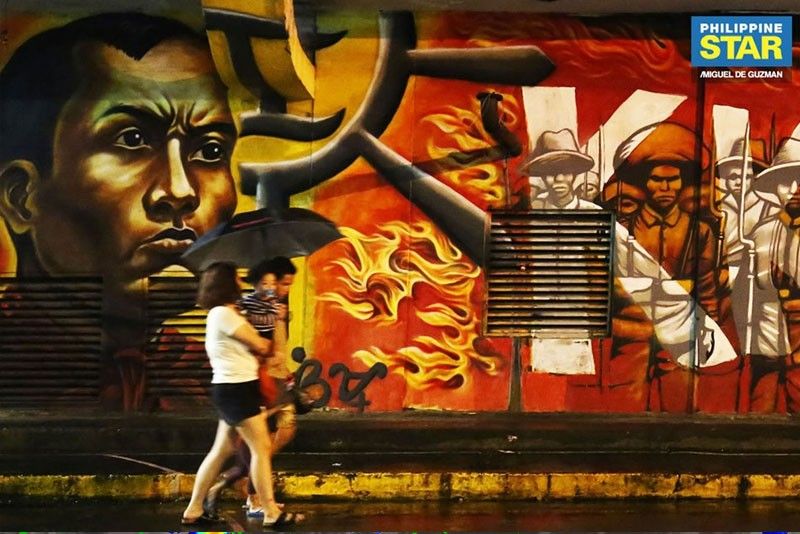
A family walks past a mural of hero and Katipunan founder Andres Bonifacio in Manila as the country celebrated National Heroes Day yesterday.

“I truly believe that every Filipino is a hero who can build on our vibrant legacy of fortitude and resilience,” the President said in his National Heroes Day statement yesterday.

Duterte called on Filipinos to reflect on the history and honor of those who sacrificed their lives and fought for the freedom and democratic ideals upon which the Philippines was founded.

“Let us make our forebears proud of our triumphs as a people by being everyday heroes who will reach out to those who are in need, especially to the ones neg-lected by society,” he said.

The President stressed that the collective sacrifice of the country’s forebears has made it possible for Filipinos to enjoy the blessings of liberty, and to continue strengthening the great nation they have left behind.


“We recognize their heroism not only by erection of statues in their honor but also by uplifting the welfare of the poor and marginalized for it is through our small deeds that their spirit of valor can live on,” he further said.

Citing the importance of solidarity in facing the future together, he encouraged everyone to “embody solidarity and sustain our momentum towards positive change not only for ourselves but for the succeeding generations as well.”

For her part, Vice President Leni Robredo stressed the importance of camaraderie, noting that no single leader could alone change the country for the better.

“Today, we remember the bravery of our heroes who sacrificed their lives for the freedom we enjoy now. Today, we remember not a single hero. Whether they were famous or not, have identities or not, we honor all those who made their contributions for the freedom of our country,” she said in Filipino.

She hopes the commemoration of National Heroes’ Day will serve as a reminder that no single hero can save the country from where it is now.

“The solutions to all our problems are not in the hands of one person and there’s no single leader that could give us a good life,” Robredo said.

“The Filipino is the hero of his fellow Filipino. You are the hero of your fellow countrymen and you have the power to make significant change on your country and on the life of other people,” she said.
Robredo also urged Filipinos to stand together for the country’s freedom, which their forefathers have died for. “In these times when we face threats against our democracy and sovereignty, let’s continue to stand firm for our freedom. It’s time for us to continue what they have started.”

Speaker Alan Peter Cayetano, who together with Vice Admiral Gaudencio Collado Jr., the Armed Forces of the Philippines vice chief of staff, led the wreath-laying ceremonies at the Tomb of the Unknown Soldier in the Libingan ng mga Bayani, urged Filipinos to “recommit ourselves to the choice to sacrifice and to love our country.”

“Their ultimate sacrifice will never be in vain. We, in our daily lives, learn to embody their courage in small deeds of heroism. And that will touch the lives of our countrymen, especially the poor and the marginalized,” Cayetano said in his speech.

He underscored that Philippine heroes are not limited to those who are honored in history, “but more so the overseas Filipino workers who have left their families in order to give their children a better future.”

AFP chief of staff Gen. Benjamin Madrigal Jr. also called on Filipinos to be heroes themselves by doing their part in serving and protecting the country and its people.

On Sunday, Philippine Army chief Lt. Gen. Macairog Alberto did his part in recognizing the living heroes by pinning the ranks and awards to soldiers who fought in battle and are still confined at the Army General Hospital.

Brig. Gen. Bernard Banac, spokesman for the Philippine National Police, said the country and the police force would never run out of heroes as he stressed that someone will always rise to the challenge to defend and protect.

It was a different take for Sen. Imee Marcos though as she asked if the holiday is not actually a misnomer.

“Here’s a historical fact that will shock most Filipinos. The reality is that, officially, we have no heroes. Little do most Filipinos know that ever since the Philippines gained independence, the government has never officially proclaimed who our national heroes really are even if it has been taught as early as grade school that the likes of Jose Rizal and Andres Bonifacio are among them,” she pointed out.

Marcos said that the Philippine National Heroes Committee officially recommended several people for the designation in 1995, including Jose Rizal, Andres Bonifacio, Emilio Aguinaldo, Apolinario Mabini, Marcelo H. del Pilar, Sultan Dipatuan Kudarat, Juan Luna, Melchora Aquino and Gabriela Silang.

However, the issue deteriorated into a debate involving regional interests and was never resolved. – With Helen Flores, Michael Punongbayan, Emmanuel Tupas, Cecille Suerte Felipe, Delon Porcalla, Rhodina Villanueva

Sunday, June 15, 2014

...the OFWs contribution in GCC

Why GCC would not be the same without Filipinos


By Dr Jasim Ali,
Special to Gulf News
First Published:  May 24, 2014
Gulf News
 
"Much to their credit, OFWS have made the first impression with respect to working habits and ethics.

They are admired for possessing traits of productivity, discipline, customer service, attention to detail, and ease of communicating in English, and presentable.

It is not unfair to claim that Filipinos have emerged as a factor in local economic activities in all GCC countries. And it can be asserted that quality of life in the GCC cannot be the same without the OFWs on the back of their significant presence in diverse sectors."   - Dr. Jasim Ali, Member of Parliament, Bahrain
 
 
The Gulf countries are home to the largest number of Overseas Filipino Workers (OFWs) and it’s an arrangement which benefits both sides. For instance, for the Philippines, the workers send home billions of dollars.
 
GCC airlines benefit from the traffic to the Philippines, with Emirates dominating the Manila route.
Fact is, a sizable number of Filipinos live and work abroad for economic reasons, with their number estimated at around 10.5 million and comprising around 11 per cent of the country’s total population. The stats include some 5 million permanently living abroad and about 1.5 million irregulars.
 
However, this piece focuses on OFWs, officially estimated at more than 2.2 million by end 2012, including some 0.45 million working on the high seas. Yet, thousands of Filipinos were exposed for overstaying their work permits following the implementation of the Nitaqat scheme in Saudi Arabia in July. The controversial project is meant to make Saudi nationals, rather than immigrant workers, employees of choice in the private sector.
Notably, five of the six Gulf countries are on the list of top 10 destinations for OFWs, an evidence of openness of the economies of the grouping.
 
Saudi Arabia continues to maintain its position as the top destination for OFWs, which has been the case since 2004, followed by the UAE. In 2012, Saudi Arabia and the UAE accounted for 20 and 16 per cent of OFWs, respectively. Qatar emerges in fourth popular place after Singapore in third position. Qatar alone boasts some 200,000 Filipinos.
 
Service workers
 
The increasing significance of Gulf countries for Filipinos partly reflects the changing composition of OFWs, with more emphasis placed on household services workers. Unlike the GCC, Western countries are known for applying relatively strict conditions on employment of live-in housemaids.
 
To a degree, the changing make up of OFWs is in response to difficulties surrounding employment in the Philippines. The challenges include an unemployment rate of 7 per cent, and under-employment of nearly 20 per cent. More than 40 per cent of the employed work in the informal sector.
 
The Philippines enticed some $24 billion (Dh88 billion) in remittances in 2012, the third highest worldwide after India and China, according to the World Bank. The amount represents around 10 per cent of the country’s gross domestic product (GDP). This sum is inclusive of money sent via financial institutions, cash carried by returning and visiting Filipinos and others in-kind.
 
The figure could be higher for the lifestyle of Filipinos, who are known to spend in the local economies. The habit of spending a considerable amount of their salaries in local markets adds to the attraction of having Filipinos in the GCC workforce.
 
Much to their credit, OFWS have made the first impression with respect to working habits and ethics.

They are admired for possessing traits of productivity, discipline, customer service, attention to detail, and ease of communicating in English, and presentable.
 
It is not unfair to claim that Filipinos have emerged as a factor in local economic activities in all GCC countries. And it can be asserted that quality of life in the GCC cannot be the same without the OFWs on the back of their significant presence in diverse sectors.
 
The writer is a Member of Parliament in Bahrain.

...the foreigners' new home

Why foreigners love calling Philippines home


06/13/2014
 
 
MANILA - It only took one random act of goodwill, a smile, and the positivity that Filipinos have to convince some foreigners that they have found a new home in the Philippines.

In a video uploaded online on Monday, a popular local fastfood chain sought to find out the answer to the question: "Bakit ang sarap maging Pilipino?"


Marcus Davis, an American singer, lauded Filipinos' spirit of volunteerism and reaching out "even if no one asked for it."

"When I arrived in the airport, I was a bit lost. Someone saw me and walked up to me and offered me to use their cellphone. While I was calling, he actually went and got me a drink," Davis said.

"I think that was one of my fondest memories because I've never showed up in a country and someone just walked up and offered to help you like that," he added.

Anna Rabstun-Baylosis, a Russian singer who now lives in the Philippines, said she finds her Filipino husband Erick very sweet, loving and caring.

"It's so personal here in the Philippines. There's no handshake, there's kissing and hugging. You really feel taken care of," she shared.

Bryan Gallinger, who volunteers for a local child welfare organization, said that he only had one thing in mind when he first arrived in the country -- business.

However, after "falling in love" with the positivity of the Filipinos, he decided to stay. "I can honestly say that I'm a better person by living here in the Philippines," he said.

As of writing, the video has already reached over 40,000 views on YouTube.

Most netizens who commented were touched by the glowing words the foreigners had for the Filipinos, but also took a chance to take a swipe at the current state of the country's government.


Friday, April 25, 2014

...the Filipino strength


Down but not out... the stoical people of storm-hit Philippines

When Typhoon Haiyan struck the Philippines six months ago the images shocked the world and inspired a huge international aid effort.
Award-winning Belfast photographer Matt Mackey visited the area with Concern Worldwide shortly after the islands were devastated.
His pictures are now part of a major exhibition in Belfast's Waterfront Hall, capturing the moving stories of individuals whose lives were forever changed by the storm.
"The idea was to show the people of Northern Ireland where their money goes when they support humanitarian organisations such as Concern through their emergency appeals," said Matt (right).
"It constantly evolves in front of you as you talk to local people and find out their personal stories. That's how the pictures develop."
Matt visited three islands on his trip, taking over 15,000 photographs. He also spent time in Concepcion, where Concern is based.
He then faced the difficult task of trying to choose just 24 for the exhibition entitled: Faces Of The Philippines: 7,000 Islands, 1 Typhoon, 4 Lives.
Concern is still helping those whose lives were ripped apart when the typhoon struck and has so far reached over 110,000 people.
Peter Anderson, Northern Ireland director of Concern, said the exhibition is a testament to the people of the Philippines, who showed incredible resilience and determination to rebuild their lives.

Monday, March 17, 2014

...the lone Asian football team

Pinoy football team is sole Asian team in Italy competition

03/17/2014
 
 
Deustfratres Boys Philippine football team in Italy.


ROME, Italy - The Deustfratres Boys Philippine football team made it to Italy's Presidential Football World Cup (Coppa del Presidente della Republica Italiana Mundialido 2014).

The Deustfratres Boys Philippine football team are training hard in Rome, in preparation for Italy's Presidential Football World Cup.

They will be up against 32 countries in the competition, so they are making sure they are prepared. The Presidential Football World Cup will be held from March 25 to June 9.

“Naghahanda po kami, nag-papraktis po kami. Inihahanda po talaga namin ang laro naming sa Mundialido sa March 25 so magandang tournament po ito," Ryan Mendoza, a member of the team, said.

“Kailangan naming talaga ng panahon para makapag-ensayo pero excited kami para po sa aming pamilya, sa ating bansa. Kaya sana po marami ang sumporta sa amin dahil kami ang unang mag-represent ng Pilipinas dito sa Italya," Manuel Paner, another player, said.

The Deustfratres Boys Philippine football team has won 10 games in various football matches in Italy.

Many believe that the team has a chance to win in the upcoming competition.

"Lagi akong naglalaro ng football, almost 30 years na dito sa Italya. Iba iyong laro ng mga Pilipino na dito na sila ipinanganak, mabilis, may technique at tsaka may grupo at kung ipagpapatuloy nila I think sa atin ang coppa ng Mundialido," Fr. Boni Lopez, a football player, said.

“Parang handa na sila at nakita ko talaga iyong abilidad nila kung paanu sila maglaro at iyong galing nila sa paglalaro ng soccer," Eloi Arancina, an OFW, said.

The Philippine embassy in Rome is supporting the Filipino youths in the competition.

“Iyong team lang po ng Deusftratres ang nakasali sa Asian po na kasali at nakakataba po ng puso na mga Pilipino ang mga representative po natin sa Mundialido na ito. Ako ay naniniwala na napakalaki ng tsansa nila na manalo sa World Cup," Consul Jarie Osias said.

The team is appealing for help in raising funds for their uniforms and other financial needs for the competition.

“Sana marami pang sumuporta katulad ng mga nasa gobyerno natin sa Pilipinas at sa mga local business, local communities para suportahan ang mga pangangailangan ng football player dito sa Italya. Hinihintay po naming kayo tulungan po ninyo kami," said Arnel Teves, chairman of the Deustfratres Boys Philippine football team.


Saturday, March 8, 2014

...the new Filipino

Indian by blood, Filipino at heart

Neelesh Sajnani
03/08/2014
MANILA, Philippines – It was the seventh of February 2014. A cheery morning greeted the Philippines as it was the last day of work and the warm weather was seeping into the city. While it was a routine day for most, it marked a formal and legal transition for me.
 
It had been a time-consuming process – the law required a number of legal documents, not to mention the number of offices that I was required to visit in different corners of Metro Manila. From medical tests and certification of documents in Manila, to application for various clearances in Makati, the effort was all worth it, however. 
 
 
I have been calling the Philippines home for the past 24 years. Maybe this isn't too novel for most expats, but this has nonetheless been a place where I and my family earned our daily bread and butter. We were given permanent residence visas back in the late '90s, but something just didn’t seem right. Parang may kulang.
 
Nationalism was a core discipline instilled in me at a very young age. From the classroom to the real world, I would always see the Philippine flag waving gloriously and how Filipinos would sing their national song with much glee. At times, I too would sing along with them.
 
This begs several questions: Is there something lacking in India that only the Philippines has? Would Filipinos even accept me despite the different name and background? How would my other family members based in India react?
 
JUST NATURALIZED. Neelesh Sajnani stands proudly with his family after his naturalization ceremony. JUST NATURALIZED. Neelesh Sajnani stands proudly with his family after his naturalization ceremony.
And then the one question that was worth thinking about: What can I contribute to this country? 
 
What's expected of a citizen
 
Unlike most countries, India does not allow dual citizenship but rather extends a lifelong visa for former nationals so they may visit the country for whatever purpose. And so I stayed with that arrangement.
 
As I entered college in the Philippines, the concepts of nationalism, patriotism, international relations, among others, were first introduced and further expounded by some well-rounded professors or even guest lecturers. They would sometimes end their lectures with: “Maraming salamat at mabuhay tayong lahat.”
 
Coupled with a number of factors, I started to feel distant from India though not culturally. I felt I could no longer contribute and live up to the expected standards of being a citizen. I was no longer immersed in India’s history, politics, and other socio-civil aspects.
 
Instead, my mind was filled with Filipino names and concepts, such as Dr Jose Rizal, El Filibusterismo, Sineskwela, Jollibee, Arroyo, Aquino, etc. I could express my thoughts and answers in straight Filipino.
 
It’s not that I never bothered to learn Hindi – India's national language. I was not ignorant of the different aspects of India either. I was simply more struck by and immersed in the Filipino culture.
 
It’s not every day that you'd hear a foreigner proudly declaring and getting excited over becoming a Filipino. For reasons beyond me, I also don't understand the lack of nationalism on the part of some Filipinos. One friend told me once, “Some Pinoys have lost faith in their own country and moved to different countries. It’s good you stayed.”
 
It’s a bitter pill to swallow – some may or may not agree – but it is what it is. One can argue about the better life out there, in another country with a flourishing economy, cleaner streets, and a better public transport system. But would you trade it all away so easily?
 
Hit the polls
 
Where will progress be without the bright minds and hardworking Filipino men and women? We aren’t known for giving up so easily – as shown by our reslience after Super Typhoon Yolanda.
 
Remember, our bayanihan spirit cannot and must not be easily extinguished. 
 
My heart and my beliefs are rooted in the Philippines. Nothing will ever change my mind and no other venue can replace my homeland.
 
The late Senator Benigno “Ninoy” Aquino Jr once said, “The Filipino is worth dying for.” Today, we’ve overcome a number of tribulations and we need to overcome future ones together.
 
I love the Philippines, and I’ve always called it my motherland. Pledging allegiance to the Philippine flag has always instilled pride in me and encouraged me to do more for this country – as one among equals. I believe in the Constitution of this country, in the strength of Philippine democracy, and in the bright future of the Filipino nation.
 
Come 2016, I will finally be eligible to vote – a first in my life. By that time, I would be 26 years old. For a kid who has been dealing with politics, specifically foreign policy and development studies, this will be a thirst finally quenched.
 
No other country has given me such happiness and financial stability. A lot of people complain – sometimes unjustly – about the country. Any country has its own flaws, and we must work as a nation to build and develop it. 
 
I proudly declare: I love the Philippines. You are indeed home. – Rappler.com
 
 
Neelesh Sajnani is Indian by blood, Filipino from birth and at heart, and now legally Filipino on paper. Neelesh received his consular and diplomatic affairs undergraduate degree from the College of Saint Benilde and is a political science graduate student at De La Salle University.