Showing posts with label Filipino identity. Show all posts

Tuesday, August 27, 2019

...the living heroes

Duterte: Every Filipino is a hero


Edith Regalado
Philippine Star
27 August 2019


DAVAO CITY, Philippines — President Duterte said there is no mistaking that every Filipino is a hero.

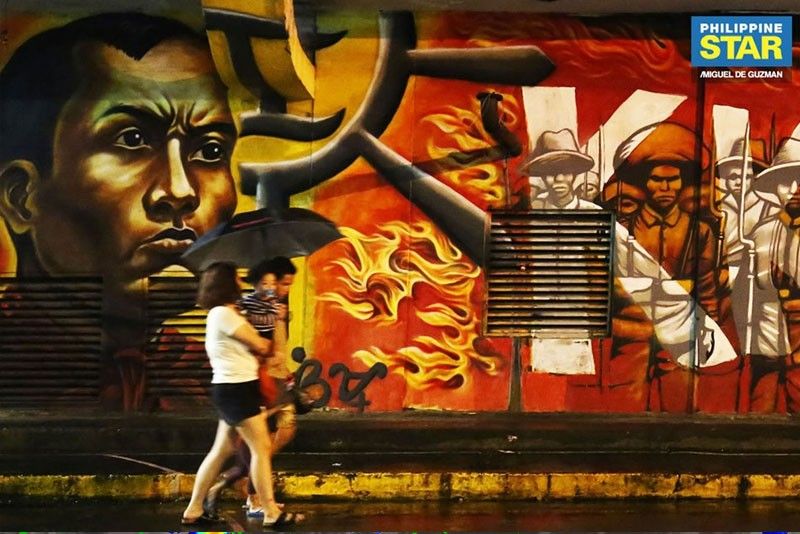
A family walks past a mural of hero and Katipunan founder Andres Bonifacio in Manila as the country celebrated National Heroes Day yesterday.

“I truly believe that every Filipino is a hero who can build on our vibrant legacy of fortitude and resilience,” the President said in his National Heroes Day statement yesterday.

Duterte called on Filipinos to reflect on the history and honor of those who sacrificed their lives and fought for the freedom and democratic ideals upon which the Philippines was founded.
“Let us make our forebears proud of our triumphs as a people by being everyday heroes who will reach out to those who are in need, especially to the ones neg-lected by society,” he said.

The President stressed that the collective sacrifice of the country’s forebears has made it possible for Filipinos to enjoy the blessings of liberty, and to continue strengthening the great nation they have left behind.


“We recognize their heroism not only by erection of statues in their honor but also by uplifting the welfare of the poor and marginalized for it is through our small deeds that their spirit of valor can live on,” he further said.

Citing the importance of solidarity in facing the future together, he encouraged everyone to “embody solidarity and sustain our momentum towards positive change not only for ourselves but for the succeeding generations as well.”

For her part, Vice President Leni Robredo stressed the importance of camaraderie, noting that no single leader could alone change the country for the better.

“Today, we remember the bravery of our heroes who sacrificed their lives for the freedom we enjoy now. Today, we remember not a single hero. Whether they were famous or not, have identities or not, we honor all those who made their contributions for the freedom of our country,” she said in Filipino.

She hopes the commemoration of National Heroes’ Day will serve as a reminder that no single hero can save the country from where it is now.

“The solutions to all our problems are not in the hands of one person and there’s no single leader that could give us a good life,” Robredo said.

“The Filipino is the hero of his fellow Filipino. You are the hero of your fellow countrymen and you have the power to make significant change on your country and on the life of other people,” she said.
Robredo also urged Filipinos to stand together for the country’s freedom, which their forefathers have died for. “In these times when we face threats against our democracy and sovereignty, let’s continue to stand firm for our freedom. It’s time for us to continue what they have started.”

Speaker Alan Peter Cayetano, who together with Vice Admiral Gaudencio Collado Jr., the Armed Forces of the Philippines vice chief of staff, led the wreath-laying ceremonies at the Tomb of the Unknown Soldier in the Libingan ng mga Bayani, urged Filipinos to “recommit ourselves to the choice to sacrifice and to love our country.”

“Their ultimate sacrifice will never be in vain. We, in our daily lives, learn to embody their courage in small deeds of heroism. And that will touch the lives of our countrymen, especially the poor and the marginalized,” Cayetano said in his speech.

He underscored that Philippine heroes are not limited to those who are honored in history, “but more so the overseas Filipino workers who have left their families in order to give their children a better future.”

AFP chief of staff Gen. Benjamin Madrigal Jr. also called on Filipinos to be heroes themselves by doing their part in serving and protecting the country and its people.

On Sunday, Philippine Army chief Lt. Gen. Macairog Alberto did his part in recognizing the living heroes by pinning the ranks and awards to soldiers who fought in battle and are still confined at the Army General Hospital.

Brig. Gen. Bernard Banac, spokesman for the Philippine National Police, said the country and the police force would never run out of heroes as he stressed that someone will always rise to the challenge to defend and protect.

It was a different take for Sen. Imee Marcos though as she asked if the holiday is not actually a misnomer.

“Here’s a historical fact that will shock most Filipinos. The reality is that, officially, we have no heroes. Little do most Filipinos know that ever since the Philippines gained independence, the government has never officially proclaimed who our national heroes really are even if it has been taught as early as grade school that the likes of Jose Rizal and Andres Bonifacio are among them,” she pointed out.

Marcos said that the Philippine National Heroes Committee officially recommended several people for the designation in 1995, including Jose Rizal, Andres Bonifacio, Emilio Aguinaldo, Apolinario Mabini, Marcelo H. del Pilar, Sultan Dipatuan Kudarat, Juan Luna, Melchora Aquino and Gabriela Silang.

However, the issue deteriorated into a debate involving regional interests and was never resolved. – With Helen Flores, Michael Punongbayan, Emmanuel Tupas, Cecille Suerte Felipe, Delon Porcalla, Rhodina Villanueva

Sunday, June 15, 2014

...the foreigners' new home

Why foreigners love calling Philippines home


06/13/2014
 
 
MANILA - It only took one random act of goodwill, a smile, and the positivity that Filipinos have to convince some foreigners that they have found a new home in the Philippines.

In a video uploaded online on Monday, a popular local fastfood chain sought to find out the answer to the question: "Bakit ang sarap maging Pilipino?"


Marcus Davis, an American singer, lauded Filipinos' spirit of volunteerism and reaching out "even if no one asked for it."

"When I arrived in the airport, I was a bit lost. Someone saw me and walked up to me and offered me to use their cellphone. While I was calling, he actually went and got me a drink," Davis said.

"I think that was one of my fondest memories because I've never showed up in a country and someone just walked up and offered to help you like that," he added.

Anna Rabstun-Baylosis, a Russian singer who now lives in the Philippines, said she finds her Filipino husband Erick very sweet, loving and caring.

"It's so personal here in the Philippines. There's no handshake, there's kissing and hugging. You really feel taken care of," she shared.

Bryan Gallinger, who volunteers for a local child welfare organization, said that he only had one thing in mind when he first arrived in the country -- business.

However, after "falling in love" with the positivity of the Filipinos, he decided to stay. "I can honestly say that I'm a better person by living here in the Philippines," he said.

As of writing, the video has already reached over 40,000 views on YouTube.

Most netizens who commented were touched by the glowing words the foreigners had for the Filipinos, but also took a chance to take a swipe at the current state of the country's government.


Saturday, March 8, 2014

...the new Filipino

Indian by blood, Filipino at heart

Neelesh Sajnani
03/08/2014
MANILA, Philippines – It was the seventh of February 2014. A cheery morning greeted the Philippines as it was the last day of work and the warm weather was seeping into the city. While it was a routine day for most, it marked a formal and legal transition for me.
 
It had been a time-consuming process – the law required a number of legal documents, not to mention the number of offices that I was required to visit in different corners of Metro Manila. From medical tests and certification of documents in Manila, to application for various clearances in Makati, the effort was all worth it, however. 
 
 
I have been calling the Philippines home for the past 24 years. Maybe this isn't too novel for most expats, but this has nonetheless been a place where I and my family earned our daily bread and butter. We were given permanent residence visas back in the late '90s, but something just didn’t seem right. Parang may kulang.
 
Nationalism was a core discipline instilled in me at a very young age. From the classroom to the real world, I would always see the Philippine flag waving gloriously and how Filipinos would sing their national song with much glee. At times, I too would sing along with them.
 
This begs several questions: Is there something lacking in India that only the Philippines has? Would Filipinos even accept me despite the different name and background? How would my other family members based in India react?
 
JUST NATURALIZED. Neelesh Sajnani stands proudly with his family after his naturalization ceremony. JUST NATURALIZED. Neelesh Sajnani stands proudly with his family after his naturalization ceremony.
And then the one question that was worth thinking about: What can I contribute to this country? 
 
What's expected of a citizen
 
Unlike most countries, India does not allow dual citizenship but rather extends a lifelong visa for former nationals so they may visit the country for whatever purpose. And so I stayed with that arrangement.
 
As I entered college in the Philippines, the concepts of nationalism, patriotism, international relations, among others, were first introduced and further expounded by some well-rounded professors or even guest lecturers. They would sometimes end their lectures with: “Maraming salamat at mabuhay tayong lahat.”
 
Coupled with a number of factors, I started to feel distant from India though not culturally. I felt I could no longer contribute and live up to the expected standards of being a citizen. I was no longer immersed in India’s history, politics, and other socio-civil aspects.
 
Instead, my mind was filled with Filipino names and concepts, such as Dr Jose Rizal, El Filibusterismo, Sineskwela, Jollibee, Arroyo, Aquino, etc. I could express my thoughts and answers in straight Filipino.
 
It’s not that I never bothered to learn Hindi – India's national language. I was not ignorant of the different aspects of India either. I was simply more struck by and immersed in the Filipino culture.
 
It’s not every day that you'd hear a foreigner proudly declaring and getting excited over becoming a Filipino. For reasons beyond me, I also don't understand the lack of nationalism on the part of some Filipinos. One friend told me once, “Some Pinoys have lost faith in their own country and moved to different countries. It’s good you stayed.”
 
It’s a bitter pill to swallow – some may or may not agree – but it is what it is. One can argue about the better life out there, in another country with a flourishing economy, cleaner streets, and a better public transport system. But would you trade it all away so easily?
 
Hit the polls
 
Where will progress be without the bright minds and hardworking Filipino men and women? We aren’t known for giving up so easily – as shown by our reslience after Super Typhoon Yolanda.
 
Remember, our bayanihan spirit cannot and must not be easily extinguished. 
 
My heart and my beliefs are rooted in the Philippines. Nothing will ever change my mind and no other venue can replace my homeland.
 
The late Senator Benigno “Ninoy” Aquino Jr once said, “The Filipino is worth dying for.” Today, we’ve overcome a number of tribulations and we need to overcome future ones together.
 
I love the Philippines, and I’ve always called it my motherland. Pledging allegiance to the Philippine flag has always instilled pride in me and encouraged me to do more for this country – as one among equals. I believe in the Constitution of this country, in the strength of Philippine democracy, and in the bright future of the Filipino nation.
 
Come 2016, I will finally be eligible to vote – a first in my life. By that time, I would be 26 years old. For a kid who has been dealing with politics, specifically foreign policy and development studies, this will be a thirst finally quenched.
 
No other country has given me such happiness and financial stability. A lot of people complain – sometimes unjustly – about the country. Any country has its own flaws, and we must work as a nation to build and develop it. 
 
I proudly declare: I love the Philippines. You are indeed home. – Rappler.com
 
 
Neelesh Sajnani is Indian by blood, Filipino from birth and at heart, and now legally Filipino on paper. Neelesh received his consular and diplomatic affairs undergraduate degree from the College of Saint Benilde and is a political science graduate student at De La Salle University.

Thursday, February 6, 2014

...the Filipino delicacy

Balut: The Filipino delicacy that makes the world squirm


By Justin Calderon, for CNN
February 6, 2014

The only thing left is the yolk. It can be scooped out with a spoon, but many Filipinos prefer to use their fingers. It's easily detached from the shell, veins and all. Some prefer to reverse these steps -- cracking the wider end of the shell to eat the yoke first -- saving the little duckling for last. The only thing left is the yolk. It can be scooped out with a spoon, but many Filipinos prefer to use their fingers. It's easily detached from the shell, veins and all. Some prefer to reverse these steps -- cracking the wider end of the shell to eat the yoke first -- saving the little duckling for last.
 
 
STORY HIGHLIGHTS
  • Balut, an 18-day-old fertilized duck egg, is a popular snack in the Philippines
  • Acceptance of balut depends on exposure at a young age
  • First time eaters are advised to not dwell on the textures
 
(CNN) -- Despite being an object of culinary fascination around the world, balut is no beauty queen.

The 18-day-old fertilized duck egg -- a snack widely eaten in the Philippines -- has revolted even the most daring foodies with its carnal textures, earning it lofty rankings on many a "most disgusting/strange/terrifying food" list.
 
While food journalists commonly label balut as the Philippines' "much loved delicacy," in reality Filipinos are decidedly split over their nation's oft-sung snack.
 
The science experiment you eat
 
Acceptance of balut often depends on exposure at a young age, much like Vegemite in Australia.
 
In an apparent attempt to preserve the delicacy's popularity among the country's rapidly modernizing and discriminating palates, some schools in the Philippines introduce balut to young students during science classes.
 
Students use balut to study the anatomy of birds, then eat the compressed bird beak, veins and developing wings within.
 
"Our teacher made us eat the egg so it wouldn't go to waste," says Manila resident Anna Vecin of her ordeal.
 
"And if we didn't eat it, we'd get a low score on that day's lesson. Of course, I had no choice but to eat it."
 
The experience can leave some with a lifelong aversion to the so-called national delicacy.
 
Even balut's tamer cousin, penoy -- an unfertilized duck egg billed as a less carnal option, given that it lacks the semi-developed chick within -- can be hard to stomach.
 
The yolk is easily detached from the shell, veins and all.
Taste over appearance
 
For others, balut's combination of savory soup, fresh meaty bird and warm yolk is a revelation.
"My dad had a duck farm once upon a time in Binangonan, Rizal, so at some point growing up, we had a lot of them at home," recalls Cheryl Tiu, a Manila-based writer.
 
"My mom's parents always enjoyed eating it, thus it got passed on to her and her siblings, and then down to us. My favorite part is the soup. And then I dip the yolk in rock salt.
 
"Today though, I'm not sure if I can eat the whole chick anymore, unlike when I was much younger."
 
The dish is particularly popular among Filipino families with ethnic Chinese backgrounds.
 
Balut is also widely enjoyed across numerous provinces in China, especially in the south.
 
Like many Chinese dishes, balut comes with a list of putative health benefits.
 
Among these, it's claimed balut can boost male fertility and libido.
 
Balut in New York
 
Can't make it to Manila?
 
Though balut is hard to find outside the Philippines, New York Filipino restaurant Maharlika offers the delicacy for $5 a pop.
 
The restaurant hosts an annual balut eating contest, held every August.
 
Last year's winner knocked back 27 balut in five minutes.
 
Think you can do better?


Wednesday, June 12, 2013

...the Filipiniana

Filipiniana fashion shines in New York show


A special exhibit featuring Philippine fashion has brought established and promising designers with Filipino roots in New York last week.

About 20 Filipiniana dresses were featured in the "Filipiniana Romance" exhibit, which was launched by the Philippine Consulate General and the Philippine Center in the Big Apple.

“What makes the exhibit doubly special is that the featured pieces are from private collections of members of the Filipino-American community in the U.S. Northeast,” the Department of Foreign Affairs (DFA) said in a statement.

“(It) speaks volumes about the great pride these women have in their cultural heritage,” it added.

Pitoy Moreno, Rene Salud, and Patis Tesoro were among the designers, who contributed their works for the city’s month-long celebration of Philippine independence from Spain.

Philippine national artists for fashion Leonard Co, Ben Farrales, Edgard Madamba, Cora Manimbo, and Elvira Reyes also created dresses for the exhibit.

Live models also worked the runway showcasing up-and-coming young Filipino designer Anna Purugganan’s modern take on the terno during the exhibit’s opening on June 5.

The pieces on display all have the common features of the basic Baro’t Saya, the Maria Clara design, and their more modern cousin, the Terno.

Only designer Alfonso Guino-o featured a one-of-a-kind ethnic costume the collection of April Talangbayan.

...the International Celebs on PH


8 International Celebrities Who Said Good Things About The Philippines
 
 
By Wincy Aquino Ong
8list.ph
 
 
The Philippines. It’s definitely not paradise. Dan Brown could be right on some points.
 
But despite the flak our nation has received from international media from time to time, there still must be something pleasant about our nation, right?

Yes, there are many bad and ugly things about The Philippines. But if one can see past a cartoonized Third World reputation, surely there is gold to be found here, to paraphrase the great Steven Seagal.

Read on, because for every naysayer out there, there’s one or two who genuinely enjoyed their stay here.

The Philippines. It’s definitely not paradise, but we’re sure as hell it’s not inferno either.


Quentin Tarantino | Director of Pulp Fiction and Kill Bill

  • "I've been wanting to come to the Philippines since I was a little boy, and to actually come here, actually have people know who I am and actually welcome me in this way...it's overwhelming. Absolutely overwhelming!
  • In 2007, film auteur Quentin Tarantino visited Manila for the Cinemanila International Film Festival. And guess what? Being a lifelong fan of grindhouse movies produced in our archipelago in the ‘70s, Tarantino had a blast riding the pedicab on his way to Malacañang to meet then-president Gloria Macapagal-Arroyo. He even wore a Barong Tagalog in the event’s ceremonies.


Mark Millar | Comic Book Writer of Wanted, Kick Ass and The Ultimates
 
“The Manila signing was the best signing I’ve done. I was amazed at the patience of the people queuing up to eight hours. What a lovely country and people!”


In 2012, Scottish comic book scribe Mark Millar visited for a fan signing of his book Supercrooks at Glorietta 5 in Makati. In a heartwarming and hilariously written blog entry about his visit, he waxes about how his jetlag disappeared upon witnessing the crowd of Filipino fans who cheered.


Neil Gaiman | Writer of Sandman and American Gods

"#itsmorefuninthephilippines hashtag is a true one. They applaud loudly and hug you a lot." 

The award-winning fantasy author Neil Gaiman has been to the Philippines numerous times to host his fiction-writing contest for Fully Booked. Greeted by his legion of fans during his many book signings, Gaiman has developed a love for the Filipinos and even cited the mananangal as his favorite Filipino mythological monster.

 
  •  
     

    Rachel Weisz | Actress

    “Palawan is more like the Emerald City. It’s like a fantasy. Maybe it’s real to you but to me, it looked like a fantasy place.”

    The Oscar-winning English actress visited the Philippines to shoot the third act of The Bourne Legacy in Manila and Navotas. It seems like she enjoyed the food here, like lumpia, adobo, and, yes, Soup Number 5. She also seemed to have a grand time in Palawan, comparing the island to the Emerald City.


    Zach Efron | Actor
     
    “We had lunch on top of a volcano!”
     
    In an interview with Ellen Degeneres, the High School Musical star and Penshoppe endorser raved about the wonders of our archipelago, when he toured Legazpi City. He even shared his experience about eating balut.
     
     
  •  
  •  
     
    Ernest Hemingway | Writer of The Old Man and The Sea
     
    On what makes a good novel: “It’s a good story if it is like The Manila Hotel
     
  • In 1941, one of America’s greatest novelists stayed for a long stopover as a war correspondent at The Manila Hotel. It seems that he liked the tropical clime of the city and enjoyed the gentle breeze from Manila Bay.
  •  
    • Johnny Depp | Actor

      “We landed in the Philippines on March 2, 1986. It was just days after Marcos had left the country and Corazon Aquino had taken power, and they were trying to figure out what to do with Imelda’s shoes. There were tanks in the streets. I’ve never seen anything like that in my life. All in all, it was, as I’ve said, an amazing experience.”
      The eccentric character actor’s first trip outside the United States of America was Manila for a shoot of Oliver Stone’s war drama Platoon. Coincidentally, it was also around the time of the 1986 EDSA Revolution, so Depp, who was bunkered in a hotel, witnessed the spectacle of nuns and civilians stopping tanks with roses and songs—a story he often tells during interviews.
     

    •  
    • David Pomeranz | Singer and Composer

      Need we say more? David Pomeranz has become so ubiquitous in our country that he practically lives here.


    Tuesday, April 16, 2013

    ...the UAE's New Pinoy Radio


    New Pinoy radio channel makes waves in the UAE


    The presenters on the Filipino radio station TAG 91.1 include, left to right, Louaaeeeeise da Costa, Joselito Bluebird Echivarria, Jonaphine 'Maria Maldita' Caraan and Nathalia Junbie 'Chikay' Cermino.
Courtesy TAG 91.1
     

    Music brings people together. And for the thousands of Filipinos living in the UAE, homegrown songs remind them of anything that is distinctly Pinoy – from the jeepney (passenger vehicle) to halo-halo (shaved-ice dessert) to adobo (meat in a sauce of vinegar, soy sauce and garlic) – and the smiles of loved ones who are thousands of miles away.

    And this is exactly what inspired the founding of the country’s first radio station that is devoted to the large and still-growing Filipino expatriate community.
     
    TAG 91.1 was the product of long and meticulous planning by the Arabian Radio Network (ARN) group, which was looking to tap into an enormous yet overlooked market in the country’s widely varied demographics.
     
    “ARN has spent more than two years conducting wide-ranging -research to determine the under-served communities,” explains Louise da Costa, one of the station’s stable of presenters.
     
    Brought over from Virgin Radio where she was dubbed the station’s “Filipina Queen”, da Costa joined the fledgling station to boost its young staff.
     
    The station has an all--Filipino team and the management made it a point to visit the Philippines to scout for the right talent to represent its new project.
     
    Studying Manila’s radio scene, ARN representatives zeroed in on the presenters from the country’s three leading stations. A Filipino music manager and a production manager were also hired.
     
    In hindsight, the station is a grand offshoot of the 10pm to 6am Filipino radio programme heard over the past five years on Dubai Eye 103.8.
     
    “Nearly 645,000 Filipinos live in the UAE and because of the strong demand, developing TAG 91.1 was a natural choice for ARN,” explains da Costa.
     
    The Filipino community has welcomed the new station and social networking sites are already spreading the news. In fact, TAG 91.1 had more than 5,000 visits on its website during its debut broadcast on March 25. “Hundreds of thousands of listeners have already interacted with this programme,” says da Costa. “It has 10,000 Facebook likes, a number that is increasing by the minute.”
     
    TAG 91.1 is also a multi-platform radio station: it broadcasts 24 hours a day, is online at www.tag911.ae, has dedicated iPhone, Android, Nokia and BlackBerry apps and a built-in player on all Samsung Smart -televisions.
     
    The station’s line-up includes music, celebrity gossip, games and news, all dished out in a distinctly Pinoy fashion.


    Wednesday, March 13, 2013

    ...the Pinoy resto at the Big Apple

    NY Times reviews balut, Pinoy restaurants


    03/13/2013
     
     
    "Kamayan Night" at Jeepney, a Filipino gastro pub in New York City. Photo from the restaurant's Facebook page


    MANILA, Philippines – The New York Times gave a review on the Filipino delicacy balut – and the writer seemed to like it.

    In another sign that Filipino food is continuing to make inroads abroad, the respected newspaper on Tuesday reviewed two Filipino restaurants in New York: Jeepney, which promotes itself as a “Filipino gastro pub” in the East Village; and Pig and Khao, whose chef, Leah Cohen, is half-Filipino and best known for being a contestant on TV’s “Top Chef.”

    “I felt as if I were poring over an album of carefully edited postcards from her travels,” the article’s author Pete Wells wrote about Cohen’s food. “Dinner at Jeepney, on the other hand, felt more like parachuting into Manila myself. I didn’t know all the vocabulary and didn’t always know what I was putting in my mouth, but I knew I had left home.”

    “I’ve grown fond of both places, but I would take different sets of friends to each,” Wells said.


    Sizzling sisig at Pig and Khao. Photo from the restaurant's Facebook page


    Among the dishes Wells tried at Pig and Khao is sizzling sisig, which he described as “a modern Filipino classic” and recommended to the Times readers along with the turon.

    He said those who try the sisig would “devour the chopped bits of pork — some crisp, some gelatinous, some meaty — seasoned with soy and slicked with the yolk of an egg cracked over the platter at the last minute.”

    Wells also showed that he knows Filipino food when he noted that Cohen’s adobo is not authentic, writing “the adobo in ‘crispy quail adobo’ was not a stewing liquid, as it might be in the Philippines, but a rich soy and garlic sauce tossed with deep-fried quail.”

    As for Jeepney, which is a sister restaurant of the well-praised Filipino restaurant Maharlika, Wells recommended the adobo wings, pinakbet salad, arroz caldo, bulalo, dinuguan and puto and pancit malabok negra.

    Bulalo at Jeepney. Photo from the restaurant's Facebook page

    Wells seemed particularly taken with the bulalo saying his friend would “pay $7 more for an extra marrow bone to supplement the impressive one that rides on top of a short-rib and vegetable soup called bulalo. They would mash the marrow with a fork into a lump of jasmine rice, then drink the deeply restorative broth from their bowls and ladle some into mine.”

    He described the dinuguan as “cubes of pork stewed in a fascinating chocolate-colored sauce of beef blood, bay leaves and vinegar.”

    And the balut, which is served at Jeepney?

    “The liquid on top tasted, yes, like chicken broth; the yolk was chalky; parts of the white were confusingly hard. As for the little embryo, it gave way to the spoon as easily as custard and tasted something like duck liver mixed with duck breast. If you didn’t grow up eating balut, it probably helps to stop thinking about the feathers,” Wells said.

    Wells gave both restaurants two stars each.


    ...the Filipino workforce

    Filipino labor is worth hiring – P-Noy


    MANILA, Philippines - President Aquino made a pitch for Filipino workers before potential investors yesterday, saying their creativity, dedication and loyalty are worth investing in.

    In a speech to keynote the Philippine Investment Forum 2013 at the Manila Peninsula in Makati City, the President cited the success of the business process outsourcing industry in which Filipinos have excelled and brought the country “to great heights in such a short time.”

    “Given the opportunity, they will do the same for you, whatever industry you may be involved in,” Aquino said.

    Aquino said the intrinsic characteristics of Filipino workers are what investors want from their work force.

    The President also called on investors to partner with the government in expanding their businesses in the country. He said the country is in a better position to offer more and meet their needs.

    He said potential investors could invest in agriculture, the source of income for some 12.1-million Filipinos; tourism, with the target 56-million tourist arrivals by 2016; and infrastructure, which is seen to support agriculture and tourism through the development of road networks, ports, and airports.
    “Whether in these three sectors or in others…we know that, here, hard work, innovation, and creativity are rewarded with success,” he said.

    The President said new investments would create thousands of jobs that will put food on the tables, send children to school and meet family expenses.

    “Together, we will be empowering them; giving them greater power to contribute to economic growth and opportunities to uplift their lives and even the lives of their fellow Filipinos,” Aquino said.

    The President also noted since he assumed office, he has been devoted to weeding out graft and corruption to level the playing field and “ensure that integrity, transparency, and accountability characterize our actions.”

    He cited efforts to reform the judiciary, streamline the process of setting up business in the country and ensure the strict implementation of bidding and procurement laws.

    “We are also investing heavily in our countrymen – empowering them to take stock of their lives and to realize their potential,” Aquino said.


    Tuesday, March 12, 2013

    ...the musical Filipinos

    Musical Talent of Filipinos – Making the World their Stage


    Bruno Mars

    It has long been known that Filipinos love to sing and that music is a part of life of almost every Filipino. Music is in their blood and Filipinos have an innate sense of rhythm. And they are well-versed in different music genres, wowing audiences wherever they perform. The musical talent of Filipinos is comparable to some of the best singers in the world.

    Several musical talents in the United States are of Filipino descent, which could surprise many since their names and their looks belie their ancestry.

    American musical talents of Filipino ancestry


    Enrique Iglesias


    Enrique Iglesias


    He is a very popular Spanish singer. He is the youngest son of an equally famous balladeer father, Julio Iglesias and Isabel Preysler, a magazine journalist and socialite from the Philippines. He started in theatre when he was still in preparatory school. Enrique does not speak Filipino but he is fluent in English and Spanish. He loved singing but did not want to be in the shadow of his famous father and used Enrique Martinez as his first stage name. He was taking a business course at the University of Miami before finally deciding to drop out of college to actively pursue a musical career.

    Bruno Mars


    Bruno Mars

    His real name is Peter Gene Hernandez, was raised in Hawaii by his half-Puerto Rican father, Peter Hernandez and Filipina mother, Bernadette San Pedro Bayot. The record producer, singer and songwriter had written, co-wrote, produced and sang several music hits. Top of mind are “Billionaire,” “Grenade” and “Just the Way You Are.” He’s had seven Grammy nominations, winning the Best Male Vocal Performance Award in 2011 for “Just the Way You Are.” In 2012 Bruno Mars won the award for Best International Male Solo Artist at the Brit Awards.

    Allan Pineda Lindo


    Apl.de.ap

    He is known popularly as apl.de.ap is a member of American band Black Eyed Peas. Pineda was born in Angeles City in the Philippines to a Filipina mother and an African American father. He was raised by his mother, Cristina Pineda. The Pearl S. Buck Foundation found him a sponsor, Joe Ben Hudgens, who adopted Pineda when he was 14. He later moved to the U.S. to live with Hudgens.

    Nicole Scherzinger


    Nicole Scherzinger

    She was born in Hawaii and raised in Kentucky. The front-woman of the Pussycat Dolls and its lead singer is of mixed ancestry. Her father, Alfonso Valiente is of Filipino descent while her mother, Rosemary Elikolani is of Russian and Hawaiian heritage. She took the last name of her German American stepfather who adopted her when she was only six years old.

    Neal McCoy


    Neal McCoy

    He is a country singer , whose full name is Hubert Neal McGaughey, Jr. He was born in Jacksonville, Texas. His mother is of Filipino American descent while his father is Irish American. He first made it to the Billboard Hot Country Songs chart in 1988, but his first single to hit the Top 40 was “Where Forever Begins” in 1992. In 1993 he had Number 1 singles back-to-back, “Wink” and “No Doubt About It.” He’s had commercial success since late in the 1990s, with his 2005 single, “Billy’s Got His Beer Googles On” reaching the Top 10 in the Billboard country music charts.

    Dustin Perfetto


    Dustin Perfetto

    He is a hip-hop artist, better known as Nump Trump. He has a Filipina mother. He has released quite a number of solo albums since 2006 and singles, including “I Gott Grapes.” He had worked with several artists including apl.de.ap (Black Eye Peas), DJ Shadow, MIA, DJ Qbert and E-40 among so many others. He is also a recording engineer and has worked with top acts like Iggy Pop, Smash Mouth, Green Day and Blackalicious.

    Dan Layus


    Augustana

    He is the lead singer and guitarist of Augustana, a San Diego, California band. The half-Filipino is the main songwriter of the group. They are the group behind the hits, “Sweet and Low” and “Boston.”

    Joe Bataan


    He is from the Spanish Harlem in New York, where he was born in 1942. He is of Filipino-African American descent. His real name is Bataan Nitollano. Bataan used to be a famous Latin soul singer, singing with his band, Joe Bataan and the Latin Swingers. His music was influenced by African American doo-wop and Latin boogaloo. He has released quite a number of singles and a few albums, with hits like “Gypsy Woman,” and “Riot.” His latest album “Call My Name” was released in 2005. One of his songs, “Subway Joe” is included in the soundtrack of the video game “Driver Parallel Lines.” He is the father of Asia Nitollano, a former singer with the Pussycat Dolls who has later embarked on a solo career.

    Kate Earl


    She is from Anchorage in Alaska. Her mother is Filipina and her father is of Dutch and Welsh descent. She’s released three albums so far. “Fate is the Hunter,” her debut album was released in 2005. It was followed by a self-titled album, “Kate Earl” in 2009 and “Stronger” in 2012.

    Richard Baluyut


    He is from Detroit. He is the guitarist and lead singer of the bands “Flower,” “Versus” and “Whysall Lane.” He composed the soundtrack for the 17-minute film, Midas’ Son in 2009. Richard co-owns Remora Records and produces singles for indie bands.

    Jessica Sanchez


    Jessica Sanchez

    She is of Mexican and Filipino blood. The young lady from California had been an aspiring singer since she was young, and started to sing when she was two years old. Prior to being a contestant in American Idol, she was a competitor in the reality TV show, “America’s Got Talent” in its first season. She was eleven years old at that time. A year earlier, she was runner-up to Jonathan Liberato on the TV Show, “Showtime at the Apollo.” She’s been invited by the San Diego Chargers to sing “The Star-Spangled Banner” twice, in 2008 and 2009.

    Sanchez auditioned for the 11th season of “American Idol” in 2011. For her first appearance on screen she sang an updated version of “It Doesn’t Matter Anymore” by Buddy Holly. Her voice is very much suited for ballads, and her renditions of songs by Whitney Houston, Billy Joel, Beyoncé, Aretha Franklin, Jazmine Sullivan and Alicia Keys earned her rave reviews from the judges and the media. However, she received the lowest vote on April 11 and the three judges were unanimous in using the “Judges’ Save” option to spare her from being ousted. She may have a very great voice, but later on in the competition, the judges reminded her that she needed to have an emotional connection with the song. At the finals, she emerged runner up to Phillip Phillips. Jessica Sanchez has signed up a recording contract with Interscope Records.

    Fil-Ams in American Idol


    In the TV show “American Idol” alone, the musical talent of Filipinos was shown with half-Filipinos who have tried their luck in the prestigious singing competition, starting from Season 1 (Brad Estrin) of the franchise. Only in Seasons 8 and 9 have there been no contestants of Filipino origin. Some of the well-known contestants were Jasmine Trias (Season 3), Ramiele Malubay (Season 7) and Thia Megia (Season 10).


    Monday, February 18, 2013

    ...the Filipinos in the eye of an American expat

    Love letter to Filipinos


    By David H. Harwell
    Philippine Daily Inquirer


    I am writing to thank Filipinos for the way you have treated me here, and to pass on a lesson I learned from observing the differences between your culture and mine over the years.

    I am an expatriate worker. I refer to myself as an OAW, an overseas American worker, as a bad joke. The work I do involves a lot of traveling and changing locations, and I do it alone, without family. I have been in 21 countries now, not including my own. It was fun at first. Now, many years later, I am getting tired. The Philippines remains my favorite country of all, though, and I’d like to tell you why before I have to go away again.

    I have lived for short periods here, traveled here, and have family and friends here. My own family of origin in the United States is like that of many Americans—not much of a family. Americans do not stay very close to their families, geographically or emotionally, and that is a major mistake. I have long been looking for a home and a family, and the Philippines is the only place I have lived where people honestly seem to understand how important their families are.

    I am American and hard-headed. I am a teacher, but it takes me a long time to learn some things. But I’ve been trying, and your culture has been patient in trying to teach me.

    In the countries where I’ve lived and worked, all over the Middle East and Asia, it is Filipinos who do all the work and make everything happen. When I am working in a new company abroad, I seek out the Filipino staff when I need help getting something done, and done right. Your international reputation as employees is that you work hard, don’t complain, and are very capable. If all the Filipinos were to go home from the Middle East, the world would stop. Oil is the lifeblood of the world, but without Filipinos, the oil will not come from the ground, it will not be loaded onto the ships, and the ships will not sail. The offices that make the deals and collect the payments will not even open in the morning. The schools will not have teachers, and, of course, the hospitals will have no staff.

    What I have seen, that many of you have not seen, is how your family members, the ones who are overseas Filipino workers, do not tell you much about how hard their lives actually are. OFWs are very often mistreated in other countries, at work and in their personal lives. You probably have not heard much about how they do all the work but are severely underpaid, because they know that the money they are earning must be sent home to you, who depend on them. The OFWs are very strong people, perhaps the strongest I have ever seen. They have their pictures taken in front of nice shops and locations to post on Facebook so that you won’t worry about them. But every Pinoy I have ever met abroad misses his/her family very, very much.

    I often pity those of you who go to America. You see pictures of their houses and cars, but not what it took to get those things. We have nice things, too many things, in America, but we take on an incredible debt to get them, and the debt is lifelong. America’s economy is based on debt. Very rarely is a house, car, nice piece of clothing, electronic appliance, and often even food, paid for. We get them with credit, and this debt will take all of our lifetime to pay. That burden is true for anyone in America—the OFWs, those who are married to Americans, and the Americans themselves.

    Most of us allow the American Dream to become the American Trap. Some of you who go there make it back home, but you give up most of your lives before you do. Some of you who go there learn the very bad American habits of wanting too many things in your hands, and the result is that you live only to work, instead of working only to live. The things we own actually own us. That is the great mistake we Americans make in our lives. We live only to work, and we work only to buy more things that we don’t need. We lose our lives in the process.

    I have sometimes tried to explain it like this: In America, our hands are full, but our hearts are empty.

    You have many problems here, I understand that. Americans worry about having new cars, Filipinos worry about having enough food to eat. That’s an enormous difference. But do not envy us, because we should learn something from you. What I see is that even when your hands are empty, your hearts remain full.

    I have many privileges in the countries where I work, because I am an expat. I do not deserve these things, but I have them. However, in every country I visit, I see that you are there also, taking care of your families, friends, bosses, and coworkers first, and yourselves last. And you have always taken care of me, in this country and in every other place where I have been.

    These are places where I have been very alone, very tired, very hungry, and very worried, but there have always been Filipinos in my offices, in the shops, in the restaurants, in the hospitals, everywhere, who smile at and take good care of me. I always try to let you know that I have lived and traveled in the Philippines and how much I like your country. I know that behind those smiles of yours, here and abroad, are many worries and problems.

    Please know that at least one of us expats has seen what you do for others and understands that you have a story behind your smiles. Know that at least one of us admires you, respects you, and thanks you for your sacrifices. Salamat po. Ingat lagi. Mahal ko kayong lahat.

    David H. Harwell, PhD, is a former professor and assistant dean in the United States who now travels and works abroad designing language training programs. He is a published author and a son of a retired news editor.


    ...the Filipino people

    Who is the Filipino? genome expert asks


    By Tarra Quismundo
    Philippine Daily Inquirer
     

    It is a question that has been asked for generations: “Who is the Filipino?”

    A Filipino-American scientist and global genomics expert believes the answer is in every one of us, literally.

    Michael Purugganan, a world authority on the molecular study of the origin, evolution and characteristics of organisms, is calling on the government, private sector and Filipino scientists to embark on the Philippines’ own genome project—an undertaking that would determine where the Filipino comes from.


    “One of the things that I’ve always advocated is a systematic analysis of the genome of Filipinos… It’s still really basic research but I think it has practical values. It allows us to see, for example, what genetic diseases we might have, which might help doctors,” Purugganan told the Inquirer on Jan. 30.

    “Just as important is that it allows us to see who we are, to tell the story of who we are. That’s a very powerful idea, that we as Filipinos can go to our DNA and see who we are and what makes us different,” said the dean of science at New York University (NYU) while on a visit to Manila.

    Purugganan, who works closely on rice genome studies with the Laguna-based International Rice Research Institute, proposed to look into the DNA of a representative group of 10 Filipinos from different provinces and tribal groups, and sequence their genome, the entirety of an organism’s genetic makeup.

    The project would ultimately answer the question that one local apparel brand posed through billboard ads last year: “What’s your mix?”


    “I remember somebody asking me that and I had to think about it. I said, ‘I actually don’t know what being a Filipino means genetically.’ So, genetically we’re mixtures of Taiwanese, Chinese, Indonesian, Indian, Arab, Spanish, probably some American and British. It’s just different degrees,” Purugganan said.

    This is not to say, however, that no one is native Filipino, said Purugganan, who became the features editor of the Collegian in the early 1980s and finished a chemistry degree at the University of the Philippines (UP), before taking up advanced studies in top universities in the United States.

    Most everyone, after all, is born with a mix of bloodlines from different parts of the world, given the long history of human migration, settlement and, in the case of the Philippines, colonization.

    “Of course, there is native Filipino. What it means to be native Filipino is to be somebody who lives on these islands and traces his ancestry from all these people who have come to these islands for tens and thousands of years,” said the professor, who heads NYU laboratories in New York and Abu Dhabi primarily studying the evolution of plant genomes.

    “Even though we’re mixtures from all these places, we can find out what makes us different from all those mixtures,” said the Manila-born Purugganan.

    He said other countries like India and China had sequenced the genomes of their citizens as they understood “why it’s important economically and culturally.”

    “India has sequenced 200 genomes. China has done it and there’s a big international project on a thousand genomes. They want to know who they are. They want to know what mutations there are in genomes of citizens that would allow them to develop new drug therapies,” the professor said.

    It’s a test that Purugganan had done on himself to determine his ancestry. “I actually thought that my father was a quarter Spanish. Turns out my father was half-Spanish. My grandmother was full Spanish. I’m quarter,” said the 49-year-old professor, who visits the Philippines once or twice a year.

    “And I found out that my Y chromosome, the maleness gene, is related to the Y chromosomes found in China, which is probably true because we probably got a lot of immigration from China and a lot of intermarriages,” he said.

    While already tied up in teaching, laboratory and administrative tasks at NYU, Purugganan said he would be willing to lead the effort. He believed the project should be conducted by an all-Filipino team.

    “We do have in the country people who can do it. They’ve never done this project but I don’t think that would stop them from doing this… I think our scientists are very, very good, really motivated, well-trained and they’re looking for exciting challenges,” he said.

    He expressed admiration for his Filipino colleagues, noting how they cope with challenges that continue to hound scientists in the Philippines, including limited resources for research and low pay.

    Purugganan said the Philippine Genome Center at UP Diliman had expressed interest in the project if granted proper funding. The NYU dean of science, who sits on the center’s international advisory board, said he was “very impressed” with UP’s genome lab, saying it had genome sequencers and other equipment at par with those used in top laboratories overseas.

    He said his proposed Philippine genome study could be done at P5 million. Government and private foundations could partner for the program. “It’s something that would be exciting, something that would resonate with Filipinos,” he said.


    Wednesday, January 23, 2013

    ...the Adobo republic

    Swiss Get ‘Adobo’ Craving


    By Genalyn D. Kabiling
    Manila Bulletin
    January 22, 2013
     
     
    ZURICH, Switzerland — In the land known for its cheese and chocolates, a quintessential Filipino dish has become quite a favorite among the Swiss.

    The Swiss patrons of two Filipino-owned restaurants here crave “adobo” after being introduced to the popular dish during their vacation to the Philippines.

    “Wilma’s Kitchen” and “Anthony’s” are restaurants owned by Filipinos who ventured to promote the Filipino cuisine in the one of the richest countries in the world.


    Wilma Mueller, who opened her own restaurant in 2009, said the Swiss, especially those who have visited the Philippines, enjoy adobo, a meat dish cooked in soy sauce, vinegar and garlic, due to its unique and delicious taste. Wilma’s Kitchen offers Euro-Asian cuisine.

    “There are many Swiss tourists who are interested to try again what they tasted back home like adobo, kaldereta and sinigang. Adobo has become a popular dish here,” Mueller said in Filipino.

    The idea of opening up a Filipino restaurant came to Mueller when she found no restaurant offering such cuisine in her neighborhood in Switzerland. Most restaurants offered Indian and Chinese food.
    “I really love to cook since I was in the Philippines. It’s my hobby,” Mueller said.

    “Filipinos are considered great cooks and yet there is no Filipino restaurant here. And so I decided to try and start a small take-away restaurant until it expanded,” she added.

    Through her restaurant, Mueller said she wanted to showcase not only the Filipino food but kind of warmth and friendship Filipinos give.

    Anthony Carlos, another Filipino restaurateur, also is benefitting from the fondness of the Swiss for adobo. Carlos quit his job in a restaurant and opened up his pub in 2005.


    “It operated well and many people started to pay attention to my different style of cooking. We eventually became a hot topici in the circle of gastronomists in Switzerland,” he said.

    “Among their favorite dishes are our chicken adobo, fish like maya-maya, and blue fin tuna,” he said.
    Carlos said he would never have succeeded in the restaurant business without hard work and constant learning.

    Tuesday, January 15, 2013

    ...the Sinulog in Dubai


    For 1st time, Sinulog festival to be held in Dubai

     
    GMA News
    January 15, 2013
     
     
    Cebuano families in the United Arab Emirates (UAE) may get their first taste of the famous Sinulog Festival there this Friday, Jan. 18, at the Al Safa Stadium in Dubai.

    Dubbed the “Sinulog sa UAE Festival 2013,” the festival is expected to bring the Cebuano families in the UAE a brief sense of home.

    “It will be celebrated with a Sinulog Dance Festival Competition from 8 a.m. to noon, to be followed by Festival Queen Contest from 1 to 3 p.m.,” United Cebuanos-UAE president Wendell Castro said in an interview with the UAE news site Khaleej Times.

    Castro said “Sinulog sa UAE Festival 2013” is the group's first major event and a replica event of the Sinulog Festival in Cebu.

    United Cebuanos—UAE is a civic organization of active professional and non-professional Cebuanos residing and working in the UAE.

    Castro said Cebuanos in the UAE have had no chance to go home to join the Sinulog celebration held every third Sunday of January.

    “We have decided to bring the festivity in Dubai highlighting the acronym C.E.B.U. as Camaraderie among Cebuanos, Engagement in social activities via Filipino Community, Business collaboration and employment opportunity, and Unselfish service to humanity,” he said.

    Castro said the festival has been approved by the Sinulog Foundation Inc. and the Cebu City Tourism Commission, the organizers of the Sinulog annual event in the Philippines.

    Sinulog promotional materials and photos featuring Cebu as a tourist destination will also be displayed at the exhibition area of the stadium.

    Contests

    Meanwhile, three Filipino groups will vie for the Sinulog Festival Dance Competition: St Mary’s Dance Group, Filipino Digirati Association and the Filipino Dance Sport Club.

    At stake is Dh5,000 cash prize and a trophy.

    “We will also give away Dh1,000 as a consolation cash prize for the other participating groups," he said.

    A dance parade inside Al Safa Stadium will usher in the “Sinulog sa UAE Festival 2013,” followed by the Festival Queen Competition will start with 10 candidates.

    Meanwhile, a bazaar which offers Filipino food will be held at the open stadium that can accommodate 5,000 people.

    “This will celebrate the ‘Kainan’ or the eating portion of the festival,” Castro said.

    During the festival, Higantes or giant papier maches - though stationary compared to the moving versions in Cebu - and banderitas will show the festive atmosphere of the Sinulog Festival. - VVP, GMA News

    Sunday, November 18, 2012

    ...the London's fav celebrity food spot

    Pinoy resto is a fav celebrity food spot in London


    Posted at 11/18/2012


    LONDON - A Pinoy restaurant named Josephine's has been a favorite hot spot by Londoners and Pinoy celebrities.

    I was invited by the Ponientes who are owners of this awesome resto to visit them for dinner.

    Josephine's

    Josephine's Restaurant http://josephinesrestaurant.co.uk/ is named after one of the owners, Josephine Poniente.

    "The Resto was started in 1996 by my parents Josie and Eddie ... Pinoy food was all my mom knew how to cook and many of the Brits were very curious to try our homegrown recipes.... So they decided to open a Pinoy Resto here in London in 19996."

    Josephine's has since then become a popular hot spot for great Pinoy and Asian food for 17 years.

    Popular among non-Pinoys

    I was surprised to see that the place was filled by non-Pinoys. In fact, me and my family were the only Pinoy customers in the joint. The place--being cleverly located in the restaurant row area of Charlotte St. that's stone throw away from Tottenham Court Road, Oxford St. and West End--has made this place a very popular destination for theater-goers, British foodies and tourists.

    But the main reason why the place is so successful for Londoners is their brand of Pinoy Asian food that's tweaked to satisfy the global palate.

    "80% of our customers are not Pinoy...I regularly ask my non-Pinoy customers what they want and ask them how they would like the taste. Then binabasa ko iba-ibang libro ng different Asian cuisine and in-aadjust ko," says Chef Josie.

    An Awesome Dinner

    Chef Josie and her son hosted me and my family to an awesome night of great conversation and delicious Pinoy food.

    We were presented by Josie and her son Edward with a sumptuous array of Pinoy delicacies such as vegetarian kare-kare, crispy pata, Bicol express, lechon kawali, ginataang isda and many more.

    I really enjoyed their lechon kawali that tasted like the Hongkong-style crunchy roast pork but served with their own version of Mang Tomas.

    Their version of ginataang isda was also awesome. It had the feel of Thai coconut milk curry in it.

    Celebrity Hot Spot

    Josephine's has also been frequented by local and foreign celebrities.

    Inside their resto, you'll see a photo wall of the numerous celebs who have visited the place such as Apl de Ap, Ricky Gervais, the British star of the TV Series "The Office," pop star Charice, Manny Pacquiao, Freddie Roach, Bob Arum, Sharon Cuneta, London's West End Star Pinky Amador, Charo Santos-Concio, Vice President Binay, and many others.

    Jospehine's is indeed an establishment that many Pinoys and non-Pinoys would be proud of. So, anytime you're in London, visit Josephine's for a superb Pinoy dining experience!

    Josephine’s Restaurant is located at Charlotte Street, Central London; A Media and Tourist District and a stone's throw away from Tottenham Court Road and Oxford Street.

    -------------

    About the writer:

    John Paul C.Tanchanco is a travel, food, party, film and music aficionado. He is also an economist, businessman, myx/awit awardwinning media producer and Kala guitarist.


    Sunday, November 11, 2012

    ...the Pampanga's Star

    Pampanga’s ‘parol’ goes global


    By Tonette Orejas
    Inquirer Central Luzon


    CITY OF SAN FERNANDO—Ornamental Christmas lanterns in various shapes and sizes handcrafted in this Pampanga capital have gone global, having been shipped out to many Filipino communities abroad for the Christmas season.


    The “Sampernandu parul” (as old folks still call the San Fernando lanterns) has brought its warm glow of lights overseas “to strengthen our Christmas tradition,” according to Mayor Oscar Rodriguez.


    “It’s one of their (Filipino communities) connections back home. It reminds them of their families and our country while they work overseas,” Rodriguez said.


    In Spanish colonial times, lantern making began in Bacolor, the Athens of Pampanga, a town from which San Fernando was founded. Bacolor was then the capital town of Pampanga, as well as of the entire Philippines under Spanish control.

    The faithful lit candles encased in paper lanterns to illuminate the religious processions in this part of Pampanga, which was the seat of Augustinian missions in Central Luzon.

    In 1908, salt vendor Francisco Estanislao of Barangay Sta. Lucia at the border of Bacolor shaped a big lantern out of bamboo and coco cloth for the Christmas dawn Masses.

    Since then, the lanterns have evolved in design, lighting technique, size and materials and have also spurred household-based enterprises.

    Since the first lantern competition in 1931, held to honor First Lady Aurora Quezon, the city government has vigorously promoted the lanterns for other objectives.

    “For foreigners to know our city for tourism purposes, to showcase our products, to help our parul makers in finding a market and to show the special skills and talent of our people,” Rodriguez said.

    Regular partners in the undertakings are associations of Filipinos, many of them Kapampangans, and embassies or consulates.

    Honolulu fest

    In December, Filipinos in Honolulu, Hawaii, are holding their first lantern festival.

    According to San Fernando tourism officer Ching Pangilinan-Gonzales, the city government is shipping to Hawaii a giant lantern and bringing in craftsmen who will share the basics of lantern making.

    The city government also sent out the first set of lanterns to the Philippine Embassy in Poland, she said.

    Two giant lanterns will be displayed at the Cathedral of Good Shepherd in Singapore. The traditional beacons will also grace the Philippine embassies in Singapore, Moscow in Russia and Ottawa, Canada.

    Pampanga’s pride embellished the Philippine embassy in Bangkok, Thailand, in 2011 just as they did the new Philippine Embassy in Dublin, Ireland; the consulate in Beijing, China; and the Ethnology Museum in Vienna, Austria, in 2010.

    In 2009, the Philippine consulate in New York and the Lord Mayor’s House in Dublin decorated the premises with lanterns.

    In 2007, they enhanced the Christmas tree that Filipinos put up on the Vienna City Hall grounds in Austria.

    In 2006, they were exhibited to commemorate the centennial of Filipino migration to Hawaii and the 60th anniversary of Philippine-Austrian diplomatic relations.

    The first documented overseas display of Pampanga’s giant lanterns was in 1979 for the 75th anniversary of the Philippine-Hawaii Commission that year.

    In 1989, a giant lantern flickered to delight audiences at the Kunitchiwa Asian Fair in Yokohama, Japan.

    In 1992, or just a year after the eruptions of Mt. Pinatubo, 40 kilometers west of Pampanga, a giant lantern was exhibited at the World Expo in Seville, Spain.

    In 1993, a float that featured a giant lantern made in San Fernando won first place in the Hollywood Christmas parade.

    In 2003, former Tourism Secretary Richard Gordon sent a giant lantern to the Taiwan International Lantern Festival in Taipei.

    In 2005, the city joined the 3rd Annual Parol Lantern Parade organized by Filipino-American Development Foundation in California.

    Popular craftsmen

    Pampanga lanterns also adorned various international exhibits, competitions or contracts undertaken by popular lantern makers like Roland Quiambao and Eric Quiwa.

    Quiwa, 40, a descendant of pioneer lantern maker Estanislao, exhibited household and giant lanterns in Seville in 1990, San Diego in California in 1993, Taipei and Hollywood in California in 1995, Dubai in 2008 and 2009, and Hawaii and Singapore this year.

    The Cultural Center of the Philippines has also displayed them on its facade since 2011.

    Craftsmen in San Fernando helped evolve the traditional lanterns.

    From the “papel de japon” (rice paper), the lanterns were soon wrapped in sheets made of capiz (flattened white sea shells), plastic vinyl, handmade paper composed of grass and in the last four years, fiberglass.

    From the original candle, the lantern used light bulbs powered by batteries, an initiative of Severino David, son-in-law of Estanislao, in the 1940s.

    The bulbs allowed the operators of giant lanterns to switch the lights on and off, in sync with the music played by a brass band.

    Mario Datu and Susing Manalang introduced the use of molded steel as the frames of Pampanga lanterns in 1950, replacing the bamboo and wood.

    The addition of a rotary motor in 1957 improved the course of illuminating lanterns, by giving out the illusion of dancing lights and shadows. The rotor is credited to David’s son, Rodolfo.

    By the 1970s, the small lanterns provided “dancing lights” through sequencers, which were appropriately attuned to international safety regulations, and which opened the opportunity for Pampanga lanterns to be exported.

    Village beacon

    The “ligligan parul” (lantern festival) has been sustained through “bayanihan” (volunteerism). Residents of a village contribute money, materials and food so their community can construct a fresh lantern and join a local contest.

    The tourism ministry supported the festival for the first time in 1975.

    No festival was held in 1978 and 1979 because then Mayor Armando Biliwang canceled the event due to martial rule.

    Gov. Estelito Mendoza revived the festival in 1980. Mayor Vicente Macalino standardized the size of giant lanterns to a ceiling of 3 meters (at present, authorities allow lanterns to loom as large as 5.4 m in diameter) and began the policy of providing subsidies of up to P5,000 in 1982.

    Held on Dec. 22, 1990, the festival was highlighted by two lanterns participating in the event, one of which was shaped by Ernesto Quiwa, a grandson of Estanislao.

    In 2007, the subsidies were increased to P125,000, but lantern makers said that represented only a quarter of the P500,000 needed to make an outstanding lantern.

    The first lanterns were exported in 1987 during the term of Mayor Virgilio Sanchez.

    Robert David, another grandson of Estanislao, made lanterns to adorn the roofs of the Paskuhan Village and the Bren Z. Guiao Convention Center, both in San Fernando.

    David also attempted to set a world record but failed to build a 31.5-m-tall lantern in 2002.

    Tourist attraction

    The lanterns are a Hall of Fame titlist in the Department of Trade and Industry’s One-Town One-Product (OTOP) program.

    The festival draws foreign and local dignitaries as well as tourists. In 2007, Nileema Noble, United Nations resident coordinator in the Philippines, said: “Magnificent! The efforts here to preserve heritage and tradition are flourishing.”

    There is no school that trains for the craft of lantern making, Pampanga-style.

    Edwin David Jr., 29, learned by “albe-albe” (watching) or “ilig” (preference) or “tuki-tuki” (tagging along).

    Fifth-generation lantern makers like Eric Quiwa are convinced that the rotor cannot be replaced by computers. “It really gives the lanterns the magical effect of dancing lights,” he said.

    Computers are only used to design the lanterns, Eric added. His 19-year-old son, Carl Ernesto, and his 15-year-old nephew, Christian Lervin, have been learning the craft by observing, helping out and running errands.

    In this year’s festival on Dec. 15 at the Robinsons Starmills in San Fernando, Eric expects to win the best lantern—his third in a row.