Showing posts with label language. Show all posts

Tuesday, November 12, 2019

...the Filipino language in German University

Leading German university launches Filipino language course 


Philippine Star 
12 November 2019

 
MANILA, Philippines— The Embassy of the Philippines in Berlin, Germany recently announced that one of the leading Germany universities, Humboldt University, would be offering a Filipino language course for the first time.

 

The course was launched during the first week of November by the Advancing Philippine Studies Program.

“Filipino language will be offered as a full module for the first time at the institute,” the organizers of the Advancing Philippine Studies Program in HU said on a Facebook post.


Advancing Philippine Studies Program, launched in July 2019, seeks to advance and promote Philippine and Filipino studies in HU "by developing academic programs, projects and activities related to the culture, society, and history of the Philippines and the Filipino people."

These projects are conceptualized and managed by Filipina sociocultural anthropologist and assistant professor at the Department for Southeast Asian Studies, Rosa Cordillera Castillo.

The Filipino language course, would be offered for the Winter term and would serve as one the major components of the Philippine Studies program.

It would be would be administered by Filipino language instructor Antonio Galang Jr. from the University of the Philippines.

The Philippine Studies program is overseen by HU's Institute of Asian and African Studies in partnership with the Philippine Embassy in Germany.

It is funded by a donation offered to HU through the office of former Sen. Loren Legarda and npw De[ity Speaker Loren Legarda and the Philippine Embassy in Berlin under the Cultural Diplomacy funds of the Department of Foreign Affairs.

HU, founded in 1810, is Germany’s premiere tertiary-level educational institution. It currently ranks 120th at the QS World University Ranking.

In May 2019, the Supreme Court ruled with finality that Filipino and Panitikan or Philippine Literature can be excluded as core subjects in college in the Philippines. —Rosette Adel

Sunday, September 15, 2019

...the Pinay Pilots

Female pilots From the Philippines Could help Asia's Travel Boom


Claire Jiao

Bloomberg
15 September 2019


The Philippines’ largest flight school is trying to bring more women into the cockpit to help meet a shortage of pilots in Asia.
Photo: Supplied
At Alpha Aviation Group’s campus in Pampanga province north of the capital, one in five of its 550 students each year are women, whereas only about 3% of the world’s pilots are female, founder Bhanu Choudhrie said in an interview.
Choudhrie said the group holds recruitment programs at universities and invites female pilots to give career talks to students to encourage more women to apply. These initiatives aim to dispel the notion in the Philippines that only men can apply to flight school, he added.

Asia’s Travel Boom in Trouble as Pilot Shortage Worsens
Boeing Co. estimates Asia will require 266,000 more pilots by 2038, a third of the global shortage, as travel booms faster in the region than anywhere else. Understaffed airlines in the region have already been forced to cut flights due to the shortage. Some local carriers are setting up their own academies to produce more pilots.

Given widespread usage of English in the Philippines, the country is well placed to cater to regional low-cost carriers, which are now required by regulators to train their pilots in the language, Choudhrie said. The school already trains pilots for local carriers, as well as VietJet Air and AirAsia India.
The rise of low-cost carriers, which mostly fly short-haul flights within the region, also makes a career as a pilot more attractive for women who don’t want to be away from home for long periods of time, Choudhrie said.
“There is huge demand and men alone can’t fill that. It’s the women who will be the ones to drive this growth,” he said.

Other Highlights

  • Choudhrie, who heads U.K. private equity firm C&C Alpha Group, could invest as much as $12 million annually over the next three years to expand the Philippine campus.
  • The school is looking to double its student intake over the same period and it has opened new facilities in La Union and Zambales provinces to meet demand.
  • Alpha Aviation is looking to open schools in two other Asian countries as airlines “fight for new pilots.”

Thursday, September 5, 2019

...the Pinoy English teacher in Cambodian Senate

Pinoy teaches English to Cambodian Senate staff 


Pia Lee-Brago
Philippine Star 
04 September 2019


MANILA, Philippines — A Filipino educator trained another batch of staff members of the Cambodian Senate in using the English language.

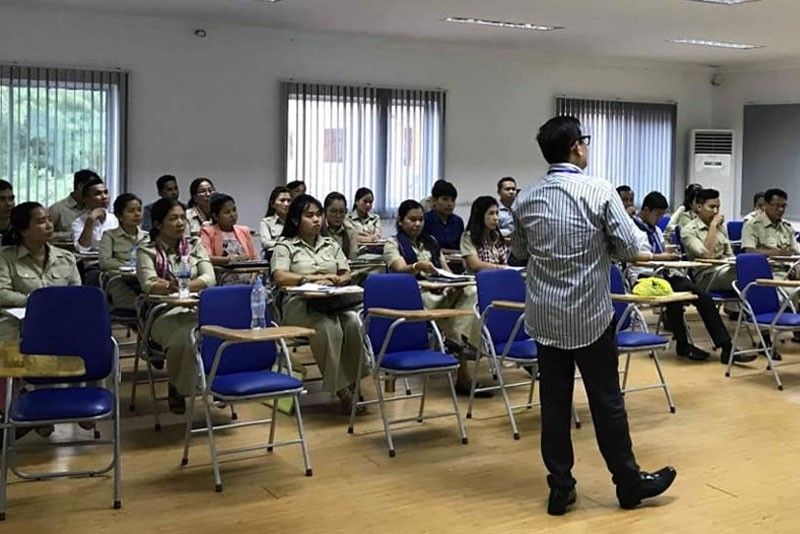
Teodoro Ariel Publico conducted an English language training program for more than 40 staff members of the Secretariat-General of the Cambodian Senate at the Pannsãstra University of Cambodia’s Institute of Foreign Languages.

Teodoro Ariel Publico conducted an English language training program for more than 40 staff members of the Secretariat-General of the Cambodian Senate at the Pannsãstra University of Cambodia’s Institute of Foreign Languages.
dfa.gov.ph

The three-month training was organized by the Philippine embassy in Phnom Penh upon request of the Cambodian Senate.

Embassy chargé d’affaires Myca Fischer said the Philippine government has provided various capacity-building programs to Cambodians.

“The English language training is a manifestation of our continuing commitment to an ASEAN community that is socially cohesive and people-oriented,” Fischer said, referring to the Association of Southeast Asian Nations.

English is the working language of the ASEAN.

The embassy tapped the services of Publico, who committed to deliver quality English education for professionals and promote the tatak gurong Pinoy (mark of a world-class Filipino teacher).
Publico, who hails from Cavite, arrived in Phnom Penh in 2014.

This is the third English language class arranged by the embassy for the Secretariat-General.

The initial three-month course was held in May 2015 and benefited 18 participants.

The second three-month module was offered in January 2016 to 20 Senate staffers.

As of June this year, there are 1,023 education professionals among the 6,773 Filipinos in Cambodia registered with the embassy.

The Filipino teachers are working in universities, international schools, language training centers and kindergartens.

Some of them teach music, physical education, mathematics, science and English.

Fischer said the embassy has received feedback from students and their parents that they appreciate the nurturing and hardworking nature of Filipino teachers in Cambodia.


Friday, August 30, 2019

...the Filipino scripts in Google keyboard

Indigenous Filipino scripts now available on Google keyboard

Janvic Mateo
Philippine Star
30 August 2019


MANILA, Philippines — Four indigenous Filipino writing systems are now available for users of Google’s virtual keyboard for Android users.

The technology company announced yesterday the inclusion of indigenous scripts Baybayin, Buhid, Tagbanwa (Aborlan) and Hanunuo in Gboard for Android, a virtual keyboard app developed by Google.

The technology company announced yesterday the inclusion of indigenous scripts Baybayin, Buhid, Tagbanwa (Aborlan) and Hanunuo in Gboard for Android, a virtual keyboard app developed by Google.


“We are committed to helping preserve the country’s local languages and scripts through relevant technology. Adding more Filipino languages and scripts on helpful products such as Translate and Gboard is one of the many ways we show this commitment,” said Google Philippines marketing head Gabby Roxas.

“To keep our indigenous languages alive, it is important that we try to continue using them. Today, where typing on our smartphones is a common behavior, making more native scripts available on Gboard will play a vital role in helping preserve them,” he added.

With the introduction of the Philippine scripts in Gboard, the company said it is now easier for users to discover and try writing in some of the country’s ethnic writing systems.

Gboard is an app developed by Google to enhance the keyboard of messaging apps and devices.
It enables users to search and send information right from their keyboard through a dedicated Google search feature.

Aside from the four indigenous Filipino scripts, the virtual keyboard also supports 19 languages from the Philippines.

These include Tagalog, Central Bikol, Koronadal Blaan, Rinconada Bikol, Chavacano, Cebuano, Capiznon, Cuyonon, Hiligaynon, Ilocano, Itawit, Kankanaey, Kinaray-a, Maguindanao, Maranao, Pangasinan, Kapampangan, Tausug and Waray.

Cebuano in Word Lens


Aside from the four indigenous scripts in Gboard, the technology company said it has also introduced Cebuano in its Word Lens, a feature within Google Translate that gives an instant camera translation.

The feature works by letting users hold their phones in front of a sign written in an unfamiliar language and instantly see the translation through an overlay in the screen.

Google said Cebuano is among the 88 source languages that can now be instantly translated into more than 100 languages.

Word Lens also supports Tagalog, with company officials saying they intend to include more Philippine languages in the feature.

“This update is helpful for tourists to communicate with the locals better and understand Cebu’s culture more. Users who are familiar with Cebuano can still use the tool to learn other languages as well,” added the company.

It noted that 175 of the 185 officially listed languages of the Philippines are indigenous, citing Ethnologue: Language of the World, an annual reference on global languages. Experts fear that at least 11 languages would soon vanish.

Google announced the inclusion of new Philippine languages and scripts in its products for the celebration of the National Language Month or Buwan ng Wika.


Monday, April 7, 2014

...the business accent

'Accent' matters: Philippines acquiring 70% of India call centers

            
A building in Manila occupied by a call center. Rajesh Pamnani


MANILA, Philippines — Most voice and call center businesses in India are transferring to the Philippines due to Filipino workers' more "neutral" English acccent, among other reasons, an Indian business group said.

The Associated Chambers of Commerce and Industry of India (Assocham) said that India is losing 70 percent of all incremental domestic business process outsourcing (BPO) businesses, particularly call centers, estimated to be worth $30 billion in foreign exchange earnings.

"Philippines ... has become the top destination for Indian investors, thus the need to reduce costs and make operations leaner is increasingly becoming significant across the BPO industry," Assocham secretary general D.S. Rawat said in a statement Sunday.

Citing Assocham's study, Rawat said that the Philippines has an advantage over India due to its large pool of "well-educated, English-speaking, talented and employable graduates."

Rawat said that only 10 percent of graduates in India are qualified to work in call centers and training could take a considerable amount of time. About 30 percent of graduates in the Philippines, on the other hand, are employable.

"Employees in Philippine call centers speak English fluently with a neutral accent which is what customers look for and that is something missing in Indian accents and that is a prime reason why BPO business is thriving in that country," Rawat explains.

"Cultural proximity to the US together with availability of talented manpower are key reasons as to why BPO companies prefer expanding their operations in Philippines," he added.

The country's IT-BPO sector saw its revenues rise by 17 percent in 2013 as more companies chose to locate and expand their operations in the Philippines.

The industry is estimated to hit revenues of up to $25 billion by 2016, and may account for approximately 10 percent of the nation's gross domestic product, employing about 4.5 million Filipinos.


Friday, May 3, 2013

...the NZ's major source of skilled migrants

Philippines Now Major Source of Skilled Migrates to NZ


Immigration Placement Services Ltd– Press Release 


Filipinos have been migrating to New Zealand for the last 15 years and many New Zealand employers have become aware of their work ethics and skills. Many other countries around the world have been recruiting Filipinos for years because of their skills and their willingness to work in jobs that their local population has been unwilling to undertake. There is an increasing interest from New Zealand employers recently in hiring skilled migrant workers from the Philippines to fill the skills shortage in the local market. For some years many hundreds of dairy farm workers have been employed by New Zealand farmers if they have been unable to find suitable staff locally.

 Today the NZ dairy farming industry has become dependent on Filipino workers to provide the labour force to meet their requirements of this rapidly growing industry. Many of the Filipinos coming to NZ have previously been working on commercial dairy farms in the Middle East or Japan, and have settled as residents with their families.

Over 11 million Filipinos work outside the Philippines. They can be found working around the world. Many Middle Eastern countries are dependent on their Filipino guest workers to keep their economies growing, where they work under contract for a certain number of years. Employers have recognised their willingness to work, their cheerful dispositions, and their ability to pick up language and new skills. Before Filipinos can leave their country to work abroad they must obtain an Overseas Employment Certificate from the Philippines Overseas Employment Agency (POEA). Without this they cannot depart though many thousands do illegally out of desperation to find jobs abroad. The reason why the POEA requires this process is to ensure that workers going abroad have a genuine job offer and not subject to scams. The process requires employers to have their employment contracts examined and approved by the POEA, along with other under-takings before the workers they wish to hire will be issues their OECs. Why have so many Filipinos forced to work abroad, rather than in their own country? The main reason is the lack of job opportunities for Filipinos in the Philippines.

 Unlike most of the rest of Asia, the Philippines have been unable to attract overseas investment to finance the growth in manufacturing and jobs as elsewhere in Asia. Yet the Philippines are one of the richest countries in Asia, with many natural resources and a talented English-speaking work-force. Overseas investors have preferred other Asian countries for investment as a result of poor government policies, and less flexible labour laws, a weak and corrupt legal system, poor infrastructure and high electricity costs. (As recently pointed out in an IMF report).

Yet in recent years the country has benefited enormously from the remittances from their overseas workers (OFWS) – over $US20 billion is sent back into the country annually providing an inflow of capital to fiancé domestic growth. The No 1 earner of overseas currency is the remittances from OFWs. 

In spite of this, nearly a third of the population lives in poverty and wages in the Philippines remain low. While the economy is expected to grow 7% this year driven by a boom in property construction, the population is growing faster than new jobs are being created. As in the nineteenth century, when many migrated from the UK and Ireland to settle around the world, today Filipinos are likewise migrating around the world to seek better opportunities than can be obtained at home. Migration of Filipinos is likely to continue until structural changes are made to the Philippines economy to become competitive to investors with other Asian economies.

As the only New Zealand Company based in the Philippines (for the last five years) supplying skilled migrants to meet the skills shortage in New Zealand, Immigration Placement Services Ltd has helped settle many hundreds of Filipinos successfully in the country. Many of these have now bought their families to New Zealand and have since become permanent residents, contributing to our society.

 New Zealand is a preferred destination for Filipinos as Immigration policies allow for approved skilled migrants on a work visa to bring their partners and children, something that is not possible for many Filipinos working in many other countries.

Many Filipino children grew up not knowing their parents as one or both need to work abroad to provide for their children’s education and necessities in live. Filipinos have integrated into NZ society well. As English is widely spoken throughout the Philippines they have fitted into NZ society much better than other Asian ethic groups, and can now be found from one end of NZ to the other.


Friday, March 29, 2013

...the Pinay in Canada's "La Voix"

Pinay to compete in quarterfinals of Canada's “La Voix” singing contest April 1


March 29, 2013
 
Maria Janice Galvez, a Filipina singer, will be competing in the quarterfinals of Canada's reality singing competition “La Voix” (The Voice) on April 1 at 7:00 a.m. (Philippine time).


Galvez, 30 told GMA News Online via email that the quarterfinals could be viewed via this live streaming website: http://www.webmaster-gratuit.com/tele/tva-quebec.htm
 
 
In February she won her 'duel' – a segment where two contestants sing the same song in parts – against Gabryelle Frappier.


She said she gave her best and tried to "think that there would not be a next time, that it would be the last.”
 
 
Both sang "Les Uns Contre les Autres," a French song originally by Michel Berger and Luc Plamondon.
 
 
She started studying French at the Centre Champlain only in September 2011, a month after her arrival in Montréal. By August 2012, she progressed to level 6 of the course.
 
“I sang my first French song on the Christmas show at school with one of my teacher, this is when my passion for singing in French started!” Galvez said.
 
Joining La Voix
 
 
Although she loved singing ever since she was a young girl, she had to be convinced by others that she actually had a talent for it.
 
“I would say that I have always loved singing since I was young. Thing is, I was not born with that talent. In my case, the basis is the passion that I put on it,” she said.
 
A friend of her husband enjoyed one of her performances in 2012 and urged her to join the pre-auditions of “La Voix” in Québec.
 
 
“We took the details from the internet… and fortunately, got in!” she recalled.
The pre-auditions for the first ever “La Voix” in Canada were held in September 2012 where Maria was screened with over 4,000 candidates.
 
She became part of the 140 contestants who went on to the blind auditions in January. She was eventually chosen to be part of Jean-Pierre Ferland’s team.
 
“My blind audition was very emotional for me because my coach, Jean-Pierre Ferland was the only one who turned around. He must have been curious to know where the accent of the voice singing in french came from,” she said.
 
 
Galvez won the ‘duel’ and 'chante de bataille' segments respectively held in February and March.


She is grateful to all the people who supported her, including those who liked her official Facebook fan page and followed her Twitter account.
 
 
Most recently, she was saved by her coach during the “en direct” (live show) segment of the show on March 17 which pushed her to the quarterfinals.
“I am being recognized a lot because of the way I learned French, how quickly I adapted, that in less than two years of speaking the language, I manage to be in this competition,” she said.
 
A difficult life
 
 
Although Galvez is experiencing success now in Canada, she recalls how she had a difficult life in the Philippines.
 
 
“My life in the Philippines was not easy. I have experienced a lot of difficulties but I have always been positive. Like everybody else, I have had ups and downs,” she admits adding “ Well, I guess I managed mine good enough.”
 
 
She said her family inspired her to continue with her dreams despite life's difficulties.
 
 
Her husband and children left the Philippines and went to Canada in 2010. She followed in 2011.
Galvez said what she misses about the Philippines are eating kwek-kwek and watching "Eat Bulaga’s" Juan for All, All for Juan program.
 
 
She is planning to go on vacation with her whole family in the Philippines soon. - VVP, GMA News


Sunday, February 24, 2013

...the anthem singer for World Youth Day in Brazil

Pinoy vocalist to sing World Youth Day anthem in Brazil

 
GMA News
February 23, 2013


Ooberfuse, a London-based electro-pop band fronted by a Filipino-British vocalist, has been chosen to record the English version of the official anthem for this year’s World Youth Day from July 23 to 28 in Rio de Janeiro, Brazil.

Composed of singer Cherrie Anderson, keyboardist Hal St. John, and guitarist Nico Cox, the band translated “Hope of the Dawn” from the original Portuguese composition “Esperanca do Amanhecer.”

“We are very happy, honored and humbled to have been given the opportunity to sing the official World Youth Day song in English,” Anderson said in an e-mail interview with GMA News Online.

Translating the song was “daunting,” Anderson said, because the band members are not fluent in Portuguese.

“[The song] is as much a tribute to a trans-Atlantic spirit of collaboration as it is to the power of the Internet and modern media,” said Cox.

“After multiple Twitter and e-mail messages recommending improvements and refinements, and numerous large music-data file downloads and uploads in Rio and London, ‘Hope of the Dawn’ was eventually born,” Cox added.

The result: a version that “remains loyal to the Portuguese original, but still reflects the style and ambience of the group,” said Phil Ross, national coordinator for the UK World Youth Day attendees.

Ooberfuse was formed in 2010 when its three members met at a church event, started to play music together, and joined the “Live and Unsigned” competition, where it was named Most Original Band and One of the Best Unsigned Live Musical Acts in the UK.

After singing the youth anthem for Pope Benedict’s UK visit in 2010, the band performed before an audience of 2 million at the 2011 World Youth Day in Madrid.

Now working on its third album, the band will be performing in Portugal, the US, Germany, and Italy this year.

Filipino influences

With one band member being Filipino—Anderson’s mom is from Leyte—it’s inevitable that Filipino influences would weave their way into Ooberfuse’s music.

“In some of our songs, we incorporate a Filipino instrument—the kulintang—which many of the UK people love,” said Anderson.

Anderson, who confesses to enjoying Filipino food like inihaw na baboy, tortang talong, pandesal, and taho, regularly visits the Philippines, where her parents are now based.

“I admire Filipinos’ love for God and family, love for all things musical, and their positive outlook in life,” Anderson said. - VVP, GMA News

Sunday, February 3, 2013

...the Pinay linguist in Oxford

Pinay at Oxford bats for Filipino-coined English words

Filipinos ‘talk in a rich mix of American, Spanish, and Malay influences’


MANILA: Are there such words as “presidentiable” and “senatoriable” in an English dictionary?

There are none, all right, but they might soon be included in the Oxford English Dictionary (OED) if a Filipino grantee of a Mellon postdoctoral research fellow in lexicography had her way.


“The Oxford English Dictionary is more than a dictionary,” Danica Salazar, PhD, recently told the Manila-based online news site rappler.com. “It’s also a historical document because it is a record of the English language as it is spoken all over the world, not just in the UK and the US.”

English-language newspapers in the Philippines always use the word 'presidentiable', referring to a potential candidate for the highest pubic office in the land, or senatoriable when referring to a candidate running for the position of senator.

The 28-year-old Salazar, who earned a bachelor’s degree in European Languages at the University of the Philippines-Diliman, in Quezon City, and went to Spain for her masters and doctorate degrees, got a job at the OED last year. She has since been working with the Oxford’s Hertford College, at the University of Oxford, and the Oxford University Press, publisher of OED.

Her job entails, among other things, looking for the “extensions of meaning” of some English words that have taken on a different meaning in the Philippines. Take “salvage”, for instance, whose original meaning is to save, but has, for decades, been used here also to mean summary execution.

Salazar’s main proposal for her Mellon fellowship, she said, included the search, systematisation, and possible inclusion into the OED of English words that have been uniquely coined by Filipinos and are widely used in the Philippines.

Her main goal now is to have Philippine English recognised globally and a Philippine English dictionary published by the Oxford University Press. The latter, she noted, recently released a South African English dictionary.

Salazar also wants a change in the attitude of many peoples, especially language scholars, in reaction to criticisms from some academics who say that acceptance of Filipino-coined English words should not hinge on their inclusion in the OED.

“But that’s the reality,” she stressed. “A dictionary plays an important role in legitimising language. I would like to change the perception that for English to be spoken correctly, it has to be spoken like the Americans or the British.”

She has prepared for this with a list of words for possible inclusion into the OED, which is undergoing a comprehensive revision. “If I can include ‘chorva’ in the OED, maybe my life would have not been in vain,” she said, although with a jest. Chorva is a gayspeak widely used in the Philippines (now by all sexes) to mean whatever or something.

She said the inclusion of the Filipino-coined English words into the OED would be a validation of the Philippine culture. “We should be proud and not ashamed to speak English anywhere in the world in the way we do.”

Salazar said she believes in preserving such words as “solon”, “thrice”, and “viand”—which are no longer widely used in the US and the UK, but are still regularly used in the Philippines. She also wants to bat for the recognition of popular Filipino acronyms like “TY” (thank you) and “CR” (comfort room).

The latter prompted one reader to comment that “CR” is no different from “WC”, an acronym widely used by native English speakers to mean water closet, when referring to toilet.

Salazar said that Philippine English could help enrich the language, noting that the integration of the Latinos in the US is prompting the introduction of new words into their lexicon.

“But in the Philippines, that kind of integration has already happened,” she said. “We talk in a rich mix of American, Spanish, and Malay influences.”

Saturday, January 26, 2013

...the Heart of Asia

What Makes Philippines the Heart of Asia


Philippine Daily Inquirer


The country’s medical tourism industry is hoping to get another boost from the soon-to-be-released “Philippines: The Heart of Asia” travel guide.


The Philippines established its Medical Tourism Program back in 2006—and now, a little over six years later, we can say that while results have not been as quick as first envisioned, the country’s efforts to become a regional healthcare hub are slowly but surely bearing fruit.

A few years ago, the country was re-launched as a medical tourism destination under the brand “Philippines: The Heart of Asia” and the tag remains as true today as it was before. The Philippines really is The Heart of Asia in more ways than one.

As the Department of Tourism meets with success in presenting the country as one of the most desirable destinations in the region, especially through its “It’s More Fun in the Philippines” campaign—it will be recalled that the Philippines was included in several international “best destinations” lists in 2012—it can be reasonably expected that this will also help highlight the Philippines’ strong points as a medical tourism, healthcare, and wellness destination.

Hearts in the right place


Various research studies show that patients’ recover faster and feel happier when they receive compassionate care. Compassionate care, unfortunately, is often overlooked as more and more hospitals overseas struggle to save on costs and increase efficiency—this is the reason why Filipino nurses are in such demand the world over: Filipino nurses are not simply competent but also friendly, cheerful, caring, and compassionate.


Friendliness, compassion, caring, and cheerfulness are aspects of Filipino culture that every Filipino grows up with and imbibes. He or she learns it from parents, siblings, relatives and friends. This is because most Filipinos value relationships more than material possessions. Whether rich or poor, strong family bonds and smooth, mutually beneficial relationships among relatives and friends define the Filipino way of life.

Foreigners who visit the country as tourists, work here as expats, or choose it as their second home after retirement, all discover the warmth and hospitality that are unique to the Filipinos. These are attributes that medical tourism travelers discover when they receive treatment in the country’s hospitals and clinics.

English fluency


English is widely spoken in the Philippines as one of its official languages. English is the language used in education and business, and Filipinos in government agencies and the service industry are fluent in it. There are many English-language publications in the Philippines, including the major newspapers and magazines. There are also many English-language programs on television and Hollywood movies are regularly shown in theaters. Foreigners who speak English will have no difficulty relating to and transacting with Filipinos.

Top-notch healthcare facilities


Filipino doctors are expertly trained in the Western medical tradition and are up-to-date with the latest advances in medical science. Many of them have trained overseas, including the United States and Europe, and are affiliated with medical organizations in those countries.

The country’s top public and private hospitals are equipped with the latest in medical tools, machines, and technologies—the same equipment, if not better, as those found in the U.S. and Europe. The high standards of their facilities assure medical tourists that they are getting the same quality care, or better, as they would receive from their home countries.

This same high quality of care is found in the Philippines’ top specialty clinics that offer dental and aesthetic procedures.

Tropical paradise


With more than 7,000 islands in its archipelago, the Philippines is home to beaches and seaside resorts that provide relaxing, refreshing tropical paradise settings. There are natural landscapes of breathtaking beauty in the highland regions. Medical travelers will discover many picturesque places where they can enjoy their recovery.

Together with these various natural settings, the Philippines also offers all the modern conveniences needed for 21st century living. From high-tech telecoms networks to cable TV, to Internet service, and highly urbanized, cosmopolitan areas with malls retail complexes offering local products and international brands.

World cuisine


Filipino food is a blend of Western and Eastern influences that include Spanish, American, Chinese, and Indian cuisines. With such a sophisticated palate, Filipinos easily welcomed the entry of Japanese, Korean, Thai, Italian and Continental food in the culinary scene. As a result, there are now so many different dining establishments that offer a gamut of authentic, gourmet fare.

More work ahead


As more of the country’s top hospitals make considerable investments in their personnel and facilities, the benefits to Filipino and foreign patients will also increase. There really is no other way to help the Philippines become a regional medical tourism hub except to make sure that its healthcare facilities are world-class.

One very important area that more Philippine hospitals need to get into is international accreditation. This accreditation is the most credible certification of a hospital’s, clinic’s, or wellness facility’s world-class quality standards.

When we talk about world-class healthcare certification or accreditation for hospitals and other healthcare facilities, we usually refer to accrediting bodies like JCI, NABH International, Accreditation Canada and others that are affiliated with the International Society for Quality in Healthcare (ISQua). The ISQua is the world body that accredits these accrediting bodies.

One ISQua-accredited body that has been giving generous support to Philippine hospitals is NABH International. Through its local affiliate, HealthCORE, the NABH International has been giving workshops to Filipino hospital administrators to help them learn how to meet ISQua standards, and assist them in the actual process of accreditation.

The success of the Department of Tourism’s campaign plus the increasing number of foreign patients being treated in the Philippines top hospitals prove that the country still has a bright future and great potential to be a medical, health, and wellness hub in the region.

To fulfill that potential, all stakeholders in the healthcare and travel sectors must get their acts together. Only then will the world truly realize that the Philippines is the Heart of Asia—a heart that gives care, compassion, life, love, and healing to those in need. – Ramil Digal Gulle, contributor

Sunday, December 16, 2012

...the Filipino language

Filipino language is going global


Hawaii-based poet and teacher Ruth Mabanglo has made it her mission to promote the Filipino language and culture worldwide

By Anna Leah Sarabia
Philippine Daily Inquirer


RUTH Elynia Mabanglo of the University of Hawaii (right) received a plaque of recognition from President Aquino, with Foreign Secretary Albert del Rosario and CFO chair Imelda Nicolas looking on. MALACAÑANG PHOTO


In this age of globalization, nothing could be more difficult for a Filipino living abroad than to work for the preservation of one’s own language and culture. But Dr. Ruth Elynia S. Mabanglo is not so easily discouraged.

As a multiawarded poet and playwright, her love for the Filipino language has found meaning and it remains a calling. The first woman to join the Hall of Fame of the Don Carlos Palanca Awards for Literature, Ruth has made it her mission to promote Filipino worldwide.

Ruth was in Manila recently to pick up a plaque from President Aquino as a 2012 Presidential Awardee for Filipino Individuals and Organizations Overseas, in the “Pamana ng Pilipino” category. It is conferred on Filipinos overseas who have brought the country honor and recognition through excellence and distinction in the pursuit of their work or profession.

She has published six books of poetry and several scholarly works included in anthologies and often cited in scholarly journals. In 2008, the De La Salle University Filipino Department convened critics and scholars for a monthly forum on her works, the “Ruth Elynia Mabanglo Lecture Series.” Her poems were among those highlighted in the 2012 Aliw award-winning film by Alvin Yapan, “Ang Sayaw ng Dalawang Kaliwang Paa.”

Ruth’s latest crusade is to nurture Filipino as a global language. Several years ago, when then President Gloria Arroyo pushed for Spanish to be taught in high schools and for prioritizing English so Filipinos could better serve global business, Ruth mobilized a protest petition.

“I encouraged my students all over the United States to sign a petition to fight the killing of Filipino in high school and college, which was part of the Gullas Bill that Arroyo favored. Later on, I organized the ‘Filipino as a Global Language’ conference as a professor of Filipino language and Philippine literature at the University of Hawaii,” she said.

Courses around the world

Through the conference, Ruth began to identify all the Filipino language programs in the world.

“I was able to identify, for instance, that in Sorbonne University in France, there is a Filipino named Marina Pattiere who is teaching Filipino. I found out that in the University of London, there is a Philippine Studies course and students there are asked to go to learn the Filipino language in the Philippine Embassy. I was looking for courses, programs and people teaching Filipino. I am in correspondence with some high school teachers in Melbourne, Australia who are teaching Filipino there.

“I also found out that there are Filipinos teaching Filipino in Malaysia, Brunei and Beijing. In Beijing, there is a masters’ degree program in Filipino. In Gaida University in Osaka, Japan, there is a Philippine Studies program, major in Filipino, and it sends students to take higher level courses in Filipino to the University of the Philippines.

“In the University of Hawaii, I have a government-funded Fulbright program that sends Fil-Am students to study advanced-level Filipino in Manila for 10 weeks.”

Teaching materials

Apart from identifying these programs and creating a global network of specialists in Filipino, Ruth and her conference colleagues agreed to help each other with materials for teaching courses on Filipino.

Right now, she said, there is a Consortium for the Advancement of Filipino started by Dr. Teresita Ramos; there is a newsletter that informs and updates members about developments and conferences.

 “In my case, I started an organization called the Global Consortium for the Advancement of Filipino Language and Culture, which is another network.

People want to study the Filipino language for different reasons. “In Germany and France, the interest would be mainly for the children of women who married Germans or French. I met some of them in 1997. There are volunteers who were teaching Filipino as a church-based activity. The idea was to connect the children to the culture of their mothers, as sometimes the mothers can’t speak German so well and the children need to have conversations with their mothers.”

In Osaka, the interest in Filipino could be related to being able to use it in business and work places where there are Filipinos. Maybe some Japanese students also take up Philippine Studies in connection with their history. “We are part of the World War II story of Japan, so they opt to learn Filipino, too,” she added.

2nd generation Filipinos

In Hawaii, Filipino is taught mainly for two reasons. One is for the younger ones to learn the language of their fathers or grandfathers. “Before, children of immigrants were not allowed to speak (any other language besides English) so they want to correct this. The third-generation Filipinos want to learn to speak with their lolas and lolos.”

The other reason has to do with the history of immigrants in Hawaii. “The American sugar barons who brought in Filipinos workers to the sugar plantations 1906 were required to hire only those who could not read or write. This was to prevent the workers from applying for jobs with other companies, since the working conditions in the plantations were very oppressive. They were treated almost like slaves,” she said.

“There are a few Filipinos in Hawaii who are saying that Tagalog is marginalizing the other languages in the Philippines. Which is untrue—historically or anthropologically,” she argued.

“In the past, others claimed that there were more Cebuano or Ilocano speakers. But today, Filipino is really the dominant language. My job is to find out how globalized Filipino is at the secondary and tertiary levels.”


Language and culture

At the basic level, overseas Filipinos have found the means to teach Filipino language and culture. In Boston, for instance, the doctors and nurses have established church-based programs including a children’s rondalla that has released a DVD. But all the teachers are volunteers, and there are no learning levels.

“However, in San Diego, California, would you believe there are 70 high schools that teach Filipino as a ‘world language’? California even has an accreditation system for those who would like to teach Filipino in high schools. I would like to bring that system to Hawaii so that Filipino majors can earn credits to teach in high schools. I am working on that now. I am also trying to standardize the curriculum so that high school students can have at least basic knowledge of Philippine culture, and a basic literacy of Philippine literature in Filipino. For instance, one basic canon of Philippine Literature is Florante at Laura by Balagtas. Students must be able to pass basic exams on this Tagalog work.

“You cannot learn a language without understanding its culture so I have developed many courses. I have a course on Philippine films… on Filipino food, music and rituals. Language and culture: they are like twins.”

...the global culture trendsetter

Psy, Charice help push global culture


12/16/2012
 
 
SINGAPORE – Internet celebrities from Asia such as Korean pop star Psy and Filipino belter Charice are helping create a truly global culture through their online videos, executives from tech giant Google Inc. said.
 
As it prepares to welcome “the next billion” of new online users, Google predicts that the Internet will evolve into a more visual web that can be easily understood by a global audience.

Google executives said more visually oriented content will be vital in making the Internet more relevant across language and cultural barriers.

Lalit Katragadda, Google’s country head for India, noted that 80% of emerging market users spend their life within 10 miles of where they live. That's why a lot of content from the west are irrelevant in their daily lives.

“If there was one product that I would put in front of users with no explanation for the next billion, it would be YouTube. It is extremely powerful and it is changing the word as we speak,” he said.
Adam Smith, the head of YouTube for Asia Pacific, noted that when the Internet was first evolving, there was a lot of concern that American culture would overwhelm local cultures.

“But what we're really seeing is that the Internet is turning out to be one of the best tools for really preserving and nurturing local cultures. And nowhere is this more evident than online video,” he said.
“One important insight is that YouTube can basically support an unlimited number of channels.

There's no scarcity and that means we at YouTube do not need to choose what content gets created,” Smith pointed out.

“Content created for a million dollars by a global star often sits right beside content created for nothing in a basement. It's an open playing field. The question whether a certain kind of programming gets created is not up to us but up to the creators. And different creators from around the world naturally want to tell their story,” he said.

Jamich and Charice

YouTube has changed the media landscape in a major way since it debuted in 2005. With the video-sharing site, anyone with a camcorder, a camera phone or a webcam can create a video that can be potentially viewed by millions of people around the world.
Charice

Smith singled out Filipinos Jamvhille Sebastian and Michelle Liggayu—more popularly known as Jamich—as among the many young creators making short films to build both local and global audiences. Jamich’s videos about their relationship have already registered over 40 million views on a global basis, Smith noted.

“If you think back even 10 years ago it's hard to imagine any of these folks getting a meeting with producers,” he said, adding that these video makers can now directly reach out and build global audiences. “And you can see from their fast rise that people just love these videos.”

“What's interesting is that YouTube isn’t just a pathway to success in traditional media. It’s creating self-sustaining and flourishing communities in its own right. By just empowering these communities to have a visible voice, it inspires and creates other folks from that community to jump in and participate as well,” Smith said.

“And as much as YouTube is about connecting cultures with each other, what we love is that YouTube is helping global culture become truly more global,” he added.

Smith said he is also proud that in Southeast Asia, a number of local celebrities have used YouTube as a platform to build audiences worldwide.

He cited the success of Filipino singer Charice, who has “gone from travelling around in the Philippines doing local festivals to uploading and building an audience in YouTube to being on ‘Oprah’ where Oprah (Winfrey) called her the most talented girl in the world.”

Psy dances in front

Of course, no discussion about YouTube these days would be complete without mentioning Korean pop star Psy, whose phenomenal video “Gangnam Style” has nearly 1 billion views on the video-sharing site.

Smith pointed out that even before “Gangnam Style,” Psy was already a big star in his home country of South Korea, although no one outside that country has heard of him.

“And nor was he even really trying (to make it globally) like a lot of his contemporaries in K-pop.

And so in July he released his song ‘Gangnam Style’ and uploaded it to YouTube and it was really just a song he thought was for his fans in Korea. But now he has nearly 1 billion views and has truly become a global phenomenon. Everyone has seen his video,” Smith said.

“It's an amazing era we live in when a song and a musician from Korea can become the No. 1 most-talked about musician in the world and do it in just a mere matter of months,” he said.

The success of “Gangnam Style,” which only has a sprinkling of English words in the lyrics, speaks to the growing diversity in today’s global culture, according to Smith.

“Ten years ago it’s hard to imagine how anyone living in France or Germany could have been exposed to the breadth and depth of Filipino and other Southeast Asian stars as they are able to do today,” he said.

“But at the same time, the act of being recognized globally helps these local acts actually become larger on a local basis. So in essence you don't have to be one or the other anymore. You can be both local and global at the same time. Psy is arguably the largest musician in current pop culture and he’s also equally larger than he's even been in Korea at the same time,” he said.

“No one cares anymore where culture comes from just that it is good,” Smith declared.

Saturday, November 17, 2012

...the Pinoys in Khmer country

Cambodians learn English from Pinoys

11/17/2012
 
 
PHNOM PENH, Cambodia – As countries belonging to the Association of Southeast Asian Nations (ASEAN) prepare to be "one community" in 2015, students in Cambodia—this year's ASEAN host—are trying their best to learn English.

And they're learning fast, thanks to their teachers from a Southeast Asian neighbor, the Philippines.

Highly-regarded for their good English, many Filipinos teach in language schools and universities in Cambodia. Some 800 Filipinos here work as teachers, according to the Philippine embassy.
 
 
Gina Lopez, Associate Dean of the College of Management at the University of Cambodia
 
Gina Lopez, a university professor, is one of them.

In 2004, Lopez left her hometown Bataan for Phnom Penh, unsure about her fate. She worked for a non-governmental organization in the Philippines that catered to Cambodian and Vietnamese refugees, and never planned to be a teacher.

When she arrived in Cambodia, Lopez landed a job at an English language school, and then transferred to the University of Cambodia. After only a year in teaching, she became associate dean of the College of Management.

"Cambodians know that when it comes to English, Filipinos are good," Lopez told ABS-CBN News in an interview. "They admire and respect us. They know they will learn something from us."

One of her students, 23-year-old Sor Kalyan, says he is awed whenever he hears his Filipino teachers and their families speak in English.

"I used to be a student at Battambang province, where there are maybe 2 or 3 Filipinos. Their daughter and their son speak English like native speakers," he says.

Kalyan, who lives in a monastery, has been studying English for 5 years now. He believes it's his ticket to a better future.

Besides, he says almost everything on the Internet, which he uses for doing research, is in English.

"I want to be a teacher and also a businessman," says Kalyan.

Lopez believes Filipino teachers play an important role in helping Cambodians meet the challenges of globalization, after many years of the isolation and social instability in their country.

Many Cambodians are very eager to learn English, she adds, treating it as their "weapon" to compete in a globalized world and overcome poverty.

"Education is the foundation of progress. So if you're one of those building that foundation, your role is very important," Lopez said.

Monday, November 12, 2012

...the World's budget English Teacher

BBC report: PH drawing thousands of foreign students for its affordable English classes

By Lawrence de Guzman
Philippine Daily Inquirer


MANILA, Philippines — The world’s “budget English teacher.”

This is how the Philippines was called in a recent BBC News report  highlighting the country’s relatively cheap access to education compared to other English-speaking nations.

The report, written by Kate McGeown and posted online on Monday, noted the surge in the number of foreign students attracted by the country’s competitive rates for English education, which costs only a fraction of the tuition in schools in the United States or Canada.

Aside from language students, the number of foreign graduate and post-graduate students in the country is reportedly on the rise, apparently recognizing that local universities are at par with global standards.

A check with the Bureau of Immigration Student Desk indicated that as of October 2012, a total of 24,680 foreigners had applied for study permits, which was more than thrice the applications in 2008 totaling 7,569.

The agency also expects the applications for full student visas to reach at least 23,000 by the end of the year, which is over four times the 2008 figure of 5,336 applications.

A major advantage for Filipinos is having a clear American accent, according to the report, “partly because the Philippines was a US colony for five decades, and partly because so many people here have spent time working in call centers that cater to a US market.”

But studying in the Philippines has presented some challenges to students, the report pointed out.

“Living here means coping with the bureaucracy and corruption, and if you’re in Manila, the heavy pollution,” it said.

Moreover, foreigners may find it difficult to understand Taglish, a mix of Tagalog and English which Filipinos use in informal communication.

“But for an increasing number of people, these are small obstacles compared with the benefits of studying in the Philippines,” added the report.

This is not the first time the country has been recognized for its English proficiency.

Last April, the Philippines topped 75 other countries in the Business English Index 2012 prepared by the GlobalEnglish Corp., a California-based company that aims to advance business English among global organizations.

Only the Philippines attained a score above 7.0, a “level within range of a high proficiency that indicates an ability to take an active role in business discussions and perform relatively complex tasks,” GlobalEnglish said in its release.

The Philippines is joined in the top five by Norway (6.54), Estonia (6.45), Serbia (6.38) and Slovenia (6.19).

Noting that a country’s business English capability is an indicator of its economic growth and business success, GlobalEnglish said that “it is not surprising that both the Philippines and Norway—the only two countries in the top five in both 2011 and 2012—are improving their economies, based on the latest GDP data from the World Bank.”

Saturday, October 27, 2012

...the Canada's fastest growing foreign language

Tagalog now the fastest-growing language in Canada


October 25, 2012
GMA News


Tagalog is the fastest growing foreign language in Canada, jumping by 64 percent from 2006 to 2011, a recent survey showed.

According to a report of the news site canada.com, "robust immigration" would probably explain the whopping increase in the number of Tagalog-speaking residents in Canada.

The country is home to some 667,674 Filipinos, based on the 2010 Stock Estimate of the Commission on Filipinos Overseas.

Canada.com said some 279,000 people claimed to be Tagalog speakers in 2011, compared to 170,000 five years earlier.

"It was the most-spoken foreign language in Edmonton; the second-most-spoken foreign language in Calgary; and the sixth-most-common in Vancouver and Toronto," the report said.

The report added that Canada admitted more permanent residents from the Philippines last year — 34,991 — than from any other country.

In 2002, new permanent residents in Canada numbered only 11,011.

Some 279,000 people reported using Tagalog in 2011, compared to 170,000 five years earlier.

Canada.com said the rise in the number of permanent residents in the Philippines can be attributed to the "Live-In Caregiver Program" that provides nannies to Canadian families.
"As well, incoming nurses and service-sector workers send money home to their families (remittances from overseas Filipinos account for roughly one-tenth of the GDP of The Philippines)," the report said.

Canada's linguistic landscape
Even though Tagalog is the fastest growing foreign language in Canada, Mandarin "is expected to make a bigger splash. How big of a splash, though, isn’t known precisely," the report said.

Mandarin users grew by 51 percent since the last census, it noted.
The 2011 census of Statistics Canada noted that the respondents who claimed Chinese as their mother tongue included:
  • 255,000 Mandarin speakers;
  • 389,000 Cantonese speakers, and
  • 441,000 people who simply wrote “Chinese” as their mother tongue.

"Statistics Canada couldn’t say exactly how many of these were Cantonese speakers, Mandarin speakers, or used one of the other eight languages spoken in China today," the report said. - VVP, GMA News

Sunday, October 21, 2012

...the PH from expat's eye

Seeing The Philippines From An Expat’s Eyes


By ANDREW JAMES MASIGAN
Manila Bulletin
October 21, 2012

 
A recent study conducted by the American Chamber of Commerce revealed that most expats of multinational companies working in the Asia Pacific region prefer to be assigned to the Philippines over any other nation. Conversely, expats already working in the country have expressed unwillingness to be transferred elsewhere.  The results of the study come as a pleasant surprise given that the Philippines is placed in direct comparison with countries like Singapore, Hong Kong and Japan. The survey shows that foreigners still prefer to live and work in the Philippines despite our lagging infrastructure and the inconveniences stemming from our densely populated cities.

The AmCham study piqued my curiosity. As a proud Pinoy, I wanted to know what made the Philippines so attractive to foreigners. I needed to get firsthand information from an expat who’s spent a significant time in the country, as well as other parts of the world. I found just the guy in Pierre Marmonier.  Pierre is a Frenchman from the southern region of León. He graduated from the prestigious Aix de Provence Business School before earning his MBA at Harford University in Connecticut. He built his career as a corporate man initially working for Swedish Match before moving on to British American Tobacco. As a marketing and export executive, Pierre spent several years working in the U.K., France, Switzerland, Algeria and the Philippines, while constantly traveling around Asia.

Not only did Pierre ask to be stationed in the Philippines twice, he also decided to settle here after his stint with the multinationals. The man from León is now happily entrenched in Philippine life, both as a family man and a thriving entrepreneur.

Why The Philippines?

Over glasses of wine, Pierre and I talked about what made him decide to raise his family and start a business in the Philippines. He is a citizen of the EU, after all, and could settle in most parts of the western world where standards of living are higher.

Pierre told me that among all the races he’s interacted with from all over the world, no one is more open and welcoming of foreigners than the Filipino. The Philippines is perhaps one among a handful of nations in the world where the locals have the compunction to make foreigners feel special. He observes how we Filipinos have it in our nature to make strangers feel welcome if he or she happens to be in our personal space. He cites how we would naturally include a stranger in a conversation if he happened to be within earshot of a chat. How we would offer a part of our meal to a stranger if he were to walk by while we were eating. How we would make the effort to speak in English if we were talking to a white person. These are traits uncommon in other nationalities, but natural to the Filipino, Pierre says.

He also finds the Pinoy to be both open-minded and tolerant of other people’s life choices. Being different in the Philippines is no big deal, he asserts. It is a welcome change from his native France, where people can be close-minded on many issues.

Here, people are not hung up on religion, skin color, cultural idiosyncrasies or even gender, he says.  He was surprised to discover that women are just as respected (sometimes, even more feared) than the men folk. He is amazed that the Muslims, Buddhists and Agnostics among a predominantly Catholic populace are looked upon with curiosity rather than resentment. He is amused that gay people are regarded as creative and “fun” rather than an object of hate. Above all, he notes how we Filipinos manage to smile even in the midst of the most dire circumstances. As far as standards of living goes, Pierre has seen it improve considerably from the first time he stepped foot in the country in 1994. Back then, he relates, brownouts were the norm, proper housing for expats were few and far between, and recreational facilities like parks, malls and country clubs were rare. Things have changed today. While infrastructure is still a problem, albeit to a lesser degree, Manila can now rival any other world cities in terms of quality of life, especially in the realm of education where numerous international schools are now in operation for the expat community. He notes, however, that there is still a lack of facilities to feed the humanities. He misses the museums, theater scene and art scene of Europe and more advanced countries in Asia. This is something not in the priority list of government, but should be.

Doing Business In The Philippines

Pierre started his business some three years ago, just when the economy started to gain traction. His timing could not have been better and he is now reaping the fruits of our favorable economic environment.

Pierre’s company manufactures artisanal jams made in the old-fashioned French manner. His products go by the name of “The Fruit Garden” and can be found in most hotels like the Dusit and Hyatt. It is also the house jam of most luxury hotel chains including the Shangri-La Group, The Peninsula, The Mandarin, The Hyatt, Discovery Shores and Oakwood, among others. Pierre is riding the tourism boom as more hotels are set to open in the next few years. He is already positioned to be part of the Raffles and Fairmont Hotels when they open next year, and he looks forward to the mammoth resorts on the rise at the Pagcor Entertainment City. My wife and I have been fans of The Fruit Garden jams for years, especially their Mango-Ginger, Strawberry-Banana and Pine-Cocorum flavors. As Pinoys, we’re not big jam eaters but this one is different. It’s light, not too sweet, and has more fruit than water and pectin. It’s become our morning fix and a regular fixture in our condiment rack. Pierre is also supplier to some of the country’s top 500 companies for their giveaways during Christmas and special events. His luxury packaging and French heritage recipes speak of class and stature, which makes it a hot seller in corporate circles.

Amidst all his success, he cites his Filipino workforce as one of his true assets. They are loyal, hardworking and have good work ethics, he says. In the manufacturing line, he finds his workers easy to train and able to retain knowledge without need for constant reminders (apparently, this is not the case with other workers in the region). In fact, he boasts of nearly zero production mistakes leading to a product reject ratio of less than one percent. He also appreciates the Filipino’s willingness to multi-task, even if not in their job description. This speaks volumes of their concern for the company.

Irritants

Still, there are irritants in doing business in the Philippines. He complains about the excessive cost of electricity and high cost of agricultural produce. For a country blessed with so much arable land, fruits are unreasonably expensive, he laments. For instance, a kilo of strawberries from Baguio can cost up to P200 while its imported equivalent from China costs less than P100. The country loses out because of its inefficient agricultural sector. Government would do good by giving it the focus it deserves, he opines.  Another issue he grapples with is the Filipino’s lack of “hunger” in generating new business. He finds it strange that companies he intends to buy from fail to act with urgency when filling his orders. They act as if they don’t need the business. Shouldn’t they be hustling to generate sales? Pierre cannot understand the laxity. In Europe, suppliers treat their clients like partners as their (the client’s) success naturally redounds to the supplier’s success. Pierre does not feel that kind of symbiotic relationships with his suppliers. If anything, their view is only up to next month’s purchase order.

But perhaps the biggest drawback in Pierre’s experience is dealing with dishonest people or people who are not forthright in their business dealings. Unfortunately, there are many of them in these parts.

Pierre told me how his landlord, a Filipino, presented his property as being suitable for commercial or industrial use, knowing full well that it was earmarked as a non-commercial zone. As a result, Pierre was unable to secure his business permits for months even after investing millions on improving the property. His landlord duped him and left him to fix the mess. Pierre was able to sort it out eventually, but not without massive setbacks on his business and personal trauma. It is unfortunate that our justice system does not provide quick recourse to address situations like this.


The Philippines Wins

In the next few months, The Fruit Garden will begin tapping the export market of Japan, Korea and China. He believes there is a demand for artisan French-made jams using the best tropical fruits from the Philippines. His closest competitor, Hero Jams, is made in Egypt and cannot compete with the wide spectrum of flavors The Fruit Garden offers.

When realized, the country stands to gain export revenues, not to mention the local taxes and employment from Pierre’s venture. In fact, even now, the country already benefits from his work on many levels. For this, he deserves our gratitude.   We should all continue to do what we naturally do best—make our expat friends feel special. As in Pierre’s case, it pays dividends a hundred-fold.