Showing posts with label national heritage. Show all posts

Saturday, March 16, 2019

...the Filipino amulets in Paris

The Philippine flag is raised in this famed Paris museum—all because of our anting-antings


The playwright and curator Floy Quintos has exposed part of our secret soul in the City of Light. At the Musée du Quai Branly along the banks of the Seine, the exposition he put together explores the story of our amulets and the complex, hybrid nature of the Filipino faith .

Renee Ultado | Mar 16 2019 
ABS-CBN News
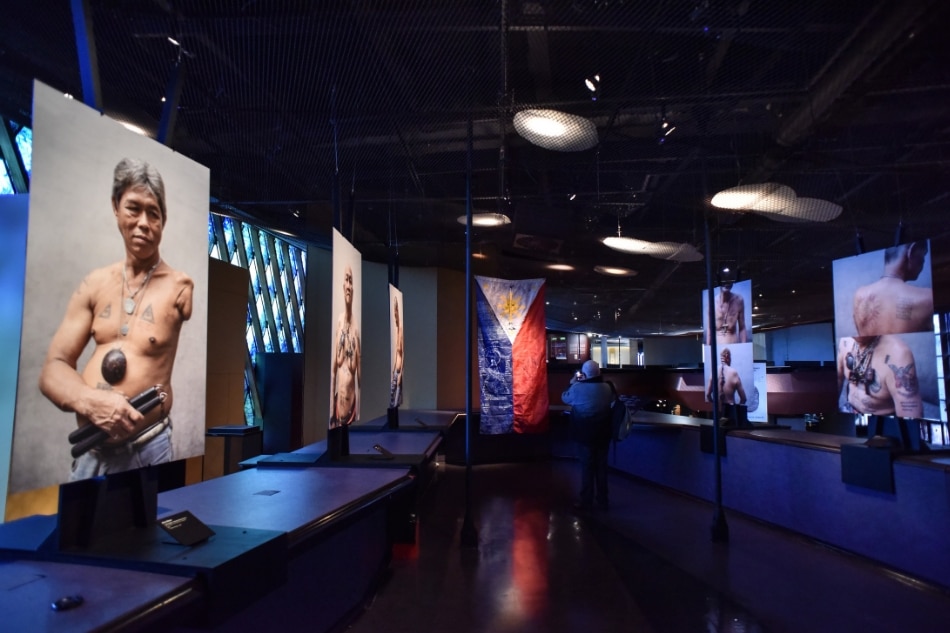

The Philippine Flag stenciled with sacred symbols and incantations, flanked by Dino Dimar photographs of current cult members wearing their anting-antings.

It was a windy Monday morning when the Musee du Quai Branly opened its doors to the press, collaborators, friends, and select patrons for the opening of two exhibitions for Spring. The buzzy Oceania assembles almost 200 archaeological objects and art pieces representative of the Pacific island cultures, while Anting-Anting—to which I was invitedis a more intimate installation telling the story of the historical and contemporary use of protective amulets, talismans, and charms in the Philippines. 


This feels like coming home,  " I said, soliciting a genuine noddy smile from a docent as she ushered me into the exhibit space, an obscure area floating above the museum's permanent collection. It was a half-lie. Whie Santo Niño, the Nazareno handkerchiefs and the odd bits of brass jewelry looked familiar, the whole ensemble felt very foreign to me. Eerie and ominous. A physical manifestation of things I have only heard before.


The exposition entitled Anting-Anting: The Secret Soul of Filipinos explores and demystifies these “charged objects” utilized by a myriad of Filipinos to this very day, from policemen to cult members. An offshoot from a previous exhibit at the Yuchengco Museum in Manila, the collection was built and curated by playwright, director, and antique dealer Floy Quintos.
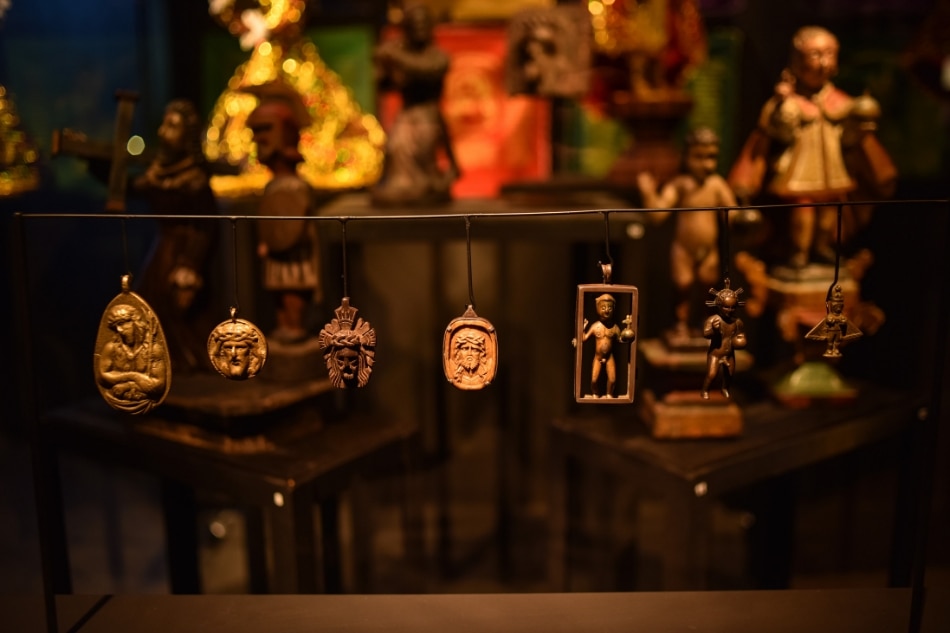
Images of Jesus Christ and the Santo Niño figure into these ancient amulets in brass and ivory, highlighting the Catholic influence on the animist nature of the anting-anting.

The invitation to show here in Paris came with challenges, mostly reworking the storytelling for a predominantly European audience. “My French colleagues would ask me, okay, how do the objects talk to me? How do we make them engage?” Quintos shares. He had to make the exhibit relatable and transportative even to people who have never been to our islands.

And transportative it was. Utilizing the Atelier Martine Aublet, a space designed to be a “contemporary cabinet of curiosities,” Quintos repackaged the exhibit into smaller pockets of stories. One corner shows Rizalista cult paraphernalia, another reveals blood-stained linen vests with pearl buttons believed to bestow protection against bullets.
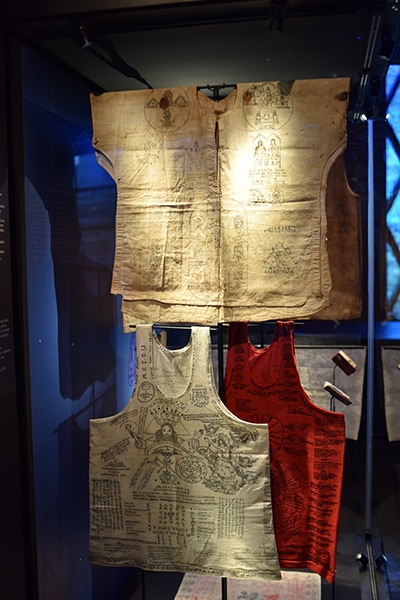

In 1967, socio-political cult Lapiang Malaya marched into Malacañang, equipped only with bolos, anting-anting, and these stenciled shirts believed to make the wearer invincible against bullets.

On the other side, a wall glows with images from a Dino Dimar documentary following the journey of pilgrims to Mount Banahaw. The space is then infused with noises both familiar (the hypnotizing sound of a waterfall hitting the plunge, a solemn rendition of Ama Namin) and unfamiliar (orations in Pig Latin murmured from sacred booklets). One is given the impression of being in the caverns with the faithful as they pray, light candles, slither into crevices, and collect blessed water.
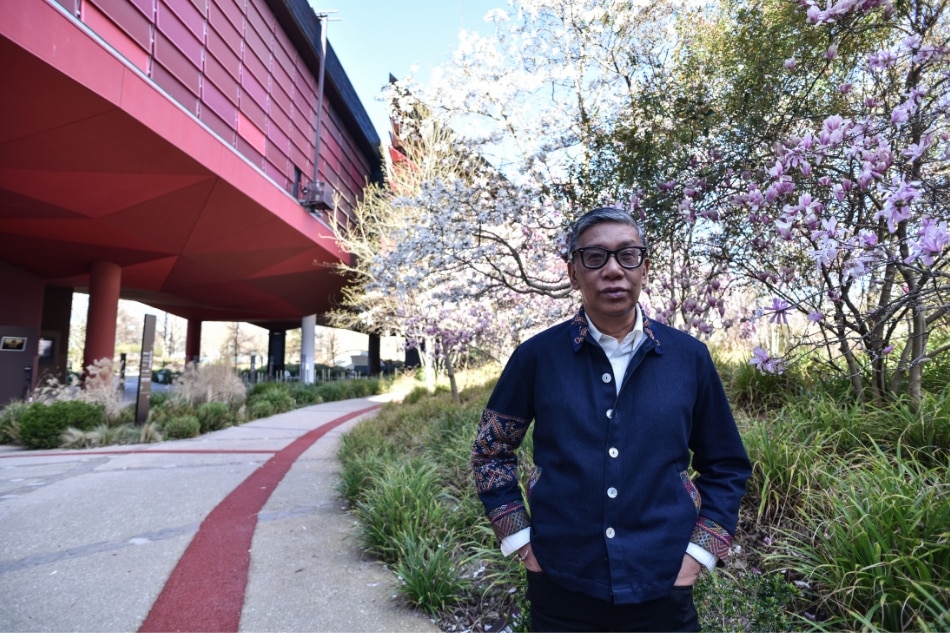
Quintos photographed outside the Musée du Quai Branly in Paris. “My French colleagues would ask me, Okay, how do the objects talk to me? How do we make them engage?” Photographs by Claudio Fleitas.
Some bearing iconographies from the Catholic religion, the anting-anting is one of the many portraits of Hispano-Filipino postcolonial hybridity. Did the Spanish try to make their Gospel more relatable, and the process of evangelization smoother, by incorporating bits and pieces from the native religion? Or did the Filipinos feign allegiance to the Catholic faith while discreetly continuing their animistic ritual under the nose of the colonizer? “That’s the question. It was the kind of dialogue we wanted to highlight,” says Quintos.
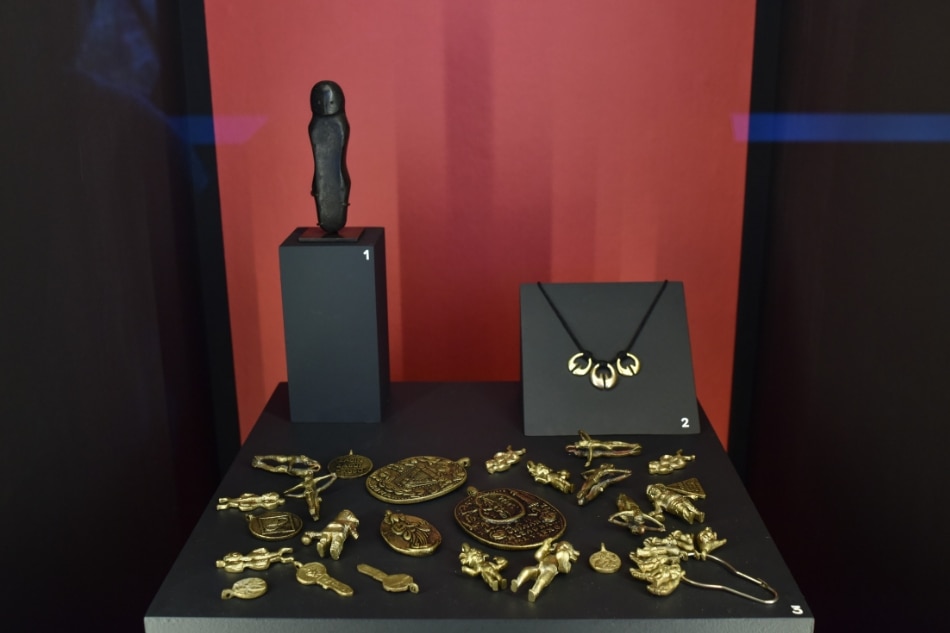
The hi'wong is an Ifugao shaman's amulet functioning as a portable idol (1) while the Lingolingo, also from the Ifugao, is a golden pendant worn to ensure good health, fertility, safety, and bounty. Towering over a collection of commercially-produced amulets (3), it shows the potent pre-colonial origins of the anting-anting and its still-widespread use in contemporary society.
A special nook stripped of protective glass is transformed into a tienda of modern anting-anting, open for people to look closely and even touch. Here, they are less spiritual and somehow devoid of a deeper meaning. Quintos wanted to show how they are today more recognized as popular charms, tailored to augment the spirit or help fix daily woes. It is truly revelatory of the multiple ways we practice our faith in the present. I think of my mother, probably the most Catholic person I know, who keeps her Vatican rosaries next to a Buddha sculpture, or my peers who hear mass on Sundays but wander around with a rose quartz crystal in their coat pocket the rest of the week.
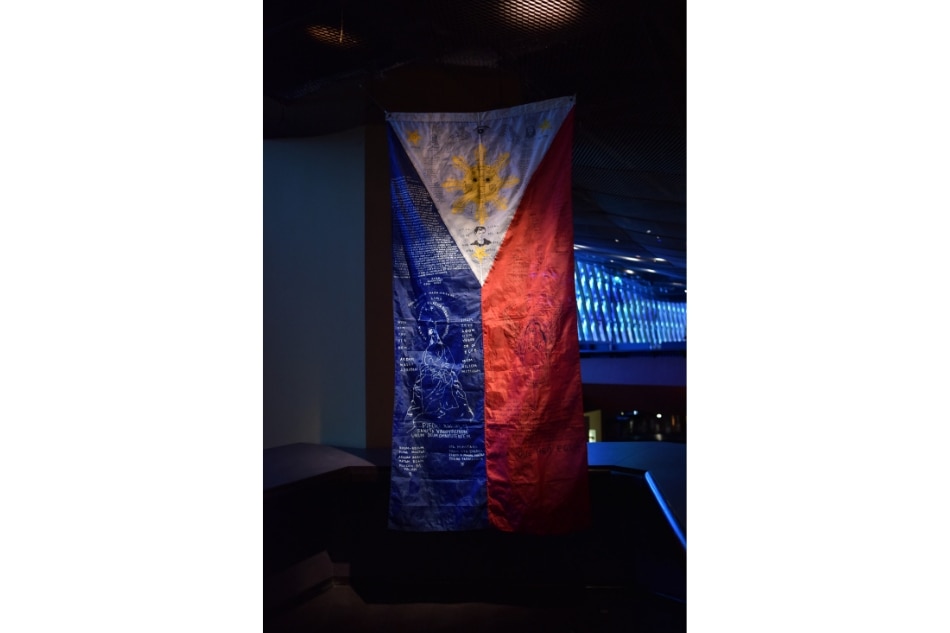
The Philippine flag stenciled with sacred symbols and incantation

The show ends in a juxtaposition of cheap, commercially-made trinkets stacked in a pile under an ancient portable idol carved from stone by the Ifugaos. It shows that the need to always carry a tangible piece of the divine, be it for protection or for luck, is universal and distinctly Filipino. It transcends class, languages, and cultures, and reminds us that everyone, from lovestruck tweens to jittery dispatched soldiers, could use a little help from beyond.

Photographs by Claudio Fleitas
The exhibit Anting-Anting : L'Âme secrète des Philippins runs from March 12 to May 26, 2019 at the Musée du Quai Branly - Jacques Chirac 37 Quai Branly, 75007 Paris, France

Thursday, May 29, 2014

...the Asia's best parks

Rizal Park one of best parks in Asia — survey


MANILA, Philippines - The newly rehabilitated Rizal Park was cited as one of the best parks in Asia, according to the latest survey made by Agoda Company PTE Ltd. (Agoda.com), one of Asia’s leading hotel booking sites.

In a statement, Agoda.com said Rizal Park, also known as Luneta Park, ranked eighth in a competitive regional list.

The output was based on customer feedback and analyzed booking information to present Asia’s highest rated parks and green spaces as selected by Agoda.com customers.

According to Agoda.com, travelers surveyed loved a wide range of green space options from lush expanses of jungle to manicured parklands.

The list includes huge national parks perfect for hiking or outdoor activities, marine parks for diving or kayaking, and green areas in the middle of a city that offer important historical context. All of the entries on the list have left a large enough impression on Agoda.com customers to warrant consistently high ratings.

In the middle of the sprawling Philippine capital, Rizal Park is both a beautiful escape from the traffic and noise and a potent symbol of the country’s tumultuous history.

The park takes its name from national hero Jose Rizal, author and Filipino nationalist who was executed in 1896 for promoting sweeping social reforms during the Spanish colonial era.

The 140-acre park is located next to the famous Intramuros walled city.

It is one of the most popular spots in Manila for locals to picnic, exercise and relax among gardens and greenery.

Adjacent to the park are the Museum of the Filipino People, Department of Tourism and the National Library. An impressive monument to Rizal stands on the western end.

Trivia note: all road distances in the Philippines are measured from Kilometer Zero, just across the street from the Rizal Monument.

In 2011, Rizal Park underwent a massive renovation by the National Parks Development Committee (NPDC) aimed at restoring significant elements of the park.

The plans included the rehabilitation of the old musical dancing fountain located on the 40 m x 100 m pool, which is the geographical center of the park. The renovation was handled by German-Filipino William Schaare, the same person who built the original fountain in the 1960s.

Restoration in the park also included the Flower Clock, which was set for the inauguration on the 113th Philippine Independence Day; the Noli me Tangere Garden and the Luzviminda Boardwalk.

Agoda.com has also provided some great hotel recommendations to round out a perfect trip to visit Rizal Park such as the Manila Hotel, Hotel H2O and Bayleaf Intramuros Hotel.

Other national parks in Asia that made it to Agoda.com’s list are Hallasan National Park Jeju-do, South Korea; Taroko National Park, Taiwan; Osaka Castle Park, Osaka, Japan; Halong Bay, Vietnam; Ang Thong National Marine Park, Ko Samui; Khao Yai National Park, Thailand; and Penang National Park, Malaysia.

Aside from being the leading online hotel reservations company, Agoda.com specializes in securing the lowest discount hotel prices.

Agoda.com includes more than 360,000 hotels worldwide. The multinational staff of more than 1,400 professionals, located throughout the world, provide a first-rate reservation service that uniquely combines local knowledge and local connections to provide the best hotel deals to both business and leisure travelers.


Thursday, November 21, 2013

...the PH seat in UNESCO body

Philippines wins seat in UNESCO'€™s World Heritage Committee


The Ifugao Rice Terraces is one of the five World Heritage Sites in the Philippines designated by UNESCO. (Photo: Lira Dalangin-Fernandez, InterAksyon.com)
 
Tourism in the Philippines got an added boost as the country won a seat in the prestigious World Heritage Committee on Wednesday after elections were held during the 19th Session of the General Assembly of States Parties to the World Heritage Convention.

This year’s elections brought together 22 country candidates who vied for 12 available seats in the Committee.

The Philippines garnered the second highest vote in the elections, having received 116 votes from the total of 173 votes cast. This was a clear indication of States Parties’ support for and belief in the country’s capabilities to perform the important mission of the Committee.

Together with the Philippines, Croatia, Finland, Jamaica, Kazakhstan, Republic of Korea, Lebanon, Peru, Poland, Portugal, Turkey and Viet Nam will now join the other 9 current members of the World Heritage Committee.
 
The Philippines will serve a 4-year term until 2017.

During her remarks before the General Assembly, Ambassador Cristina G. Ortega expressed appreciation for the trust bestowed upon the Philippines. She assured the Assembly that the Philippines will be an active and responsible member who will work hard for the interests of the world’s cultural and natural heritage. She also said “that this is indeed happy news for my country”.

The General Assembly of States Parties meets every two years and elects new members to the World Heritage Committee to replace the outgoing members and it determines the uniform percentage of contributions to the World Heritage Fund applicable to all States Parties.

The 21-member World Heritage Committee is one of the most prestigious bodies associated with UNESCO whose main responsibility is to implement the World Heritage Convention. The Committee decides on whether a property is inscribed in or deleted from the World Heritage List. It examines reports on the state of conservation of inscribed properties and asks States Parties to take action when properties are not being properly managed. It also determines the use of the World Heritage Fund and allocates financial assistance upon requests made by States Parties.

The campaign for the Philippine candidature to the Committee was spearheaded by the Permanent Delegation of the Philippines to UNESCO, led by Ambassador Ortega, with valuable support and coordination provided by the Department of Foreign Affairs and the UNESCO National Commission of the Philippines.


Tuesday, October 22, 2013

...the New 7 Wonder Cities finalists

Vigan among finalists in 'New 7 Wonders Cities' campaign


File photo of the Heritage Village in Vigan City. Val Rodriguez/The Philippine Star
 
MANILA, Philippines - The historic city of Vigan in Ilocos Sur has been included in the shortlist for the "New 7 Wonders Cities" in the world.

Vigan, a United Nations Educational, Scientific and Cultural Organization (UNESCO) World Heritage Site, is the only Philippine city in the list of 28 candidates that were selected as advised by a panel of experts.

Bernard Weber, founder-president of Swiss firm New7Wonders, said the selection of the finalists is "particularly exciting in its variety."

“This outstanding shortlist of 28 cities mirrors the diversity of urban society, especially when, for the first time in history, more than half of our planet’s population lives in cities," Weber said on the New7Wonders website.

Vigan is one of the few Hispanic towns in the country and is best known for its well-preserved colonial architecture.

Like the other finalists, Vigan was selected from an initial long list of 77 voted candidates that also included the cities of Cebu and Iloilo.

The shortlisted cities will now undergo three elimination phases determined by public voting through the New7Wonders website, which will end on December 7, 2014.
 
The 28 finalists are (in alphabetical order):
Athens, Greece
Bangkok, Thailand
Barcelona, Spain
Beirut, Lebanon
Casablanca, Morocco
Chicago, USA
Doha, Qatar
Durban, South Africa
Havana, Cuba
Ho Chi Minh City, Vietnam
Istanbul, Turkey
Kuala Lumpur, Malaysia
Kyoto, Japan
La Paz, Bolivia
London, United Kingdom
Mendoza, Argentina
Mexico City, Mexico
Mumbai, India
Perth, Australia
Phnom Penh, Cambodia
Prague, Czech Republic
Quito, Ecuador
Reykjavik, Iceland
St. Petersburg, Russia
Seoul, South Korea
Shenzhen, China
Vancouver, Canada
Vigan, Philippines

Thursday, January 17, 2013

...the Queen's jubilee awardees

Three Fil-canadians receive Queen's jubilee award


GMA News
January 17, 2013
 
 
Three Filipina-Canadians did the Philippines proud after they were awarded the Diamond Jubilee Medal of Queen Elizabeth II at Toronto's Queen's Park last Dec. 12, the Department of Foreign Affairs (DFA) said on Wednesday.

In a news release posted Wednesday on its website, the DFA said the investiture ceremony was held at the Legislative Building at Toronto’s Queen’s Park.

Awarded the Diamond Jubilee Medal were:
  • Norma Carpio, president of the Philippine Independence Day Council (PIDC), for her leadership in fostering unity and collaboration among Filipinos and other ethnic groups, for promoting Philippine culture and heritage and for organizing cultural festivals and promoting young Filipino talent.
 
 
  • Amy Ada, for her leadership in advocating causes within the Filipino-Canadian community and for showing newcomers to Canadian society need not leave the heritage of their country behind, and
  • Minda Neri, former president of PIDC, for her volunteer work and contributions in promoting cultural understanding through appreciation of Philippine heritage and culture.
 
 
The DFA said the Ontario provincial government distributed around 2,000 Diamond Jubilee Medals to recipients in recognition of their remarkable accomplishments and important contributions to society.

Citizenship and Immigration minister Michael Chan, who presided over the investiture ceremony, lauded the awardees for making a difference, for their inspiration and example, and for their constant efforts to foster a better world.

Philippine Consul-General Junever West represented the Philippine Consulate General in Toronto at the ceremony. - VVP, GMA News

Tuesday, January 15, 2013

...the Sinulog in Dubai


For 1st time, Sinulog festival to be held in Dubai

 
GMA News
January 15, 2013
 
 
Cebuano families in the United Arab Emirates (UAE) may get their first taste of the famous Sinulog Festival there this Friday, Jan. 18, at the Al Safa Stadium in Dubai.

Dubbed the “Sinulog sa UAE Festival 2013,” the festival is expected to bring the Cebuano families in the UAE a brief sense of home.

“It will be celebrated with a Sinulog Dance Festival Competition from 8 a.m. to noon, to be followed by Festival Queen Contest from 1 to 3 p.m.,” United Cebuanos-UAE president Wendell Castro said in an interview with the UAE news site Khaleej Times.

Castro said “Sinulog sa UAE Festival 2013” is the group's first major event and a replica event of the Sinulog Festival in Cebu.

United Cebuanos—UAE is a civic organization of active professional and non-professional Cebuanos residing and working in the UAE.

Castro said Cebuanos in the UAE have had no chance to go home to join the Sinulog celebration held every third Sunday of January.

“We have decided to bring the festivity in Dubai highlighting the acronym C.E.B.U. as Camaraderie among Cebuanos, Engagement in social activities via Filipino Community, Business collaboration and employment opportunity, and Unselfish service to humanity,” he said.

Castro said the festival has been approved by the Sinulog Foundation Inc. and the Cebu City Tourism Commission, the organizers of the Sinulog annual event in the Philippines.

Sinulog promotional materials and photos featuring Cebu as a tourist destination will also be displayed at the exhibition area of the stadium.

Contests

Meanwhile, three Filipino groups will vie for the Sinulog Festival Dance Competition: St Mary’s Dance Group, Filipino Digirati Association and the Filipino Dance Sport Club.

At stake is Dh5,000 cash prize and a trophy.

“We will also give away Dh1,000 as a consolation cash prize for the other participating groups," he said.

A dance parade inside Al Safa Stadium will usher in the “Sinulog sa UAE Festival 2013,” followed by the Festival Queen Competition will start with 10 candidates.

Meanwhile, a bazaar which offers Filipino food will be held at the open stadium that can accommodate 5,000 people.

“This will celebrate the ‘Kainan’ or the eating portion of the festival,” Castro said.

During the festival, Higantes or giant papier maches - though stationary compared to the moving versions in Cebu - and banderitas will show the festive atmosphere of the Sinulog Festival. - VVP, GMA News

Monday, November 26, 2012

...the Cory's legacy

Walesa: Cory made impact on Poland's democracy


Nobel Peace Prize laureate and former President of Poland Lech Walesa on Sunday recognized the influence of the late Philippine President Corazon Aquino on his country's own fight for democracy.

"For sure there were a lot of solutions which she [Cory] gave to us which we could also use in our own building up of democracy," Walesa said on the sidelines of the 9th Media Nation Summit in Tagaytay, where he spoke with the aid of a translator.

Walesa, 69, also spoke of his admiration for the 1986 People Power revolution and its leader Cory, mother of the current president Benigno Aquino III.

Walesa, along with Cory Aquino, Nelson Mandela, and only a few others, is considered one of the symbols of the democratization that swept the world in the late 20th century.

He received the Nobel Peace Prize in 1983 for leading a workers' movement against the communist regime.

He was elected President of the Republic of Poland in 1990 and, during his term, saw Poland through privatization and its transition to a market economy.

Walesa did not elaborate how Cory influenced Poland but said in his speech delivered before journalists at the summit that "in this world nothing happens by accident."

"We always have an impact better or less. It's very difficult to measure what impact it did have," he said.

Also part of his admiration of Cory stems from the Catholic wellspring of Aquino’s faith.

Walesa, as well as the majority of Poles, is a devout Catholic.

Beautiful Philippines


But in his speech, Walesa said there is still a lot to be "corrected" in the Philippines.

"You can do much more here. I see your possibilities," he said.

He specifically said that the country has "so many beautiful things which are not yet used."

"How much beauty there is here... how beautiful the girls here. If I could be a little bit younger I'd stay here," he added with a laugh.

He likewise said that in issues concerning the future of the country, the media plays a big role.

"Media have the most important role in today's world. You have to provoke a discussion. So now media move a little bit," he said.

After losing his re-election bid in 1995, Walesa established the Lech Walesa Institute, enabling him to remain active both on the international stage. — BM/HS, GMA News

Thursday, November 15, 2012

...the destinations on the rise


Metro Manila named among 'destinations on the rise'


Pinoys don't have to look too far for places to explore, as an international travel website named Metro Manila as one of the destinations in Asia that are getting more and more fun.

Trip Advisor ranked the Philippines' capital region fourth in the list of the top 10 Asian "destinations on the rise."

It followed Jakarta, Indonesia; Kathmandu, Nepal; and Calcutta, India.

Rounding out the list of 10 are Bangalore, India; Luang Prabang, Laos; Phnom Penh, Cambodia; Chiang Mai, Thailand; and the Japanese cities of Kobe and Osaka.

Sunset on Manila Bay, one of the best natural harbors in the region. (Yen Baet)

"Located on Manila Bay in the South China Sea, and bisected by the Pasig River, the capital of the Philippines is historic and modern, rich and poor," the website said.

Intramuros, the seat of power during Spanish colonization, is now a park and a popular tourist destination. (Yen Baet)

It highlighted the walled city of Intramuros as one of Metro Manila's popular sights.

"The capital during Spanish colonization, Intramuros has retained old dungeons and gunpowder rooms but added art galleries and theaters," the website said.

The Manila skyline at night. (Yen Baet)

"The city is filled with museums, shops, parks and churches, plus enough nightlife to last until dawn," it added.

This recent accolade for Manila comes as the Department of Tourism on Wednesday launched a new international television campaign promoting entertainment and lifestyle offerings in Metro Manila.

The video dubbed "Sleepless Nights," shows travel, shopping, food options; Manila's clubs and bars at night; as well as other fun events to watch out for.


Trip Advisor meanwhile noted that Manila acts as the gateway to other destinations in the country.

Among the nearby must-see sites it recommended is Corregidor.

"It is called 'The Rock' because it served as the major bastion of Philippine's Allies during World War II," the website said.

In March, Trip Advisor also ranked Boracay Island at the top beach destination in Asia and the sixth in the world.

Globally, Boracay was rated higher than a number of well-known beach destinations in Hawaii, Miami and Mexico.

Sunday, November 11, 2012

...the Pampanga's Star

Pampanga’s ‘parol’ goes global


By Tonette Orejas
Inquirer Central Luzon


CITY OF SAN FERNANDO—Ornamental Christmas lanterns in various shapes and sizes handcrafted in this Pampanga capital have gone global, having been shipped out to many Filipino communities abroad for the Christmas season.


The “Sampernandu parul” (as old folks still call the San Fernando lanterns) has brought its warm glow of lights overseas “to strengthen our Christmas tradition,” according to Mayor Oscar Rodriguez.


“It’s one of their (Filipino communities) connections back home. It reminds them of their families and our country while they work overseas,” Rodriguez said.


In Spanish colonial times, lantern making began in Bacolor, the Athens of Pampanga, a town from which San Fernando was founded. Bacolor was then the capital town of Pampanga, as well as of the entire Philippines under Spanish control.

The faithful lit candles encased in paper lanterns to illuminate the religious processions in this part of Pampanga, which was the seat of Augustinian missions in Central Luzon.

In 1908, salt vendor Francisco Estanislao of Barangay Sta. Lucia at the border of Bacolor shaped a big lantern out of bamboo and coco cloth for the Christmas dawn Masses.

Since then, the lanterns have evolved in design, lighting technique, size and materials and have also spurred household-based enterprises.

Since the first lantern competition in 1931, held to honor First Lady Aurora Quezon, the city government has vigorously promoted the lanterns for other objectives.

“For foreigners to know our city for tourism purposes, to showcase our products, to help our parul makers in finding a market and to show the special skills and talent of our people,” Rodriguez said.

Regular partners in the undertakings are associations of Filipinos, many of them Kapampangans, and embassies or consulates.

Honolulu fest

In December, Filipinos in Honolulu, Hawaii, are holding their first lantern festival.

According to San Fernando tourism officer Ching Pangilinan-Gonzales, the city government is shipping to Hawaii a giant lantern and bringing in craftsmen who will share the basics of lantern making.

The city government also sent out the first set of lanterns to the Philippine Embassy in Poland, she said.

Two giant lanterns will be displayed at the Cathedral of Good Shepherd in Singapore. The traditional beacons will also grace the Philippine embassies in Singapore, Moscow in Russia and Ottawa, Canada.

Pampanga’s pride embellished the Philippine embassy in Bangkok, Thailand, in 2011 just as they did the new Philippine Embassy in Dublin, Ireland; the consulate in Beijing, China; and the Ethnology Museum in Vienna, Austria, in 2010.

In 2009, the Philippine consulate in New York and the Lord Mayor’s House in Dublin decorated the premises with lanterns.

In 2007, they enhanced the Christmas tree that Filipinos put up on the Vienna City Hall grounds in Austria.

In 2006, they were exhibited to commemorate the centennial of Filipino migration to Hawaii and the 60th anniversary of Philippine-Austrian diplomatic relations.

The first documented overseas display of Pampanga’s giant lanterns was in 1979 for the 75th anniversary of the Philippine-Hawaii Commission that year.

In 1989, a giant lantern flickered to delight audiences at the Kunitchiwa Asian Fair in Yokohama, Japan.

In 1992, or just a year after the eruptions of Mt. Pinatubo, 40 kilometers west of Pampanga, a giant lantern was exhibited at the World Expo in Seville, Spain.

In 1993, a float that featured a giant lantern made in San Fernando won first place in the Hollywood Christmas parade.

In 2003, former Tourism Secretary Richard Gordon sent a giant lantern to the Taiwan International Lantern Festival in Taipei.

In 2005, the city joined the 3rd Annual Parol Lantern Parade organized by Filipino-American Development Foundation in California.

Popular craftsmen

Pampanga lanterns also adorned various international exhibits, competitions or contracts undertaken by popular lantern makers like Roland Quiambao and Eric Quiwa.

Quiwa, 40, a descendant of pioneer lantern maker Estanislao, exhibited household and giant lanterns in Seville in 1990, San Diego in California in 1993, Taipei and Hollywood in California in 1995, Dubai in 2008 and 2009, and Hawaii and Singapore this year.

The Cultural Center of the Philippines has also displayed them on its facade since 2011.

Craftsmen in San Fernando helped evolve the traditional lanterns.

From the “papel de japon” (rice paper), the lanterns were soon wrapped in sheets made of capiz (flattened white sea shells), plastic vinyl, handmade paper composed of grass and in the last four years, fiberglass.

From the original candle, the lantern used light bulbs powered by batteries, an initiative of Severino David, son-in-law of Estanislao, in the 1940s.

The bulbs allowed the operators of giant lanterns to switch the lights on and off, in sync with the music played by a brass band.

Mario Datu and Susing Manalang introduced the use of molded steel as the frames of Pampanga lanterns in 1950, replacing the bamboo and wood.

The addition of a rotary motor in 1957 improved the course of illuminating lanterns, by giving out the illusion of dancing lights and shadows. The rotor is credited to David’s son, Rodolfo.

By the 1970s, the small lanterns provided “dancing lights” through sequencers, which were appropriately attuned to international safety regulations, and which opened the opportunity for Pampanga lanterns to be exported.

Village beacon

The “ligligan parul” (lantern festival) has been sustained through “bayanihan” (volunteerism). Residents of a village contribute money, materials and food so their community can construct a fresh lantern and join a local contest.

The tourism ministry supported the festival for the first time in 1975.

No festival was held in 1978 and 1979 because then Mayor Armando Biliwang canceled the event due to martial rule.

Gov. Estelito Mendoza revived the festival in 1980. Mayor Vicente Macalino standardized the size of giant lanterns to a ceiling of 3 meters (at present, authorities allow lanterns to loom as large as 5.4 m in diameter) and began the policy of providing subsidies of up to P5,000 in 1982.

Held on Dec. 22, 1990, the festival was highlighted by two lanterns participating in the event, one of which was shaped by Ernesto Quiwa, a grandson of Estanislao.

In 2007, the subsidies were increased to P125,000, but lantern makers said that represented only a quarter of the P500,000 needed to make an outstanding lantern.

The first lanterns were exported in 1987 during the term of Mayor Virgilio Sanchez.

Robert David, another grandson of Estanislao, made lanterns to adorn the roofs of the Paskuhan Village and the Bren Z. Guiao Convention Center, both in San Fernando.

David also attempted to set a world record but failed to build a 31.5-m-tall lantern in 2002.

Tourist attraction

The lanterns are a Hall of Fame titlist in the Department of Trade and Industry’s One-Town One-Product (OTOP) program.

The festival draws foreign and local dignitaries as well as tourists. In 2007, Nileema Noble, United Nations resident coordinator in the Philippines, said: “Magnificent! The efforts here to preserve heritage and tradition are flourishing.”

There is no school that trains for the craft of lantern making, Pampanga-style.

Edwin David Jr., 29, learned by “albe-albe” (watching) or “ilig” (preference) or “tuki-tuki” (tagging along).

Fifth-generation lantern makers like Eric Quiwa are convinced that the rotor cannot be replaced by computers. “It really gives the lanterns the magical effect of dancing lights,” he said.

Computers are only used to design the lanterns, Eric added. His 19-year-old son, Carl Ernesto, and his 15-year-old nephew, Christian Lervin, have been learning the craft by observing, helping out and running errands.

In this year’s festival on Dec. 15 at the Robinsons Starmills in San Fernando, Eric expects to win the best lantern—his third in a row.

Saturday, November 10, 2012

...the UN Heritage Site Management awardee

Vigan City bags UN award for heritage site management


Keeping history alive is apparently more fun in the Philippines, with Vigan City bagging a United Nations award for world heritage site management.

The UN Educational, Scientific and Cultural Organization (UNESCO) has recently given the city in Ilocos Sur its first-ever "Best practice in World Heritage Site Management" award as the international body ended the 40th World Heritage Convention in Japan Thursday.

Vigan City bested 27 other cities from 23 countries considered for the recognition, which UNESCO said is aimed at highlighting challenges to world heritage conservation, lessons learned, priorities and opportunities.

"Vigan's successful and sustainable management has been achieved with relatively limited resources, which should make it adaptable to sites in all countries..." UNESCO said.

"[T]he local community is well integrated into many aspects of the sustainable conservation and management of the property; and a multi-faceted approach to the protection of the site has been developed," it added.

This year’s convention theme "World Heritage and Sustainable Development: the Role of Local Communities" highlighted the need to marry conservation programs with local community growth.

Vigan City, famous for conserving early architecture and other features, was named a world heritage site in December 1999.
"Vigan is an exceptionally intact and well-preserved example of a European trading town in East and South-East Asia," UNESCO said in its website.

"The architecture is truly reflective of its roots in both materials and design, in its fusion of Asian building design and construction with European colonial architecture and planning," it added.

The case of Vigan City and other sites discussed in this year's World Heritage Convention, UNESCO said, may "enrich current debates about the implementation" of conservation projects the international body is set to name the 1000th world heritage site.

Sunday, October 14, 2012

...the contemporary PH arts

Buyers snap up works of PH artists


Speculators see upside in value of Philippine contemporary art

By Tina Arceo-Dumlao
Philippine Daily Inquirer


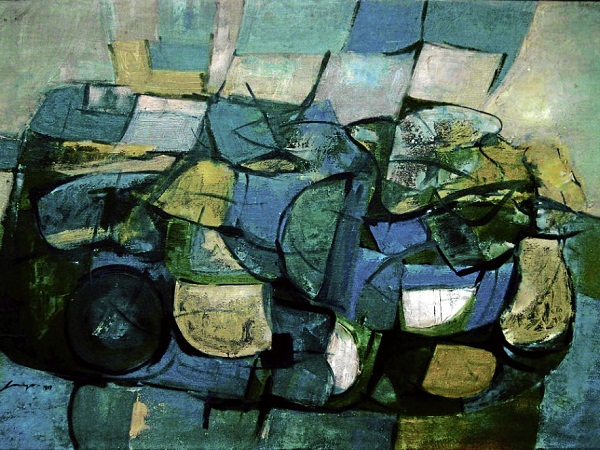
Jose Joya’s 1957 “Untitled (Abstract)” sold for P1,868,800.


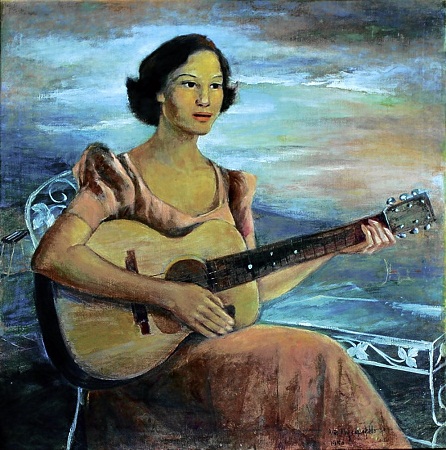
During the Important Philippine Art auction held by Salcedo Auctions on Sept. 22, Anita Magsaysay-Ho’s 1950 oil painting “Lady with Guitar” sold for P6.307 million, a whopping 425 percent over the painting’s estimated value of P1.2 million to P1.4 million.

Ronald Ventura’s “Burnout”, meanwhile, topped the estimate by an even higher margin of 569 percent. The 2005 oil on canvas with collage sold for a hefty P5.022 million, far exceeding the estimate of between P750,000 and P850,000 for the piece measuring 90.7 centimeters by 60.7 centimeters.

According to Karen Kua-Lerma, president of Salcedo Auctions, the “tremendous upsurge” in the prices that both foreign and local buyers are willing to pay for Philippine art indicated the growing reputation of Philippine artists in the international art scene, as the country’s own image abroad has improved dramatically since the Aquino administration took over in 2010.


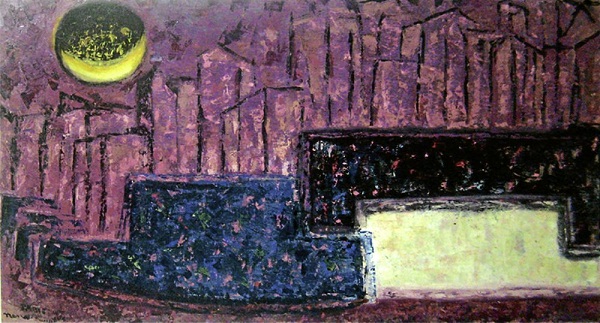
Nena Saguil’s 1956 “Paris at Night” fetched P759,200.

 
“It was not so long ago when news of a painting by a Filipino artist selling for P3 million was such a big deal. But now prices are rising and there seems to be no end to the increase,” says Karen, who put up Salcedo Auctions with husband, Ramon, in February 2010.

Karen points out that, apart from Filipinos who are either long-time art collectors or are looking to put a stamp on their growing wealth by collecting pieces of art, many foreigners also participated in the auction last Sept. 22.


Anita Magsaysay Ho’s “Lady with Guitar” (1950) went for P6,307,200.


Most foreign and local buyers collect these pieces with the hope that they will appreciate significantly in value down the road—much like how investors put their money in stocks with the intent of selling them later at a significant premium.

For these speculators, contemporary art pieces by young artists such as Ventura and Jose John Santos III are attractive because these present the best chances of appreciating significantly in value in just a few years.

Ramon, who is advisor of Salcedo Auctions and chief curator of the Ateneo Art Gallery, explains that these exponents of contemporary art are interesting to collectors because the prices they command are not yet fixed, and are in fact trending higher.

He compares them to speculative stocks on the Philippine Stock Exchange. There is great risk in purchasing these stocks issued by companies whose track record still needs to be tested. But they also promise the highest reward when and if their potential is unleashed.
 

An art enthusiast Ronald spent P5,022,400 to acquire Ronald Ventura’s “Burnout” (2005).


The works of National Artists, on the other hand, are more like the so-called blue chip stocks. The prices are set, appreciation is slow, but there is also very little risk of prices plummeting since there is general agreement on how much the art pieces are worth.

During the auction, for example, the 1957 piece of National Artist Jose Joya was sold for P1.868 million, not far from the high end of the 57.2 cm by 86.4 cm oil painting’s estimated value of P1.2 to P1.5 million.

Ramon explains that there are no hard and fast rules when it comes to putting a value to a piece of art as there are many factors that come into play, not the least of which is taste.

“Besides what the art piece represents, people are also looking at credentials. Ronald Ventura, for example, did not just pop out of the woodwork. He is critically acclaimed and he has won a number of awards,” says Ramon.
 

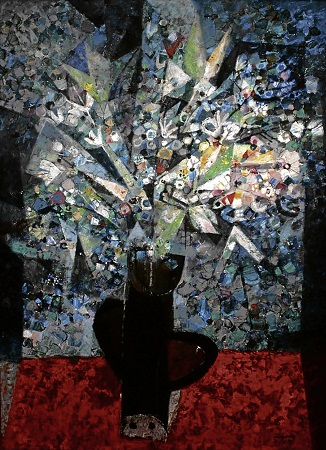
Mauro Malang Santos’ oil on canvas, “Still Life with Vase and Flowers” (1980), was sold for P934,400.


The value of the artwork of contemporary artists, he says, is mainly created by four art advocates. These are the institutions that give out awards or museums that mount exhibits; the commercial art market, or the galleries and auction houses that sell the pieces; reputable private collectors and finally the art critics.

The value, however, is ultimately decided by the buyer.

“You cannot really put a peso sign on the beauty. Ang Kiukok’s work used to shock people because of the angst and the subject matter. But now his art is called beautiful. There is a consensus among these advocates that his art is good,” says Ramon.

Ramon stresses, however, that the prices of contemporary art are also being driven by the global appetite for contemporary art that people want to keep in their homes, and not just sell to the highest bidder.

“Conversations” (2005) by Jose John Santos III was sold for P3,036,800.


“Globally, the appetite for contemporary art started growing in 2005. With the Internet and globalization, and with more people traveling, collectors now want to buy works from overseas and not just collect work done in their own countries,” says Karen.

Veteran and neophyte Filipino collectors are not far behind in the art collection scene, and they see their purchases of local art pieces by both the young and established artists as a vote of confidence in their own country.

“These young artists represent dynamism and confidence in this emerging economy. And how better to represent that emergence in the global scene than an artist selling well?” says Ramon.

There is also equally strong demand for works by established artists from Filipino buyers because they see these pieces as representations of Philippine heritage and culture. By buying a piece of art, they also get a piece of Philippine history.

“Many Filipinos see the purchases as a vote of confidence in the country, and the interest reflects the bullish sentiment prevailing in the country today,” he adds.

“For Philippine artists, this is a great time,” Ramon says.