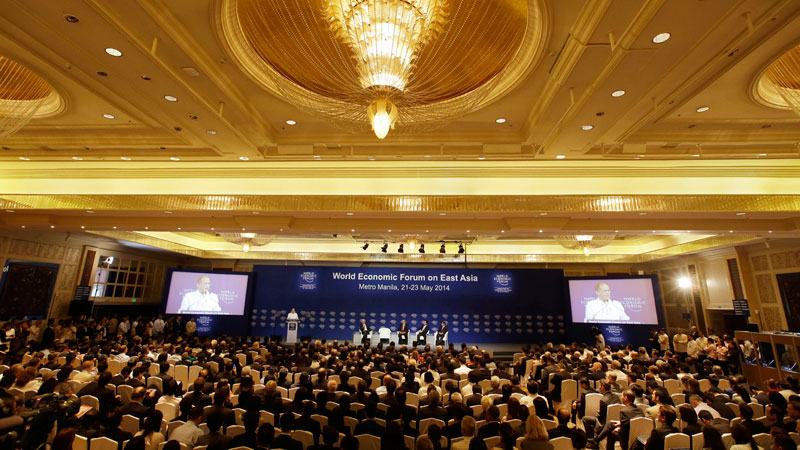
Philippine President Benigno Aquino III
delivers his speech at the opening of the two-day World Economic Forum on Asia
in May 22, 2014, at the financial district of Makati city east of Manila,
Philippines. The Philippines’ successful hosting of the World Economic Forum on
East Asia last week opened the world’s eyes to the country’s renaissance amid
challenging global and regional developments. AP Photo/Bullit Marquez
(First of two parts)
MANILA, Philippines—The Philippines’ successful hosting of the
World Economic Forum (WEF) on East Asia last week opened the world’s eyes to the
country’s renaissance amid challenging global and regional developments and at
the same time raised hopes that Filipino creativity and youth dynamism would be
the salvation of a nation weary of boom-bust cycles.
President Aquino took advantage of the event to highlight the
country’s economic turnaround anchored on governance reforms as well as the
nation’s resilience following the devastation caused by Typhoon Yolanda
(international name: Haiyan). Aquino was also a diplomatic host and avoided
talking about the country’s territorial dispute with China.
Territorial disputes were brought to the fore when Vietnam’s Prime
Minister Nguyen Tan Dung—one of the heads of state who attended the WEF
summit—gave a fiery speech against China’s territorial aggression during the
opening plenary. After the emotional speech, WEF founder and executive chair
Klaus Schwab had to immediately clarify that the WEF was a neutral platform and
appealed to the parties to discuss peaceful solutions.
Instead of discussing China, Aquino dwelt more on how reforms were
bearing fruit and benefiting ordinary Filipinos. He also spoke about the
momentum being “irreversible,” to allay concerns that governance reforms would
be put in jeopardy when his term ends in 2016.
‘PH has got it right’
“The key takeaway for the Philippines is a very strong articulation
of the case for the Philippines. I myself am a longtime observer of the
Philippines and aware of sometimes the weariness and skepticism due to many
rounds the country had gone through of what seemed like a revival but were
frustrated by politics one thing or another,” said John Pang, a visiting scholar
from New York University and the chair of WEF’s Global Advisory Council on
Southeast Asia. “Despite the natural disasters, it has really got it right,”
Pang said.
“There’s a very strong sense that the Philippines is on track. It’s
back and there’s a lot to look forward to. I think that it has managed to
communicate to the world how the fundamentals work and how these fundamental
advantages can be sustained,” he added.
Pang, a Malaysian academic and management consultant, has spent a
lot of time looking at Southeast Asian economies as founder and former head of
CIMB Asean Research Institute Ltd., which was created by the CIMB group as an
independent research institute to further the integration agenda of the
Association of Southeast Asian Nations.
“It’s great to be here in the Philippines at a time when the level
of self-confidence and hope is so high. Understandably, this year’s East Asia
Summit reflects the same exuberance and high spirits. But of course, there’s a
lot more hard work to be done both on the public and private sectors,” added
Malaysian Karim Raslan, chief executive officer of KRA Group, a Southeast Asian
public affairs consulting firm specializing in stakeholder relations, political
risk and business advisory.
Raslan, who was among the panelists at the session “Philippines:
The Next Asian Miracle,” had the most memorable line in that session when he
said Aquino had a “charisma deficit” but noted that he had “delivered” anyway.
For such a leader, Raslan said one six-year term may not be enough and urged the
current regime to use its political capital to “change the rulebook.”
For Pang, the Philippines had done a “tremendous” job hosting the
East Asia Summit. The welcome reception hosted by the Ayala group on Wednesday
night, he said, was “by any standard, quite a show and spirit of organization.”
Best of Filipino talent
The Ayala group’s reception for WEF delegates at the Ayala Triangle
featured the best of Filipino talent through traditional dance numbers, a
fashion show and a mini-concert by Lani Misalucha who wowed the audience,
especially the foreigners who watched her for the first time. It also featured
Filipino creativity by featuring furniture pieces proudly made in the
Philippines.
Gary Valenciano and Jed Madela, on the other hand, top-billed the
cultural show hosted by Aquino at the Philippine International Convention Center
on Thursday night.
So-Young Kang, founder and chief executive officer of
Singapore-based transformation design firm Awaken Group and part of WEF’s Young
Global Leader (YGL) community, said she was “highly impressed” by the quality of
people from the local service industry as well as the mindset of the young
Filipinos she interacted with at the forum.
Indeed, what left a lasting impression on the foreign delegates who
attended the three-day summit was the people: the high quality of Filipino
talent and the growing mass of young people who are eager to make a difference
and cement the country’s gains.
After the main event in Metro Manila, the US-educated Kang was
among those who flew to Mactan, Cebu, to attend the YGL-led side summit Open
Collaboration with East Asia New Champions 2014 (OCEAN14) at Movenpick Hotel.
“Overall, if I include WEF and also OCEAN14, I think my No. 1
takeaway is that Filipino people are so nice, so service-oriented,” Kang said.
Guillermo Luz, private sector cochair of the National
Competitiveness Council, said that from the start of the conference planning,
the Philippine team felt it was important to highlight the creativity of
Filipinos.
“The Philippines of course, that’s the storyline—big turnaround
since the new administration.
There’s no question in anyone’s mind that
governance was a big factor behind it and they can see the results in terms of
the economy growing at 7 percent, the improvement in competitiveness ranking and
investment grade,” Luz said.
‘One of the best’ WEF summits
But on top of these, Luz said this summit also showed Filipino
organizational skills in working with the WEF and likewise manifested creativity
as a people.
Because most of the events during the three-day East Asia Summit
were within the Makati central business district, heavy traffic in the
metropolis was not much of an issue, at least for the participants. To ensure
seamless transfer to the cultural show held at PICC, there were lanes dedicated
to the shuttles from Makati City.
“They (delegates) were agog over the music, the passion, the
entertainment part that showed off the Filipino creativity. Maybe what they
don’t know is even the furniture placement around WEF are Filipino-made
including (the creations of) Kenneth Cobonpue,” Luz said, noting the furniture
pieces that were strategically placed in the lounge where bilateral meetings
took place.
He added that some foreign delegates and East Asia Summit veterans
had even said that the meeting in the Philippines was “one of the best” WEF East
Asia Summits they had ever attended.
Over 600 top leaders in business, policymaking, media, academia and
civil society from 30 different countries gathered in Metro Manila for three
days of discussions on key global, regional and industry agendas most relevant
to East Asia.
Issues linked to the upcoming integration of 10 member-states of
Asean into a unified Asean Economic Community (AEC) by 2015 cornered much of the
discussions inside and outside the formal sessions alongside key challenges such
as inclusive growth, infrastructure backlog, skills gap and food security.
Hope for the country
As the country seeks new legs to sustain its economic growth,
proponents of the so-called creative economy championed by British author and
professor John Howkins—who first published a book on how to turn ideas into
money in 2001—hope to see this segment playing a bigger role in the Philippine
economy.
The creative economy comprises advertising, architecture, art,
crafts, design, fashion, film, music, performing arts, publishing, R&D
(research and development), software, toys and games, TV and radio and video
games where Filipinos naturally excel in.
Filipino youth dynamism also left a good impression among foreign
delegates.
With a population of some 100 million and average age of 23, the
young were an integral part of the East Asia conversations and the young
Filipino delegates—especially the social entrepreneurs and advocates of
different causes—were great ambassadors for the Philippines.
(Editor’s Note: The author is a member of WEF’s Young Global
Leaders Class of 2014).

With our country emerging as one of the fastest growing
economies in the world, it should come as no surprise that Manila was chosen to
host the
2014 World Economic Forum (WEF) on East Asia. As
the new toast of the town among the global business elite, the Philippines --
along the likes of Mexico – has transformed into one of the
most promising emerging markets in the early-21st
century.
Meanwhile, the giant economies of China, Brazil, Russia, and India have
been struggling with varying forms of “middle income trap”, as inflation,
slowing growth, and policy paralysis undermine decades of robust economic
expansion. In turn, the
Philippines has managed to amass huge foreign
exchange reserves and score above-average growth rates with relatively low
inflation and interest rates.
Under the stewardship of the Aquino administration, there has been
greater commitment to “good governance”, as exemplified by the ongoing
anti-corruption initiatives and investigations.
Host to about $300 billion in untapped mineral
reserves, Mindanao is poised to benefit from large-scale foreign investments
amid an increasingly promising peace process, which has paved the way for the
establishment of the Bangsamoro state. No wonder, given our country’s youthful
population, natural resources, myriad of tourist attractions, and huge reserve
of skilled labor, it has become fashionable these days to talk about the
Philippines as the new tiger economy of Asia.
In conjunction with the WEF, I had the privilege to join a
distinguished panel of speakers in the 2014 Bloomberg Leadership Forum, in
partnership with the Department of Finance (DOF), where we extensively discussed
two inter-related questions of utmost significance: Whether the Philippines’
recent economic boom is sustainable, and whether it is poised to become a new
tiger economy.
From our exchanges, it was quite evident that the panelists, featuring
leading businessmen, policy-makers, and bankers in the region, more or less
agreed on one thing: The Philippines suffers from an “infrastructure deficit”,
which could seriously undermine the country’s long-term development trajectory.
In addition, a more careful look at the Philippines’ recent economic growth also
suggests that our biggest problem is that
our growth is not trickling down to the greater
population. In this sense, our challenge is not only to sustain high growth
rates, but to ensure that our growth is meaningful and consequential to the
greater population.
The Real Challenge
Despite years of robust economic expansion, the Philippines continues
to suffer from a glaring absence of inclusive growth. Poverty and unemployment
figures have hardly changed, while inequality is intensifying. Few major
businesses swallow newly-generated growth, while the majority of the population
is yet to benefit from the recent economic boom.
Much of our recent growth has been anchored by
real estate expansion and low- to medium-end services. Hard-earned remittances
from abroad have fuelled domestic consumption. In light of the continuing
failure of our land reform program, rural poverty has forced millions of our
citizens to search for better opportunities in increasingly congested urban
centers, which provide cheap labour for few major conglomerates. Due to
massive annual debt-payment (about 20% of our
national budget in recent decades) and low tax-collection rates, the Philippine
government still has one of the lowest spending rates on education and health in
the developing world. Widespread corruption only compounds the situation.
In contrast, the tiger economies of Asia (South Korea and Taiwan)
largely relied on successful land-reform, export-oriented manufacturing, and
domestic capital to fuel decades of sustained economic expansion. Unless we make
our growth more inclusive, there is a high probability that the Philippines will
lose economic momentum in the medium- to long-run.
The Infrastructure Imperative
Developments in neighboring Southeast Asian countries have placed the
Philippines in a more positive light. Thailand has been engulfed by a vicious
political crisis, and the recent establishment of a military government has
drawn international criticism and widespread opposition at home. In Vietnam,
anti-China protests turned into a massive destruction of industrial plants owned
by China and Taiwan, precipitating the exodus of thousands of Chinese citizens.
Indonesia, in turn,
has drawn huge criticism for imposing new
protectionist measures against foreign investments, especially in the lucrative
mining sector.
As the Philippines packages itself as an attractive investment
destination in a highly competitive neighborhood, it seems quite scandalous that
we continue to have one of the world’s worst airports. Due to legal squabbling,
our government has struggled to efficiently transfer international flights to
alternative sites. Our infrastructure spending is among the lowest in Asia,
dwarfed by comparable economies such as Indonesia. The Aquino administration is
set to double infrastructure spending, but it is yet to finalize a single
Private-Public-Partnership (PPP) project, and the recent corruption scandals
will further complicate budget-allocation for and implementation of strategic
infrastructure projects.
Our transportation and communications infrastructure are highly
underdeveloped. Commuting is a daily struggle for millions of ordinary
Filipinos, while top government officials and businessmen benefit from
convenient private transport. The internet speed in the Philippines, meanwhile,
is among the slowest in Asia, while few companies make huge profits in a
tightly-contested market.
Attracting high-quality foreign investment is crucial to our national
development, since global companies have the resources and technology to
turbo-charge industrialization and provide well-paying employment opportunities
for the greater majority of the population. The Philippines has caught the
attention of the international community, but it will continue to struggle to
attract foreign direct investments unless it creates a robust physical
infrastructure and a more stable regulatory environment. And this will require a
committed and visionary leadership well beyond the current administration’s
term.
_____________________________________________________________________________
Richard Javad Heydarian teaches
political science and international relations at the Ateneo De Manila
University, and is a columnist for “Asia Times” and “The Huffington Post.” As a
foreign affairs specialist, he has regularly presented at varying local and
international conferences and panel discussions, and been interviewed by leading
media outlets such as Aljazeera, BBC, Bloomberg, CCTV, The New York Times, NPR,
among other publications. He can be reached at jrheydarian@gmail.com