Showing posts with label multisports. Show all posts

Saturday, November 30, 2019

...The Southeast Asian Game host (opening)

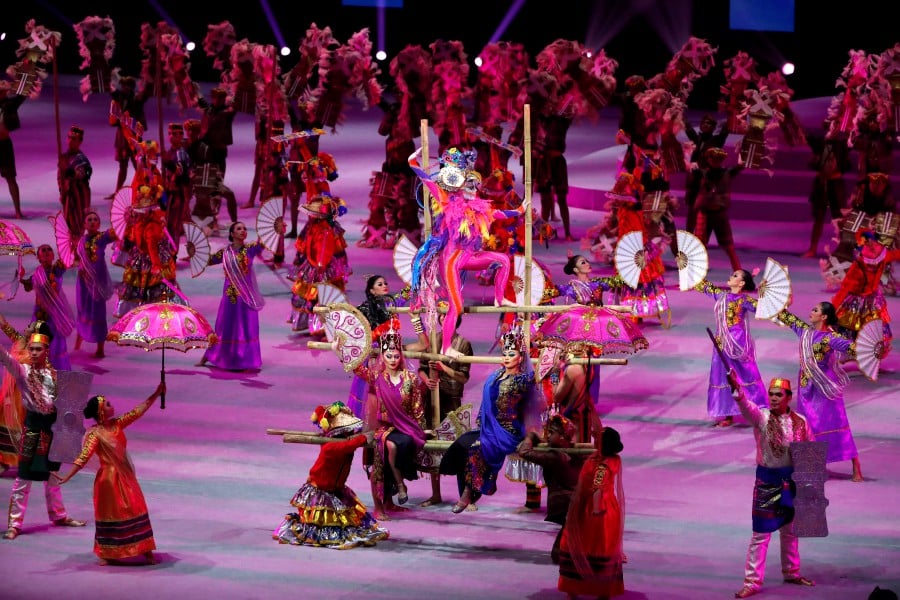
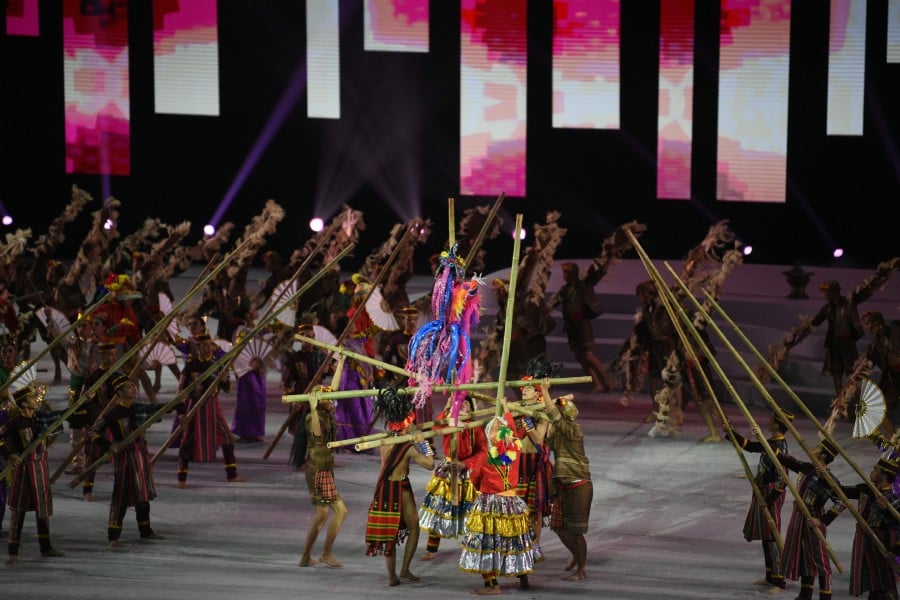
Philippines showcases cultural heritage to kick off 30th Sea Games

New Straits Times
30 November 2019


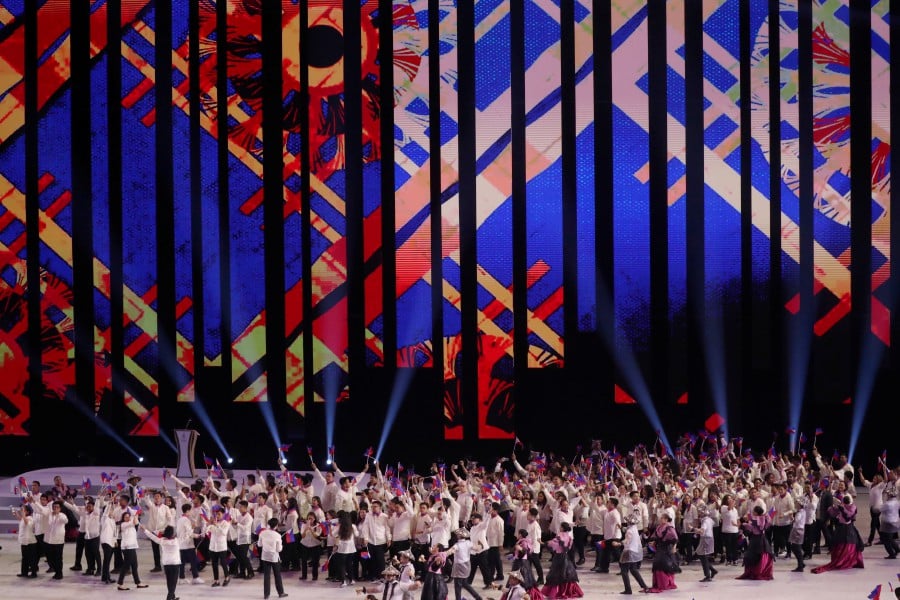
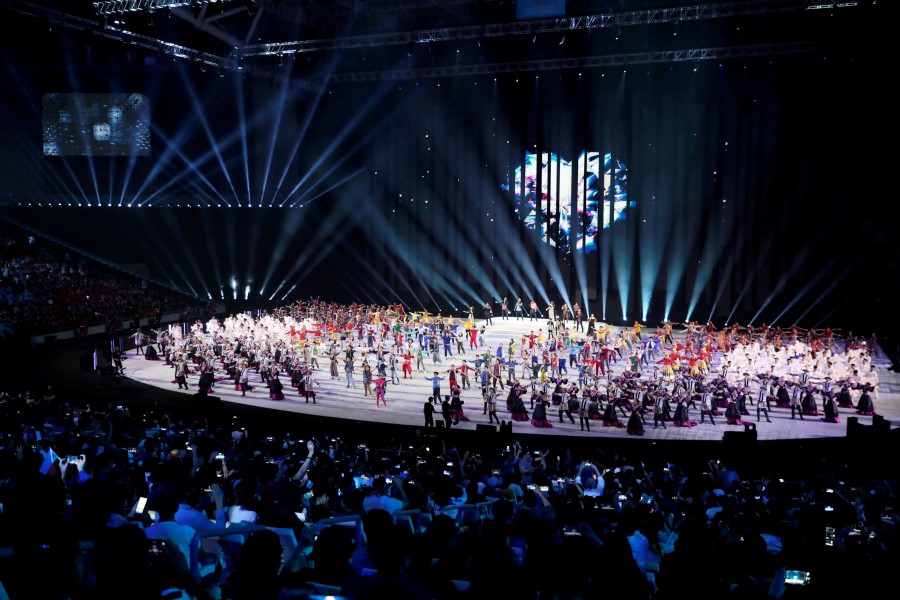
MANILA: The Philippines staged a spectacular opening ceremony for the 30th SEA Games at the world’s biggest indoor arena, the Philippine Arena, in Bulacan, near here, tonight.


In a departure from tradition, the opening ceremony was held in an indoor arena rather than a stadium.


Also, for the first time in the biennial Games’ 60-year history, the games cauldron was placed at a different location, at the New Clark City Athletics Stadium, some 90km from Bulacan, and the lighting of the cauldron was shown on screen at the 55,000 capacity arena.

The extravaganza started after Filipino singer Lani Misalucha sang the republic’s national anthem, which was followed by an extraordinary performance themed “The Roots of our Strength”, showcasing the culture and heritage of the nation.
The spectators were treated to a series of warrior dances from the Bagobo, the Kalinga, the Maguindanao, Islamic and the pre-Hispanic Visayans.

The later part of the ceremony was powered by modern and hip-hop performances led by local artistes Inigo Pascual, Robert Sena, Apl.de.Ap and KZ Tandingan, among others.
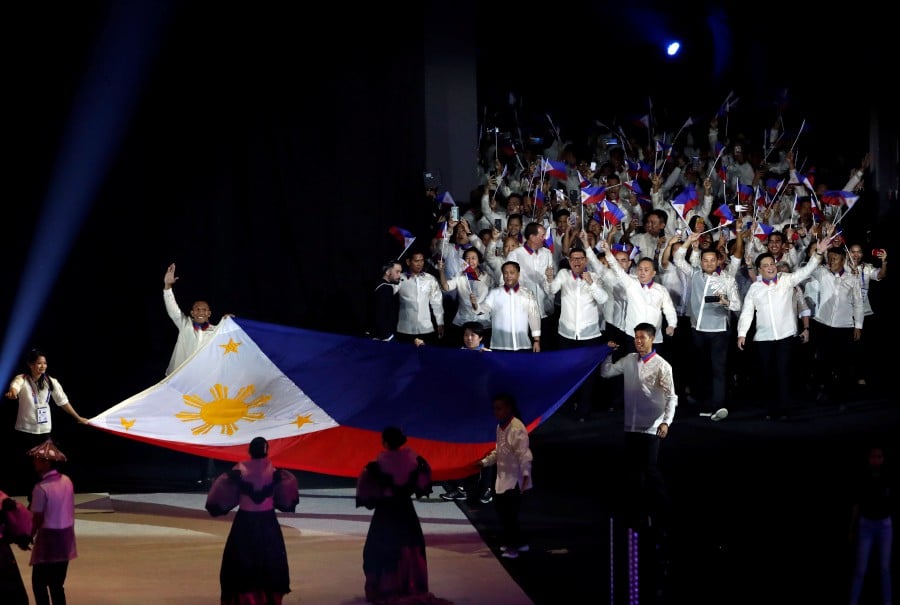
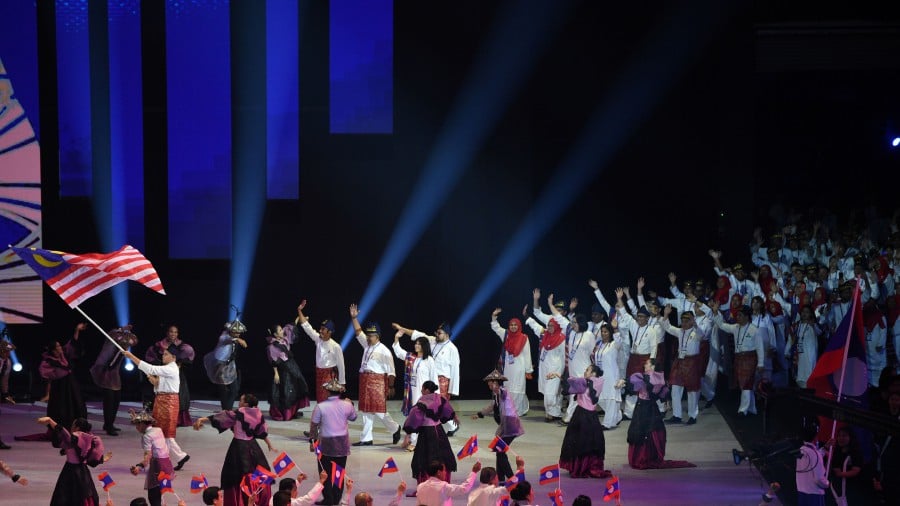
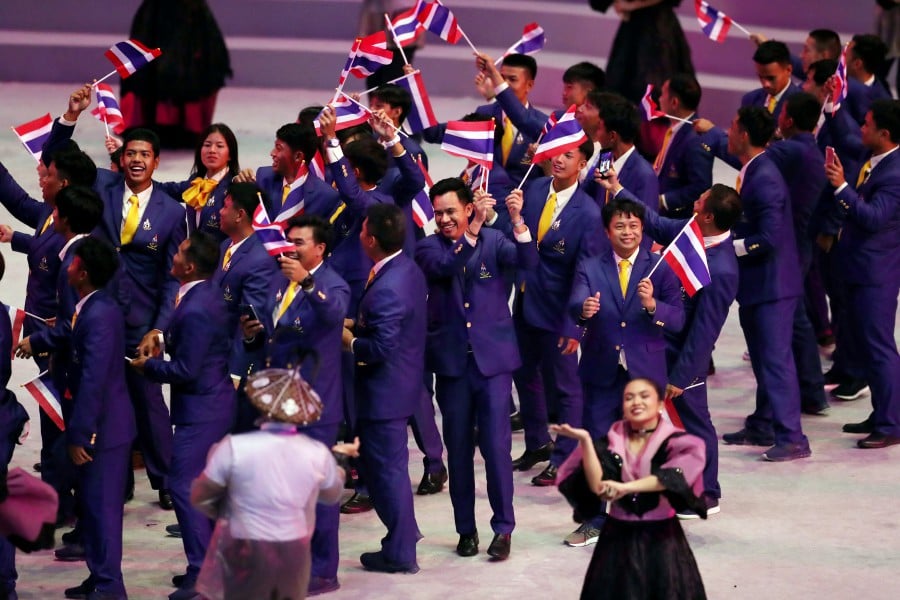
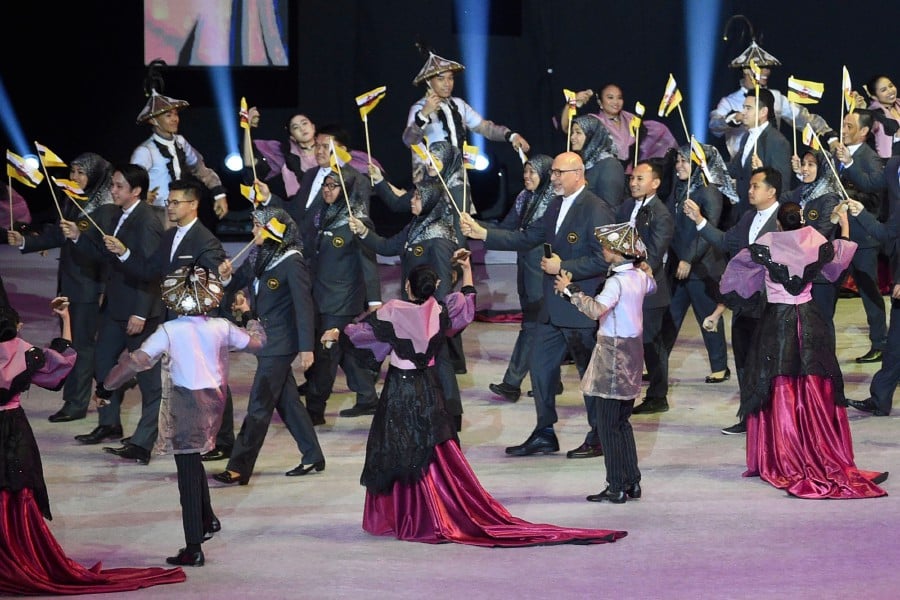
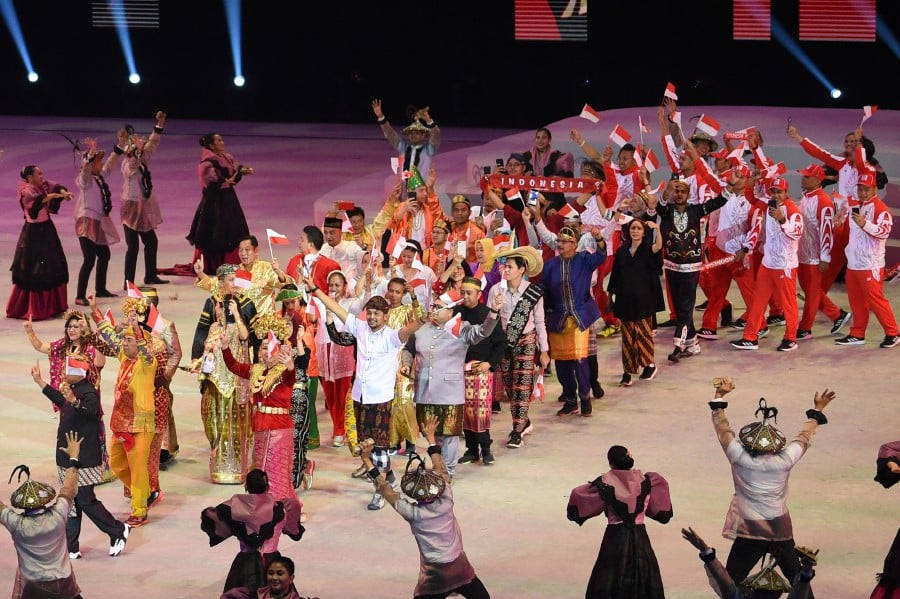
The contingents received loud cheers from the audience as they paraded into the arena in alphabetical order, starting with Brunei, Cambodia, Indonesia, Laos, Malaysia, Myanmar, Singapore, Thailand, Timor Leste and Vietnam, before host nation the Philippines ended the march.

Led by flag-bearer and 2018 bowling world champion Rafiq Ismail, the Malaysian contingent were represented by a delegation of about 100, including chef de mission Datuk Megat Zulkarnain Omardin and his two deputies, Nurul Huda Abdullah and Ahmad Faedzal Md Ramli.


With the men dressed in white baju melayu and red samping with tengkolok, and the women in white baju kurung and selendang with Jalur Gemilang motif, and black shoes, the multi-racial Malaysian contingent, the hosts of the previous games, walked past the crowd proudly, symbolising the multiculturalism of the country.

World renowned Filipino boxers Manny Pacquiao and Nesthy Petecio were given the honour as the torchbearers before they jointly lit the cauldron to officially mark the beginning of the 30th SEA Games, after Philippine President Rodrigo Duterte had declared open the Games.

Themed ‘We Win As One’, the Games will run for 12 days until the closing ceremony at the New Clark City Athletics Stadium on Dec 11.
More than 8,000 athletes from the 10 ASEAN countries and Timor Leste will compete in 530 events in 56 sports at the three main clusters, namely Manila, Clark and Subic.


The Philippines have hosted the SEA Games three times before – in 1981, 1991 and 2005.
This year’s Games see the introduction of a few new sports such as arnis, jujitsu, kickboxing, underwater hockey and esports.

Defending champions Malaysia have sent a strong contingent of 773 athletes and 339 officials to participate in 52 sports, targeting 70 gold, 51 silver and 105 bronze medals, which is expected to place them fourth overall.– BERNAMA

Wednesday, October 9, 2019

...the Ju Jitsu next big hub

The Philippines could be the next big hub for Jiu-Jitsu superstars


With height and physical strength not much of a factor, and our longstanding heritage in combat sports, the grappling martial art can be the next big thing for Pinoy athletes. And, with its debut in the Southeast Asian Games next month, our fighters can showcase what they've got to the rest of the world.


Nissi Icasiano
ABS-CBN Sports
09 October 2019


Grappling is one of the oldest forms of combat in the world. Cave drawings in France from over 15,000 years ago appear to depict people engaged in acts of grappling. Babylonian and Egyptian artifacts show people employing most of the maneuvers known today. In Greece, wrestling served as the main attraction in the ancient Olympic Games. 


Various grappling disciplines evolved across the globe, including Sumo in Japan, Turkish oil wrestling, and Uzbekistan’s Kurash among others. In the Philippines, traditional indigenous martial arts are practiced in different regions like Bultong in the Cordilleras, Dumog in Western Visayas, and Layug in Central Visayas and Mindanao.

Due to American colonization, modern-style wrestling made its way into the country and has remained up to the present time. Many Filipinos have etched marks in this field, notably in the 1954 Asian Games, where Nicolas Arcales and Mansueto Napilay brought home silver medals, and Basilio Fabila captured bronze. It was the only year in Asian Games history that the Philippines claimed medals in wrestling. Filipino wrestlers were privileged to compete at the Summer Olympics from 1936 to 1988. Since the implementation of continental qualifiers the year after, not a single grappler has had the opportunity to set foot on an Olympic mat.

Next big thing

Through lifelong Filipino martial artist Alvin Aguilar in the mid-90s, Brazilian Jiu-Jitsu was formally introduced in the Philippines. The grappling art was formed from the Kodokan Judo fundamentals that were taught by a number of individuals, including pioneers Takeo Yano, Mitsuyo Maeda, Soshihiro Satake, and Isao Okano.

Brazilian Jiu-Jitsu eventually came to be its own discipline through the experiments, practices, and adaptation of Judo through Carlos and Helio Gracie in the 1900s. Though our nation is heavily engrossed with basketball, boxing, billiards, and currently volleyball, one Filipino practitioner believes that Brazilian Jiu-Jitsu could find a foothold in the Parthenon of Philippine sports.

Franco Rulloda, who earned his black belt in Brazilian Jiu-Jitsu under the tutelage of Aguilar last May, sees a bright future for Filipinos in the sport because, unlike basketball, it does not require height. It is built on the concept that a smaller person can successfully defend against a bigger and heavier assailant. This you can do by using proper technique, leverage, and taking the fight to the ground before applying joint-locks and chokeholds to subdue the opponent.

“The fighting spirit and passion for combat sports makes Brazilian Jiu-jitsu perfect for Filipinos,” Rulloda explains. “It is honing one’s physical attributes and using acquired knowledge to his or her advantage. It does not require too much strength, height, and athleticism.”

Rulloda points out that a lot of our prominent and successful athletes come from combat sports.

 “Manny Pacquiao, Nonito Donaire, Eduard Folayang, and the list goes on. Fighting has been ingrained in every Pinoy’s DNA,” he says. “Martial arts have deep roots in Filipino culture. History has proven that Filipinos have that warrior spirit.”

There are already a handful of Filipino competitors who have made a name for themselves internationally, including Meggie Ochoa and May Masuda. Ochoa captured three-straight gold medals from 2014 to 2016 at the World Jiu-Jitsu Championship or the Mundials. On the other hand, Masuda became the first Filipina to snare a gold medal at the Mundials in 2009.

Eros Baluyot, meanwhile, had his career-defining moment in 2010 by bagging a gold medal at the age of 17. Joey Lepiten, Gian Dee, Kaila Napolis, Annie Ramirez, Kim Custodio, Vince Ortiz, and Marc Lim have likewise made it to the podium in different overseas tourneys.

“Filipinos learn fast. We somehow have this gene attributed to absorbing techniques quickly and applying them right away. We are dedicated athletes. We put our heart and soul into whatever it is we are doing. We invest so much in our endeavors, and we are passionate about what we believe in,” Rulloda says.

Making a mark

The Philippines now houses the most number of Brazilian Jiu-Jitsu black belts in Southeast Asia: Aguilar, Rulloda, Masuda, John Baylon, Fritz Rodriguez, Pichon Garcia, Allan Co, Toffy Ilagan, Froilan Sarenas, among others.

Currently, there are 10 clubs in the country that have been recognized by the International Brazilian Jiu-Jitsu Federation including DEFTAC-Ribeiro, Atos Philippines, KMA-Fabricio, John Baylon BJJ, and Cobrinha BJJ Manila.

Aguilar, who holds the distinction as the first homegrown black belt here, says the sport has come a long way since he first piloted a small class in his garage. “Back then, Jiu-Jitsu was only comprised of four or five people. Right now, we have at least more than a thousand competitors,” he shares. “I am very happy with the level and the standard that we’ve already established here in the Philippines because we’ve produced a lot of champions.”

The pioneering fighter says that we are definitely number one in Southeast Asia, and top three in Asia. “These are the things we should take advantage of. We have so many good grapplers. Everybody here is so good, not just from my team,” he adds. “You put them in any gym around the world, and they will always be able to produce.”

Brazilian Jiu-Jitsu in the Philippines made significant strides last year when both Philippine Olympic Committee and Philippine Sports Commission declared the Jiu-Jitsu Federation of the Philippines as the sport's national governing body. The sport will also make its much-awaited debut at the Southeast Asian Games, which our country will host from November 30 to December 11.

Ochoa is more than excited to participate in the regional biennial meet, as she doesn’t get a lot of opportunities to compete in her country. “It is a big deal because we’re the host, and I’m definitely going to prepare for that,” she says, “Not just me but every Filipino athlete is going to prepare for that. We want to show what we are really capable of.”

 Spreading the gospel

Despite the success of a few homegrown talents in Brazilian Jiu-Jitsu, Rulloda admitted that it still has a lot of work to do to adapt to Filipino taste. “The growth has been steady through the years. However, the biggest hindrance to the growth of the art is the lack of awareness of what really happens in an actual self-defense situation and how Jiu-Jitsu can be an effective tool for it,” he stresses. “The sporting aspect has a slow progress because the low awareness level leads to low exposure and that results in difficulty of getting sponsorships for deserving athletes.”

To help in this cause, Rulloda stages a yearly tournament called Arte Suave Manila. It started in 2015, and aims to excite at a grassroots level. “Whatever noise this event will create is going to help the future of these athletes. I want them to get exposed, I want them to be discovered, and I want them to get sponsors,” he reveals.

The two-day competition originally focused on white and blue belters, but it opened its doors to purple belts in 2016. One of its main attractions is the submission-only super-fights, where combatants will contend in a ten-minute match. If there is no submission by the end of the given time, a draw will be declared.

Arte Suave Manila is set to hold its fifth annual event from October 19 to 20 at the Commercenter Alabang in Muntinlupa, and Rulloda is expecting a promising turnout. “It is a league by fighters, for fighters. The sport is growing in the country, and so we’re expecting to see high-level Jiu-Jitsu displayed on the mats again this year,” he promises.

Rulloda reiterates that Filipinos have the potential to do great things in the sport. “We can take Jiu-Jitsu to the next level, not only here in our country, but to the Asian level, and even worldwide,” he declares.
Monday, January 28, 2013

...the 2012 Fighter of the Year

US boxing scribes hail Donaire as Fighter of the Year


Nonito Donaire Jr.


MANILA, Philippines – WBO super bantamweight champion Nonito Donaire Jr. has been named the 2012 Fighter of the Year by the Boxing Writers Association of America.

Donaire clinched the award on strength of a spectacular year wherein he fought and won four times against high-caliber opponents. He decisioned Wilfredo Vazquez in February last year, outpointed Jeffrey Mathebula in July, stopped Toshiaki Nishioka in October, then finally retired Mexican Jorge Arce in December.

This marks the fourth time in the last seven years that a Filipino boxer has won the award – also called the Sugar Ray Robinson award – with boxing icon Manny Pacquiao achieving the feat in 2006, 2008 and 2009.

Donaire plans to sustain the momentum brought by a stellar 2012 by eyeing more marquee fights this year. He is reportedly eyeing a bout against either WBC super bantamweight champion Abner Mares or WBA super bantamweight titlist Guillermo Rigondeaux.

Donaire is targeting to return to the ring by April.

Meanwhile, for his exemplary corner work on Donaire and fellow title holders Mikey Garcia and Brandon Rios, trainer Robert Garcia was hailed as the BWAA’s Trainer of the Year.

The BWAA also recognized the fourth fight between Pacquiao and rival Juan Manuel Marquez last December as its 2012 Fight of the Year. In the action-packed bout that saw vicious exchanges and several knockdowns, Marquez knocked Pacquiao out cold in the sixth round to cap off their storied rivalry.
 
Pacquiao and Marquez might meet for a fifth time this September.

Other BWAA awardees include Al Haymon (Manager of the Year), HBO boxing panelist Max Kellerman (Excellence in Boxing Journalism), middleweight Danny Jacobs (Courage in Overcoming Adversity), promoter Kathy Duva and matchmaker Bruce Tampler (Barney Nagler awar for “Long and Meritorious Service” in boxing), Showtime broadcaster Steve Farhood (Marvin Kohn "Good Guy" award), Dave Kindred (Nat Fleischer award for "Excellence in Boxing Journalism") and Peter Finney (A.J. Liebling award for "Outstanding Boxing Writing").

The BWAA said it will fete the awardees in a banquet in New York this spring.

Monday, November 12, 2012

...the PH Jins in Korea

PH-Smart Jins Clinch Five Golds


November 11, 2012
Manila Bulletin


The Philippine/SMART taekwondo team boosted its preparation for the Southeast Asian Games by bagging five gold, seven silver and 14 bronze medals in kyorugi (sparring) and poomsae (forms) events of the recent Korea Open international championships in Gyeongju, Korea.

The PH/SMART jins won gold in the junior sparring competition through Aaron James Galita, Keno Anthony Mendoza, Francios Aaron Agojo, Patricia Francesca Gonzalez and Inna Izabella Dionisio.

John Paul Lizardo led the silver medalists in sparring, nosing out an American in the quarters and knocking out the Korean Asian champion in the semis before falling to a Russian in the finals.

The other sparring semifinalists in the tourney which was participated by more than 1,000 athletes were Samuel Thomas Harper Morrison, Gershon Bautista and Kristhoper Robert Uy.

Korina Paladin produced the other PH silver medal in junior women’s sparring, while Ernesto Guzman Jr. and Mikeala Calamba pocketed a silver medal each in poomsae.

The bronze medal winners in sparring were Christian Aldela Cruz in senior men, Ma. Isabela Erika Mora and Mary Anjelay Pelaez in senior women, King Philip Pineda. Mathew Michael Padilla and Benjamin Keith Sembrano in junior men, Bianca Go, Melanie Hope Douglas, Cleio Marie Banez, Nicole Abigail Cham and Suzanne Glehn Caslangen.

The bronze medalists in poomsae were Rinna Babanto, the men’s team of Jean Pierre Sabido, Galilee Tinaya and Vidal Marvin Gabriel and the women’s team of Rani Ann Ortega, Ma. Carla Janice Lagman and Beatrice Ann Ventura.

Wednesday, September 5, 2012

...the paralympian

Fil-Am wins 2 gold medals in London Paralympics

09/05/2012


REDWOOD, California - Filipino-American athlete Raymond Martin bagged two Olympic medals at the London 2012 Paralympic Games over the weekend.

The 18-year-old Martin struck gold in the men's T-52 100 meters where he raced to the finish line in 17.02 seconds to win the first US Paralympic track and field's gold in the Games on Sunday.


In the men's T-52 400 meters race, Martin crossed the finish line in 58.54 seconds beating Japan to win his second gold Monday.

Martin has two more races to go this week.

The track and field athlete was born with a congenital deformity called Freeman Sheldon Syndrome.

He was in preschool when he learned to race in his wheelchair. At age 7, he was already competing at the National Junior Disability Championship.

Martin was also one of the nominees under the category “Best Male Athlete with Disability” in ESPN’s 2012 ESPY awards.

“It’s a huge deal, it just means that all my hard work is paying off and I’m just really excited about all of it,” he said. With a report from Don Tagala, ABS-CBN North America News Bureau

Wednesday, March 21, 2012

...the Olympic torch bearer

Pinoy in UK to carry Olympic torch for OFWs

 
March 21, 2012
 
 
Reymund Enteria, a Filipino occupational therapist in the United Kingdom will be carrying the torch for some nine million overseas Filipino workers (OFWs) around the world in the 2012 Olympics this July.

The 30-year-old, who hails from Antipolo City, disclosed to GMA News Online via e-mail that he will be running on July 22, the last Sunday before the Olympic’s opening ceremony at the Barking and Dagenham Borough of London.

“I am running in behalf of the OFWs,” he wrote, adding that he received the news only last Saturday, after waiting for five months. “I was very surprised [because] I’m not an athlete—just an ordinary individual.”
 
Enteria said he was proud to represent his fellow OFWs, who he said are “not all about money, but courage and determination.”

Currently working for a medical center based in Tonbridge Kent, Enteria was chosen as one of the 8,000 “Coca-Cola Future Flame” participants, or the “inspirational people who will carry the Olympic Flame” as it goes around this year’s host country for 70 days.
 
The list for the torch relay, made public on Monday, has 7,300 confirmed places. It is posted at http://www.london2012.com/games/olympic-torch-relay/torchbearers/.
 
In a blog entry he wrote for the UK-based Filipino site AdoboRice.com, Enteria said he entered the “Future Flame” call for nominations with his insights on the sacrifices of OFW families, which he drew from the fact that he eventually followed in his mother’s footsteps of working abroad. 
 
The occupational therapist said the first kind of loneliness that he had to endure as part of an OFW family was being apart from his mother, who left the Philippines for a better job overseas when he was only nine years old.
 
His mother, he said, worked abroad for four years with two-year contracts that left them with no choice but to communicate via snail mail and expensive long distance phone calls.
 
Years later as a licensed occupational therapist, Enteria would leave his career beginnings in the Philippines to work in Saudi Arabia, where he first experienced the loneliness of being apart from his family, coupled by “differences in employment benefits and beliefs.”
 
“I went to Saudi Arabia with thoughts of using that opportunity as a stepping stone to be in a much better place like the UK or the USA,” he wrote on his AdoboRice.com piece. “The reality is that inequality happens [there]… I [had] the same job like other OTs (occupational therapists), but we received [different] salaries and [because I’m] from the Philippines, mine was the lowest rate.”
 
The hopes he pinned on his sacrifices in the Arab country paid off, however. Aside from the chance to provide for his family, Enteria said he was “recognized in the biggest rehabilitation hospital in the Middle East, where I became the first OT to handle the newly opened brain injury unit.”
 
Two years into his work in Saudi Arabia, he got an offer from UK’s The Raphael Medical Center, where he has been working as a full-time OT specialist for more than four years.
 
Saying that not all OFWs are “lucky” to work with good employers, Enteria will dedicate his torch-bearing run to his fellow Filipinos abroad, who have to sacrifice a lot of things and bear with loneliness in order to give their families a better life.
 
“It is true that we OFWs are considered modern heroes as we help not only our families but also the growth of [the] economy. All overseas workers, particularly the Filipinos, deserve to be recognized as inspiring individuals who have burning passion of spreading happiness to others,” he wrote. - VVP, GMA News

Thursday, January 26, 2012

...the most powerful athlethes

Pacquiao among most powerful athletes

01/26/2012

MANILA, Philippines – Filipino boxing icon and Sarangani Rep. Manny Pacquiao is one of the most powerful athletes in the world, according to a list released by Bloomberg/Businessweek Wednesday (Thursday in Manila).

The Power 100 2012 was developed by CSE, an integrated sports and marketing firm and Horrow Sports Ventures. They take into account an athlete’s on-field and off-field attributes in developing their ratings.


Manny Pacquiao outranks rival Floyd Mayweather Jr. in Bloomberg's Power 100 list.
On-field attributes consider the athlete’s rankings within his own sport; in boxing, it considers the athlete’s world rankings.


Off-field attributes, meanwhile, are comprised of expected endorsement potential, endorsement earnings and social-media presence.


Pacquiao, the reigning World Boxing Organization welterweight champion, is ranked No. 28 in the Power 100 2012, four places lower than his No. 24 rank in 2011.


Bloomberg/Businessweek puts Pacquiao’s earnings at $50 million, with Nike, Hewlett-Packard and Henessy as his key sponsors.


“The most Web-searched athlete in 2011, according to Google, Pacman the Destroyer holds world championships in eight different weight divisions. Controversy may have helped fuel the Internet interest as Pacquiao was booed after a clsoe win against Juan Manuel Marquez and endless talk that Pacquiao might fight Floyd Mayweather,” Bloomberg/Businessweek noted.


“Pacquiao is also a Philippine politician and singer who has become more recognizable in recent years with new high-profile commercials such as those for the HP TouchPad.”


Mayweather also in the list

Meanwhile, undefeated American boxer Floyd Mayweather Jr. made his way back to the list after not being included last year.


Mayweather is ranked 49th with $40 million in total earnings. His key sponsor is SMS Audio.


“Unbeaten in his professional boxing career, Floyd Mayweather Jr. has won six world boxing championships in five differen weight classes. He’s recently drummed up a lot of attention for calling on eight-division world champion Manny Pacquiao to fight him,” Bloomber/Businessweek said.


“If Pacquiao accepts, it will have to wait until Mayweather finishes an 87-day jail sentence for pleading guilty to domestic violence and harassment charges.”


Pacquiao and Mayweather were the only boxers on the list, which was dominated by players of the National Football League.


New Orleans Saints quarterback Drew Brees was ranked No. 1, followed by Green Bay Packers quarterback Aaron Rodgers at No. 2 and New England Patriots quarterback Tom Brady at No. 3.


The Miami Heat’s LeBron James is the highest ranked basketball player on the list at No. 4.
Tennis superstar Rafael Nadal rounds out the top 5.

Saturday, December 3, 2011

...the Athlete of the Year nominees

Pacquiao nominated as USSA 'Athlete of the Year'


12/03/2011


MANILA, Philippines – Boxing superstar Manny Pacquiao is among the 12 nominees for the United States Sports Academy's (USSA) 2011 Male Athlete of the Year.


Philboxing.com reported that Pacquiao was nominated together with David Beckham (soccer), Patrick Chan (figure skating), Novak Djokovic (tennis), Kirani James (track and field), Ryan Lochte (swimming), Rory McIlroy (golf), Geoffrey Mutai (marathon), Dirk Nowitzki (basketball), Aaron Rodgers (football), Kohei Uchimura (gymnastics) and Justin Verlander (baseball).

The annual awarding rites, which also recognize a female athlete, are held in cooperation with USA Today and NBC Sports.

The 12 nominees for USSA’s “Female Athlete of the Year” are Miki Ando (figure skating), Seimone Augustus (basketball), Tatyana Chernova (track and field), Kim Clijsters (tennis), English Gardner (college track and field), Carmelita Jeter (track and field), Li Na (tennis), Federica Pellegrini (swimming), Yani Tseng (golf), Lindsey Vonn (skiing), Jordyn Wieber (gymnastics) and Chrissie Wellington (triathlon).

Sunday, November 20, 2011

...the gold diggers

SEA Games: Philippine men’s baseball, rowing teams strike gold


By Celest R. Flores
Philippine Daily Inquirer


MANILA, Philippines—The Philippine men’s baseball team, which bucked funding woes to get to Indonesia, delivered a gold medal for the country in the 26th Southeast Asian Games.

The baseball squad bucked adversity and raced to a 2-0 win over Indonesia in the finals Sunday behind an overall effort and clutch pitching from ace Darwin de la Calzada.

The Filipino clouters almost didn’t make it to the biennial competition because of lack of funding from the Philippine Sports Commission. They were only given the green light after a businessman, Marty Eizmendi, came to the rescue of the team.

Meanwhile, the Philippine dragonboat team also caught gold in the 20-man crew for the 500 meter traditional boat race with a time of 01:53.950.

The Filipino rowers edged Myanmar (01:54.120) and Thailand (01:56.210) for the title and also settled for silver in the standard men’s 500m race.

Alfie Catalan toppled his Indonesian rivals and claimed the 4000m individual pursuit title for the gold medal in cycling.

In weightlifting, Hidilyn Diaz took home the silver in the 58kg women’s category, which brought the Philippines’ medal haul as of 7 p.m. Sunday at 25-45-63 (gold, silver, bronze).


SEA Games: Sinag Pilipinas outclass Thailand to bag basketball gold

Sinag Pilipinas outclassed the Thailand squad on the back of a big second quarter run to win 85-57. - OMG, GMA News

Monday, November 14, 2011

...the medal haul of the day (at SEA games 2011)

Athletics and taekwondo bag two golds each for PHL


A new Games record and four gold medals were the highlights of a fairly productive haul by Team Philippines on the second day of competition at the 26th Southeast Asian Games in Indonesia, with athletics and taekwondo contributing two golds apiece, even as the hosts began pulling away in the overall medal count.


Long jumper Marestella Torres successfully defended her SEA Games title, setting a new meet record of 6.71 meters to bag the country's first gold medal early Saturday morning. The new mark bested the previous record, also held by Torres, of 6.67 meters set two years ago Laos. It's also a new Philippine record.

A couple of hours later, the taekwondo trio of Rani Ortega, Camille Alarilla and Janice Lagman produced the second goal by topping the pomsae women's team competition. This was followed by jin Maria Camille Manalo winning the under-62 kilogram female category of taekwondo for the Philippines' third gold.

Later in the day, Rene Herrera came through in the 3,000-meter steeplechase with a gold-medal winning time of 8:52.23 to bring the Philippines' total haul to four golds on top of two silvers and five bronzes, good enough for fifth place overall. The two silvers were courtesy of Joey Barba in the 1.5K mountain bike downhill race and the poomsae pair of Marvin Gabriel Vidal and Shaneen Ched Sia.

Athletics chipped in two bronzes from Khatherine Santos in the women's long jump and Loralie Sermona in the women's hammer throw, while karatedo also had two bronzes courtesy of OJ Delos Santos in the male individual kata and Erica Celin Samonte in the 50kg and below kumite. The fifth bronze came from Vidal in the male individual poomsae.

The news from other disciplines wasn't all good, though, as our badminton bets in the men's team and women's team events were ousted in the quarterfinals. The young swimming team also came up empty-handed, with Jose Joaquin Gonzales missing out on the bronze in the men's 400m individual medley by two seconds and Jasmine Alkhaidi finishing sixth in the women's 200m freestyle. Lee Dhill Anderson was also sixth in the men's 50m butterfly.

In the new SEAG sport of bridge, the men's team beat Singapore, 21-9, and Malaysia, 25-1, but lost to Thailand, 4-25, and Indonesia, 14-16. The women's team beat Thailand, 22-8, but bowed to Singapore, 14-16, and Indonesia, 11-19.

Softball produced mixed results, with the men's team falling to Indonesia, 2-4, and the women's team blasting Thailand, 10-1. Meanwhile, in sepak takraw, the Philippines lost to Indonesia, 3-0 in men's regu.

Host Indonesia was a juggernaut on several fronts, bagging 20 gold medals today to raise its total to 22, which was more than the combined golds of Singapore, Thailand, and Vietnam. At the end of the day, Indonesia stood at 22-15-10, followed by Singapore's 8-7-8. First-day leader Thailand, which won three golds yesterday, won another three and was at third with a 6-9-9 count. Vietnam was fourth with 6-7-10.

The hosts struck heavily in karatedo (five gold medals), roller sport (four), athletics (four), and taekwondo (three). As usual, Singapore ruled the pool with four golds and two silvers in swimming.

It will be another heavy day on Sunday Team Philippines, with Filipino bets seeing action in 11 of 12 athletics events, as well as in 11 other sports including billiards, bridge, diving, men's football, gymnastics, pentaque, softball, sport climbing, sepak takraw, swimming, tennis and water polo.

Wednesday, July 20, 2011

...the Asian Games (formalized)

Philippines to host 2013 Asiad Centennial Games

By June Navarro
Philippine Daily Inquirer


MANILA — The Olympic Council of Asia has designated the Philippines as host of the Centennial Asian Games celebration in 2013.

Philippine Olympic Committee chair Monico Puentevella yesterday said athletes and officials from the 45 member-countries of OCA are expected to participate in what will be called the Asian Unity Games to be held in late November 2013 in world famous Boracay.

Puentevella said the Philippine Olympic Committee president Jose “Peping” Cojuangco Jr. immediately formed an executive task force after the OCA approved the hosting during its general assembly meeting last week in Tokyo.

Cojuangco and Puentevella made the pitch to host the event which was also attended by POC secretary general Steve Hontiveros and OCA athletes commission member Mikee Jaworski.

The Asian Games started as the Far Eastern Games, which had its inaugural in Manila 1913. The first Asian Games was held in 1951 in New Delhi.

Puentevella said outstanding athletes all over Asia in the last 100 years will be invited while active national athletes from the 45 nations will compete in several disciplines, including beach volleyball and open sea marathon.

“We haven’t hosted an event of such magnitude in the last 50 years or so,” said Puentevella, whose father, the late Jesus Puentevella, donned the national colors in tennis and baseball during the 1st Far Eastern Games.

Friday, July 8, 2011

...the Olympic medal haul

PHL team bags 49 medals in Special Olympics in Greece


Philippine athletes won 49 medals in the 2011 Special Olympics World Games held in Athens, Greece, from June 25 to July 4, the Department of Foreign Affairs (DFA) said Friday.

Of the 49 medals, 21 were gold, 13 were silver, and 15 were bronze, the DFA said in a statement.

“Team Philippines won gold medals in athletics, powerlifting, swimming, bocce, and rhythmic gymnastics, while the silver and bronze medals were also won in these five sports events, in addition to bowling and badminton," the DFA said.

It added the 47-member Philippine delegation had participated in seven of 22 sports events at the Special Olympics. More than 7,000 athletes from nearly 180 countries competed in the games.

The DFA said the Philippine delegation included 38 intellectually challenged athletes and their coaches and trainers. Leading the Philippine team was Ma. Theresa Macapagal, president of Special Olympics Philippines.

According to the DFA, the Philippine Embassy in Athens gave full support to the athletes during the 10-day Special Olympics.

The DFA said present during the opening ceremonies were international celebrities such as Stevie Wonder, Vanessa Williams, and Zhang Ziyi, and sports icons Yao Ming, Nadia Comaneci, and Michelle Kwan.

“The Filipino community members cheered the Philippine athletes during the various competitions as well as during the opening ceremonies on June 25 at the historic Kallimarmaron Panthinaikon Olympic Stadium, the site of the first Olympic Games of the modern era," the DFA said.

The DFA also said the embassy hosted a “meryenda" of cookies and ice cream for the athletes at the embassy premises on June 21. At the event, swimming gold medalist Raymond Macasaet and bowling silver medalist Roxanne Ng rendered heartfelt song numbers to the delight of the staff.

On July 3, members of the Philippine team also enjoyed a hearty dinner of Filipino food at the embassy to celebrate the victory of the Philippine team during the sports event. — JE, GMA News