Showing posts with label Singapore. Show all posts

Saturday, November 30, 2019

...The Southeast Asian Game host (opening)

Philippines showcases cultural heritage to kick off 30th Sea Games

New Straits Times
30 November 2019


MANILA: The Philippines staged a spectacular opening ceremony for the 30th SEA Games at the world’s biggest indoor arena, the Philippine Arena, in Bulacan, near here, tonight.


In a departure from tradition, the opening ceremony was held in an indoor arena rather than a stadium.




Also, for the first time in the biennial Games’ 60-year history, the games cauldron was placed at a different location, at the New Clark City Athletics Stadium, some 90km from Bulacan, and the lighting of the cauldron was shown on screen at the 55,000 capacity arena.

The extravaganza started after Filipino singer Lani Misalucha sang the republic’s national anthem, which was followed by an extraordinary performance themed “The Roots of our Strength”, showcasing the culture and heritage of the nation.
The spectators were treated to a series of warrior dances from the Bagobo, the Kalinga, the Maguindanao, Islamic and the pre-Hispanic Visayans.

The later part of the ceremony was powered by modern and hip-hop performances led by local artistes Inigo Pascual, Robert Sena, Apl.de.Ap and KZ Tandingan, among others.
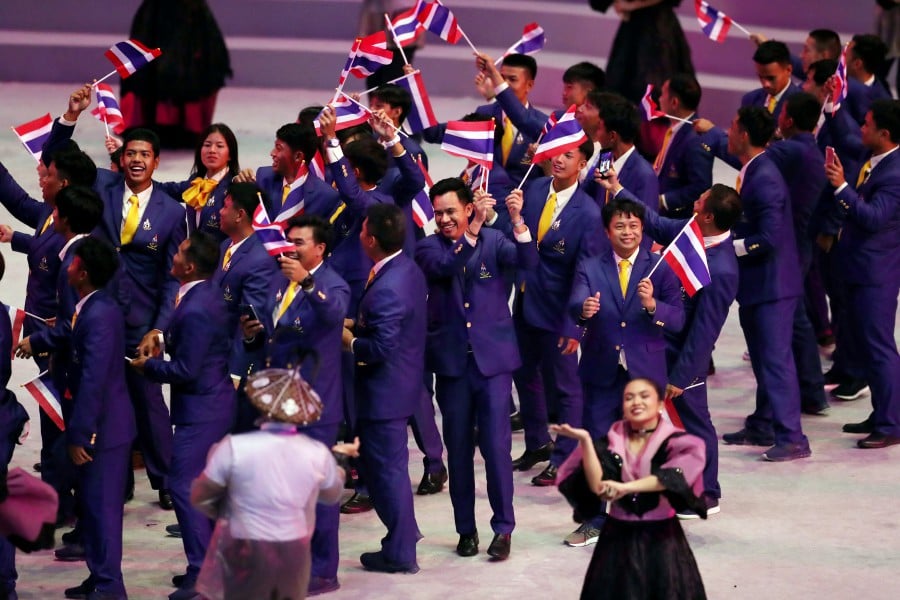
The contingents received loud cheers from the audience as they paraded into the arena in alphabetical order, starting with Brunei, Cambodia, Indonesia, Laos, Malaysia, Myanmar, Singapore, Thailand, Timor Leste and Vietnam, before host nation the Philippines ended the march.

Led by flag-bearer and 2018 bowling world champion Rafiq Ismail, the Malaysian contingent were represented by a delegation of about 100, including chef de mission Datuk Megat Zulkarnain Omardin and his two deputies, Nurul Huda Abdullah and Ahmad Faedzal Md Ramli.
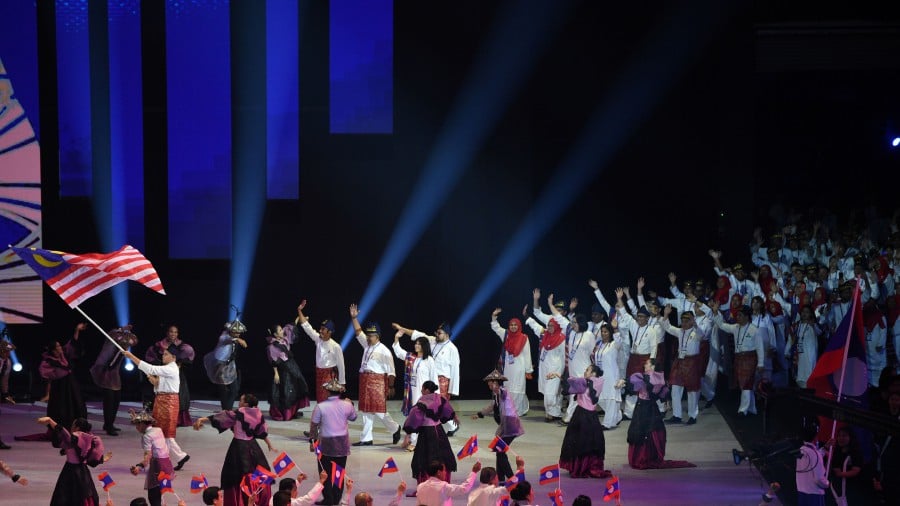

With the men dressed in white baju melayu and red samping with tengkolok, and the women in white baju kurung and selendang with Jalur Gemilang motif, and black shoes, the multi-racial Malaysian contingent, the hosts of the previous games, walked past the crowd proudly, symbolising the multiculturalism of the country.

World renowned Filipino boxers Manny Pacquiao and Nesthy Petecio were given the honour as the torchbearers before they jointly lit the cauldron to officially mark the beginning of the 30th SEA Games, after Philippine President Rodrigo Duterte had declared open the Games.

Themed ‘We Win As One’, the Games will run for 12 days until the closing ceremony at the New Clark City Athletics Stadium on Dec 11.
More than 8,000 athletes from the 10 ASEAN countries and Timor Leste will compete in 530 events in 56 sports at the three main clusters, namely Manila, Clark and Subic.


The Philippines have hosted the SEA Games three times before – in 1981, 1991 and 2005.
This year’s Games see the introduction of a few new sports such as arnis, jujitsu, kickboxing, underwater hockey and esports.

Defending champions Malaysia have sent a strong contingent of 773 athletes and 339 officials to participate in 52 sports, targeting 70 gold, 51 silver and 105 bronze medals, which is expected to place them fourth overall.– BERNAMA

Tuesday, November 19, 2019

...the PH improved world talent ranking

Philippines up 6 notches in world talent ranking


Louella Desiderio
Philippine Star 
19 November 2019


MANILA, Philippines — The Philippines was among 63 countries that posted the biggest climb in the latest World Talent Ranking (WTR) report of the International Institute for Management Development (IMD), as it rose six places to 49th place from 51st last year.


The country remained the laggard however, among Southeast countries.

Released in partnership with the Asian Institute of Management Rizalino S. Navarro Policy Center for Competitiveness in the Philippines, the WTR looks at countries’ ability to attract, develop and retain an employable talent pool.

The other countries which posted the biggest improvements are Taiwan, which went up seven places to 20th; Lithuania, which rose eight notches to 28th; and Colombia which advanced six places to 54th.

While the Philippines’ ranking improved in this year’s report, it was still behind its peers in the region.
All other Southeast Asian countries included in the report had better rankings than the Philippines such as Singapore (10th), Malaysia (22nd), Indonesia (41st), and Thailand (43rd).

In ranking countries, the WTR looked at three factors such as investment and development, appeal and readiness, and took into account responses to IMD’s executive opinion survey.

In the investment and development factor which measures funds poured in, as well as development of domestic human resources, the Philippines ranked 61st, up from the 62nd spot last year.

“This represents a one-place improvement from 2018, but this factor has consistently ranked in the 60s. Its low rank was mostly driven by pupil-teacher ratio in primary and secondary education and public expenditure on education per student,” IMD said.

As for the appeal factor, which looks at the ability to attract and retain high-quality talent from abroad, the Philippines rose to 31st place from 38th a year ago.

IMD said the highest ranked indicators for the Philippines under the appeal factor were cost of living and effective personal income tax rate, while the lower ranked ones were quality of life, justice, and brain drain.

When it comes to the readiness factor which assessed the quality and growth of the existing talent pool, the country placed 26th, 11 places higher than the previous year’s 37th.

“The relatively higher rank of the readiness factor was mostly driven by indicators on skilled labor, language skills, and share of science graduates among college degree holders,” IMD said.

Switzerland continued to top the WTR, strengthening its position as a global talent hub.

This was followed by Denmark in second place, and Sweden on the third spot. Mongolia, on the other hand, was at the bottom of the list or 63rd place.

Friday, November 8, 2019

..the Philippine FDI 2019

Investments in Philippines double up in January -September 2019, hitting 15.14 bln dollars

Xinhuanet.com
08 November 2019

MANILA, Nov. 8 (Xinhua) -- The Philippine Board of Investments (BOI) said on Friday it has recorded cumulative investments worth 764.7 billion pesos (roughly 15.14 U.S. dollars) as of September 2019, a 105 percent increase from 327.9 billion pesos (roughly 6.50 billion U.S. dollars) approved in the same period of 2018.

"The sustained high growth of investments is a proof of the business sector's strong confidence in both the Philippines' economic fundamentals as further shown by the acceleration of the third-quarter gross domestic product (GDP) growth to 6.2 percent and the reform agenda of President Rodrigo Duterte," Philippine Trade Secretary and BOI Chairman Ramon Lopez said.

The BOI said approved investments from domestic sources topped 524.9 billion pesos (10.40 billion U.S. dollars), a 54.7 percent increase from 339.3 billion pesos (roughly 6.7 billion U.S. dollars) in the same period in 2018.

On the other hand, the BOI said approved projects by foreign investors amounted to 239.9 billion pesos (roughly 4.8 billion U.S. dollars) or 613 percent increase from just 33.6 billion pesos (roughly 665.7 million U.S. dollars) a year ago.

According to the BOI, Singapore continues to set the pace among all foreign entities with 170 billion pesos (roughly 3.37 billion U.S. dollars) in the capital. It added that South Korea is now second with 34.1 billion pesos (roughly 675.62 million U.S. dollars), while The Netherlands places third with 9.2 billion pesos (roughly 182.3 million U.S. dollars).

According to the BOI, all projects once operational will generate employment of 41,862, which is 38.5 percent higher than last year's figure of 30,218.

"We are particularly pleased to highlight that the share of foreign investments in BOI projects have increased from just eight percent during January to September 2018, to already 31.4 percent this year," Lopez added.

This is expected to continue as Lopez noted that Duterte's policy of furthering relations with non-traditional partners has been yielding results.

Philippine Trade Undersecretary and BOI Managing Head Ceferino Rodolfo said investments from the information and communications technology (ICT) and power sectors accounted for 85 percent of the total figure or 652.9 billion pesos (roughly 12.94 billion U.S. dollars).

"This massive infrastructure buildup for more power and connectivity across the archipelago is critical towards addressing binding constraints to the Philippines' competitiveness," he added.

Thursday, October 24, 2019

...the PH ranking in Ease of Doing Business

Philippines climbs to 95th spot in World Bank’s ‘Doing Business’ rankings

Ian Nicolas Cigaral
Philippine Star
24 October 2019

MANILA, Philippines — Ease of doing business in the Philippines improved over the past year, with the Southeast Asian country climbing 29 notches in World Bank’s “Doing Business 2020” report released Thursday.
Philippine economy
Out of 190 economies, the Philippines advanced to the 95th spot from 124th place in 2019. The country’s score improved to 62.8 from 60.9 previously.

Compared to its peers in the East Asia Pacific, the Philippines ranked below Singapore (2nd), Hong Kong (3rd), Malaysia (12th), Taiwan (15th), Thailand (21st), China (31st), Brunei (66th), Vietnam (70th), Indonesia (73rd) and Mongolia (81st).

The Washington-based multilateral lender’s annual report looks into the regulations that enhance business activity and those that constrain it.

Quezon City was used as a benchmark for the Philippines.
According to World Bank, starting a business in the Philippines became easier following the abolition of the minimum capital requirement for domestic companies.

The country also made dealing with construction permits easier by improving coordination and streamlining the process for obtaining an occupancy certificate.

“The Philippines strengthened minority investor protections by requiring greater disclosure of transactions with interested parties and enhancing director liability for transactions with interested parties,” World Bank added.

Worldwide, 115 economies made it easier to do business, World Bank said, with New Zealand remaining the most business-friendly country in the world.

Somalia was the worst with a score of 20.

Meanwhile, the economies with the most notable improvement in Doing Business 2020 are Saudi Arabia, Jordan, Togo, Bahrain, Tajikistan, Pakistan, Kuwait, China, India and Nigeria.

“The Doing Business 2020 study shows that developing economies are catching up with developed economies in ease of doing business,” World Bank President David Malpass said.

“Still, the gap remains wide,” he added.

Wednesday, October 23, 2019

...the Philippines in Asian Century


The opportunity for the Philippines in the Asian century 

The Corner Oracle
Andrew J. Marasigan
Philippine Star 
23 October 2019


The 300-year reign of the west as the world’s economic epicenter is coming to a close.

By next year, the collective size of all Asian economies will eclipse that of the rest of the world combined. Thus, the year 2020 marks the official beginning of the Asian Century, declared the United Nations Conference for Trade and Development (UNCTAD).

Asia is now the new center of the world as it is home to more than half of the world’s population and half of the world’s middle class consumers. It is also where 21 out of the world’s 30 largest global cities are located. Experts agree that the average growth rate of Asian economies will be more than double that of the rest of the world in the next 20 years.

Driving Asia is the phenomenal rise of China, India and ASEAN as economic powerhouses. To provide perspective on the phenomenal rise of the continent, Asia accounted for only one-third of global output in the year 2000. It now comprises 50 percent of the planet’s gross domestic product.

On a purchasing power parity (PPP) perspective, China’s economy is now bigger than that of the United States. India has overtaken Japan to become the 3rd largest economy. Within ASEAN, Indonesia is well on its way to becoming the 7th largest economy while Vietnam has overtaken 17 countries to take 32nd position. The Philippines, despite challenges in its manufacturing sector, has overtaken seven countries and it now has 26th largest economy. If the Philippines plays its cards right, it can be the 16th largest economy by the year 2050.

Prospects are promising for ASEAN. With China and India slowing down due to the trade war, ASEAN is in the position to take center stage as the world’s engine of growth. ASEAN’s economy is now bigger than that of Great Britain.

ASEAN’s development came in waves with Singapore and Brunei being the first to achieve high income status. Thailand and Malaysia achieved rapid growth in the 90’s and are now counted among upper middle income economies. In the last ten years, however, Indonesia, Vietnam and the Philippines have lead the way in as far as economic development is concerned. The three nations have clocked-in an average annual growth rate of between five and six percent since 2010. The Philippines is seen to graduate to upper-middle income status next year.

As I mentioned, China and India’s slowdown have made Indonesia, Vietnam and the Philippines the most dynamic global economies today. All three are in stiff competition to attract foreign investments. But to compete on an equal footing, the Philippines must resolve several structural weaknesses.

The gaping hole in the Philippines’ growth story is its manufacturing sector. It is weak, to say the least. For context, our merchandise exports revenues of $67 billion is less than a fourth of Vietnam’s $297 billion. We have become a nation dependent on imports – from simple ball pens to heavy equipment. This is why our budget deficit (and current account deficit) is growing at an alarming rate every year.

Deficits are covered by debt so it goes without saying that the country’s debt load is growing at an alarming rate too. Sure, it is still manageable today, but if government fails to balance the national budget soon, we could face a serious debt crisis.

To put it simply, we need to export more to pay for the debts government is amassing for its infrastructure program and for its massive importations of consumer goods.

The crux of our woes is our inability to attract foreign investments. Again, for context, the Philippines attracted $9.8 billion worth of investment last year while Vietnam attract $35.5 billion. Foreign investments are the silver bullet to our problems since they bring both capital and technologies needed to build factories. These factories export goods and provide the local market with what it needs, thus, making the country less import-dependent.

The structural weaknesses I referred to earlier are those that contribute in making the Philippines unattractive to foreign investors. They include the constitutional provisions that restrict foreign investments in certain industries, expensive power cost, insufficient infrastructure and difficulty to do business (due to bureaucratic red tape). Exacerbating matters is that corporate income tax in the Philippines is 30 percent, compared to only 20 percent in Vietnam and 25 percent in Indonesia.

The Philippines must address these structural weaknesses if it is to compete. Our economic managers have numerous reforms waiting to be approved by Congress.Whether our legislators have the political will to enact these reforms without watering them down is another story.

On corporate income tax, the CITIRA Law proposes to gradually reduce corporate income tax from 30 percent to 20 percent over a ten-year period. I reckon, however, that 10 years is too long. If we are to be a real contender, this should be accelerated to just three years. Indonesia just passed a law to reduce its rate to 20 percent next year. The CITIRA Law is now pending in the Senate.

As far as infrastructure is concerned, while construction of several roads, rails and ports are ongoing, it is still grossly insufficient. Only 9 out of the 75 projects in Build Build Build are under construction today. Government must work faster and with more urgency lest it fail to deliver its promise of a “golden age of infrastructure”.

Another reform we must undertake is to open up more industries in which foreigners can participate as a majority stakeholder. Unfortunately, the 1987 Constitution was written with a protectionist intent and it has been a great impediment to attracting investors. That said, only an amendment of the Constitution can fix this. Even if politically contentious, we must confront this issue eventually.

The transport and telecommunications backbone of the country needs to be strengthened if we are to be truly competitive, especially in the information and communication technology space. The Open Access in Data Transmission Act and the amendment to the Public Services Act will address this. Both bills are pending in Congress.

As for bureaucratic red tape goes, the Ease of Doing Business and Efficient Government Service Delivery Act has already been passed into law and is now awaiting implementation. When completely rolled out, it is envisioned that all front-line government services will be fully automated, making it easier to conduct business. Again, the devil is in the execution.

Apart from this, Congress must revisit the EPIRA Law which has proved ineffective to bring down power cost.

Conditions are right for the Philippines to break away economically. However, we must first get our house in order before investors come. It would be a shame if the Asian century happens and we are left behind.

Wednesday, October 16, 2019

...the world's best hotel bars

LOOK: One of the best hotel bars in the world is in Manila

ABS-CBN News
16 October 2019

MANILA -- One of the best hotel bars in the world is in Manila, according to an exclusive list published by Forbes Travel Guide on Tuesday. 
The Bar of The Peninsula Manila has been included in a list of the best hotel bars in the world. The Peninsula Manila's website
The Peninsula Manila's The Bar, with its swanky, Cuban-inspired design, was among the 44 hotel bars that made the cut. It is one of only four watering holes in Southeast Asia featured. 

The list -- a first from Forbes Travel Guide -- described The Bar as: "Bedecked in checkered flooring and wood walls, the bar gleans inspiration from an old Cuban cigar factory." 

It also recommends some of its menu items like the sisig croquetas, the Sriracha butter duck wings, and the Batangas Old Fashioned, "which swaps in Maker's Mark infused with Kapeng Barako." 

The full list can be seen here

To come up with the list, Forbes Travel Guide sent "inspectors" to stay at hotels around the world anonymously. They then evaluate the bars based on up to 900 standards for the guide's annual star ratings. 

Two bars in Indonesia and one from Singapore were also included in the prestigious list. 

...the improved PH FIFA Ranking

FIFA Rankings 2019: Thailand, Philippines set for rise, Indonesia to fall after poor display


Fox Sports Asia
16 October 2019


Thailand and Philippines are set to rise up the FIFA Rankings table after their latest exploits in the 2022 FIFA World Cup Qualifiers while Indonesia, Cambodia and Singapore are set to fall down.

Thailand registered a massive 2-1 win over the United Arab Emirates while Philippines produced a fine defensive display to hold the mighty Chinese side for a goalless draw. Indonesia, on the other hand, lost 3-1 to Vietnam, Cambodia suffered a 4-0 defeat to Iraq and Singapore went down 3-1 against Uzbekistan.


With their win over UAE, Thailand are expected to move up six spots to 109, while Philippines will gain one spot and will move up to 126. Indonesia will lose one spot and go down to 171 while Singapore will lose two spots and will go down to 159. Cambodia, who were hammered 14-0 by Iran last week, will go down to the 172nd spot after the loss against Iraq.

Tuesday, October 8, 2019

...the fintech and digital awardee

Union Bank of the Philippines bags prestigious fintech and digital awards, 3 years running


SINGAPORE – Media OutReach – 8 October 2019 – Union Bank of the Philippines (UnionBank), with its vision of transforming into “A technology company, also a bank,” recently made waves as its top executives won big at the Singapore Fintech Awards 2019. 

UnionBank Chairman Justo A. Ortiz and Senior Vice-President and Fintech Business Group Head Arvie de Vera each won the Asia Fintech Leaders Award which recognizes remarkable leaders across the region for their continuing commitment to excellence, developing best practices and pursuing innovative strategies.

The Awards aims to highlight those across Asia who have made extraordinary contributions to the fintech industry’s meteoric rise on the global stage. Indeed, Ortiz and de Vera have been making strides globally, advocating for smart banking as a way to realize the bank’s purpose of elevating lives, fulfilling dreams and enabling communities. 

The Awards were hosted by the Singapore Fintech Association, while the rigorous judging process was helmed by none other than PwC Singapore. 

The winners were announced at a Gala Night graced by Ravi Menon, Managing Director of the Monetary Authority of Singapore (MAS) and Minister Ng Chee Meng, Secretary-General of the National Trades Union Congress (NTUC) of Singapore. 

In addition, UnionBank also won, for the third year in a row, the Best Digital Bank — Philippines award at the Asiamoney Best Bank Awards 2019 in Singapore on September 25. Asiamoney also identified UnionBank as one of 30 financial institutions to watch out for in Asia, and among 5 on its radar for digital banking. 

In awarding the bank for the third year straight, Asiamoney considered the long list of innovative initiatives UnionBank is pursuing, some of which include the first fully digital branch The Ark, a tokenized fiat cross-border transaction pilot from OCBC Bank in Singapore to a rural bank in the Philippines, and the country’s first central bank-compliant two-way virtual currency ATM among many others.

Tuesday, October 1, 2019

...the Asia's Top best Employer Brands

Home Credit Philippines named as one of Asia's Top 100 Best Employer Brands


Manila Bulletin
01 October 2019

Home Credit Philippines was distinguished as one of the Top 100 Best Employer Brands in Asia for 2019-2020 by the Employer Branding Institute and World HRD Congress at the 10th Asia’s Best Employer Brand Awards. 

Held last August 15, 2019 at the Pan Pacific, Singapore, the Asia’s Best Employer Brand Awards recognizes leading organizations within the region that have effectively built its employer brand through exemplary human resource initiatives and practices. 

This is the first time Home Credit Philippines has been awarded by the said award-giving body.
PR 9-26_Image 2

Alpha Omega Aquino, SHRM-SCP, Home Credit Philippines’ Head of Talent Acquisition, proudly dedicated the organization’s success to its people. “This [award] is for our more than 5 million customers in the Philippines and our 12,000 employees, who are our own brand ambassadors.”

Wednesday, September 25, 2019

...the good neighbor

Singapore keen on bigger investment to Philippines


Bianca Cuaresma
Business Mirror
25 September 2019


Singapore businesses looking for expansion opportunities in the region are highly considering the Philippine market as their choice investment destination, a recent survey showed.

The Singapore Business Federation’s (SBF) recent National Business Survey showed that the Philippines was among the top 10 markets of interest for Singaporean companies looking to expand their business.

“While many Singapore companies have established operations in the Philippines in industries such as manufacturing and infrastructure, there are untapped opportunities in areas such as information technology and digital solutions, which our companies with the capabilities will be able to take up,” SBF Chairman Teo Siong Seng said.

He added that the economic and social progress the Philippines has made, thus far, makes for an attractive and compelling case for Singapore investors.

“Asean remains a bright spot in a cloudy global economy and has abundant opportunities and potential for growth. Singapore and the Philippines have always enjoyed close economic ties,” the SBF chairman said.

In 2018, Singapore was the second-largest investor in the Philippines, and the Philippines’s largest export market among the member-states of the Asean.

Loh Chin Hua, chief executive officer of Keppel Corp. who is also co-chairman of the Philippines-Singapore Business Council, said the company is now exploring ways on how it can expand its investments in the Philippines, especially with the Duterte’s administration’s “Build, Build, Build” infrastructure modernization program now in full swing.

Keppel Corp. is one of Singapore’s largest conglomerates with involvement in the infrastructure sector.

He also noted that among the advantages of doing business in the Philippines is that investors can borrow in the local currency, thus reducing risks and enabling them to get reasonable returns.

“And that is quite a remarkable achievement because not many countries in this region can say that. And when you have to invest abroad but you have to borrow in their currencies, it always increases the risks,” Loh said. “For Keppel, we have operated two shipyards in the Philippines, and we are now looking to see how we can do more here.”

Earlier this month, a delegation of 21 Singapore business leaders from 14 companies joined the business mission organized by the SBF from September 9 to 11 2019. The delegation was led by SBF Chairman Teo Siong Seng.