Showing posts with label UK. Show all posts

Tuesday, October 22, 2019

...the PH Army at world's toughest patrolling test

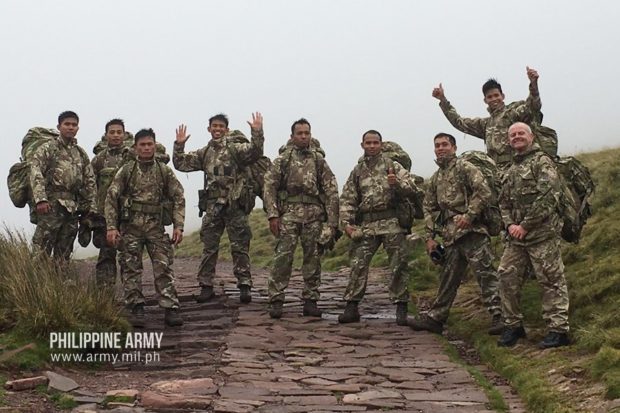
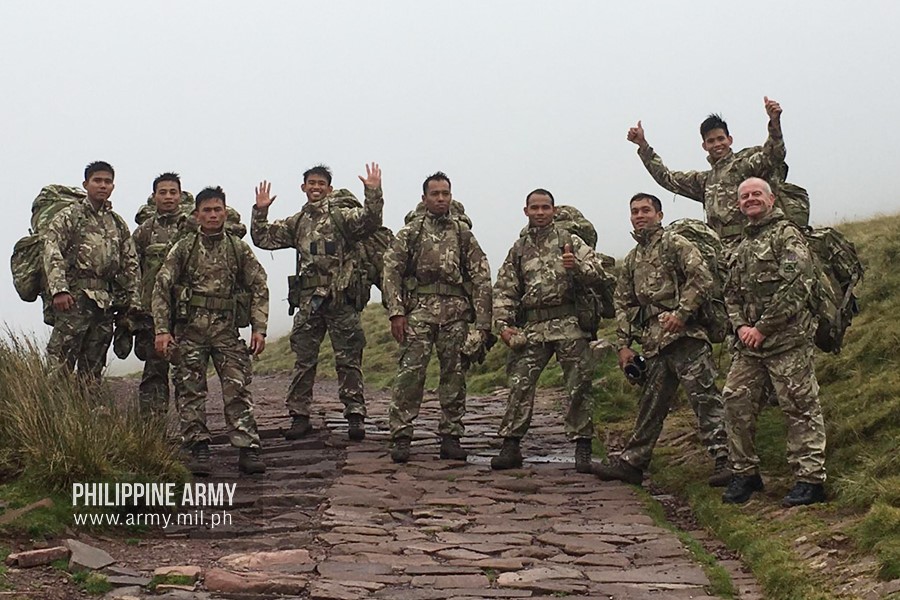
Philippine army bags silver at world's toughest patrolling test


Frances mangosig
inquirer.net
21 October 2019


Manila, Philippines - A Philippine army team has bagged the silver medal at the recently concluded Exercise pambrian Patrol in Wales, Unirted Kingdom.

An annual event organized by the British Army, the Exercise Cambrian Patrol is touted as the world’s toughest patrol exercise. 

Philippine Army bags silver at world’s toughest patrolling test

The international exercise tests the basic soldiering skills, as well as qualities like leadership, teamwork, and physical fitness of the participating military units.


The eight-man Scout Ranger team was able to carry out various military operations despite extreme weather and terrain conditions.


“For 51 sleepless hours, the Army’s eight-man team successfully accomplished its mission by performing various military operations along the rugged Cambrian Mountains of Mid-Wales, with loads of logistics and minimal food and water,” said Army spokesperson Lt. Col. Ramon Zagala.


Around 130 teams from different overseas military units joined the exercises for this year.

On Monday, the Scout Ranger team that bagged the award was recognized by Army chief Lt. Gen. Macairog Alberto in a ceremony at Fort Bonifacio in Taguig.


He said their accomplishment only proves the “world-class caliber” of the Philippine Army.


“The challenge now is to how to enable many more of our soldiers reach the skills of these awardees,” he said.

Monday, May 11, 2015

...the First Filipino UK councilor

Filipina elected as borough and town councilor in UK


Agnes Constante
Asian Journal
12 May 2015


A BRITISH-Filipina was elected councilor of the Hertfordshire borough Hertsmere and town Elstree and Borehamwood in the United Kingdom on May 8, marking the highest level of public office any Filipino has ever held in the European state.

Cynthia Barker, originally from San Pablo City, Laguna, ran under the Conservative Party and garnered 1,513 votes in the UK national elections.
“I am really humbled to have been selected by the residents,” she said, according to the Watford Observer. “I never imagined I would be standing here. I am looking forward to the challenges and working with residents.”
Barker first moved to the UK in the mid-1980s to join her family. Her mother arrived first in the 1970s.
“[My mother] will always be my hero. She made the same sacrifice that most OFWs make, sent all her money home while she worked long hours to ensure that the family was well-fed and educated. We now have four generations of family in the UK,” she said in an interview with the magazine The Filipino Expat.
Barker said she has become accustomed to the British lifestyle since relocating and has immersed herself in the country through studying and exploring the city.
“I was quite insular before and I only went out with fellow Filipinos. This gradually changed as I continued my studies here. [I] realized we are all the same, people wanting to protect our country by becoming involved with our local community,” she said.
Still, Barker said she remembers the Filipino values her parents instilled in her and that they helped her in adapting to British society.
The newly-elected councilor is an experienced immigrant advisor who previously served as president of the Rotary Club of Elstree and Borehamwood, as well as other charitable organizations including the National Society for the Prevention of Cruelty to Children. In her local town of Elstree and Borehamwood, she is actively involved in the local church and residents’ association. She is also chair of the town’s museum and is a school governor at St. Nicholas School.
“I have always been curious about everything that happens in our local town,” she said.
Barker said she has always found politics important. She said she has always supported the Conservative Party because of how it ran policy in her local town. Barker became involved with the party’s campaigns even before she became a full member.
The British-Filipina hopes her recent win will inspire more Filipinos to become more active in British politics.
“It is important to be a part of the political machinery – the British are open and they embrace us. But we Filipinos need to make the first step and adapt,” she said.
Gene Alcantara, an immigration adviser in London, called Barker’s victory “a very encouraging wake-up call to the Filipino community in the UK,” as it is indicative of Filipino empowerment and representation in the British community. Alcantara said more political involvement is expected from Filipinos after Barker’s election.
“The vital point about it is that British-Filipinos are participating in the political process,” he said.
Alcantara added that he hopes more Filipinos will also be encouraged to vote not only in the UK, but in the 2016 Philippine national elections.
Prior to Barker’s win, the highest public office ever held by a Filipino in the United Kingdom was a town councilor. 

Thursday, June 19, 2014

...the world's sexiest

Filipinas among world's 'sexiest' in dating poll


06/19/2014
 
 
MANILA -- With the country's recent dominance in beauty pageants, it is no wonder that Filipinas have been voted as one of world's most "sexiest" dating partners.

The survey, conducted by travel dating website MissTravel, listed Filipinas among the top five preferred nationalities to travel with ahead of the Spaniards and the Australians.

Topping the list are the Brazilians, followed by women from Russia, Colombia and the United Kingdom, while the Bulgarians, South Africans and the Canadians took the last three spots.

Male Filipinos, however, did not make the list ranking the opposite sex. Men from Australia are considered the sexiest travel partners, while the Italians and the British came in second and third, respectively.

Here is the full rankings published on Huffington Post:

The sexiest nationalities (women):


1. Brazilian
2. Russian
3. Colombian
4. British
5. Filipina
6. Spanish
7. Australian
8. Bulgarian
9. South African
10. Canadian

The sexiest nationalities (men):
1. Australian
2. Italian
3. British
4. Scottish
5. Spanish
6. American
7. Irish
8. Brazilian
9. Canadian
10. Dutch


Thursday, May 1, 2014

...the PH climb in World Bank economic ranking

PH is 28th largest economy


05/01/2014
 
 
MANILA - The Philippines emerged as the world’s 28th largest economy in the International Comparison Program (ICP) 2011 study, results of which were released by Washington-based lender World Bank on Wednesday.

Taguig City, Metro Manila  Skyline
 
The ICP 2011 is a project undertaken through the authority of the United Nations Statistical Commission. It covered 199 economies and compared their shares to the global economy and expenditures. It also used the so-called purchasing-power parities (PPPs) in comparing the size and price levels of economies around the world.

The PPPs make it possible to compare gross domestic products (GDPs) of economies in real terms by removing the price-level differences among them.

“Six of the world’s 12 largest economies were in the middle-income category [based on the World Bank’s definition]. When combined, the 12 largest economies account for two-thirds of the world economy, and 59 percent of the world population,” the World Bank said.

The World Bank said the PPP-based world GDP amounted to $90.65 trillion in 2011, higher than the $70.29-trillion GDP measured in terms of exchange rates.

Data showed that the Philippines’s share in terms of global GDP was at 0.6 percent in PPP terms and 0.3 percent in terms of exchange rates. The 30 largest economies accounted for 84.1 percent of the global GDP in PPP terms.

The Philippines is one of the four Southeast Asia countries that made it to the 30 largest economies worldwide. Indonesia ranked 10th, followed by Thailand at 21st and Malaysia at 27th.

Globally, the world’s largest economy is the United States, with a share of 17.1 percent of global GDP. But China was a close second, with a share of 14.9 percent; with India a far third, with a share of 6.4 percent.

“The six largest middle-income economies—China, India, Russia, Brazil, Indonesia and Mexico—account for 32.3 percent of world GDP, whereas the six largest high-income economies—the United States, Japan, Germany, France, the United Kingdom and Italy—account for 32.9 percent,” the World Bank said.

“Asia and the Pacific, including China and India, accounts for 30 percent of world GDP; Eurostat-OECD 54 percent, Latin America 5.5 percent [excluding Mexico, which participates in the OECD; and Argentina, which did not participate in the ICP 2011]; and Africa and Western Asia about 4.5 percent each,” it added.

The Philippines also had a price-level index (PLI) of 53.2, which indicates it is not an expensive country but not the cheapest, either. The PLI is the ratio of a PPP to a corresponding exchange rate.

The World Bank said an index of over 100 means prices are higher than the world average; and 1 less than 100 means prices are relatively lower.

The most expensive economies in GDP terms are Switzerland, Norway, Bermuda, Australia and Denmark, with indices ranging from 210 to 185. The United States ranked 25th in the world, lower than most other high-income economies, including France, Germany, Japan and the United Kingdom.

But only 23 economies showed a PLI of 50 or below. The cheapest economies are Egypt, Pakistan, Myanmar, Ethiopia and Lao People’s Democratic Republic, with indices ranging from 35 to 40.

Meanwhile, even if the Philippines is one of the largest economies in the world and one of the “not so expensive” places to live globally, it is still not the richest in terms of GDP per capita.

The Philippines’s GDP per capita in 2011 in PPP terms was only at $5,772 and $2,379 in terms of exchange rates. These are below the average GDP per capita in Asia and the Pacific, at around $7,621 in PPP terms and $3,527 in terms of exchange rates.

The five economies with the highest GDP per capita are Qatar, with a GDP per capita in PPP terms at $146,521, followed by Macao with $115,441; Luxembourg, $88,670; Kuwait, $84,058; and Brunei Darussalam, $74,397.

In contrast, around eight economies have a GDP per capita of less than $1,000. These are Malawi with $973, followed by Mozambique, $951; Central African Republic, $897; Niger, $852; Burundi, $712; Congo, $655; Comoros, $610; and Liberia, $537.

“Eleven economies have more than $50,000 per capita, while they collectively account for less than 0.6 percent of the world’s population. The United States has the 12th-highest GDP per capita,” the World Bank said.

The ICP implementation was led and coordinated by the ICP Global Office, hosted by the World Bank, in partnership with regional agencies overseeing activities in eight geographic regions.

These are Africa, Asia and the Pacific, Commonwealth of Independent States, Latin America, the Caribbean, Western Asia, Pacific Islands, and the countries of the regular PPP program managed by the Statistical Office of the European Communities and the Organization for Economic Cooperation and Development.

Further, the World Bank explained that two “singleton” economies, Georgia and Iran, participated in bilateral exercises with partner economies, without being part of any regional comparisons.


Thursday, April 24, 2014

...the PH Infotech uptrend

PH jumps 8 spots in global ICT rankings


04/24/2014
 
 
MANILA, Philippines - The Philippines jumped eight notches to 78th spot in the Networked Readiness Index 2014 of the World Economic Forum.

The Philippines had previously ranked 86th on the index for the past three years. The index, which covers 148 countries, assesses an economy's capacity to fully leverage information and communications technology (ICT) for growth and well-being.

The WEF Global Information Technology Report 2014 noted the significant improvement of the Philippines' ranking in the overall index, as well as among ASEAN countries.

"With a significant improvement in its overall score, the country continues its positive trend. The scores of all the 10 networked readiness pillars register an increase. A significant improvement in the perceived efficiency in the country’s legal system and property rights protection drive the political and regulatory environment up to 87th place," the report noted.

Another area where the Philippines showed significant improvement is ICT readiness, with "more affordable (75th) access to ICT infrastructure and better skills (69th), despite the need for higher quality in the educational system."

"Business usage is, as in many other Asian economies, at a more advanced stage (43rd) than individual usage (91st). Progress made in terms of economic impacts registered last year continues this year, moving up eight positions and reaching 48th place. The role of ICTs in fostering innovation by creating new products and services (42nd) and organizational models (28th) is confirmed and contributes to this promising result," the report noted.

However, the Philippines still lagged behind other ASEAN neighbors, such as Singapore (2nd), Malaysia (30th), Brunei Darussalam (45th), Indonesia (64th), and Thailand (67th), in the index.

The Philippines ranked ahead of Vietnam (84th), Cambodia (108th), Lao PDR (109th), and Myanmar (146th) in the index.

Makati Business Club executive director Peter Perfecto said the Philippines has competitive advantages in 11 out of the 54 indicators under the networked readiness index.

These 11 indicators are: availability of latest technologies, venture capital availability, quality of management schools, internet and telephony competition, quality of educational system, use of virtual social networks, firm-level technology absorption, capacity for innovation, extent of staff training, impact of ICTs on new services and products, and impact of ICTs on new organizational models.

Digital divide remains

The Global Information Technology Report 2014 noted that there is little progress in bridging the digital divide between tech-savvy countries and others.

Overall, Finland ranked 1st in the Networked Readiness Index, followed by Singapore (2nd), Sweden (3rd), Netherlands (4th), Norway (5th), Switzerland (6th), United States (7th), Hong Kong (8th), United Kingdom (9th) and South Korea (10th).

On the other hand, emerging economies such China (62nd), Brazil (69th), Mexico (79th) and India (83rd) registered a drop in the rankings, as they struggle to realize their full digital potential.

A key finding of the WEF report is that countries cannot rely only on ICT infrastructure development to become competitive. It noted that the benefits of ICT can be fully realized when a country "implements a holistic strategy aimed at creating conditions for skills, innovation and entrepreneurship to flourish alongside modern infrastructure."

"In addition to the persistent digital divide across countries, governments should also be wary of understanding, identifying and addressing potential internal digital divides so that new opportunities can be created for all and support enhanced social inclusion,” said Beñat Bilbao-Osorio, senior economist at the WEF's Global Competitiveness and Benchmarking Network and co-editor of the report.

Tuesday, April 22, 2014

...the PH might

Philippines ranks 37th in military power Index


Philippine Marines fire an M101 105 mm howitzer during artillery live-fire training April 12 at Crow Valley, Philippines. Cpl. Courtney G. White/U.S. Marine Corps
 
 
MANILA, Philippines — The Philippines ranked 37th of 106 countries listed in Global Firepower's 2014 Power Index, which measures each nation's military strength.

In a statement released this month, the data-collecting site ranked countries based on 50 factors, which determine the militaries' "potential conventional war-making capabilities across land, sea and air."

"The final ranking also incorporates values related to resources, finances and geography," Global Firepower explained. Sources are publicly available including the CIA factbook, online listings and media reports.

Nuclear capability and current political and military leadership, meanwhile, are not taken into account, purportedly to allow smaller, technologically-advanced, nations to compete with larger, lesser-developed ones.

The baseline or perfect value of the index is set at 0.0000, with the United States topping the list with a military power index of 0.2208. America is followed by Russia with 0.2355 and China with 0.2594.

The Philippines has a power index of 1.3042, higher by a notch than Malaysia's 1.3143 but lower than Asian neighbors such as Vietnam wilith 0.8962 and Taiwan with 0.7564.

The Philippines' relatively large population base contributed to the ranking, having 41 million fit for military service out of its total population of over 105 million.
 
About 220,000 Filipinos are active frontline personnel, while 430,000 are active reservists.

The country's tank value was among the factors included in the data, which notes the Philippines 531 Armored Fighting Vehicles and 270 Towed-Artillery. It does not, however, have any tanks, self-propelled guns or mutli-launch rocket systems.

Components of its air and naval power similarly figured in the index. Global Firepower said the Philippines has 145 aircrafts and 124 helicopters in service. It also has a naval strength of 120 with three frigates, 11 corvettes and 38 coastal defense crafts.

The researchers also considered the country's logistics including its labor force, merchant marine strength, major ports and terminals, roadways and railways, and serviceable airports.

"War is much a battle of logistics--moving man and machine from points all over--as is direct combat. Labor force reflects possible wartime strength," it said.

Oil resources were also taken into account as it is deemed the lifeblood of any fighting force. The Philippines itself produces only 12,000 oil barrels per day day, and consumes 315,000 oil barrels.

The country, however, has proven oil reserves of 138,500,000 oil barrels per day, a bulk of which is underutilized.

Defense budget, debt, foreign exchange and gold reserves as well as purchasing power parity were included.

Finally, the Philippines' geographical values were estimated as they figure into a "defensive-minded war," the researchers said. The country boasts a long coastline of 36,289 kilometers and waterways of 3,219 kilometers with no shared border.

The top 10 strongest global powers in the list are:

Screenshot from Global Firepower


Saturday, February 8, 2014

...the gratitude to the world

Philippines thanks world for typhoon aid with billboards, tweets


Posted at 02/08/2014


TACLOBAN - The Philippines said "Thank you" on billboards around the world Saturday in gratitude for the massive outpouring of international help after a typhoon that killed about 8,000 people three months ago.

Electronic billboards lit up with "Thank you" signs at New York's Times Square, Galeries Lafayette in Paris, Tokyo's Shibuya Crossing, London's Piccadilly Circus and five other cities at 2040 GMT Friday, exactly three months after Super Typhoon Haiyan struck the central Philippines.

"The number of lives lost and affected is unprecedented. But ever since then, the world has been one with the Philippines in helping rebuild the nation," the tourism ministry behind the ad and social media campaign said on its website.

"The Philippines wants to say a big thank you to everyone who are helping us rebuild after Typhoon Haiyan," the ministry said on its official Twitter page, where it later posted the billboard pictures.

Haiyan, one of the strongest typhoons ever to hit land, smashed across 171 towns and cities in the central islands with a combined land area the size of Portugal, wrecking the homes of more than four million people.

The government is still collecting corpses and looking for nearly 2,000 missing people with 6,201 deaths already confirmed, many of them swept away by giant, tsunami-like waves unleashed by Haiyan on coastal communities.

In the hard-hit central city of Tacloban, many shops have reopened in a frenzy of rebuilding but tents and lean-to structures remain the norm in many ruined neighbourhoods, most of which are still without power.

"We're traumatised but there's nowhere else to go," Helen May Gabornes, a 27-year-old mother of two, said as she cooked a meal of tinned sardines at a muddy school yard near downtown.

The fisherman's wife and her extended family are among about 500 people living in blue tarpaulin tents and on relief goods there.

She told AFP her family went to live with Manila relatives on November 12, but returned after Christmas because they could not find jobs and were becoming a burden at her sister's home.

"We came back because we heard the government is giving free housing, but so far, nothing."
Amid the continuing difficulties, the tourism ministry urged the world's 100 million Filipinos on Saturday to join its "#PHthankyou" campaign on social media.

It suggested they download some of the ministry's "The Philippines says thank you" notes from its website and adorned with pictures of the country's top tourist draws, and post them on Facebook, Twitter, and other popular social networking sites.

Russell Geekie, spokesman for the UN disaster agency in the Philippines, told AFP the government-led relief effort has addressed many of the survivors' most acute emergency needs.

It was shifting to an "early recovery" phase with a focus on restoring livelihoods for millions of people, he added.

However, "shelter needs remain enormous".

"Obviously we talk about resilient people, but the scope of the disaster and destruction is such that it's very hard. There are remaining psycho-social needs that need to be met," he said.

These include finding the hundreds missing to give their families "closure".

The United Nations launched an international aid appeal in December for $788 million to finance the humanitarian effort for this year. Geekie said the appeal was about 45 percent funded.

President Benigno Aquino has said the rebuilding effort would take at least four years and require more than $8 billion in funding.


Wednesday, January 8, 2014

...the Pinoy factor

The Pinoy factor in reality TV competitions


Ira Agting
Rappler.com
01/08/2014
X FACTOR. Filipino caregiver Rose Fostanes has taken Israel by storm. Screen grab from Youtube (Miggi Lucman)X FACTOR. Filipino caregiver Rose Fostanes has taken Israel by storm. Screen grab from Youtube (Miggi Lucman)

MANILA, Philippines - A Fiilipino caregiver has captivated audiences in the first season of reality singing show X Factor Israel, adding to the growing list of Pinoy achievers in the international entertainment, reported the Associated Press.

47-year-old Rose Fostanes secured a place in the top 4 of the competition after her renditions of Christina Aguilera's "Beautiful," Queen's "Bohemian Rhapsody," and Lady Gaga's "You and I" made her an instant star.

Fostanes' performances were lauded by the judges, particularly by Israeli singer Shiri Maimon, who doubles as her mentor. She described "Beautiful," which earned Fostanes a standing ovation, "moving and more than perfect."

Fostanes, who has been working overseas for almost 20 years, said she hopes winning the competition will change her life.

The Pinoy factor

Now in the top 4 of the competition, Fostanes is now among a number of Filipinos who have shown exceptional musical talent in reality singing competitions.

Other bright stars in the X Factor franchise are Ellona Santiago who placed 6th in the US version and Rafael Aguilar who made waves in X Factor Bulgaria in 2011.


American Idol, since its start in 2002, has also placed Pinoy talent in the spotlight, most notably in Season 11 where Filipino-Mexican Jessica Sanchez placed 2nd next to Phillip Phillips.

 
Jessica Sanchez, American Idol Season 11 Top 2

The show's 3rd season featured two contestants with Filipino lineage. Fil-Am Jasmine Trias placed 3rd, while Camille Velasco was part of the top 9 contestants. In Season 7, Ramielle Malubay placed 9th.


Jasmine Trias, American Idol Season 3 Top 3


Camile Velasco, American Idol Season 3 Top 9

While many other Filipinos dazzled in the American Idol's auditions, one Pinoy went viral for singing an original composition. Renaldo Lapuz may not have gotten through to the next round, but he certainly left a mark in Idol audition history with "I Am Your Brother."


In Britain's Got Talent 2013, 11-year-old Arisxandra Libantino earned praise from the judges, even Simon Cowell, who told her that she was proof that talent goes beyond age. The young Filipina made it to the finals and placed 8th.


Arisxandra Libanto, Britain's Got Talent 2013 Top 8
Filipino-American group The Filharmonic are currently part of NBC's a capella singing competition The Sing Off. While still early in the battle, the 6 boys have already dazzled viewers and the judges with their 90s-inspired performances.

2013 big wins

Jonathan Yabut, a young marketing executive from Manila, shot to fame late July after winning The Apprentice Asia, the first Asian adaptation of the reality TV franchise.
 
Yabut was one of two Filipino contestants in the competition, where 12 professionals from all over Asia battled to conquer the world's "toughest job interview." Filipino contestant Celina le Neindre, a food and beverage consultant, made it until week 7.
 
In December, Deankie Latonio and Tiara Sison, a Filipino duo from Cebu, recently won reality interior design competition The Apartment, where contestants were tasked to design apartments with time and budget constraints. The two fresh graduates beat 8 other pairs from US, Singapore, Indonesia, Thailand, India, Malaysia, and Singapore. - Rappler.com


Sunday, January 5, 2014

...the UK's top 10 destination list

Philippines in UK’s top 10 countries to see in 2014


The Philippines is among the Top 10 Countries worldwide to visit this 2014, according to British travel guidebook Rough Guides.

In its 2014 edition, the Philippines made it to the 10th place along with other beautiful and culturally-rich countries. Rough Guides cited Philippines’ natural places that are “not to miss” which include the islands of Boracay, the limestone islands El Nido in Palawan, the coasts of Coron that hides beautiful beaches and pristine mountain lakes, and Puerto Gallera.


The Rough Guides, known for its travel references, has also recommended a must-visit in Chocolate Hills in Bohol, despite being partly damaged by the 7.2-magnitude earthquake the struck the province last year. It also recommended to visitors to see the tiny primate Tarsiers in the region.

“Soak up the bizarre landscape of Bohol’s iconic Chocolate Hills, conical brown-green mounds said to be the calcified tears of a broken-hearted giant,” Rough Guides said.

Aside from the crystal-clear waters of Philippine beaches, Rough Guides also suggest to tourists to also try to explore the country’s beautiful mountains and the majestic top views they offier, including the perfectly-coned Mt. Mayon and mountain lakes in Mt. Pinatubo.

Rough Guide describes the crystal-clear waters of Apo Reef Marine Natural Park in Mindoro as a “scuba diver’s dream,” along with other underground river in the country.

Aside from places, tourist should also explore the traditions and colorful festivals in the country like the Ati-Atihan Festival on Panay to see the “indigenous dress and learn tribal dances,” the travel advisor said, adding that if one gets exhausted from the heat of the sun, a tall glass of Halo-halo, a local sweet icy dessert, will quench tourist’ thirst.

Other countries in Rough Guides’ Top 10 countries to visit in 2014 are Georgia in Central Asia, Turkey, Macedonia, Japan, Rwanda, Ethiopia, Brazil, Bulgaria and Madagascar.


Thursday, January 2, 2014

...the Top Economies of 2028

Philippine economy forecast to be among the top 30 by 2028

BusinessWorld Online

02 January 2014

THE PHILIPPINES is expected to become one of the world’s 30 biggest economies by 2028, buoyed by improving macroeconomic fundamentals and a continued global reordering, a United Kingdom-based think tank said.

People walk among debris next to a ship washed ashore in the aftermath of super typhoon Yolanda at Anibong, Tacloban in this Nov. 11, 2013 photo. The storm, which killed over 6,100 poeple and caused some P36.7 billion in damage, is expected to weigh on near-term Philippine economic growth. -- AFP

“We forecast that the Philippines will rise gradually from 42nd position in 2012 to 28th in 2028,” the Centre for Economics and Business Research said in its World Economic League Table (WELT) report for 2013.

Released annually, the WELT identifies the world’s 30 biggest economies based on nominal gross domestic product (GDP). It also forecasts which countries will be in the top 30 in five, 10 and 15 years.

“This year’s report is updated to take account of the likely surplus of energy and falling oil and gas prices in the 2020s, weaker commodity prices than had previously been expected and the sell-off of some emerging market currencies in mid-2013,” CEBR said.

It noted that the Philippine economy was currently being weighed down by the aftermath of super typhoon Yolanda (international name: Haiyan), which devastated parts of the country last November.

The impact is expected to extend to this year, particularly in terms of agriculture output.

“But it (the Philippines) is expected to recover in 2014 and 2015. Meanwhile, the improved outlook for the US economy is important for the Philippines, which has much closer economic links with the US than other ASEAN economies,” CEBR said.

The country’s projected rise in the rankings, it noted, has to do with an expected reordering among economies.

For 2013 the US continued to best other nations in the WELT, followed by China, Japan, Germany, and France, respectively. Rounding out the top ten were the United Kingdom, Brazil, Russia, Italy, and Canada. Russia overtook Italy to gain 8th place, while Canada snatched 10th from India, which fell to 11th.

“Below the top 20 some of the changes are more dramatic -- Iran drops from 21st position to 30th as sanctions bite; South Africa drops from 28th out of the top 30 (to 33rd) as strikes, slow growth and a weakening currency affect its position,” the report noted.

CEBR predicts that by 2028, China will replace the US to become the world’s largest economy. India is likewise seen to overtake Japan to become the world’s third largest economy. Japan will fall to fourth, and Brazil, seventh in 2013, will climb up to fifth.

“The UK is the West’s second-best performing economy. Indeed it is the only major Western economy expected to move up the league table becoming the world’s 5th largest economy in 2018 by overtaking France. After that it slips back to 7th place in 2023 and 2028 as India and Brazil overtake,” CEBR said.

“But by 2028 the UK economy is forecast to be only 3% smaller than the German economy and is likely to overtake Germany to become the largest Western European economy around 2030.”

More emerging economies will start climbing up the ranks by 2018, it said, a trend seen to continue in the following ten years.

“By 2028 the league table is being reordered. China has moved to No. 1; India to No 3. Mexico is in the top 10 at No 9. Korea and Turkey are 11th and 12th and have overtaken France,” it said.

“As symbols of the new world order, Nigeria, Egypt, Iraq and the Philippines break into the top 30. All the latter group depend on maintaining or in some cases regaining political stability.”


Saturday, November 23, 2013

...the PH best Islands

The Philippines: a guide to the best islands


Six of the country's 7,000-plus islands were devastated by Typhoon Haiyan; many of the others badly need tourists to return. Local writer Aya Lowe picks the best places to go.
 
 
Aya Lowe
theguardian.com (United Kingdom)              


Young surfers at Cloud Nine surf point, Siargao, Philippines
Two young surfers carrying boards at Cloud Nine surf point, Siargao. Photograph: Alamy
 
For a country with thousands of idyllic islands, plus world-class surfing and diving, the Philippines is a relatively undiscovered travel destination. Tourism is crucial to the country's economy, accounting for eight per cent of its GDP, but compare the UK visitor numbers – 120,000 in 2012 – to those of Thailand (800,000 per year) and you get some idea of just how off the radar this vast archipelago is.

This month, of course, the country is firmly on the world's radar – for all the wrong reasons. Typhoon Haiyan caused wide spread destruction across the provinces of Leyte and eastern Samar on the mid-eastern side of the Philippines and some parts of Palawan and Cebu on the mid-western side. But while the areas in the path of the typhoon were devastated, much of the country was not damaged.

The storm caused havoc on six of the country's 7,107 islands, so most resorts and tourists activities are open and fully functional, and those that were hit are quickly getting back on their feet in the run up to December and January, two of their busiest months of the year.

The tourist board and tour operators are reassuring visitors that the country is not only safe, but in desperate need of visitors to bring a vital boost to the economy. Those who go will receive a very warm welcome. So, how do you choose which of those 7,000-plus islands to visit? Here's our guide to 10 islands, each offering something different.

1. Chill out in El Nido, Palawan

Bacuit Bay, Palawan, Philippines Bacuit Bay, Palawan, Philippines. Photograph: Alamy
 
This jungle beach town on the northern tip of Palawan hasn't changed much since before Spanish colonisation and has been cited as Alex Garland's The Beach. Explore the many islets of the nearby Bacuit archipelago on a boat-hopping tour, where the water so clear you can see the fish darting in between coral at 15 metres deep. Prices range from around £17-£20 per day for a tour and that usually includes lunch. There is grilled seafood is in abundance across the island.

Palawan was one of the islands in the path of Typhoon Haiyan, however it was only the city of Coron and the nearby island communities that were hit. El Nido has not suffered any damage and the surrounding coral reefs are intact, with only very shallow ones sustaining damage.

Where to stay: For beachfront living, Rainforest Beach Hotel offers rooms from £31 per night in high season. For a high-quality budget option, try Residencia Katrina , five minutes from the beach (from £21 per night).

How to get there: Local airlines fly directly to Palawan's capital, Puerto Princesa. From the city's main bus terminal, you can take a seven-hour Roll-On Roll-Off (RORO) bus to El Nido for £7, one way.

2. Shake your tail feather in Boracay

White Beach, Boracay, Philippines White Beach, Boracay Island, is often voted the best beach in Asia. Photograph: John Harper/Corbis


With endless beaches of powdery-white sand, long happy hours, abundance of restaurants and hotels to suit all budgets, and plenty of watersports, Boracay is the party island.

It has 12 beaches, the most popular being White beach and Bulabog. The island is divided up into "boat stations", which are used a reference points. Station One in the north is known for its high-end resorts and tranquillity; station two is the liveliest part, and station three is where all the budget accommodation can be found. While many locals look back longingly at good old days in the 70s before the hotels and restaurants started springing up, Boracay is still a Phuket in its infancy.

There was some storm damage to the island. Electricity still remains a problem for many parts of the island, but most hotels are up and running with generators.

Where to stay: Frendz Resort Boracay has one of the best beach locations out of all the midrange options (£50 for a beachside bungalow, sleeping four). Nigi Nigi Nu Noos has Balinese-style bamboo cottages furnished with handicrafts and wooden sculptures. Rooms are £70 per night.

How to get there: You can fly via Kalibo and then take a two-hour bus ride for £4, then a 15-minute ferry.

3. See a UNESCO World Heritage sight in Banaue, North Luzon

Rice terraces, northern Luzon, Philippines Amazing two thousand year old rice terraces, Banaue, northern Luzon. Photograph: Alamy
 
North Luzon, the biggest island of the Philippines, is a land of misty mountains, where pines replace palm trees. Head to Banaue and Batad to admire the 2,000-year-old rice terraces etched along plunging ravines. The 20,000km UNESCO-listed terraces still provide a livelihood for the various tribal groups that continue to live in relative isolation in the mountains. Treks along the rice terraces to various villages and waterfalls can be organised through the Banaue Tourist Information Center. Expect to pay around £10 for a guide for a whole day.

Where to stay: If you want to wake up to a view of the famous rice terraces, head to Batad, where a number of low-cost, basic guest houses line the mountains. Try Ramon's Homestay, where the owners are a great source of information about the local culture. It's £2.80 for a regular room or £3.50 to stay in a traditional Ifugao (local tribe) hut.

How to get there: North Luzon is best reached by bus, but be prepared for a long journey. Buses leave regularly from Manila and take nine hours to get to Banaue, costing £7.

4. See the curious in Bohol

Chocolate Hills Natural, Bohol, Philippines
Asia
Chocolate Hills, Bohol Island. Photograph: Per-Andre Hoffman/Alamy
 
Located just off Cebu, Bohol's most famous attraction is the surreal Chocolate Hills: over 1,500 mounds formed by coral deposits sculpted by a millennia of erosion. Depending on the season, they will either be green or brown. The island's famous resident is the camera-shy tarsier, the world's smallest monkey. Visit them in their protected enclosure at the Philippines Tarsier Foundation. Don't visit them in the cages kept along the river; they are mistreated and don't live long there. Either hire a motorbike or book a tour from a local company, such as Bohol Travel Tours, for around £35 with car, guide and lunch.

In October this year, the island suffered from a 7.2-magnitude earthquake, destroying many houses. Two weeks afterwards, Bohol was back on its feet, bringing in tourists as normal. The island was also hit by Typhoon Haiyan, but sustained little damage to its infrastructure. Tour operators and hotels remain fully open. The main issue being tackled by the island's authority is limited power supply, which is slowly but surely getting fixed.

Where to stay:Alumbung Bohol is a comfortable resort of beachside bungalows on popular Panglao island (from £20 per night). For something different head to Bohol Bee Farm , an organic vegetable and bee farm with rooms on Panglao, from £28 to £70 per person.

How to get there: Local airlines, including Cebu Pacific, fly to Tagbilaran airport from Manila, or you can catch a two-hour ferry from Cebu to Bohol (£7, one way).

5. Go surfing in Siargao

Facing the Pacific Ocean, just north of the island of Mindanao, is Siargao, one of the Philippines' surf centres. The town sees a steady stream of dedicated surfers who arrive to challenge themselves on the island's famous Cloud 9 reef break. The small beachside town hosts a number of international surfing competition, which make it a busy during surf season, but completely dead when the waves are down.

Novices can hire trainers, who you can find on the beach, for around £7 per hour, or you can book a package from a surf hotel, such as Kermit Surf Resort , which has a package for £394 per person per week, including accommodation, transfers and one-to-one surf lessons.

Where to stay: The no-frills, £5-a-night Bamboo Garden is popular among backpackers. Surfers tend to stay in Kermit Surf Resort (bungalows are £11 per night).

How to get there: There are direct flights to Siargao Island. Siargao airport is 45 minutes away from General Luna, the location of the popular Cloud 9 beach.

6. Get off the beaten track in Camiguin Island

Camiguin Island, Philippines Camiguin Island, Philippines. Photograph: Stuart Dee/Getty Images
 
This pear-shaped volcanic island, just off the northern tip of Mindanao, is often bypassed because of various Islamist uprisings that have been reported on Mindanoa. However, Camiguin itself has never had any incidents and those who make the effort to travel there are rewarded with an island barely touched by tourism. For such a small landmass, this tiny island packs quite a punch, its 29,187 hectares including seven volcanoes. It also offers good diving through an eerie sunken cemetery, waterfalls, a lagoon, and hot and cold springs. All of these can be reached easily by foot, or hire a motorbike (£11 a day with a driver,£7 without).

Where to stay: If you want to splurge, go to Bahay Bakasyunan sa Camiguin for £50 per night. If you are on a budget, try the Enigmata Tree House homestay at £15 per night (minimum of two people).

How to get there: The easiest way is to book a flight from Cebu, via Cebu Pacific Air, then take an 11-hour ferry to the island for (£2.30).

7. Go witch hunting in Siguijor

Cambugahay Falls, Siquijor, Philippines Cambugahay Falls, Siquijor. Photograph: Deddeda/Design Pics/Corbis

The magical Siquijor is both feared and revered by locals. It's the place to go, if you're looking for a boroboro, or witch doctor. The Provincial Tourism Department has a list of "official healers", or just ask any local and they'll be able to point you in the right direction. You'll need to rent a tricycle (a local motor taxi) for around £14 for half a day, as most of the healers live high in the mountains.

These witch doctors or healers welcome paying visitors – but be polite and respectful as it is an age-old tradition that is widely believed by locals. Away from all the magic, it's also a beautiful island for relaxing, snorkelling and diving.

Where to stay: Beachside bungalows at Coco Grove Beach Resort cost £19 per person.
How to get there: There are no direct flights. Fly to Dumaguete city, then take an hour-long ferry to Siquijor (£1.60).

8. Explore the misty mountains of Batanes

Batanes hills, Philippines Batanes, Philippines. Photograph: Ferdz Decena/Getty Images/Flickr RF

The Batanes Islands are found on the very northern tip of the Philippines archipelago, a land of gently sloping hills, thatched roof houses and locals who wear traditional straw hats. With weather reminiscent of drizzly British summers, locals visit the islands for some respite from the tropical heat, while tourists travel here for a completely different island experience from the rest of the Philippines. To get around, rent a bicycle or book a tour with a company, such as Batanes Travel and Tours , which charges £211 for a three-day trip including accommodation, transport and guide.

Where to stay: Batanes Resort offers comfortable, air-conditioned cottages for £25 per night.
How to get there: There are direct flights from Manila to Batanes, but being at the very tip of the country it's one of the more expensive islands to reach. Flights are often cancelled during bad weather.

9. Go diving in Mindoro

Apo Reef, Philippines Filipino divers swimming at the Apo Reef. Photograph: Dennis M Sabangan/EPA

Good dives spots are a dime a dozen in the Philippines, but the best scuba spots can be a bit harder to reach. Apo Reef is one of them. A mostly sunken atoll, two hours off the west coast of Mindoro, the 40 sq km reef is famous among the diving community for its abundance of larger creatures, such as sharks, rays and sea turtles. Most divers stay on Pandan Island (a 20-minute boat ride from Mindoro) and, from there, access the reef via a three-hour boat ride. Apo Reef Club is one of the closest dive operators to the reef. A package of five dives, including two night's accommodation and transfers, is £212.

Where to stay: As well as dive trips, Apo Reef Club offers clean, simple accommodation . Prices range from £10 to £46 per room.

How to get there: Domestic flights go from Manila to San Jose in Mindoro. Once you get on the island, head to Sablayan port (near the town market) and get a 30-minute boat ride to Pandan island (£7, one way).

10. Go hiking in Davao, Mindanao

Mindanao island, Philippines Mindanao island, with Mount Apo in the background. Photograph: Alamy

Davao is the biggest city on the island of Mindanao, an area that is scarce of tourists due to the aforementioned Islamist insurgencies. Davao City is widely regarded as a safe haven on the island and has been ranked as one best places to live in the country. This is where the world's smelliest fruit, the Durian, originates from. It is also home to the rare Philippine eagle (pay a visit to the Philippine Eagle Centre for an educational tour).

But the island's crown jewel is the country's tallest peak and semi-active volcano, Mount Apo. A 2,956-metre climb to the top will take you through the full spectrum of Filipino biodiversity, from steamy jungle to pine forests, and belching sulphuric vents. Join a group tour with Climb Mt Apo for £56 per person. If you go independently you will need a permit from the city hall in Santa Cruz, an hour south of Davao (contact Julius Paner, +63 2 441 1467). The permit costs £4 per person. You can then hire a freelance guide and/or porter at a rate of £4 per day for the porter and £7 per day for the guide. The permit office will be able to put you in touch with a certified porter and guide.

Where to stay: Green Windows hostel in the city centre offers clean and spacious dorm beds for £2.60 per night. A smarter option is Casa Leticia, £40 per night.

How to get there: Davao is a 1.5hr flight from Manila and there are at least six flights servicing the city on a daily basis.

Getting to the Philippines: Philippine Airlines flies to Manila five times a week from Heathrow. Once in Manila, the cost of domestic flights to get to the different islands can vary depending on what time of year you are flying and where. Local airlines such as Cebu Pacific, Air Asia and Tiger Airways offer seat sales throughout the year, where you can often bag return flights for around £50. Outside of the sales, expect to payaround £100 return.