Showing posts with label scientist. Show all posts

Monday, October 21, 2019

...the world's largest caldera

Pinay scientist discovers 'largest caldera' Apolaki in Benham Rise


Ma. Angelica Garcia
GMA News
21 October 2019


A Filipina marine geophysicist has discovered the existence of what could be the world's largest caldera within Benham Rise.

New Zealand-based scientist Jenny Anne Barretto, an alumnus of the University of the Philippines, recently published a research paper titled "Benham Rise unveiled: Morphology and structure of an Eocene large igneous province in the West Philippine Basin," detailing the morphology and formation of the underwater feature.
a close up of a map: apolaki caldera
Benham Rise is described in the paper as "a large igneous province located in the West Philippine Basin." A caldera is a large volcanic crater created by a major eruption.
Named the Apolaki Caldera, Barretto's discovery has a diameter of about 150 kilometers, about 90 kilometers larger than Yellowstone, one of the earth's largest calderas.
The size is comparable to shield calderas such as Olympus Mons on Mars (80 km x 65 km) and Sacajawea on Venus (150 km x 105 km).
The name Apolaki, meaning "giant lord," comes from the Filipino mythical god of the sun and war.
"Features like a breached rim, intra-caldera benches, and a resurgent dome indicate a multi-phase volcanic history consisting of both quiet and explosive eruptions," the paper's abstract read.
The research paper became available online on Sunday as part of  "Marine Geology," an international journal of Marine Geology, Geochemistry and Geophysics. 

Sunday, September 29, 2019

...the VIP of global marine biodiversity

A 'VIP' of global marine biodiversity in the Philippines


Mikael Angelo Francisco
GMA News

Whenever we hear about a newly discovered plant or animal, we tend to focus on the exotic location where it was found, or distinguishing morphological traits that merit its classification as an entirely new species. We rarely talk about how scientists determine new species, which isn’t really surprising. After all, it isn’t that hard to understand that the process of naming a new species is far more complicated than thinking of a cool-sounding Latin binomial name and calling it a day.
When experts come across an unidentified specimen, they use a system of concepts ranging from physical appearance to reproductive compatibility in figuring out whether or not it really is a new species. Another part of the process involves checking existing records to ensure that the seemingly new species isn’t just a variation of an existing one.
Admittedly, it’s not uncommon for scientists to discover new species each year. Roughly two million unique species have been catalogued over the course of human history; scientists estimate that the actual number of species in the wild could easily be five times that.
Nevertheless, one can only imagine the kind of rush that comes with adding yet another name to the taxonomic record. It’s probably the same kind of rush that Dr. Terry Goslinger, Senior Curator of Invertebrate Zoology at the California Academy of Sciences, has felt during virtually every single one of his visits to the Philippines over the last 27 years.
VIP: A very important place
“I started working on coral reefs in the Philippines in 1992,” Goslinger said at a recent forum in Manila. His colleagues had told him that the marine life in the Philippines was rich and diverse, in waters that were relatively unexplored. At that point, Goslinger had been conducting his research in Papua New Guinea.
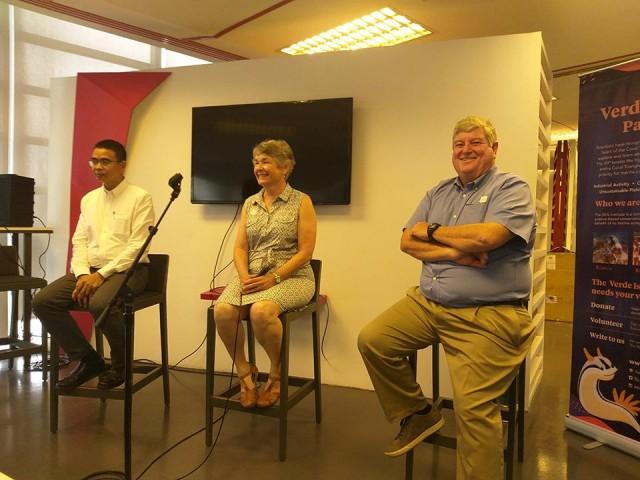
Dr. Wilfredo Licuanan, Dr. Meg Burke, and Dr. Terry Goslinger speaking during a forum.


“One of my colleagues said, ‘If you think Papua New Guinea is rich, you ought to come to the Philippines.’ And they were absolutely right, and I was astounded,” he said.
It didn’t take long for Goslinger and his fellow scientists to verify that the Philippines was exceptionally rich in marine biodiversity. Furthermore, they found that the richest area was a 1.14-million-hectare waterway separating Luzon and Mindoro known as the Verde Island Passage (or VIP).
The VIP is part of what marine scientists call the Coral Triangle. Located in the western region of the Pacific Ocean, the Coral Triangle encompasses the waters of the Philippines, Indonesia, Malaysia, Papua New Guinea, Timor-Leste (also known as East Timor), and the Solomon Islands.
Serving as the underwater home of six marine turtle species, nearly 600 species of reef-building corals, and over 2,000 reef fish species, the Coral Triangle is recognized as the global center of marine biodiversity—and the VIP is the center of the center.
The VIP itself houses over 400 species of corals, and functions as a safe haven for hundreds of marine species from both subtropical and tropical climate zones. These include, but are not limited to, whale sharks, sea turtles, nudibranchs (colloquially known as sea slugs), and about 60 percent of the world’s shorefish species. Various species of fish and larvae also find their way to the VIP, carried by strong currents from the Pacific Ocean.
Additionally, local and foreign experts from different research and conservation institutions discover new marine species in the VIP every year. In 2018, the Academy announced that it had found 14 new species in the Philippines, a number of which were nudibranchs from the VIP.
These factors have earned the VIP not one, but two scientifically backed titles: the Center of the Center of Marine Shorefish Biodiversity, and the Center of the Center of the Marine Biodiversity of the World.
Coral lesson
For over three decades, Dr. Wilfredo Licuanan has been actively surveying and monitoring coral reefs across the country. Recently, he led a nationwide assessment of the overall health of coral reefs in the Philippines.
Throughout Licuanan’s career, however, there’s one significant detail about his work — specifically, about corals — that he has had to explain to various audiences and stakeholders more times than he can probably remember:
“When we talk about corals [in the context of coral reefs], we’re not talking about rocks; we’re talking about animals.”
According to Licuanan, a Full Professor of De La Salle University’s Biology department, each of these tiny coral animals — called polyps — possess very thin tissue.
“Most of the coral is actually skeleton,” he explained, “hence the common misconception that corals are rocks.”
Not all corals have skeletons. Soft corals (such as gorgonians, sea fans, and sea pens) are feathery, flexible, and plant-like. The ones that we tend to mistake for rocks are hard corals — corals with skeletons made of aragonite, a type of calcium carbonate. These skeletons are designed to protect the corals from strong waves or other animals.
Coral reefs are formed when polyps living in colonies (groups of hundreds, thousands, or even more) deposit calcium carbonate beneath their bodies and form large structures. For this reason, hard corals are also known as reef-building corals.
Coral reefs support some of the most biodiverse areas on the planet. Aside from being a fortified habitat for countless marine species, they also play a significant role in the food chain, as they provide important nutrients (such as nitrogen) and facilitate nutrient recycling (the movement and exchange of organic and inorganic matter back into the production of living matter).
Coral grief
Corals have a symbiotic relationship with microscopic algae called zooxanthellae. Zooxanthellae serve as the corals’ primary food source, as well as the reason behind their color.
However, when water temperatures grow warmer, the relationship becomes stressed, resulting in the expulsion of the algae from the corals. When this happens, the corals turn ghostly white--a phenomenon we call coral bleaching. And while this does not immediately kill corals, they will eventually die if they are unable to recover.
Rising ocean temperatures due to global warming are the primary cause of coral bleaching. Meanwhile, water pollution and abusive fishing practices are significant hindrances to coral recovery.
Consequently, the death and breakdown of corals and coral reefs will have severe effects on the countless marine populations that depend on the reefs for sustenance and protection. Coral bleaching also negatively impacts entire industries, such as fishing and tourism.
One of the most noteworthy examples of wide-scale coral bleaching in the Philippines happened in 2010, brought about by El NiƱo. It was one of three incidents documented by the Philippine Coral Bleaching Watch over the last twenty years.
“We lost many of the coral reefs in Southeast Asia, and we saw extensive bleaching in places like Palawan,” recalled Goslinger, “We saw a lot of coral death.”
At the time, approximately 25 to 30 percent of the VIP experienced massive coral bleaching.
“The corals were getting rid of their algae, looking very sick, and looking like they may die. This was the first time we had really seen this extent of coral bleaching and unhealthy conditions, and we were very, very concerned about that,” he said.
To the scientists’ surprise, however, things looked different when they returned to the VIP six weeks later.
“Already, the corals that had bleached were starting to regain their color, because they were absorbing new algae,” he said.
Eventually, the damage that the VIP’s corals had previously sustained was almost completely gone, revealing that apart from its rich biodiversity, the VIP also possesses natural resilience, for reasons that require further research to understand.
“There is great hope that the Verde Island Passage can repopulate other parts of the Philippines, and can be a genetic storehouse [as well],” he said.
Reef power, reef responsibility
Truth be told, while the VIP is full of marine wonders and mysteries, there may not be enough scientists in the Philippines (or even in the world) to understand what must be done and take the necessary measures before it’s too late.
And that’s precisely where citizen action comes into play.
“We think it’s not only important, but an obligation to help the local community understand why we’re there, and why the reefs are important,” explained Dr. Meg Burke, the Academy’s Associate Dean of Science Operations.
A frequent visitor of the Philippines and the VIP, Burke’s efforts are focused on science education—specifically, engaging the communities and empowering them with the skills and knowledge necessary to monitor their own reefs.
“If you can take that first step and help people understand that corals are living animals, you can often see the lightbulb go off,” shared Burke. “And it’s like, ‘Now I get it.' Because if corals are living animals, then when anchors are dropped on corals, you’re killing living animals. You’re not just breaking up a rock. If dynamites are used, you’re not just making big rocks smaller. You’re killing animals."
“Only by training local communities can you help ensure that there will be eyes on the reef — that people will be watching to see what’s going on,” she added.
Over the last few years, government agencies, conservation groups, and law enforcement have worked on initiatives to combat the major threats to the VIP’s sustainability: overfishing, illegal waste disposal, and daily commercial vessel activity. Just last year, the local government declared every fourth week of September to be the Verde Island Passage (VIP) Conservation Awareness Week.
Additionally, marine conservationists and concerned parties in the area have been pushing for the VIP’s nomination and proclamation as a United Nations Educational, Scientific and Cultural Organization (UNESCO) World Heritage Site—not for recognition, but for the purposes of pressuring officials to take better care of the VIP. 
“We still have time to protect the richest reefs in the world," Goslinger assured. "Our treasure trove of biodiversity on this planet.”
—JCB, GMA News

Monday, August 26, 2019

...the biodiversity hotspot

‘Like spaghetti’: Worm-slurping, hopping rats discovered in the Philippines


Nandita Chandraprakash
Mongabay.com
26 August 2019

  • The highly biodiverse island of Luzon in the Philippines has yielded up two species of rats new to science.
  • Both are found high up on Luzon’s mountains, where they’ve evolved to feed on the earthworms that abound in the lush, wet habitat.
  • Researchers say they hope the new discoveries, the latest of dozens made here since 2000, will help shine a spotlight on the importance of conserving Luzon’s unique habitats and wildlife.

As you explore the high altitudes of Luzon Island in the Philippines, you’ll encounter plenty of earthworms. There’s an abundance of them. So the ecosystem did exactly what nature does to bring balance: it evolved predators. And the most common earthworm predators here are rats. Two of them, in fact, are new to science, having only just been described in a paper published in July.


“They’re quite bizarre,” says lead author Eric Rickart, a curator at the Natural History Museum of Utah, University of Utah. “They hop around on their sturdy hind legs and large hind feet, almost like little kangaroos. They have long, delicate snouts, and almost no chewing teeth.”

The scientists caught one of these new “tweezer-beaked hopping rats” when they set traps with a regularly employed bait: peanut butter. The first capture, however, happened quite by chance as the rat wasn’t interested in the peanut butter. However, it did slurp up an earthworm when the scientists offered it one as an experiment. Subsequently, when the team, led by the late Danilo Balete of Chicago’s Field Museum of Natural History, set traps with live, wriggling earthworms as bait, they came across the two new earthworm-loving rat species.
Scientists named the new species Rhynchomys mingan and Rhynchomys labo after the mountains they’re respectively found on, Mount Mingan and Mount Labo. Their genus name comes from the ancient Greek rhyncos for “snout,” due to the rats’ long pointed noses, and mys for “mouse.”

The rats catch earthworms by quietly hop-stalking little trails they make among the mud and humus of the forest. Once they detect an earthworm, they quickly pounce. They then brush the dirt off and swallow the worm whole, “like a long spaghetti,” according to the scientists.

“One of the things that’s striking to see was their reflexes — they’re lightning quick,” says Lawrence Heaney, a curator at the Field Museum and co-author of the study. “It later became obvious why they’re that fast. They’re trying to catch a nimble earthworm that's partly in a hole.
The research team and porters at the beginning of the hike to Mount Labo, where one of the two new species was discovered. Heaney, Balete and Alviola are in the front, center. Image by TKTK.
Island evolution
Luzon is the largest Philippine island and, at 27 million years old, one of the oldest oceanic islands in the world with never any direct dry-land connection to continental Asia. With volcanoes and mountain ranges, life in Luzon has rich resources and undisturbed geographical diversity to evolve uniquely. Today, all native animals and plants of Luzon are descendants of ancient species that colonized the island by crossing formidable water barriers. The tweezer-beaked hopping rats of the Rhynchomys genus evolved from a single ancient colonization event 7 million to 9 million years ago. They are found nowhere else on Earth.
These “earthworm rats” had to adapt to the prey available: earthworms. They quietly hop trails, dig deep in the soil, work through leaf litter, or go up the trees among orchids and other epiphytes, all in search of the best sustenance available. The worms are common in Luzon’s high, wet altitudes, with a forest floor covered in fallen plant material that takes a long time to decompose.
An example of the mossy forest habitat where species of Rhynchomys live in northern Luzon. Image by L.R. Heaney.
Scientists find Luzon particularly fascinating because it’s a natural laboratory for studying evolution.
“These interwoven processes occur everywhere, but they can be studied most readily on islands because of the effects of isolation,” Rickart says. As for the rats, they have adapted uniquely to take advantage of the rainforest’s abundance in earthworms and provide a great example of how evolution works as generations of a species are isolated in confined pockets.
Scientists have described 30 new species of mammals in Luzon since 2000 and expect to find more. In that same period, just one new mammal species was discovered in all of Europe, a land mass 92 times larger than Luzon. Rickart and his team say they believe Luzon has the world’s greatest concentration of endemic mammals on the planet.
“There are sky islands within the big island [of Luzon],” Heaney adds.
Conservation of the rats and biodiversity in Luzon
Only 6 percent of the tropical old-growth forests that blanketed the Philippines 500 years ago survive today. The country is losing its rainforests to oil palm plantations and other agricultural interests.
But the two new species are lucky; they live in high-elevation forests — wet, cold and steep — and are not currently threatened by agriculture or logging. Still, experts say geothermal energy development and mining could pose threats down the road. And it may not take much to endanger the new species.
“As far as we know, the two species are geographically restricted to small areas on isolated mountains, so any broad-scale disturbance to their habitat could be a great threat,” Rickart says.
The good news is that scientists have seen a steady rise in the growth of secondary forests, albeit a slow one, over the last 25 years. The earthworm rats don’t necessarily require old-growth forests but do need high-altitude habitats at elevations above 1,500 meters (about 5,000 feet).
“What we see is that as the forest regenerates, the native mammals move back in,” Heaney says.
Cloud field atop Mount Mingan. Cloud forests are believed to contain the maximum mammalian diversity. Image by L.R. Heaney/Field Museum of Natural History.

Locals understand the importance of the forests, especially old-growth ones, against the pummeling of typhoons, according to the researchers. Without forests in higher lands, and the absorbent, mulch-carpeted mossy floors that act as intact watersheds, typhoons can cause extensive damage, including loss of life, due to erosion, landslides, mudslides and floods.
“The local populations and governments want to protect the land on which they depend for water and indirect resources,” Heaney says, adding that the researchers got a lot of support from the Philippines Department of Environment and Natural Resources.
The scientists say they hope the discovery of the tweezer-beaked hopping rats, and of all the other creatures here in recent decades, will put additional focus on conservation in Luzon. When a new species is discovered, it provides publicity and spark, Heaney says: “It often helps a lot to promote the establishment of new protected areas and national parks.” The docile earthworm-slurping rats, it turns out, may inadvertently promote conservation in their home range.


Map of the Philippine archipelago, showing the locations of modern islands in green, Late Pleistocene (ice-age) islands in light blue, and deep seas in dark blue. From “The Mammals of Luzon Island: Biogeography and Natural History of a Philippine Fauna,” Johns Hopkins University Press. Image © Heaney, Balete and Rickart (2016).

Thursday, February 21, 2019

...the NASA awardee

Philippine Team wins NASA Award


Roy Mabasa
Manila Bulletin
21 February 2019


The team iNon from the Philippines on Thursday received an award from the United States government for capturing the Best Galactic Impact category in the 2018 NASA Space Apps Challenge beating out 1,395 other teams from around the world.

Teams iNON and Space Force will represrnt the country in the National Aeronautics and Space Administration (NASA) Space Apps Global Challenge (Photo courtesy of Animo Labs via Facebook / MANILA BULLETIN)
Teams iNON and Space Force will represent the country in the National Aeronautics and Space Administration (NASA) Space Apps Global Challenge
(Photo courtesy of Animo Labs via Facebook / MANILA BULLETIN)

US Ambassador to the Philippines Sung Kim awarded the certificate of recognition to iNON team members Revbrain Martin, Marie Jeddah Legaspi, Julius Czar Torreda, and Matthew Concubierta during the ceremony at the US Embassy. Leandro de Guzman, the fifth member of the team, was unable to attend the ceremony.

The Filipino innovators ISDApp, from the Filipino word "Ć­sda" (meaning fish) to communicate crucial information about real-time weather and sea conditions to fisherfolks.

The app enables local government officials to provide potentially life-saving information to fisherfolk's analog cellphones using NASA globe observer data.

"I am deeply impressed by team iNON's fantastic achievement in defeating teams from around the world to win first place in the Galactic Impact category of the NASA Space Apps Challenge . They can inspire other Filipino youth to develop innovative solutions to problems in their own communities, " Kim said at the event.

ISDApp was conceived by the Team iNON at the US Embassy-sponsored NASA Space Apps Challenge in October 2018.

US Embassy Deputy Chief of Mission LAw, who served on the panel of judges, said Team iNON's approach to getting important information out to fisherfolks without internet connectivity struck him as "clever and compassionate.

"I am pleased they received global recognition," Law said.

For Team  iNON member Legaspi, he explained that ISDApp is a "simple solution with an important purpose" which helped the technology swim to success. "This is proof that even technology needs a heart."

His team mate Martin said: "We saw the problem, and figured we could do something to help the lives of coastal communities around the world."


Monday, May 6, 2013

...the bacteria research for waste water

Philippines may use bacteria to clean wastewater


Researchers are identifying ways to clean up polluted water bodies
 
By Gilbert P. Felongco, Correspondent
Gulf News (Dubai, UAE)
Published:  May 5, 2013


Manila: Philippine experts will be counting on an unlikely ally to help clean up the country’s polluted water systems — bacteria.
 
A research being conducted by the University of the Philippines in Los Banos and funded by the Department of Science and Technology (DoST) are looking at certain types of bacteria to help improve wastewater quality.
 
According to an article published in the DoST website, a team headed by professor Arlene Llamado of UP Los Banos assessed the bacteria’s potential in wastewater treatment applications.
 
Llamado’s team isolated five bacteria cultures taken from the soil of an abandoned mine site in Mogpog in Marinduque, central Philippines, to determine if these can form biofilms. A biofilm is the slimy substance similar to slime on un-brushed teeth or the film on top of leftover soup. They are secreted by certain types of bacteria. In hospital settings, biofilm-forming bacteria are notorious for infections because they are resistant to antibiotics and cleaning agents.
 
While biofilms are by themselves unclean and make living things prone to infections, their potential as agents for eliminating other hazardous materials lie in their ability to attract positively charged metal ions such as those found in effluent wastewater. These can also be found in abandoned or contaminated mining sites.
 
The researchers wanted to leverage the ability of microorganisms to form biofilms as they are negatively charged and can, therefore, attach to positively charged metal ions.
 
“By the simple idea of negatively charged polymers attaching to positively charged ions, we actually have a potential to remove heavy metal ions from waste water,” Lllamado said.
 
Cleaning oil spills
 
It is known that such bacteria is employed in applications such as to remove oil spills.
 
Lllamado added that they had collected samples from abandoned mining sites where there is a low concentration of organic elements and high concentration of copper because they expected that bacteria living in these soils would be resistant to heavy metals.
 
“All of the bacteria samples isolated from the site exhibited ability to produce biofilms. Further evaluation showed that all of these isolates were capable of removing heavy metals in water-copper solution. The planktonic cells of each bacterial isolate ate up the copper within six hours of contact time,” she said.
 
According to Llamado, further studies are under way to test the ability of these bacterial isolates in removing metals in wastewater.
 
If the tests deliver results, there is a strong chance that bacteria could be used not only to clean up abandoned mine sites but also in contaminated river systems and tributaries.


Sunday, April 28, 2013

...the TIME's most influential people 2013

Sense and Science: The unsung Filipina who cured HIV


April 28, 2013

Pinay doctor part of US team that found cure for HIV
Pinay doctor part of US team that found cure for HIV. Dr. Katherine Luzuriaga, a Filipino-American pediatric immunologist, led a team that cured HIV in an infant in Mississippi, USA. She has cautiously pointed out that while this cure is unprecedented, it is only one case. It does, however, suggest that early and aggressive treatment of pediatric AIDS could result in a cure, without children having to take the drugs for the rest of their life. She and her colleagues were subsequently listed among Time's 100 Most Influential People in the World for 2013. University of Massachusetts Med School
Time Magazine’s 2013 listing of the 100 most influential people in the world included two Filipinos: President Benigno Aquino and Dr. Katherine Luzuriaga, a pediatric immunologist from the University of Massachusetts.

And yet, despite the groundbreaking impact of her work, she remains largely unacknowledged in her own country.

Luzuriaga —whose father is Filipino and who still does, in fact, speak Filipino— was part of an all-woman medical team acknowledged for the first cure of a baby with Human Immunodeficiency Virus (HIV), the cause of AIDS.

The cured baby was born in Mississippi more than two years ago to a mother who had HIV but was not diagnosed until she had gone into labor. The mother apparently did not have prenatal care because if she did, she would have been diagnosed early and given three drugs to prevent the fetus from being infected.

In this case, the child was first given the drugs 30 hours after she was born. Right before being given the medicines, the baby was tested for HIV, the results of which came back positive. Within the first month of therapy, tests could no longer find the virus. However, doctors kept the child on the drugs, standard practice in the United States and developed countries because of the possibility of reservoirs or “hideouts” for the virus that allow it to continue to replicate.

With time though, the mother began to become irregular with her hospital visits for her child. When the child was brought in for a check-up around the age of two, the mother admitted that the child had missing out on the drugs. Yet when tests were conducted, the child’s HIV levels still remained undetectable, which means a “functional cure”.

Luzuriaga herself explains the breakthrough in a brief interview:


The other two members of the team, Dr. Hannah Gay of the University of Mississippi and Dr. Deborah Persaud, a virologist at Johns Hopkins Children’s Center, were also included in Time’s 100.

A more detailed technical discussion with all three women physicians can be found here:


The child’s cure brings hopes into the rather bleak AIDS research front. HIV is a retrovirus and several anti-retroviral drugs have been developed over the last few years but these only slow down the replication of the virus. It does not cure AIDS and the expensive treatment has to be maintained for a lifetime. Efforts to develop a vaccine have been unsuccessful, the latest trial just halted this week after researchers reported the vaccine did not seem to be making a difference, and might even have led to an increase in the risk of infection.

Luzuriaga and her colleagues presented their case report at a conference last March, cautiously pointing out that while this cure is unprecedented, it is only one case. It does, however, suggest that early and aggressive treatment of pediatric AIDS could result in a cure, without children having to take the drugs for the rest of their life. Pediatric AIDS is still a major problem, with some 300,000 new infections each year in the world.

What struck me was that the local press initially only picked up on the president’s making it to the list. After the Time awards ceremony on April 23, there has been some, but, I feel, not enough, mention of Luzuriaga, who is acknowledged as one of the experts in the field of pediatric AIDS. She is also professor of pediatrics and molecular medicine at the University of Massachusetts, and directs the university’s Center for Clinical and Translational Medicine. (If you’re wondering, translational medicine involves linking research to actual applications in clinical practice.)

Even more importantly, the work of Luzuriaga and her two colleagues once again emphasize the contributions of women scientists, and how they remain all too invisible. — TJD, GMA News