Showing posts with label Indonesia. Show all posts

Saturday, November 30, 2019

...The Southeast Asian Game host (opening)

Philippines showcases cultural heritage to kick off 30th Sea Games

New Straits Times
30 November 2019


MANILA: The Philippines staged a spectacular opening ceremony for the 30th SEA Games at the world’s biggest indoor arena, the Philippine Arena, in Bulacan, near here, tonight.


In a departure from tradition, the opening ceremony was held in an indoor arena rather than a stadium.




Also, for the first time in the biennial Games’ 60-year history, the games cauldron was placed at a different location, at the New Clark City Athletics Stadium, some 90km from Bulacan, and the lighting of the cauldron was shown on screen at the 55,000 capacity arena.

The extravaganza started after Filipino singer Lani Misalucha sang the republic’s national anthem, which was followed by an extraordinary performance themed “The Roots of our Strength”, showcasing the culture and heritage of the nation.
The spectators were treated to a series of warrior dances from the Bagobo, the Kalinga, the Maguindanao, Islamic and the pre-Hispanic Visayans.

The later part of the ceremony was powered by modern and hip-hop performances led by local artistes Inigo Pascual, Robert Sena, Apl.de.Ap and KZ Tandingan, among others.
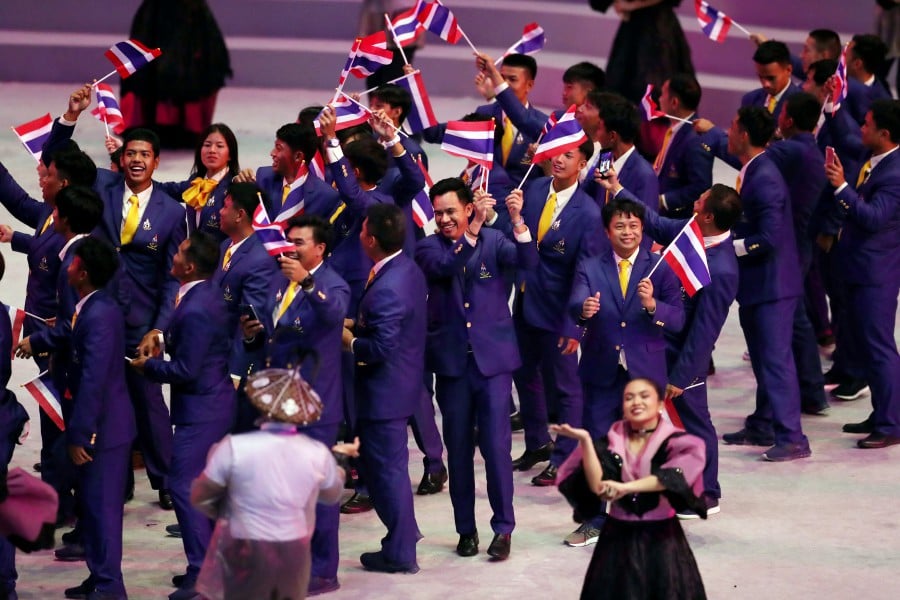
The contingents received loud cheers from the audience as they paraded into the arena in alphabetical order, starting with Brunei, Cambodia, Indonesia, Laos, Malaysia, Myanmar, Singapore, Thailand, Timor Leste and Vietnam, before host nation the Philippines ended the march.

Led by flag-bearer and 2018 bowling world champion Rafiq Ismail, the Malaysian contingent were represented by a delegation of about 100, including chef de mission Datuk Megat Zulkarnain Omardin and his two deputies, Nurul Huda Abdullah and Ahmad Faedzal Md Ramli.
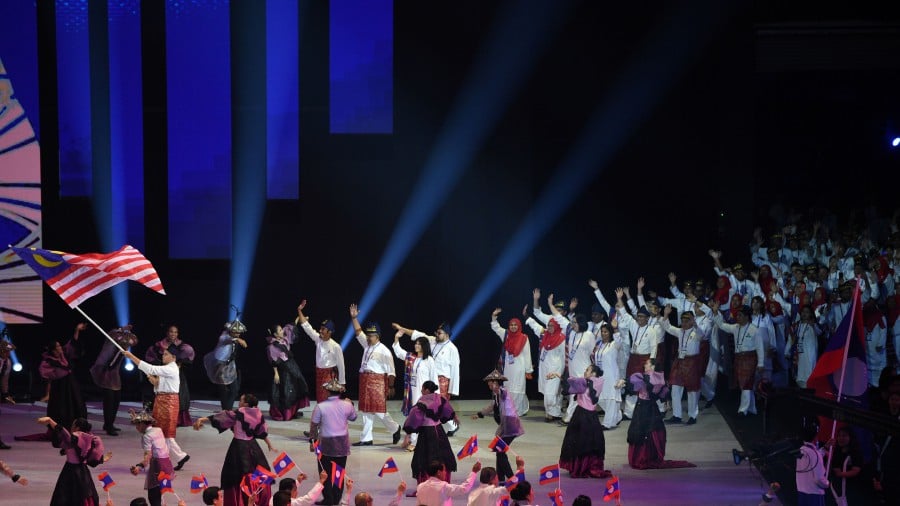

With the men dressed in white baju melayu and red samping with tengkolok, and the women in white baju kurung and selendang with Jalur Gemilang motif, and black shoes, the multi-racial Malaysian contingent, the hosts of the previous games, walked past the crowd proudly, symbolising the multiculturalism of the country.

World renowned Filipino boxers Manny Pacquiao and Nesthy Petecio were given the honour as the torchbearers before they jointly lit the cauldron to officially mark the beginning of the 30th SEA Games, after Philippine President Rodrigo Duterte had declared open the Games.

Themed ‘We Win As One’, the Games will run for 12 days until the closing ceremony at the New Clark City Athletics Stadium on Dec 11.
More than 8,000 athletes from the 10 ASEAN countries and Timor Leste will compete in 530 events in 56 sports at the three main clusters, namely Manila, Clark and Subic.


The Philippines have hosted the SEA Games three times before – in 1981, 1991 and 2005.
This year’s Games see the introduction of a few new sports such as arnis, jujitsu, kickboxing, underwater hockey and esports.

Defending champions Malaysia have sent a strong contingent of 773 athletes and 339 officials to participate in 52 sports, targeting 70 gold, 51 silver and 105 bronze medals, which is expected to place them fourth overall.– BERNAMA

Tuesday, November 19, 2019

...the PH improved world talent ranking

Philippines up 6 notches in world talent ranking


Louella Desiderio
Philippine Star 
19 November 2019


MANILA, Philippines — The Philippines was among 63 countries that posted the biggest climb in the latest World Talent Ranking (WTR) report of the International Institute for Management Development (IMD), as it rose six places to 49th place from 51st last year.


The country remained the laggard however, among Southeast countries.

Released in partnership with the Asian Institute of Management Rizalino S. Navarro Policy Center for Competitiveness in the Philippines, the WTR looks at countries’ ability to attract, develop and retain an employable talent pool.

The other countries which posted the biggest improvements are Taiwan, which went up seven places to 20th; Lithuania, which rose eight notches to 28th; and Colombia which advanced six places to 54th.

While the Philippines’ ranking improved in this year’s report, it was still behind its peers in the region.
All other Southeast Asian countries included in the report had better rankings than the Philippines such as Singapore (10th), Malaysia (22nd), Indonesia (41st), and Thailand (43rd).

In ranking countries, the WTR looked at three factors such as investment and development, appeal and readiness, and took into account responses to IMD’s executive opinion survey.

In the investment and development factor which measures funds poured in, as well as development of domestic human resources, the Philippines ranked 61st, up from the 62nd spot last year.

“This represents a one-place improvement from 2018, but this factor has consistently ranked in the 60s. Its low rank was mostly driven by pupil-teacher ratio in primary and secondary education and public expenditure on education per student,” IMD said.

As for the appeal factor, which looks at the ability to attract and retain high-quality talent from abroad, the Philippines rose to 31st place from 38th a year ago.

IMD said the highest ranked indicators for the Philippines under the appeal factor were cost of living and effective personal income tax rate, while the lower ranked ones were quality of life, justice, and brain drain.

When it comes to the readiness factor which assessed the quality and growth of the existing talent pool, the country placed 26th, 11 places higher than the previous year’s 37th.

“The relatively higher rank of the readiness factor was mostly driven by indicators on skilled labor, language skills, and share of science graduates among college degree holders,” IMD said.

Switzerland continued to top the WTR, strengthening its position as a global talent hub.

This was followed by Denmark in second place, and Sweden on the third spot. Mongolia, on the other hand, was at the bottom of the list or 63rd place.

Thursday, November 7, 2019

...the PH GDP growth in Q3 2019

Philippine growth accelerates on public spending and rate cuts

But 6.2% expansion in Q3 means year-end pick up needed to hit 2019 growth target

MANILA -- The Philippine economy grew 6.2% in the third quarter, as government spending and lower interest rates contributed to a recovery from weak expansions in the first half of the year.


The expansion was faster than the median forecast in a Reuters survey of economists of 6%, and up from the previous quarter's pace of 5.5%. The data released Thursday puts growth for the first nine months of 2019 at 5.8% -- still below the government's 6%-7% target.

The data is a boost to the administration of President Rodrigo Duterte, as it seeks to safeguard the domestic economy from the impact of the U.S. -China trade war, which has dented the growth of other Southeast Asian countries. Indonesia, the largest economy in the region, announced a 5.02% expansion earlier this week.

Government spending, which jumped 9.6% was a big factor in the acceleration. President Rodrigo Duterte's 2019 budget was not signed until mid-April after congressional wrangling over pork barrel funds delayed its passage. This forced the government to operate based on the 2018 budget, crimping state spending by nearly 1 billion pesos (around $20 million) a day, according to Finance Secretary Carlos Dominguez.

On the supply side, services rose 6.9%, the industrial sector climbed 5.6%, while agriculture improved 3.1% despite an outbreak of African swine fever that killed tens of thousands of pigs.
The economy must grow 6.7% in the fourth quarter to achieve the full-year growth target. 

Socioeconomic Planning Secretary Ernesto Pernia said Thursday this was "very achievable."

"We have seen the economy surging and the momentum will continue for us to reach that," Pernia told reporters in Manila.

The Philippine economy historically sees faster growth in the final quarter, as remittances from 10 million overseas Filipino workers help power a Christmas spending splurge.

Yet, Pernia said external factors could imperil growth. "The trade war between the U.S. and China is the biggest threat not only to the Philippines, but to the whole global economy," he said.

The Philippine central bank has cut the benchmark interest rate by a total of 75 basis points to 4.0% this year amid stabilizing inflation. The central bank also reduced reserve requirements for banks by 400 basis points to 14% in an attempt to pump money into the financial system.

Central bank Benjamin Diokno has signaled that the monetary easing has ended, ahead of the next policy meeting on Nov. 14.

Asked to react to Diokno's stance, Finance Secretary Dominguez, who is also a member of the monetary board, said on Monday that rate cuts were "sufficient" and they "will do the job" for now.

Saturday, October 26, 2019

...the favorite countries among travelers

Philippines 8th favorite country among travelers

Christina Mendez/Catherine Talavera
Philippine Star
26 October 2019


MANILA, Philippines — Foreign visitors’ interest in the Philippines remains strong after the country was voted by readers of travel magazine Conde Nast Traveler as one of the favorite destinations in the world to visit.


Based on results of Conde Nast Traveler’s Top 20 Countries in the World: Readers Choice Awards 2019, the Philippines ranked eighth with a score of 90.63.

The magazine cited island hopping, surfing and shopping as some of the activities tourists can do in the country.

It also cited Palawan, particularly Coron, El Nido and Linapacan, as among the top destinations.

The Philippines joined the other favorite countries to visit that included Indonesia, Thailand, Portugal and Sri Lanka.

“Gaining yet another prestigious recognition as the 8th Favorite Country in the World speaks well of the concerted effort of the Philippine tourism industry stakeholders in nurturing the many natural wonders the country is blessed with,” Tourism Secretary Bernadette Romulo-Puyat said.

Department of Tourism New York attaché Francisco Lardizabal received the award in behalf of the Philippines during ceremonies at the One World Trade Center in New York.

“All these accolades that the country and our other island destinations continue to receive bode well for the country’s sustainable tourism development program as continuity is the very essence of sustainability,” Puyat said.

Malacañang lauded yesterday the DOT for efforts to promote the Philippines after the country placed 8th in the Readers’ Choice Awards 2019 of Conde Nast Traveler.

“The world has spoken: it is truly more fun in the Philippines,” presidential spokesman Salvador Panelo said.

The Palace official is grateful to the readers of Conde Nast Traveler for making the Philippines eighth in their list of favorite countries in the world.

“We commend the Department of Tourism, their industry partners and other stakeholders for their splendid job. In its most recent report, the DOT counted a total of 5,554,950 visitors between January and August 2019,” Panelo said.

On top of this, Panelo noted that the Philippines registered a 14.08 percent year-on-year increase in the country’s international inbound traffic.

The recognition comes on the heels of two major awards the Philippines won at the recent 2019 World Travel Awards held at Phu Quoc island in Vietnam.

Readers of Conde Nast Traveler also voted three Philippine islands as the best islands in Asia, with Boracay grabbing the number one spot, despite the six-month closure of the island last year due to clean up and rehabilitation efforts.

“This itty-bitty island (just under four square miles) in the Western Philippines is as close to a tropical idyll as you’ll find in Southeast Asia, with gentle coastlines and made-for-Instagram sunsets,” according to Conde Nast Traveler.

“Fold in a thriving nightlife scene, and you have one of the top tourist spots in the region,” it added.
The magazine acknowledged the island’s closure and ongoing rehabilitation, noting that it has “become too touristed” in the past.

At present, the Philippine government is implementing a carrying capacity for Boracay, with only 19,215 tourists allowed to be on the island at any one time, and 6,405 tourists allowed to enter the island per day.

“The aptly named White Beach is Boracay’s main draw, with powdery white sand and shallow azure water ideal for swimming and snorkeling,” Conde Nast said.

Following Boracay is Cebu and the Visayas islands landing in second spot.

“Located in the center of the Philippines, Cebu draws nearly two million travelers annually for its pristine beaches and diving off the island’s northern coast. Spanish and Roman Catholic influences permeate Cebu City; Basilica Minore del Santo Niño houses a small statue of Christ that was presented by Ferdinand Magellan,” Conde Naste said.

The magazine highlighted Cebu’s Kawasan Falls near Cebu’s southwest coast, noting its popularity among locals and tourists.

Thursday, October 24, 2019

...the PH ranking in Ease of Doing Business

Philippines climbs to 95th spot in World Bank’s ‘Doing Business’ rankings

Ian Nicolas Cigaral
Philippine Star
24 October 2019

MANILA, Philippines — Ease of doing business in the Philippines improved over the past year, with the Southeast Asian country climbing 29 notches in World Bank’s “Doing Business 2020” report released Thursday.
Philippine economy
Out of 190 economies, the Philippines advanced to the 95th spot from 124th place in 2019. The country’s score improved to 62.8 from 60.9 previously.

Compared to its peers in the East Asia Pacific, the Philippines ranked below Singapore (2nd), Hong Kong (3rd), Malaysia (12th), Taiwan (15th), Thailand (21st), China (31st), Brunei (66th), Vietnam (70th), Indonesia (73rd) and Mongolia (81st).

The Washington-based multilateral lender’s annual report looks into the regulations that enhance business activity and those that constrain it.

Quezon City was used as a benchmark for the Philippines.
According to World Bank, starting a business in the Philippines became easier following the abolition of the minimum capital requirement for domestic companies.

The country also made dealing with construction permits easier by improving coordination and streamlining the process for obtaining an occupancy certificate.

“The Philippines strengthened minority investor protections by requiring greater disclosure of transactions with interested parties and enhancing director liability for transactions with interested parties,” World Bank added.

Worldwide, 115 economies made it easier to do business, World Bank said, with New Zealand remaining the most business-friendly country in the world.

Somalia was the worst with a score of 20.

Meanwhile, the economies with the most notable improvement in Doing Business 2020 are Saudi Arabia, Jordan, Togo, Bahrain, Tajikistan, Pakistan, Kuwait, China, India and Nigeria.

“The Doing Business 2020 study shows that developing economies are catching up with developed economies in ease of doing business,” World Bank President David Malpass said.

“Still, the gap remains wide,” he added.

Wednesday, October 23, 2019

...the Philippines in Asian Century


The opportunity for the Philippines in the Asian century 

The Corner Oracle
Andrew J. Marasigan
Philippine Star 
23 October 2019


The 300-year reign of the west as the world’s economic epicenter is coming to a close.

By next year, the collective size of all Asian economies will eclipse that of the rest of the world combined. Thus, the year 2020 marks the official beginning of the Asian Century, declared the United Nations Conference for Trade and Development (UNCTAD).

Asia is now the new center of the world as it is home to more than half of the world’s population and half of the world’s middle class consumers. It is also where 21 out of the world’s 30 largest global cities are located. Experts agree that the average growth rate of Asian economies will be more than double that of the rest of the world in the next 20 years.

Driving Asia is the phenomenal rise of China, India and ASEAN as economic powerhouses. To provide perspective on the phenomenal rise of the continent, Asia accounted for only one-third of global output in the year 2000. It now comprises 50 percent of the planet’s gross domestic product.

On a purchasing power parity (PPP) perspective, China’s economy is now bigger than that of the United States. India has overtaken Japan to become the 3rd largest economy. Within ASEAN, Indonesia is well on its way to becoming the 7th largest economy while Vietnam has overtaken 17 countries to take 32nd position. The Philippines, despite challenges in its manufacturing sector, has overtaken seven countries and it now has 26th largest economy. If the Philippines plays its cards right, it can be the 16th largest economy by the year 2050.

Prospects are promising for ASEAN. With China and India slowing down due to the trade war, ASEAN is in the position to take center stage as the world’s engine of growth. ASEAN’s economy is now bigger than that of Great Britain.

ASEAN’s development came in waves with Singapore and Brunei being the first to achieve high income status. Thailand and Malaysia achieved rapid growth in the 90’s and are now counted among upper middle income economies. In the last ten years, however, Indonesia, Vietnam and the Philippines have lead the way in as far as economic development is concerned. The three nations have clocked-in an average annual growth rate of between five and six percent since 2010. The Philippines is seen to graduate to upper-middle income status next year.

As I mentioned, China and India’s slowdown have made Indonesia, Vietnam and the Philippines the most dynamic global economies today. All three are in stiff competition to attract foreign investments. But to compete on an equal footing, the Philippines must resolve several structural weaknesses.

The gaping hole in the Philippines’ growth story is its manufacturing sector. It is weak, to say the least. For context, our merchandise exports revenues of $67 billion is less than a fourth of Vietnam’s $297 billion. We have become a nation dependent on imports – from simple ball pens to heavy equipment. This is why our budget deficit (and current account deficit) is growing at an alarming rate every year.

Deficits are covered by debt so it goes without saying that the country’s debt load is growing at an alarming rate too. Sure, it is still manageable today, but if government fails to balance the national budget soon, we could face a serious debt crisis.

To put it simply, we need to export more to pay for the debts government is amassing for its infrastructure program and for its massive importations of consumer goods.

The crux of our woes is our inability to attract foreign investments. Again, for context, the Philippines attracted $9.8 billion worth of investment last year while Vietnam attract $35.5 billion. Foreign investments are the silver bullet to our problems since they bring both capital and technologies needed to build factories. These factories export goods and provide the local market with what it needs, thus, making the country less import-dependent.

The structural weaknesses I referred to earlier are those that contribute in making the Philippines unattractive to foreign investors. They include the constitutional provisions that restrict foreign investments in certain industries, expensive power cost, insufficient infrastructure and difficulty to do business (due to bureaucratic red tape). Exacerbating matters is that corporate income tax in the Philippines is 30 percent, compared to only 20 percent in Vietnam and 25 percent in Indonesia.

The Philippines must address these structural weaknesses if it is to compete. Our economic managers have numerous reforms waiting to be approved by Congress.Whether our legislators have the political will to enact these reforms without watering them down is another story.

On corporate income tax, the CITIRA Law proposes to gradually reduce corporate income tax from 30 percent to 20 percent over a ten-year period. I reckon, however, that 10 years is too long. If we are to be a real contender, this should be accelerated to just three years. Indonesia just passed a law to reduce its rate to 20 percent next year. The CITIRA Law is now pending in the Senate.

As far as infrastructure is concerned, while construction of several roads, rails and ports are ongoing, it is still grossly insufficient. Only 9 out of the 75 projects in Build Build Build are under construction today. Government must work faster and with more urgency lest it fail to deliver its promise of a “golden age of infrastructure”.

Another reform we must undertake is to open up more industries in which foreigners can participate as a majority stakeholder. Unfortunately, the 1987 Constitution was written with a protectionist intent and it has been a great impediment to attracting investors. That said, only an amendment of the Constitution can fix this. Even if politically contentious, we must confront this issue eventually.

The transport and telecommunications backbone of the country needs to be strengthened if we are to be truly competitive, especially in the information and communication technology space. The Open Access in Data Transmission Act and the amendment to the Public Services Act will address this. Both bills are pending in Congress.

As for bureaucratic red tape goes, the Ease of Doing Business and Efficient Government Service Delivery Act has already been passed into law and is now awaiting implementation. When completely rolled out, it is envisioned that all front-line government services will be fully automated, making it easier to conduct business. Again, the devil is in the execution.

Apart from this, Congress must revisit the EPIRA Law which has proved ineffective to bring down power cost.

Conditions are right for the Philippines to break away economically. However, we must first get our house in order before investors come. It would be a shame if the Asian century happens and we are left behind.

Saturday, October 19, 2019

...the land of believers

China has the most atheists, Indonesia and Philippines the most believers


Tanutam Thawan| The Thaiger.com
19 October 2019

“According to the survey there is a connection between religiosity, beliefs and socio-demographic characteristics like age, income and education level.”
China has the most atheists, Indonesia and Philippines the most believers | The Thaiger

China is the least believing country in the world but belief in a God gets 100% mention in countries like Indonesia, Bangladesh and Philippines, according to the survey by Gallup International.

According to the survey exploring religious tendencies of 66,000 people in 68 countries across the world, 62 per cent of people in the world define themselves as religious, 74% of people globally believe we have a ‘soul’ and 71% believe in a God. Another 56% believe in heaven, 54% in life after death and 49% in hell.
China has the highest percentage of atheists in the world with 67% not believing in any religion. Every seven out ten people are atheists, more than double than any other country. 23% consider themselves as non-religious. Less than 10% identify themselves as religious in China.
China’s atheist percentage is followed by Japan, a long way behind in second place at 29%, Slovenia (28%) and Chech Republic (25%). Despite rapid industrialisation and urbanisation religion has stayed relevant in the South Korean region with only 23% identifying as atheist.
European countries like Belgium (21 %), France (21%) , Sweden (18%) and Iceland (17%) also have a large percentage of believing population.
Bangladesh, Indonesia and Philippines are the most believing countries with entire population claiming to believe in God, soul, hell and heaven. Thailand and Pakistan have 99% believing population, followed by India, Vietnam and Mongolia.
The survey shows that the levels of religiosity diminish as income and education levels increase. While 66% of people with low income affirm to be religious, this percentage drops to 50% among people with higher incomes. The same trend is verified in relation to education levels: 83% of people with lower education level are religious against 49% of higher level.
According to the survey there is a connection between religiosity, beliefs and socio-demographic characteristics like age, income and education level. As education and income levels grow higher, religiosity levels tend to go down. Also, the expression of different beliefs is higher among young people.
The level of education has a considerable influence on the perception of religion by the society. Women and young children show higher percentage for spiritual forces.