Showing posts with label foreign investment. Show all posts

Monday, November 25, 2019

...the PH economic gain with China

Philippines reaping economic benefits from harmonious ties with China: Finance Chief

Xinhuanet.com
25 November 2019
MANILA, Nov. 25 (Xinhua) -- Philippine Finance Secretary Carlos Dominguez has said that the 
Philippines is reaping the benefits from building a harmonious relationship with China, reiterating 
the Philippines' full support for China's Belt and Road Initiative (BRI).
In a finance forum held in Guangzhou, China over the weekend, Dominguez pointed out that as a 
result of this warming of relations between the two countries on President Rodrigo Duterte's 
watch, China has become the Philippines' biggest trading partner and one of the largest 
tourism markets.
Since 2016, he said, the Philippines' total trade with China increased at an average of 15 percent 
annually. Last year, the total trade with China reached 52 billion U.S. dollars, which was 15 
percent higher than the 2017 level.
Chinese tourist arrivals in the Philippines, meanwhile, grew at an average of 27 percent per 
year since the start of the Duterte administration, he added. "It reached 1.63 million arrivals in 
2018, or 23 percent higher than the visits recorded in 2017."
Moreover, he said the Philippines obtained the best terms - a very tight spread of 32 basis points 
over  the benchmark - for its maiden and subsequent "Panda" bond issuances in the Chinese 
market.
The China Lianhe Credit Rating also rated the Philippines' Panda bond issuances as Triple A, 
which is its highest rating, he said.
"The synergy created by closer Philippines-China economic cooperation is true for all the rest 
of the region. This is the reason we see even closer economic integration between China and
 the ASEAN economies," Dominguez said.
During the forum, Dominguez reiterated the Philippines' full support for China's Belt and Road 
Initiative (BRI), which, he said, will open the vast economic potentials of all countries in the region.
"Improved infrastructure will enhance trade among our economies. Enhanced trade will encourage 
more efficient investment flows. Improved connectivity will enhance the inclusiveness of our 
growth patterns. We have everything to gain from this."
Dominguez noted that the Philippines also has its version of the BRI dubbed the 
"Build, Build, Build" program, which involves 100 highly strategic infrastructure projects as 
well as thousands of infrastructure and logistics improvements all over the country.
This infrastructure modernization strategy, aimed at lowering the Philippines' poverty incidence 
from 27.6 percent in the first half of 2015 to just 14 percent by 2022, will lower the costs of 
moving people and goods, bring remote communities closer to the economic mainstream, and 
"create numerous  investment opportunities that will unleash the latent strengths of our economy," 
he said.
"We are relying on this program to induce internally generated growth that will enable us to 
expand despite a challenging global environment brought about by protectionist policies 
in the West," Dominguez said.

Friday, November 22, 2019

...the top foreign investment destination

Philippines a top foreign investment destination  with 613% surge in approved investments

PR  Newswire Asia
22 November 2019

BOI Figures Show +600% Rise by September 2019 with South Korea Topping Foreign Investments from East Asia

MANILA, Philippines, Nov. 22, 2019 /PRNewswire/ -- New data has unveiled a surge in BOI approved foreign investments which are expected to flow into the Philippines over the next 2-3 years.

These initiatives have made the Philippines a top investment destination, largely attributable to its continuing digital transformation and combined information and communications technology (ICT) and infrastructure efforts.

Skyline of Makati City, Manila, Philippines, Asia

Approved foreign investments by the end of September 2019 reached USD4.7 billion, a 613% rise from USD659 million in the same period in 2018, BOI figures show. Investment approvals as of September 2019 totaled USD15 billion, a 105% jump from USD7.31 billion in the same period of the previous year. 

The tourism sector also continues to rise with USD186.3 million worth of hotel and accommodation projects, while manufacturing is seeing consistent growth of USD1.24 billion of approvals, a 190% increase on last year. 

Trade and Industry Secretary and BOI chairman Ramon M. Lopez applauded the results, commenting: "This data shows that big-ticket projects are now rolling in, proving the strength and resilience of the Philippines economy in attracting foreign investors despite the global slowdown. 

"The results are a testament to the Philippines as a great place for foreign investment where business can thrive."

Explore investment opportunities in the Philippines

Investors can explore business opportunities in the Philippines at Invest ASEAN 2019 in Busan, South Korea on November 25-26 where the BOI will represent the country considered by the US News and World Report in 2018 as the best to invest in.

At this event, BOI will showcase opportunities in specific priority sectors: manufacturing, specifically electric vehicle and auto parts; infrastructure and construction; and tourism

"This growth, together with a suite of incentives such as tax holidays and exemptions from duties on imported spare parts makes the Philippines an enviable investment destination and one-stop-shop for business within Asia and beyond," added Lopez. 

Friday, November 8, 2019

..the Philippine FDI 2019

Investments in Philippines double up in January -September 2019, hitting 15.14 bln dollars

Xinhuanet.com
08 November 2019

MANILA, Nov. 8 (Xinhua) -- The Philippine Board of Investments (BOI) said on Friday it has recorded cumulative investments worth 764.7 billion pesos (roughly 15.14 U.S. dollars) as of September 2019, a 105 percent increase from 327.9 billion pesos (roughly 6.50 billion U.S. dollars) approved in the same period of 2018.

"The sustained high growth of investments is a proof of the business sector's strong confidence in both the Philippines' economic fundamentals as further shown by the acceleration of the third-quarter gross domestic product (GDP) growth to 6.2 percent and the reform agenda of President Rodrigo Duterte," Philippine Trade Secretary and BOI Chairman Ramon Lopez said.

The BOI said approved investments from domestic sources topped 524.9 billion pesos (10.40 billion U.S. dollars), a 54.7 percent increase from 339.3 billion pesos (roughly 6.7 billion U.S. dollars) in the same period in 2018.

On the other hand, the BOI said approved projects by foreign investors amounted to 239.9 billion pesos (roughly 4.8 billion U.S. dollars) or 613 percent increase from just 33.6 billion pesos (roughly 665.7 million U.S. dollars) a year ago.

According to the BOI, Singapore continues to set the pace among all foreign entities with 170 billion pesos (roughly 3.37 billion U.S. dollars) in the capital. It added that South Korea is now second with 34.1 billion pesos (roughly 675.62 million U.S. dollars), while The Netherlands places third with 9.2 billion pesos (roughly 182.3 million U.S. dollars).

According to the BOI, all projects once operational will generate employment of 41,862, which is 38.5 percent higher than last year's figure of 30,218.

"We are particularly pleased to highlight that the share of foreign investments in BOI projects have increased from just eight percent during January to September 2018, to already 31.4 percent this year," Lopez added.

This is expected to continue as Lopez noted that Duterte's policy of furthering relations with non-traditional partners has been yielding results.

Philippine Trade Undersecretary and BOI Managing Head Ceferino Rodolfo said investments from the information and communications technology (ICT) and power sectors accounted for 85 percent of the total figure or 652.9 billion pesos (roughly 12.94 billion U.S. dollars).

"This massive infrastructure buildup for more power and connectivity across the archipelago is critical towards addressing binding constraints to the Philippines' competitiveness," he added.

Monday, November 4, 2019

...the Japanese innovation investment in PH

Japanese firms to invest $215 million in Philippine innovation projects

Business Mirror
04 November 2019


Japanese firms are investing $215 million in new projects and expansions in the Philippines, as they seek to take advantage of the growing innovation environment here.

On the sidelines of a business forum in Tokyo, Trade Undersecretary Rafaelita M. Aldaba met with Japanese manufacturers to pitch investment opportunities in the Philippines. A total of $215 million worth of projects, most of which related to innovation, were secured during these meetings.

The projects include the opening of the first MOS Burger, Japan’s second-largest burger joint, by March of next year, and the interest of Assemblepoint to develop smart four-wheel electric vehicle using latest Internet of Things technologies.

Also, Satelight is eyeing to outsource animation work from the Philippines, while Kanepackage is planning to build a new factory. Further, Sumitomo Wiring presented during the meetings its expansion projects on wiring harness and components production.
Marubeni Corp. also shared its joint-venture project with two local firms to put up 30 primary care clinics and 10 cancer centers, as well as install five centralized laboratory testing hubs in strategic urban areas.

“There are many potential opportunities for the Philippines and Japan to deepen trade and investment partnership through innovation. I am delighted that the companies I met during this trip are making significant contributions in the areas of creating new industries, products and leapfrogging to Industry 4.0 by adopting smart manufacturing to transform our industries,” Aldaba said in a news statement issued on Monday.

Aside from those who committed to invest, there were investment intentions in infrastructure development, railways, electric vehicle public transport system, retail, manufacturing, logistics, warehousing, factory automation, construction and real estate.

Last week Aldaba presented the government’s Inclusive Innovation Industrial Strategy to over 600 Japanese investors at the Philippine-Japan Business Investment Forum organized by the Nikkei Business Publications Inc. Aldaba discussed the areas where Manila and Tokyo can collaborate under the i3s, which is geared toward improving the manufacturing, agriculture and services sectors of the country.

“In the context of these trade and investment trends between the Philippines and Japan, along with global developments, such as the entry of new technologies, we feel the need to focus our efforts on innovation to address the opportunities and challenges arising from Industry 4.0, but also from increasing global competition, United States-China trade war and regional economic integration,” Aldaba added.
Last year Japan is the country’s third-largest foreign source of investments. Based on records from the Philippine Statistics Authority, Japanese investments in 2018 declined 38.33 percent to P19.72 billion, from P31.98 billion in 2017.

Wednesday, September 25, 2019

...the good neighbor

Singapore keen on bigger investment to Philippines


Bianca Cuaresma
Business Mirror
25 September 2019


Singapore businesses looking for expansion opportunities in the region are highly considering the Philippine market as their choice investment destination, a recent survey showed.

The Singapore Business Federation’s (SBF) recent National Business Survey showed that the Philippines was among the top 10 markets of interest for Singaporean companies looking to expand their business.

“While many Singapore companies have established operations in the Philippines in industries such as manufacturing and infrastructure, there are untapped opportunities in areas such as information technology and digital solutions, which our companies with the capabilities will be able to take up,” SBF Chairman Teo Siong Seng said.

He added that the economic and social progress the Philippines has made, thus far, makes for an attractive and compelling case for Singapore investors.

“Asean remains a bright spot in a cloudy global economy and has abundant opportunities and potential for growth. Singapore and the Philippines have always enjoyed close economic ties,” the SBF chairman said.

In 2018, Singapore was the second-largest investor in the Philippines, and the Philippines’s largest export market among the member-states of the Asean.

Loh Chin Hua, chief executive officer of Keppel Corp. who is also co-chairman of the Philippines-Singapore Business Council, said the company is now exploring ways on how it can expand its investments in the Philippines, especially with the Duterte’s administration’s “Build, Build, Build” infrastructure modernization program now in full swing.

Keppel Corp. is one of Singapore’s largest conglomerates with involvement in the infrastructure sector.

He also noted that among the advantages of doing business in the Philippines is that investors can borrow in the local currency, thus reducing risks and enabling them to get reasonable returns.

“And that is quite a remarkable achievement because not many countries in this region can say that. And when you have to invest abroad but you have to borrow in their currencies, it always increases the risks,” Loh said. “For Keppel, we have operated two shipyards in the Philippines, and we are now looking to see how we can do more here.”

Earlier this month, a delegation of 21 Singapore business leaders from 14 companies joined the business mission organized by the SBF from September 9 to 11 2019. The delegation was led by SBF Chairman Teo Siong Seng.

Friday, September 13, 2019

...the ties that binds Singapore and Philippines

Opportunities abound for Singapore-Philippines collaboration: Halimah Yacob


Buena Bernal 
Channel News Asia
13 September 2019


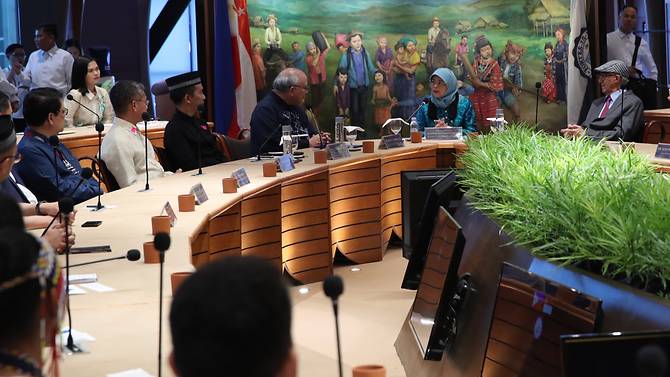
MANILA/DAVAO: Singapore and the Philippines can collaborate in many areas, Singapore President Halimah Yacob said as she concluded on Thursday (Sep 12) a five-day state visit to the Philippines, during which she met Philippines President Rodrigo Duterte in Manila and headed to his home city of Davao in Mindanao.

Singapore's President Halimah Yacob and Philippine President Rodrigo Duterte shake hands
Singapore's President Halimah Yacob (left) and Philippine President Rodrigo Duterte shake hands following the official Palace Guest Book signing on Monday, Sep 9, 2019 at the Presidential Palace in Manila, Philippines. (Photo:AP/Bullit Marquez)

Madam Halimah said that as founding members of ASEAN, the two countries' close ties, resulting in public and private collaboration, is ultimately about raising the quality of life for people in the region.

Singapore and the Philippines can collaborate in human capital development, innovation and infrastructure, not just in the megacities but also in the provinces, she added.

"I think that our businesses which have niche core capabilities in the areas of sustainable town development, urban development will find opportunities, particularly in the areas of smart city, waste management, water supply and other areas related to urban town development," she said.

In his opening remarks during a meeting between Singapore and Philippines officials, Mr Duterte admitted there is much to learn from Singapore.

"The Singapore story dating back to its beginning as a trading port in 1819 is truly remarkable. It is by itself an inspiration for many nations around the world," said Mr Duterte.
Among the highlights of Madam Halimah's trip was a stop in Davao, Mr Duterte's hometown. 

The southern Philippine islands of Mindanao are home to dozens of tribes and to most of the Muslim population in the Philippines, a country where 80 per cent are Roman Catholics.

Madam Halimah and her spouse, Mr Mohamed Abdullah Alhabshee, were welcomed at the Davao airport by performers dancing to tribal rhythms that she said showcased the diversity of the country's south, where not many heads of state have set foot. The southern part of the Philippines houses the country's poorest provinces.

"Diversity is also something that teaches us tolerance, teaches us magnanimity, teaches us understanding ... It makes you a better human being. And it makes the whole society better," she said.
She is the third head of state to visit Mindanao since Mr Duterte took power, after Japanese Prime Minister Shinzo Abe and Indonesian President Joko Widodo in 2017.

Halimah at Mindanao youth dialogue
Singapore President Halimah Yacob speaks during a dialogue with Mindanao youth. (Photo: MCI)

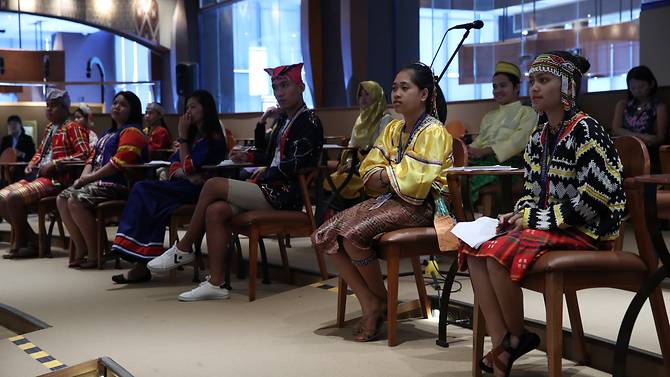
In a dialogue with Mindanaoan youth of different religious backgrounds, Madam Halimah emphasised the need for engagement to counter ignorance and prejudice.

"A society is fragile if one group views another as a threat. It is important to overcome the forces of division, and build bridges instead of walls," she said.

Prejudice against the Philippines' Muslim minority is a flashpoint in Mindanao, which saw an armed Muslim rebellion half a century ago after decades of land-grabbing, marginalisation and even massacre of their kin.

Bangsamoros, Muslim natives in the country's south, now have greater autonomy after a law resulting from a peace deal with the country's largest Muslim rebel group was ratified.

In their meeting, Philippines President Rodrigo Duterte told Madam Halimah about the ratification of this law that is seen to help end decades-long conflict and open up the region to outside investments.
"It was my pleasure to share with President Yacob our gains in peace and development in Mindanao, particularly our progress in establishing the Bangsamoro Autonomous Region in Muslim Mindanao,” said Mr Duterte in a joint press conference with Madam Halimah after their meeting.

“We discussed ways by which our cooperation could help contribute in bringing just and lasting peace and meaningful progress and development in Mindanao."


Mindanaoan youth of different religious backgrounds are pictured during a dialogue


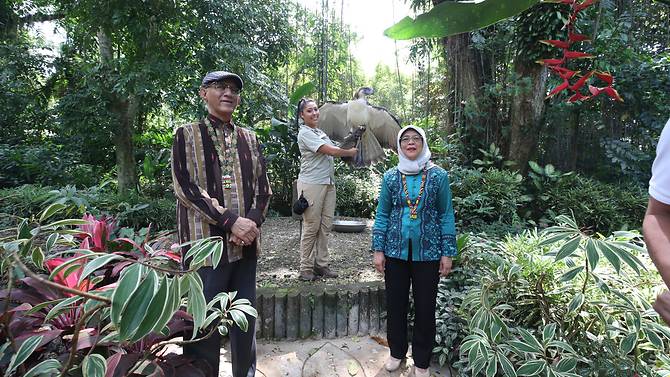
At Davao City, Madame Halimah also visited an eagle centre where she saw up close the critically endangered bird of prey known as the Philippine Eagle.

The rare biological heritage can only be found in the Philippines and only lays a single egg every two years. Its numbers are dwindling due to the clearing of forests that destroy their habitat.

A pair of Philippines Eagles are on a 10-year loan to Singapore. or conservation and breeding.

Halimah and Philippine Eagle
Singapore President Halimah Yacob (right) and her spouse, Mr Mohamed Abdullah Alhabshee (left), pose for a photo with a Philippine Eagle at the Philippine Eagle Center in Davao in Davao City. (Photo: MCI)

SINGAPORE BUSINESSES IN THE PHILIPPINES

High on the agenda of President Halimah's visit was for Singapore corporations as well as its small and medium enterprises (SMEs) to venture and expand in the Philippines.

Eight memoranda of understanding between the Philippines and Singapore were exchanged during Madam Halimah's state visit, ranging from agri-tech, water management and electricity supply in rural areas, to arts and culture, data protection, and training people for the next industrial revolution.
Madam Halimah also graced the opening of The Podium, an office and retail complex in Metro Manila developed by Singapore and Philippine firms Keppel Land and BDO Unibank.

“We also like to see more integrated mixed use development happening in Philippines. This is applying the concept that we learned in our Singapore Marina Bay financial centres where we incorporate office, residences and retail together so that's fulfilling the live, work, play scenarios," Keppel Land CEO Tan Swee Yiow told CNA.

Madam Halimah cited the Philippines' young, tech-savvy population as a reason to venture into the country.

"There is a strong consumer demand for goods and services. Our Singapore brand - in terms of our products and services - do have a reputation, largely also because we have a large Filipino community in Singapore. They have had opportunities to try out our Singapore brand, and they like it," she told Singapore media.

Singapore was the Philippines’ largest foreign investor among Southeast Asian countries and the second largest worldwide last year. Bilateral trade between the two countries grew by 18.6 per cent compared with the previous year.

Moving forward, Madam Halimah says she hopes to see progress in two particular areas - updating an existing agreement to avoid double taxation, as well as expanding a bilateral air transport deal.


APEX OF 50 YEARS OF DIPLOMATIC TIES


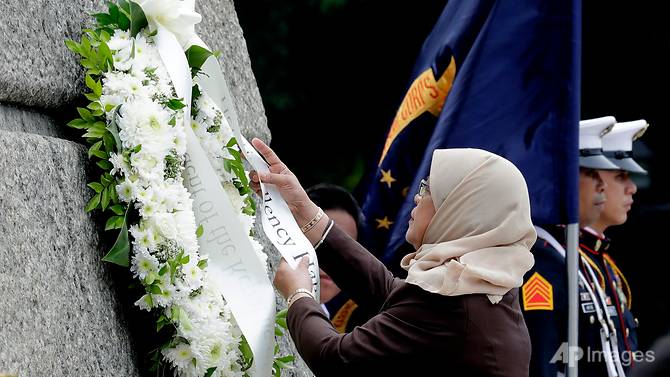
Singapore's President Halimah Yacob adjusts the wreath at the foot of the monument of Dr Jose Rizal
Singapore's President Halimah Yacob adjusts the wreath at the foot of the monument of Dr Jose Rizal, the country's National Hero, in ceremony on Sep 9, 2019 in Manila, Philippines. (Photo: AP/Bullit Marquez)

Prior to her meeting with Mr Duterte, Madam Halimah also paid her respects to the late Philippine national hero Jose Rizal, the novelist who believed in the power of words to help liberate the Southeast Asian nation from colonial powers. 

It is customary for visiting heads of state to the Philippines to offer flowers at the monument of Rizal.
The Philippines foreign ministry described Madam Halimah's state visit to the Philippines as an apex in the two countries’ celebration of 50 years of diplomatic ties this year.

Thursday, September 12, 2019

...the world's best countries to invest 2019

Friday, September 6, 2019

...the neighbors

In Bid for Friendship Renewal, China Offers Philippines More Development Money


Ralph Jennings| Voice of America
06 September 2019

TAIPEI, TAIWAN - China has pledged to help fund a $169 billion infrastructure renewal drive in the Philippines, an apparent bid for friendship as Filipinos question whether officials in Beijing are trying to squelch their maritime sovereignty claims.
Construction workers stand on scaffolding around metal rods of a new pillar as they add more floors to a building project in suburban Paranaque city, south of Manila, Philippines, Jan. 26, 2017.
FILE - Construction workers stand on scaffolding around metal rods of a new pillar as they add more floors to a building project in suburban Paranaque city, south of Manila, Philippines, Jan. 26, 2017.

Over the past year, Chinese boats have surrounded a Philippine-held islet in a disputed tract of the South China Sea. A collision between vessels from the two countries sank a Philippine boat in June. Filipinos want China to honor a 2016 ruling by the Permanent Court of Arbitration in the Hague against the legal basis for its sovereignty claims to the sea, but Chinese officials reject the verdict.

Too much distaste for China could pivot the Philippines closer to the United States, a staunch military supporter, and to Japan, a steady development aid donor. China is at odds with both Tokyo and Washington politically.

Philippine President Rodrigo Duterte, who made peace with China in 2016 by setting aside the maritime dispute, met last week with Chinese President Xi Jinping and Chinese Premier Li Keqiang. Li vowed to “step up cooperation” on the five-year Philippine infrastructure drive, Duterte’s website said.

“Perhaps it’s a way to reassure the government and at the same time also the public that it remains committed to the support in terms of the infrastructure projects in the Philippines,” said Maria Ela Atienza, a political science professor at the University of the Philippines Diliman.

“At the same time, maybe they thought it’s a way to placate the rising dissatisfaction of the public and even some sectors in government about the Chinese movements in the EEZ [maritime exclusive economic zone] of the Philippines,” she said.
Funding targets
During his meeting in Beijing with Duterte, Xi said it was “necessary” to pair the Philippine infrastructure drive with China’s own Belt and Road initiative, the Chinese official Xinhua News Agency reported.
China's President Xi Jinping, left, shakes hands with Philippines President Rodrigo Duterte during the opening ceremony of the 2019 Basketball World Cup in Beijing, China, Aug. 30, 2019. FILE - China's President Xi Jinping, left, shakes hands with Philippines President Rodrigo Duterte during the opening ceremony of the 2019 Basketball World Cup in Beijing, China, Aug. 30, 2019

The Belt and Road initiative is a 6-year-old, $1 trillion campaign by Beijing to open trade routes around Eurasia by helping other countries build ports, roads and other infrastructure.

Xi called at the meeting for “major” cooperative projects in infrastructure construction, industrial parks, energy and telecommunications, Xinhua said.
“First and foremost, the Chinese are trying to send a message that it’s not just words, but actually we’re going to step up to the plate and pledge some money,” said Stephen Nagy, senior associate politics and international studies professor at International Christian University in Tokyo.
China stepped up trade and development support for much of Southeast Asia after losing in the International Court of Arbitration. In 2016 Xi pledged $24 billion in aid and loans for the Philippines.
About $4.7 billion of that pledge had reached the Philippines as of February, according to domestic media reports. Ordinary Filipinos have complained that China is giving too little so far.
Duterte kicked off his infrastructure renewal, a program called "Build, Build, Build," to help prepare the country for more industry. About one-in-five Filipinos live in poverty today, due largely to lack of jobs.
South China Sea
Philippine President Rodrigo Duterte, left, and Chinese President Xi Jinping, right, meet at the Diaoyutai State Guesthouse in Beijing, China, Aug. 29, 2019.
FILE - Philippine President Rodrigo Duterte, left, and Chinese President Xi Jinping, right, meet at the Diaoyutai State Guesthouse in Beijing, China, Aug. 29, 2019

China and the Philippines dispute sovereignty over parts of the 3.5 million-square-kilometer body, valued for fisheries and fossil fuel reserves. Three other Southeast Asian countries and Taiwan claim all or parts of the same sea, but China calls about 90% of the waterway its own.
About a decade ago, China began taking a military and technological lead by reclaiming land to expand small islets and place military equipment on some of them.
Duterte’s predecessor filed a lawsuit in the International Court of Arbitration in 2013.
Xi said last week that China and the Philippines should set aside disputes, according to the Xinhua report.
Poor Sino-Philippine relations would raise the prominence of U.S. and Japanese help for the Southeast Asian country, analysts believe.

Duterte initially shunned the United States to build ties with China, but a survey by the Manila-based research organization Social Weather Stations released in July found that 51% of Filipinos feel “little trust” in China while 81% had “much trust” in the United States.
Washington irks China by passing Navy ships into the disputed sea as a statement it’s open for international use. Xi told Duterte China would “continue to firmly support the Philippines' efforts to safeguard national sovereignty and resist external interference,” Xinhua said.
China must boost aid to “change the security equation,” Nagy said.
Japan, which had given the Philippines a cumulative $24.4 billion in development support through 2017, also enjoys a favorable image among Filipinos. Japan is courting much of Southeast Asia through development aid to shore up its own influence in the region as China grows economically.
“Any funder who would like to help the Philippines is always welcome, however at the moment, just to give you an update, the biggest share of our ‘Build, Build, Build’ remains with Japan,” said Jonathan Ravelas, chief market strategist with BDO Unibank.