Why tourists are not that much attracted to the Philippines?
Salah Uddin Shoaib Choudhury
Weeklyblitz.net
16 September 2019
"The Philippines has garnered numerous titles related to tourism, namely, the traditional capital of the world’s festivities, the capital of the western Pacific, the centre of Hispanic Asia, the Pearl of the Orient Seas, center of the Coral Triangle, and the capital of fun. The country is also a biodiversity hotspot, having the world’s highest endemism rate for bird species, and one of the highest for mammals and flora. It is also the largest bastion for Roman Catholicism in all of Asia."
While Thailand every year attracts over forty million tourists, the Philippines has not been even able to get just one million every year. Although there is no doubt about Thailand being one of the most attractive nations enjoying a leading position amongst nations drawing tourists, it is not a fact that the Philippines does not have any place to visit or it is a country as dull as Afghanistan or Pakistan.
Rather, the Philippines too is gifted with plenty of places filled with natural picturesque and most importantly the people are extremely friendly and the cities are safe for the foreigners. Knowing about some incidents in the Mindanao province and activities of the radical Islamist or jihadist group, if we start thinking the Philippines is a country affected by jihad and terror, it will certainly be a blunder. On the other hand, we should not buy the Western propaganda against this beautiful country, as some of the Western media are competing in projecting this country as a land of drugs and thugs.
In May 2019, the Department of Tourism (DOT) reported a 7.59 percent increase in tourist arrivals to the Philippines in the first quarter of 2019, indicating that the country’s tourism “is on the right track”.
According to figures released by the DOT, around 2,204,564 foreign visitors arrived in the country from January to March 2019, reflecting a 7.59 percent rise from 2,049,094 over the same period last year.
South Korea remains the top source market with 519,584 tourist arrivals compared to last year’s 477,087.
The period also saw the Chinese market ranking second with 463,804 tourists, 24.87 percent higher than the previous year’s tally of 371,429. In the third spot is the United States, registering 293,780 visitors, up by 3.10 percent from last year.
Taiwanese visitors posted the highest percentage increase which grew to 77,908 from 59,877 in 2018 or 30.11 percent higher than last year.
Completing the top 12 markets for the three-month period are: Japan, 177,769; Taiwan, 77,908; Australia, 73,147; Canada, 72,352; United Kingdom, 53,402; Singapore, 39,484; Malaysia, 37,651; India, 36,275; and Germany, 33,725.
For March numbers alone, the DOT reported a visitor arrival of 714,309 or an 11.13 percent growth versus the same month last year.
“Notably, France entered the top 12 for the month of March, posting 10,715 visitors, a 26.21 percent growth from last year’s March tally of 8,489 while Germany rose to 11th place with 11,075 visitors, sporting a 9 percent increase,” the DOT said.
Germany nudged India to 13th place, with a total of 10,086, up slightly with a 1.52 percent increase vis-a-vis 9,935 of last year.
Meanwhile, visiting Philippine passport-holders permanently residing abroad (not including overseas Filipino workers), otherwise known as “balikbayans,” totaled 14,610 as of March.
Despite the fact of only less than a million tourists visiting the Philippines each year, tourism still plays an important role in the country’s economy. In 2015, the travel and tourism industry contributed 10.6% to the country’s GDP. Philippines is an archipelagic country composed of 7,641 islands with 82 provinces divided into 17 regions. The country is known for having its rich biodiversity as its main tourist attraction. Its beaches, heritage towns and monuments, mountains, rainforests, islands and diving spots are among the country’s most popular tourist destinations. The country’s rich historical and cultural heritage, including its festivals and indigenous traditions, is also one of the attractions of the Philippines. Popular destinations among tourists are Cebu, Boracay, Palawan, Siargao, and many more.
The Philippines has garnered numerous titles related to tourism, namely, the traditional capital of the world’s festivities, the capital of the western Pacific, the centre of Hispanic Asia, the Pearl of the Orient Seas, center of the Coral Triangle, and the capital of fun. The country is also a biodiversity hotspot, having the world’s highest endemism rate for bird species, and one of the highest for mammals and flora. It is also the largest bastion for Roman Catholicism in all of Asia.
The country is also home to one of the New7Wonders of Nature, the Puerto Princesa Subterranean River National Park, and one of the New7Wonders Cities, the Heritage City of Vigan. It is also home to 6 UNESCO world heritage sites scattered in 9 different locations, 3 UNESCO biosphere reserves, 3 UNESCO intangible cultural heritage, 4 UNESCO memory of the world documentary heritage, 1 UNESCO creative city, 2 UNESCO world heritage cities, 7 Ramsar wetland sites, and 8 ASEAN Heritage Parks. More than 90 percent of all Filipinos can understand and speak English, as many are multilingual.
 |
| New7Wonders of Nature: Puerto Princesa Subterranean River, Palawan (from web) |
Tourism in the Philippines traces its origins during the ancient times when the first set of people chose to migrate through land bridges, followed by the other sets of migrations from the Malayan archipelago in the south and Taiwan in the north. Through time, numerous ethno-linguistic groups developed, until some of them became monarchies, plutocracies, hunter-gatherers, city-states, and so on. Trade also became part of the tourism as Arabs, Indians, Japanese, Chinese, Malays, and other ethnic groups in mainland Southeast Asia, Taiwan, and Ryukyu traded goods with the natives. When the islands became part of the territory of Spain, an influx of Spanish people migrated into the country, though still few compared to the Spanish migrations in South America as the Philippines was farther from Spain.
 |
New Seven Wonder Cities of the world: Vigan City, Ilocos Sur (from web)
|
The tourism industry first truly flourished during the late 19th to early 20th century due to the influx of immigrants from Europe and the United States. It was listed as one of the best countries to visit in Asia aside from Hong Kong and Japan, earning the nickname “Pearl of the Orient Seas”. The tourism declined during and after the World War II, leaving the country with a completely devastated economy, and a landscape filled with destroyed heritage towns. The second wave of tourist influx flourished in the 1950s but declined drastically during the dictatorship era. After the People Power Revolution, the tourism industry continued to decline due to the domino effect caused by the dictatorship. The industry only managed to cope in 1991 and 1992, where 1.2 million tourists visited the Philippines. It afterward waned again after a decade due to corrupt practices in government.
The tourism industry flourished again for the third time at the early part of the 2010s under the “It’s More Fun in the Philippines” slogan, which was widely regarded as an international success, gaining international media attention. The country saw an influx of tourists from all over the world, with the help of social media and the creative tagline, the tourism went at its peak with having 5,360,682 foreign million tourists recorded in 2015.
Isn’t it more fun in the Philippines, truly?
If we will look into the growth of tourism in Thailand, we shall be seeing a very well-planned promotion by the government which helps the country in getting an increased number of tourists every year. The Amazing Thailand slogan works very well, while the Thai authorities are smartly using the print, electronic and social media in always keeping the country into the top chart of tourist’s favorite. No doubt, people in Thailand have already learnt the art of letting the tourists feel the excitement and delight of returning to the land of beauty anytime they plan a tour.
To the Westerners, a tour to Thailand is like a dream and everyone is eager to see the natural picturesque mixed with excellent Buddhist culture of hospitality, warmth, and kindness. Thais always hold the smile to welcome their foreign guests with their signature greetings – Sawasdee. Similarly, why the Filipinos cannot say Salamat with a broad smile? Why they do not take enthusiasm in letting people realize – It’s More Fun in the Philippines?
While a foreigner will feel the fragrance of warmth immediately after landing in Bangkok, they may not get a similar feeling while being in Manila, unless they plan to visit Cebu, Boracay, Palawan or Siargao. But truly, Manila itself has a lot to offer to the tourists – from its beautiful bays and ocean beach to historic places within the Manila city.
 |
| Rizal Park, Manila: Asia's largest urban park (from web) |
As an archipelago composed of 7,641 islands, the Philippines offers a range of attractions such as the white sand beaches of Boracay and Cebu, surfing spots in Siargao, rice terraces of Ifugao, Mayon Volcano in Albay, diving sites of Palawan and Cebu, heritage houses in Vigan, and the cultural /shopping attractions of Cebu, and Metro Manila.
 |
| Mayon Volcano, Albay: world's most perfect volcanic cone (from web) |
The island of Luzon is considered the political and economic center of the Philippines. The economy of Luzon is centered in Metro Manila, the national capital region. Manila was ranked 11th most attractive city for American shoppers out of 25 Asia Pacific cities by a Global Blue survey in 2012. Shopping malls can be found around the metropolis, especially in the business and financial districts of Makati, Ortigas and Bonifacio Global City. Despite the rise of modern shopping malls, traditional Filipino shopping centers such as flea markets and bazaars still remain around the metropolis.
 |
| Makati Central Business District (from web) |
The Visayas, the central island group of the Philippines, is the heart of the country’s biodiversity. The most popular destinations in Visayas are Cebu and Boracay: islands popular for pure white sand beaches and has been favorite island destinations for local and foreign visitors. In 2012, Boracay received the “best island” award from the international travel magazine Travel + Leisure. Aside from its white sand beaches, Boracay is also a popular destination for relaxation, tranquility and an exciting nightlife. In 2018, 3 Philippine islands, Siargao Island, Boracay, and Palawan, were listed on Condé Nast Traveler’s list of Asia’s best islands. The three islands were ranked first, second, and third, respectively.
 |
| Boracay Aklan, world's best island (from web) |
|
|
Mindanao, the southernmost island of the Philippines, is known for its mountain ranges; it is one of the best climbing destinations in the Philippines. Mindanao is home to the country’s highest mountain, Mount Apo. On average, it takes two days to reach the summit. The mountain has a wide range of flora and fauna, including over 272 bird species, 111 of which are endemic to the area, including the national bird, the Philippine eagle. Mount Apo has become a popular hiking destination for mountain climbers.
 |
| Philippine Eagle: the largest eagle in the world, endemic to the Philippines. (from web) |
Beach tourism is currently the major tourist draw of the Philippines. Various beaches in the Philippines have landed in multiple magazines, ranking them anywhere between 1st place to 8th place. Among the most popular beach and diving choices in the country includes Boracay, El Nido, Coron, Cebu, and Siargao. Other common beach places are in Samal, Cagayan, La Union, Pangasinan, Zambales, Batangas, Iloilo, Dumaguete, Camarines Sur and Zamboanga. In 2018, Canadian-based travel agency Flight Network listed Hidden Beach in Palawan (No. 1) as the best beach in all of Asia. The beach was also cited by Travel+Leisure as among the 13 places to see the bluest water in the world. Other beaches ranked from the Philippines were Guyam White Sand Beach in Siargao (No. 13), Palaui Beach in Cagayan Valley (No. 22), Caramoan Island Beach in Camarines Sur (No. 29), Dahican Beach in Mati, Davao Oriental (No. 41), Gumasa Beach in Sarangani (No. 45), Alona Beach in Panglao, Bohol (No. 46), Kalanggaman Island in Cebu (No. 49), and Paliton Beach in Siquijor (No. 50).
 |
| Coron Island, Palawan (from web) |
Hiking is a rising form of tourism in the Philippines, especially among locals and Western foreigners. Among the most famous hiking areas in the country are Mount Apo, Mount Pinatubo, Mount Halcon, Mount Banahaw, Mount Makiling, and Mount Pulag.
 |
| Mount Pinatubo: from deadly to lovely (from web) |
Online magazine, Culture Trip, cited Mount Batulao in Batangas, Masungi Georeserve in Rizal, Tarak Ridge in Bataan, Mount Daraitan and Maynoba in Rizal, Kibungan Circuit in Benguet, and Mount Pulag in Nueva Vizcaya for having the most spectacular hiking trails in the country in 2017.
Due to the diverse number of flora and fauna of the country, researchers from around the world have flocked various biodiversity sites in Philippine environmental corridors. Among the big draws for environmental researchers include Mount Mantalingajan, Sibuyan Island, Dinagat Islands, Mount Hamiguitan, Central Panay Mountain Range, Verde Island Passage, Tubbataha Reef, Mount Malindang, Northern Sierra Madre Natural Park, and Turtle Islands, Tawi-Tawi. Local and foreign archaeologists and anthropologists have also flocked the country’s archaeological sites, such as Cagayan Valley, Butuan, Tabon Cave, Callao Cave, Banton, Ifugao, Cebu, Lanao del Sur, and many others. Various universities in the country, such as University of the Philippines, Ateneo de Manila University, De La Salle University, University of Santo Tomas, Silliman University, University of San Carlos, and University of Mindanao, have also been influential in research tourism, especially for graduate students and students seeking better review centers.
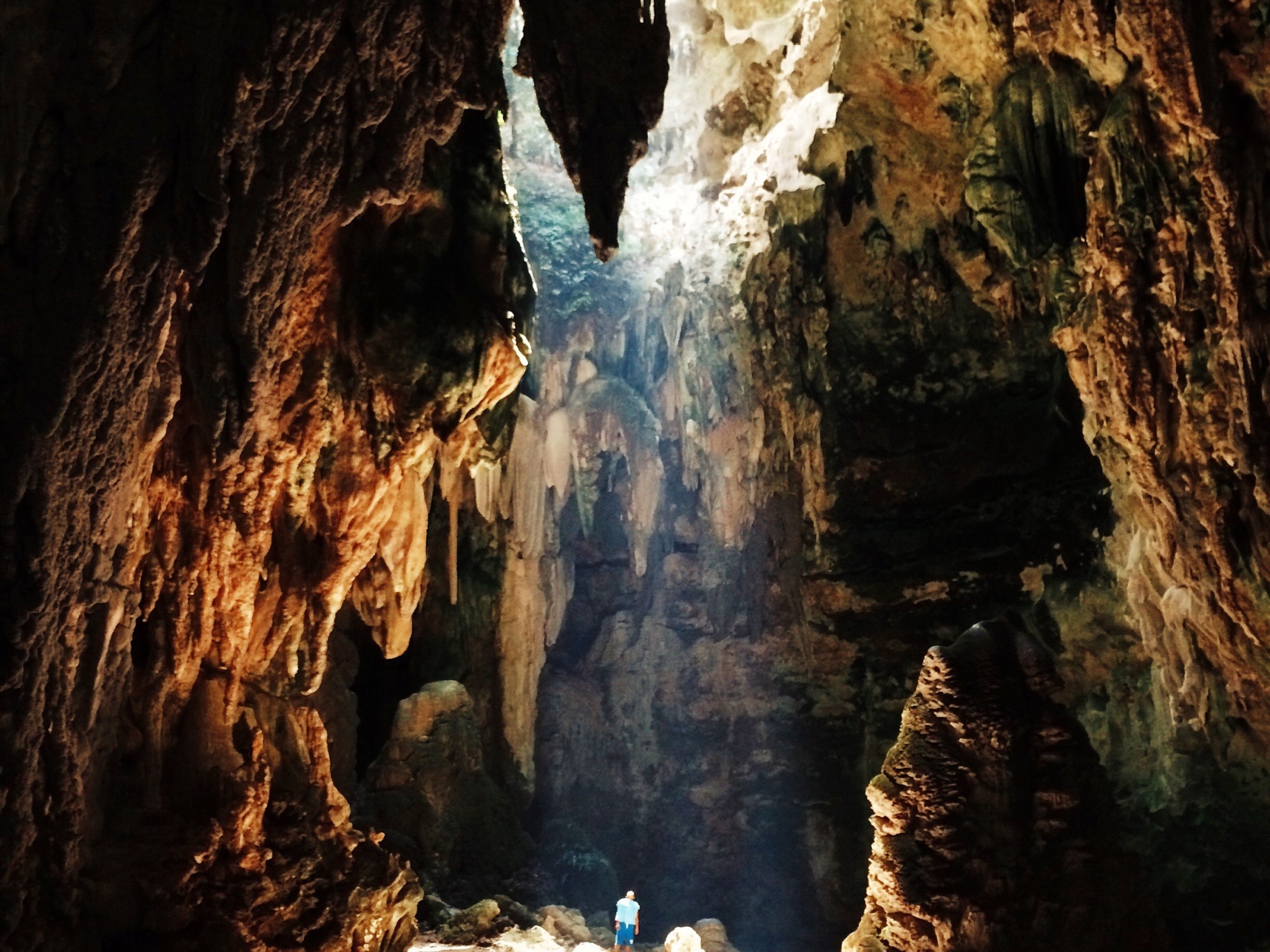 |
| Callao Cave, Cagayan. Homo luzonensis lived here about 67,000 before present. (from web) |
Common nationals that seek graduate degrees or reviewer sessions in the Philippines usually come from India, South Korea, and Palau. Language schools with English language programs are also popular among Asian foreigners from South Korea, Thailand, Vietnam, Myanmar, Taiwan, and Japan. Government-approved institutions that teach Philippine mythology and suyat scripts, such as baybayin, have also become popular among locals and foreigners.
Arts and crafts tourism in the Philippines has recently expanded following several attempts to establish a cultural renaissance. The numbers of art museums, galleries, exhibitions, festivals, and town fairs throughout the country has doubled in the past 10 years. The country was conferred its first UNESCO Creative City through Baguio in 2016. Other arts and crafts centers are in Manila, Quezon City, San Fernando City, Iloilo City, Angono, Santiago City, Cebu City, Basey, Davao City, Lake Sebu, Angeles City, Vigan, Basco, Zamboanga City, Marawi, Tugaya, Cotabato City, Sariaya, Tagbilaran, and Dumaguete.
 |
| Baguio: UNESCO Creative City (from web) |
The Philippines is the Catholic pilgrimage capital of Asia, possessing hundreds of olden churches, most of which were established between the 15th to 19th centuries through the earthquake baroque architecture. Historic mosques, temples, and indigenous places of worship such as dambanas are also present throughout the country. Among the most popular pilgrimage sites in the Philippines are Paoay Church, Manila Cathedral, Maragondon Church, Cebu Metropolitan Cathedral, Baclayon Church, Panay Church, Loboc Church, Daraga Church, Boljoon Church, Guiuan Church, Calasiao Church, Manaoag Church, Tumauini Church, Naga Cathedral, San Sebastian Church of Bacolod, Betis Church, Quiapo Church, Taal Basilica, Miagao Church, Caraga Church, Paete Church, Lucban Church, San Sebastian Church of Manila, Jimenez Church, Barasoain Church, Seng Guan Temple, Sheik Karimol Makhdum Mosque, Taluksangay Mosque, Sultan Haji Hassanal Bolkiah Masjid, Masjid Dimaukom, Mount Banahaw, Kabayan Mummy Burial Caves, Limestone tombs of Kamhantik, Bud Bongao, Mount Apo, Mount Bulusan, Mount Pulag, Callao Cave, Mount Kalatungan, Mount Matutum, Mount Makiling, Kanlaon, Mount Arayat, Mayon Volcano, Mount Pinatubo, and Mount Kitanglad.
 |
| UNESCO World Heritage: San Agustin Church Paoay, Ilocos Norte (from web) |
Various festivals in the country are flocked annually by both locals and foreigners. The country has been known as the traditional capital of the world’s festivities and the capital of fun due to the thousands of festivals which happen in the country, most of which are annual spectacles. Among the most famous of these events are the Sinulog Festival of Cebu, the Kadayawan Festival of Davao, the Ati-Atihan Festival of Aklan, the Dinagyang Festival of Iloilo, the Panagbenga Festival of Baguio, the Moriones Festival of Marinduque, the Pahiyas Festival of Quezon province, the Obando Fertility Rites Festival of Bulacan, the Pintados Festival of Leyte, the Sandugo Festival of Bohol, the Ibalong Festival of Bicol, the MassKara Festival of Bacolod, and the Giant Lantern Festival of Pampanga. Each of the festivals, or locally known as fiesta, have different traditions at play. The festivals may be Anitist, Hindu, Buddhist, Catholic, Muslim, or a mixture of religions in origin. Some festivals, however, are not interlaced with any form of religion.
 |
| Sinulog Festival, Cebu (from web) |
The Philippines is home to numerous heritage towns and cities, many of which have been intentionally destroyed by the Japanese through fire tactics in World War II and the Americans through bombings during the same war. After the war, the government of the Empire of Japan withheld from giving funds to the Philippines for the restoration of the heritage towns they destroyed, effectively destroying any chances of restoration since the pre-war Philippines’ economy was devastated and had limited monetary supply. On the other hand, the United States gave minimal funding for only two of the hundreds of cities they destroyed, namely, Manila and Baguio. Today, only the centres (poblacion or downtown areas) of Filipino heritage towns and cities remain in most of the expansive heritage cities and towns in the country. Yet, some heritage cities in their former glory prior to the war still exist, such as the UNESCO city of Vigan which was the only heritage town saved from American bombing and Japanese fire and kamikaze tactics. The country currently lacks a city/town-singular architectural style law. Due to this, unaesthetic cement or shanty structures have taken over heritage buildings annually, destroying many former heritage townscapes. Some heritage buildings have been demolished or sold to corporations, and have been replaced by commercial structures such as shopping centers, condominium units, or newly-furnished modern-style buildings, completely destroying the old aesthetics of many former heritage towns and cities. This is one of the reasons why UNESCO has repeatedly withheld from inscribing further Filipino heritage towns in the World Heritage List since 1999. Only the heritage city of Vigan has a town law that guarantees its singular architecture (the Vigan colonial style) shall always be used in constructions and reconstructions. While Silay, Iloilo City, and San Fernando de Pampanga have ordinances giving certain tax exemptions to owners of heritage houses. In 2010, the Philippine Cultural Heritage Act passed into law, effectively giving protection to all cultural heritage properties of the Philippines. However, despite its passage, many ancestral homeowners continue to approve the demolition of ancestral structures. In certain cases, government entities themselves were the purveyors of such demolitions. Because of the minimal reach of the current governmental culture agency and the lack of awareness on the importance of Filipino sites, a bill establishing a Department of Culture was formally filed in 2016. The bill is expected to pass into law by late 2018 or early 2019 as it was declared priority legislation by both houses of Congress. If the bill reaches its deadline, a secretary of culture will be appointed by June–July 2019.
In Luzon, other notable heritage towns and cities include the UNESCO City of Manila, Taal, UNESCO Town of Banaue, UNESCO Town of Mayoyao, UNESOC Town of Hungduan, UNESCO Town of Kiangan, Laoag, Sarrat, Pila, UNESCO City of Baguio, San Fernando, Bacolor, Guagua, Santa Rita, Malolos, Angeles City, Sabtang, Mahatao, Uyugan, Sariaya, San Pablo, Alaminos de Laguna, Tayabas, Lucban, Lucena, Balayan, Calaca, Kawit, UNESCO Town of Paoay, Batac, Roxas, Panay, Daraga, Legazpi, Camalig, Antipolo, Angono, Tanay, Morong de Rizal, Baras, Majayjay, Nagcarlan, Liliw, Magdalena, Pagsanjan, Paete, PakilQuezon City, Naga, Maragondon, Lingayen, Alaminos, San Miguel, Bustos, Plaridel, Angat, Baliuag, Los Baños, Calamba, Corregidor, San Juan de Batangas, Cabuyao, Biñan, Santa Rosa, Tuguegarao, Malabon, Sagada, Baler, San Juan de Manila, Daet, Tabaco, Batangas City, San Nicolas, UNESCO Town of Santa Maria, and Santa Cruz.
In the Visayas, notable heritage towns and cities include Iloilo City, UNESCO Town of Miagao, Cebu City, Silay, Carcar, Argao, Dalaguete, Oslob, UNESCO City of Puerto Princesa, Bacolod, Dumaguete, Bacong, Romblon, Boac, Baclayon, Tagbilaran, Dauis, Panglao, Victorias, Capul, Cuyo, Taytay, Culion, Lazi, and Bantayan.
In Mindanao, notable heritage towns and cities include Dapitan, Lake Sebu, Zamboanga City, Jimenez, Ozamiz, Oroquieta, Cagayan de Oro, Jasaan, Balingasag, Butuan, Cabadbaran, Iligan, Marawi, Jolo, Davao City, UNESCO Town of Tugaya, UNESCO Town of Mati, and Glan.
Enthusiasm gets killed
For someone from Bangladesh, who is willing to visit the Philippines, the visa process is the first obstacle, which would greatly dent the enthusiasm. The Philippines Embassy in Dhaka would require each visa applicant to submit a ‘Police Clearance Certificate’, which is not required by any other embassy in the country unless it is a working visa. The embassy also needs ten working days for the visa process, which certainly is too long. Even the US embassy would need just three days while Singaporean or Thai embassy needs a week. It is beyond my knowledge as to why the Philippines embassy asks for a Police Clearance Certificate. If the authorities in the Philippines are to welcome more tourists, they should definitely simplify the visa process instead of making it unnecessarily complicated, especially when it is proved – none of the Bangladeshis would ever want to find a job in that country. Bangladesh already is amongst the world’s fastest-growing economies and countries in the world need to re-adjust its visa policy towards Bangladeshis. It may be mentioned here that, Bangladesh has already emerged as a top destination of many foreign nationals who come here to work. Currently, over six hundred thousand Indians are illegally working in Bangladesh as the number of unemployment is growing in India at an alarming level.
Bangladesh no more is a poor or struggling country and by 2030, we truly are going to make out position amongst the developed nations. Hopefully, authorities in the Philippines will take note of it and immediately simplify the visa process if not fully waive the visa requirement similarly as Indonesia, Nepal and many other countries.
Salah Uddin Shoaib Choudhury is a multi-award-winning journalist and editor of Blitz.


