Showing posts with label environment protection. Show all posts

Wednesday, November 13, 2019

...the PH zero-waste city

Ten zero-waste cities: How Taguig in the Philippines became clean


By Sonia Henam, Swati Singh Sambyal
downtoearth.org

Last Updated: Wednesday 13 November 2019


Can we imagine a city in India without waste? Arguably, no. Rather our cities are drowning in their own wastes.

It is a big challenge now to collect, segregate and manage our waste in cities and towns. But there are cities across the world, including in India that have become completely waste-free.

They did so by adopting the ‘zero waste model’. This model is all about significantly reducing waste, eventually completely eliminating it.

Most of what we now waste can be safely and economically recycled, reused, composted, or turned into biogas through anaerobic digestion. It also creates a large number of well-paying jobs. Informal waste collectors are brought into the net and provided with decent earnings and dignity.

This is a unique model of solid waste management — frugal and generating wealth from waste. And it is successfully being implemented.

Down To Earth has curated a list of 10 cities across India and the world which are now ‘zero-waste’.

Taguig’s fight to be clean

The first among them is Taguig in the Philippines, which became clean mainly by segregating waste at source and diverting it. 
File:Bonifacio Global City - skyline (view from Pioneer) (Taguig and Makati)(2018-04-24) cropped.jpg

A few years back, the city, a barangay or community of metropolitan Manila, was known for its dumpsite, a vacant plot, where heaps of mixed waste from its households as well as those in its affluent neighbours landed.

Perhaps the best example of how Taguig’s transformation took place is one of its own barangays, Fort Bonifacio. The youngest barangay in Taguig, Fort Bonifacio had a population of about 11,739 according to the 2015 Census. It produces about 0.32 kilogram per capita per day of waste.

In 2009, Fort Bonifacio officials were facing challenges on managing its waste. They had limited resources and no clue from where to start the process of managing waste.

In order to address the increasing issue of solid waste, the city officials approached Mother Earth Foundation (MEF), a Filipino non-profit, for assistance.

In 2011, under the guidance of MEF, Fort Bonifacio officials visited barangays with the best RA 9003 (a legislation in the Philippines on SWM) practices such as Barangay Bagumbuhay in Quezon City; Teresa in Rizal; and Puerto Prinsesa in Palawan.

They then proceeded with a self-assessment and baseline survey, visiting each of Fort Bonifacio’s eight zones to scope out problem areas where waste accumulated.

The MEF trained barangay officials and project staff on waste analysis and characterisation study (WACS) and ecological solid waste management (ESWM). It followed this by conducting an intensive information education communication (IEC) campaign and finally setting up a materials recovery facility (MRF).

MEF and Fort Bonifacio formally launched ESWM in 2012 and the barangay passed an ordinance in full compliance with the national law on ESWM.

This ordinance formally established the barangay ecological solid waste management programme, mandating correct segregation, collection, recycling, and disposal, as well as an MRF site for the barangay. In 2014, the ordinances were updated to respond to new developments. This further helped the work on ground.

According to the WACS, organic waste comprised 40 per cent of the total waste in Fort Bonifacio, representing the amount that could easily be composted and converted into fertiliser, and thus diverted from the landfill. This showed that there was a value in waste, if segregated.

“Eighty per cent of the waste collected is diverted at the MRF and has 95 per cent household compliance rate,” Sonia Mendoza, chairman of MEF, said.

Source: Mother earth Foundation (2012)

 Waste Composition in Brgy. Fort Bonifacio (2012)


“During the pilot, 15 informal waste pickers were trained and absorbed as official waste collectors of the barangay. Now, the waste pickers earn about PHP 8,000 (US$ 186) as compared to PHP 3,000 (US$ 70),” she added.

Mendoza said this also reduced the number of city trucks collecting waste from the barangay, from the daily average of four trips per day, down to only one trip per day, resulting in savings of around P10, 000 (US $195) per day for the city.

According to the GAIA report on Taguig city, waste diversion serves as an indicator for both income — as recyclables are sold — and project success.

The project resulted in more efficient use of Taguig’s budget, saving PHP 800 (US$ 15) per cubic feet.

As the number of dump trucks dropped from four in 2012 to one per day in 2013, just a year after the project began, hauling expenses were similarly slashed by three-fourths, from PHP 7.3 million (US$ 141,200), to PHP 1.825 million (US$ 35,300) per year.

Today, 95 per cent of Taguig’s households segregate their waste before it is collected. The city is now clean and free of litter, and has shown remarkable progress in the fight against waste.

It was recognised as the ‘cleanest barangay in metro Manila’ in terms of solid waste management (SWM) in 2015.

Tuesday, October 29, 2019

...the paper from pineapple

Pinoy-made paper "Pinyapel" is produced from discarded pineapple leaves and it just won an int'l award


GMA NEWS
29 October 2019

"Pinyapel" is a Pinoy paper product made from discarded pineapple leaves and it just won the D&AD Future Impact Awards for Environment and Sustainability in New York City.
With the help of Department of Trade and Industry (DTI) and Design Center of the Philippines (DCP), Lolita "Luchi" Cabanlet of Cagayan De Oro Handmade Paper was able to develop "Pinyapel" a "locally-manufactured specialty paper" produced from discarded pineapple leaves from plantations in Bukidnon.
DCP helped coin the term "Pinyapel" from the Filipino words pinya (pineapple) and papel (paper).
A press statement from DTI Misamis Oriental describes Pinyapel as "the future of packaging." It's water-resistant making it a good material to be developed into paper cups, paper bags and other food container options.
DTI-DCP partnered with CDO Handmade Paper "to launch a sustainable innovation to transform waste into new and useful material, a forward-thinking approach to combat the growing problem on non- biodegradable plastic."


They collaborated with Nature's Fresh, a pineapple exporter from Bukidnon, to use their discarded pineapple leaves to be developed into pineapple paper sheets using a technology developed by the DCP.
The paper sheets was then supplied to Ideatechs Packaging Corporation, a company producing food container products.
The award will be given in New York City, USA on November 6, the event is an "annual activity recognizing those who put their creative ideas into world-changing projects, products and campaigns."
Check out some of the products developed from Pinyapel sheets in the gallery below.


Saturday, October 12, 2019

...the bird sanctuary in Megacity

Metro Manila is more than a corporate jungle: DOT

Philippine News Agency
12 Ocober 2019
MANILA-- Trying to do away with the usual image of Metro Manila as a corporate jungle, the Department of Tourism (DOT) vowed to strengthen its efforts to promote the Las Piñas-Parañaque Critical Habitat and Ecotourism Area (LPPCHEA), a wetland in the highly urbanized Parañaque City, as a prime destination for nature-loving tourists and foreign birdwatchers.
"This is a breathing space inside the metro so it's good because in a year, LPPCHEA has around 5,000 visitors and we want to increase that further," DOT-National Capital Region (NCR) Woodrow Maquiling said on Saturday.
"Our approach should be sustainable. In the midst of all these corporate jungles and all of these buildings, we have to have something like this in Metro Manila," he added.
Maquiling said the DOT will coordinate with tour operators to include the destination in their NCR itinerary.
"We have cruise tourism here in the country bringing as much as 2,500 per ship so what we want to do is to also take them here," he said.
Maquiling was among the guest speakers for the World Migratory Bird Day celebration organized by the Society for the Conservation of Philippine Wetlands at the LPPCHEA.
Highlighting the occasion, the official believes LPPCHEA has a big potential to attract foreigners specifically the growing Chinese tourists in the Philippines.
"Chinese is one good source for bird watching," he told the Philippine News Agency in an interview.
"Right now, our top source market for the bird watchers are the Europeans. The Tourism Promotions Board wants to push for the catalog of all migratory birds here because in LPPCHEA we have 84 species."
LPPCHEA, a 175-hectare wetland off Manila Bay, had been declared as critical habitat on April 22, 2007, under Presidential Proclamation No.1412.
Since then, through cooperation with the local government unit, the Department of Environment and Natural Resources-National Capital Region was able to preserve what they cannily tag as the "last natural bastion" in Metro Manila.
Soon to rise inside the park is the LPPCHEA Wetland Center which will house a museum and a spacious lounge for tourists. No entrance fee is collected in LPPCHEA but a permit from the DENR office, which can be easily obtained, is required upon the park's entry. (PNA)

Tuesday, October 1, 2019

...the Royal Cambodia awardee

Sultana from the Philippines, the First International Woman to Receive the Royal Monisarapown Award from the Royal Government of Cambodia


By MENAFN
01 October 2019 


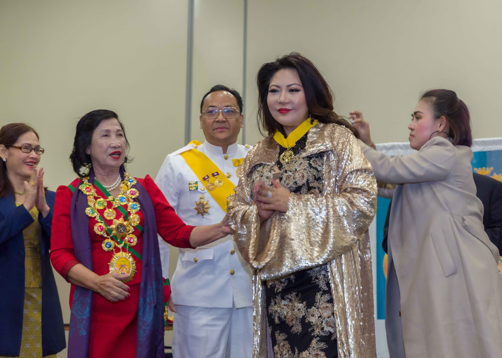
We Care for Humanity Founder and G.O.D. Chairman, Maria Amor received an award given by the Prime Minister of Cambodia, Samdach Hun Sen for her unwavering support to Save Nature Cambodia for planting almost a million trees in the Kingdom.


H.E. Oknah Sam Dararath, PhD , founder of Save Nature Cambodia and Adviser to Samdach Prime Minister felicitated the Monisarapown Award from the Royal Government of Cambodia to HRH Maria Amor onthe occasion of the8th Global Order of Dignitaries and Philanthropists (G.O.D.) AwardsCeremony and Dinner Gala at the Anaheim Convention Center, one of California’s landmark last September 21, 2019. Dr. Dararath was enjoined on the stage by other Cambodian delegates and honorees of the said function: H.E. Iv Sry, Advisor to the Ministry of Interior who received the Woman of Honor of Asia from G.O.D.; Mrs. Kimly Lim, President of Family Agricultural Development Community who also G.O.D. recipient as Humanitarian Icon of Cambodia; and Dr. Siphal Pheng, a businessman.

Sunday, September 29, 2019

...the VIP of global marine biodiversity

A 'VIP' of global marine biodiversity in the Philippines


Mikael Angelo Francisco
GMA News

Whenever we hear about a newly discovered plant or animal, we tend to focus on the exotic location where it was found, or distinguishing morphological traits that merit its classification as an entirely new species. We rarely talk about how scientists determine new species, which isn’t really surprising. After all, it isn’t that hard to understand that the process of naming a new species is far more complicated than thinking of a cool-sounding Latin binomial name and calling it a day.
When experts come across an unidentified specimen, they use a system of concepts ranging from physical appearance to reproductive compatibility in figuring out whether or not it really is a new species. Another part of the process involves checking existing records to ensure that the seemingly new species isn’t just a variation of an existing one.
Admittedly, it’s not uncommon for scientists to discover new species each year. Roughly two million unique species have been catalogued over the course of human history; scientists estimate that the actual number of species in the wild could easily be five times that.
Nevertheless, one can only imagine the kind of rush that comes with adding yet another name to the taxonomic record. It’s probably the same kind of rush that Dr. Terry Goslinger, Senior Curator of Invertebrate Zoology at the California Academy of Sciences, has felt during virtually every single one of his visits to the Philippines over the last 27 years.
VIP: A very important place
“I started working on coral reefs in the Philippines in 1992,” Goslinger said at a recent forum in Manila. His colleagues had told him that the marine life in the Philippines was rich and diverse, in waters that were relatively unexplored. At that point, Goslinger had been conducting his research in Papua New Guinea.
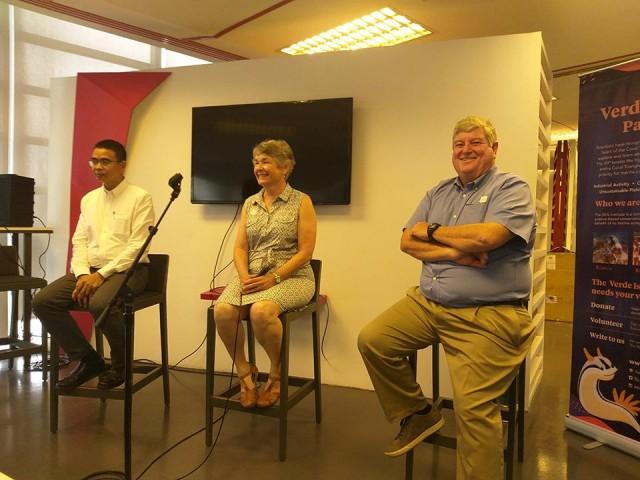
Dr. Wilfredo Licuanan, Dr. Meg Burke, and Dr. Terry Goslinger speaking during a forum.


“One of my colleagues said, ‘If you think Papua New Guinea is rich, you ought to come to the Philippines.’ And they were absolutely right, and I was astounded,” he said.
It didn’t take long for Goslinger and his fellow scientists to verify that the Philippines was exceptionally rich in marine biodiversity. Furthermore, they found that the richest area was a 1.14-million-hectare waterway separating Luzon and Mindoro known as the Verde Island Passage (or VIP).
The VIP is part of what marine scientists call the Coral Triangle. Located in the western region of the Pacific Ocean, the Coral Triangle encompasses the waters of the Philippines, Indonesia, Malaysia, Papua New Guinea, Timor-Leste (also known as East Timor), and the Solomon Islands.
Serving as the underwater home of six marine turtle species, nearly 600 species of reef-building corals, and over 2,000 reef fish species, the Coral Triangle is recognized as the global center of marine biodiversity—and the VIP is the center of the center.
The VIP itself houses over 400 species of corals, and functions as a safe haven for hundreds of marine species from both subtropical and tropical climate zones. These include, but are not limited to, whale sharks, sea turtles, nudibranchs (colloquially known as sea slugs), and about 60 percent of the world’s shorefish species. Various species of fish and larvae also find their way to the VIP, carried by strong currents from the Pacific Ocean.
Additionally, local and foreign experts from different research and conservation institutions discover new marine species in the VIP every year. In 2018, the Academy announced that it had found 14 new species in the Philippines, a number of which were nudibranchs from the VIP.
These factors have earned the VIP not one, but two scientifically backed titles: the Center of the Center of Marine Shorefish Biodiversity, and the Center of the Center of the Marine Biodiversity of the World.
Coral lesson
For over three decades, Dr. Wilfredo Licuanan has been actively surveying and monitoring coral reefs across the country. Recently, he led a nationwide assessment of the overall health of coral reefs in the Philippines.
Throughout Licuanan’s career, however, there’s one significant detail about his work — specifically, about corals — that he has had to explain to various audiences and stakeholders more times than he can probably remember:
“When we talk about corals [in the context of coral reefs], we’re not talking about rocks; we’re talking about animals.”
According to Licuanan, a Full Professor of De La Salle University’s Biology department, each of these tiny coral animals — called polyps — possess very thin tissue.
“Most of the coral is actually skeleton,” he explained, “hence the common misconception that corals are rocks.”
Not all corals have skeletons. Soft corals (such as gorgonians, sea fans, and sea pens) are feathery, flexible, and plant-like. The ones that we tend to mistake for rocks are hard corals — corals with skeletons made of aragonite, a type of calcium carbonate. These skeletons are designed to protect the corals from strong waves or other animals.
Coral reefs are formed when polyps living in colonies (groups of hundreds, thousands, or even more) deposit calcium carbonate beneath their bodies and form large structures. For this reason, hard corals are also known as reef-building corals.
Coral reefs support some of the most biodiverse areas on the planet. Aside from being a fortified habitat for countless marine species, they also play a significant role in the food chain, as they provide important nutrients (such as nitrogen) and facilitate nutrient recycling (the movement and exchange of organic and inorganic matter back into the production of living matter).
Coral grief
Corals have a symbiotic relationship with microscopic algae called zooxanthellae. Zooxanthellae serve as the corals’ primary food source, as well as the reason behind their color.
However, when water temperatures grow warmer, the relationship becomes stressed, resulting in the expulsion of the algae from the corals. When this happens, the corals turn ghostly white--a phenomenon we call coral bleaching. And while this does not immediately kill corals, they will eventually die if they are unable to recover.
Rising ocean temperatures due to global warming are the primary cause of coral bleaching. Meanwhile, water pollution and abusive fishing practices are significant hindrances to coral recovery.
Consequently, the death and breakdown of corals and coral reefs will have severe effects on the countless marine populations that depend on the reefs for sustenance and protection. Coral bleaching also negatively impacts entire industries, such as fishing and tourism.
One of the most noteworthy examples of wide-scale coral bleaching in the Philippines happened in 2010, brought about by El Niño. It was one of three incidents documented by the Philippine Coral Bleaching Watch over the last twenty years.
“We lost many of the coral reefs in Southeast Asia, and we saw extensive bleaching in places like Palawan,” recalled Goslinger, “We saw a lot of coral death.”
At the time, approximately 25 to 30 percent of the VIP experienced massive coral bleaching.
“The corals were getting rid of their algae, looking very sick, and looking like they may die. This was the first time we had really seen this extent of coral bleaching and unhealthy conditions, and we were very, very concerned about that,” he said.
To the scientists’ surprise, however, things looked different when they returned to the VIP six weeks later.
“Already, the corals that had bleached were starting to regain their color, because they were absorbing new algae,” he said.
Eventually, the damage that the VIP’s corals had previously sustained was almost completely gone, revealing that apart from its rich biodiversity, the VIP also possesses natural resilience, for reasons that require further research to understand.
“There is great hope that the Verde Island Passage can repopulate other parts of the Philippines, and can be a genetic storehouse [as well],” he said.
Reef power, reef responsibility
Truth be told, while the VIP is full of marine wonders and mysteries, there may not be enough scientists in the Philippines (or even in the world) to understand what must be done and take the necessary measures before it’s too late.
And that’s precisely where citizen action comes into play.
“We think it’s not only important, but an obligation to help the local community understand why we’re there, and why the reefs are important,” explained Dr. Meg Burke, the Academy’s Associate Dean of Science Operations.
A frequent visitor of the Philippines and the VIP, Burke’s efforts are focused on science education—specifically, engaging the communities and empowering them with the skills and knowledge necessary to monitor their own reefs.
“If you can take that first step and help people understand that corals are living animals, you can often see the lightbulb go off,” shared Burke. “And it’s like, ‘Now I get it.' Because if corals are living animals, then when anchors are dropped on corals, you’re killing living animals. You’re not just breaking up a rock. If dynamites are used, you’re not just making big rocks smaller. You’re killing animals."
“Only by training local communities can you help ensure that there will be eyes on the reef — that people will be watching to see what’s going on,” she added.
Over the last few years, government agencies, conservation groups, and law enforcement have worked on initiatives to combat the major threats to the VIP’s sustainability: overfishing, illegal waste disposal, and daily commercial vessel activity. Just last year, the local government declared every fourth week of September to be the Verde Island Passage (VIP) Conservation Awareness Week.
Additionally, marine conservationists and concerned parties in the area have been pushing for the VIP’s nomination and proclamation as a United Nations Educational, Scientific and Cultural Organization (UNESCO) World Heritage Site—not for recognition, but for the purposes of pressuring officials to take better care of the VIP. 
“We still have time to protect the richest reefs in the world," Goslinger assured. "Our treasure trove of biodiversity on this planet.”
—JCB, GMA News

Wednesday, September 25, 2019

...the city of recycled tulips

Philippine city turns plastic trash into tulips to fight waste


Reuters
25 September 2019

MANILA (Reuters) - A southern Philippine city has turned discarded plastic bottles into flowers to fill a garden of thousands of colorful tulips, capturing tourists’ attention and building awareness about recycling. 


The tulip garden, which opened on Monday, was built from 26,877 bottles collected from 45 villages around Lamitan City in Basilan, an island province on the southwestern tip of the archipelago.
Plastic bottles were cut into the shape of tulips and painted red, yellow, pink and blue, while others were blended into sand and cement and used to make pathways in the garden.
The Philippines is a major source of ocean plastics and only a small amount of its waste is recycled.
Plastic bottles make up a large chunk of waste in Lamitan, and turning them into a tourist attraction can help combat plastic pollution, said the city’s mayor, Rose Furigay.
“Let us be mindful of how to minimize the use of plastic,” she said.
Basilan is among the country’s poorest provinces, notorious for being a stronghold of an Islamist group known for banditry and kidnapping.
Reporting by Jay Ereno; Writing by Neil Jerome Morales; Editing by Martin Petty and Clarence Fernandez

Saturday, September 14, 2019

...the environment-friendly country

Philippines joins Southeast Asian nations rejecting plastic waste


Jun Endo
Nikkei Asian Review
14 September 2019


MANILA -- The Philippines is getting serious about plastic waste imported illegally from developed countries, announcing in August that it would impose a three-month moratorium on waste-related imports.

Plastic waste is sorted at a new recycling plant in Metro Manila. The Philippines has seen its plastic waste imports rise 150% from 2016 to about 11,800 tons in 2018.

It has even sent some back to Canada, which had been discovered shipping waste illegally to the country for years -- a revelation that so infuriated President Rodrigo Duterte that he recalled his ambassador to Canada and threatened war.

"We are not the world's dump site," the outspoken president said.

To help deal with the problem, a new 25 million peso ($481,877) garbage-disposal plant in Metro Manila is scheduled to go online soon. The project is being headed by the Philippine Alliance for Recycling and Materials Sustainability, a nonprofit organization consisting of global food and consumer goods giants such as Nestle, Coca-Cola and Unilever.

The facility will pulverize about 1 ton of plastic a day -- equal to about 400,000 sachets of shampoo and instant coffee -- to make sidewalk blocks and other products.

But while every bit helps, the plant will hardly put a dent in the roughly 60 billion plastic sachets said to be in circulation, the vast majority of which are destined for dumps. And because making road blocks from recycled plastic is about 14% more expensive than from concrete, the facility will encourage environmentally conscious infrastructure and construction companies to buy them.

"Our first goal is to make projects like this investable," said PARMS Executive Director Paolo Gonzales. "If we can prove that it will be profitable -- that we can gain a return on our investment -- we will be able to get other sources of funding and replicate it, maybe in other cities in Metro Manila."


More than 8 million tons of plastic is dumped into the world's oceans each year, with China and four other Asian nations accounting for the majority of this. Meanwhile, the mountains of plastic waste produced globally had largely gone unnoticed until China began reducing waste imports in 2014 before banning them outright in 2018.

With nowhere to go, the waste found its way to Southeast Asia, with the Philippines seeing plastic waste imports rise 150% from 2016 to about 11,800 tons in 2018.

But the country has had enough. Following Duterte's tirade, the Department of Environment and Natural Resources announced the three-month moratorium. A department official urged businesses to take the waste matter seriously and promised to cooperate with them in their efforts to tackle the problem.

The Global Alliance for Incinerator Alternatives has heavily criticized multinationals' reliance on single-use plastics, saying that nearly 60% of plastic packaging in the Philippines comes from 10 multinational companies, including Nestle, Unilever and Procter & Gamble.

Moreover, investors are beginning to focus on environmental, social and governance -- or ESG -- investment principles so businesses cannot afford to ignore the issue.

Many other Southeast Asian countries are also unhappy with multinationals over the vast amounts of plastic waste they generate. This has prompted about 40 companies -- including Dow Chemical and BASF -- to establish in January the nonprofit Alliance to End Plastic Waste.

At an August meeting in Bangkok, the Alliance announced it will invest $1 billion in Southeast Asia and elsewhere over the next five years to improve waste control systems and infrastructure needed to collect plastics.

"While our effort will be global, the Alliance can have the greatest impact by focusing on parts of the world where the challenge is greatest -- such as Southeast Asia, where more than half of the world's plastic waste has been found -- and by sharing solutions and best practices so that these efforts can be amplified and scaled-up around the world," said Antoine Grange, CEO of Recycling and Recovery of SUEZ Asia, an Alliance member.
The Alliance's ultimate goal is to build recycling-oriented economies in the region in cooperation with member companies.global

Researcher Ella Hermonio contributed to this report.